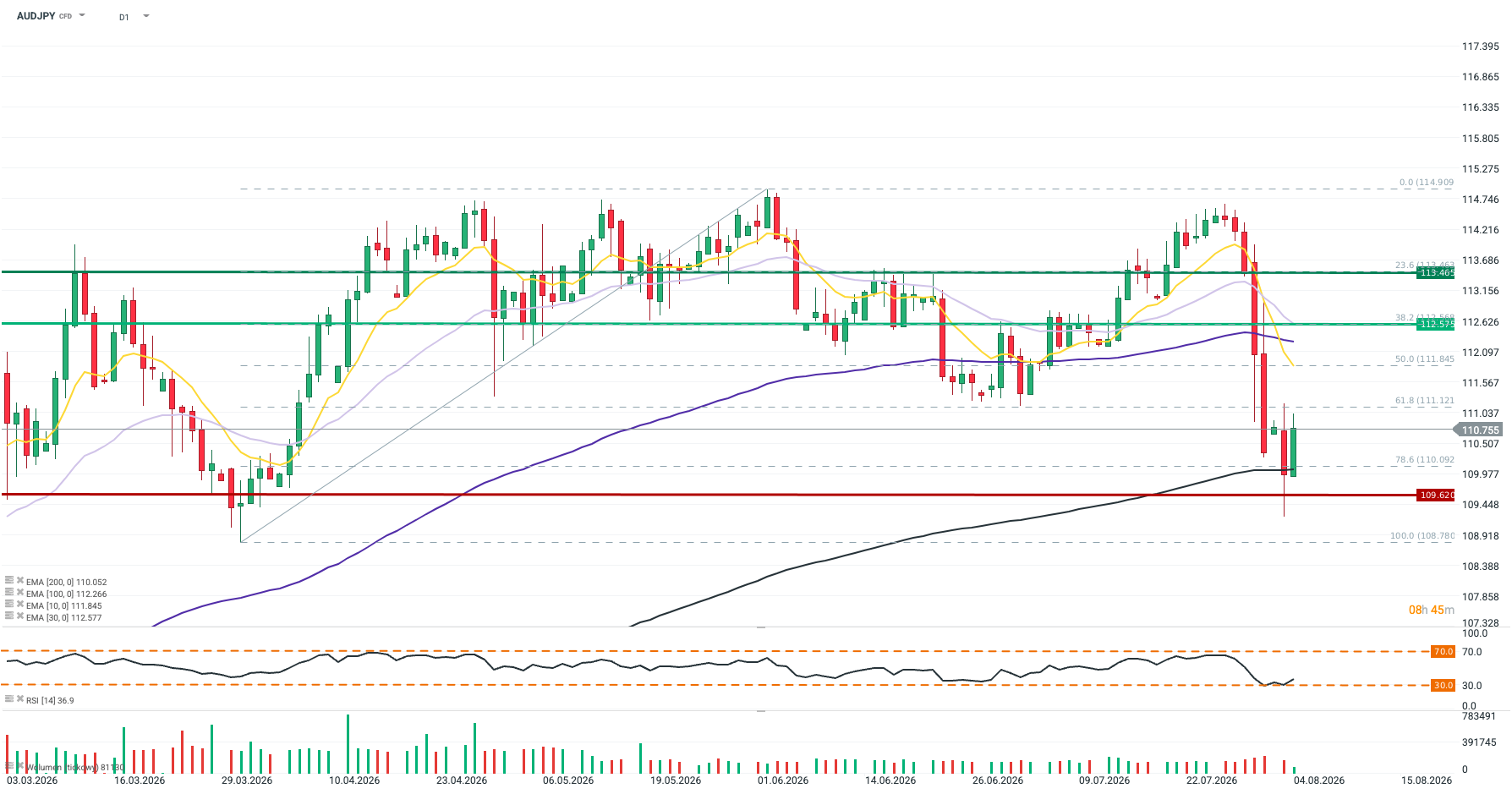
Recent currency interventions on the yen and a unified narrative from Japanese and US authorities standing behind the Japanese currency (US Treasury Secretary Bessent today: “The United States will do everything in its power to support the yen”) led to a sharp sell-off in JPY-led pairs (AUDJPY: -3.5%, USDJPY: -3.9%, EURJPY: -2.6% change over the past week). The determination communicated by Tokyo and Washington should limit speculative selling of the yen; however, a sustained recovery in the Japanese currency will likely only be possible following stabilization in the bond market and a clear hawkish turn by the Bank of Japan. With current interest rates (Australia: 4.35%, Japan: 1.00%), the recent AUDJPY sell-off enhances the appeal of the carry trade, even in light of recent, fairly dovish remarks from the RBA. A rebound off the 200-day EMA (black), combined with a global increase in risk appetite (gains in risk assets, falling oil prices, de-escalation in the Middle East), should therefore motivate at least a local upward correction in AUDJPY. This is further supported by the fact that AUDUSD itself remains in an uptrend (trading above the EMA30 and EMA100 on the daily interval), bolstered by the recent decline in US rate hike expectations.
Methodology
This recommendation was prepared based on a technical analysis of the AUDJPY chart and a fundamental analysis of the respective economies (monetary policy in Japan, Australia, and the US). The directional bias was determined using moving averages and market expectations regarding central bank policies. Take Profit and Stop Loss levels were established using Fibonacci retracements and price action:
TP1 is set at the 38.2% Fibonacci level.
TP2 is set at the 23.6% Fibonacci level.
SL is placed between the 100% and 78.6% Fibonacci levels, slightly below the EMA200.
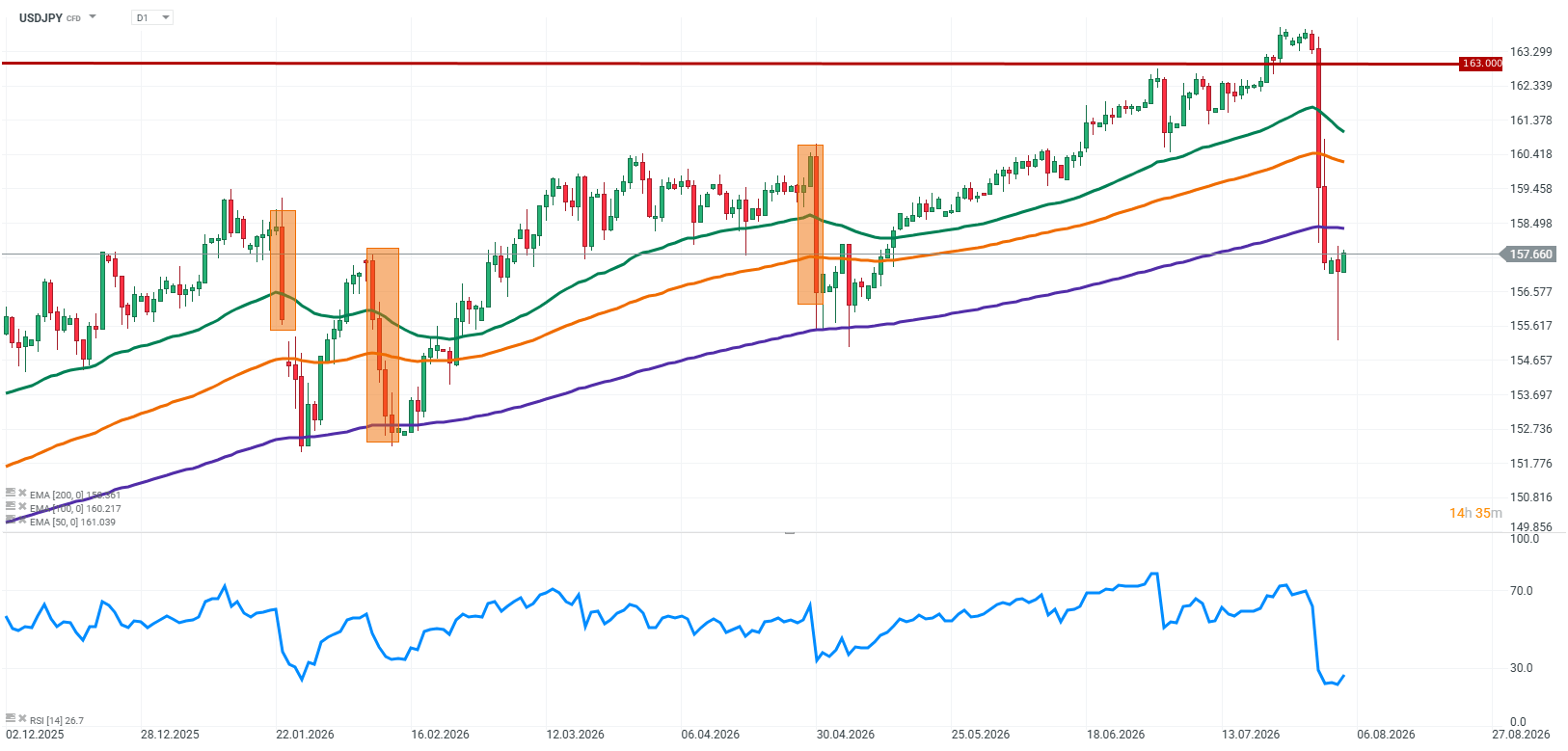
USDJPY remains one of the key topics in the foreign exchange market following the recent reaction by Japanese authorities to the sharp depreciation of the yen. The pair has once again come under selling pressure and moved toward the 158 area, falling below the 160 level, which has repeatedly been described by Japanese government officials as a level requiring particular attention. The currency market intervention delivered a short-term effect. The yen strengthened significantly, and USDJPY moved away from the psychological 160 level. However, the key question that remains is whether this move can be sustained. History shows that currency intervention can effectively limit sharp exchange-rate movements, but without a change in the fundamental factors behind a currency’s weakness, its impact is often limited in duration. In the short term, USDJPY may continue declining and move toward the 157 level. From a technical perspective, the market has received a signal that the area around 160 remains a level where Japanese authorities are prepared to respond decisively. In the longer term, however, the outlook for the yen remains challenging, as the main factor influencing the exchange rate — the interest rate differential between the United States and Japan — continues to work against the Japanese currency.
Source: xStation5
Factors Currently Shaping USDJPY
Japan’s Intervention Stopped the Move, but Did Not Solve the Yen’s Problem
The most important event of recent days was the reaction of Japanese authorities to the yen’s weakening. A move above 160 on USDJPY was considered too rapid and unfavorable, increasing pressure on households and businesses through higher import costs. The actions taken in the foreign exchange market helped limit the scale of the yen’s depreciation and pushed USDJPY below the 160 level. The market received a clear signal that Japan is willing to intervene if currency movements become excessively rapid. However, the problem is that intervention does not change the underlying fundamentals. If the interest rate gap between the United States and Japan remains wide, pressure on the yen may return. Therefore, the key question is no longer whether Japan can stop USDJPY from rising, but how long it can maintain the effects of such intervention without additional support from monetary policy.
Fed and BoJ: Interest Rate Differential Still Works Against the Yen
One of the most important factors for USDJPY remains the monetary policy stance of both central banks. At its latest meeting, the Federal Reserve kept interest rates unchanged. Markets reduced expectations for further rate hikes in the United States, but US interest rates remain at very high levels compared with Japan. On the other side, the Bank of Japan began its rate-hiking cycle this year and has clearly indicated that the current move may not be the last. Markets are pricing in the possibility of another rate increase this year, especially if inflation and wage growth remain at appropriate levels. Even if the BoJ decides on another rate hike, the scale of the interest rate gap between the US and Japan will remain significant. This factor has been the main argument behind selling the yen for many months and remains one of the biggest challenges facing the Japanese currency.
Bank of Japan Is Changing Its Stance, but the Yen Needs More Support
The start of a rate-hiking cycle by the Bank of Japan is an important shift after many years of ultra-loose monetary policy. Markets are increasingly focusing on the possibility of further policy normalization by the Japanese central bank. The problem, however, remains the pace of these changes. The BoJ continues to act cautiously because Japan’s economy is significantly more sensitive to higher financing costs than the US economy. For the yen, it will therefore be crucial not only whether the BoJ raises interest rates, but also whether markets believe the central bank is prepared to continue this process in the coming months. If expectations for the BoJ rise faster than expectations for the Fed, the yen could receive additional support. At this stage, however, the interest rate differential remains the main challenge for the Japanese currency.
Oil and the Persian Gulf Increase Risks for the Yen
Another factor affecting USDJPY is the geopolitical situation and energy prices. Tensions around the Persian Gulf and the risk of disruptions to oil supplies remain important market factors. Japan, as an economy heavily dependent on energy imports, is particularly vulnerable to rising oil prices. Higher energy costs may increase inflationary pressure in Japan, while at the same time worsening the country’s trade balance through higher import expenses. Historically, such factors have often had a negative impact on the yen. Additionally, during periods of rising geopolitical uncertainty, the US dollar often benefits as a global safe-haven currency. This means that even amid challenges facing the US economy, the dollar may remain supported against the yen.
Japan’s Fiscal Risks Are Another Challenge for the Currency
Beyond monetary policy, the market is paying increasing attention to Japan’s fiscal situation. Plans to increase public spending and possible tax cuts are raising questions about further growth in the country’s debt burden. For the currency market, the key issue is whether fiscal policy will support economic growth or increase concerns about the sustainability of public finances. If markets conclude that Japan will pursue a more expansionary fiscal policy without sufficient spending control, this could limit the potential for further yen appreciation.
USDJPY Ahead of Another Test
The current decline in USDJPY shows that the 160 level remains a threshold where Japanese authorities are prepared to intervene. In the short term, the pair may continue moving lower, particularly if markets further reduce expectations regarding Fed policy. In the longer term, however, the situation remains more complicated. The yen continues to face pressure due to the large interest rate differential between the United States and Japan, and currency intervention alone does not change the fundamental market picture. The future direction of USDJPY will depend primarily on whether the Fed begins easing monetary policy faster or whether the Bank of Japan delivers more aggressive interest rate increases. For now, the market has received a clear signal that the area around 160 is being defended by Tokyo. The remaining question is whether this will be only a short-term correction or the beginning of a more lasting change in the yen trend.
Key Takeaways
Japan’s intervention pushed USDJPY below the 160 level, but the sustainability of the move remains the biggest uncertainty.
In the short term, the pair may move toward 157, but long-term pressure on the yen remains.
The Fed continues to maintain high interest rates, and the difference between US and Japanese monetary policy remains unfavorable for the yen.
The Bank of Japan has started a rate-hiking cycle, and markets are pricing in the possibility of another move, but the interest rate gap remains significant.
Oil prices and geopolitical tensions may further affect the yen through higher energy import costs and increased risk aversion.
The future direction of USDJPY will depend mainly on whether changing expectations regarding the Fed occur faster than further monetary policy normalization by the BoJ.
Swiss CPI drops to 0.4%, signaling minimal energy cost pass-through.
SNB Monetary policy projected to remain unchanged through the end of the year.
Markets price in a 65% chance of a September 25-bps rate increase.
USD/CHF moves little after two days of gains, trading around 0.8100 during the Asian hours on Tuesday. The currency pair may appreciate further as the Swiss Franc (CHF) faces headwinds from easing domestic inflation.
Swiss CPI slowed to 0.4% in July, down from 0.5% in the previous month to hit its lowest level in four months. This slowdown underscores a limited pass-through from higher geopolitical energy prices, contrasting with the Swiss National Bank’s (SNB) expectations of a modest near-term inflation pickup following its decision to hold policy rates at 0%.
Franc under pressure as SNB keeps rates at zero
Strategists at Brown Brothers Harriman highlight that “Swiss July CPI stays muted,” underscoring the absence of inflationary pressure in the economy. In their view, the “bottom line” is that the SNB “has plenty of room to keep rates at 0.00% for some time, which is an ongoing drag for CHF.” They note that against this backdrop of subdued price dynamics and a firmly anchored policy rate, “CHF is the worst performing G10 currency so far this quarter.”
Looking ahead, the SNB is anticipated to keep borrowing costs unchanged through year-end; additional rate cuts remain a contingency plan rather than a base case, particularly given the absence of severe stress within the Swiss banking sector.
Meanwhile, price action in the pair remains muted as the US Dollar (USD) stabilizes amid ongoing diplomatic uncertainty. Tensions rose after US President Donald Trump characterized his offer for discussions with Iran as a “last chance,” following his decision to call off a major military strike. Iranian leadership swiftly dismissed the proposal, with General Mohsen Rezaei, an advisor to Iran’s Supreme Leader, rejecting the conditions and asserting that Iran will not permit a second corridor in the Strait of Hormuz.
Meanwhile, market participants are continuing to recalibrate their monetary policy expectations following the Fed’s decision to hold interest rates steady in July. According to the CME FedWatch tool, traders are currently pricing in roughly a 65% probability of a 25-basis-point rate hike at the Federal Reserve’s upcoming September meeting.
EUR/USD trades flat near 1.1505 in Tuesday’s early European session.
Hot Eurozone inflation report adds to an already strong case for another ECB rate hike.
Traders await the US JOLTS Job Openings data on Tuesday ahead of the July employment report.
The EUR/USD pair holds steady around 1.1505 during the early European trading hours on Tuesday. Markets remain cautious ahead of the US JOLTS Job Openings data, which is due on Tuesday. On Friday, the attention will shift to the crucial US July jobs report.
Eurozone inflation ticked up in July, bolstering the case for a rate hike from the European Central Bank (ECB). The headline Eurozone inflation rose to 2.9% YoY in July from 2.8% in June, in line with expectations, Eurostat data showed last week. Meanwhile, the core Eurozone inflation accelerated to 2.5% YoY in July versus 2.4% prior, above the consensus of 2.4%.
Financial markets are betting on more than two ECB rate hikes, with moves fully priced in by October and April, according to Reuters.
The US employment data will be the highlight later on Friday, which could offer some hints about the health of the labour market and US interest rate path. Economists expect Nonfarm Payrolls (NFP) to increase by 83,000 in July, while the Unemployment Rate is projected to rise to 4.3% during the same period. In case of stronger-than-expected outcomes, this could lift the Greenback in the near term.
Markets have priced in nearly a 64.7% chance of a US rate hike in September, down from about 77% before the July Fed meeting, according to the CME FedWatch tool.
Fed decision seen as key driver for EUR/USD direction into September
Strategists at ING emphasise that the path for EUR/USD in the coming weeks hinges largely on the Federal Reserve. They argue that “the bigger and more lasting driver of the EUR/USD trend will be the Fed’s September decision,” which “remains unresolved,” leaving this week’s US data as a crucial catalyst. ING notes that the incoming figures will “have a big say if we end the week pressing 1.1615/20 resistance or trading back below 1.15,” underscoring how sensitive the pair remains to shifts in Fed expectations.
Technical Analysis: EUR/USD remains capped below the key 100-day SMA
In the daily chart, EUR/USD retains a bearish near-term bias as spot remains capped beneath the 100-day Simple Moving Average (SMA). Price holds above the 20-day Bollinger SMA, but proximity to the upper Bollinger band suggests upside attempts are constrained within a tightening volatility envelope. The Relative Strength Index (14) at 58.9 stays below overbought territory, hinting at fading bullish momentum rather than a decisive trend reversal.
On the topside, immediate resistance aligns with the upper Bollinger band near 1.1535, ahead of the more significant 100-day SMA barrier at 1.1570, which continues to define the broader bearish cap on the pair. On the downside, initial support emerges at the current price pivot zone around 1.1510, followed by the mid-Bollinger baseline at 1.1435, while a deeper slide would expose the lower Bollinger band support near 1.1335.
The Indian Rupee opens flat around 95.33 against the US Dollar in the countdown to the RBI policy.
Investors expect the RBI to leave the Repo Rate unchanged.
Financial markets await the outcome of US-Iran talks.
The Indian Rupee (INR) trades flat at around 95.33 against the US Dollar (USD) in the opening session on Tuesday. The Indian currency is expected to trade sideways as investors await the Reserve Bank of India’s (RBI) monetary policy announcement on Wednesday.
RBI seen holding rates with inflation still in target band
Analysts at Commerzbank note that the Reserve Bank of India is likely to maintain its current policy stance, with the central bank “expected to leave the benchmark repurchase rate unchanged at 5.25% at its next meeting on 5 August.” They acknowledge that “inflation risks remain tilted to the upside due to higher global commodity prices and a weaker monsoon season,” but point out that the latest June CPI report “showed it rose 4.4% YoY, which was within RBI’s 2-6% target range,” reinforcing the case for policy continuity in the near term.
Oil prices rise amid US-Iran deal uncertainty
Oil prices attract bids on Tuesday as financial markets remain concerned about the outcome of talks between the United States (US) and Iran. On Monday, US President Donald Trump said that discussions with Iran are going on, but he doesn’t know why they are denying it in the media. Trump added, “This is the last chance for them to sign a good document.” He further added, “They’re going to go quickly one way or the other. It’s not very complex. We’re talking about the opening of the strait, having it open literally by tomorrow—completely open,” Reuters reported.
Over the weekend, US President Trump shelved planned attacks on Iran, stating that Tehran has agreed to reopen the Strait of Hormuz and the nuclear conditions. This led to a significant plunge in oil prices.
In the opening session, the MCX Crude Oil contract expiring on August 19 trades 1.3% higher to near Rs. 7,745.
Higher oil prices bode poorly for currencies from economies, such as India, which rely heavily on oil imports to meet their energy needs.
US JOLTS Job Openings data awaited
During the Asian session, the US Dollar clings to Monday’s recovery move, with investors awaiting the US JOLTS Job Openings data for June, which will be published at 14:00 GMT. US employers are expected to have posted 7.45 million fresh jobs, slightly lower than 7.594 million in May.
At press time, the US Dollar Index (DXY), which gauges the Greenback’s value against six major currencies, reflects strength near 100.00.
This week, the major event for the US Dollar will be the US Nonfarm Payrolls (NFP) data for July, which will be released on Friday.
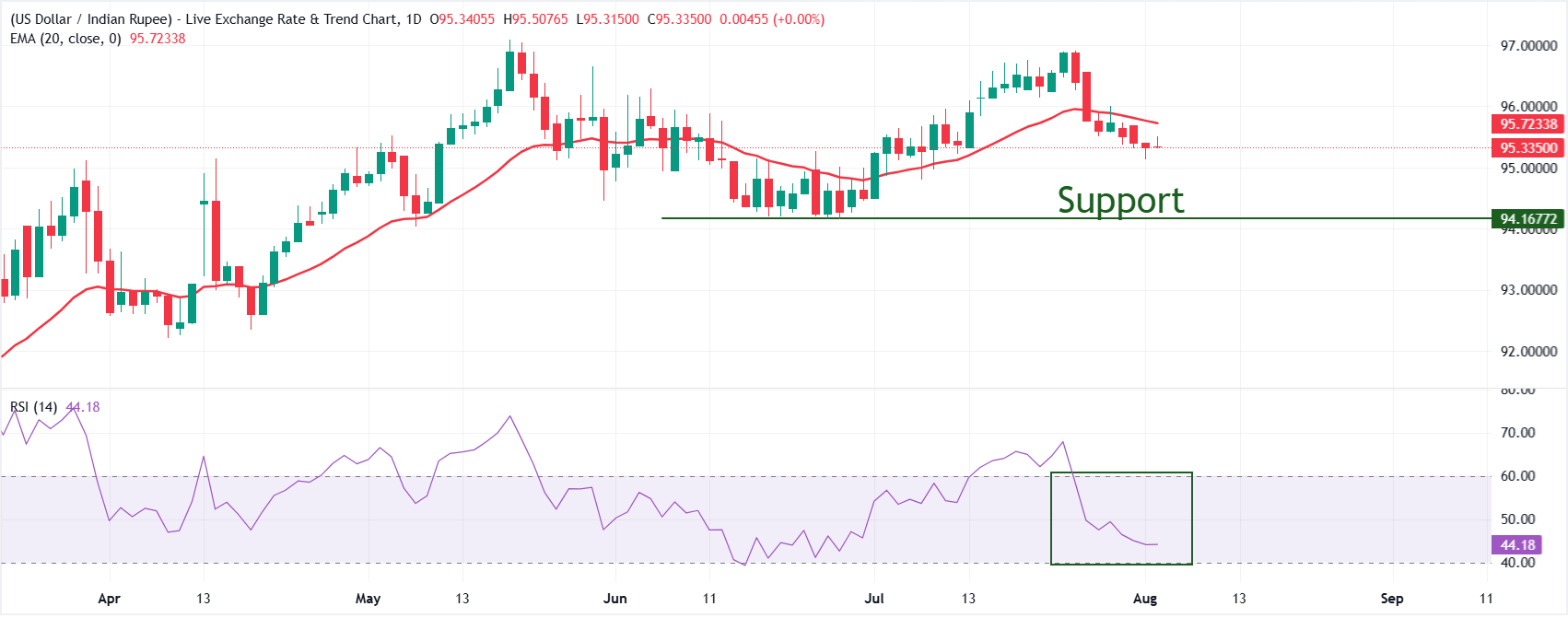
Technical Analysis: USD/INR remains under 20-day EMA
USD/INR trades at around 95.33, maintaining a bearish near-term bias as spot holds beneath the 20-day exponential moving average (EMA) at 95.7234.
The pair’s inability to reclaim this short-term EMA suggests upside remains capped, while the Relative Strength Index (14) at 44.18 leans slightly soft, hinting at waning bullish momentum rather than outright oversold conditions.
On the topside, immediate resistance is located at the 20-day EMA at 95.72, and a sustained break above this barrier would be needed for a more constructive recovery toward the July 29 high near 96.00. On the downside, major support levels are the July 7 low at 94.80 and the June low at 94.21.
AUD/JPY attracts some buyers to around 110.70 in Tuesday’s early European session.
The cross keeps a negative tone below the 100-day SMA, with bearish RSI momentum.
The initial support level is seen at 110.40; the first upside barrier is located at 112.85.
The AUD/JPY cross trades in positive territory near 110.70, snapping the six-day losing streak, during the early European trading hours on Tuesday. However, the potential upside for the cross might be limited due to the coordinated intervention between the United States (US) and Japan, which could provide some support to the Japanese Yen (JPY) against the Australian Dollar (AUD).
“The view that FX intervention cannot have a lasting impact and merely alters short-term market flows seems right in many cases. However, depending on the circumstances and broader context, intervention can exert a significant influence on the market and trigger an inflection,” said Bank of America analyst Shusuke Yamada.
Japan and US step in to stabilise Yen after historic slide
Strategists at BNY note that Japan’s finance ministry and the US Treasury have “intervened in the foreign exchange market to support the yen” after the currency weakened to its lowest level against the Dollar since 1986. Japanese Finance Minister Satsuki Katayama is cited as saying the joint action was aimed at “countering excessive volatility and disorderly movements in recent months,” underscoring that Tokyo “would not hesitate to carry out further joint intervention if needed.” BNY concludes that the authorities have made it clear they “remain ready to defend the currency” should renewed pressure on JPY emerge.
Technical Analysis:
In the daily chart, AUD/JPY extends a corrective move below the 100-day simple moving average (SMA) and the Bollinger Bands 20-day middle band, which form a dense overhead supply zone. The pair is now drifting toward the lower Bollinger band support, while the Relative Strength Index (RSI) at 34.33 hovers just above oversold territory, hinting that bearish momentum remains in control but could be nearing exhaustion.
On the downside, immediate support is located at the lower Bollinger band near 110.40, where a pause or bounce could emerge if sellers take profits. The next contention level to watch is the 110.00 psychological level, followed by the August 3 low of 109.24.
On the topside, initial resistance is seen at the 100-day SMA at 112.85, followed by the Bollinger Bands middle band at 113.00; a daily close above these clustered barriers would be needed to ease the current bearish bias and open the way toward the upper Bollinger band near 115.62.
USD/JPY rises to near 157.60 as the Japanese Yen faces profit booking.
US-Japan joint intervention strengthened the Japanese Yen.
Investors await key US JOLTS Job Openings data for June.
The Japanese Yen (JPY) trades lower against its major currency peers on Tuesday after a rare juggernaut outperformance in the last few trading days. In the Asian session, the Japanese currency is down 0.25% to near 157.60 against the US Dollar (USD).
Japanese Yen Price Today
The table below shows the percentage change of Japanese Yen (JPY) against listed major currencies today. Japanese Yen was the weakest against the Australian Dollar.
USD
EUR
GBP
JPY
CAD
AUD
NZD
CHF
USD
-0.00%
0.07%
0.27%
-0.01%
-0.25%
0.12%
-0.02%
EUR
0.00%
0.06%
0.29%
-0.02%
-0.27%
0.10%
-0.01%
GBP
-0.07%
-0.06%
0.23%
-0.07%
-0.32%
0.05%
-0.07%
JPY
-0.27%
-0.29%
-0.23%
-0.29%
-0.53%
-0.19%
-0.18%
CAD
0.00%
0.02%
0.07%
0.29%
-0.24%
0.11%
0.00%
AUD
0.25%
0.27%
0.32%
0.53%
0.24%
0.36%
0.25%
NZD
-0.12%
-0.10%
-0.05%
0.19%
-0.11%
-0.36%
-0.10%
CHF
0.02%
0.00%
0.07%
0.18%
-0.00%
-0.25%
0.10%
The heat map shows percentage changes of major currencies against each other. The base currency is picked from the left column, while the quote currency is picked from the top row. For example, if you pick the Japanese Yen from the left column and move along the horizontal line to the US Dollar, the percentage change displayed in the box will represent JPY (base)/USD (quote).
The Asia-Pacific currency outperformed due to rare joint intervention by the United States (US) and Japan to support the Yen.
Japan and US step in as Yen hits weakest level since 1986
BNY notes that Japan’s finance ministry and the US Treasury have moved to shore up the Yen, jointly intervening in the foreign exchange market after the currency fell to its lowest level against the Dollar since 1986. Japanese Finance Minister Satsuki Katayama said the coordinated action was aimed at countering “excessive volatility and disorderly movements in recent months.” She underscored that Tokyo “would not hesitate to carry out further joint intervention if needed,” signaling that the authorities remain ready to defend the currency should renewed pressure emerge.
Meanwhile, the US Dollar (USD) holds onto its Monday’s recovery move, with investors awaiting key US economic data, notably the Nonfarm Payrolls (NFP), releasing this week. As of writing, the US Dollar Index (DXY), which gauges the Greenback’s value against six major currencies, trades firmly near 100.00.
In Tuesday’s session, investors will focus on the JOLTS Job Openings data for June, which will be published at 14:00 GMT. The US economy is expected to have posted 7.45 million fresh jobs, slightly lower than 7.594 million in May.
USD/JPY technical outlook
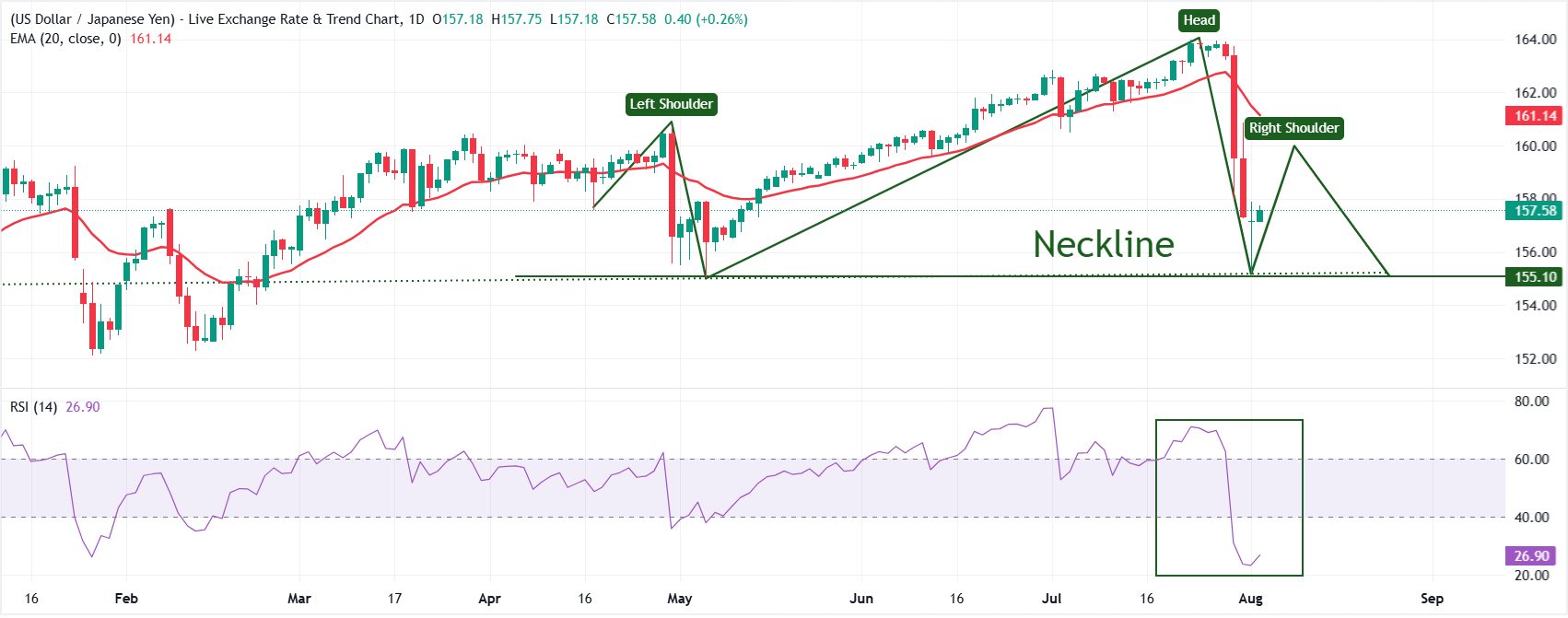
USD/JPY trades at around 157.58 at press time, retaining a bearish near-term bias as spot holds well below the 20-day exponential moving average (EMA) at 161.14. The chart structure of the pair reflects a Head and Shoulders pattern in the making, whose right shoulder is yet to be formed, likely near 160.00, suggesting a respite is highly likely after a juggernaut fall.
The pair has retreated from recent highs, and the Relative Strength Index (RSI) at 26.90 sits in oversold territory, which hints that downside momentum is stretched but does not yet show a clear reversal signal.
Going forward, a “Sell on Rise” strategy appears optimal in these conditions, and the round level of 160.00 would be a key barrier. After that, the pair might retest the neckline at around 155.10.
On the contrary, the pair would regain a bullish bias if it manages to extend the recovery above the July 16 low near 162.00. The pair would aim to revisit the multi-decade high at around 164.00 if it manages to break above 162.00.
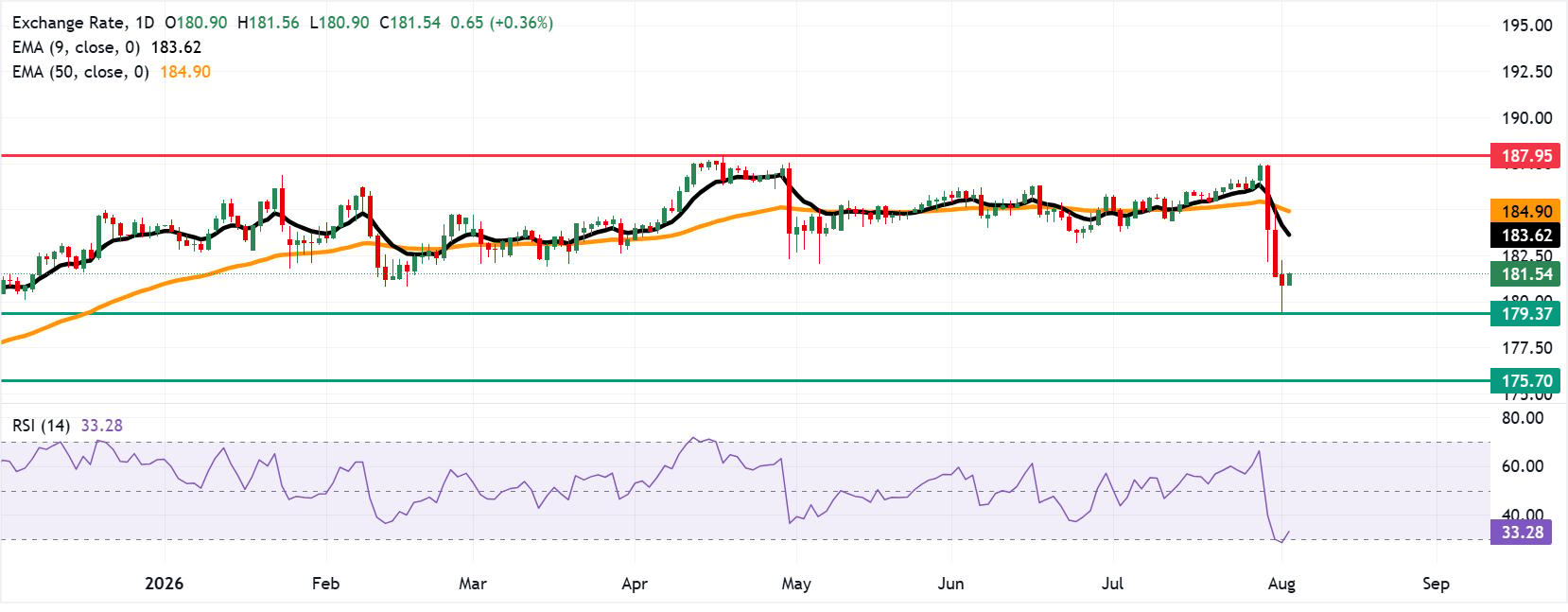
EUR/JPY may fall toward the immediate support at the eight-month low of 179.37.
The 14-day Relative Strength Index at 32.97 signals dominant downside momentum.
The initial resistance lies at the nine-day EMA at 183.62.
EUR/JPY gains ground after three days of losses, trading around 181.50 during the Asian hours on Tuesday. The currency cross is maintaining a bearish near-term tone as it holds beneath both the nine-day and 50-day Exponential Moving Averages (EMAs).
The EUR/JPY cross is retreating away from recent highs, while the 14-day Relative Strength Index (RSI) at 32.97 hovers just above oversold territory, hinting that downside momentum is still dominant but nearing stretched conditions.
The EUR/JPY cross may retest the initial support at the eight-month low of 179.37, reached on August 3. Further support lies at the nine-month low of 175.70.
On the upside, the EUR/JPY cross could rise toward the nine-day EMA at 183.62, followed by the 50-day EMA at 184.90. Further advances above these moving averages would cause a bullish emergence and support the currency cross to explore the region around the all-time high of 187.95, which was recorded on April 17.
Yen positioning seen shifting after Japan-US intervention
Strategists at Rabobank highlight that “JPY net shorts had climbed to their highest levels since 2024 last week,” just before the “concerted intervention from the MoF and the US Treasury to stem the weakness in the JPY.” The bank argues that this official action “suggests that positioning is likely to be sharply changed in the next data release,” but cautions that “it is too early to assess whether Japan’s fundamentals have strengthened sufficiently to allow the JPY to hold better levels vs. the USD in the spot market over the medium-term.”
(The story was corrected on August 4 at 03:45 GMT to say in the title that EUR/JPY rebounds from eight-month lows and not highs.)
To provide the best experiences, we use technologies like cookies to store and/or access device information. Consenting to these technologies will allow us to process data such as browsing behavior or unique IDs on this site. Not consenting or withdrawing consent, may adversely affect certain features and functions.
Functional
Always active
The technical storage or access is strictly necessary for the legitimate purpose of enabling the use of a specific service explicitly requested by the subscriber or user, or for the sole purpose of carrying out the transmission of a communication over an electronic communications network.
Preferences
The technical storage or access is necessary for the legitimate purpose of storing preferences that are not requested by the subscriber or user.
Statistics
The technical storage or access that is used exclusively for statistical purposes.The technical storage or access that is used exclusively for anonymous statistical purposes. Without a subpoena, voluntary compliance on the part of your Internet Service Provider, or additional records from a third party, information stored or retrieved for this purpose alone cannot usually be used to identify you.
Marketing
The technical storage or access is required to create user profiles to send advertising, or to track the user on a website or across several websites for similar marketing purposes.