

Currency Hedger No Comments

AUD/USD edges lower as US-Iran tensions outweigh support from stronger Australian PMI

  • AUD/USD posts a modest decline despite improving Australian PMI data.
  • Rising tensions between the United States and Iran dampen risk appetite.
  • PMI data may provide short-term direction.

AUD/USD trades around 0.7140 on Thursday, down 0.27% on the day, moving within a tight range as market sentiment remains pressured by geopolitical tensions.

The Australian Dollar (AUD) struggles to benefit from supportive domestic data. S&P Global’s Purchasing Managers Index (PMI) reports show manufacturing activity returning to expansion territory, while the services sector also rebounds. However, these positive signals are offset by a still-uncertain outlook, marked by weak demand and rising costs.

The main source of pressure comes from the global backdrop. Escalating tensions between the United States (US) and Iran are fueling risk aversion, following incidents in the Strait of Hormuz and the lack of progress in peace negotiations. This environment supports demand for safe-haven assets and weighs on risk-sensitive currencies such as the AUD.

According to Société Générale, the Australian Dollar remains particularly vulnerable in this context due to its reliance on imported petroleum products. The bank highlights that this exposure could amplify AUD volatility, especially in the event of prolonged supply disruptions.

On the US side, the latest labor market data shows Initial Jobless Claims rising slightly to 214K, above expectations. However, the release has had a limited impact on the US Dollar (USD), as investors remain primarily focused on geopolitical developments and Oil price dynamics.

Meanwhile, the US Dollar is supported by higher Treasury yields and reduced expectations of Federal Reserve (Fed) rate cuts. The US Dollar Index (DXY) is moving higher, reflecting this trend.

In this environment, AUD/USD remains highly sensitive to geopolitical headlines and upcoming macroeconomic releases, particularly the US PMI figures due later in the day, which could provide further clues on monetary policy expectations.

US Dollar Price Today

The table below shows the percentage change of US Dollar (USD) against listed major currencies today. US Dollar was the strongest against the New Zealand Dollar.

USDEURGBPJPYCADAUDNZDCHF
USD0.11%0.10%0.02%0.06%0.20%0.46%0.11%
EUR-0.11%0.00%-0.11%-0.05%0.07%0.35%-0.03%
GBP-0.10%-0.00%-0.09%-0.05%0.09%0.36%-0.03%
JPY-0.02%0.11%0.09%0.03%0.19%0.42%0.08%
CAD-0.06%0.05%0.05%-0.03%0.15%0.40%0.03%
AUD-0.20%-0.07%-0.09%-0.19%-0.15%0.27%-0.13%
NZD-0.46%-0.35%-0.36%-0.42%-0.40%-0.27%-0.39%
CHF-0.11%0.03%0.03%-0.08%-0.03%0.13%0.39%

The heat map shows percentage changes of major currencies against each other. The base currency is picked from the left column, while the quote currency is picked from the top row. For example, if you pick the US Dollar from the left column and move along the horizontal line to the Japanese Yen, the percentage change displayed in the box will represent USD (base)/JPY (quote).

Currency Hedger No Comments

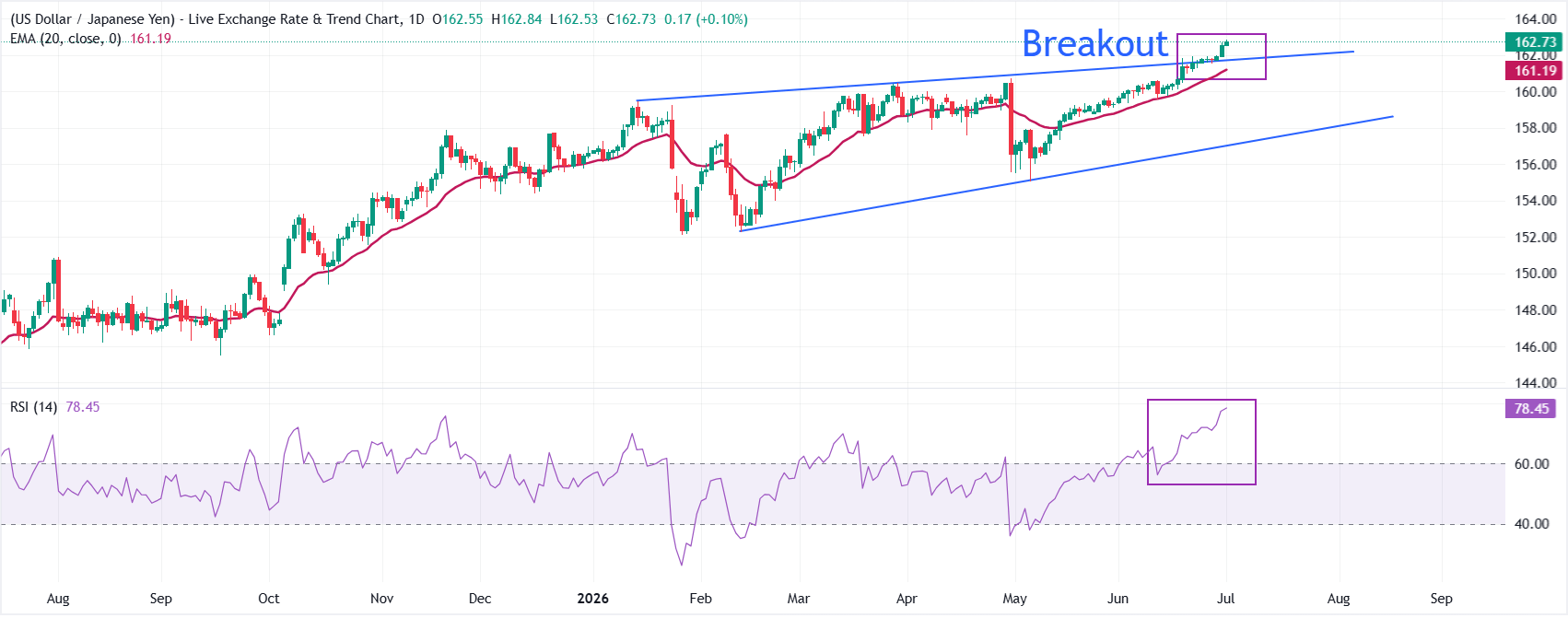
Chart of the Day – USD/JPY Under The Shadow of Hormuz and the BOJ?

The USDJPY pair continues to trade in a heightened uncertainty environment, where geopolitical factors, macroeconomic data, and growing expectations regarding Bank of Japan policy are all influencing price action at the same time. The market is moving around key technical levels, with particular attention focused on the 160 area, which has been consistently defended and is widely viewed as a significant psychological barrier as well as a potential intervention zone for Japanese authorities. This raises an increasingly important question: whether this level will eventually be broken, and if so, under what conditions and timing. The current dynamics are driven both by global geopolitical tensions and by an intensifying debate over the possible normalization of monetary policy in Japan.

Source: xStation5

What drives USDJPY pricing? Geopolitics and the Strait of Hormuz as a source of global risk aversion

One of the key drivers of market sentiment remains geopolitical tensions in regions critical for global energy transport, such as the Strait of Hormuz. The market reacts very sensitively to any risk of disruptions in oil and gas flows, which leads to higher energy prices and increased volatility. Japan is heavily dependent on energy imports, largely sourced from the Persian Gulf region. As a result, rising oil and gas prices deteriorate Japan’s trade balance and increase imported inflation pressures. Therefore, prolonged tensions in the Hormuz region do not necessarily support the yen. Instead, they tend to weaken it. In this context, geopolitics does not provide a clear directional signal for USDJPY, but rather reinforces upside pressure on the pair while increasing overall volatility.

Japanese macro data and PMI signals

Recently, Japanese PMI data has attracted more attention, showing a gradual improvement in economic activity. While this is not yet a strong upward trend, signs of stabilization in both manufacturing and services increase the likelihood that the Bank of Japan will have more room to continue normalizing monetary policy. For the FX market, this is important because the yen has remained under pressure for years due to ultra-loose monetary conditions. Even small shifts in this area can have a meaningful impact on global capital flows.

Inflation (CPI) as a key BOJ catalyst

One of the most important short-term drivers remains Japanese CPI data, which plays a central role in shaping expectations regarding future Bank of Japan actions. If inflation remains above the 2% target, markets increasingly price in the possibility of further rate hikes or at least a more hawkish communication stance from the central bank. In such a scenario, upward pressure on the yen increases. Conversely, weaker inflation data reinforces expectations that ultra-loose policy will be maintained for longer, which supports further yen weakness against the dollar.

Bank of Japan policy and interest rate differentials

A key medium- and long-term factor remains Bank of Japan policy, which is gradually moving away from its long-standing regime of ultra-low interest rates and yield curve control. Even though this process is slow, its direction is highly significant for markets. USDJPY is particularly sensitive to the interest rate differential between the US and Japan, which has been a major driver of yen weakness through carry trade strategies for years. Any narrowing of this spread could trigger significant capital flows and lead to shifts in the medium-term trend.

The 160 level and intervention risk

The 160 level on USDJPY remains a key reference point, both technically and politically. Historically, levels around this area have been repeatedly highlighted as zones of heightened vigilance by Japanese authorities regarding excessive FX volatility. As a result, markets are increasingly pricing in the risk of intervention by the Japanese Ministry of Finance, which may take the form of either verbal warnings or direct FX market operations. Such interventions typically result in sharp but often short-lived strengthening of the yen.

Key Takeways

  • USDJPY remains in a high-volatility environment where direction is driven simultaneously by macroeconomic data, geopolitical developments, and central bank policy.
  • Geopolitical tensions, including the situation in the Strait of Hormuz, increase global risk aversion.
  • Japanese macro data, particularly PMIs, indicate gradual economic improvement and support the case for further BOJ normalization.
  • Inflation (CPI) remains a key short-term catalyst for BOJ expectations and the yen’s direction.
  • BOJ policy is becoming an increasingly important source of volatility, with even small communication shifts capable of moving the market.
  • The US–Japan interest rate differential remains the core structural driver of USD/JPY, and its potential narrowing could reshape medium-term dynamics.
  • The 160 level represents a major psychological and political barrier, increasing the risk of intervention or verbal action by Japanese authorities.
  • The market remains in a phase dominated by expectations and narratives, which supports sharp but often short-lived price moves.
Currency Hedger No Comments

CAD flat lines as traders await US PMI data

  • USD/CAD holds steady near 1.3670 in Thursday’s early European session. 
  • Trump extended the ceasefire and vowed to continue the US blockade on Iranian ports.
  • Traders brace for the preliminary reading of the S&P Global US PMI report for April, which is due on Thursday. 

The USD/CAD pair trades on a flat note around 1.3670 during the early European session on Thursday. The pair steadies as traders await signs of diplomatic progress to end the war in the Middle East.  

The US is extending the ceasefire with Iran at Pakistan’s request as US President Donald Trump waits for a unified proposal from Iran. Nonetheless, tensions remain high in the Middle East as Tehran keeps a tight grip on the Strait of Hormuz, controlling passage through the trade route and firing on ships. 

Iran’s top negotiator and parliament speaker, Mohammad Bagher Ghalibaf, stated Israel’s warmongering and “flagrant” ceasefire breaches made reopening the Strait of Hormuz “impossible.” Surging oil prices, driven by Middle East conflict risks, lift the commodity-linked Loonie. It is worth noting that Canada is a major oil-exporting country, and high crude oil prices generally have a positive impact on the Canadian Dollar (CAD). 

The preliminary reading of the S&P Global US Purchasing Managers Index (PMI) will be the highlight later on Thursday. The Manufacturing PMI figure is expected to improve slightly to 52.5 in April from 52.3 in the previous reading. Services PMI is projected to rise to 50.0 in April, versus 49.8 prior. If the reports show a stronger-than-expected outcome, this could underpin the Greenback against the CAD in the near term. 

Currency Hedger No Comments

EUR/GBP posts modest gains above 0.8650 ahead of Eurozone, UK PMI releases

  • EUR/GBP posts modest gains near 0.8675 in Thursday’s early European session. 
  • The UK CPI inflation climbed to 3.3%YoY in March, driven by higher fuel costs due to the Iran war.
  • ECB’s Simkus said the central bank shouldn’t raise interest rates in April.

The EUR/GBP cross trades with mild gains around 0.8675 during the early European session on Thursday. However, the potential upside for the cross might be limited due to hot UK inflation data. Traders will keep an eye on the preliminary readings of the Purchasing Managers Index (PMI) from the Eurozone and the United Kingdom (UK). 

Data released by the Office for National Statistics (ONS) on Wednesday showed that the UK headline Consumer Price Index (CPI) inflation rose to 3.3% YoY in March, compared to 3.0% in February. This increase marks the first official reflection of the US-Israel war with Iran on the UK’s cost of living. The core CPI, excluding volatile food and energy items, climbed 3.1% YoY in March, versus 3.2% prior, below the forecast of 3.2%.

The Bank of England (BoE) is expected to hold the base rate at 3.75% at its next meeting on April 30, though the jump in inflation has fueled speculation of potential future hikes or delayed cuts.

The European Central Bank (ECB) officials are leaning toward leaving interest rates unchanged at the April policy meeting. ECB Governing Council member Martins Kazaks said on Wednesday that the central bank has ‘luxury’ to wait on interest rate rises. 

Meanwhile, ECB policymaker Gediminas Simkus reiterated the cautious stance regarding the ECB’s monetary policy, saying that while a rate hike in April is unlikely, the door remains open for policy tightening later this year. While a hold is expected in the April policy meeting, Barclays analysts anticipate the focus to shift toward potential 25 basis point (bps) hikes in June and September to combat an energy-driven inflation surge.

Currency Hedger No Comments

When are the German/ Eurozone flash HCOB PMIs for April and how could they affect EUR/USD?

German/ Eurozone flash PMIs Overview

The preliminary German and Eurozone flash HCOB Purchasing Managers’ Index (PMI) data for April is due for release today at 07:30 and 08:00 GMT, respectively.

Amongst the Euro area economies, the German and the composite Eurozone PMI reports hold more relevance, in terms of their impact on the European currency and the related markets as well.

The flash Composite PMI for Germany is expected to have expanded again, but at a moderate pace due to a slowdown in both the manufacturing and the services sectors. The Composite PMI is seen arriving lower at 51.1 from 51.9 in March.

Germany’s Manufacturing PMI is expected to have fallen to 51.3 from the previous reading of 52.2. Meanwhile, the Services PMI is estimated to have dropped to 50.3 from the prior release of 50.9.

The forecast for the Eurozone flash Composite PMI for April also shows that the overall private sector output expanded at a moderate pace. Eurozone’s manufacturing output growth slowed down, and the services sector activity contracted. A figure below the 50.0 threshold is considered a contraction in the economic activity.

According to preliminary estimates, the Eurozone Composite PMI drops to 50.2 from 50.7 in March. The Manufacturing PMI is seen arriving lower at 50.8 from the prior release of 51.6. The Services PMI is expected to have contracted to 49.8 after slowing down to 50.2 in March.

How could German/ Eurozone flash PMIs affect EUR/USD?         

EUR/USD is marginally down to near 1.1700 during the early European trade on Thursday. The pair has corrected to near the 20-period exponential moving average (EMA), which is at 1.1691, but sits north of the 38.2% Fibonacci retracement at 1.1666 of the 1.1408–1.2082 swing, suggesting underlying demand on shallow pullbacks.

The Relative Strength Index (RSI) falls into the 40.00-60.00 zone after failing to hold above the 60.00 level, indicating balanced momentum with an upside bias.

On the topside, initial resistance is located at the 50% Fibonacci retracement at 1.1745; a daily close above this barrier would expose the 61.8% retracement at 1.1825, followed by 1.1938 and the cycle high region near 1.2082. On the downside, immediate support is provided by the 20-period EMA at 1.1691, ahead of the 38.2% retracement at 1.1666; a deeper setback would bring the 23.6% level at 1.1567 into view, with more important structural support down at the 1.1408 swing low.

Currency Hedger No Comments

EUR/USD: PMI signals and softer pair – Danske Bank

Danske Research Team highlights that Euro area April flash PMIs (Purchasing Managers’ Index) are a key input ahead of the next European Central Bank (ECB) meeting, with Manufacturing PMI expected to drop below 50 while Services PMI holds at 50.2. The bank notes unusually high uncertainty around the indices and stresses that price components will be crucial. In markets, EUR/USD has slipped back below 1.1700.

Euro PMIs and weaker currency tone

“In the euro area, the April flash PMI report is released, a key input ahead of the ECB meeting. We expect the manufacturing PMI to show a steep decline from 51.6 to 49.6, driven by higher energy prices.”

“The surprise increase in the headline index in March was largely due to longer delivery times, which pose an upward risk to the headline number again. As such, monitoring the output sub-component will be crucial.”

“The services PMI fell more than expected in March to 50.2 and we expect it to remain at same level in April, as services are less directly hit than manufacturing. However, the uncertainty of the index is unusually high, so interpretation should be more cautious than usual.”

“Markets open on a weak foot with headlines from a locked-in stand-off over the SOH [Strait of Hormuz] dominating the news. Asian equities are down while US treasuries rise a couple of basis points this morning and EUR/USD falls back below 1.1700.”

Currency Hedger No Comments

JPY strengthens on extended US-Iran ceasefire

  • USD/JPY softens to around 159.35 in Thursday’s Asian session. 
  • Trump said the ceasefire agreed on April 7 would stay in place indefinitely. 
  • The BoJ is widely expected to maintain its policy rate at 0.75% during the April meeting.

The USD/JPY pair loses traction to near 159.35 during the Asian trading hours on Thursday. US President Donald Trump’s extension of a ceasefire with Iran weighs on the US Dollar (USD) against the Japanese Yen (JPY). The preliminary reading of the S&P Global Purchasing Managers Index (PMI) will be published later on Thursday. 

Trump said on Tuesday that he is extending the ceasefire with Iran while awaiting a “unified proposal” from Tehran. Iran vowed not to reopen the Strait of Hormuz amid the US naval blockade despite the ceasefire extension. Earlier, the White House press secretary Karoline Leavitt said that she doesn’t view Iran’s assertion that it seized two ships in the Strait of Hormuz as a violation of the ceasefire. 

Meanwhile, Lebanon will push for a one-month extension of the current truce with Israel during a new round of meetings in Washington on Thursday. Talks between Lebanon and Israel on April 14 were their first in decades, and the US soon after announced the 10-day truce, set to expire on Sunday.

Bank of Japan (BoJ) Governor Kazuo Ueda avoided signaling an April rate hike, citing high economic uncertainty from the “negative supply shock” of the war. Financial markets now widely anticipate the Japanese central bank to hold rates steady until at least June 2026. 

Markets are now pricing in nearly a 72%-77% probability of a rate increase in May, with expectations for a hike of nearly 99% by June, according to Reuters. 

Currency Hedger No Comments

GBP/USD Tests nine-day EMA support after slipping below 1.3500

  • GBP/USD may rebound toward the two-month high of 1.3599.
  • The 14-day Relative Strength Index near 56 indicates positive momentum without overbought conditions.
  • The immediate support lies at the nine-day EMA of 1.3493.

GBP/USD remains subdued for the third successive day, trading around 1.3500 during the Asian hours on Thursday. The technical analysis of the daily chart indicates a potential for bearish reversal as the pair moves below the ascending channel pattern.

However, the GBP/USD pair holds a constructive bullish bias as it stays marginally above the nine-period Exponential Moving Average (EMA) and comfortably over the 50-period EMA. This alignment of short- and medium-term EMAs below spot hints at underlying demand. The 14-day Relative Strength Index around 56 suggests positive but not overstretched momentum, allowing room for further upside while the pair remains supported on dips.

The return to the ascending channel would lead the GBP/USD pair to test the initial barrier at the two-month high of 1.3599, recorded on April 17. Further advances would support the pair to test the upper boundary of the ascending channel around 1.3810. A break above the channel would reinforce the bullish bias and support the GBP/USD pair to approach the 1.3869, the highest level since September 2021, reached on January 27.

On the downside, the GBP/USD pair is testing the immediate support at the nine-day EMA of 1.3493, followed by the 50-day EMA at 1.3427. A sustained break below these short- and medium-term averages would expose a nearly five-month low of 1.3159, recorded on March 31, followed by the 1.3010, the lowest since April 2025, which was recorded in November 2025.

GBP/USD: Daily Chart

Pound Sterling Price Today

The table below shows the percentage change of British Pound (GBP) against listed major currencies today. British Pound was the weakest against the US Dollar.

USDEURGBPJPYCADAUDNZDCHF
USD0.07%0.11%0.05%0.02%0.23%0.24%0.12%
EUR-0.07%0.05%-0.02%-0.05%0.14%0.16%0.03%
GBP-0.11%-0.05%-0.06%-0.10%0.11%0.12%-0.02%
JPY-0.05%0.02%0.06%-0.04%0.19%0.17%0.06%
CAD-0.02%0.05%0.10%0.04%0.23%0.22%0.08%
AUD-0.23%-0.14%-0.11%-0.19%-0.23%0.02%-0.15%
NZD-0.24%-0.16%-0.12%-0.17%-0.22%-0.02%-0.15%
CHF-0.12%-0.03%0.02%-0.06%-0.08%0.15%0.15%

The heat map shows percentage changes of major currencies against each other. The base currency is picked from the left column, while the quote currency is picked from the top row. For example, if you pick the British Pound from the left column and move along the horizontal line to the US Dollar, the percentage change displayed in the box will represent GBP (base)/USD (quote).