

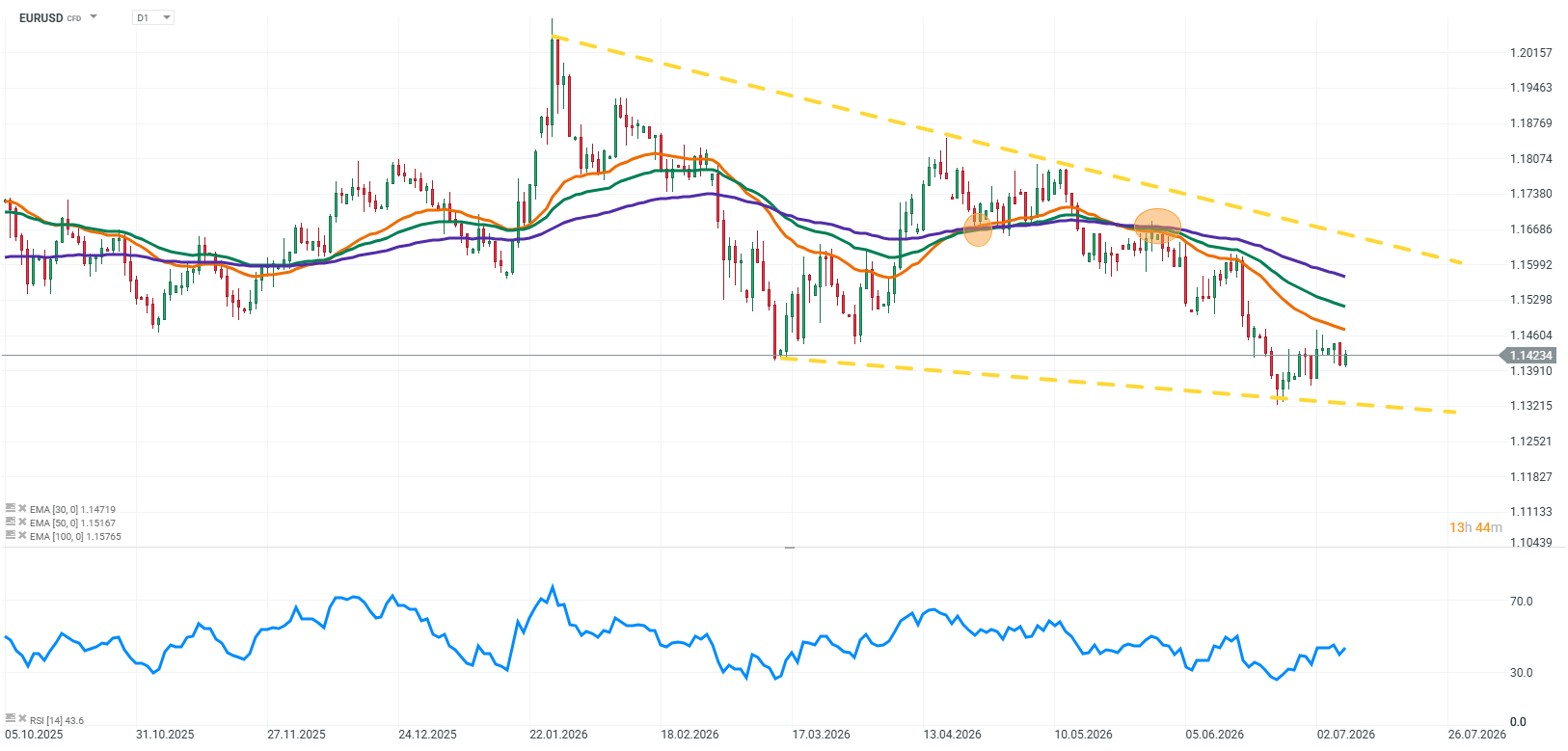
Wednesday’s session on the EURUSD market is being shaped by a clash of three key forces: expectations regarding the future path of Federal Reserve policy, the increasingly firm stance of the European Central Bank, and the renewed risk premium linked to geopolitical developments in the Middle East. The market is currently at an unusual point, as investors are no longer focused solely on which central bank will maintain the more restrictive stance.
The key question now is how long the Fed will keep rates at current levels and whether the ECB will indeed be forced to deliver further rate hikes. Today’s release of the FOMC meeting minutes could provide important clues about the future direction of US monetary policy. At the same time, markets must also factor in geopolitical developments and rising oil prices, which could once again complicate the inflation outlook on both sides of the Atlantic.
Source: xStation5
Three factors currently shaping EURUSD
1. FOMC Minutes: Markets are looking for clues on future Fed rate cuts
The main event of the day remains the release of the latest Federal Open Market Committee meeting minutes. This time, markets are not focusing solely on whether the Fed will remain restrictive. The more important question is when and under what conditions the Federal Reserve will be ready to shift the direction of monetary policy.
Markets have been increasingly assessing the possibility of future rate cuts in the United States, but the Fed must remain extremely cautious in its communication. Signalling readiness to ease policy too quickly could be interpreted as declaring victory over inflation prematurely and could undermine the central bank’s credibility. The fact that markets are analysing the first signals of Fed communication under Kevin Warsh’s leadership adds further importance to today’s release. The new Fed Chair faces a difficult balancing act: acknowledging market expectations for lower interest rates while avoiding any suggestion that the fight against inflation has already been won. Today’s minutes may provide insight into how FOMC members assess:
- the persistence of inflationary pressures,
- the resilience of the US economy,
- the timing of a potential rate-cut cycle.
If the document shows greater caution towards rate cuts, the dollar could receive additional support. However, if markets interpret the minutes as signalling greater willingness to ease policy, the US currency could come under renewed pressure.
2. ECB remains hawkish and continues to support the euro
The situation across the Atlantic currently looks different. Following its 25 basis point rate hike in June, the European Central Bank remains focused on risks related to persistent inflationary pressures. Markets are increasingly pricing in a scenario where the ECB could deliver another rate increase later this year. This marks a significant shift compared with the previous period, when the main concern for the euro was slowing economic growth and the possibility of monetary easing. Currently, markets must consider that persistent inflation, particularly in the services sector, combined with the potential for higher energy prices, could force the ECB to maintain a restrictive policy stance for longer. For EURUSD, this provides an important source of support. Even if the dollar remains strong due to the relative strength of the US economy and its safe-haven status, the euro continues to benefit from the prospect of higher interest rates in the euro area.
3. Rising US-Iran tensions and the renewed importance of oil markets
One of the most important new drivers for global markets remains the situation in the Middle East. Rising tensions between the United States and Iran, along with concerns over restrictions on Iranian oil exports, have increased the risk of supply disruptions in energy markets. The market response has been a rise in Brent and WTI crude prices, with investors once again considering the possibility that inflationary pressures could remain elevated for longer. The impact of this factor on EURUSD is not straightforward. On one hand, geopolitical uncertainty traditionally supports the US dollar as a safe-haven asset. During periods of increased risk aversion, investors often turn towards the American currency. On the other hand, higher energy prices increase inflationary pressure and complicate central bank decisions. The euro area economy remains particularly vulnerable to rising import costs due to its dependence on energy supplies. If oil prices move significantly higher again, markets may begin pricing in the risk of both the Fed and the ECB maintaining tighter monetary policy for longer.
EURUSD: Markets await the next move in the Fed-ECB policy divergence
The current situation in the major currency pair reflects the clash of three different narratives:
- Fed – markets are trying to determine the timing of potential interest rate cuts,
- ECB – investors are pricing in the possibility of further monetary tightening,
- Middle East tensions and oil prices – a factor increasing inflation uncertainty and market volatility.
In this environment, EURUSD remains highly vulnerable to sharp moves, as every new development can quickly change expectations regarding the policy gap between the two central banks. US bond yields will remain a key transmission channel. Rising yields could support the dollar by increasing the market pricing of higher financing costs, while falling yields could increase pressure on the US currency.
Key takeaways
- Today’s FOMC minutes could become the most important event for the dollar market.
- The Fed is now at a stage where investors are analysing not the possibility of further rate hikes, but the timing of potential rate cuts.
- Kevin Warsh must balance market expectations for easier policy with the need to preserve credibility in the fight against inflation.
- The ECB remains an important source of support for the euro due to expectations of another rate hike this year.
- Escalating tensions in the Middle East and rising oil prices could once again increase inflationary pressures.
EURUSD therefore remains at a point where the next major move may be determined by one key question: will Fed policy