

Currency Hedger No Comments

AUD/USD slides as US Dollar gains on geopolitical tensions ahead of Fed decision

  • AUD/USD weakens as softer Australian CPI and a firm US Dollar pressure the Aussie.
  • US-Iran tensions remain elevated as peace talks stall and supply disruptions in the Strait of Hormuz persist.
  • Markets await the Federal Reserveโ€™s monetary policy announcement.

The Australian Dollar (AUD) edges lower against the US Dollar (USD) on Wednesday, weighed by softer-than-expected Australian inflation data, while fading hopes that the US-Iran war will end anytime soon support the Greenback.

At the time of writing,ย AUD/USDย is trading around 0.7139, down nearly 0.60% on the day. Meanwhile, the US Dollar Index (DXY), which tracks the Greenbackโ€™s value against a basket of six major currencies, is trading around 98.78, up about 0.15%.

Market sentiment weakens after Reuters reported that US President Donald Trump and oil companies discussed plans to maintain the Iran blockade for months if needed, citing a White House official. Trump also warned that โ€œIran canโ€™t get their act together. They donโ€™t know how to sign a nonnuclear deal. They better get smart soon,โ€ he wrote on Truth Social. The comments follow US skepticism over Iranโ€™s proposal to end the war and reopen the Strait of Hormuz while delaying nuclear talks.

Looking ahead, attention turns to the Federal Reserveโ€™s (Fed) monetary policy decision due at 18:00 GMT. Markets widely expect the central bank to keep interestย ratesย unchanged in the 3.50%-3.75% range as policymakers assess the impact of rising energy prices on inflation, driven by ongoing supply disruptions in the Strait of Hormuz.

Inflation continues to run above the Fedโ€™s 2% target, with rising Oil prices increasing upside risks. This has dampened expectations for near-term rate cuts, reinforcing a higher-for-longer policyย outlook. Markets will therefore focus on guidance fromย Fedย Chair Jerome Powell.

A hawkish tone could further support the US Dollar, while any signal that theย Fedย remains open to rate cuts later this year may limit the Greenbackโ€™s upside. However, downside in the US Dollar is likely to remain limited amid persistent geopolitical uncertainty.

Although the Reserve Bank of Australiaโ€™s (RBA) hawkish outlook continues to provide underlying support for the Aussie, the latest inflation data showed Consumer Price Index (CPI) rising to 4.6% in March from 3.7% in February, but still below expectations of 4.7%.


Currency Hedger No Comments

Aussie Holds Firm on Hot CPI Print

The Australian dollar edged down to below $0.72, but stayed near four-year highs as a sharp rise in inflation kept expectations of a rate hike next week. Headline inflation jumped to 4.6% annually in March, slightly below forecasts of 4.7%, but stayed above the Reserve Bankโ€™s 2โ€“3% target and marked the highest since monthly CPI data began in 2025.

The annual trimmed-mean measure held at 3.3%, in line with expectations as higher fuel costs stemming from Middle East supply disruptions added to already elevated price pressures. In the absence of a major upside inflation surprise, the Aussie attracted some sellers amid cautious risk sentiment due to persistent geopolitical uncertainties. Still, markets priced in increased odds of a 25 bp rate hike next week. In the US and other G-7 economies, policymakers are likely to hold rates steady this week while monitoring the risk of rising energy costs fueling inflation, as the Strait of Hormuz remained effectively closed amid US-Iran tensions.

Currency Hedger No Comments

AUD/JPY holds losses below 114.50 as BoJ keeps rate steady at 0.75%

  • AUD/JPY loses ground to around 114.30 in Tuesdayโ€™s Asian session.ย 
  • BoJ kept the policy rate unchanged at 0.75% at its April policy meeting on Tuesday.ย 
  • The Australian March CPI inflation report will be the highlight later on Wednesday.ย 

The AUD/JPY cross declines to near 114.30 during the Asian trading hours on Tuesday. The Japanese Yen (JPY) strengthens against the Australian Dollar (AUD) after the Bank of Japan’s (BoJ) interest rate decision. Traders will closely monitor Governor Kazuo Ueda’s press conference for any hints about the next move.

As widely expected, theย BoJย decided to hold the short-term interest rate steady at 0.75% after concluding its two-day monetary policy review meeting on Tuesday. According to the BoJโ€™s policy statement, the central bank will continue to raise interestย ratesย in accordance with developments in the economy, prices, and financial markets. It said wages and prices may face upward pressure more than what the output gap suggests. Theย BoJย will scrutinize the timing and pace of policy adjustment with a close eye on economic and price impact from Middle East war developments.ย 

The attention will shift to the BoJโ€™s Governor Kazuo Ueda press conference for more clues about the interest rate path in Japan. Any hawkish comments from policymakers could lift the JPY and act as a headwind for the cross.

On the Aussie front, the Reserve Bank of Australia (RBA) is anticipated to raise the Official Cash Rate (OCR) for a third consecutive time at its next meeting on May 5, 2026. Markets are pricing in a 74% chance of another 25-basis-point increase to 4.35% in the May policy meeting, according to Reuters. 

Traders will take more cues from the Australian March Consumer Price Index (CPI) inflation data on Wednesday for fresh impetus. The headline CPI is projected to show a rise of 4.7% YoY in March, compared to 3.7% in February. Any signs of hotter inflation in Australia could lift the Aussie against the JPY. 

Currency Hedger No Comments

AUD/USD rallies to 10-day highs near 0.7200 amid US Dollar weakness

  • AUD/USD rallies more than 0.5% to reach session highs near 0.7200.
  • Moderate hopes of a US-Iran peace deal are feeding a mild risk appetite on Monday.
  • The US Fed decision and Australian CPI will gather investors’ focus this week.

The Australian Dollar (AUD) accelerates its rally against a weak US Dollar (USD) on Monday, reaching 10-day highs at 0.7190 at the time of writing, after bouncing from lows near 0.7100 last week. News of a peace proposal from Tehran and hopes that high energy prices will boost inflation and force the Reserve Bank of Australia (RBA) to hike rates next week are keeping the Aussie buoyed.

A report published by Axios earlier on Monday, citing a US official and sources related to the matter, affirmed that Tehran has sent a peace proposal to the US, offering to end the war and reopen the Strait of Hormuz, and to postpone nuclear conversations to a later stage. This news helps sustain hopes of a negotiated end to the conflict and adds weight to the US Dollar.

Central banks return to the focus

The US Federal Reserve (Fed) will also come into focusย this week. The US central bankโ€™s Federal Open Market Committee (FOMC) meets on Wednesday and is widely expected to leave interestย ratesย unchanged at the 3.50%-3.75% rate.

The bank is also likely to hint at a steady policy for the next few months. The rising inflationary pressures stemming from Iranโ€™s war have prompted markets to dial down hopes of interest rate cuts this year, and the CME Fed Watch Tool shows that futures markets price a 66% chance that monetary policy will remain on hold by the end of the year. Investors were betting on between one and two rate cuts before the war started.

Before that, Australian Consumer Price Index (CPI) figures will provide further insight about next weekโ€™s RBA decision. Inflation is expected to have accelerated in the first month of the US-Iran war, boosting speculation that the central bank might hike interest rates for the third consecutive time in May. These rumours are keeping theย Aussie Dollarย close to multi-year highs against the US Dollar.

Currency Hedger No Comments

AUD/USD Advances to 0.7170 as bulls await range breakout on softer USD

  • AUD/USD attracts some dip-buyers on Monday amid a modest US Dollar weakness.
  • The RBAโ€™s hawkish stance counters US-Iran tensions and offers support to the Aussie.
  • The technical setup favors bulls as the market focus shifts to the key FOMC meeting.

The AUD/USD pair turns positive for the second consecutive day following a modest dip on Monday and climbs to a three-day high, around the 0.7170 region during the Asian session. Spot prices, however, remain confined within a familiar range that has been held over the past two weeks or so, warranting some caution for bullish traders.

Despite stalled US-Iran peace talks and a standoff over the Strait of Hormuz, the US Dollar (USD) struggles to lure buyers and remains on the defensive as bulls seem reluctant ahead of the crucial FOMC meetingย this week. Moreover, a generally positive risk tone is seen undermining the Greenback’s safe-haven demand and acting as a tailwind for the AUD/USD pair amid the Reserve Bank of Australia’s (RBA) hawkish stance.

From a technical perspective, the recent range-bound price action might be categorized as a bullish consolidation phase against the backdrop of a rally from the 100-day Simple Moving Average (SMA), touched in March. Furthermore, positive momentum studies maintain a constructiveย outlookย for theย AUD/USDย pair, suggesting that the path of least resistance remains to the upside and backing the case for an eventual bullish breakout.

The Relative Strength Index (RSI) holds above 60 without yet signaling overbought conditions and points to sustained upside pressure. Also, the Moving Average Convergence Divergence (MACD) histogram remains in a positive zone, indicating that the recent advance is broadly backed by upward momentum. However, a move above the 0.7185-0.7190 area, or the trading range hurdle, is needed to reaffirm the constructive outlook.

On the flip side, any corrective pullback could be seen as a buying opportunity and continue to find decent support ahead of the 0.7100 mark. A convincing break below the said handle, along with any loss of momentum in the indicators, would warn of a corrective phase within the broader bullish structure.

(The technical analysis of this story was written with the help of an AI tool.)

AUD/USD daily chart

Currency Hedger No Comments

Currency Talk – AUDCAD, NZDUSD, USDJPY

Key takeaways

  • What is the technical outlook for AUDCAD, NZDUSD, and USDJPY?

This analysis from the Overbalance series aims to identify three financial instruments, analyzed primarily on the daily/four-hour (D1/H4) timeframe. The analysis uses only the Overbalance methodology, which helps determine where a trend may continue or where a reversal might occur. Todayโ€™s analysis covers three instruments, evaluated solely in terms of 1:1 correction structures.

AUDCAD

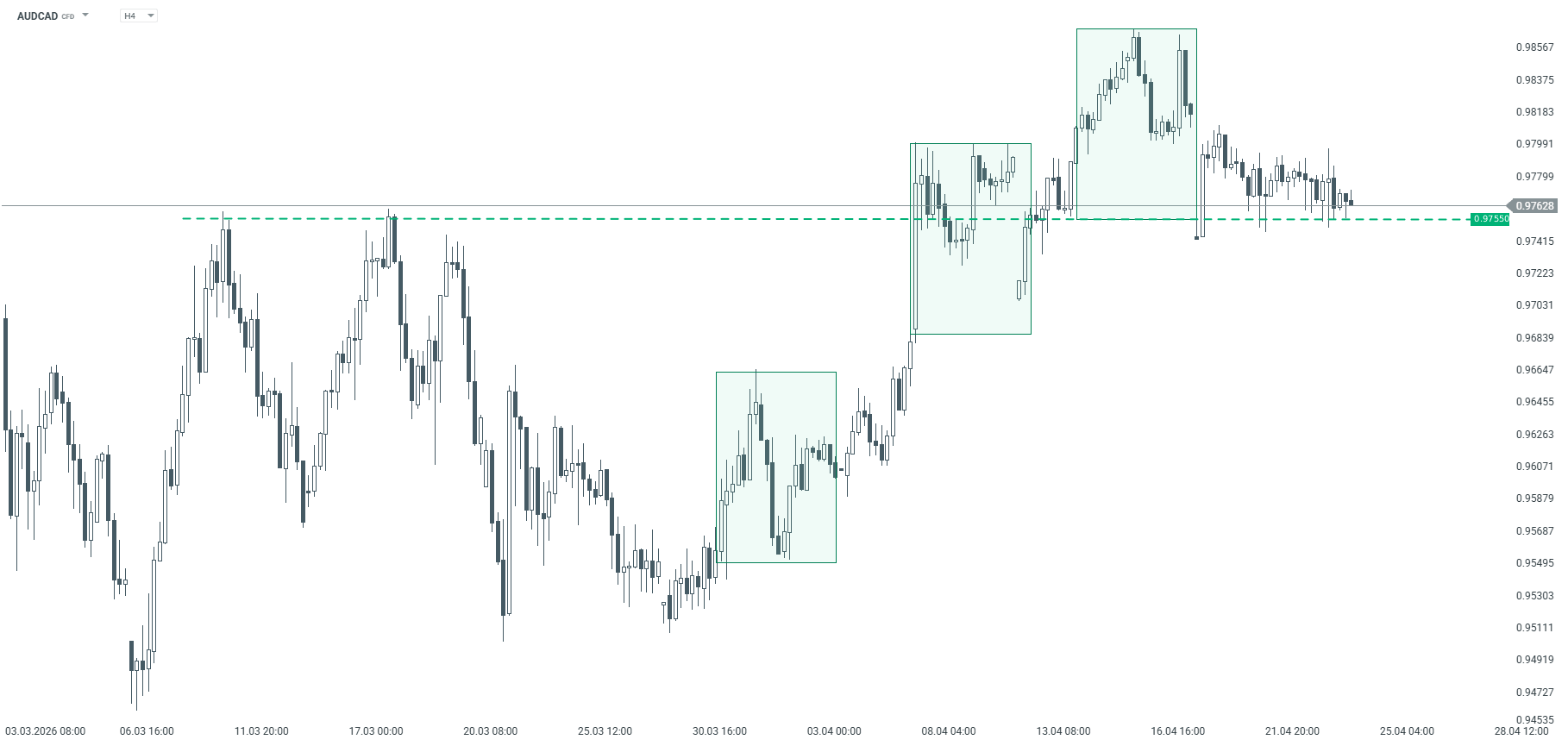
Since late March, AUDCAD has been trending upward. The key level remains the support at 0.9755, which stems from the lower boundary of the local 1:1 pattern, as well as from previous local peaks. According to the Overbalance methodology, as long as the price remains above this level, the uptrend remains in effect. However, it is worth noting the lack of a clear demand reactionโ€”further tests of this support level could weaken it, increasing the risk of a breakout to the downside. Therefore, the 0.9755 level is critical in the short term for the direction of the market.

AUDCAD – H4 timeframe. Source: xStation

NZDUSD

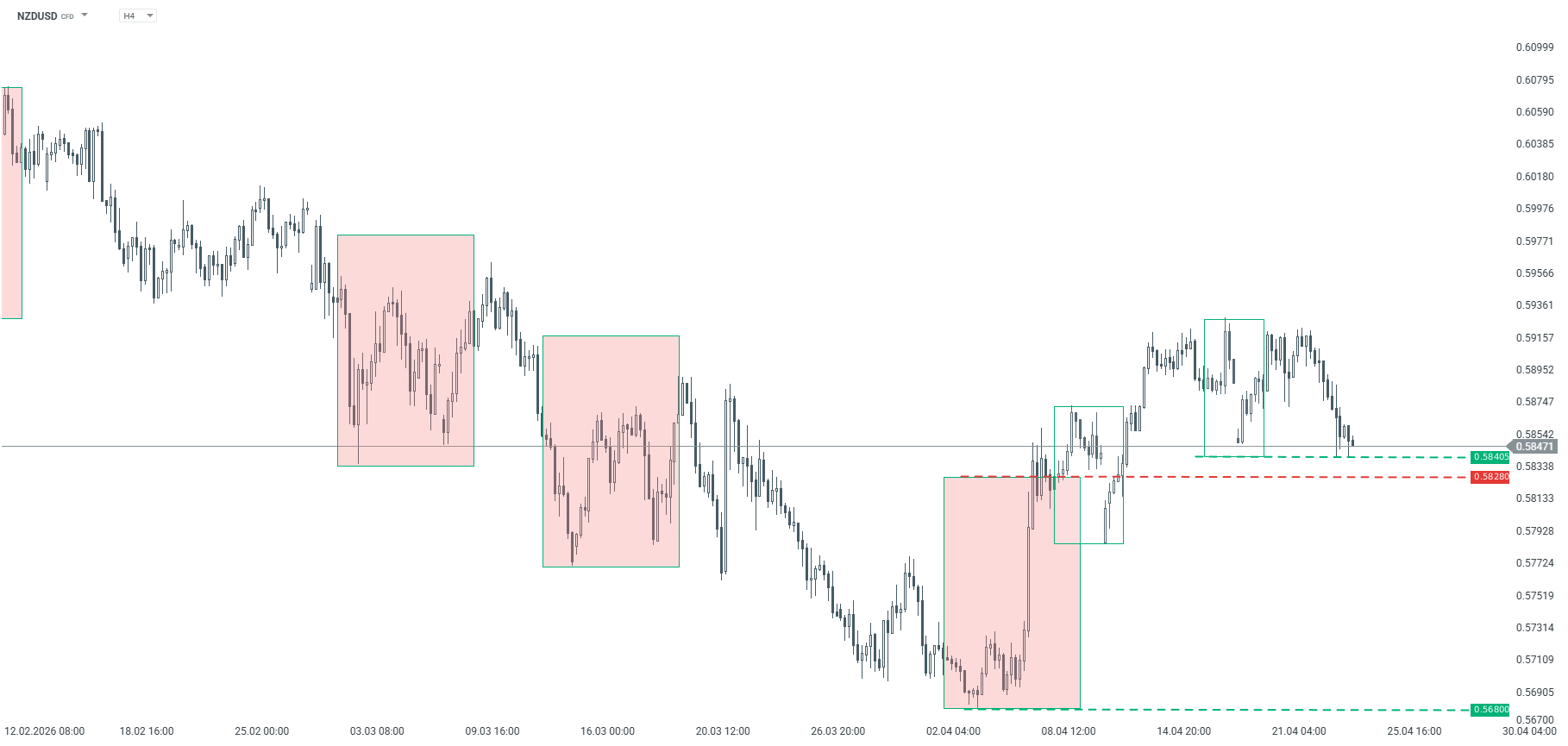
Since early April, the NZDUSD pair has been trending upward, but the market is currently testing key support at the 0.5840 level. Holding this level could trigger another upward move. Conversely, a break below this level and a return below 0.5828 could pave the way for a resumption of the downward trend. The current levels are therefore crucial for determining the short-term direction.

NZDUSD – H4 chart. Source: xStation

USDJPY

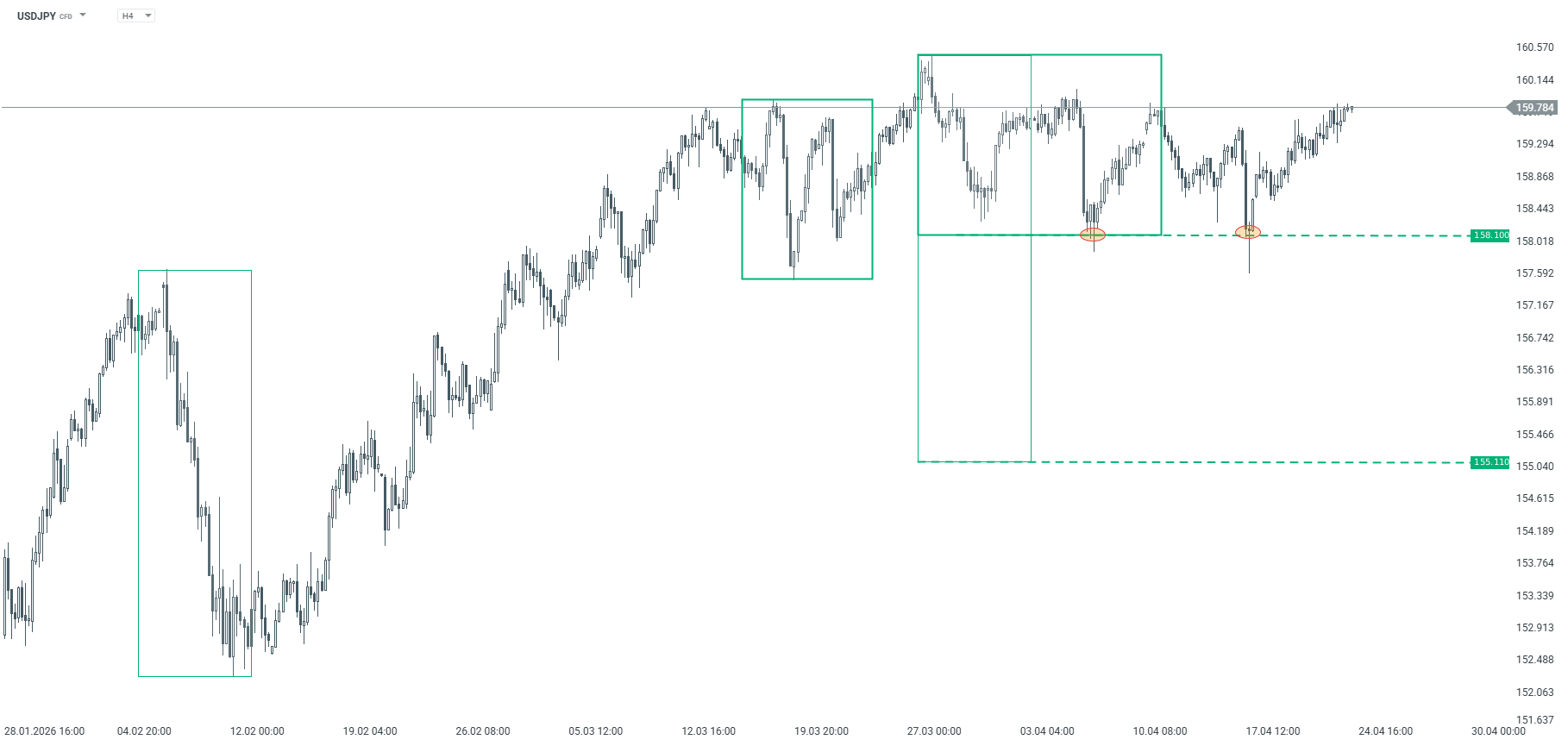
USDJPY has been trending upward for quite some time, but in April we saw a consolidation phase and two tests of support at the 158.10 level. This level was successfully defended, which supports the current uptrend. A break above the March 29 high would confirm the continuation of the uptrend. However, as long as support at 158.10 holds, the base case scenario is for further gains. A break below this level, however, could lead to a larger correction toward 155.11.

USDJPY – H4 chart. Source: xStation

Currency Hedger No Comments

AUD/USD edges lower as US-Iran tensions outweigh support from stronger Australian PMI

  • AUD/USD posts a modest decline despite improving Australian PMI data.
  • Rising tensions between the United States and Iran dampen risk appetite.
  • PMI data may provide short-term direction.

AUD/USDย trades around 0.7140 on Thursday, down 0.27% on the day, moving within a tight range as market sentiment remains pressured by geopolitical tensions.

The Australian Dollar (AUD) struggles to benefit from supportive domestic data. S&P Globalโ€™s Purchasing Managers Index (PMI) reports show manufacturing activity returning to expansion territory, while the services sector also rebounds. However, these positive signals are offset by a still-uncertainย outlook, marked by weak demand and rising costs.

The main source of pressure comes from the global backdrop. Escalating tensions between the United States (US) and Iran are fuelingย risk aversion, following incidents in the Strait of Hormuz and the lack of progress in peace negotiations. This environment supports demand for safe-haven assets and weighs on risk-sensitive currencies such as the AUD.

According to Sociรฉtรฉ Gรฉnรฉrale, the Australian Dollar remains particularly vulnerable in this context due to its reliance on imported petroleum products. The bank highlights that this exposure could amplify AUD volatility, especially in the event of prolonged supply disruptions.

On the US side, the latest labor market data shows Initialย Jobless Claimsย rising slightly to 214K, above expectations. However, the release has had a limited impact on the US Dollar (USD), as investors remain primarily focused on geopolitical developments and Oil price dynamics.

Meanwhile, the US Dollar is supported by higher Treasury yields and reduced expectations ofย Federal Reserveย (Fed) rate cuts. The US Dollar Index (DXY) is moving higher, reflecting this trend.

In this environment, AUD/USD remains highly sensitive to geopolitical headlines and upcoming macroeconomic releases, particularly the US PMI figures due later in the day, which could provide further clues on monetary policy expectations.

US Dollar Price Today

The table below shows the percentage change of US Dollar (USD) against listed major currencies today. US Dollar was the strongest against the New Zealand Dollar.

USDEURGBPJPYCADAUDNZDCHF
USD0.11%0.10%0.02%0.06%0.20%0.46%0.11%
EUR-0.11%0.00%-0.11%-0.05%0.07%0.35%-0.03%
GBP-0.10%-0.00%-0.09%-0.05%0.09%0.36%-0.03%
JPY-0.02%0.11%0.09%0.03%0.19%0.42%0.08%
CAD-0.06%0.05%0.05%-0.03%0.15%0.40%0.03%
AUD-0.20%-0.07%-0.09%-0.19%-0.15%0.27%-0.13%
NZD-0.46%-0.35%-0.36%-0.42%-0.40%-0.27%-0.39%
CHF-0.11%0.03%0.03%-0.08%-0.03%0.13%0.39%

The heat map shows percentage changes of major currencies against each other. The base currency is picked from the left column, while the quote currency is picked from the top row. For example, if you pick the US Dollar from the left column and move along the horizontal line to the Japanese Yen, the percentage change displayed in the box will represent USD (base)/JPY (quote).

Currency Hedger No Comments

AUD/USD Turns upside down as market sentiment turns risk-off

  • AUD/USD surrenders early gains and turns negative as investors turn risk-averse after Iranian attacks on three ships in Hormuz.
  • Higher oil prices due to the Hormuz closure remain a key concern for global markets.
  • Australian Composite PMI returns above 50.0 in April.

Theย AUD/USDย pair gives up its early gains and trades 0.24% lower around 0.7145 during the Asian trading session on Thursday. The Aussie pair faces selling pressure as the market sentiment turns risk-averse, following Iranian attacks on three ships in the Strait of Hormuz, a vital passage to almost 20% of global energy supply.

Australian Dollar Price Today

The table below shows the percentage change of Australian Dollar (AUD) against listed major currencies today. Australian Dollar was the weakest against the US Dollar.

USDEURGBPJPYCADAUDNZDCHF
USD0.06%0.11%0.03%0.02%0.25%0.29%0.12%
EUR-0.06%0.07%-0.04%-0.04%0.16%0.23%0.04%
GBP-0.11%-0.07%-0.09%-0.11%0.11%0.17%-0.03%
JPY-0.03%0.04%0.09%-0.02%0.22%0.24%0.08%
CAD-0.02%0.04%0.11%0.02%0.24%0.27%0.08%
AUD-0.25%-0.16%-0.11%-0.22%-0.24%0.06%-0.16%
NZD-0.29%-0.23%-0.17%-0.24%-0.27%-0.06%-0.20%
CHF-0.12%-0.04%0.03%-0.08%-0.08%0.16%0.20%

The heat map shows percentage changes of major currencies against each other. The base currency is picked from the left column, while the quote currency is picked from the top row. For example, if you pick the Australian Dollar from the left column and move along the horizontal line to the US Dollar, the percentage change displayed in the box will represent AUD (base)/USD (quote).

As of writing, S&P 500 futures trade 0.53% lower to near 7,100, reflecting a weak risk appetite of investors. The US Dollar Index (DXY), which tracks the Greenbackโ€™s value against six major currencies, is up 0.1% to near 98.70, the highest level seen in over a week.

According to a report from The Wall Street Journal (WSJ), Tehran fired on three ships in the Hormuz and escorted two of them to Iranian waters, and is bringing those ships to Iran.

Though the US-Iran ceasefire extension has diminished fears of military activities, higher oil prices due to the Hormuz closure are keeping currencies from economies that rely on oil imports to meet their energy needs under pressure.

On the economic data front, Australian flash S&P Global Purchasing Managersโ€™ Index (PMI) data for April has come in stronger than the previous reading. The Composite PMI returns above 50.0, a figure that separates expansion from contraction. The overall business activity improved to 50.1 from 46.6 in March due to higher output from both the manufacturing and the services sectors.

AUD/USD technical analysis

IAUD/USD trades lower at around 0.7145 as of writing; however, the pair holds a constructive nearโ€‘term bullish bias as spot remains above the 20-period Exponential Moving Average (EMA) at 0.7086, keeping the short-term trend supported after its recent recovery from sub-0.70 levels.

The Relative Strength Index (RSI) at about 60 stays in positive territory without entering overbought conditions, hinting that upside momentum is still present but not yet stretched.

On the downside, immediate support is defined by the 20-period EMA at 0.7086, where a break would signal fading bullish pressure and expose a deeper pullback toward recent lows. As long as AUD/USD defends this moving average on closing bases, the technical picture favors dip-buying strategies and keeps scope open for further gains in the sessions ahead.

Looking up, the multi-year high at 0.7222 is the major barrier for the pair; however, a breakout above the same would open the scope of extending the rally towards 0.7300.