
Currency Hedger No Comments

CAD rises on oil rebound, Middle East de-escalation hopes

  • USD/CAD depreciates as the commodity-linked Canadian Dollar gains on the oil prices rebound.
  • Emirati officials seek UNSC approval for a multinational military action to restore Strait navigation, potentially using force.
  • The US Dollar weakens as Trump indicated that the US will withdraw from Iran conflict within two to three weeks.

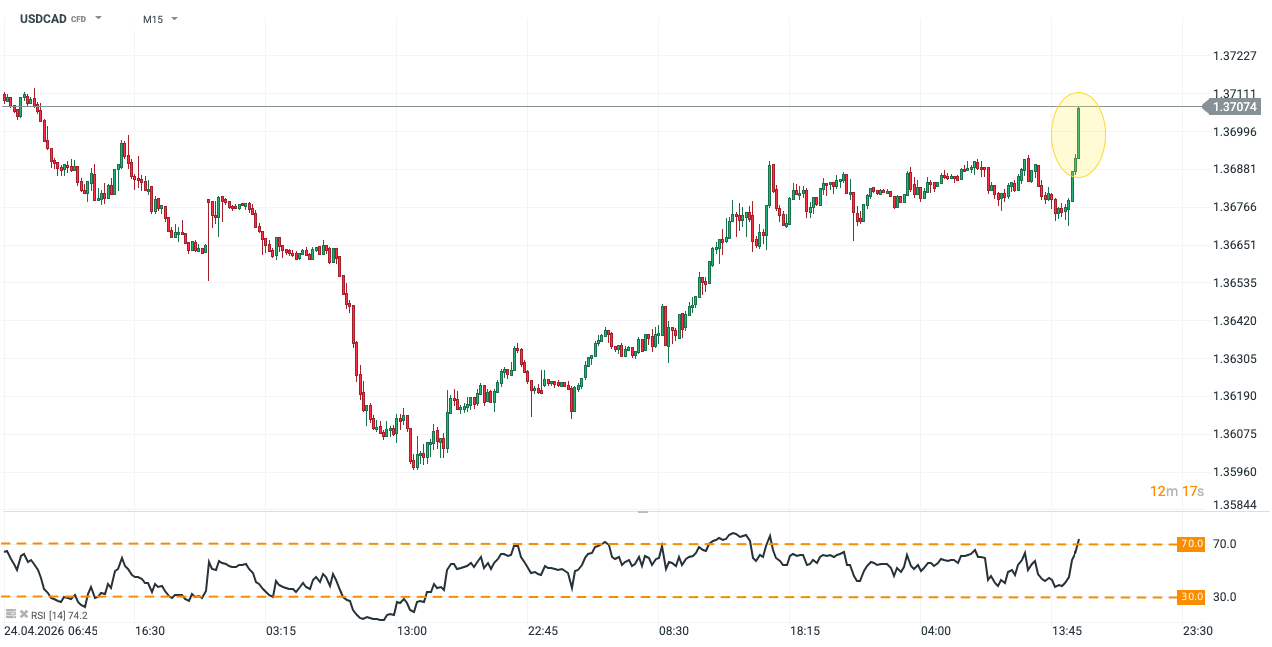
USD/CADย remains subdued for the second successive trading day, hovering around 1.3910 during the Asian hours on Wednesday. The pair depreciates as the commodity-linked Canadian Dollar (CAD) receives support from higher oil prices, given Canadaโ€™s status as the largest crude exporter to the United States (US).

West Texas Intermediate (WTI) oil price rebounds after registering over 4% losses in the previous day, trading around $98.60 per barrel at the time of writing. Oil prices rebound as the Emirati officials are lobbying for a United Nations Security Council (UNSC) resolution to authorize a multinational military mission to restore navigation in the strait, elevating risks of broader regional escalation.

The UAE is also urging the United States (US) and allied nations across Europe and Asia to form a coalition to clear mines, escort commercial vessels, and, if required, secure strategic positions along the waterway.

The USD/CAD pair also weakens as the US Dollar (USD) softens, weighed down by improving risk appetite amid rising hopes for Middle East peace. US President Donald Trump stated on Tuesday that the United States (US) would be โ€œleaving very soonโ€ from the Iran war, noting that a withdrawal could take place within two to three weeks.

Trump further emphasized that a formal agreement with Tehran is not a necessary condition for ending hostilities. On the Iranian side, President Masoud Pezeshkian expressed a willingness to de-escalate regional tensions if specific guarantees are met.

Currency Hedger No Comments

USD/CAD rises to fresh three-month highs despite softer US Dollar

  • USD/CAD rises to fresh three-month highs despite a softer US Dollar.
  • Canada’s GDP signals a soft start to the year, with a modest rebound expected in February.
  • US Dollar eases from multi-month highs as traders reassess risk sentiment.

USD/CAD edges higher on Tuesday, with the Canadian Dollar (CAD) extending its decline against the US Dollar (USD) for a seventh consecutive day, even as the Greenback eases. At the time of writing, the pair is trading around 1.3960, hovering near its highest level since December 2025.

The US Dollar Index (DXY), which tracks the Greenback’s value against a basket of six major currencies, is trading near 100.17, pulling back after touching fresh ten-month highs of 100.64 earlier in the day.

The pullback in the US Dollar appears largely technical, while some easing in geopolitical risk sentiment is also weighing on demand after The Wall Street Journal reported that Donald Trump is willing to end the US military campaign against Iran even if the Strait of Hormuz remains largely closed.

However, geopolitical risks remain elevated. Iranโ€™s Islamic Revolutionary Guard Corps (IRGC) warned that it could target US companies in the region starting April 1 in retaliation for recent attacks.

The Loonie has remained under sustained pressure since the US-Israel war with Iran erupted, pushing energy prices sharply higher. While Canada is a net Oil exporter, persistent downside pressure on the CAD reflects growing concerns that elevated energy costs could weigh on domestic demand and slow broader economic growth.

Adding to the cautious tone, Canadaโ€™s January Gross Domestic Product (GDP) rose by 0.1% MoM, slightly above expectations for a flat reading, though it marked a slowdown from the previous 0.2% expansion, pointing to soft underlying economic momentum at the start of the year.

However, preliminary estimates suggest that real GDP rose by 0.2% in February, indicating a modest pickup in activity and keeping growth broadly in line with the Bank of Canadaโ€™s 1.8% projection outlined in its January Monetary Policy Report.

Meanwhile, traders are increasingly pricing in at least two Bank of Canada (BoC) rate hikes by year-end amid oil-driven inflation pressures. However, persistent labour market headwinds and contained underlying inflation suggest the Bank could remain patient, with rate hikes likely only if Oil prices stay elevated for longer.

In the United States, economic data released on Tuesday showed that JOLTS Job Openings fell to 6.882 million in February from 7.24 million in January, slightly below expectations of 6.92 million.

US Conference Board Consumer Confidence rose to 91.8 in March, beating forecasts of 87.9 and improving from 91 in February.

Currency Hedger No Comments

Currency Talk – EUR/NZD, EUR/CAD, AUD/USD

The Overbalance analysis aims to identify three financial instruments, analyzed primarily on the daily/four-hour (D1/H4) timeframe. The analysis uses only the Overbalance methodology, which helps determine where a trend may continue or where it may reverse.
Todayโ€™s analysis covers three instruments, evaluated solely in terms of 1:1 correction structures.

EURNZD
Last week, the EURNZD broke through key resistance at 1.9855, which corresponded to the upper boundary of the 1:1 geometric pattern. According to the Overbalance methodology, this breakout suggests potential for a move toward last Novemberโ€™s highs, around 2.0680. An additional argument in favor of the bullish scenario is the earlier double bounce off support at 1.9540. In the event of a correction, the 1.9855 level should act as short-term support.

EURNZD – H4 timeframe. Source: xStation

EURCAD
The EURCAD pair is attempting to resume its upward trend. The price has broken above the upper boundary of the 1:1 bearish pattern at the 1.5945 level and has also broken above the polarity of the previous bullish pattern, which falls exactly at the same point. According to the Overbalance methodology, as long as the price remains above the 1.5945 level, the bullish scenario remains in effect.

EURCAD – H4 timeframe. Source: xStation

AUDUSD
The AUDUSD price has broken below the key support level at 0.6905, which corresponded to the lower boundary of a broad 1:1 pattern. A break below this level could support a scenario involving a deeper correction or even a trend reversal. Currently, the 0.6905 level acts as key resistance. To signal a return to an uptrend, the price would need to additionally break above the 0.6984 level, where the upper boundary of the local 1:1 downtrend pattern is located.

AUDUSD – H4 chart. Source: xStation

The material on this page does not constitute financial advice and does not take into account your level of understanding, investment objectives, financial situation or any other specific needs. All information provided, including opinions, market research, mathematical results and technical analyzes published on the Website or transmitted To you by other means, it is provided for information purposes only and should in no way be construed as an offer or solicitation for a transaction in any financial instrument, nor should the information provided be construed as advice of a legal or financial nature on which any investment decisions you make should be based exclusively To your level of understanding, investment objectives, financial situation, or other specific needs, any decision to act on the information published on the Website or sent to you by other means is entirely at your own risk if you In doubt or unsure about your understanding of a particular product, instrument, service or transaction, you should seek professional or legal advice before trading. Investing in CFDs carries a high level of risk, as they are leveraged products and have small movements Often the market can result in much larger movements in the value of your investment, and this can work against you or in your favor. Please ensure you fully understand the risks involved, taking into account investments objectives and level of experience, before trading and, if necessary, seek independent advice.

Currency Hedger No Comments

Canadian Dollar gains as US Dollar weakens on easing risk aversion

  • USD/CAD depreciates as market sentiment improves on the US pausing attacks on Iranโ€™s energy sector.
  • The US Dollar may rebound as inflation fears curb Fed cut bets, boosting hike expectations.
  • The commodity-linked CAD may face challenges amid softer oil prices.

USD/CAD halts its four-day winning streak, trading around 1.3850 during the Asian hours on Friday. The pair weakens as the US Dollar (USD) softens on decreasingย risk aversionย after recent remarks from US President Donald Trump.

Trump said Washington would pause attacks on Iranโ€™s energy sector for 10 days at Tehranโ€™s request, extending the April 6 deadline to allow more time for negotiations. However, the Wall Street Journal reported that mediators said Iran denied making such a request, underscoring fragile diplomacy and low odds of a near-term ceasefire.

The Greenback may regain its ground on rising inflation concerns, prompting traders to scale back expectations of furtherย Federal Reserveย (Fed) rate cuts and increase bets on a potential hike by year-end.

Federal Reserve (Fed) Vice Chair of Supervision Philip Jefferson said higher energy prices should have a modest impact on inflation, though a sustained shock could be more significant. Meanwhile, Fed Governor Michael Barr warned that another price shock could lift inflation expectations, reinforcing the case for the Fed to assess economic conditions before adjusting policy.

The downside inย USD/CADย may be limited as the commodity-linked Canadian Dollar (CAD) could struggle amid softer oil prices. Traders remain cautious as the Pentagon considers deploying up to 10,000 additional ground troops to the Middle East to maintain strategic flexibility and deterrence if talks fail.

Currency Hedger No Comments

USD/CAD extends rally to near 1.3830 amid uncertainty over Middle East conflicts

  • USD/CAD rallies further to near 1.3830 as investors remain on edge amid Middle East conflicts.
  • The Fed is unlikely to deliver any dovish monetary policy adjustment this year.
  • Higher oil prices are expected to keep the Canadian Dollar broadly on the front foot.

Theย USD/CADย pair extends its winning streak for the fourth trading day on Thursday and jumps to near 1.3830 during the Asian trading session, the highest level seen in two months.

The Loonie pair trades firmly as the US Dollar (USD) rises amid uncertainty surrounding the war in the Middle East, which involves the United States (US), Israel, and Iran. As of writing, the US Dollar Index (DXY), which tracks the Greenbackโ€™s value against six major currencies, holds onto Wednesdayโ€™s gains around 99.65.

The safe-haven demand of the US Dollar remains firm as Iran continues to push back hopes of de-escalation in Middle East conflicts, stating that it is not directly involved in negotiations with the US.

Regarding the month-long ceasefire proposal and 15-point settlement plan, Iran said that the Pakistan-delivered proposal was excessive and demanded sovereignty over the Strait of Hormuz. A senior Iranian official said talks could be held in Pakistan or Turkey if they proceed, Reuters reports.

On the domestic front, traders remain confident that theย Federal Reserveย (Fed) will not cut interestย ratesย this year, as surging energy prices have de-anchored inflation expectations.

Meanwhile, the Canadian Dollar (CAD) underperforms its major currency peers, except antipodeans, as investors remain on edge amid the Middle East war. However, the broaderย outlookย of the Loonie remains firm amid higher oil prices.

Given that Canada is a net oil exporter, higher oil prices due to an energy supply shock is a favorable situation for the Canadian Dollar.