EUR/JPY Remains above 183.50 to test nine-day EMA barrier

April 1, 2026
  • EUR/JPY tests the immediate resistance at the nine-day EMA of 183.70.
  • The Relative Strength Index hovers near the 50 mid-line, indicating balanced momentum.
  • The initial support appears at the 50-day EMA at 183.36.

EUR/JPY extends its gains for the second consecutive day, trading around 183.60 during the Asian hours on Wednesday. The technical analysis of the daily chart suggests the currency cross moves sideways within the ascending triangle pattern, reflecting buying pressure.

The near-term bias is mildly bullish as the EUR/PY cross holds above the 50-day Exponential Moving Average (EMA), continuing to offer a rising trend base. The nine-day EMA remains above the 50-day EMA, keeping a short-term positive alignment despite the recent consolidation under the 184.00 area.

Momentum is balanced, with the Relative Strength Index (RSI) hovering close to the 50 mid-line after recovering from last week’s dip, which points to stabilizing demand rather than aggressive buying pressure.

The EUR/JPY cross is testing the immediate barrier at the nine-day EMA of 183.70, followed by the upper ascending triangle boundary around 184.60. Further advances above the triangle would reinforce the bullish bias and lead the currency cross to explore the region around the all-time high of 186.88, reached on January 23.

On the downside, the primary support lies at the 50-day EMA at 183.36, followed by the lower boundary of the ascending triangle around 182.70. A break below the channel would expose the three-month low of 180.81, recorded on February 12.

EUR/JPY: Daily Chart

(The technical analysis of this story was written with the help of an AI tool.)

Euro Price Today

The table below shows the percentage change of Euro (EUR) against listed major currencies today. Euro was the strongest against the New Zealand Dollar.

USDEURGBPJPYCADAUDNZDCHF
USD-0.09%-0.09%0.10%-0.03%-0.05%0.17%-0.21%
EUR0.09%-0.01%0.18%0.06%0.05%0.28%-0.11%
GBP0.09%0.00%0.19%0.06%0.06%0.29%-0.09%
JPY-0.10%-0.18%-0.19%-0.11%-0.10%0.09%-0.25%
CAD0.03%-0.06%-0.06%0.11%0.00%0.20%-0.18%
AUD0.05%-0.05%-0.06%0.10%-0.01%0.22%-0.15%
NZD-0.17%-0.28%-0.29%-0.09%-0.20%-0.22%-0.37%
CHF0.21%0.11%0.09%0.25%0.18%0.15%0.37%

The heat map shows percentage changes of major currencies against each other. The base currency is picked from the left column, while the quote currency is picked from the top row. For example, if you pick the Euro from the left column and move along the horizontal line to the US Dollar, the percentage change displayed in the box will represent EUR (base)/USD (quote).


EUR/USD Trades above mid-1.1500s as bulls await move beyond 61.8% Fibo.

April 1, 2026
  • EUR/USD struggles to capitalize on modest Asian session move up to a one-week high.
  • Inflation fears keep Fed rate hike bets in play, supporting the USD and capping the pair.
  • The mixed technical setup also warrants caution before positioning for additional gains.

The EUR/USD pair touches a one-week top on Wednesday, though it lacks follow-through buying and remains below the 1.1600 mark through the Asian session. Moreover, the mixed fundamental backdrop warrants some caution before positioning for any further appreciating move.

Despite the optimism over hopes for an early US exit from the Iran war, reports that the UAE is pushing for military action to reopen the Strait of Hormuz keep geopolitical risks in play. This continues to fuel inflationary concerns and hawkish US Federal Reserve (Fed) expectations, which act as a tailwind for the US Dollar (USD) and cap the upside for the EUR/USD pair.

From a technical perspective, the overnight breakout through the 200-hour Exponential Moving Average (EMA) was seen as a key trigger for bullish traders. Moreover, the Moving Average Convergence Divergence (MACD) indicator eases toward the signal line while remaining marginally positive, suggesting fading but still positive momentum after the advance.

Meanwhile, the Relative Strength Index (RSI) near 66 retreats from overbought readings above 70, indicating cooling upside pressure rather than a clear reversal at this stage. Hence, it will be prudent to wait for a move beyond the 61.8% Fibonacci retracement level of the recent fall witnessed over the past week or so before placing fresh bullish bets around the EUR/USD pair.

A sustained break higher would open the way toward the 1.1599 barrier and then the recent swing high around 1.1641. On the downside, immediate support emerges at the 38.2% Fibo. at 1.1520, reinforced by the nearby 200-hour EMA to form a key demand zone. A deeper setback would expose the 23.6% Fibo. level at 1.1492, where buyers would be expected to defend the broader upswing.

(The technical analysis of this story was written with the help of an AI tool.)

EUR/USD 1-hour chart

Chart Analysis EUR/USD

EUR/GBP fluctuates as energy-led Eurozone inflation contrasts with fragile UK growth

March 31, 2026
  • EUR/GBP trades choppy as traders assess Eurozone inflation and UK growth data.
  • Rising energy costs push Eurozone inflation above target, adding pressure on the ECB.
  • UK growth stays weak, limiting the scope for aggressive BoE tightening.

EUR/GBP trades in a choppy range on Tuesday, as traders digest the latest economic data from both the United Kingdom and the Eurozone. At the time of writing, the cross is trading around 0.8691, rebounding after marking an intraday low of 0.8676.

The latest Eurozone preliminary inflation data, the first since the escalation of tensions in the Middle East, showed early signs of the impact from rising energy prices, pushing inflation above the ECB’s 2% target.

Headline inflation showed a notable pickup, with the Harmonized Index of Consumer Prices (HICP) rising by 1.2% MoM in March, accelerating from 0.6% in February. On an annual basis, inflation rose to 2.5% from 1.9%, coming in below expectations of 2.7%.

Core inflation, however, remained more contained. The Core HICP rose 0.8% MoM, unchanged from the previous month, while the annual rate eased slightly to 2.3%, coming in below both the 2.4% forecast and the prior reading.

The data strengthen the case that the European Central Bank (ECB) could consider raising rates in the coming months if Oil prices remain elevated. However, markets are scaling back expectations of any immediate rate hike that had been priced in earlier, as rising energy costs are also fueling concerns about an economic slowdown, particularly in the Eurozone given its heavy reliance on imported energy.

EU Energy Commissioner Dan Jørgensen warned that member states should prepare for a prolonged disruption to energy markets due to the Iran war, according to a letter sent to EU energy ministers.

ECB policymaker Madis Müller said on Tuesday that “the ECB must act if energy prices stay high for a long period,” adding that a rate hike in April “cannot be ruled out.”

In the United Kingdom, growth remained modest. GDP rose 0.1% QoQ in Q4, in line with expectations and unchanged from the preliminary estimate. On a yearly basis, the economy grew 1%, also matching forecasts.

Meanwhile, traders expect the Bank of England (BoE) to consider rate hikes to deal with oil-driven inflation. However, weak growth in the UK, reflected in the latest Q4 GDP data, points to a stagflationary environment, complicating the central bank’s policy outlook.

Euro Drops Over 2% in March as Middle East Tensions Weigh

March 31, 2026

The euro closed March below $1.15, nearing its lowest point in nearly two weeks, after a volatile month marked by escalating tensions in the Middle East. The common currency lost over 2% against the dollar as traders assessed the economic impact of the deepening conflict. Adding to the uncertainty, a Wall Street Journal report revealed that US President Donald Trump had signaled a potential end to the US military campaign against Iran, even if the critical Strait of Hormuz remained largely blocked. Soaring oil prices fueled inflation across Europe, prompting markets to drastically revise their expectations for the European Central Bank’s policy.

Investors now anticipate at least two interest rate hikes in 2026, abandoning earlier forecasts of a 40% chance of a rate cut. While French central bank chief François Villeroy de Galhau reaffirmed the ECB’s commitment to curbing energy-driven inflation, he cautioned that it was “too early” to specify the timing of any rate adjustments.

EUR/USD snaps five-day losing streak as Trump mulls ending Iran war

March 31, 2026

EUR/USD finds support near 1.1450 after snapping a five-day losing streak.

US President Trump is willing to end the war with Iran, WSJ reported.

Investors await flash Eurozone HICP data for March.

The EUR/USD pair attracts bids after a five-day losing streak and edges higher to near 1.1475 during the Asian trading session on Tuesday. The major currency pair ticks up as the US Dollar (USD) edges down amid hopes of an end to the month-long war in the Middle East.

As of writing, the US Dollar Index (DXY), which tracks the Greenback’s value against six major currencies, trades slightly lower to near 100.40.

The expectations of peace in the Middle East war, which involves the United States (US), Israel, and Iran, have accelerated as President Trump has stated that he is willing to end the war, the Wall Street Journal (WSJ) reported. The report also shows that Trump is ready for peace despite the Strait of Hormuz remaining largely closed, as he doesn’t intend a forceful reopening to avoid stretching the military mission beyond his timeline of four to six weeks.

The continuous closure of the Hormuz, through which almost 20% of global energy is supplied, would limit the upside in the oil price, a scenario that will keep global inflation projections elevated. This could be the reason behind a slight downtick in the US Dollar, which should have faced intense selling pressure on peace hopes, as it rallied in the past few weeks due to hopes that de-anchored inflation expectations would discourage the Federal Reserve (Fed) from loosening the monetary policy in the near term.

Meanwhile, higher oil prices are expected to remain a key drag on the Euro (EUR), given that the Eurozone is an energy importer.

On the macro front, investors await the flash Eurozone Harmonized Index of Consumer Prices (HICP) data for March, which will be published at 09:00 GMT. The headline HICP is expected to have grown at a robust pace of 2.7% Year-on-Year (YoY) against the previous reading of 1.9%.

Currency Talk – EUR/NZD, EUR/CAD, AUD/USD

March 30, 2026

The Overbalance analysis aims to identify three financial instruments, analyzed primarily on the daily/four-hour (D1/H4) timeframe. The analysis uses only the Overbalance methodology, which helps determine where a trend may continue or where it may reverse.
Today’s analysis covers three instruments, evaluated solely in terms of 1:1 correction structures.

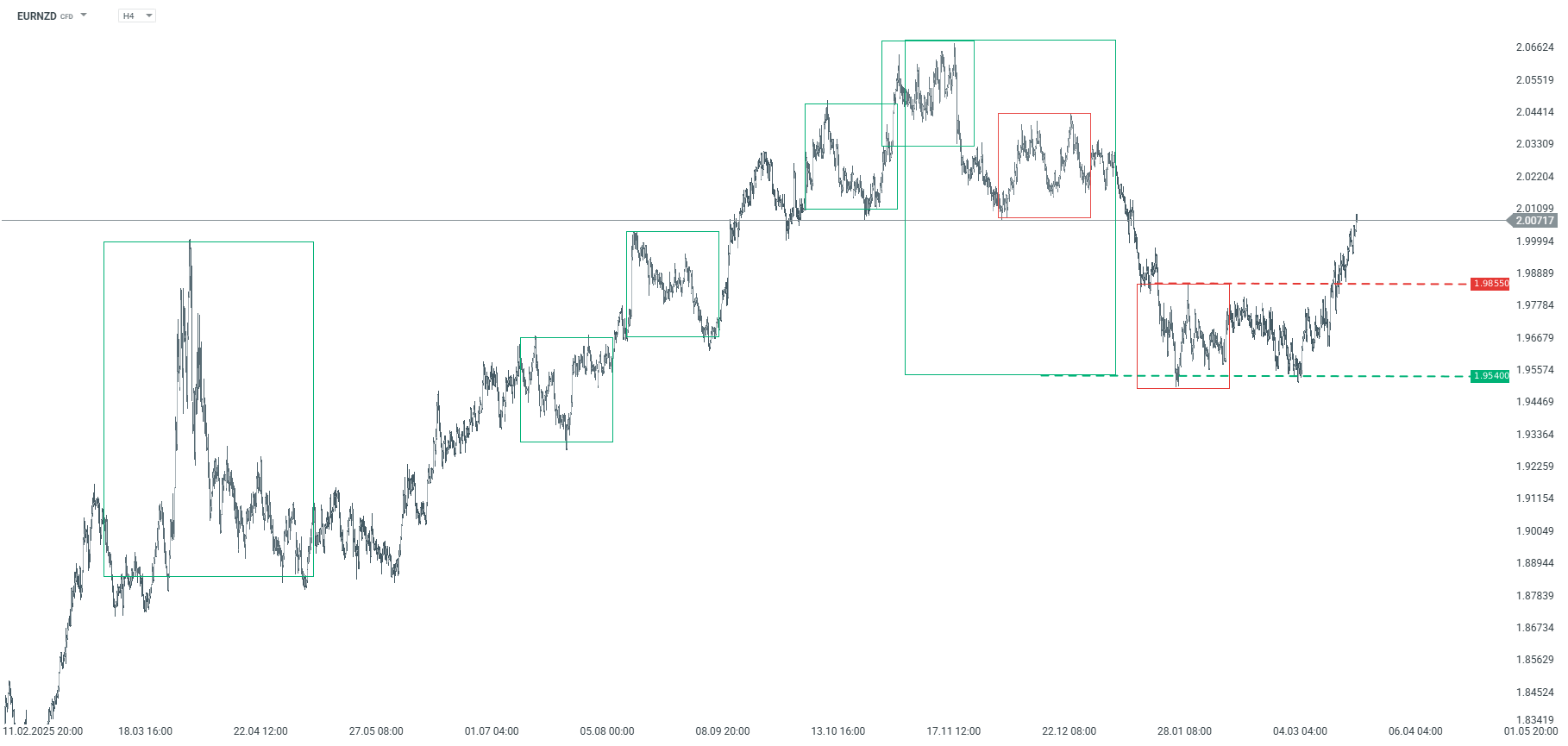
EURNZD
Last week, the EURNZD broke through key resistance at 1.9855, which corresponded to the upper boundary of the 1:1 geometric pattern. According to the Overbalance methodology, this breakout suggests potential for a move toward last November’s highs, around 2.0680. An additional argument in favor of the bullish scenario is the earlier double bounce off support at 1.9540. In the event of a correction, the 1.9855 level should act as short-term support.

EURNZD – H4 timeframe. Source: xStation

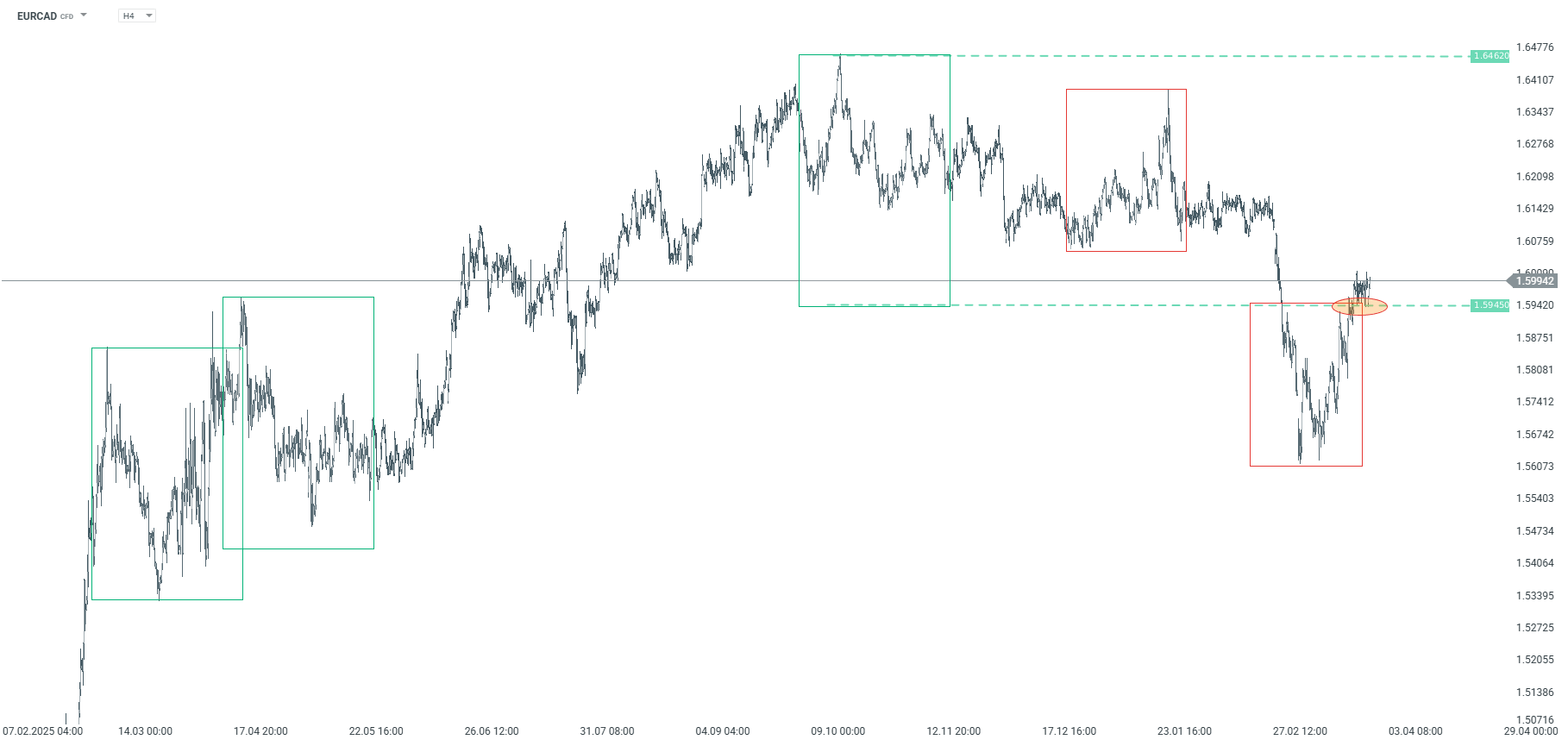
EURCAD
The EURCAD pair is attempting to resume its upward trend. The price has broken above the upper boundary of the 1:1 bearish pattern at the 1.5945 level and has also broken above the polarity of the previous bullish pattern, which falls exactly at the same point. According to the Overbalance methodology, as long as the price remains above the 1.5945 level, the bullish scenario remains in effect.

EURCAD – H4 timeframe. Source: xStation

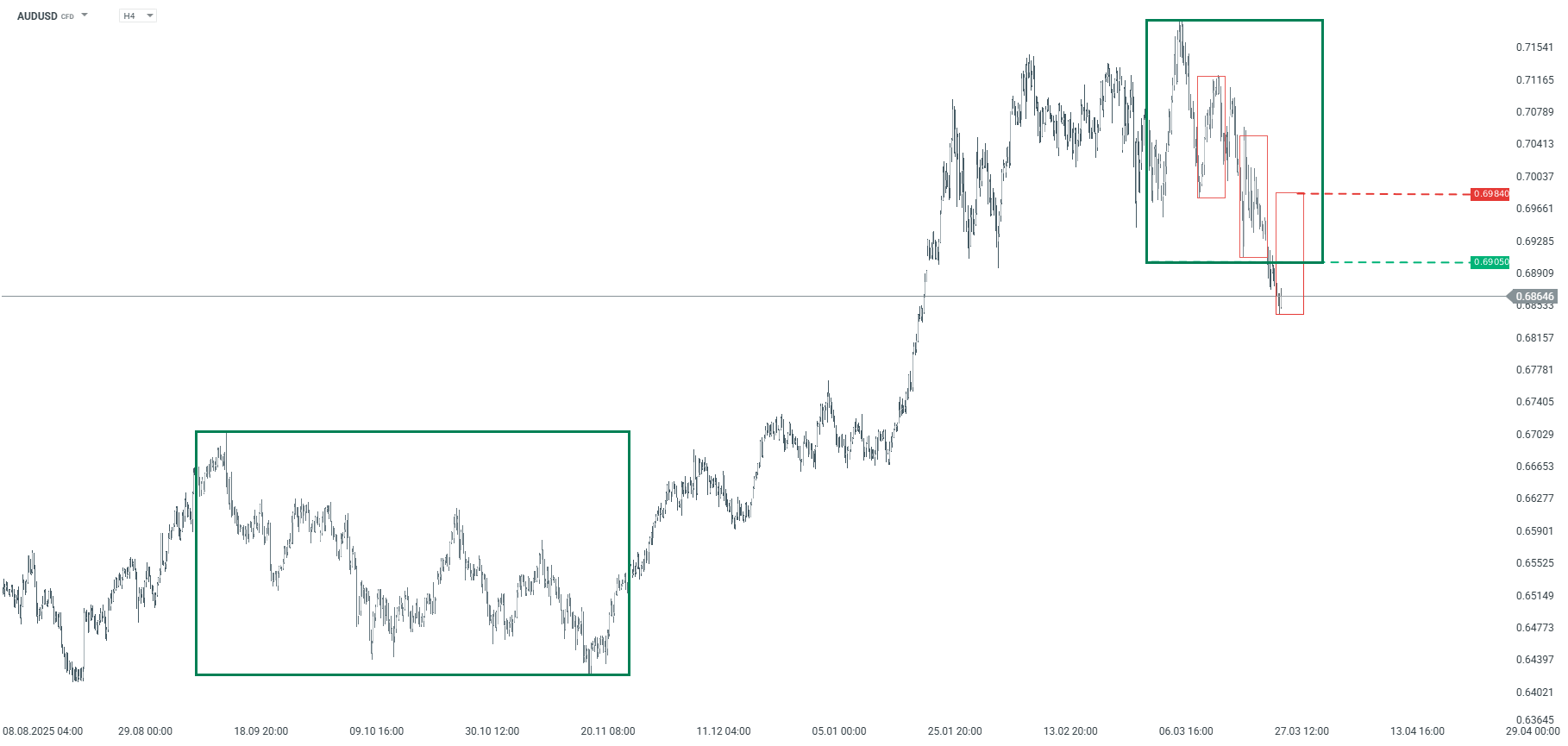
AUDUSD
The AUDUSD price has broken below the key support level at 0.6905, which corresponded to the lower boundary of a broad 1:1 pattern. A break below this level could support a scenario involving a deeper correction or even a trend reversal. Currently, the 0.6905 level acts as key resistance. To signal a return to an uptrend, the price would need to additionally break above the 0.6984 level, where the upper boundary of the local 1:1 downtrend pattern is located.

AUDUSD – H4 chart. Source: xStation

The material on this page does not constitute financial advice and does not take into account your level of understanding, investment objectives, financial situation or any other specific needs. All information provided, including opinions, market research, mathematical results and technical analyzes published on the Website or transmitted To you by other means, it is provided for information purposes only and should in no way be construed as an offer or solicitation for a transaction in any financial instrument, nor should the information provided be construed as advice of a legal or financial nature on which any investment decisions you make should be based exclusively To your level of understanding, investment objectives, financial situation, or other specific needs, any decision to act on the information published on the Website or sent to you by other means is entirely at your own risk if you In doubt or unsure about your understanding of a particular product, instrument, service or transaction, you should seek professional or legal advice before trading. Investing in CFDs carries a high level of risk, as they are leveraged products and have small movements Often the market can result in much larger movements in the value of your investment, and this can work against you or in your favor. Please ensure you fully understand the risks involved, taking into account investments objectives and level of experience, before trading and, if necessary, seek independent advice.

Euro Heads for Over 2% Monthly Loss as Middle East Risks Weigh

March 30, 2026

The euro held steady at $1.15 by the end of March, poised for a monthly decline of over 2% against the US dollar. Traders offloaded riskier assets as concerns mounted over the economic fallout from the escalating Middle East conflict, with reports suggesting thousands of US troops were preparing for a potential ground operation, despite Washington’s insistence that diplomatic talks with Iran were progressing. Investors also turned their attention to a wave of key economic data due this week, including March inflation flash estimates from Europe’s major economies. Market sentiment has shifted sharply on ECB policy, with traders now pricing in at least two interest rate hikes this year and a growing possibility of a third, abandoning earlier expectations of a 40% chance of a rate cut in 2026.

EUR/USD edges higher as Dollar takes breather after weekly surge

March 27, 2026
  • EUR/USD rebounds as the US Dollar eases from intraday highs.
  • Weak US consumer sentiment contrasts with rising inflation expectations.
  • Markets reassess interest rate outlook amid elevated Oil prices and geopolitical risks.

EUR/USD edges higher on Friday after early weakness, as the US Dollar (USD) pulls back from intraday highs, offering some support to the Euro (EUR). At the time of writing, the pair trades around 1.1545, recovering from a daily low at 1.1501.

The pullback in the US Dollar appears largely technical, as buyers take a breather following a strong rally earlier this week that pushed the US Dollar Index (DXY) above the key 100.00 psychological level.

The index, which tracks the Greenback against a basket of six major currencies, is currently hovering near 99.85, reflecting a modest pause in upside momentum. However, it remains on track for weekly gains, staying broadly supported amid ongoing Middle East tensions.

On the data front, the University of Michigan figures came in weaker than expected. The Consumer Sentiment Index fell to 53.3 in March, down from the preliminary estimate of 55.5. The Consumer Expectations Index also declined to 51.7 from 54.1.

At the same time, inflation expectations moved higher. The 1-year outlook rose to 3.8% from 3.4%, while the 5-year expectation stayed at 3.2%.

Richmond Fed President Thomas Barkin said higher gasoline prices are weighing on consumer sentiment and could crowd out other spending. He added that even before the recent oil shock, progress on inflation was at risk of stalling. Barkin also noted that while the unemployment rate remains low, the labor market still feels fragile, highlighting risks to both sides of the Fed’s dual mandate.

On the geopolitical front, the lack of fresh headlines has kept trading conditions relatively calmer on Friday compared to earlier this week, when conflicting signals around potential US-Iran negotiations drove volatility. US President Donald Trump announced a delay in planned military strikes targeting Iran’s energy infrastructure. The deadline, initially set to expire on Friday, has now been extended by 10 days. 

However, with no clear signs of a resolution yet and the Strait of Hormuz largely closed, Oil prices remain elevated, continuing to fuel inflation concerns. This is prompting markets to reprice the interest rate outlook, with traders now pricing in 2-3 European Central Bank (ECB) hikes by year-end, while expectations for Federal Reserve (Fed) rate cuts are being trimmed, with some even seeing the possibility of a hike later this year.