

Currency Hedger No Comments

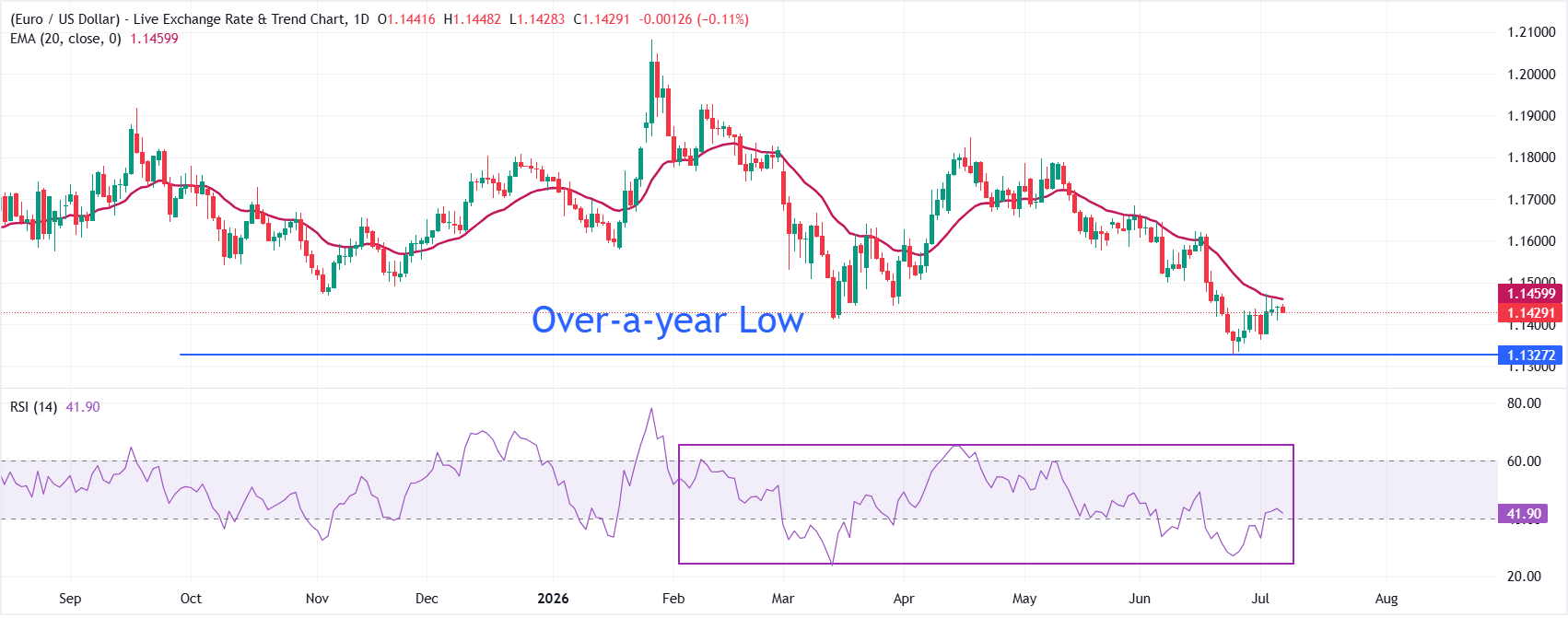
EUR/USD Price Forecast: Loses traction to near 1.1450 as bearish trend tests lower Bollinger support

  • EUR/USD declines to near 1.1465 in Mondayโ€™s early European session.ย 
  • The pair keeps the bearish vibe, downside pressure prevails with RSI holding below the midline.ย 
  • The first downside target to watch is 1.1450; the immediate resistance level emerges at 1.1570.ย 

The EUR/USD pair loses ground to around 1.1465 during the early European session on Monday. The uncertainty surrounding the US-Iran peace deal, following threats from President Donald Trump to restart the war in the Middle East, weighs on the riskier assets such asย the Euroย (EUR) against the US Dollar (USD). ย 

On Monday, Qatar and Pakistan issued a joint statement on the conclusion of negotiations between the US and Iran in Bรผrgenstock, Switzerland, saying that talks were conducted in a positive, constructive atmosphere. Meanwhile, Pakistani and Qatari mediation yields significant progress to end the Lebanon conflict, adding that oil and petrochemical exports are exempt, the blockade is removed, some frozen assets are freed, and a major reconstruction and development plan is initiated for Iran. 

On the other hand, hawkish remarks from European Central Bank (ECB) officials might help limit the USDโ€™s losses. On Friday,ย ECBย policymaker and the head of Belgium’s central bank, Pierre Wunsch, said that the central bank may raise interestย ratesย one more time as soon as next month if it sees more evidence ofย Eurozoneย inflation spreading beyond energy.ย 

The ECBโ€™s deposit rate currently stands at 2.25%, and financial markets expect additional 25 basis point hikes in September or October, possibly followed by one more in the early months of next year.

Chart Analysis EUR/USD

Technical Analysis:

In the daily chart, EUR/USD keeps a clear bearish bias as spot holds well below the 100-day simple moving average (SMA) and the Bollinger middle band. Price is nearing the lower Bollinger band support while the Relative Strength Index (RSI) at about 34 drifts towards oversold territory, which suggests persistent downside pressure but also warns that selling momentum could start to fatigue near current levels.

On the downside, the immediate cushion emerges at the lower Bollinger band near 1.1450; a sustained break under this level would open the door toward fresh lows in the broader downtrend. On the topside, initial resistance is seen at the Bollinger middle band around 1.1570, followed by the 100-day SMA at 1.1665 and the upper Bollinger band near 1.1695, with the pair needing to reclaim at least the mid-band to ease the prevailing bearish tone.

Currency Hedger No Comments

The Euro Falls on its own rate hike

  • EUR/USD broke to a fresh multi-week low this week before steadying near a tentative floor.
  • The slide came despite the ECB’s first rate hike since 2023, a move forced by the energy shock rather than by strength.
  • With the eurozone economy contracting, the Euro stays chained to broad Dollar direction into next week’s US data.

The Euro did something this week that ought to be impossible: it fell in the same fortnight the European Central Bank (ECB) delivered its first interest rate hike since 2023. EUR/USD slid to a fresh multi-week low near 1.1400 before clawing back to a tentative floor around 1.1450; the lesson is that not every rate hike is a vote of confidence. The ECB tightened because an energy shock forced its hand, not because the eurozone economy is firing. That distinction is why the single currency cannot turn a hawkish central bank into a rally.

A hike that smells like surrender

Look at what the ECB actually did and the bind becomes obvious. It raised the deposit rate for the first time in nearly three years while simultaneously cutting its growth forecasts and lifting its inflation projections, an unambiguous stagflation signal. Euro-area inflation has climbed to its highest in nearly three years on surging energy costs tied to disruptions through the Strait of Hormuz, even as the bloc’s economy contracted in the first quarter. Tightening into that mix is a defensive move; currency markets know the difference between a central bank hiking from strength and one hiking because it has no choice.

Out-hawked across the Atlantic

Even on the narrow question of rate differentials, the Euro is losing. The ECB paired its hike with no-preset-path guidance, which markets read as a one-and-watch rather than the start of a campaign; German Bund yields barely budged. The Federal Reserve (Fed), by contrast, held at 3.75% but revised its dot plot higher, pricing toward a hike of its own from a position of relative economic strength, with the US Dollar Index parked at a 13-month high. When both sides lean hawkish, the currency attached to the stronger economy and the firmer conviction wins; right now that is unambiguously the Greenback.

A bounce on a short leash

The near-term picture is the one part of the Euro story that favours the bulls, and only just. Price has carved out a tentative floor near 1.1450, with the hourly Stochastic Relative Strength Index (Stoch RSI) pushing into overbought after the bounce off the lows, a sign the immediate move is stretched. There is room for a corrective rally toward the 1.1500 area, though it stays on a short leash: the daily chart sits below both the 50-day and 200-day Exponential Moving Average (EMA), clustered near 1.1600, with the broader trend still pointing lower.

A wall of ECB speakers and Tuesday’s still-contractionary flash Purchasing Managers Index (PMI) prints will not change that calculus; whatever bounce the Euro manages is unlikely to survive a hot reading from next Thursday’s US data, when the third estimate of first-quarter Gross Domestic Product (GDP) and the May Personal Consumption Expenditures Price Index (PCE) land together at 12:30 GMT.

Resistance: The 1.1500 area is the first test, then 1.1550; the heavier barrier is the 1.1600 zone, where the 50-day and 200-day EMA converge and any recovery would have to prove itself.

Support: The tentative floor near 1.1450 is the level bulls must defend. Below it sit the 1.1400 handle and this week’s low; a clean break there reopens the downtrend.

Bias: Tactically neutral with scope for a short-term bounce toward 1.1500 while 1.1450 holds, but bearish on any longer horizon. The Euro remains a hostage to the Dollar; a hot US PCE next week is the most likely trigger to drag it back to 1.1400 and beyond. Only a soft US inflation print gives the bounce real legs.


EUR/USD hourly chart

Currency Hedger No Comments

Euro holds losses against British Pound following bright UK Retail Sales data

  • EUR/GBP retreated to the mid-range of the 0.8600s after rejection at one-month highs near 0.8685.
  • UK Retail Sales increased well beyond expectations in May.
  • Public Sector Net Borrowing has also risen against expectations, which might dent the Pound’s recovery.

The Euro (EUR) is pulling back against a stronger British Pound (GBP) on Friday, with the EUR/GBP pair trading at the 0.8665 area following rejection at one-month highs near 0.8685. UK Retail Sales figures released beat expectations in May, but the increase in government borrowing might have offset the positive impact on the GBP.

Retail consumption increased by 1.2% in the UK in May, according to data released by the Office for National Statistics, more than twice the 0.5% expected and following a 1% decline in April. Excluding fuel purchases, sales of all other products also increased by 1.2% after a 0.1% contraction in the previous month.

At the same time, National Statistics also revealed that Public Sector Net Borrowing rose to GBP 23.29 billion in May, from GBP 23.03 billion in April, against expectations of a decline to GBP 18.5 billion. These figures might increase concerns about the UKโ€™s fiscal deficit and dent the Poundโ€™s recovery.

German producer prices slow down in May

In the Eurozone, German Producer Prices Index (PPI) data showed that factory-gate inflation accelerated to 2.2% year-on-year in May, up from 1.7% in April, but below the 2.5% rate expected. The Monthly PPI eased to 0.3% from 1.2% in the previous month.

On Thursday, the Bank of England (BoE) met market expectations and left interest rates on hold at 3.75, with two policymakers calling for a quarter-point rate hike. The central bank also lowered its inflation forecasts for the rest of the year, but warned that the impact of the energy shock on the UK economy remains uncertain.

Also on Thursday, the Labour Mayor of Manchester, Andrew Burnham, won the election in Makerfield, securing the parliamentary seat needed to challenge the Prime Minister, Keir Starmer. The compact on the Pound, however, has been marginal so far.

Currency Hedger No Comments

EUR/USD Price Forecast: Weakens below 1.1450 amid oversold RSI momentum

  • EUR/USD softens to near 1.1425 in Fridayโ€™s early European session.
  • The pair keeps a bearish vibe; downside pressure persists with an oversold RSI.
  • The first upside barrier emerges at 1.1450; the initial support level to watch is 1.1411.

The EUR/USD pair trades in negative territory around 1.1425 during the early European trading hours on Friday. The uncertainty surrounding the US-Iran peace deal provides some support to a safe-haven currency such as the US Dollar (USD) and acts as a headwind for the major pair.

Reuters reported on Friday that the Swiss Foreign Ministry announced that US-Iran talks at Bรผrgenstock will not take place as planned on Friday. US Vice President JD Vance canceled his trip to talks with Iran in Switzerland.

On Thursday, Iran’s Tasnim news agency quoted informed sources as saying that the Iranian delegation’s trip to Switzerland had not been finalized. Meanwhile, Lebanon’s Al Mayadeen TV also quoted sources as saying that, due to the ongoing Israeli attacks in southern Lebanon, the Iranian negotiation team has postponed its trip to Switzerland.

Chart Analysis EUR/USD

Technical Analysis:

In the daily chart, EUR/USD extends a bearish near-term bias as spot holds below the 20-day Bollinger middle band and well under the 100-day simple moving average. The pair is pressing the lower end of the Bollinger envelope, with price lodged beneath the latest lower band, while the Relative Strength Index (RSI) at 30.6 is edging into oversold territory, hinting that downside pressure persists but could be nearing exhaustion.

On the topside, initial resistance is aligned with the lower Bollinger band at 1.1450, followed by the 20-day Bollinger SMA around 1.1577, where a recovery would start to ease immediate selling pressure. Above that, the 100-day SMA at 1.1665 and the upper Bollinger band near 1.1705 form a broader supply zone that is likely to cap rebounds unless buyers can reclaim it decisively. On the downside, the first contention level is seen at the March 13 low of 1.1411. Any follow-through selling below this level could pave the way to the April 23, 2025 low of 1.1308.

Currency Hedger No Comments

EUR/USD Price Forecast: Recovers further from March low, climbs to 1.1525 on weaker USD

  • EUR/USD gains positive traction as the USD drifts lower in reaction to the US-Iran peace deal.
  • The ECBโ€™s rate hike signal supports the Euro, while hawkish Fed bets should limit USD losses.
  • The bearish technical setup warrants caution before positioning for any further appreciation.

The EUR/USD pair attracts some buyers during the Asian session on Thursday and moves away from its lowest level since late March, around the 1.1480-1.1475 region touched the previous day. The intraday move up is sponsored by a broadly weaker US Dollar (USD) and lifts spot prices to a fresh daily high, around the 1.1525 area in the last hour.

The US-Iran deal, aimed at ending hostilities and reopening the Strait of Hormuz, boosts investors’ confidence and prompts some USD profit-taking following Wednesdayโ€™s strong move up to a fresh high since late March. Furthermore, the European Central Bank’s (ECB) hawkish signal lends some support to the shared currency and the EUR/USD pair. However, rising bets for a rate hike by the US Federal Reserve (Fed) in December could limit USD losses and cap the currency pair.

From a technical perspective, spot prices hold well below the 200-period Simple Moving Average (SMA) on the 4-hour chart and keep a bearish near-term tone. Adding to this, the Moving Average Convergence Divergence (MACD) indicator is in negative territory, while the Relative Strength Index (RSI) hovers around 38. Momentum indicators together suggest that downside pressure persists even as the EUR/USD pair attempts to stabilize above the recent swing lows.

Hence, any subsequent move up is more likely to confront a hurdle near the 1.1575-1.1580 horizontal support breakpoint ahead of the 1.1600 round figure. Meanwhile, the 200-period SMA at 1.1638 should act as a strong barrier that bulls would need to reclaim to ease the current bearish bias and open the door to a more sustained recovery.  On the downside, acceptance below the 1.1500 mark would expose the EUR/USD pair to further weakness as momentum remains skewed to the downside.

EUR/USD 4-hour chart

Chart Analysis EUR/USD
Currency Hedger No Comments

Chart of the Day – A New Era at the Fed and the Hawkish Shadow of the ECB. EUR/USD at a Turning Point

EURUSD starts todayโ€™s session in a noticeably tense yet somewhat uneven atmosphere, where the market lacks a single dominant narrative. On one side, investors are already looking ahead to the evening and the Federal Reserveโ€™s decision, which could set the tone for the US dollar over the coming weeks. On the other side, Europe refuses to fade into the background, as fresh inflation data once again highlights that the ECB story and its future policy response to price pressures remain unresolved.

In practice, EURUSD is trading in an environment where no clear narrative has taken control. Market participants are simultaneously trying to price in the Fed, the ECB, and the widening divergence between them, which naturally increases volatility and means that any new impulse can quickly shift the balance of forces. In such a setup, the currency pair becomes particularly sensitive to changes in expectations, especially on a day filled with major macroeconomic events.

Source: xStation5

What is driving EURUSD today? Kevin Warshโ€™s debut and the Fed credibility test

Todayโ€™s Federal Reserve meeting carries special significance as it is the first under the leadership of Kevin Warsh. Markets are almost fully aligned in expecting interest rates to remain unchanged in the 3.50โ€“3.75% range, but the decision itself is not the key focus. Far more important will be the tone of communication and how the new Fed Chair outlines the future path of monetary policy. Warsh takes control at a time when US inflation remains sticky and the economy continues to show relative resilience, limiting room for an early policy easing cycle. This makes todayโ€™s message potentially a directional signal for the entire Fed cycle. Even a subtle shift toward a more hawkish stance could strengthen the US dollar and add downward pressure on EURUSD.

Europe: inflation in line with forecasts, but pressure persists

On the European side, today brought the final release of May HICP inflation. The reading of 3.2% year on year came in exactly in line with consensus expectations, which helps stabilize short-term market positioning. However, it does not change the broader picture, where inflation remains elevated compared to last year. This keeps price pressures firmly on the radar of the European Central Bank. Particular attention continues to be drawn to persistent core inflation and the services component, both of which still show no clear disinflationary trend.

ECB and rising risks of further tightening

The lack of any positive surprise in inflation data leaves the ECB in a challenging position. After its recent rate hike, markets are once again reassessing whether the tightening cycle is truly over. If price pressures in services remain elevated and core inflation fails to meaningfully ease, the European Central Bank may be forced into another move later this year. Such a scenario limits the downside potential for the euro and acts as an important counterbalance to US dollar strength.

Market picture: tension between two central banks

EURUSD remains a market driven by two opposing narratives. On one side, investors are focused on the Fed and its impact on US dollar valuation. On the other, persistent inflation in Europe continues to support cautious expectations regarding the ECB. In this environment, markets become highly sensitive to central bank communication, while the technical structure of price action reinforces the sense of a fragile equilibrium, vulnerable to sharp shifts.

Key takeaways

  • Todayโ€™s EURUSD session is shaped by two opposing forces that broadly offset each other
  • The Fed remains the primary driver for the US dollar and could set the tone for the coming period
  • Europe continues to face persistent inflation with no clear signs of meaningful easing
  • The market remains in a wait-and-see mode with no dominant narrative
  • The key resolution will likely come only after the evening Fed decision and press conference
Currency Hedger No Comments

Eur sticks to positive bias above 1.1600 as bulls await Fed rate decision

  • EUR/USD attracts some buyers for the third straight day as the US-Iran peace deal undermines the USD.
  • The ECBโ€™s hawkish outlook benefits the shared currency and further lends support to the currency pair.
  • Traders, however, seem hesitant and opt to wait for the highly anticipated FOMC interest rate decision.

The EUR/USD pair trades with a positive bias for the third straight day and holds steady above the 1.1600 mark through the Asian session on Wednesday. Bulls, however, seem hesitant and opt to wait for the outcome of a two-day FOMC policy meeting before positioning for an extension of the recent goodish recovery from the 1.1500 psychological mark, or over a two-month low, touched last week.

The latest optimism over an interim peace deal between the US and Iran keep the safe-haven US Dollar (USD) on the defensive, which, in turn, is seen as a key factor acting as a tailwind for the EUR/USD pair. The shared currency, on the other hand, draws support from the European Central Bank’s (ECB) hawkish signal following an interest rate hike for the first time in three years. In fact, the ECB raised its 2026 inflation projections to 3% amid prolonged energy shocks and broadening price pressures across the eurozone.

Furthermore, traders are still pricing in a roughly 40 basis points in additional hikes for 2026 by the ECB despite the de-escalation of tensions in the Middle East. The US and Iran agreed to a framework peace deal intended to end the war that began earlier in 2026. The initial memorandum of understanding (MOU) establishes a 60-day ceasefire, the reopening of the Strait of Hormuz, and sets the stage for technical negotiations over Iran’s nuclear program. However, other details about the agreement remain scarce.

This, along with expectations that the US Federal Reserve (Fed) might still hike interest rates by 25 bps in December, holds back the USD bears from placing aggressive bets and caps the upside for the EUR/USD pair. Hence, market focus will remain glued to the crucial Fed rate decision, the latest economic projections, and the so-called dot plot. Adding to this, the new Fed Chair, Kevin Warsh’s comments during the post-meeting presser will be scrutinized for cues about the future policy path.

Currency Hedger No Comments

EUR/JPY – Could rebound toward 186.50 as bullish bias prevails

  • EUR/JPY cross may rise toward the all-time high of 187.95.
  • The 14-day Relative Strength Index near 60 indicates solid upward momentum.
  • The primary support appears at the nine-day EMA of 185.66.

EUR/JPY depreciates after three days of gains, trading around 186.20 during the Asian hours on Wednesday. The currency cross holds a constructive bullish bias as it remains above both the nine-day and 50-day Exponential Moving Averages (EMAs). This positioning suggests the recent advance is supported by underlying demand.

The 14-day Relative Strength Index (RSI) near 60 hints at firm but not yet overextended upside momentum. Additionally, the technical analysis of the daily chart suggests the EUR/JPY cross is remaining within the ascending channel pattern, suggesting an ongoing bullish bias.

The EUR/JPY cross may explore the region around the all-time high of 187.95, recorded on April 17, followed by the upper boundary of the ascending channel around 188.30.

On the downside, the primary support lies at the nine-day EMA of 185.66, followed by the 50-day EMA of 185.18. A break below these moving averages would cause a bearish shift, exposing the lower boundary of the ascending channel near 184.70. Further declines could push the EUR/JPY cross to test its nearly four-month low of 181.87, recorded on March 16, with further declines targeting the six-month low of 180.81, reached on February 12.

Chart Analysis EUR/JPY
EUR/JPY: Daily Chart

Euro Price Today

The table below shows the percentage change of Euro (EUR) against listed major currencies today. Euro was the weakest against the Swiss Franc.

USDEURGBPJPYCADAUDNZDCHF
USD-0.03%-0.01%-0.08%0.02%0.05%0.01%-0.13%
EUR0.03%0.01%-0.06%0.03%0.08%0.08%-0.10%
GBP0.01%-0.01%-0.06%0.03%0.11%0.05%-0.08%
JPY0.08%0.06%0.06%0.08%0.12%0.05%-0.02%
CAD-0.02%-0.03%-0.03%-0.08%0.04%-0.00%-0.11%
AUD-0.05%-0.08%-0.11%-0.12%-0.04%-0.02%-0.13%
NZD-0.01%-0.08%-0.05%-0.05%0.00%0.02%-0.11%
CHF0.13%0.10%0.08%0.02%0.11%0.13%0.11%

The heat map shows percentage changes of major currencies against each other. The base currency is picked from the left column, while the quote currency is picked from the top row. For example, if you pick the Euro from the left column and move along the horizontal line to the US Dollar, the percentage change displayed in the box will represent EUR (base)/USD (quote).