

Currency Hedger No Comments

EUR/JPY remains subdued below 187.00 as risk-off sentiment weighs on Euro

  • EUR/JPY falls as the Euro weakens amid rising risk aversion over uncertainty surrounding a potential Middle East ceasefire.
  • US officials say President Donald Trump has directed aides to prepare for a prolonged blockade of Iran.
  • JPY remains firm amid BoJ rate-hike expectations and speculation about intervention to limit further currency weakness.

EUR/JPY edges lower after three days of gains, trading around 186.80 during the Asian hours on Wednesday. The currency cross declines asย the Euroย (EUR) struggles amid heightenedย risk aversionย driven by uncertainty over a potential ceasefire in the Middle East.

The Wall Street Journal reported on Wednesday that US officials said President Donald Trump has instructed aides to prepare for a prolonged blockade of Iran. The report noted that Trump chose to keep pressuring Iranโ€™s economy and oil exports by restricting shipping to and from its ports. Sources added that he viewed alternative options, such as resuming bombing or disengaging from the conflict, as riskier than maintaining the blockade.

Traders turn their attention to the European Central Bank (ECB) interest rate decision on Thursday, where markets expect a โ€œhawkish holdโ€ as policymakers weigh potential rate hikes in June or July. Analysts at Goldman Sachs anticipate two 25 basis point hikes in the coming months, starting in June and followed by another in September, which would lift the deposit rate back to 2.50%.

The EUR/JPY cross remains under pressure as the Japanese Yen (JPY) stays firm amid expectations of a near-term rate hike from the Bank of Japan, alongside speculation that authorities may intervene to curb further yen weakness.

However, the JPY has struggled to attract sustained buying interest despite the BoJโ€™s hawkish pause on Tuesday. Notably, three of the nine policy board members backed a rate hike, highlighting growing concern over inflation pressures linked to the Iran conflict.

BoJ Governor Kazuoย Uedaย reaffirmed the central bankโ€™s commitment to gradual policy tightening, signaling that interestย ratesย could continue to rise as economic, price, and financial conditions evolve. Meanwhile, Finance Minister Satsuki Katayama reiterated that authorities stand ready to intervene in currency markets at any time to support the Yen.

Currency Hedger No Comments

Trade of The Day – GBP/JPY – Long GBP/JPY at market price Target: 215.85

Facts:

The pair reached the lower limit of 1:1 structure at 215.14 Main trend on the pair remains upward

Recommendation:

Trade: Long GBPJPY at market price Target: 215.85, 216.30 Stop: 214.90

Opinion:

Looking at GBPJPY chart, one can observe that the price reached the key technical support today. This support is marked with the lower limit of 1:1 structure (green rectangles), as well as 200-period moving average. In addition the bullish candlestick pattern – pin bar appeared on the H1 chart. Should buyers manage to hold the price above the support at 215.14, another upward impulse may be on the cards. We recommend taking a long position on GBPJPY at market price with two targets: 215.85 and 216.30 We recommend placing a stop loss order at 214.90.

Currency Hedger No Comments

Chart of The Day – USD/JPY with mixed reaction to cautious Bank of Japan decision. Is stagflation heading to Japan?

The Bank of Japan kept interest rates unchanged at 0.75%, in line with market expectations, although the reaction of the USDJPY pair to the decision appears rather mixed. Bank of Japan (BoJ) Governor Kazuo Ueda spoke at a press conference, explaining the reasons behind maintaining the key interest rate at 0.75% during the April meeting. Rate hikes will continue in line with developments in the economy and inflation, with particular attention paid to the impact of the situation in the Middle East. The goal remains to achieve a stable 2% inflation rate, although Japanโ€™s economic growth is expected to slow in 2026. Higher oil prices are likely to reduce corporate profits and householdsโ€™ real income, although the economy will be supported by government measures such as fuel subsidies.

Key takeaways from the BoJ conference

The situation in the Middle East remains uncertain. Japanโ€™s economy is recovering moderately, although some signs of weakness are visible. Economic growth is likely to slow in fiscal year 2026 due to developments in the Middle East. Close attention must be paid to how these developments affect financial markets, FX markets, as well as Japanโ€™s economy and prices. There is also a need to carefully monitor the risk of inflation deviating significantly to the upside, which could negatively impact the economy. Real interest rates remain at very low levels. The BoJ will continue to raise rates and adjust the degree of monetary accommodation depending on economic activity, prices, and financial conditions. The timing and pace of adjustments will be assessed in the context of the impact of Middle East developments and the likelihood of achieving the baseline scenario. The decision was made by a 6โ€“3 vote, with Nakagawa, Takata, and Tamura dissenting, as they proposed raising the rate to 1%.

Board membersโ€™ remarks

Tamura suggested including a statement that underlying inflation is in line with the target, while Takata proposed noting that CPI has already reached the target level. Both proposals were ultimately rejected. Additional comments Oil prices may have a stronger impact on inflation than before. The Bank needs more time to assess the effects of the Middle East situation. Underlying inflation is currently slightly below 2%. It is difficult to determine when the next rate hike will occur. Monetary policy will be conducted in a way that avoids falling โ€œbehind the curve.โ€ The decision to hold rates reflects a lower probability of the baseline scenario being realized. The dissent of three board members highlights the difficulty of conducting monetary policy under current conditions. There is no immediate need to raise rates, but they may become necessary if supply shocks generate secondary effects. The risk of rising inflation could be a reason for rate hikes, though not the only one.

BoJ Quarterly Outlook Report

Real interest rates remain very low. Underlying inflation is expected to reach levels consistent with the 2% target in the second half of fiscal 2026 and in 2027. Risks to economic growth are tilted to the downside, while risks to inflation are tilted to the upside. Economic growth is expected to slow in 2026 but should moderately accelerate from 2027 onward. Rising oil prices are expected to affect both CPI and incomes.

BoJ forecasts Core CPI

  • 2026: 2.8% (previously 1.9%)
  • 2027: 2.3% (previously 2.0%)
  • 2028: 2.0%

Real GDP

  • 2026: 0.5% (previously 1.0%)
  • 2027: 0.7% (previously 0.8%)
  • 2028: 0.8%

Key risks highlighted by the BoJ

The BoJ noted that rising oil prices may now pass through more easily into the prices of goods and services than in the past. There is also a risk of stronger increases in food prices, particularly if higher raw material costs feed into production costs. The Bank pointed to the possibility of significant disruptions in global supply chains, which could materially affect the production activity of Japanese firms. The report also addressed artificial intelligence. Strong corporate investment in AI could support the global economy, but if it is not matched by profit growth, it may lead to adjustment pressures in asset markets. The BoJ also emphasized that exchange rate movements now have a greater impact on inflation than in the past, while trade policies implemented so far have partly altered the course of globalization. Medium- to long-term inflation expectations are rising moderately. USDJPY charts (H1, D1)

Source: xStation5

Source: xStation5

Currency Hedger No Comments

USD/INR boards fresh rally as oil prices remain elevated

  • The Indian Rupee falls further against the US Dollar as higher oil prices boost demand for the Greenback by Indian importers.
  • Fresh concerns over India Inc.’s earnings projections have dampened the FIIs interest in the Indian stock market.
  • This week, investors will pay close attention to the Fedโ€™s monetary policy.

The Indian Rupee (INR) weakens further after a brief pause against the US Dollar (USD) in the opening session on Tuesday. The USD/INR pair jumps to near 94.50 as elevated oil prices continue to hurt the Indian Rupee.

As of writing, the WTI Oil price trades 0.6% higher to near $95.60 and is close to its two-week high of $97 posted on Thursday.

Currencies from economies, such as India, which rely heavily on oil imports to meet their energy needs, tend to underperform in a high oil price environment.

Oil prices have remained higher due to uncertainty over the reopening of the Strait of Hormuz, a critical passage to almost 20% of global energy supply.

According to a Reuters report, oil-linked flows and hedging-related US Dollar demand are key headwinds for the Indian Rupee

Hormuz closure keeps oil prices elevated

The uncertainty regarding the reopening of the Hormuz remains escalated, as Washington has not shown any signs of interest in proposals delivered by Iran to end the war. On late Monday, White House press secretary Karoline Leavitt stated that US President Trump discussed Iranโ€™s proposal with the national security team, which calls for the reopening of the Strait of Hormuz and a permanent ceasefire. Leavitt didnโ€™t reveal any information regarding the odds of whether it will be taken forward by Washington.

“I wouldn’t say they’re considering it. I would just say that there was a discussion this morning that I don’t want to get ahead of, and you’ll hear directly from the president, I’m sure, on this topic,” Leavitt said.

On Monday, US President Trump received another proposal from Iran, which he called โ€œbetterโ€ than the one, which it was expected to present in canceled peace talks in Islamabad over the weekend, but “still not good enoughโ€.

FIIs extends selling pressure in Indian stock market

In the last six trading days, Foreign Institutional Investors (FIIs) have remained net sellers and have offloaded their stake worth Rs. 18,291.34 crore after a little buying in the April 15-17 period. FIIs appear to be dumping their stake in the Indian equity market due to elevated oil prices, which have raised concerns over India Inc.’s earnings projections.

Fed seems to maintain status quo

This week, the major trigger for the US Dollar will be the Federal Reserveโ€™s (Fed) monetary policy announcement on Wednesday, in which it is expected to leave interest rates unchanged in the range of 3.50%-3.75% for the third time in a row. Investors will pay close attention to Fed Chair Jerome Powellโ€™s comments regarding the monetary policy outlook in the wake of the energy price shock amid the Hormuz closure.

Technical Analysis: USD/INR approaches all-time high of 95.20

USD/INR trades higher at around 94.50, maintaining a bullish near-term bias, as it holds above the 20-day Exponential Moving Average (EMA) at 93.53. The positioning above this rising EMA suggests the broader uptrend remains intact, while the Relative Strength Index (RSI) around 61 indicates firm but not overstretched upside momentum.

On the downside, the 20-day EMA at 93.53 stands as the first layer of dynamic support, and a daily close below this level would hint at a deeper corrective phase within the broader trend. Looking up, the pair aims to revisit the all-time high around 95.20. The spot would enter uncharted territory if it manages a decisive break above 95.20.

Currency Hedger No Comments

Japanese Yen pares hawkish BoJ-inspired gains; USD/JPY rebounds from sub-159.00 levels

  • USD/JPY drops to a one-week low as the BoJโ€™s hawkish pause provides a goodish lift to the JPY.
  • Economic concerns stemming from the Middle East conflict cap the JPY and limit losses for the pair.
  • The US-Iran peace talks uncertainty benefit the safe-haven USD and further supports spot prices.

The USD/JPY pair attracts some intraday selling after the Bank of Japan (BoJ) announced its policy decision and touches a one-week low earlier this Tuesday. Spot prices, however, manage to recover a major part of the losses and trade around the 159.30 area, down less than 0.10% for the day during the early European session.

As was widely anticipated, the Japanese central bank kept its benchmark interest rate unchanged at 0.75% at the conclusion of a two-day meeting. However, the 6-3 vote split, with threeย BoJย board members calling for a rate hike, along with an upward revision of inflation forecasts, keeps a June or July rate hike firmly on the table. This comes on top of a fresh intervention warning from Japan’s Finance Minister Satsuki Katayama, saying that authorities were ready to take decisive action against speculative activity, lifting the Japanese Yen (JPY) and weighing on the USD/JPY pair.

In the post-meeting press conference, BoJ Governor Kazuoย Uedaย noted that real interestย ratesย are at significantly low levels and acknowledged that the risk of inflation is significantly deviating upwards and exerting a negative impact on the economy. This, in turn, validates the hawkishย outlookย and remains supportive of the bid tone surrounding the JPY. However, economic concerns stemming from continued disruptions to energy supplies through the Strait of Hormuz cap JPY gains. This, along with a goodish pickup in the US Dollar (USD) demand, lends support to the USD/JPY pair.

Hopes for diplomatic efforts to end the Iran war receded after US President Donald Trump canceled his special envoy, Steve Witkoff, and Jared Kushner’s planned visit to Pakistan. Furthermore, Trump reportedly was dissatisfied with Iran’s new proposal on resolving the war, which would set โ€Œaside discussion of Iran’s nuclear program. This, along with a standoff over the Strait of Hormuz, keeps geopolitical risks in play, which, in turn, is seen benefiting the USD’s reserve currency status, which, in turn, assists the USD/JPY pair to rebound around 35-40 pips from sub-159.00 levels.

Currency Hedger No Comments

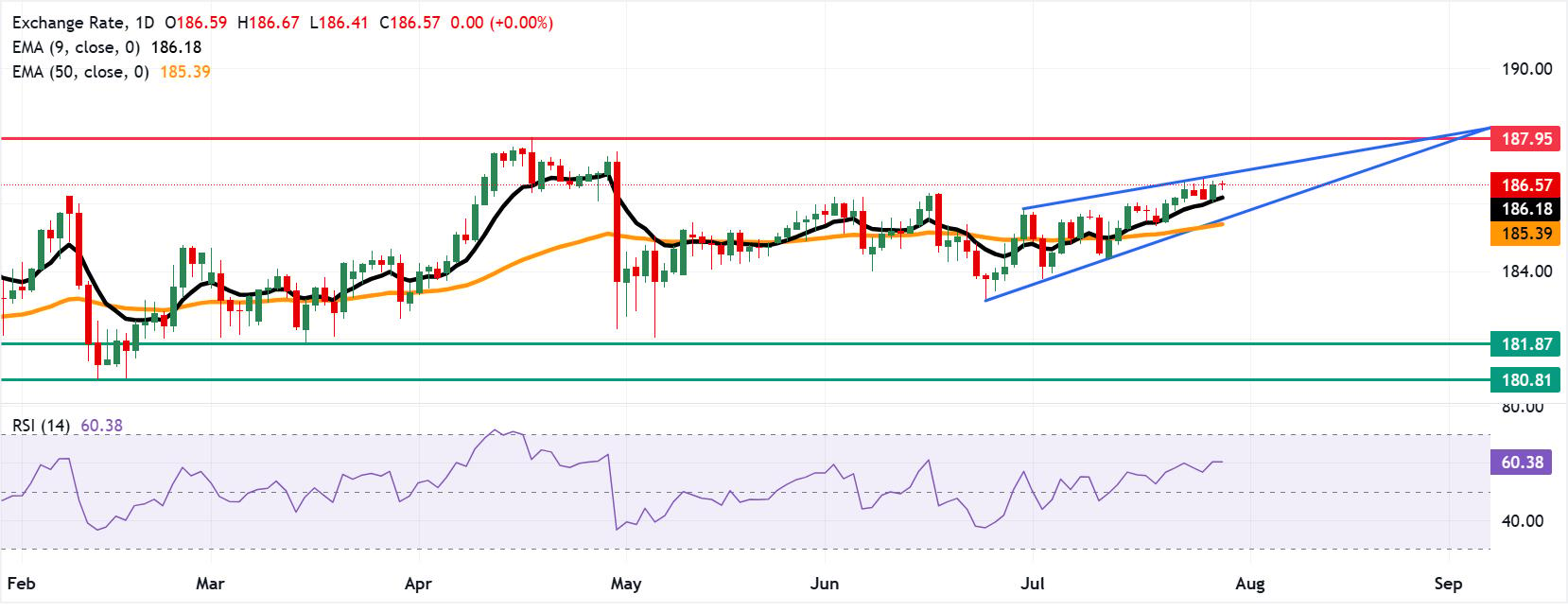
EUR/JPY – Price Moves below 186.50, nine-day confluence

  • EUR/JPY may rebound toward the nine-day EMA at 186.66 near the ascending channelโ€™s lower boundary.
  • The 14-day Relative Strength Index near 53 signals positive, not overstretched momentum.
  • The primary support lies at the 50-day EMA at 185.00.

EUR/JPY depreciates after two days of gains, trading around 186.40 during European hours on Tuesday. The technical analysis of the daily chart indicates the currency cross slips below the ascending channel, signaling a possible bearish reversal.

However, the EUR/JPY cross holds above the 50-day Exponential Moving Average (EMA), keeping the near-term bias mildly bullish even as it consolidates just under the nine-day EMA, which acts as immediate resistance.

The 14-day Relative Strength Index (RSI) hovers near 53, suggesting positive but not overstretched momentum, and hints that dips toward the underlying averages could continue to attract buyers while the broader uptrend structure remains intact.

The rebound toward the nine-day EMA at 186.66 around the lower boundary of the ascending channel would revive the bullish bias and lead the EUR/JPY cross to test the all-time high of 187.95, which was recorded on April 17. Further advances above this level would support the currency cross to explore the region around the upper boundary of the channel, around 189.80.

On the downside, the EUR/JPY cross may fall toward initial support, which lies at the 50-day EMA at 185.00.

EUR/JPY: Daily Chart

Euro Price Today

The table below shows the percentage change of Euro (EUR) against listed major currencies today. Euro was the weakest against the Japanese Yen.

USDEURGBPJPYCADAUDNZDCHF
USD0.19%0.17%0.00%0.05%0.19%0.32%0.40%
EUR-0.19%-0.04%-0.22%-0.17%-0.02%0.07%0.20%
GBP-0.17%0.04%-0.17%-0.12%0.03%0.13%0.23%
JPY0.00%0.22%0.17%0.06%0.20%0.30%0.40%
CAD-0.05%0.17%0.12%-0.06%0.14%0.24%0.35%
AUD-0.19%0.02%-0.03%-0.20%-0.14%0.11%0.24%
NZD-0.32%-0.07%-0.13%-0.30%-0.24%-0.11%0.09%
CHF-0.40%-0.20%-0.23%-0.40%-0.35%-0.24%-0.09%

The heat map shows percentage changes of major currencies against each other. The base currency is picked from the left column, while the quote currency is picked from the top row. For example, if you pick the Euro from the left column and move along the horizontal line to the US Dollar, the percentage change displayed in the box will represent EUR (base)/USD (quote).

Currency Hedger No Comments

GBP/JPY slides to 215.25 after BoJ’s hawkish pause; downside seems limited

  • GBP/JPY retreats further from a multi-year top as the BoJโ€™s hawkish outlook boosts the JPY.
  • A 6-3 vote split and upward revision of inflation forecasts keep BoJ rate hike bets on the table.
  • Bets for two BoE rate hikes by late 2026 should support the GBP and limit losses for spot prices.

The GBP/JPY cross attracts some sellers during the Asian session on Tuesday and, for now, seems to have snapped a two-day winning streak to its highest level since January 2008, just above the 216.00 mark touched the previous day. Spot prices touch a fresh daily low, around the 215.25 region, amid a goodish pickup in demand for the Japanese Yen (JPY) following the Bank of Japan (BoJ) policy decision.

As was widely expected, the Japanese central bank left the short-term interest rate unadjusted at 0.75%. The JPY, however, gains strong positive traction in reaction to a hawkish vote split, with three board members voting for a rate hike. Furthermore, theย BoJย delivered a significantly more hawkish inflationย outlookย amid elevated Crude Oil prices and acknowledged that the Iran war is clouding the economic growth trajectory.

Meanwhile, Japan’s Finance Minister Satsuki Katayama said that Crude Oil volatility is feeding into FX markets and affecting the broader economy. Katayama also warned that authorities were ready to take decisive action against speculative activity, fueling intervention fears and underpinning the JPY. Moreover, a firmer US Dollar (USD) weighs on theย British Poundย (GBP), which contributes to the GBP/JPY pair’s intraday slide.

Any meaningful GBP downfall, however, seems elusive in the wake of rising bets for two Bank of England (BoE) interest rate hikes by late 2026. Furthermore, investors remain worried that Japan’s economy will come under substantial strains as the risk to energy supplies remains due to continued disruptions to shipping through the Strait of Hormuz. This, in turn, could support the GBP/JPY cross and help limit losses.

Currency Hedger No Comments

EUR/JPY slips below 186.50 following BoJ policy decision

  • EUR/JPY holds losses after the Bank of Japan policy decision.
  • The BoJ kept its short-term rate at 0.75% on Tuesday, as expected.
  • ECB is expected to keep its deposit rate at 2.0% on Thursday.

EUR/JPY remains subdued after two days of gains, trading around 186.40 during the Asian hours on Tuesday. The currency cross holds losses following the release of theย Bank of Japanย (BoJ) policy decision.

The Bank of Japan left its short-term rate unchanged at 0.75% after its two-day policy meeting Tuesday, in line with expectations. The decision passed 6โ€“3, with board members Nakagawa, Takata, and Naoki Tamura dissenting and proposing a hike to 1.0%.

BoJโ€™s Nakagawa said while situation in middle east remained unclear, given economic developments, risks to prices were skewed to the upside under accommodative financial conditions. While, Takata said price stability target had been more or less achieved and that risks to prices in japan were already skewed to the upside due to the second-round effects of price rises stemming from overseas developments.

Economists expect the European Central Bank (ECB) to leave policy unchanged at Thursdayโ€™s meeting, maintaining its benchmark deposit rate at 2.0%, where it has remained since June last year.

ECB policymakers are likely to adopt a wait-and-see approach amid elevated economic uncertainty driven by the Middle East conflict.ย ECBย official Martins Kazaks said last week that โ€œwe still have the large luxury of collecting data and forming our view.โ€