USD/CAD falls as the US Dollar weakens on improved sentiment amid Middle East de-escalation hopes.
Trump said the war is “close to over,” with reports suggesting a possible two-week ceasefire extension.
Easing energy prices eased inflation concerns and reduced expectations of further tightening.
USD/CAD loses ground for the fourth successive day, trading around 1.3730 during the Asian hours on Thursday. The pair depreciates as the US Dollar (USD) continues to lose ground on improved market sentiment, driven by expectations of a potential de-escalation in the Middle East conflict.
US President Donald Trump stated that the war was “close to over.” A Bloomberg report indicated speculation about a possible two-week extension of a ceasefire, although Trump dismissed the necessity of such a move, citing ongoing negotiations aimed at ending the conflict.
The Greenback faced additional pressure from easing energy prices, which helped ease inflation concerns and tempered expectations of further central bank tightening. The Federal Reserve (Fed) is widely anticipated to hold interest rates steady this month and possibly for the rest of the year.
However, the downside of the USD/CAD pair could be restrained as the commodity-linked Canadian Dollar (CAD) may face challenges with easing oil prices. It is important to note that Canada is the largest crude exporter to the United States (US).
Reports suggested that Washington and Tehran are considering extending their two-week ceasefire to allow more time for peace negotiations, even as the Strait of Hormuz remains effectively shut under a dual blockade. However, Tehran may permit vessels to transit freely via the Omani side of the Strait if an agreement is reached to prevent a renewed escalation in hostilities.
AUD/USD holds gains near 0.7180 in Thursday’s Asian session.
Australia’s Unemployment Rate steadied at 4.3% in March, in line with the consensus.
Traders will closely monitor geopolitical developments in the Middle East.
The AUD/USD pair holds positive ground around 0.7180 during the Asian trading hours on Thursday. The Australian Dollar (AUD) strengthens against the Greenback amid mixed economic data from Australian and Chinese dockets.
Data released by the Australian Bureau of Statistics (ABS) on Thursday showed that Unemployment Rate held steady at 4.3% in March. The figure came in line with the market consensus. Additionally, the Australian Employment Change arrived at 17.9K in March. This reading followed 49.7K in February (revised from 48.9K), missing the forecast of 20K.
On the Chinese front, the annual March Retail Sales increased by 1.7% versus 2.3% expected and 2.8% prior, while Industrial Production came in at 5.7% versus 5.5% estimate and February’s reading of 6.3%. Chinese Gross Domestic Product (GDP) rose 1.3% QoQ in the first quarter (Q1) of 2026, compared to a 1.2% growth in Q4 of 2025. The Aussie attracts some buyers in an immediate reaction to the mixed readings.
Ongoing tensions in the Middle East could boost a safe-haven currency such as the US Dollar (USD) and act as a headwind for the pair. The Associated Press reported on Wednesday that the US and Iran are closer to extending a ceasefire and restarting negotiations about a longer-term peace deal. However, tensions remain particularly high over the Strait of Hormuz, a critical waterway for oil and gas that’s been effectively shuttered since the start of the war almost seven weeks ago.
NZD/USD stays firm following China’s first-quarter GDP data release.
China’s Q1 2026 GDP rose 1.3% QoQ from 1.2% in Q4 2025, matching expectations.
The US Dollar weakens on improved sentiment amid expectations of Middle East de-escalation.
NZD/USD remains stronger for the fourth consecutive day, trading around 0.5920 during the Asian hours on Thursday. The pair remains stronger following China’s first-quarter Gross Domestic Product figures. China’s economic change could impact the NZD as a key trading partner for New Zealand.
China’s economy expanded 1.3% quarter-over-quarter (QoQ) in the first quarter (Q1) of 2026, compared to a 1.2% growth in Q4 of 2025, coming in line with the market consensus. On an annual basis, the Chinese Gross Domestic Product (GDP) rate rose 5.0% in Q1 after advancing 4.5% in the previous quarter, stronger than the market expectation of 4.8% print.
China’s annual March Retail Sales increased by 1.7% versus 2.3% expected and 2.8% prior, while Industrial Production came in at 5.7% versus 5.5% estimate and February’s reading of 6.3%.
The NZD/USD pair appreciates as the US Dollar (USD) continues to lose ground on improved market sentiment, driven by expectations of a potential de-escalation in the Middle East conflict.
US President Donald Trump stated that the war was “close to over.” A Bloomberg report indicated speculation about a possible two-week extension of a ceasefire, although Trump dismissed the necessity of such a move, citing ongoing negotiations aimed at ending the conflict.
The Greenback faced additional pressure from easing energy prices, which helped ease inflation concerns and tempered expectations of further central bank tightening. The Federal Reserve (Fed) is widely anticipated to hold interest rates steady this month and possibly for the rest of the year.
USD/CHF declines to near 0.7800 due to continued underperformance from the US Dollar.
The US Dollar has been battered by the US-Iran permanent ceasefire optimism.
US President Trump expresses confidence in some positive announcements relating to Iran soon.
The USD/CHF pair trades 0.2% lower to near 0.7800 during the Asian trading session on Thursday. The Swiss Franc pair faces selling pressure as the US Dollar (USD) continues to underperform amid increasing hopes that the United States (US) and Iran would reach a permanent ceasefire soon.
During the press time, the US Dollar Index (DXY), which tracks the Greenback’s value against six major currencies, trades 0.15% lower to near 97.85, the lowest level seen in over six weeks.
US Dollar Price Today
The table below shows the percentage change of US Dollar (USD) against listed major currencies today. US Dollar was the weakest against the Australian Dollar.
USD
EUR
GBP
JPY
CAD
AUD
NZD
CHF
USD
-0.13%
-0.17%
-0.27%
-0.17%
-0.29%
-0.06%
-0.19%
EUR
0.13%
-0.04%
-0.13%
-0.04%
-0.15%
0.04%
-0.06%
GBP
0.17%
0.04%
-0.09%
-0.02%
-0.13%
0.08%
-0.03%
JPY
0.27%
0.13%
0.09%
0.08%
-0.01%
0.14%
0.07%
CAD
0.17%
0.04%
0.02%
-0.08%
-0.11%
0.10%
-0.01%
AUD
0.29%
0.15%
0.13%
0.01%
0.11%
0.19%
0.12%
NZD
0.06%
-0.04%
-0.08%
-0.14%
-0.10%
-0.19%
-0.10%
CHF
0.19%
0.06%
0.03%
-0.07%
0.01%
-0.12%
0.10%
The heat map shows percentage changes of major currencies against each other. The base currency is picked from the left column, while the quote currency is picked from the top row. For example, if you pick the US Dollar from the left column and move along the horizontal line to the Japanese Yen, the percentage change displayed in the box will represent USD (base)/JPY (quote).
The optimism over a US-Iran permanent truce has diminished the safe-haven demand for the US Dollar. Also, traders have priced out the possibility of interest rate hikes by the Federal Reserve (Fed) this year on expectations that oil prices will fall if the US and Iran reach a deal. Higher oil prices forced traders to raise hawkish Fed bets for the year in March. There was anticipation of at least one interest rate hike this year.
The US-Iran optimism has been prompted by comments from US President Donald Trump that there could be a positive announcement over Middle East conflicts, which came on early Wednesday. “I think you’re going to be watching an amazing two days ahead. I really do,” Trump said in an interview with ABC News.
In Switzerland, investors await the Producer and Import Prices data of March, which will be published at 06:30 GMT. The data is estimated to have grown 0.2% after declining 0.3% in February.
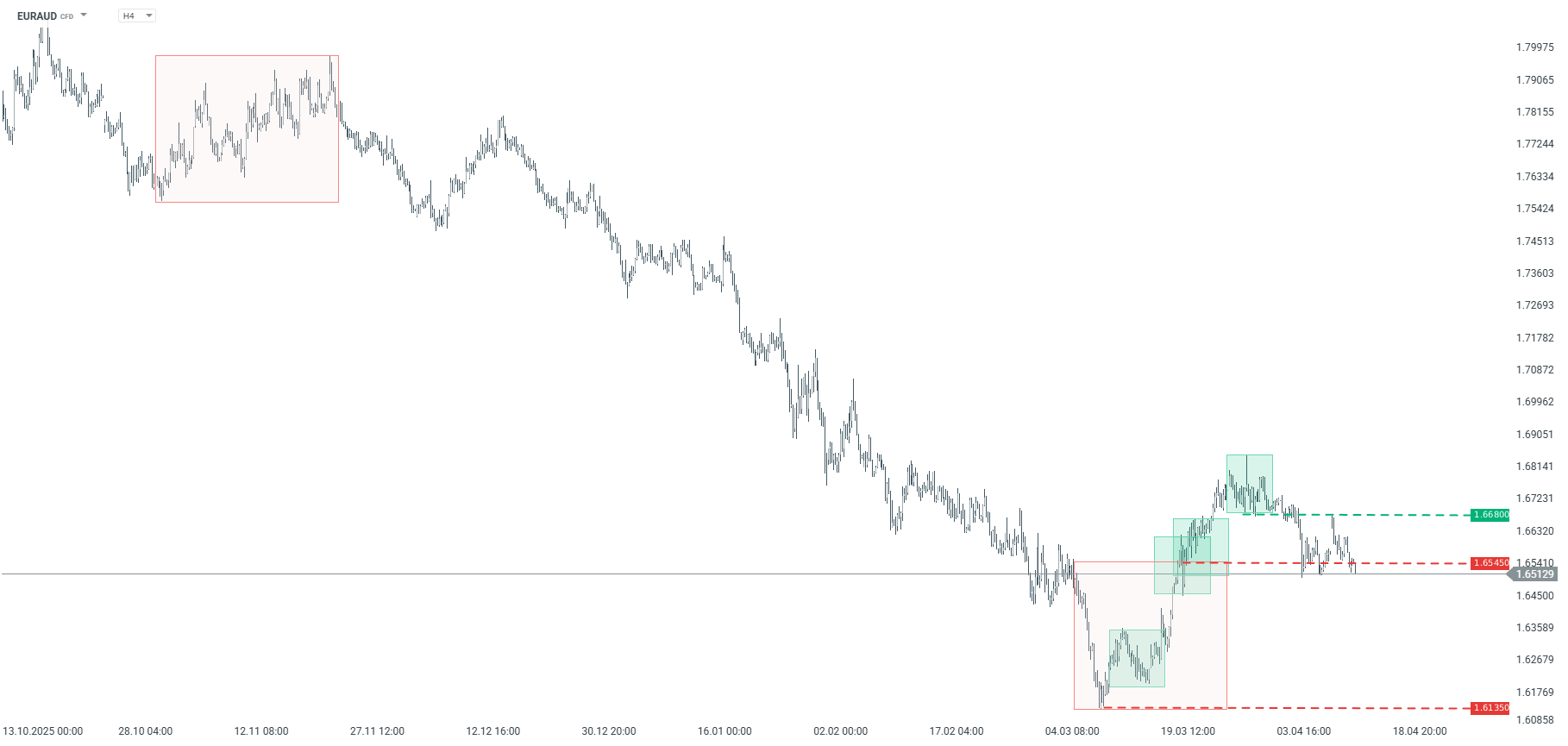
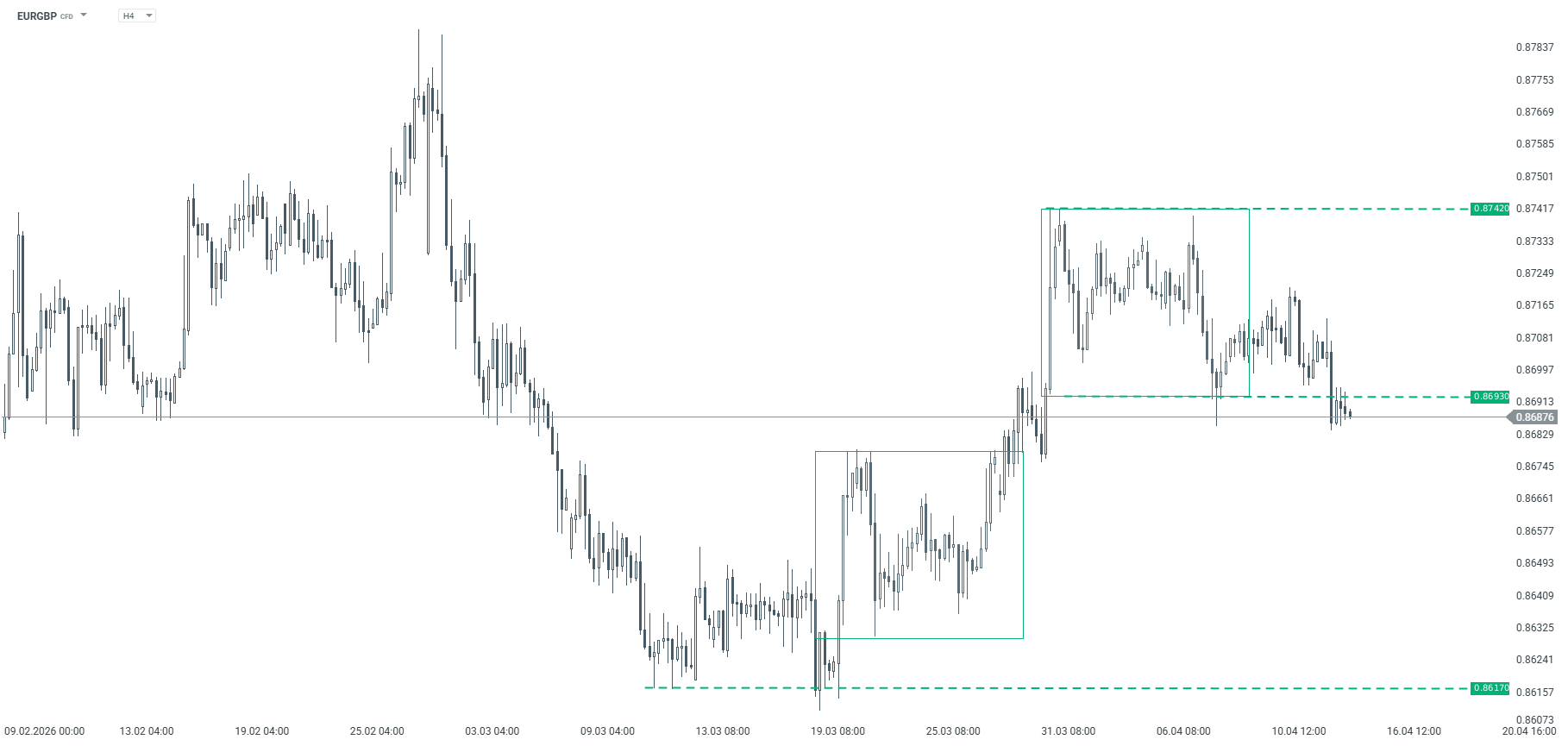
This analysis from the Overbalance series aims to identify three financial instruments, analyzed primarily on the daily/four-hour (D1/H4) timeframe. The analysis uses only the Overbalance methodology, which helps determine where a trend may continue or where it may reverse. Today’s analysis covers three instruments, evaluated solely in terms of 1:1 correction structures. EURAUD The EURAUD exchange rate had been in a downtrend for quite some time. However, between March and April, we observed a significant upward correction that broke through the largest corrective pattern, suggesting a potential trend reversal. Ultimately, it turned out to be merely a corrective move within the downtrend, and the price is once again attempting to resume its decline. In the short term, the local 1:1 upward pattern was negated at the 1.6680 level, which was subsequently tested from the other side. Currently, the price is attempting to fall below the 1.6545 level, where the polarity of the previously negated 1:1 downward pattern is located. If this level holds as resistance, the base case scenario will be a continuation of the decline, potentially even toward 1.6135. Conversely, a return above 1.6680 could pave the way for a shift to an uptrend.
EURAUD – H4 timeframe. Source: xStation EURGBP The EURGBP pair hit a local low around 0.8617, after which it attempted to generate a stronger upward move. Currently, however, there appears to be an issue with sustaining the rally. The price is oscillating around the key level of 0.8693, which previously acted as support. Retests of this level could result in its rejection and a return to declines. If the price remains above 0.8693, another upward impulse may be generated. Otherwise, the base scenario will be a retest of the lows around 0.8617.
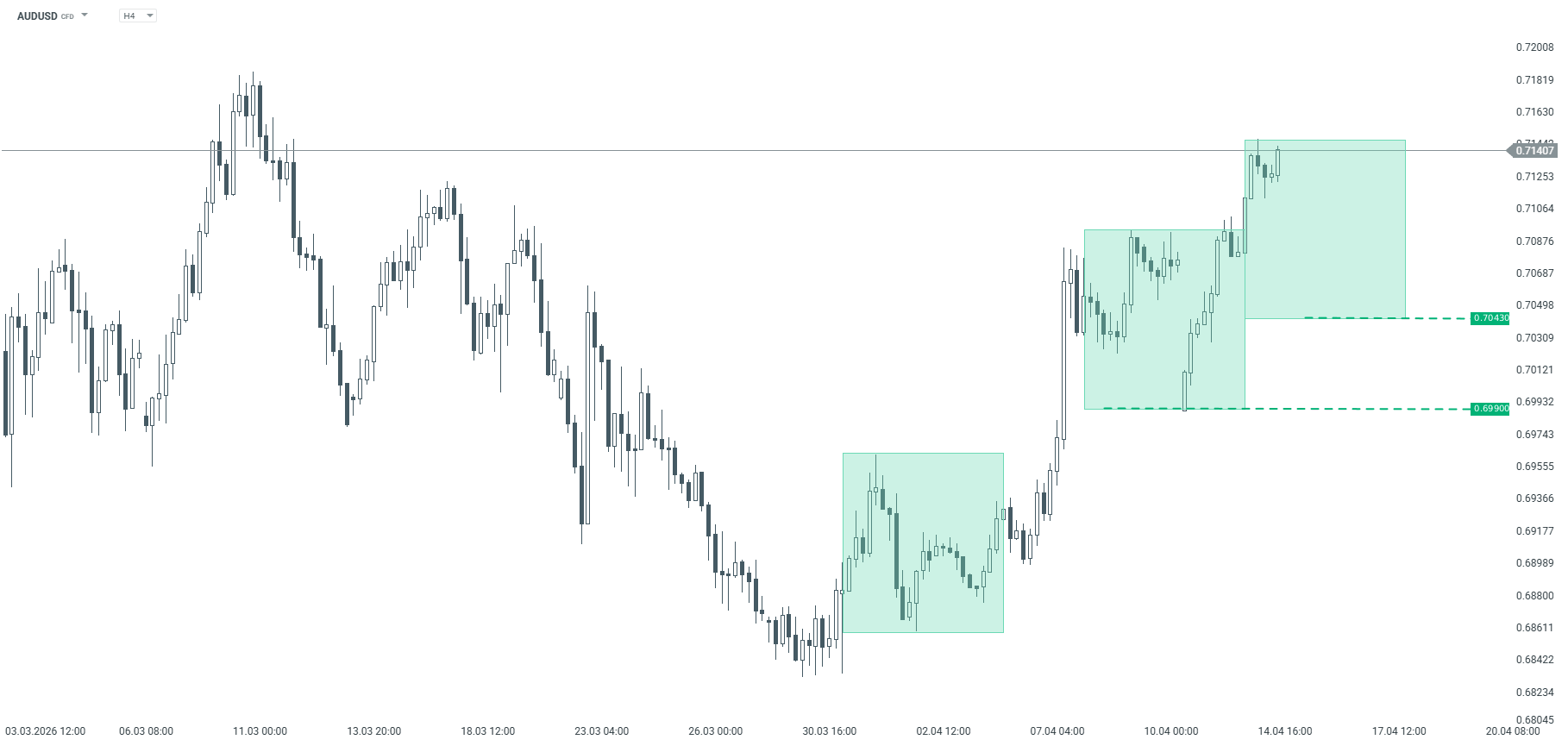
EURGBP – H4 timeframe. Source: xStation AUDUSD Since late March, AUDUSD has been trading within a local uptrend. Two corrections of similar magnitude—around 100 pips—are visible, confirming a market structure consistent with the Overbalance methodology. A local uptrend has been in place since the low on March 30, and as long as the geometric pattern is not negated, further gains remain the base case scenario. In the event of a correction, the key support level is 0.7043, derived from the lower boundary of the 1:1 pattern.
AUDUSD – H4 chart. Source: xStation
The material on this page does not constitute financial advice and does not take into account your level of understanding, investment objectives, financial situation or any other specific needs. All information provided, including opinions, market research, mathematical results and technical analyzes published on the Website or transmitted To you by other means, it is provided for information purposes only and should in no way be construed as an offer or solicitation for a transaction in any financial instrument, nor should the information provided be construed as advice of a legal or financial nature on which any investment decisions you make should be based exclusively To your level of understanding, investment objectives, financial situation, or other specific needs, any decision to act on the information published on the Website or sent to you by other means is entirely at your own risk if you In doubt or unsure about your understanding of a particular product, instrument, service or transaction, you should seek professional or legal advice before trading. Investing in CFDs carries a high level of risk, as they are leveraged products and have small movements Often the market can result in much larger movements in the value of your investment, and this can work against you or in your favor. Please ensure you fully understand the risks involved, taking into account investments objectives and level of experience, before trading and, if necessary, seek independent advice.
EUR/JPY maintains its position as the Japanese Yen struggles on improving oil prices.
Oil prices gain as US–Iran talks face uncertainty after Trump said he isn’t considering extending the ceasefire.
The currency cross’s upside may be limited as the Euro weakens amid cautious sentiment following uncertainty over renewed Iran talks.
EUR/JPY moves little after registering little losses in the previous day, trading around 187.30 during the early European hours on Wednesday. The currency cross maintains its gains as the Japanese Yen (JPY) remains under pressure, reflecting Japan’s heavy dependence on Middle East oil imports, as oil prices pare daily losses. However, the JPY may receive support from speculation surrounding potential Japanese intervention.
Crude oil prices gain as US-Iran further talks come into question after US President Donald Trump said in an ABC News interview on Wednesday that he is not considering extending the ceasefire, adding that he does not believe it will be necessary. “I think you’re going to be watching an amazing two days ahead. I really do,” Trump remarked.
Moreover, the US military also announced a full blockade of the Strait of Hormuz on Tuesday, tightening supply conditions and casting doubt over the next round of negotiations with Iran.
Meanwhile, Bank of Japan (BoJ) Governor Kazuo Ueda said policymakers must remain vigilant to the economic fallout from the Middle East conflict, warning that higher oil prices could weigh on Japan’s growth outlook.
The upside in the EUR/JPY cross may be limited as the risk-sensitive Euro (EUR) comes under pressure, with market sentiment turning slightly cautious after uncertainty emerged over renewed Iran talks.
However, The New York Post reported earlier that Trump had indicated talks could resume this week, while also opposing a 20-year suspension of Iran’s nuclear enrichment program. Meanwhile, Vice President JD Vance pointed to “significant progress” in the initial round of Iran negotiations held in Pakistan, with follow-up discussions potentially expected within days.
The Euro (EUR) may find underlying support as markets continue to price in modest tightening by the European Central Bank (ECB) at the April 30 meeting, along with expectations of two additional rate hikes this year. ECB President Christine Lagarde said the central bank is well-positioned to manage developments related to Iran, while cautioning that it remains too early to dismiss the broader impact of the shock.
AUD/USD jumps to near 0.7137 as the Australian Dollar outperforms its peers.
The US-Iran optimism has diminished the US Dollar’s safe-haven appeal.
US President Trump expresses confidence regarding a permanent ceasefire with Iran.
The Australian Dollar (AUD) outperforms its major currency peers, trading 0.23% higher to near 0.7137 against the US Dollar (USD), during the early European session on Wednesday. The antipodean trades firmly as the market sentiment is risk-on due to optimism towards a permanent ceasefire between the United States (US) and Iran.
Australian Dollar Price Today
The table below shows the percentage change of Australian Dollar (AUD) against listed major currencies today. Australian Dollar was the strongest against the Japanese Yen.
USD
EUR
GBP
JPY
CAD
AUD
NZD
CHF
USD
0.04%
0.00%
0.08%
0.03%
-0.27%
-0.01%
0.03%
EUR
-0.04%
-0.03%
0.07%
-0.01%
-0.21%
-0.04%
-0.01%
GBP
-0.01%
0.03%
0.09%
0.05%
-0.18%
-0.03%
0.02%
JPY
-0.08%
-0.07%
-0.09%
-0.07%
-0.29%
-0.15%
-0.09%
CAD
-0.03%
0.00%
-0.05%
0.07%
-0.21%
-0.05%
-0.02%
AUD
0.27%
0.21%
0.18%
0.29%
0.21%
0.17%
0.22%
NZD
0.01%
0.04%
0.03%
0.15%
0.05%
-0.17%
0.05%
CHF
-0.03%
0.00%
-0.02%
0.09%
0.02%
-0.22%
-0.05%
The heat map shows percentage changes of major currencies against each other. The base currency is picked from the left column, while the quote currency is picked from the top row. For example, if you pick the Australian Dollar from the left column and move along the horizontal line to the US Dollar, the percentage change displayed in the box will represent AUD (base)/USD (quote).
As of writing, S&P 500 futures hold onto Tuesday’s gains around 6,970, reflecting an upbeat market mood. The US Dollar Index (DXY), which tracks the Greenback’s value against six major currencies, edges up to near 98.10, but is close to its almost seven-week low of 98.00.
US President Donald Trump has expressed confidence that Washington and Iran could reach a permanent ceasefire in the next two days. Trump said in an interview with ABC News that he doesn’t think extending the two-week ceasefire, adding, “I think you’re going to be watching an amazing two days ahead. I really do.”
On the domestic front, the warning of stagflation from Reserve Bank of Australia (RBA) Deputy Governor, in a fire chat event on Tuesday, has raised concerns over the Australian economic outlook. Hauser said that the coming months will be “challenging” for Australia in the wake of an energy crisis due to Middle East conflicts and high inflationary pressures.
AUD/USD technical analysis
AUD/USD trades higher at around at 0.7140 at the press time. The pair holds a constructive near-term bias as it remains above the 20-day Exponential Moving Average (EMA) at 0.7023, suggesting that recent dips have been bought and that the short-term trend is underpinned by rising demand.
The Relative Strength Index (RSI) at 63.3 leans into bullish territory without yet signaling overbought conditions, hinting that upside momentum is still developing rather than exhausted.
On the downside, initial support is located at the 20-day EMA at 0.7023, where a break would likely weaken the current bullish structure and open the door to a deeper correction toward prior congestion levels around 0.6935. As long as spot continues to trade above this moving average and RSI holds above the midline, pullbacks are likely to be treated as corrective pauses within the broader upward bias, and it could attempt to reclaim the multi-year high near 0.7200
USD/CHF trades vulnerably around 0.7800 as the US Dollar underperforms across the board.
US President Trump expresses confidence that the war with Iran is close to an end.
The US and Iran are expected to resume talks soon.
The USD/CHF pair trades flat around 0.7812 during the late Asian trading session on Wednesday, but is still close to its monthly low of 0.7790 posted the previous day. The Swiss Franc pair faces selling pressure as the US Dollar (USD) underperforms its peers amid optimism that the United States (US) and Iran could reach a permanent ceasefire soon.
During the press time, the US Dollar Index (DXY), which tracks the Greenback’s value against six major currencies, ticks higher to near 98.15, but is still close to its almost seven-week low of 98.00.
The optimism over the US-Iran permanent ceasefire is backed by positive commentary from US President Donald Trump, in an interview with Fox Business earlier in the day, that the war with Iran is close to an end. “I think it’s close to over, yeah. I view it as very close to being over,” Trump said. He also said to The New York Post on Tuesday that negotiations with Iran could resume in Pakistan in the next two days.
US Vice President (VP) JD Vance also said in a public event that talks with Iran are taking place via channels including Pakistan, will continue, as “both sides work toward a deal”.
Meanwhile, traders are no longer pricing in interest rate hikes by the Federal Reserve (Fed) this year, as inflation expectations have de-anchored due to US-Iran optimism, a sharp turnaround from two hike projections seen in March after the war started.
To provide the best experiences, we use technologies like cookies to store and/or access device information. Consenting to these technologies will allow us to process data such as browsing behavior or unique IDs on this site. Not consenting or withdrawing consent, may adversely affect certain features and functions.
Functional
Always active
The technical storage or access is strictly necessary for the legitimate purpose of enabling the use of a specific service explicitly requested by the subscriber or user, or for the sole purpose of carrying out the transmission of a communication over an electronic communications network.
Preferences
The technical storage or access is necessary for the legitimate purpose of storing preferences that are not requested by the subscriber or user.
Statistics
The technical storage or access that is used exclusively for statistical purposes.The technical storage or access that is used exclusively for anonymous statistical purposes. Without a subpoena, voluntary compliance on the part of your Internet Service Provider, or additional records from a third party, information stored or retrieved for this purpose alone cannot usually be used to identify you.
Marketing
The technical storage or access is required to create user profiles to send advertising, or to track the user on a website or across several websites for similar marketing purposes.