

The move represents the first hike from a major European central bank.
EUR/NOK is down by approx. 0.5%
Contrary to most economists’ expectations, Norges Bank decided to raise interest rates by 25 bp, bringing the benchmark rate up to 4.25%. Norges Bank is thus the first major European central bank to decide on such move. Earlier, the ECB, BoE, and Riksbank had opted to hold rates steady. In response to the move, the Norwegian krone strengthened by approx. 0.5% against the benchmark euro, recouping a significant share of yesterdayโs losses, which were largely the result of declining energy commodity prices.
Figure: EUR/NOK (2025-2026)
Source: xStation,
07/05/2026 The hike is primarily intended to anchor inflation expectations, especially in light of fairly persistent core inflation, which remained at 3% in March, and still elevated wage growth, which exceeds 4% YoY in many sectors. Officialsโ statements lacked clear indications regarding future moves. The meeting was not accompanied by a new interest rate projection. The March one suggested a single rate hike before the end of the yearโunder current conditions, however, it seems likely that the bank will continue to tighten its monetary policy in the coming months. A rate hike at the June (18/06) meeting is almost fully priced in by the markets. Yet another hike in September is considered a base case scenario.
In todayโs session, EUR/USD is strengthening around the 1.17 area, but the move is not driven by a single dominant factor. Instead, it reflects a combination of several parallel impulses, including unchanged policy rates from both the Fed and the ECB, improving sentiment linked to potential de-escalation of tensions around Iran, and stronger-than-expected German industrial data. It is important to stress that the current appreciation looks more like a repricing of expectations than a durable shift in underlying fundamentals.
Source: xStation5
What is shaping EUR/USD price action?Fed on hold, but the market is already pricing rate cuts
The Federal Reserve kept interest rates unchanged, while signalling a gradual slowdown in economic momentum and increasing sensitivity in the labour market. At the same time, inflation in the US is still not fully under control, particularly in services and core inflation, where price pressures remain persistent. Despite this, markets are increasingly pricing in future rate cuts, not as a response to rapidly falling inflation, but rather as a reaction to a potential weakening in economic activity. This scenario reduces the attractiveness of the US dollar and gradually supports EUR/USD through expectations of a narrowing interest rate differential.
The ECB remains cautious, with no automatic path to hikes
The European Central Bank also left rates unchanged, maintaining a cautious and data-dependent communication stance. While some forecasts still allow for further tightening, the dominant view remains one of stabilisation and inflation-driven decisions rather than an aggressive hiking cycle. At the same time, improving real economy data, especially from Germany, is limiting earlier expectations of a deeper slowdown in the euro area, supporting the single currency through the activity channel rather than monetary policy expectations alone.
Geopolitics and hopes for an Iran agreement
Reports of potential de-escalation in tensions surrounding Iran are improving global risk sentiment. A decline in the geopolitical risk premium reduces demand for the US dollar as a traditional safe-haven currency, while benefiting risk-sensitive assets such as the euro. In addition, a potential easing of tensions in the Middle East lowers pressure on energy prices, which in the medium term could reduce inflationary pressures and strengthen expectations of a more accommodative Fed stance.
Germany surprises to the upside, lifting European sentiment
Stronger-than-expected German industrial data is an important element of todayโs market picture. Against the backdrop of earlier concerns about stagnation in Europe, this release is helping stabilise perceptions of the euro area. As a result, the euro is increasingly seen not only through the lens of cyclical weakness, but also as a relatively stable alternative to the US dollar, particularly in an environment of shifting monetary policy expectations.
What else is influencing the market in the background
Beyond central bank decisions and macroeconomic data, the key driver remains the pace of change in market expectations regarding future Fed and ECB policy. The market is currently in a repricing phase rather than a full economic cycle shift. This makes EUR/USD particularly sensitive to incoming data and central bank communication that could either confirm or challenge the scenario of faster US easing combined with relatively stable policy in Europe. In such an environment, even moderately positive European data can support the euro in the short term, but the sustainability of the trend will ultimately depend on whether the Fed actually moves towards more decisive monetary easing.
The pair returned below the horizontal resistance area at 0.9220
EURCHF is trading below the 100-period exponential moving average from D1 interval
Recommendation: Trade: Short EURCHF at market price Target: 0.8995 Stop: 0.9272
Opinion:
Looking at EURCHF on the D1 interval, one can see a potential downward trend resumption. Following a break above the 1:1 geometry, the pair quickly returned below the upper limit of the aforementioned 1:1 structure. According to the Overbalance methodology, the main trend remains downward. In addition the pair sits below the 100-period moving average from the D1 interval. We recommend going short USDCAD at market price with a target of 0.8995. We also recommend placing a stop loss order at 0.9272.
The offshore yuan strengthened to around 6.80 per dollar on Thursday, extending its rally for a third straight session and reaching its strongest level since February 2023, as risk sentiment firmed amid growing optimism over a potential diplomatic breakthrough between Washington and Tehran.
Reports indicated that the US and Iran are close to finalizing a one-page memorandum designed to halt weeks of hostilities, paving the way for the reopening of the Strait of Hormuz, easing disruptions to oil flows, and improving global growth prospects. Investors are also watching a highly anticipated summit next week between Trump and Chinese President Xi Jinping, previously postponed amid heightened geopolitical tensions tied to the Middle East war. Meanwhile, Chinaโs financial regulator reportedly told major lenders to suspend new financing to five refineries sanctioned by the US over alleged Iranian oil ties, contrasting with earlier guidance from Beijing urging firms to ignore US sanctions.
EUR/JPY trades calmly amid hopes that Japan could intervene again.
Japanโs Mimura said that he will closely monitor the forex markets.
The risk-on impulse has improved the Euroโs appeal.
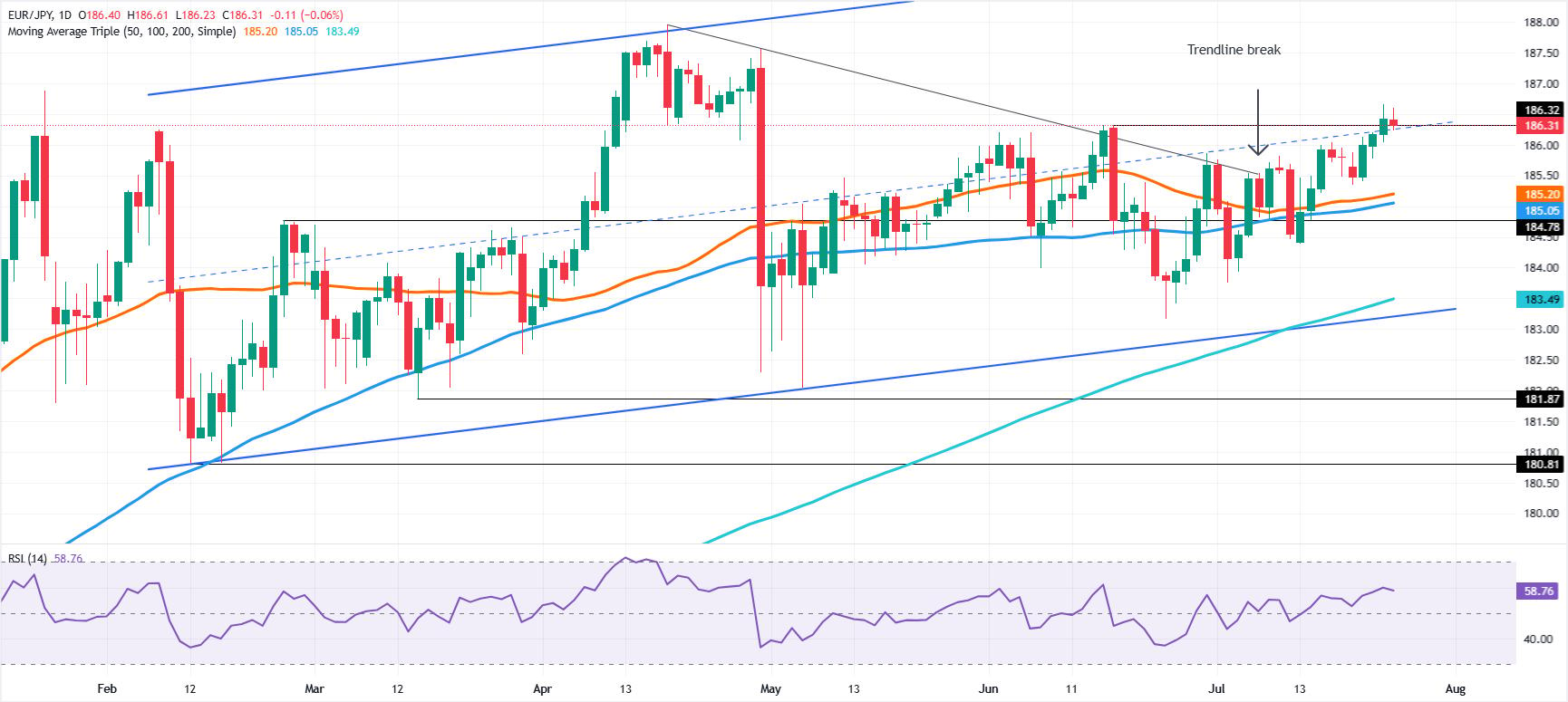
The EUR/JPY pair trades in a tight range around 183.75 during the Asian trading session on Thursday. The pair struggles for a direction as investors remain on the sidelines amid hopes that Japanโs Ministry of Finance (MoF) could intervene again.
Japanโs Vice Finance Minister (FM) for International Affairs and top foreign exchange official, Atsushi Mimura, said earlier in the day, that he will closely monitor the foreign exchange (FX) markets. However, Mimura declined to comment on specific levels where an intervention could take place.
While there has been no official confirmation from Japan that it has intervened in markets to counter one-way speculative moves against the Japanese Yen (JPY) in the last few trading days, there have been strong upside moves in the Asia-Pacific currency on April 30 and May 6.
Although theyโve not commented officially, I think we have to assume that the MoF stepped in again,” analysts atย Pepperstoneย said, adding, “You donโt get a huge move like that, with no obvious catalyst, unless thereโs a โsilent handโ involved, Reuters report.
Meanwhile,ย the Euroย (EUR) trades broadly firm as the risk-on impulse remains boosted amid firm hopes of the reopening of the Strait of Hormuz. An Axios report has shown that Washington is close to reaching a deal with Iran on a one-page memorandum of understanding to end the war.
Going forward, investors will focus on European Central Bank (ECB) President Christineย Lagardeโs speech, which is scheduled for Friday, for fresh cues on the monetary policyย outlook.
The hawkish BoJ and intervention speculations underpin the JPY, keeping a lid on the pair.
The divergent BoJ-Fed policy outlooks warrant some caution before initiating bullish bets.
The USD/JPY pair struggles to capitalize on the previous day’s goodish rebound from its lowest level since February 24, around the 155.00 psychological mark, and oscillates in a narrow band during the Asian session on Thursday. Spot prices currently trade just below mid-156.00s, nearly unchanged for the day.
The Japanese Yen (JPY) continues to draw support from speculations that authorities will step in again to prop up the domestic currency and the Bank of Japan’s (BoJ) hawkishย outlook. In fact, Japanโs Vice Finance Minister for International Affairs and top currency diplomat, Masato Mimura, delivered another round of verbal intervention and reiterated his close watch on foreign exchange markets. This comes on top of JPY intervention reports, which suggested that Japan may have spent as much as ยฅ5.48 trillion ($35 billion) buying the JPY after the USD/JPY pair surged past the 160.00 psychological mark last Friday.
Meanwhile, Minutes of the March 18-19ย BoJย meeting showed board members reaffirmed that further rate hikes remained appropriate if the economic and price outlook was realised. The pace and timing will be determined meeting by meeting based on wages, prices, and the evolving Iran situation, the Minutes revealed further. This marks a significant divergence in comparison to diminishing odds for a rate hike by the USย Federal Reserveย (Fed), benefiting the lower-yielding JPY. The US Dollar (USD), on the other hand, remains depressed amid hopes for a US-Iran peace deal and also caps the USD/JPY pair.
In fact, US President Donald Trump struck an optimistic tone on Wednesday, saying that negotiations had made progress over the past 24 hours and that Iran wants to make a deal. Adding to this, Axios, citing two US officials, reported that the White House was nearing a deal with Iran on a one-page memorandum of understanding to end the war. The optimism, in turn, is seen undermining the USD’s reserve currency status. Investors, however, reassess the likelihood of a possible Iran-US deal amid major disagreements over Iran’s nuclear program, holding back traders from placing directional bets on the USD/JPY pair.
Japanese Yen Price Last 7 Days
The table below shows the percentage change of Japanese Yen (JPY) against listed major currencies last 7 days. Japanese Yen was the strongest against the US Dollar.
USD
EUR
GBP
JPY
CAD
AUD
NZD
CHF
USD
-0.60%
-0.87%
-2.48%
-0.35%
-1.64%
-2.10%
-1.58%
EUR
0.60%
-0.23%
-1.97%
0.27%
-1.04%
-1.48%
-0.96%
GBP
0.87%
0.23%
-1.72%
0.51%
-0.79%
-1.24%
-0.72%
JPY
2.48%
1.97%
1.72%
2.27%
0.91%
0.41%
1.11%
CAD
0.35%
-0.27%
-0.51%
-2.27%
-1.34%
-1.86%
-1.23%
AUD
1.64%
1.04%
0.79%
-0.91%
1.34%
-0.39%
0.07%
NZD
2.10%
1.48%
1.24%
-0.41%
1.86%
0.39%
0.51%
CHF
1.58%
0.96%
0.72%
-1.11%
1.23%
-0.07%
-0.51%
The heat map shows percentage changes of major currencies against each other. The base currency is picked from the left column, while the quote currency is picked from the top row. For example, if you pick the Japanese Yen from the left column and move along the horizontal line to the US Dollar, the percentage change displayed in the box will represent JPY (base)/USD (quote).
EUR/USD stalls the previous dayโs late pullback from over a two-week high amid a weaker USD.
US-Iran peace deal hopes and fading hawkish Fed expectations continue to undermine the buck.
Traders look to second-tier macro data for some impetus ahead of the US NFP report on Friday.
The EUR/USD pair attracts some dip-buying during the Asian session on Thursday and stalls the previous day’s late pullback from the 1.1800 neighborhood, or over a two-week high. Spot prices currently trade just above mid-1.1700s, up nearly 0.10% for the day, and remain at the mercy of the US Dollar (USD) price dynamics.
The US Dollar (USD) struggles to capitalize on the previous day’s upbeat US employment data-inspired bounce from a nearly three-week low and remains depressed for the second straight day amid hopes for a US-Iran peace deal. In fact, the ADP report showed that private-sector employment grew by 109K in April, compared to a downwardly revised reading of 61K in the previous month. This, however, was offset by the optimism over a potential agreement to end the Iran war.
US President Donald Trump struck an optimistic tone on Wednesday, saying that negotiations had made progress over the past 24 hours and that Iran wants to make a deal. Adding to this, Axios, citing two US officials, reported that the White House was nearing a deal with Iran on a one-page memorandum of understanding to end the conflict. This, along with fading hawkish USย Federal Reserveย (Fed) expectations, undermines the USD’s reserve currency status and supports the EUR/USD pair.
However, according to the CME Group’s CME FedWatch Tool, traders are still pricing in the possibility of a Fed rate hike by the end of this year. Furthermore, investors reassess the likelihood of a possible Iran-US peace deal amid major disagreements over Iran’s nuclear program. This keeps investors on edge and could act as a tailwind for the Greenback, warranting caution before placing aggressive bullish bets around the EUR/USD pair and positioning for any further appreciating move.
Traders now look to the second-tier macro data โ German Factory Orders, French Trade Balance, US Challenger Job Cuts, and Weekly Initialย Jobless Claimsย โ for some impetus. The focus, however, will remain glued to the US Nonfarm Payrolls (NFP) report on Friday. Apart from this, fresh developments surrounding the Middle East crisis might continue to infuse volatility, which, in turn, will drive the USD and produce trading opportunities aroundย the EUR/USD pair.
US Dollar Price Today
The table below shows the percentage change of US Dollar (USD) against listed major currencies today. US Dollar was the strongest against the Canadian Dollar.
USD
EUR
GBP
JPY
CAD
AUD
NZD
CHF
USD
-0.12%
-0.11%
-0.19%
-0.02%
-0.15%
-0.16%
-0.10%
EUR
0.12%
0.01%
-0.06%
0.11%
-0.04%
-0.04%
0.02%
GBP
0.11%
-0.01%
-0.08%
0.08%
-0.05%
-0.06%
0.00%
JPY
0.19%
0.06%
0.08%
0.16%
0.03%
-0.02%
0.10%
CAD
0.02%
-0.11%
-0.08%
-0.16%
-0.13%
-0.14%
-0.08%
AUD
0.15%
0.04%
0.05%
-0.03%
0.13%
-0.00%
0.05%
NZD
0.16%
0.04%
0.06%
0.02%
0.14%
0.00%
0.06%
CHF
0.10%
-0.02%
-0.00%
-0.10%
0.08%
-0.05%
-0.06%
The heat map shows percentage changes of major currencies against each other. The base currency is picked from the left column, while the quote currency is picked from the top row. For example, if you pick the US Dollar from the left column and move along the horizontal line to the Japanese Yen, the percentage change displayed in the box will represent USD (base)/JPY (quote).
To provide the best experiences, we use technologies like cookies to store and/or access device information. Consenting to these technologies will allow us to process data such as browsing behavior or unique IDs on this site. Not consenting or withdrawing consent, may adversely affect certain features and functions.
Functional
Always active
The technical storage or access is strictly necessary for the legitimate purpose of enabling the use of a specific service explicitly requested by the subscriber or user, or for the sole purpose of carrying out the transmission of a communication over an electronic communications network.
Preferences
The technical storage or access is necessary for the legitimate purpose of storing preferences that are not requested by the subscriber or user.
Statistics
The technical storage or access that is used exclusively for statistical purposes.The technical storage or access that is used exclusively for anonymous statistical purposes. Without a subpoena, voluntary compliance on the part of your Internet Service Provider, or additional records from a third party, information stored or retrieved for this purpose alone cannot usually be used to identify you.
Marketing
The technical storage or access is required to create user profiles to send advertising, or to track the user on a website or across several websites for similar marketing purposes.