Currency Hedger No Comments

USD/JPY – Price Strength beyond 160.00 awaited amid bullish technical setup

  • USD/JPY struggles to build on modest Asian session gains as intervention fears limit JPY losses.
  • The fundamental backdrop favors the USD bulls and backs the case for further gains for the pair.
  • The technical setup also suggests that the path of least resistance for spot prices is to the upside.

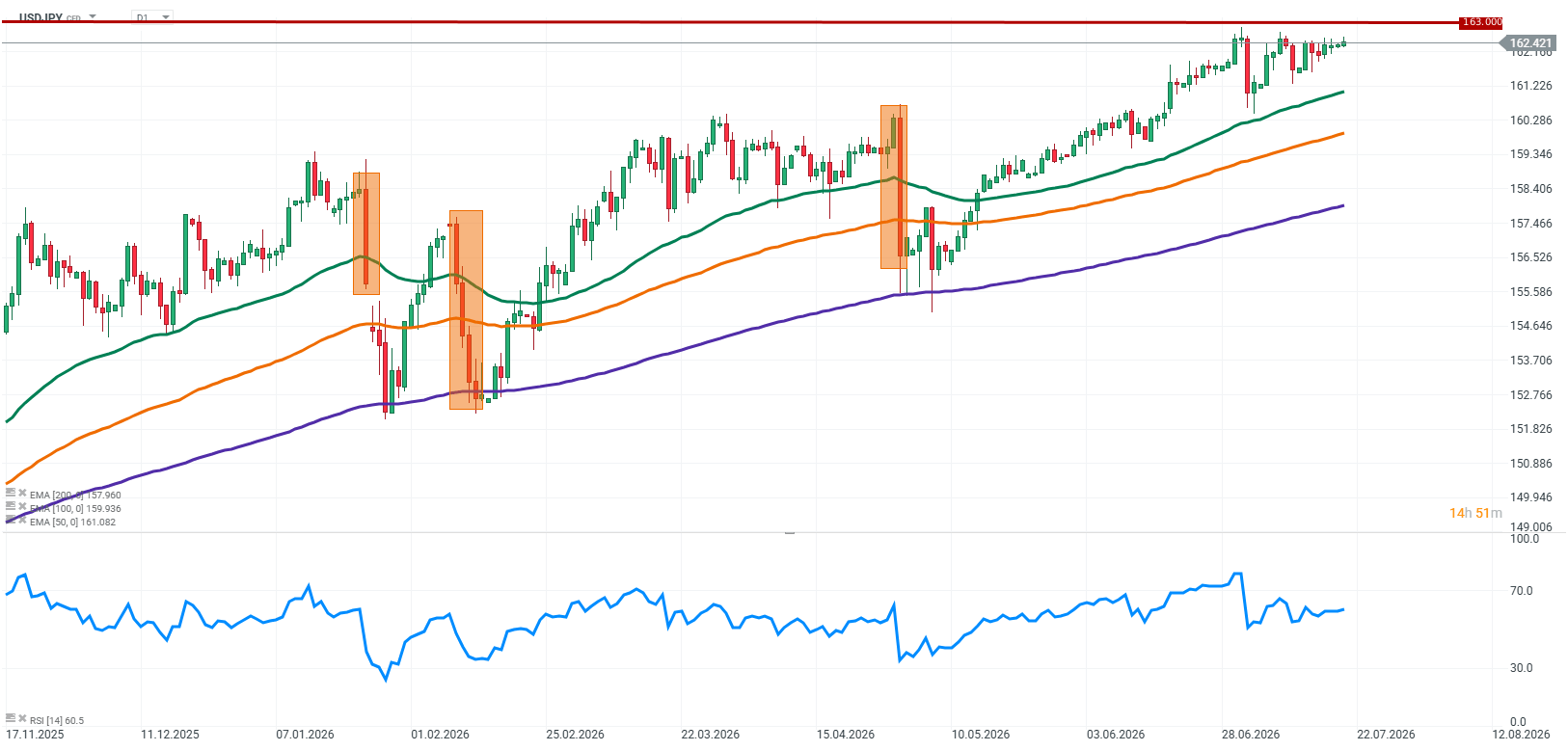
The USD/JPY pair builds on gains from the past two days and opens with a bullish gap at the start of the new week, rising to the 159.85 region during the Asian session. However, intervention fears keep a lid on any further appreciation for spot prices.

Failed US-Iran peace talks trigger a fresh wave of the global risk-aversion trade and benefit the US Dollar’s (USD) reserve currency status. Adding to this, rallying Crude Oil prices fuel inflationary fears and reaffirm hawkish USย Federal Reserveย (Fed) expectations, which further underpins the buck and offers support to the USD/JPY pair.

The Japanese Yen (JPY), on the other hand, is weighed down by economic concerns stemming from imported energy shocks due to the Middle East conflict. However, speculations that authorities would step in to stem further JPY weakness hold back bearish traders from placing aggressive bets and cap gains for the USD/JPY pair.

Spot prices retain a bullish bias following last week’s resilience below the 158.25-158.20 horizontal support. Furthermore, the USD/JPY pair holds comfortably above the 200-period Simple Moving Average (SMA). The Relative Strength Index (RSI) near 63 suggests firm upside momentum without yet signaling overbought conditions.

Adding to this, the Moving Average Convergence Divergence (MACD) turns increasingly positive, hinting that buyers retain control for now. The USD/JPY bulls, however, might await a sustained strength and acceptance above the 160.00 psychological mark before positioning for an extension of a three-day-old appreciating move.

On the downside, initial support is reinforced by the 200-period SMA at 158.56, which underpins the broader uptrend and would be the first level watched in the event of a corrective pullback. This is followed by the 158.25-158.20 support and the 158.00 mark, which, if broken, could turn the USD/JPY pair vulnerable.

USD/JPY 4-hour chart

Chart Analysis USD/JPY
Currency Hedger No Comments

EUR/USD Price Rebounds to near 1.1700 as bullish bias prevails

  • EUR/USD may face key resistance near 1.1750 at the upper ascending channel boundary.
  • The 14-day Relative Strength Index near 56 signals positive momentum.
  • The immediate support lies at the 50-day EMA near 1.1640.

EUR/USD edges higher after opening at a gap down, trading around 1.1690 during the Asian hours on Monday. The daily chart technical analysis indicates a bullish bias, as the pair is rising within an ascending channel.

The EUR/USD pairย holds a modest bullish bias as it stays above both the nine-day and 50-day Exponential Moving Averages (EMAs). This constructive positioning is backed by a 14-day Relative Strength Index near 56, which suggests positive but not overstretched momentum, leaving room for further upside while the pair remains supported on dips.

On the upside, the EUR/USD pair may find its primary barrier at the upper boundary of the ascending channel around 1.1750, followed by the eight-week high of 1.1834, reached on February 23. Further advances above this confluence resistance zone would lead the pair in exploring the region around 1.2082, the highest since June 2021, reached on January 27.

The EUR/USD pair may find the immediate support at the 50-day EMA of 1.1640, aligned with the nine-day EMA of 1.1636. A break below these averages would weaken the price momentum and expose the lower ascending channel boundary around 1.1500, followed by the eight-month low of 1.1411, recorded on March 13.

EUR/USD: Daily Chart

(The technical analysis of this story was written with the help of an AI tool.)

Euro Price Today

The table below shows the percentage change of Euro (EUR) against listed major currencies today. Euro was the weakest against the US Dollar.

USDEURGBPJPYCADAUDNZDCHF
USD0.32%0.46%0.27%0.17%0.45%0.28%0.35%
EUR-0.32%0.12%-0.04%-0.14%0.11%-0.03%0.07%
GBP-0.46%-0.12%-0.17%-0.29%-0.02%-0.17%-0.10%
JPY-0.27%0.04%0.17%-0.15%0.14%-0.03%0.11%
CAD-0.17%0.14%0.29%0.15%0.32%0.13%0.19%
AUD-0.45%-0.11%0.02%-0.14%-0.32%-0.15%-0.02%
NZD-0.28%0.03%0.17%0.03%-0.13%0.15%0.10%
CHF-0.35%-0.07%0.10%-0.11%-0.19%0.02%-0.10%

The heat map shows percentage changes of major currencies against each other. The base currency is picked from the left column, while the quote currency is picked from the top row. For example, if you pick the Euro from the left column and move along the horizontal line to the US Dollar, the percentage change displayed in the box will represent EUR (base)/USD (quote).

Currency Hedger No Comments

CAD pares losses vs USD as rallying oil prices counter hawkish Fed bets

  • USD/CAD struggles to build on its modest gains amid a combination of factors.
  • The door for further diplomacy remains open, capping the USD and the major.
  • Rallying Oil prices underpin the Loonie and act as a headwind for spot prices.

Theย USD/CADย pair retreats a few pips from the Asian session high and currently trades around the 1.3860-1.3855 region, up around 0.15% for the day. Meanwhile, the mixed fundamental backdrop warrants caution before positioning for an extension of a modest recovery from sub-1.3800 levels, or over a two-week low set on Friday.

The US Dollar (USD) struggles to capitalize on the weekly bullish gap opening amid reports that regional countries are racing to bring the US and Iran back to the negotiating table within days. This keeps the door open for further diplomacy and caps the safe-haven Greenback. Moreover, an intraday rally in Crude Oil prices underpins the commodity-linked Loonie and contributes to capping the USD/CAD pair.

West Texas Intermediate (WTI) โ€“ the benchmark US Crude Oil price โ€“ rallies back to the $105/barrel mark in reaction to failed US-Iran peace talks over the weekend. In fact, US Vice President JD Vance said that he placed a final andย bestย offer on the table, but Iran declined to accept the terms, leading to a stalemate. Meanwhile, Iranian state media said that excessive demands sank the possibility of an agreement.

Furthermore, US President Donald Trump said that the US Navy would start blockading the Strait of Hormuz, jeopardizing a fragile two-week ceasefire. Adding to this, continued Israeli strikes in Lebanon raise the risk of a renewed escalation of tensions in the Middle East and support oil prices. However, hawkish USย Federal Reserveย (Fed) bets should limit deeper losses for the buck and the USD/CAD pair.

Data released on Friday showed that inflation in the US surged by the most in nearly four years during March. Apart from this, the war-driven surge in elevated energy prices led investors to abandon bets on Fed rate cuts and shift focus to potential interest rate hikes this year. Theย outlookย triggers a fresh leg up in US Treasury bond yields, which favors the USD bulls and acts as a tailwind for the USD/CAD pair.

Currency Hedger No Comments

Offshore Yuan Snaps 6-Session Winning Streak

The offshore yuan weakened to around 6.83 per dollar on Monday, snapping a six-session winning streak, as the greenback strengthened broadly after USโ€“Iran peace talks ended without a breakthrough. The face-to-face negotiations between the two countries’ delegations concluded with both sides acknowledging that significant differences remain. Vice President JD Vance reiterated the lack of progress, while Iranian representatives echoed similar concerns. Following the talks, President Trump announced that the US Navy would begin blockading the Strait of Hormuz, raising further concerns over potential disruptions to global energy supplies. On the domestic front, investors are closely watching a packed economic calendar this week. Key data releases, including the trade balance, Q1 GDP growth, industrial output, retail sales, and the unemployment rate, are expected to provide fresh insights into the strength and trajectory of the economy.

Currency Hedger No Comments

Scenario Analysis – What to expect from weekend peace talks

Markets are in a jubilant mood as we lead up to the weekend. Spurred by a milder March reading of US inflation than expected, rate cut expectations are building, and stocks are rallying. Headline CPI in the US rose at a 3.4% annual rate, a hefty jump from the 2.4% rate in February, but lower than the 3.5% expected core prices rose by a 2.6% annual rate, also weaker than expected. The BLS reported that the index for energy rose  by 10% in March, driven by a 21% rise in the price of gasolene.

US price growth not as bad as feared

The jump in gasolene prices accounted for three quarters of the rise in inflation last month, according to the BLS. Airline fares also rose sharply last month, but this was partly offset by a drop in medical costs and in used car prices. Todayโ€™s data suggests two things: 1, the inflationary impact from this crisis has been huge, but it is offset by weaker inflation growth elsewhere, such as a moderate increase in shelter costs, a drop in the cost of utilities and no change in food prices last month. 2, if the Strait of Hormuz is not reopened soon, then the impact on inflation could spread to food prices and to core inflation, which typically takes longer to absorb energy price shocks.

The immediate market reaction has been relief. A higher-than-expected reading for inflation could have spooked financial markets as we lead up to the weekend. Instead, this supports current expectations of a rate cut from the Federal Reserve by year end, which is boosting the market mood.

Markets optimistic about peace talks

Some concrete economic data that quantifies the effect of the war as being less onerous than first anticipated, combined with hopes for successful peace talks is helping US stocks to extend their longest winning streak this year. Rather than selling stocks on a Friday in case of an escalation of the conflict in the Middle East over the weekend, the market is willing to โ€˜give peace a chance.โ€™

Stocks have strong week, as dollar reverses course

The dollar is weaker across the board on Friday after the lower-than-expected US inflation print, which is boosting hopes of a rate cut from the Fed. However, the bond market is less enthusiastic, and bonds are selling off across Europe after Forties crude from the North Sea reached a fresh record high above $147 per barrel. Until  the Strait of Hormuz is fully open and Gulf energy infrastructure is operational, the bond market is likely to trade with a more cautious tone compared to stocks.

Stocks are on course for their best weekly performance of the year so far, as you can  see below, and this has been spurred by the marketโ€™s conviction that President Trump will continue with a ceasefire and the conflict in the  Middle East is now at its end stages. The  Trump reversal index is now back at levels last reached before the war started. The market is pricing for a positive outcome from the negotiations between the US and Iran this weekend, below, we assess potential outcomes from this weekendโ€™s talks and their impact on financial markets:

Peace talks, assessing the potential outcomes

1, Positive outcome: The two sides agree to reopen the Strait of Hormuz, which leads to an immediate reopening of the waterway. An even better outcome would be one without tariffs to pass through the Strait. The oil price is likely to fall back to pre-war levels for Brent, between $75 and $80 per barrel, stocks could surge and bonds will also rally, leading to another sharp decline in global bond yields. We believe there is a low probability, 30% or less, of this perfect outcome happening straight away.

2, Moderate outcome: The negotiations end without a deal, but more talks are expected. The prospect of prolonged negotiations could knock sentiment at the start of next week, but any weakness could fade if there are continued pledges to work towards a lasting peace. While stocks may extend this weekโ€™s rally, a high oil price could stymie further gains, especially if there is no concrete plans to reopen the Strait of Hormuz. We think that this is the most likely outcome and think there is a 70-80% chance that further talks will be needed.

3, Negative outcome: The talks fail, both sides walk away and the bombing in Iran and around the Gulf resumes. This could see the oil price reach fresh highs above $120 per barrel for Brent, stocks will tank and bond yields will surge. We believe that this is also a low probability outcome, with 10-15% chance.

Overall, the outcome of negotiations are the main focus for markets as we end the week.

Chart 1: S&P 500, weekly performance chart 1 year

Source: XTB and Bloomberg

The material on this page does not constitute financial advice and does not take into account your level of understanding, investment objectives, financial situation or any other specific needs. All information provided, including opinions, market research, mathematical results and technical analyzes published on the Website or transmitted To you by other means, it is provided for information purposes only and should in no way be construed as an offer or solicitation for a transaction in any financial instrument, nor should the information provided be construed as advice of a legal or financial nature on which any investment decisions you make should be based exclusively To your level of understanding, investment objectives, financial situation, or other specific needs, any decision to act on the information published on the Website or sent to you by other means is entirely at your own risk if you In doubt or unsure about your understanding of a particular product, instrument, service or transaction, you should seek professional or legal advice before trading. Investing in CFDs carries a high level of risk, as they are leveraged products and have small movements Often the market can result in much larger movements in the value of your investment, and this can work against you or in your favor. Please ensure you fully understand the risks involved, taking into account investments objectives and level of experience, before trading and, if necessary, seek independent advice.

Currency Hedger No Comments

USD/MXN Rises on Weak Dollar

The Mexican peso strengthened 0.3% on Friday, trading around 17.31 as markets focused on geopolitical developments, including USโ€“Iran negotiations. Uncertainty in the Middle East, particularly risks around the Strait of Hormuz, continues to support a geopolitical risk premium. The US dollar remains under pressure as US inflation stays broadly in line with expectations and the Federal Reserve maintains a cautious, data-dependent stance, limiting Treasury yield upside. At the same time, resilient but uneven US growth keeps markets balanced between inflation and slowdown risks. Risk appetite supports emerging market currencies, with the peso benefiting from strong carry appeal and a wide interest rate differential versus the US. USD/MXN is down 14.79% this year, reflecting dollar weakness and sustained inflows into Mexican assets.

Currency Hedger No Comments

Currency Talk – GBP/USD, AUD/NZD, USD/CHF

This analysis from the Overbalance series aims to identify three financial instruments, analyzed primarily on the daily/four-hour (D1/H4) timeframe. The analysis relies solely on the Overbalance methodology, which helps determine points where a trend may continue or where a reversal might occur.
Todayโ€™s analysis covers three instruments, evaluated solely in terms of 1:1 correction structures.

GBPUSD
The GBPUSD price has broken its downward trend by rising above the 1.3360 level, which, according to the Overbalance methodology, paves the way for a larger upward correction or even a trend reversal. Currently, the 1.3360 levelโ€”the upper boundary of the negated 1:1 geometryโ€”serves as key support. Conversely, for a return to the downtrend, the price would also need to fall below the 1.3315 level, where the lower boundary of the local 1:1 uptrend pattern is located.

GBPUSD – H4 chart. Source: xStation

AUDNZD
The AUDNZD pair has been in an uptrend for quite some time. The latest correction was exactly the same size as the previous ones, marked by the green rectangle. We are currently observing a local corrective move. If the correction continues, key support based on the Overbalance methodology is at the 0.6992 level, where the lower boundary of the 1:1 pattern is located. As long as the price remains above this level, the uptrend remains in effect.

AUDNZD – H4 timeframe. Source: xStation

USDCHF
USDCHF prices have been trending downward for quite some time, but since late January we have seen a dynamic upward correction. Currently, the price has rebounded from a key resistance level at 0.8042, where the upper boundary of the largest 1:1 pattern is located, which, according to the Overbalance methodology, may signal a return to the downtrend. For this scenario to be confirmed, the price should sustainably fall below the 0.7902 level, where the lower boundary of the smaller pattern is located. In that case, a acceleration of the decline toward recent lows would be possible. Conversely, a break above the 0.8042 level would open the way for further gains.

USDCHF – H4 timeframe. Source: xStation

The material on this page does not constitute financial advice and does not take into account your level of understanding, investment objectives, financial situation or any other specific needs. All information provided, including opinions, market research, mathematical results and technical analyzes published on the Website or transmitted To you by other means, it is provided for information purposes only and should in no way be construed as an offer or solicitation for a transaction in any financial instrument, nor should the information provided be construed as advice of a legal or financial nature on which any investment decisions you make should be based exclusively To your level of understanding, investment objectives, financial situation, or other specific needs, any decision to act on the information published on the Website or sent to you by other means is entirely at your own risk if you In doubt or unsure about your understanding of a particular product, instrument, service or transaction, you should seek professional or legal advice before trading. Investing in CFDs carries a high level of risk, as they are leveraged products and have small movements Often the market can result in much larger movements in the value of your investment, and this can work against you or in your favor. Please ensure you fully understand the risks involved, taking into account investments objectives and level of experience, before trading and, if necessary, seek independent advice.

Currency Hedger No Comments

CAD declines as oil prices ease, US Dollar gains

  • USD/CAD rises as the commodity-linked Canadian Dollar weakens amid falling oil prices.
  • WTI drops over 11.5% this week after the USโ€“Iran agreed to a two-week ceasefire, easing supply concerns.
  • US official confirms Lebanonโ€“Israel talks will be held next week in Washington, DC.

USD/CADย gains ground after four days of losses, trading around 1.3820 during the Asian hours on Friday. The pair appreciates as the commodity-linked Canadian Dollar (CAD) struggles amid lower oil prices, given Canadaโ€™s status as the largest crude exporter to the United States (US).

West Texas Intermediate (WTI) oil price holds losses after experiencing volatility, trading around $91.80 per barrel at the time of writing. The WTI price is down by over 11.5% for the week, at the time of writing, after the US and Iran agreed to a two-week ceasefire.

However, crude oil prices may regain ground as Israeli strikes on Lebanon and the ongoing closure of the Strait of Hormuz strain diplomatic efforts. Israeli Prime Minister Benjamin Netanyahu said that there is โ€œno ceasefire in Lebanonโ€ and Israel would continue โ€œto strike Hezbollah with full forceโ€ as the countryโ€™s military launched fresh strikes.

Reuters reported that a US State Department official confirmed that talks between Lebanon and Israel will take place next week in Washington, DC. โ€œWe can confirm that the Department will host a meeting next week to discuss ongoing ceasefire negotiations with Israel and Lebanon,โ€ said a US official.

US Federal Reserveโ€™s (Fed) March Meeting Minutes suggest the central bank remains in a wait-and-see stance, while acknowledging that inflationary risks linked to higher oil prices are becoming more balanced. Traders await the US Consumer Price Inflation (CPI) report due later in the North American session.