


The Indian rupee fell to around 96.4 per dollar, reaching its lowest level since May as sentiment deteriorated after escalating tensions in the Middle East drove oil prices higher. Investor concerns over India’s import bill and inflation outlook intensified after Brent crude climbed above $90 per barrel, extending its July rally as the US carried out a ninth consecutive night of strikes on Iran following the collapse of an interim ceasefire. The rupee has lost about 1.7% this month, with traders warning that Brent crude rising above $95 per barrel could push the currency to fresh all-time lows unless the Reserve Bank of India intervenes more aggressively. Meanwhile, investors also monitored foreign portfolio flows after recent policy measures aimed at attracting dollar inflows, with overseas investors having net purchased $2.3 billion of Indian stocks and bonds so far in July, while markets awaited a decision on the inclusion of Indian government bonds in a global debt index.

GBP holds steady near 1.3450 as US-Iran strikes intensify
- GBP/USD flatlines near 1.3450 in Monday’s early Asian session.
- The US launched a new wave of Iran strikes on Sunday, extending its military campaign into a ninth straight night.
- Andy Burnham becomes UK Labour leader, the last step before taking over as Prime Minister.
The GBP/USD pair trades on a flat note around 1.3450 during the early Asian session on Monday. Traders continue to assess the developments surrounding US-Iran tensions after the US said that a third American troop was killed in the past two days. The UK employment report will be in the spotlight later on Tuesday.
The US reported the death of another American service member, who was killed in northern Iraq during the controlled detonation of a downed Iranian drone. US Central Command (CENTCOM) also said on Sunday that it has located unidentified remains in Jordan, where a separate Iranian attack left two US troops dead and one missing in action, per Bloomberg.
A week of back-and-forth strikes has expanded beyond strictly military targets to include bridges, utilities, and port facilities, raising fears of a prolonged conflict in the Middle East. This, in turn, could weigh on riskier assets, such as the British Pound (GBP), against the US Dollar (USD) in the near term.
However, signs of softer US consumer and producer inflation have dampened the US Federal Reserve (Fed) rate-hike bets, which might cap the upside for the Greenback. The chance for a Fed rate hike in July stood at 14%, versus a 25% implied odds last week, according to the CME FedWatch tool. Traders are pricing in 30 basis points (bps) of hikes by December.
The probability for a Fed rate hike in July stood at 14%, versus a 25% implied chance last week, according to the CME FedWatch tool. Traders are pricing in 30 basis points (bps) of hikes by December.

Japanese Yen hangs near four-decade low as bears turn cautious amid intervention risks
- USD/JPY struggles to gain any meaningful traction amid mixed fundamental cues.
- Intervention risks hold back the JPY bears from placing fresh bets and cap spot prices.
- The wide US-Japan rate gap and rising US-Iran tensions act as a tailwind for the pair.
The USD/JPY pair seesaws between tepid gains/minor losses during the Asian session on Monday and currently trades just below mid-162.00s amid relatively thin liquidity on the back of a holiday in Japan. Nevertheless, spot prices remain close to a four-decade high, touched earlier this July, though bulls seem hesitant amid speculations that Japanese authorities will step in to prop up the Japanese Yen (JPY).
Japan’s Finance Minister Satsuki Katayama said on Friday that the government will take decisive action at any time if it becomes necessary. Despite the warning of possible intervention in the currency market, the JPY continues with its struggle to attract any meaningful buyers amid the wide rate differential between Japan and other major economies, which keeps the so-called carry trade active. Apart from this, economic risks stemming from the Middle East crisis continue to undermine the JPY, which, along with a modest US Dollar (USD) strength, acts as a tailwind for the USD/JPY pair.
Given that Japan relies on the Middle East for over 90% of its crude oil, investors are increasingly worried that the economy will remain under strain due to escalating US-Iran tensions and supply disruptions in the Strait of Hormuz. In fact, the US military said that it carried out a ninth straight night of strikes against Iran aimed at degrading its capabilities used to attack commercial vessels and civilian mariners transiting the strategic waterway. Moreover, US allies in the region reported a new wave of attacks on Sunday, prompting traders to continue to price in the geopolitical risk premium.
Meanwhile, US-Iran hostilities benefit the safe-haven USD amid concerns that rising crude oil prices would revive inflationary pressures and force the US Federal Reserve (Fed) to adopt a more hawkish stance. According to the CME Group’s FedWatch Tool, traders are still pricing in the possibility of at least one interest rate hike by the Fed in 2026. This, in turn, favors the USD bulls and backs the case for a further near-term appreciating move for the USD/JPY pair. Hence, any corrective pullback could be seen as a buying opportunity and is more likely to be limited.

Canadian Dollar edges higher to near 1.4000 as crude oil gains
- USD/CAD declines to around 1.4005 in Monday’s Asian session.
- Iran said it targeted US aircraft in Jordan.
- Cooling in June’s US inflation data slashed the immediate odds of a Fed July rate hike.
The USD/CAD pair extends its downside to near 1.4005 during the Asian trading hours on Monday. Rising crude oil prices provide some support to the commodity-linked Canadian Dollar (CAD) against the US Dollar (USD). Traders brace for the release of Canada’s Consumer Price Index (CPI) inflation data later on Monday.
The Guardian reported on Monday that US President Donald Trump said that the latest US strikes on Iran were being carried out in honor of US service members killed in recent days. Meanwhile, Iran’s Islamic Revolutionary Guard Corps (IRGC) said that the Strait of Hormuz will not be safe for petrochemical products or ‘single drop of oil and gas’ transit as long as US actions in the region continue. The Iranian military added that it targeted US aircraft at Jordan’s Aqaba airport with ballistic missiles.
Air raid sirens sounded across Bahrain after Iran carried out a fresh wave of ballistic missiles and one-way attack drones targeting sites in Bahrain, Jordan, Kuwait and Iraq. It is worth noting that Canada is a major oil-exporting country, and high crude oil prices generally have a positive impact on the Loonie.
Traders reduce their bets on the US interest rate hike in July after signs of softer inflation in the US, which could weigh on the Greenback. The odds for a Federal Reserve (Fed) rate hike in July stood at 14%, versus a 25% implied chance last week, according to the CME FedWatch tool. However, Fed Governor Christopher Waller warned that policymakers need to see “several months” of sustained cooling before taking rate hikes off the table.

United States Dollar Index struggles to lure buyers despite Iran tensions, Fed hike bets
- DXY bulls refrain from placing aggressive bets and opt to wait for further geopolitical developments.
- Rising oil prices fuel inflation fears and lift Fed rate hike bets, acting as a tailwind for the Greenback.
- The supportive fundamental backdrop suggests that corrective pullbacks are likely to be bought into.
The US Dollar Index (DXY), which tracks the Greenback against a basket of currencies, struggles to capitalize on a modest Asian session uptick on Monday and currently trades around the 100.80-100.75 region, nearly unchanged for the day. Meanwhile, the near-term bias seems tilted firmly in favor of bullish traders amid escalating US-Iran tensions and hawkish US Federal Reserve (Fed) expectations.
In the latest developments surrounding the Middle East crisis, the US launched a ninth straight night of strikes against Iran on Sunday after announcing the death of another American service member in Iraq. US President Donald Trump said that the latest strikes were being carried out in honor of US service members killed in recent days. In response, Iran fired ballistic missiles and one-way attack drones targeting sites in Bahrain, Jordan, Kuwait, and Iraq. This raises the risk of a broader regional war and prompts traders to continue pricing in the geopolitical risk premium, which, in turn, should benefit the US Dollar’s (USD) safe-haven status.
Meanwhile, crude oil prices have jumped to a fresh high since June 12 as the closure of the critical Strait of Hormuz, alongside the US naval blockade of Iranian ports, fuels concerns about more supply disruptions in the Middle East. This sudden spike in energy prices stokes fears of a reacceleration in global inflation, which might force major central banks, including the US Federal Reserve (Fed), to adopt a more hawkish stance. According to the CME Group’s FedWatch Tool, traders are still pricing in the possibility of at least one interest rate hike by the Fed in 2026. This further validates the positive outlook for the USD and warrants some caution for bears.
Moving ahead, there isn’t any relevant market-moving economic data due for release from the US on Monday, leaving the buck at the mercy of comments from influential FOMC members. Apart from this, incoming geopolitical headlines might continue to infuse volatility in global financial markets and drive the USD demand. Nevertheless, the aforementioned fundamental backdrop suggests that the path of least resistance for the index remains to the upside, and any meaningful corrective pullback is more likely to be bought into.
US Dollar Price Today
The table below shows the percentage change of US Dollar (USD) against listed major currencies today. US Dollar was the strongest against the Swiss Franc.
| USD | EUR | GBP | JPY | CAD | AUD | NZD | CHF | |
|---|---|---|---|---|---|---|---|---|
| USD | 0.02% | -0.05% | -0.03% | -0.09% | -0.09% | -0.13% | 0.07% | |
| EUR | -0.02% | -0.04% | -0.06% | -0.13% | -0.11% | -0.18% | 0.05% | |
| GBP | 0.05% | 0.04% | -0.02% | -0.07% | -0.04% | -0.12% | 0.07% | |
| JPY | 0.03% | 0.06% | 0.02% | -0.05% | -0.05% | -0.06% | 0.10% | |
| CAD | 0.09% | 0.13% | 0.07% | 0.05% | 0.00% | -0.01% | 0.14% | |
| AUD | 0.09% | 0.11% | 0.04% | 0.05% | -0.01% | -0.03% | 0.17% | |
| NZD | 0.13% | 0.18% | 0.12% | 0.06% | 0.01% | 0.03% | 0.17% | |
| CHF | -0.07% | -0.05% | -0.07% | -0.10% | -0.14% | -0.17% | -0.17% |
The heat map shows percentage changes of major currencies against each other. The base currency is picked from the left column, while the quote currency is picked from the top row. For example, if you pick the US Dollar from the left column and move along the horizontal line to the Japanese Yen, the percentage change displayed in the box will represent USD (base)/JPY (quote).

Swiss Franc gains ground ahead of Trade Balance data
- USD/CHF slips as SNB Minutes showed cautious policymakers, boosting safe-haven Swiss Franc demand.
- The US Dollar falls despite escalating hostilities between Washington and Tehran, as traders focus on softer domestic economic data instead.
- CME FedWatch Tool indicates that markets price in a 61.4% probability of a rate hike in September.
USD/CHF extends its gains for the second successive day, trading around 0.8070 during the Asian hours on Monday. The pair depreciates as the Swiss Franc (CHF) receives support ahead of the release of Trade Balance data for June.
While the Swiss National Bank (SNB) maintains that its medium-term inflation outlook remains largely unchanged, recent Meeting Minutes show that policymakers are growing cautious. Rising geopolitical tensions have heightened near-term inflation risks, prompting the SNB to reiterate its readiness to intervene in the foreign exchange market to prevent the franc from overappreciating and to protect price stability.
The USD/CHF pair depreciates as the US Dollar (USD) declines despite escalating hostilities between the United States (US) and Iran. The US has launched its ninth consecutive night of strikes against Iranian targets. In response, Iranian officials declared that the ceasefire between the two nations has been effectively abandoned, opening the door for deepening disruptions to crucial energy pathways through the region’s narrow waterways.
The Greenback struggles as the Federal Reserve (Fed) is widely expected to hold interest rates steady at its upcoming meeting, though market pricing via the CME FedWatch Tool now reflects a 61.4% probability of a rate hike in September.
Hammack flags broad-based inflation pressures, reinforcing hawkish Fed tone
Fed’s Hammack delivers a more hawkish-than-usual message, with a 7.2/10 FXS Speechtracker score standing above the 6.6/10 historical average and emphasizing that persistently high inflation is the “bigger concern.” The focus on businesses calling for action to curb inflation and consumers “who can’t make ends meet” underscores mounting political and social pressure for tighter policy, even as Hammack acknowledges solid growth and stable consumer spending. References to energy, supply chains, insurance, and AI data center investment as drivers of broad-based price pressures point to a Fed bias toward keeping policy restrictive for longer, which is supportive for the Dollar on balance.
The FXS Fed Sentiment Index has risen by 2.06 points to 128.64, signaling a clear move deeper into hawkish territory well above the neutral 100 line. In combination with the elevated FXS Speechtracker score, this suggests that Fed communication today tilts toward sustained vigilance on inflation, limiting near-term prospects for aggressive rate cuts and underpinning the Dollar against peers.

AUD/USD Recovers to near 0.7000 amid US Dollar’s weakness
- AUD/USD rises to near 0.6995 after a weak opening.
- The Fed is highly anticipated to leave interest rates unchanged in the policy meeting later this month.
- Soft US CPI data for June forced traders to pare hawkish Fed bets.
The Australian Dollar (AUD) trades 0.12% higher to near 0.6995 against the US Dollar (USD) during the Asian trading session on Monday. The AUD/USD pair bounces back after a weak opening, as the US Dollar faces selling pressure amid intensified expectations that the Federal Reserve (Fed) will not hike interest rates in the policy meeting later this month.
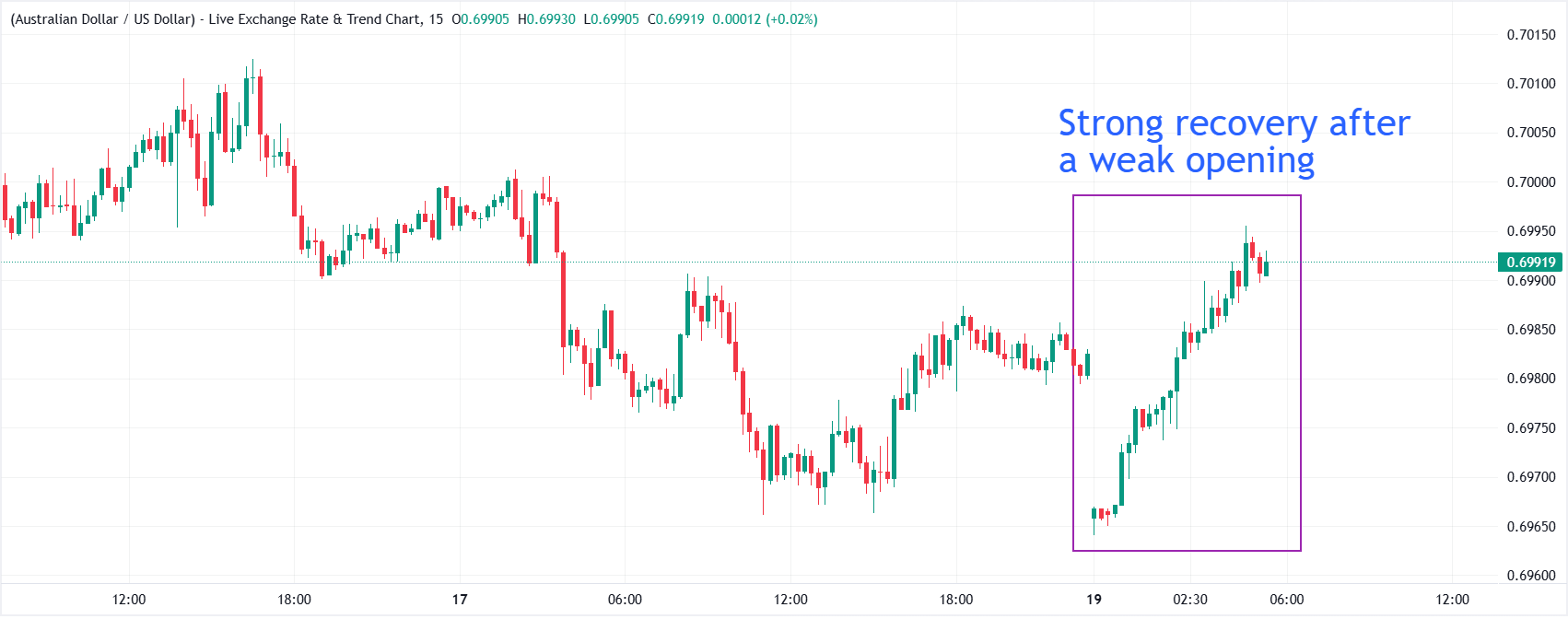
At press time, the US Dollar Index (DXY), which gauges the Greenback’s value against six major currencies, trades marginally lower around 100.70. The USD Index fell sharply after a strong opening move.
According to the CME FedWatch tool, the odds of the Fed leaving interest rates unchanged in the July meeting are 85.6%, up from 65.8% recorded last week. Market participants turned confident that the Fed will maintain the status quo in the July meeting after the release of the United States (US) Consumer Price Index (CPI) data for June, which showed that inflationary pressures cooled down.
On the Australian Dollar front, the currency outperforms its major peers, following the People’s Bank of China’s (PBOC) monetary policy announcement, in which it left Prime Lending Rates (PLRs) unchanged.
AUD/USD technical analysis
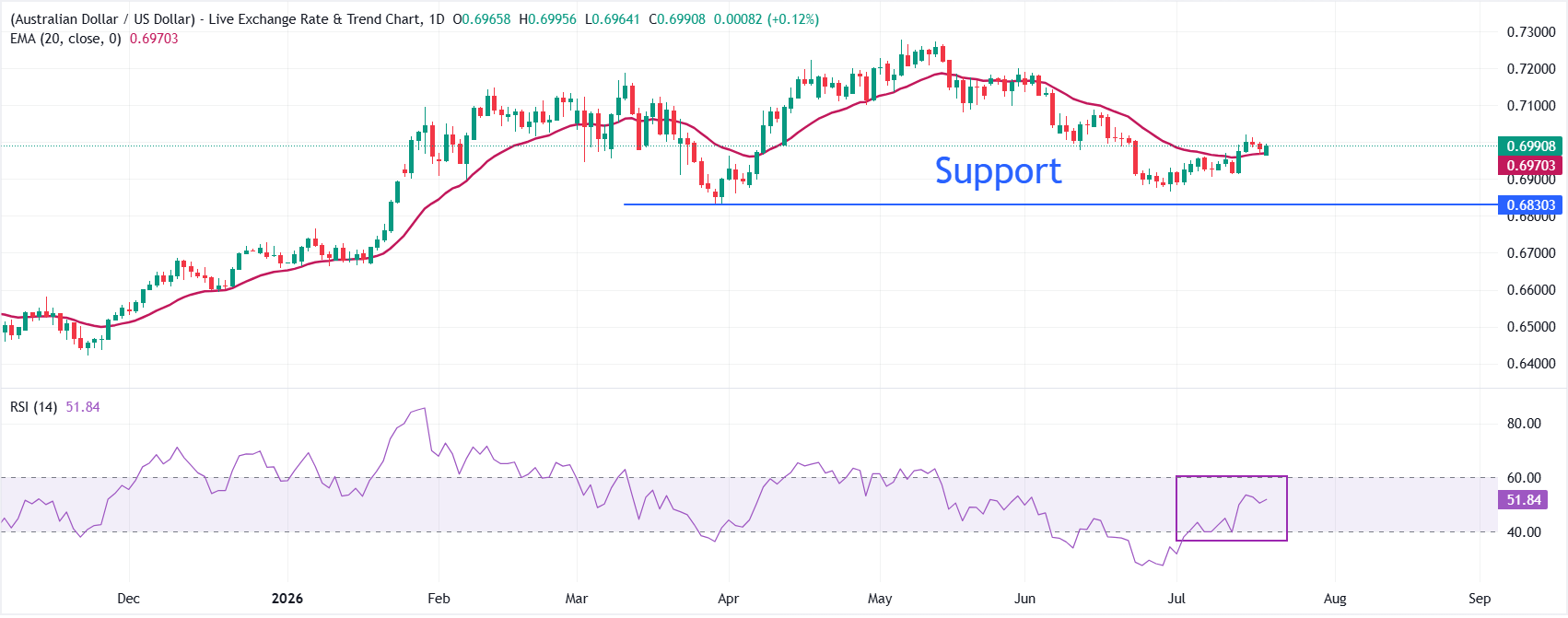
AUD/USD trades higher at around 0.6990 at press time, holding a modestly bullish near-term bias as it extends above the 20-day exponential moving average (EMA) at 0.6970. The pair has reclaimed this short-term trend indicator after its late-June weakness, while the Relative Strength Index (14) at 51.8 sits just above the neutral line, suggesting stabilizing upside momentum rather than aggressive buying pressure.
On the downside, immediate support is located at the 20-day EMA near 0.6970, which is likely to act as the first line of defence on any pullback, followed by the recent price troughs below 0.6950 if sellers regain control. Below 0.6950, the March 30 low at 0.6874 will be the key support level. As long as spot holds above the 0.6970 region on a daily closing basis, the technical tone should remain mildly constructive. Looking up, the pair could extend its advance towards 0.7100 if it manages to break above the July 15 high at 0.7021.

EUR/JPY Price Holds above nine-day EMA support at 185.50
- EUR/JPY may find immediate resistance at the ascending triangle top near 186.10.
- The 14-day Relative Strength Index of 55.33 signals healthy bullish momentum that is not yet overextended.
- The initial support lies at the nine-day EMA at 185.50.
EUR/JPY remains subdued for the third consecutive day, trading around 185.80 during the Asian hours on Monday. The currency cross is holding a constructive bullish bias as it stays above both the nine-day and 50-day Exponential Moving Averages (EMAs), now aligned as nearby dynamic support.
The 14-day Relative Strength Index (RSI) at 55.33 leans to the upside without signalling overbought conditions, suggesting bullish momentum is present but not yet overstretched while price consolidates just under the recent highs.
The daily chart technical analysis shows the EUR/JPY cross is remaining within the ascending triangle, at the top near 186.10. This flat ceiling, combined with shallower dips, signals aggressive buying pressure. A decisive break above the triangle could trigger a powerful bullish continuation, which could expose the all-time high of 187.95, which was recorded on April 17.
On the downside, primary support lies at the nine-day EMA at 185.50, followed by the 50-day EMA at 185.12 and the ascending triangle’s lower boundary around 185.00. A break below the triangle would weaken the bullish bias and put downward pressure on the EUR/JPY cross to navigate the region around the five-month low of 181.87, recorded on March 16, and the seven-month low of 180.81.
Euro Price Today
The table below shows the percentage change of Euro (EUR) against listed major currencies today. Euro was the weakest against the New Zealand Dollar.
| USD | EUR | GBP | JPY | CAD | AUD | NZD | CHF | |
|---|---|---|---|---|---|---|---|---|
| USD | -0.01% | -0.07% | -0.02% | -0.09% | -0.15% | -0.24% | 0.02% | |
| EUR | 0.01% | -0.02% | 0.00% | -0.08% | -0.13% | -0.25% | 0.03% | |
| GBP | 0.07% | 0.02% | 0.02% | -0.06% | -0.11% | -0.21% | 0.04% | |
| JPY | 0.02% | 0.00% | -0.02% | -0.06% | -0.13% | -0.19% | 0.03% | |
| CAD | 0.09% | 0.08% | 0.06% | 0.06% | -0.06% | -0.12% | 0.09% | |
| AUD | 0.15% | 0.13% | 0.11% | 0.13% | 0.06% | -0.08% | 0.18% | |
| NZD | 0.24% | 0.25% | 0.21% | 0.19% | 0.12% | 0.08% | 0.22% | |
| CHF | -0.02% | -0.03% | -0.04% | -0.03% | -0.09% | -0.18% | -0.22% |
The heat map shows percentage changes of major currencies against each other. The base currency is picked from the left column, while the quote currency is picked from the top row. For example, if you pick the Euro from the left column and move along the horizontal line to the US Dollar, the percentage change displayed in the box will represent EUR (base)/USD (quote).