


Dollar Stands Tall on Hawkish Fed Bets
The dollar index traded near 101.5 on Thursday, holding around its highest levels in more than a year as investors continued to price in Federal Reserve interest rate hikes later this year, while awaiting a key inflation report for further direction. Last week, the Fed signaled growing support for tighter monetary policy, with Chair Kevin Warsh reaffirming his commitment to restoring price stability. Those expectations have largely outweighed the impact of progress in US-Iran peace negotiations, which have pushed oil prices back to pre-conflict levels and helped ease inflation concerns. Market participants are now focused on the latest PCE price index report, the Fed’s preferred measure of inflation. Other closely watched releases include final first-quarter GDP figures, May personal income and preliminary durable goods orders data, as well as weekly jobless claims for the period ending June 20.

Australian Dollar Approaches 3- Month Low
The Australian dollar fell further below $0.690, approaching a three-month low as broad US dollar strength outweighed a rebound in domestic employment data. Australia’s economy added 40,300 jobs in May, rebounding from a revised decline of 40,600 in April and exceeding market forecasts for a 30,000 increase, while the unemployment rate edged down to 4.4% from 4.5%, as expected. The latest labor market report comes on top of Wednesday’s mixed consumer inflation figures, which have left markets divided on another interest rate hike, priced in at 50% likely by year’s end rather than at the August meeting. RBA Deputy Governor Andrew Hauser said on Wednesday that the central bank still has more work to do to bring inflation back to its 2-3% target, indicating that further policy tightening may be needed as underlying price pressures remain elevated. Meanwhile, the US dollar remained broadly stronger as investors continued to price in Federal Reserve interest rate hikes later this year.

Offshore Yuan Holds Near 1-Month Low
The offshore yuan steadied around 6.81 per dollar on Thursday, hovering near a one-month low after the People’s Bank of China unveiled plans to introduce overnight reverse repo operations as part of its next phase of monetary policy reform. The central bank said it will conduct overnight reverse repurchase operations on June 29–30, providing fixed-rate overnight liquidity to better address short-term funding needs in the banking system. The new overnight reverse repo rate will complement the existing seven-day rate of 1.4%, bringing the PBOC’s policy toolkit closer in line with major global central banks such as the Federal Reserve. During the Lujiazui Forum, Governor Pan Gongsheng outlined the central bank’s plans to broaden overnight reverse repo operations. Externally, the yuan remained under pressure from a stronger US dollar amid growing market expectations of further Federal Reserve interest rate hikes later this year.

Chart of The Day – EUR/USD Deepens Decline. What’s Next For The Pair?
The U.S. dollar has strengthened significantly in recent days, and hawkish revisions to Federal Reserve projections have become the primary catalyst behind the decline in the world’s most important currency pair. Notably, EUR/USD has continued to fall even though the European Central Bank recently delivered a 25-basis-point rate hike.
This suggests that the move is being driven by more than just interest-rate expectations. Investors are increasingly focused on the divergence between the U.S. and eurozone economies. In the United States, key indicators such as ISM surveys, PMI data, and Nonfarm Payrolls continue to point to relatively solid economic growth. By contrast, the eurozone appears stuck in what could be described as “stable stagnation.” Across Europe, risks remain tilted to the downside due to ongoing disruptions in energy markets and persistent weakness in manufacturing, which remains an important contributor to regional growth.
Today German Ifo Business Climate data at 9 AM GMT can move the pair.
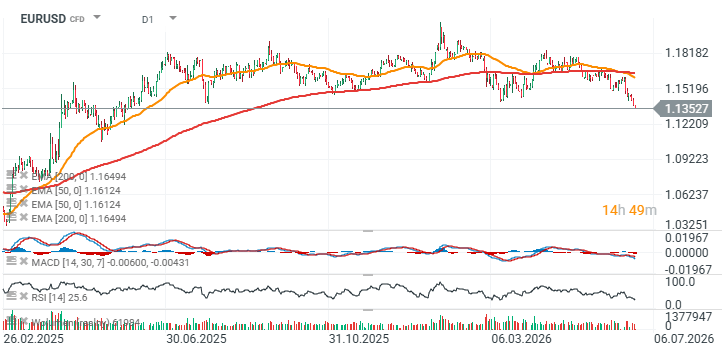
EUR/USD Chart (D1, H1) EUR/USD has fallen toward the 1.135 area, signaling a reversal into a bearish trend. The pair is now trading significantly below the 200-day exponential moving average (EMA200, red line), which is located near 1.16 and reinforced by several important historical price reactions. The pair has now posted nearly five consecutive losing sessions, with the biggest catalyst for the selloff being the Federal Reserve’s shift toward a more hawkish policy outlook.
Source: xStation5
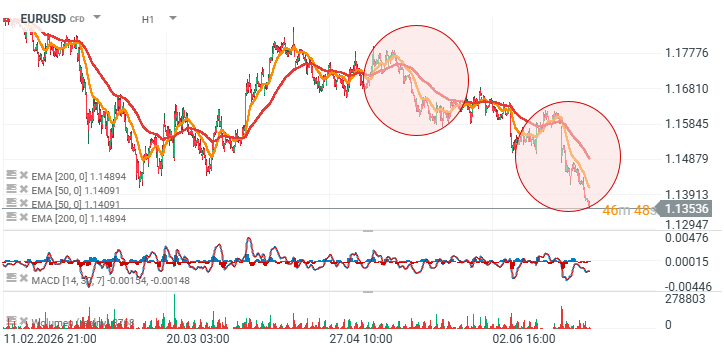
Looking at the hourly timeframe, EUR/USD is currently mirroring the previous correction almost point for point. The key question is whether the strong downside momentum is beginning to fade. If selling pressure starts to ease around current levels, the decline could slow and allow for a rebound toward 1.14, where the 50-period exponential moving average (EMA50, orange line) is currently located.
Source: xStation5

USD/JPY Price – Range tightens further at around 161.60
- USD/JPY consolidates around 161.60 as hawkish BoJ supporting Japanese Yen counters outperforming the US Dollar.
- One BoJ member expects interest rates to rise to 2% as soon as possible.
- BoJ’s Asada, PM Takaichi appointee, voted against the interest rate hike in the policy meeting this month.
The USD/JPY pair trades in a limited range around 161.60 during the European trading session on Wednesday. The pair consolidates as hawkish Bank of Japan (BoJ) bets are supporting the Japanese Yen (JPY) against the US Dollar’s (USD) continued outperformance.
Earlier in the day, the BoJ Summary of Opinions (SoP) of the June meeting showed that a majority of officials favor more interest rate hikes to counter mounting inflation risks. Also, one board member said Japan’s policy rate must be brought closer to the estimated neutral rate of around 2% as soon as possible.
The BoJ SoP also showed that new board member, Toichiro Asada, the appointee of Prime Minister (PM) Sanae Takaichi, voted against the hike, citing downside inflation and employment risks due to the Middle East crisis. In the policy meeting, the BoJ lifted interest rates by 25 basis points (bps) to 1%.
Meanwhile, a Reuters report shows that the BoJ is almost certain to deliver another interest rate hike this year in December.
At press time, the US Dollar Index (DXY), which tracks the Greenback’s value against six major currencies, trades 0.1% higher to near 101.50, the highest level seen in over a year.
USD/JPY technical analysis
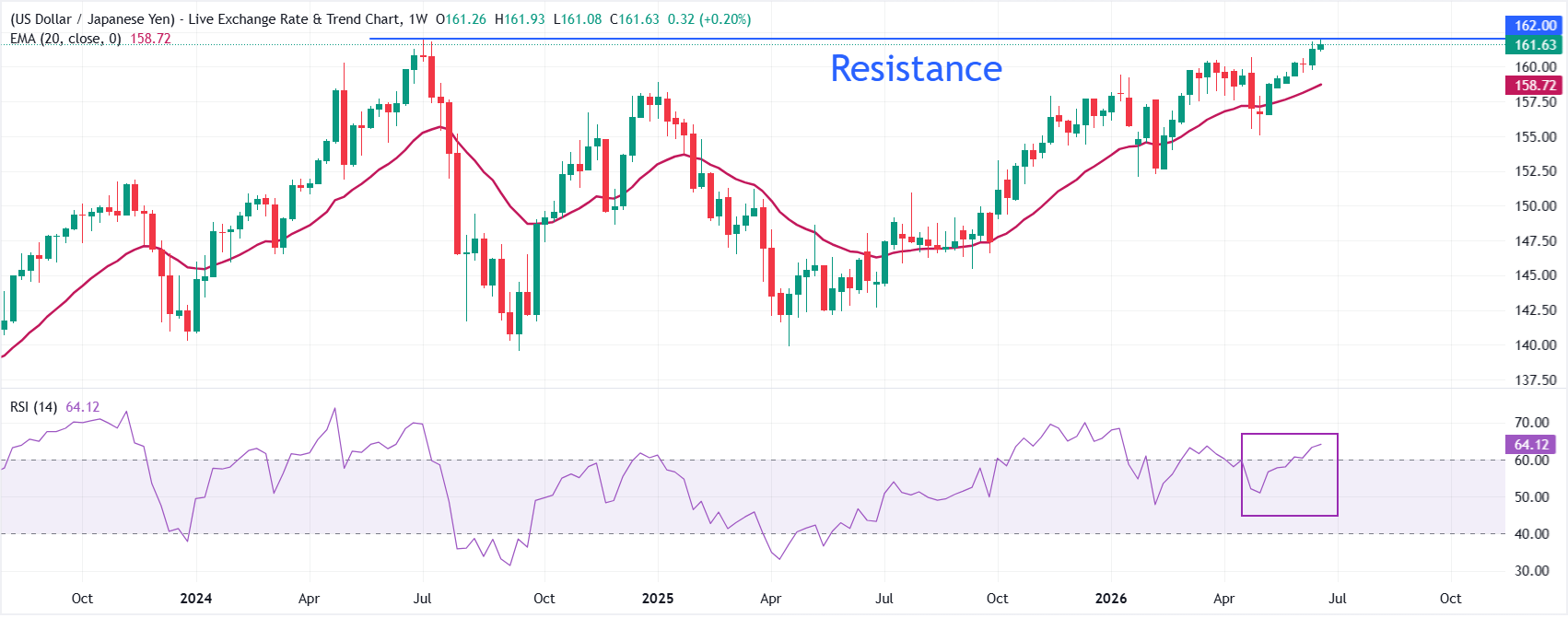
USD/JPY trades flat at around 161.65 at press time. The pair maintains a bullish near-term bias as price holds well above the 20-week exponential moving average (EMA) at 158.72, keeping the broader uptrend intact.
Weekly Relative Strength Index (RSI) at 64.11 stays in positive territory but below overbought levels, suggesting strong yet not extreme upside momentum.
On the downside, immediate support is seen at the round-level 160.00, followed by the 20-week EMA at 158.72. On the upside, the pair would enter uncharted territory if it breaks above the all-time high around 162.00.

EUR/GBP Price – Testing 10-month lows at 0.8611 in risk-off markets
- EUR/GBP depreciates 0.6% so far this week to test 10-month lows in the 0.8610 area.
- A tech rout in stock markets and frictions in the US-Iran peace deal are weighing on risk appetite on Wednesday.
- Momentum indicators suggest that upside attempts are likely to find sellers.
The Euro (EUR) extends losses for the fourth consecutive day against the British Pound (GBP) on Wednesday. The EUR/GBP pair has lost about 0.6% so far this week and is testing the 0.8610 area at the time of writing, its lowest level in the last 10 months.
The Pound sterling seems to be faring better than the Euro amid the risk-off market mood. Stock markets in Asia and the US have been dragged down by sharp declines in tech shares, as investors take profits after a long AI rally, while frictions between the US and Iran regarding nuclear inspections have cast a shadow over the outcome of the peace deal.
On the macroeconomic front, the Bank of England’s (BoE) official, Alan Taylor, stated on Tuesday that an extended hold is the right response to the increase in price pressures and that the bank should be ready to cut rates if a benign scenario plays out. In the Eurozone, the focus on Wednesday will be on German ZEW Business Climate data, which is expected to show a minor improvement in June.
Technical Analysis: Euro remains under significant bearish pressure
EUR/GBP trades at 0.8615 with a bearish near-term tone, holding a few pips above the lows of March 2026 and August 2025, with momentum indicators in most timeframes highlighting strong negative pressure. The 4-hour Relative Strength Index (14) sits just above oversold levels, while the Moving Average Convergence Divergence (MACD) remains slightly negative.
A confirmation below the mentioned 0.8611 would expose the August 2025 bottom, at 0.8595, and the 161.8% Fibonacci extension of Monday’s sell-off, at the 0.8585 area. On the topside, initial resistance appears at Tuesday’s highs of 0.8634, followed by the June 19 low, at 0.8657. A break above these would open the way toward the June 18 and 21 highs, around 8.8680.
(The technical analysis of this story was written with the help of an AI tool.)
Pound Sterling Price Today
The table below shows the percentage change of British Pound (GBP) against listed major currencies today. British Pound was the strongest against the Swiss Franc.
| USD | EUR | GBP | JPY | CAD | AUD | NZD | CHF | |
|---|---|---|---|---|---|---|---|---|
| USD | 0.14% | 0.08% | 0.06% | 0.09% | 0.08% | 0.24% | 0.22% | |
| EUR | -0.14% | -0.06% | -0.07% | -0.06% | -0.06% | 0.06% | 0.09% | |
| GBP | -0.08% | 0.06% | -0.04% | -0.02% | 0.00% | 0.12% | 0.14% | |
| JPY | -0.06% | 0.07% | 0.04% | 0.02% | 0.00% | 0.13% | 0.15% | |
| CAD | -0.09% | 0.06% | 0.02% | -0.02% | -0.01% | 0.10% | 0.15% | |
| AUD | -0.08% | 0.06% | -0.00% | -0.01% | 0.00% | 0.12% | 0.13% | |
| NZD | -0.24% | -0.06% | -0.12% | -0.13% | -0.10% | -0.12% | 0.02% | |
| CHF | -0.22% | -0.09% | -0.14% | -0.15% | -0.15% | -0.13% | -0.02% |
The heat map shows percentage changes of major currencies against each other. The base currency is picked from the left column, while the quote currency is picked from the top row. For example, if you pick the British Pound from the left column and move along the horizontal line to the US Dollar, the percentage change displayed in the box will represent GBP (base)/USD (quote).
Offshore Yuan Hits 1-Month Low
The offshore yuan depreciated to around 6.80 per dollar on Wednesday, hitting its lowest level in a month, as a stronger US dollar continued to weigh on the currency. The greenback remained supported by mounting expectations that the Federal Reserve could raise interest rates in September, with markets now assigning roughly a 70% chance of a rate hike. Further pressure came from the People’s Bank of China, which continued to set the yuan’s daily reference rate at weaker-than-expected levels. The central bank fixed the currency at 6.8195 per dollar on Wednesday, extending its longest streak of weaker fixings since April 2025. Meanwhile, China has effectively halted certain tungsten exports to Japan, while rare-earth magnet shipments fell to a one-year low in May, when Beijing first rolled out its global export-control regime. Such restrictions have remained in place amid tensions over Taiwan-related remarks by Japanese Prime Minister Sanae Takaichi.