ING’s Chris Turner says the Bank of Japan’s 25 bp hike to 1.00% is no game-changer for the Japanese Yen, as policy remains accommodative and real rates stay comfortably negative. With markets not expecting another hike until December, USD/JPY is seen skewed toward a retest of 160.70 and possibly 161/162, where further BoJ FX intervention is anticipated.
Accommodative stance keeps Yen vulnerable
“As expected, the BoJ today hiked the policy rate by 25bp to 1.00%.”
“The market thinks the next follow-up hike will not emerge until December.”
“This leaves Japan with comfortably negative real interest rates and leaves the yen as a funding currency if volatility slows even more this summer and renewed interest emerges in the carry trade.”
“Tomorrow’s FOMC meeting will also have a strong say in where USD/JPY goes from here.”
“So far, FX intervention has been ineffective and until it becomes clear that the dollar is ready to turn lower, USD/JPY looks skewed to a retest of this year’s 160.70 high, with risks to the 161/162 area, where more BoJ intervention shoul
The Reserve Bank of Australia (RBA) left its cash rate unchanged at 4.35% , ending a streak of three consecutive rate hikes and opting for its first pause of the year. The decision was widely expected and unanimous, but the tone of the statement remained clearly cautious. The RBA emphasized that inflation is still too high and warned that further monetary tightening remains possible if price pressures fail to ease.
Inflation remains the main concern
The RBA noted that inflation accelerated noticeably in the second half of 2025, partly due to growing demand and supply-side pressures in the economy. Although CPI inflation declined to 4.2% in April , it remains well above the RBA’s 2–3% target range , while underlying inflation also remains elevated. Key inflation risks include:
Higher fuel and energy prices feeding through into transportation, food, construction materials, and services costs.
Businesses passing higher input costs on to consumers.
Persistently high inflation in the services sector.
Wage pressures, including recent increases in the minimum wage and regulated salaries.
Uncertainty regarding the pace of normalization in global oil supplies.
The RBA’s primary concern is that the energy-driven inflation shock could become entrenched.
Slowing economy gives the RBA room to pause
The main argument for keeping rates unchanged was weaker economic activity data. Australia’s economy expanded by just 0.3% q/q in the first quarter , compared with 0.9% in Q4 2025 , largely due to softer consumer spending. Households are facing increasing pressure from higher mortgage repayments, rising living costs, and declining savings. The labor market has also started to cool. The unemployment rate rose to 4.5% , its highest level in several years, although the RBA noted that broader labor market indicators remain relatively resilient. At the same time, the slowdown is not yet severe enough to justify a shift in policy direction.
Monetary policy outlook: a pause, not a pivot toward easing
The RBA’s message is clear: the current decision represents a pause to assess incoming data, not the end of the tightening cycle. In other words, it is a classic
hawkish hold :
Interest rates remain at 4.35% .
The RBA wants to assess the impact of previous rate hikes.
Inflation remains too high to consider easing policy.
Oil and energy prices remain significant upside risks to inflation.
Further rate hikes remain possible if price pressures prove persistent.
Nevertheless, most major Australian banks expect rates to remain at 4.35% , with potential rate cuts not arriving until 2027 . Westpac remains the most hawkish, forecasting two additional rate hikes this year , which would lift the cash rate to 4.85% .
AUD reaction
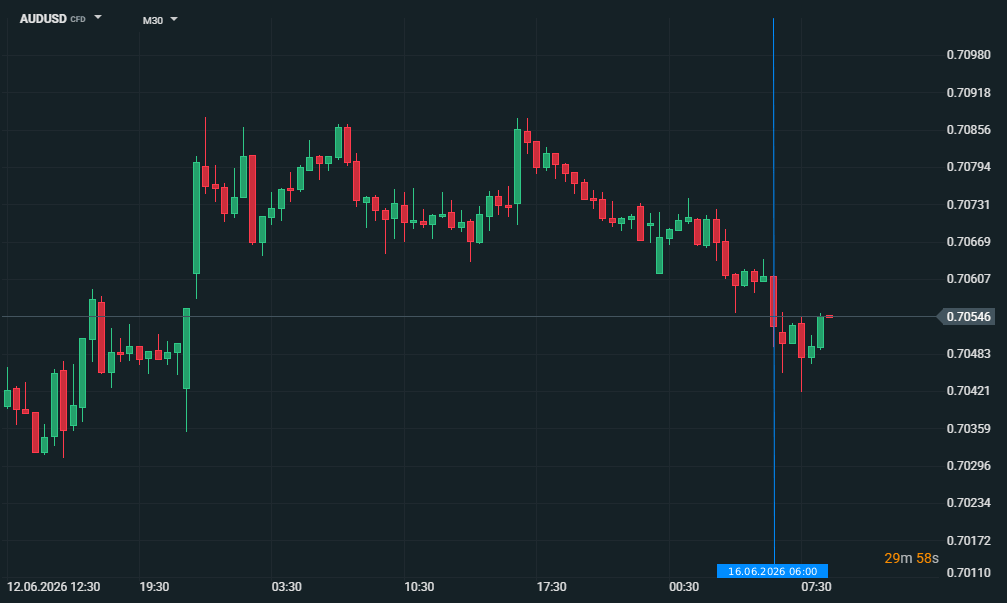
The Australian dollar weakened following the RBA decision, suggesting that investors interpreted the rate hold as reducing the near-term probability of another hike. AUDUSD fell from around 0.7060 to 0.7050 immediately after the announcement, losing approximately 0.3% on the day . The reaction was relatively modest because the decision itself was fully anticipated by markets. However, the decline in the currency indicates that investors placed greater weight on the pause and signs of economic slowing than on the RBA’s warnings that further rate increases remain possible.
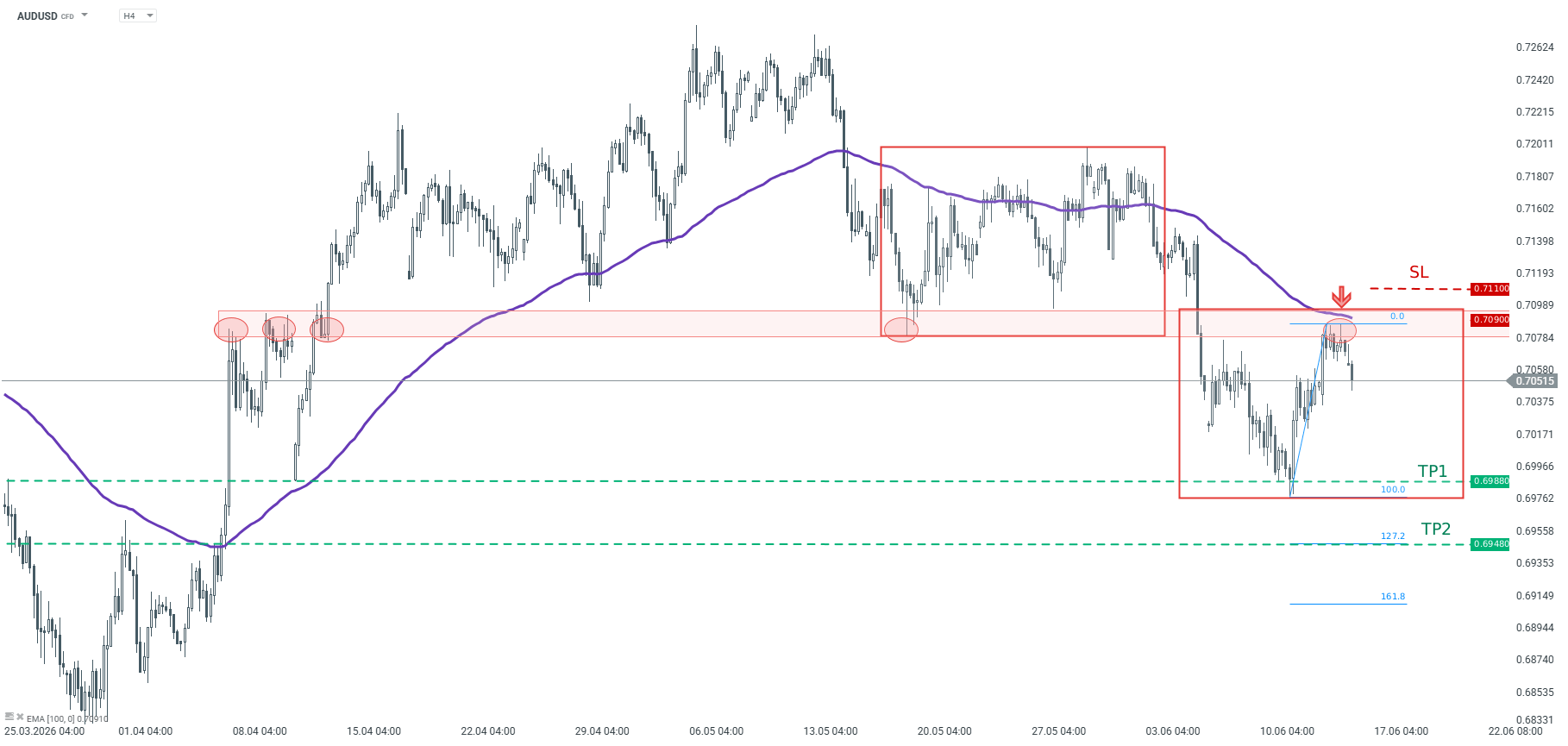
The pair bounced off the key resistance area near 0.7090 Short – term trend remains downward from the mid-May
Recommendation:
Trade: Short position on AUDUSD at market price Target: 0.6988, 0.6948 Stop: 0.7110
Opinion:
AUDUSD has been trading in a downward move recently. Looking at the H4 interval, one can see that the price bounced off the key 0.7090 resistance area. Red area near 0.7090 handle on the chart below is marked with previous price reactions, 100-period moving average from H1 interval, as well as upper limit of 1:1 structure. Taking this into account, continuation of the downward move looks to be the base case scenario for now. We recommend going short AUDUSD at market price with two targets: 0.6988 and 0.6948. We also recommend placing a stop loss order at 0.7110.
NZD/USD weakens as broad caution and a steady US Dollar kept investors defensive ahead of updates on Iran’s nuclear program.
Fed is widely expected to keep interest rates unchanged at 3.50% to 3.75% in June.
China’s Retail Sales fell 0.6% year-on-year in May, missing expectations of a flat reading.
NZD/USD extends its losses for the third consecutive day, trading around 0.5810 during the Asian hours on Tuesday. The pair depreciates as the US Dollar (USD) holds steady amid broad market caution. Investors remain on the defensive as they await further updates regarding Iran’s unresolved nuclear program.
Both Washington and Tehran have not released the official text of the agreement; major shipping lines are delaying vessel rerouting through the strategic waterway until full transparency is established.
Even though US President Donald Trump announced that a memorandum of understanding (MoU) has been signed to end the conflict and reopen the blockaded Strait of Hormuz, market participants remain deeply cautious. According to Iran’s semi-official Mehr news agency, the current draft calls for the strait to reopen within 30 days under Iranian arrangements.
The Federal Reserve (Fed) is widely expected to keep its benchmark interest rate unchanged at a target range of 3.50% to 3.75% on Wednesday, which could be attributed to the higher US inflation due to elevated energy prices linked to Middle East tensions. Traders will be closely monitoring the press conference for cues on how new Fed Chair Kevin Warsh intends to lead the central bank into its next era.
The New Zealand Dollar (NZD) struggles following a wave of weak economic data out of China. Because China is New Zealand’s largest trading partner, buying roughly one-third of all Kiwi goods exports, the New Zealand Dollar acts as a primary liquid proxy for the Chinese economy.
China’s domestic demand slumped sharply in May, with Retail Sales contracting by 0.6% year-on-year against expectations of a flat reading. Additionally, Fixed Asset Investment dropped at a faster pace of -4.1%, failing to meet the projected -2%. While Industrial Production offered a minor bright spot by coming in stronger-than-expected at 4.5%.
The Indian Rupee trades firmly against the US Dollar due to multiple tailwinds.
Lower oil prices and signs of improvement in FIIs sentiment towards the Indian stock market have strengthened the Indian Rupee.
The Fed is expected to leave interest rates steady on Wednesday.
The Indian Rupee (INR) opens firmly against the US Dollar (USD) on Tuesday. The USD/INR pair trades lower around 94.58 as lower oil prices due to the successive reopening of the Strait of Hormuz, following the signing of a peace deal between the United States (US) and Iran, and signs of improvement in sentiment of overseas investors towards the Indian stock market have strengthened the Indian Rupee.
In the opening session, the MCX Crude Oil contract expiring on June 18 rises slightly to near 7,640, but is close to its over eight-week low of 7,550 posted on Monday.
Currencies from economies, such as India, which rely heavily on oil imports to meet their energy needs, tend to outperform when oil prices remain lower.
US-Iran signs peace deal
On Monday, US President Donald Trump announced that a peace deal with Iran had signed and the Strait of Hormuz had fully reopened. Trump added that details of the deal will be released shortly, but confirmed that Tehran won’t have nuclear weapons.
Investors await details of the deal to get clarification regarding whether Hormuz remains toll-free or not. The resumption of normal traffic will keep oil prices lower, a scenario that will be favorable for the Indian currency.
FIIs turns of net buyers for first time in June
On Monday, Foreign Institutional Investors (FIIs) emerged as net buyers in the Indian stock market for the first time in June after diluting their stake worth Rs. 46,430.42 crore in the first two weeks. The sentiment of foreign investors towards the Indian equity market appears to have improved due to the US-Iran peace deal signing, which has eased the global risk-off impulse. In Monday’s session, FIIs bought shares worth Rs. 200.05 crore.
Investors await two-day Fed policy meeting
This week, the major trigger for the US Dollar will be the Federal Reserve’s (Fed) monetary policy announcement on Wednesday. According to the CME FedWatch tool, the Fed is certain to leave interest rates unchanged in the 3.50%-3.75%.
Investors will pay close attention to the Fed’s monetary policy guidance under the new Chairman Kevin Warsh, and interest and economic projections in the near-to-longer term.
US President Trump has provided significant breathing room to Chairman Warsh by giving him a free hand on decision-making, stating in recent days that he wants him to “do whatever he wants” and “be totally independent”, CNBC reported. While Trump was seen criticizing former Chairman Jerome Powell numerous times for not reducing interest rates quickly, despite inflationary pressures remaining higher.
Technical Analysis: USD/INR stays below 20-day EMA
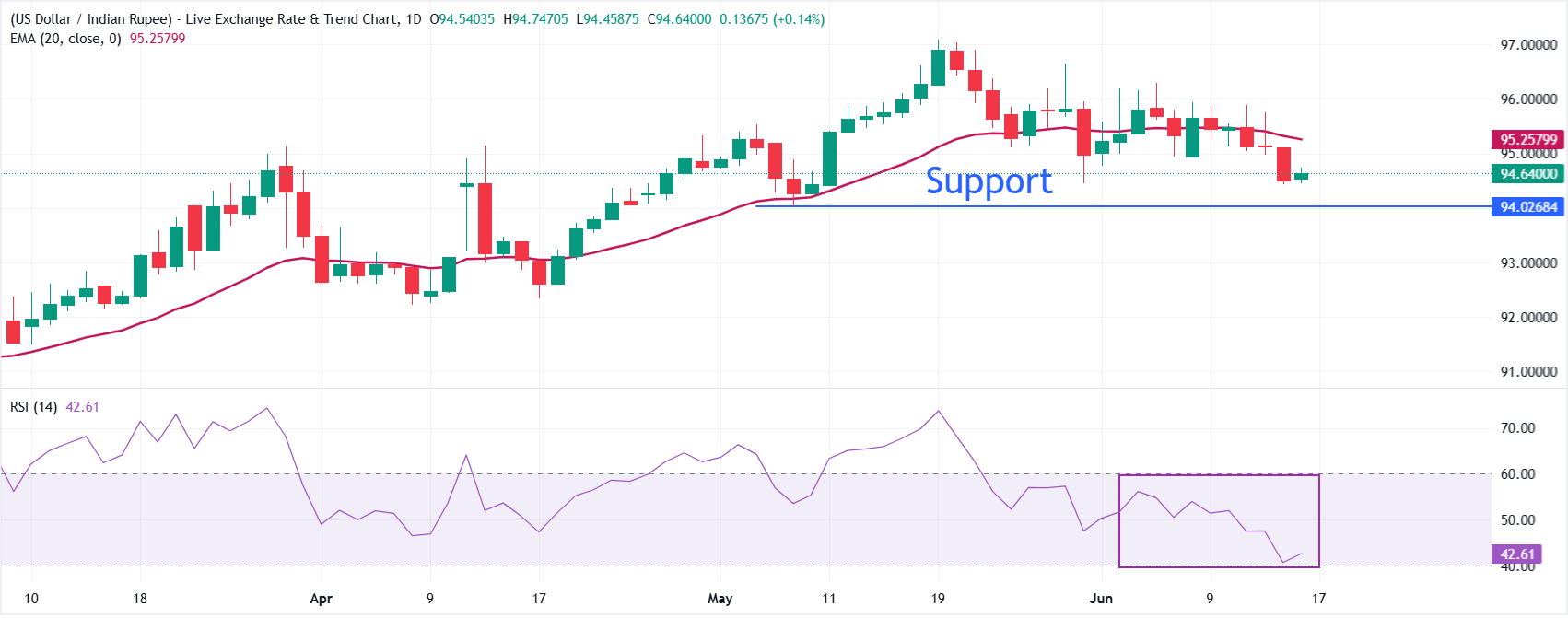
USD/INR trades weakly at around 94.58, extending a corrective phase below its 20-day exponential moving average (EMA) at 95.2580, which now acts as the first topside barrier and keeps the near-term bias tilted lower.
The Relative Strength Index (RSI) at 42.6 remains below the midline, suggesting waning bullish momentum and leaving the pair vulnerable while it holds under the short-term EMA cap.
On the topside, a daily close above the 20-day EMA around 95.26 would be needed to ease immediate downside pressure and open the way for a more sustained rebound towards 96.00. Looking down, the pair could extend the decline to the May 7 low at 94.03 if it fails to hold the June 15 low at 94.43.
AUD/USD remains subdued as the RBA held its Official Cash Rate steady at 4.35%, matching market expectations.
China’s Retail Sales fell 0.6% year-on-year in May, missing expectations of a flat reading.
Traders price in the odds of the Fed holding interest rates steady at 3.50% to 3.75% this Wednesday.
AUD/USD pares its recent gains from the previous day, trading around 0.7050 during the Asian hours. The pair remains subdued as the Australian Dollar (AUD) struggles to shake off losses following the Reserve Bank of Australia’s (RBA) latest monetary policy update.
As widely anticipated by the market, the RBA decided to keep its Official Cash Rate (OCR) unchanged at 4.35% during its Tuesday meeting. The decision offered few surprises and lacked the hawkish spark needed to lift the currency, leaving the Australian Dollar highly sensitive to outside economic pressures.
Compounding the pressure on the AUD is a wave of weak economic data out of China. Because Australia’s economy relies heavily on commodity exports to Beijing, negative developments in China routinely drag down the antipodean currency.
China’s domestic demand slumped sharply in May, with Retail Sales contracting by 0.6% year-on-year against expectations of a flat reading. Additionally, Fixed Asset Investment dropped at a faster pace of -4.1%, failing to meet the projected -2%. While Industrial Production offered a minor bright spot by coming in stronger-than-expected at 4.5%, the overall data packet highlighted an uneven recovery that is weighing heavily on Aussie trader sentiment.
Meanwhile, the US Dollar (USD) is holding steady as broad market caution keeps investors on the defensive. Geopolitical anxieties persist around Iran’s unresolved nuclear program, keeping risk appetite low. Even though US President Donald Trump announced that a memorandum of understanding has been signed to end the regional conflict and reopen the blockaded Strait of Hormuz, market participants remain deeply skeptical because neither Washington nor Tehran has released the official text of the agreement. This ongoing uncertainty has driven defensive flows into the safe-haven greenback.
Looking ahead, the Federal Reserve (Fed) is universally expected to keep its benchmark interest rate unchanged at a target range of 3.50% to 3.75% on Wednesday. Elevated energy prices stemming from the Middle East tensions have kept US inflation sticky, giving the central bank reason to hold steady. Market participants will be intensely focused on the upcoming press conference for crucial clues on how the new Fed Chair, Kevin Warsh, intends to guide the central bank and shape monetary policy in this new era.
The Australian Dollar retreats to near 1.2150 against the New Zealand Dollar after the RBA’s monetary policy announcement.
The RBA has left its OCR steady at 4.35% after three back-to-back interest rate hikes.
The Australian central bank has stated that short-term measures of inflation expectations have eased.
The Australian Dollar (AUD) falls back to near 1.2150 from its intraday high of 1.2168 against the New Zealand Dollar (NZD) after the Reserve Bank of Australia’s (RBA) monetary policy announcement. The Australian central bank has announced a pause on its monetary-tightening cycle by leaving the Official Cash Rate (OCR) steady at 4.35%, as expected.
In all three policy announcements so far this year, the RBA raised interest rates by 25 basis points (bps).
The RBA was expected to leave interest rates unchanged as latest Australian inflation data showed that the Consumer Price Index (CPI) has started cooling down and employment conditions appear to be worsening.
In April, Australia’s CPI arrived lower at 4.2% Year-on-Year (YoY), missed 4.4% estimates and the prior reading of 4.6%. The Unemployment Rate jumped to 4.5% from expectations and the previous reading of 4.3%.
In the monetary policy statement, the RBA has stated that short-term measures of inflation expectations have eased, but remain higher than earlier in the year. On external shocks, the RBA said, “Global oil supply issues will take some time to resolve, maintaining upward pressure on global energy prices and inflation.”
In New Zealand (NZ), investors await the Q1 Gross Domestic Product (GDP) data, which will be released on Thursday. The NZ economy is expected to have expanded at a stronger pace of 0.9% against the previous reading of 0.2%.
USD/CHF appreciates as the US Dollar remains stronger amid market caution ahead of further US-Iran peace talk updates.
Traders price in the odds of the Fed holding interest rates steady at 3.50% to 3.75% this Wednesday.
Money markets expect the Swiss National Bank to keep interest rates unchanged through the end of the year.
USD/CHF gains ground after registering modest losses in the previous day, trading around 0.7950 during the Asian hours on Tuesday. The pair appreciates as the US Dollar (USD) holds steady amid broad market caution. Investors remain on the defensive as they await further updates regarding Iran’s unresolved nuclear program.
Both Washington and Tehran have not released the official text of the agreement; major shipping lines are delaying vessel rerouting through the strategic waterway until full transparency is established.
Even though US President Donald Trump announced that a memorandum of understanding (MoU) has been signed to end the conflict and reopen the blockaded Strait of Hormuz, market participants remain deeply cautious. According to Iran’s semi-official Mehr news agency, the current draft calls for the strait to reopen within 30 days under Iranian arrangements.
The Federal Reserve (Fed) is widely expected to keep its benchmark interest rate unchanged at a target range of 3.50% to 3.75% on Wednesday, which could be attributed to the higher US inflation due to elevated energy prices linked to Middle East tensions. Traders will be closely monitoring the press conference for cues on how new Fed Chair Kevin Warsh intends to lead the central bank into its next era.
Sharp declines in oil prices have helped alleviate inflationary pressures, reducing expectations for further monetary tightening. Consequently, money markets are now pricing in no additional interest rate changes from the Swiss National Bank (SNB) for the remainder of the year.
This aligns with the latest data showing Swiss Producer and Import Prices fell 1.8% year-on-year in May. While this marks the softest pace of deflation in five months, easing from April’s 2.0% decline due to slower drops in import prices, the monthly figures caught markets off guard. On a month-over-month basis, the price index fell 0.4%, missing forecasts for a 0.4% increase and reversing April’s 0.8% gain.
To provide the best experiences, we use technologies like cookies to store and/or access device information. Consenting to these technologies will allow us to process data such as browsing behavior or unique IDs on this site. Not consenting or withdrawing consent, may adversely affect certain features and functions.
Functional
Always active
The technical storage or access is strictly necessary for the legitimate purpose of enabling the use of a specific service explicitly requested by the subscriber or user, or for the sole purpose of carrying out the transmission of a communication over an electronic communications network.
Preferences
The technical storage or access is necessary for the legitimate purpose of storing preferences that are not requested by the subscriber or user.
Statistics
The technical storage or access that is used exclusively for statistical purposes.The technical storage or access that is used exclusively for anonymous statistical purposes. Without a subpoena, voluntary compliance on the part of your Internet Service Provider, or additional records from a third party, information stored or retrieved for this purpose alone cannot usually be used to identify you.
Marketing
The technical storage or access is required to create user profiles to send advertising, or to track the user on a website or across several websites for similar marketing purposes.