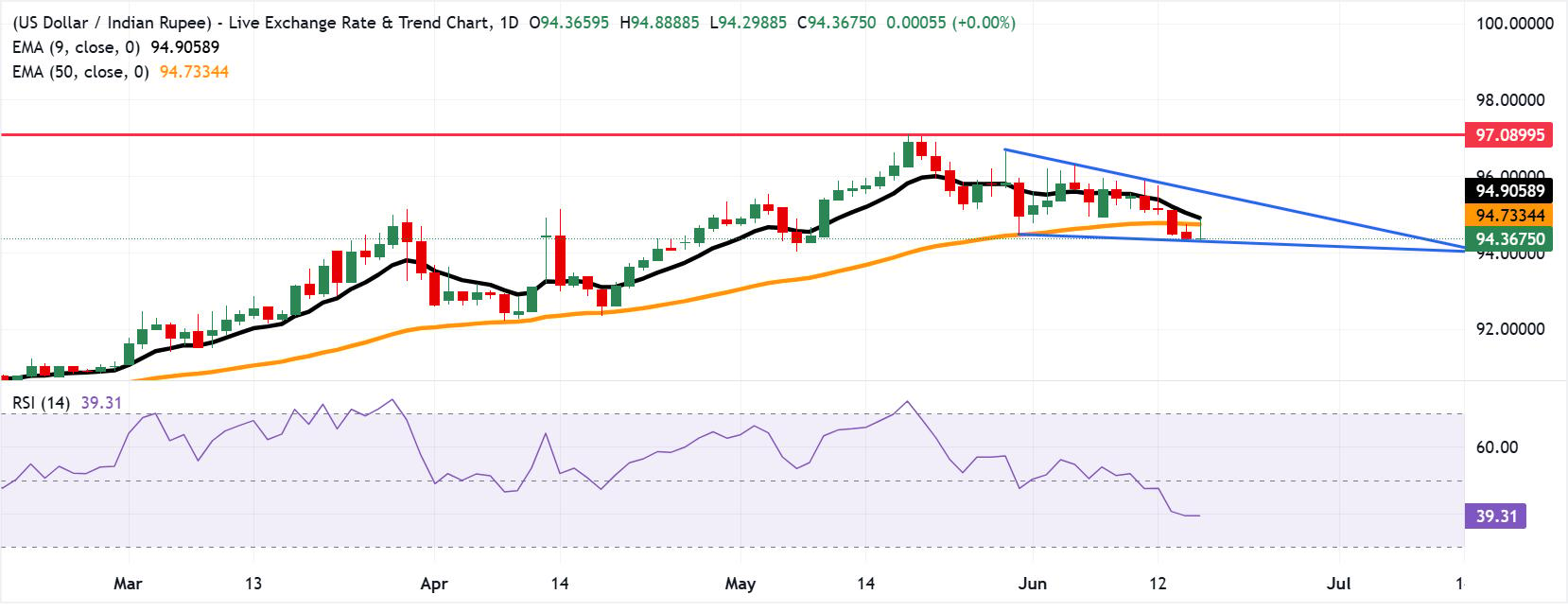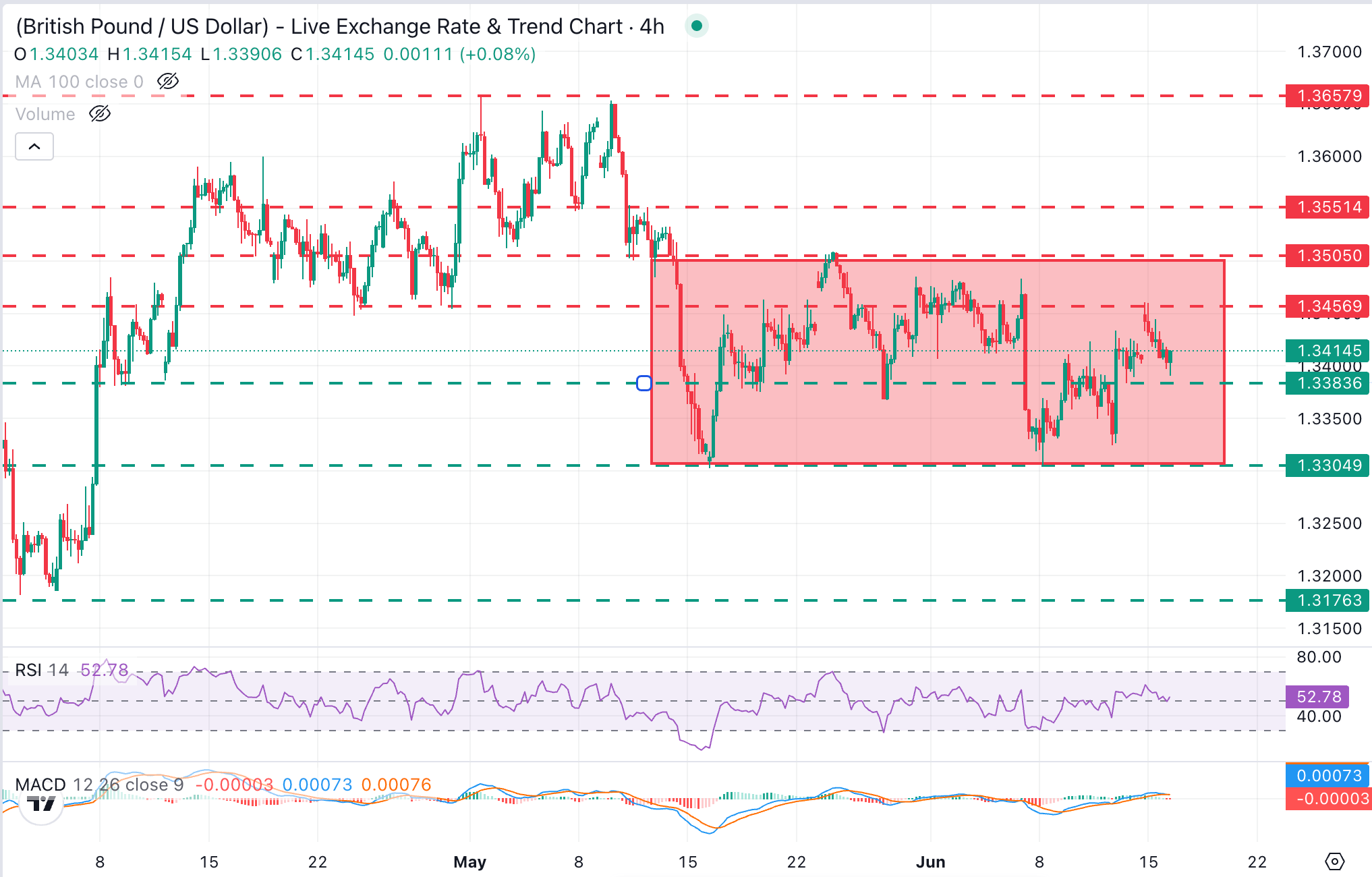


The Mexican peso strengthened 0.3% on Friday, trading around 17.31 as markets focused on geopolitical developments, including USโIran negotiations. Uncertainty in the Middle East, particularly risks around the Strait of Hormuz, continues to support a geopolitical risk premium. The US dollar remains under pressure as US inflation stays broadly in line with expectations and the Federal Reserve maintains a cautious, data-dependent stance, limiting Treasury yield upside. At the same time, resilient but uneven US growth keeps markets balanced between inflation and slowdown risks. Risk appetite supports emerging market currencies, with the peso benefiting from strong carry appeal and a wide interest rate differential versus the US. USD/MXN is down 14.79% this year, reflecting dollar weakness and sustained inflows into Mexican assets.
Currency Talk – GBP/USD, AUD/NZD, USD/CHF
This analysis from the Overbalance series aims to identify three financial instruments, analyzed primarily on the daily/four-hour (D1/H4) timeframe. The analysis relies solely on the Overbalance methodology, which helps determine points where a trend may continue or where a reversal might occur.
Todayโs analysis covers three instruments, evaluated solely in terms of 1:1 correction structures.
GBPUSD
The GBPUSD price has broken its downward trend by rising above the 1.3360 level, which, according to the Overbalance methodology, paves the way for a larger upward correction or even a trend reversal. Currently, the 1.3360 levelโthe upper boundary of the negated 1:1 geometryโserves as key support. Conversely, for a return to the downtrend, the price would also need to fall below the 1.3315 level, where the lower boundary of the local 1:1 uptrend pattern is located.

GBPUSD – H4 chart. Source: xStation
AUDNZD
The AUDNZD pair has been in an uptrend for quite some time. The latest correction was exactly the same size as the previous ones, marked by the green rectangle. We are currently observing a local corrective move. If the correction continues, key support based on the Overbalance methodology is at the 0.6992 level, where the lower boundary of the 1:1 pattern is located. As long as the price remains above this level, the uptrend remains in effect.

AUDNZD – H4 timeframe. Source: xStation
USDCHF
USDCHF prices have been trending downward for quite some time, but since late January we have seen a dynamic upward correction. Currently, the price has rebounded from a key resistance level at 0.8042, where the upper boundary of the largest 1:1 pattern is located, which, according to the Overbalance methodology, may signal a return to the downtrend. For this scenario to be confirmed, the price should sustainably fall below the 0.7902 level, where the lower boundary of the smaller pattern is located. In that case, a acceleration of the decline toward recent lows would be possible. Conversely, a break above the 0.8042 level would open the way for further gains.

USDCHF – H4 timeframe. Source: xStation
The material on this page does not constitute financial advice and does not take into account your level of understanding, investment objectives, financial situation or any other specific needs. All information provided, including opinions, market research, mathematical results and technical analyzes published on the Website or transmitted To you by other means, it is provided for information purposes only and should in no way be construed as an offer or solicitation for a transaction in any financial instrument, nor should the information provided be construed as advice of a legal or financial nature on which any investment decisions you make should be based exclusively To your level of understanding, investment objectives, financial situation, or other specific needs, any decision to act on the information published on the Website or sent to you by other means is entirely at your own risk if you In doubt or unsure about your understanding of a particular product, instrument, service or transaction, you should seek professional or legal advice before trading. Investing in CFDs carries a high level of risk, as they are leveraged products and have small movements Often the market can result in much larger movements in the value of your investment, and this can work against you or in your favor. Please ensure you fully understand the risks involved, taking into account investments objectives and level of experience, before trading and, if necessary, seek independent advice.
CAD declines as oil prices ease, US Dollar gains
- USD/CAD rises as the commodity-linked Canadian Dollar weakens amid falling oil prices.
- WTI drops over 11.5% this week after the USโIran agreed to a two-week ceasefire, easing supply concerns.
- US official confirms LebanonโIsrael talks will be held next week in Washington, DC.
USD/CADย gains ground after four days of losses, trading around 1.3820 during the Asian hours on Friday. The pair appreciates as the commodity-linked Canadian Dollar (CAD) struggles amid lower oil prices, given Canadaโs status as the largest crude exporter to the United States (US).
West Texas Intermediate (WTI) oil price holds losses after experiencing volatility, trading around $91.80 per barrel at the time of writing. The WTI price is down by over 11.5% for the week, at the time of writing, after the US and Iran agreed to a two-week ceasefire.
However, crude oil prices may regain ground as Israeli strikes on Lebanon and the ongoing closure of the Strait of Hormuz strain diplomatic efforts. Israeli Prime Minister Benjamin Netanyahu said that there is โno ceasefire in Lebanonโ and Israel would continue โto strike Hezbollah with full forceโ as the countryโs military launched fresh strikes.
Reuters reported that a US State Department official confirmed that talks between Lebanon and Israel will take place next week in Washington, DC. โWe can confirm that the Department will host a meeting next week to discuss ongoing ceasefire negotiations with Israel and Lebanon,โ said a US official.
US Federal Reserveโs (Fed) March Meeting Minutes suggest the central bank remains in a wait-and-see stance, while acknowledging that inflationary risks linked to higher oil prices are becoming more balanced. Traders await the US Consumer Price Inflation (CPI) report due later in the North American session.
EUR/JPY Price Eyes upper ascending channel boundary near 186.50
- EUR/JPY may rise toward the 186.50 level near the ascending channelโs upper boundary.
- The Relative Strength Index stands at 65.55, indicating strong upward momentum.
- The initial support appears at the nine-day EMA of 184.94.
EUR/JPY extends its gains for the second successive day, trading around 186.10 during the Asian hours on Friday. The technical analysis of the daily chart indicates the currency cross is trending higher within an ascending channel, signaling a persistent bullish bias.
The EUR/JPY cross extends its advance above both the nine-day and 50-day Exponential Moving Averages (EMAs), which reinforce a constructive bullish bias. The rising Relative Strength Index (RSI) at 65.55 sits just below overbought territory, suggesting firm upward momentum.
The EUR/JPY cross may target the immediate resistance at the upper boundary of the ascending channel around 186.50. A break above the channel would reinforce the bullishย outlookย and open the door toward the all-time high of 186.88, recorded on January 23.
On the downside, the primary support lies at the nine-day EMA of 184.94. A move below this level could weaken the short-term price momentum, exposing the 50-day EMA at 183.76, followed by the channelโs lower boundary around 183.60. A break below this confluence support zone would cause the emergence of the bearish bias and open the doors for the EUR/JPY cross to navigate the region around a four-month low of 180.81, recorded on February 12.
(The technical analysis of this story was written with the help of an AI tool.)
Euro Price Today
The table below shows the percentage change of Euro (EUR) against listed major currencies today. Euro was the strongest against the Australian Dollar.
| USD | EUR | GBP | JPY | CAD | AUD | NZD | CHF | |
|---|---|---|---|---|---|---|---|---|
| USD | 0.03% | 0.07% | 0.10% | 0.04% | 0.19% | 0.17% | 0.05% | |
| EUR | -0.03% | 0.05% | 0.09% | -0.01% | 0.17% | 0.14% | 0.02% | |
| GBP | -0.07% | -0.05% | 0.04% | -0.03% | 0.11% | 0.10% | -0.10% | |
| JPY | -0.10% | -0.09% | -0.04% | -0.07% | 0.09% | 0.03% | -0.15% | |
| CAD | -0.04% | 0.00% | 0.03% | 0.07% | 0.13% | 0.12% | -0.07% | |
| AUD | -0.19% | -0.17% | -0.11% | -0.09% | -0.13% | -0.02% | -0.22% | |
| NZD | -0.17% | -0.14% | -0.10% | -0.03% | -0.12% | 0.02% | -0.20% | |
| CHF | -0.05% | -0.02% | 0.10% | 0.15% | 0.07% | 0.22% | 0.20% |
The heat map shows percentage changes of major currencies against each other. The base currency is picked from the left column, while the quote currency is picked from the top row. For example, if you pick the Euro from the left column and move along the horizontal line to the US Dollar, the percentage change displayed in the box will represent EUR (base)/USD (quote).
USD/CHF Softens to near 0.7900 with rangebound tone ahead of US CPI release
- USD/CHF weakens to around 0.7905 in Fridayโs early European session.ย
- Further consolidation cannot be ruled out as the pair remains capped below the Bollinger Bandsโ 20-day SMA, with neutral RSI.ย
- The immediate resistance level emerges at 0.7930; the initial support level is seen at 0.7895.ย
- The US March CPI inflation report is due later on Friday.ย
The USD/CHF pairย loses ground to near 0.7905 during the early European session on Friday. A fragile two-week ceasefire between theย United States (US)ย andย Iran provides some support to a safe-haven currency such as the Swiss Franc (CHF) against the US Dollar (USD).ย
Ahead of the US and Iran talks in Pakistan, Israel continues to bombard Lebanon after killing more than 300 people and injuring at least 1,150 in a single day of strikes across the country on Wednesday. Earlier Friday, Israeli Prime Minister Benjamin Netanyahu said that there is โno ceasefire in Lebanonโ and Israel would continue โto strike Hezbollah with full forceโ as the countryโs military launched fresh strikes.
Traders will closely monitor the US Marchย Consumer Price Indexย (CPI) inflation report later on Friday. The headline CPI is projected to see a rise of 3.3% YoY in March, compared to 2.4% in February, driven by soaring oil prices due to the Middle East war. Any signs of hotter inflation in the US could boost the Greenback against the CHF in the near term.ย
Technical Analysis:
In the daily chart, USD/CHF is hovering just above the 100-day exponential moving average (EMA) at 0.7893, which lends nearby support, but it remains capped by the Bollinger Bandsโ 20-day simple moving average around 0.7932, keeping the broader tone neutral and range-bound. The Relative Strength Index (RSI) at 49 is essentially flat, hinting that directional conviction is lacking after the recent pullback from higher levels.
On the topside, initial resistance is located at the Bollinger midline/20-day SMA near 0.7930, with a break there exposing the upper Bollinger band at roughly 0.8032 as the next hurdle. On the downside, immediate support is seen at the 100-day EMA at 0.7895; a clear break below this level would open the way toward the lower Bollinger band support around 0.7832, where buyers could look to defend the broader range.
EUR/USD – Bears seem hesitant as breakout above 1.1670 remains in play
- EUR/USD consolidates its weekly gains as Hormuz risks offer some support to the US Dollar.
- The downside remains cushioned as traders await the latest US consumer inflation figures.
- The technical setup favors bulls and backs the case for an extension of the weekly uptrend.
The EUR/USD pair struggles to capitalize on its weekly gains registered over the past four days and trades with a mild negative bias below the 1.1700 mark during the Asian session on Friday. The downside, however, remains cushioned amid the lack of any meaningful US Dollar (USD) buying and ahead of the US consumer inflation figures, due later today.
In the meantime, tensions around the Strait of Hormuz offer some support to Crude Oil prices, fueling inflationary concerns and bolstering hawkish USย Federal Reserveย (Fed) expectations. This, in turn, is seen acting as a tailwind for the safe-haven USD and underminingย the EUR/USD pair. However, hopes of Iran ceasefire stabilizing hold back the USD bulls from placing aggressive bets ahead of the crucial USย Consumer Price Indexย (CPI) and offer some support to the currency pair.
From a technical perspective, the overnight breakout through the 1.1670 confluence โ comprising the 200-day Simple Moving Average (SMA) and the 38.2%ย Fibonacciย retracement level of the January-March slideโ favors the EUR/USD bulls. Moreover, momentum indicators underpin the constructive tone, with the Relative Strength Index (RSI) hovering near 58, while staying short of overbought conditions, and the Moving Average Convergence Divergence (MACD) in positive territory.
Meanwhile, initial resistance emerges at the 50.0% retracement around 1.1742, followed by the 61.8% Fibo. level at 1.1820, with further barriers at 1.1931 and the prior swing high region near 1.2072. On the downside, immediate support is located at the 200-day SMA at 1.1672 and the nearby 38.2% Fibo. retracement level at 1.1665, while deeper pullbacks would look toward the 23.6% level at 1.1568 and the March monthly swing low, just ahead of the 1.1400 round-figure mark.
EUR/USD daily chart
Sterling remains depressed vs USD; GBP/USD holds above 1.3400 as traders await US CPI
- GBP/USD attracts some sellers as Hormuz risks act as a tailwind for the safe-haven USD.
- The divergent BoE-Fed policy expectations favor bulls and act as a tailwind for spot prices.
- Traders also seem reluctant and opt to wait for the crucial US consumer inflation figures.
The GBP/USD pairย drifts lower during the Asian session on Friday, though it lacks follow-through selling and remains close to its highest level since late February, set earlierย this week. Spot prices currently trade around the 1.3420-1.3415 region and seem poised to register strong weekly gains as investors now look to the latest US consumer inflation figures for a fresh impetus.
The crucial USย Consumer Price Indexย (CPI) report is expected to show that inflation likely rose further in March amid the war-driven surge in Crude Oil prices. This could further discourage the USย Federal Reserveย (Fed) from cutting interestย ratesย for a while. Adding to this, tensions around the Strait of Hormuz offer some support to the US Dollar (USD), which is seen as a key factor exerting some pressure on the GBP/USD pair.
Iran halted shipping traffic through the strategic waterway in response to brutal Israeli attacks on Lebanon. Adding to this, US President Donald Trump accused Iran of doing a very poor job of handling oil through the Strait of Hormuz, and that it was not the agreement they had. Trump also warned of renewed strikes if the Iran deal fails. This suggests that escalation risks remain on the table and supports Crude Oil prices.
Meanwhile, traders have sharply reduced Bank of England (BoE) rate hike bets and are now pricing in roughly 30-40 basis points (bps) of increases by the year-end. This still marks a significant divergence in comparison to the Fed’s signal for one interest rate reduction by the end of this year and another in 2027. This, in turn, favors the GBP/USD bulls and warrants some caution before positioning for any further losses.
AUD/USD Rally pauses as RSI (14) struggles to extend above 60.00
- AUD/USD corrects to near 0.7065 after a four-day winning streak.
- Investors await the outcome of US-Iran ceasefire talks in Pakistan.
- The US headline CPI is expected to have risen at a faster pace of 3.3% YoY in March.
The AUD/USD pair is down 0.23% to near 0.7065 in the late Asian trading session, struggling to extend its winning streak for the fifth trading day on Friday. The Aussie pair comes under pressure as the Australian Dollar (AUD) underperforms amid uncertainty surrounding the first round of talks between the United States (US) and Iran in Pakistan over the weekend regarding the permanent ceasefire.
Australian Dollar Price Today
The table below shows the percentage change of Australian Dollar (AUD) against listed major currencies today. Australian Dollar was the weakest against the US Dollar.
| USD | EUR | GBP | JPY | CAD | AUD | NZD | CHF | |
|---|---|---|---|---|---|---|---|---|
| USD | 0.09% | 0.15% | 0.16% | 0.08% | 0.23% | 0.25% | 0.02% | |
| EUR | -0.09% | 0.05% | 0.09% | -0.03% | 0.12% | 0.16% | -0.08% | |
| GBP | -0.15% | -0.05% | 0.04% | -0.06% | 0.09% | 0.11% | -0.14% | |
| JPY | -0.16% | -0.09% | -0.04% | -0.09% | 0.07% | 0.04% | -0.18% | |
| CAD | -0.08% | 0.03% | 0.06% | 0.09% | 0.13% | 0.16% | -0.07% | |
| AUD | -0.23% | -0.12% | -0.09% | -0.07% | -0.13% | 0.02% | -0.22% | |
| NZD | -0.25% | -0.16% | -0.11% | -0.04% | -0.16% | -0.02% | -0.24% | |
| CHF | -0.02% | 0.08% | 0.14% | 0.18% | 0.07% | 0.22% | 0.24% |
The heat map shows percentage changes of major currencies against each other. The base currency is picked from the left column, while the quote currency is picked from the top row. For example, if you pick the Australian Dollar from the left column and move along the horizontal line to the US Dollar, the percentage change displayed in the box will represent AUD (base)/USD (quote).
Market participants doubt that US-Iran talks will go on smoothly amid continued military attacks in Lebanon between Iran-backed Houthis and the Israeli army.
Israeli Prime Minister (PM) Benjamin Netanyahuย has pushed back hopes of a ceasefire in Lebanon, stating thatย Tel Aviv would continue โto strike Hezbollah with full forceโ as the countryโs military launched fresh strikes.
On Thursday, Israeli PM Netanyahu stated, through a tweet on X, that he is open to direct negotiations with Lebanon after repeated requests from the nation.
On the macro front, investors await the USย Consumer Price Indexย (CPI) data for March, which will be published at 12:30 GMT. The US headline inflation is expected to arrive significantly higher at 3.3% from 2.4% in February.
AUD/USD technical analysis

AUD/USDย trades lower at around 0.7065 as of writing. However, the pair maintains a constructive bullish bias as spot holds above the 20-day exponential moving average (EMA) at 0.6989. The pair has rebounded from last monthโs lows and is stabilizing near recent highs.
However, the price needs a fresh trigger to extend its upside, with the Relative Strength Index (RSI) struggling to break into the 60.00s zone.
On the downside, initial support is provided by the 20-day EMA at 0.6989, which reinforces the short-term bullish structure as long as it holds on closing bases. A daily close below this dynamic floor would signal fading upward momentum and expose a deeper correction towards the April 7 low around 0.6900.
Looking up, the April 9 high around 0.7100 is the immediate resistance; a decisive break above the same would allow the price to extend its rebound towards the March high at 0.7187.