

Currency Hedger No Comments

British Pound retreats from weekly high vs firmer USD as focus shifts to BoE, US data

  • GBP/USD meets with a fresh supply as the USD regains positive traction after the post-FOMC fall.
  • Fed rate hike remains on the table amid inflation fears, supporting the USD amid Mideast tensions.
  • Traders now look forward to the key BoE rate decision and important US macroeconomic releases.

The GBP/USD pair struggles to capitalize on the previous day’s strong move up to the weekly high and drifts lower during the Asian session on Thursday. Spot prices currently trade around mid-1.3300s, down over 0.10% for the day, and, for now, seem to have stalled the recovery move from a nearly four-week low, touched on Tuesday.

The US Dollar (USD) regains some positive traction following the previous day’s post-FOMC slide to an over one-week low and turns out to be a key factor exerting downward pressure on the GBP/USD pair. As was widely expected, the US Federal Reserve (Fed) held interest rates steady at the end of a two-day meeting on Wednesday. The central bank, however, refrained from adopting a more aggressive stance on monetary policy, which, in turn, weighed heavily on the Greenback.

Meanwhile, the on-hold rate decision was far from unanimous, featuring three dissents in a 9โ€“3 vote, which reflected a deeply divided central bank. Furthermore, traders are still pricing in a greater chance of at least one interest rate hike by the end of this year amid rapidly shifting inflationary dynamics due to volatile oil prices. This, along with a further escalation of tensions in the Middle East, helps the safe-haven USD to attract some dip-buyers and is seen weighing on the GBP/USD pair.

Traders, however, might refrain from placing aggressive directional bets and opt to wait for the crucial Bank of England (BoE) policy decision, due later today. This will be followed by important US macro releases โ€“ the Advance Q2 GDP report and the Personal Consumption Expenditures (PCE) Price Index. Apart from this, the incoming geopolitical headlines will play a key role in influencing the USD price dynamics and produce some meaningful trading opportunities around the GBP/USD pair.


Currency Hedger No Comments

Australian Dollar gains despite cooling domestic Inflation, hawkish Fed hold

  • AUD/USD may depreciate as the US Dollar could find support, as three policy members dissented in favor of a rate hike.
  • Australiaโ€™s 10-year yield fell to 4.9% as cooling June inflation reduced rate hike expectations.
  • Markets cut the probability of a 2026 RBA rate increase to 50% following softer inflation data.

AUD/USD inches higher after two days of losses, trading around 0.6960 during the Asian hours on Thursday. The currency pair may face potential downside pressure as the US Dollar (USD) could gain strength following a hawkish interest rate pause by the Federal Reserve (Fed).

Although the Fed kept rates steady in the 3.5%โ€“3.75% range at its July policy meeting, an outcome widely anticipated by the markets, the decision revealed underlying hawkish sentiment.

Dallas Fed President Lorie Logan, Cleveland Fed President Beth Hammack, and Minneapolis Fed chief Neel Kashkari all dissented, advocating instead for a 25 basis point rate hike. Reinforcing this stance during the post-meeting press conference, Fed Chairman Kevin Warsh stated that while the central bank will not offer forward guidance on future rate paths, it remains committed to taking all necessary actions to achieve its 2% inflation target.

Fedโ€™s warsh doubles down on 2% goal, keeping Dollar bulls engaged

Warshโ€™s press conference tone is clearly more forceful than the established baseline, with the FXS Speechtracker score at 7/10 versus a historic 6/10, underscoring a firmer commitment to the inflation fight. The repeated insistence that โ€œonly one target and it is 2%โ€ and that โ€œinflation cannot be cured in 9 weeksโ€ signals a resolute, patient stance on tightening conditions, even as Warsh highlights โ€œimpressive resilienceโ€ in the economy and solid labor markets. The emphasis on trend over short-term data, the rejection of any tolerance for a higher inflation target, and the pledge that the Committee โ€œwill not hesitate to actโ€ collectively reinforce a hawkish bias supportive of the Dollar.

The FXS Fed Sentiment Index jumped by +18.94 points to 147.58, firmly in hawkish territory and consistent with the stronger tone captured by the FXS Speechtracker. This elevated reading, well above the neutral 100 mark, suggests markets should continue to price a persistent anti-inflation stance, with upside risks for the Dollar as Warsh stresses resolve on delivering the 2% target.

The Australian Dollar (AUD) may encounter headwinds as Australia’s 10-year government bond yield retreats toward 4.9%, backing off multi-week highs following weaker inflation data. Headline inflation unexpectedly slowed to a four-month low of 3.8% in June, underperforming both May’s figures and market forecasts of 4.0%. Although inflation remains above the Reserve Bank of Australia’s (RBA) 2%โ€“3% target range, the cooler readings led markets to drastically slash expectations for another rate increase this year, dropping probabilities to around 50%, down from over 90% prior to the data release.

These softer economic readings have largely cemented expectations that the RBA will keep policy on hold at its upcoming August 11 meeting. However, the downside for the Australian Dollar may find some support, as the RBA governor recently cautioned that additional rate hikes cannot be entirely ruled out if necessary to return inflation to its target.

Australia inflation holds firm as RBA focus stays on underlying pressures

Strategists at BNY highlight that Australiaโ€™s inflation pulse showed little sign of easing in June, with “Australiaโ€™s headline CPI rose 3.8% y/y in June 2026, unchanged from May.” They add that underlying price pressures also remained stubborn, noting that “underlying inflation, measured by the trimmed mean, was steady at 3.6% y/y, also flat on the previous month.” This combination of unchanged headline and core readings underscores persistent inflation dynamics that keep attention firmly on RBA policy and the Aussieโ€™s performance.

Currency Hedger No Comments

Canadian Dollar consolidates as Mideast crisis supports oil and USD ahead of US data

  • USD./CAD struggles to gain any meaningful traction amid a combination of diverging forces.
  • The USD recovers a part of the post-FOMC losses and acts as a tailwind for the currency pair.
  • Supply worries support oil prices, underpinning the Loonie and capping gains for spot prices.

The USD/CAD pair is seen consolidating below mid-1.4000s during the Asian session on Thursday, though it remains close to an over one-week trough touched the previous day. However, a mixed fundamental backdrop warrants some caution before placing directional bets as the focus shifts to important US macro releases.

Thursday’s US economic docket features the Advance Q2 GDP report and the Personal Consumption Expenditures (PCE) Price Index. The data will be looked for more cues about the US Federal Reserve’s (Fed) policy path, which, in turn, will play a key role in influencing the US Dollar (USD) and provide some meaningful impetus to the USD/CAD pair. Apart from this, oil price dynamics should contribute to producing short-term trading opportunities.

In the meantime, the growing acceptance that the US central bank will hike interest rates by the end of this year amid inflation risks stemming from volatile oil prices supports the USD. Adding to this, escalating US-Iran tensions help the safe-haven buck to recover a part of the previous day’s post-FOMC decline to an over one-week low. This, in turn, is seen acting as a tailwind for the USD/CAD pair and warrants some caution for aggressive bearish traders.

The US central bank refrained from adopting a more hawkish stance at the end of a two-day policy meeting on Wednesday. That said, three members voted for a 25 basis points (bps) rate hike amid concern that inflation remains stubbornly above the Fed’s 2% target. Moreover, the CME Group’s FedWatch Tool indicates that traders have nearly priced in at least one interest rate hike by the end of this year, which favors USD bulls and supports the USD/CAD pair.

Meanwhile, US President Donald Trump said that he will order heavy strikes on Iran in retaliation for its โ€œsurprise attackโ€ on US forces on Tuesday. Adding to this, the US-Iran standoff over the Strait of Hormuz and Yemenโ€™s Iran-backed Houthi attacks in the Red Sea fuel concerns about significant disruptions to global energy supplies. This acts as a tailwind for crude oil prices, which could benefit the commodity-linked Loonie and cap the USD/CAD pair.

Currency Hedger No Comments

New Zealand Dollar rises as ANZ Business Outlook Index jumps in July

  • NZD/USD rises as New Zealand’s July ANZ Business Outlook Index surged to 56.1, its highest since February.
  • Markets widely anticipate a 25-basis-point RBNZ interest rate hike at the September meeting.
  • The US Dollar could find support as three policy members dissented in favor of a rate hike.

NZD/USD extends its gains for the third consecutive day, trading around 0.5810 during the Asian hours on Thursday. The currency pair climbs higher as the New Zealand Dollar (NZD) receives support from a sharp rise in domestic business confidence.

New Zealand’s ANZ Business Outlook Index jumped to 56.1 in July, up significantly from 36.6 in the previous month to reach its highest level since February. This uptick was largely driven by easing international oil prices as geopolitical tensions in the Middle East began to subside.

Further underpinning the NZD’s strength are hawkish expectations surrounding the Reserve Bank of New Zealand (RBNZ). Following last week’s hot inflation report, markets are widely anticipating a 25-basis-point interest rate increase at the September meeting. Futures markets now price in rates reaching at least 3.0% by the end of the year, with a projected peak of 3.5% around mid-2027.

However, TD Securities stated that the recent escalation in regional tensions is increasingly disrupting critical energy shipping routes. Strategists highlight that โ€œthe return of Iranian-US strikes after a multi-day pause, along with continued Houthi risks for Saudi energy infrastructure, are keeping flows in both the Strait of Hormuz and Bab el-Mandeb heavily constrained,โ€ underscoring the growing strain on global oil supply channels.

The upside for the NZD/USD pair could be limited, as the US Dollar (USD) may gain strength following a hawkish pause in interest rates by the Federal Reserve (Fed). Although the Fed kept rates steady in the 3.5%โ€“3.75% range at its July policy meeting, an outcome widely anticipated by the markets, the decision revealed underlying hawkish sentiment.

Dallas Fed President Lorie Logan, Cleveland Fed President Beth Hammack, and Minneapolis Fed chief Neel Kashkari all dissented, advocating instead for a 25 basis point rate hike. Reinforcing this stance during the post-meeting press conference, Fed Chairman Kevin Warsh stated that while the central bank will not offer forward guidance on future rate paths, it remains committed to taking all necessary actions to achieve its 2% inflation target.

Fed holds rates but hawkish tone keeps Dollar supported

The Fed Monetary Policy Statement scores 7.4/10 on the FXS Speechtracker, a notably more hawkish tone relative to the historical average of 4.9/10. By holding the key overnight rate at 3.50-3.75% while stressing elevated inflation, solid economic activity, and strong productivity and investment, the Fed signals confidence in growth and a firm commitment to price stability, reinforced by the 9-3 vote where three regional presidents favored a hike. The emphasis on ample reserves and steady labor markets underlines a bias toward further tightening if inflation fails to converge convincingly toward the 2% goal, a backdrop that tends to underpin the Dollar.

The FXS Fed Sentiment Index was unchanged, moving 0.00 points to a still-elevated 128.64, confirming that the overall policy stance remains firmly in hawkish territory. The combination of a high index level and a stronger-than-baseline speech score suggests that, despite no immediate rate move, the Fed continues to lean toward restrictive policy, a configuration that should keep Dollar bulls engaged while limiting upside for Euro and Yen in the near term.

Currency Hedger No Comments

Japanese Yen softens after Fed leaves rates on hold

  • USD/JPY edges higher to around 163.50 in Thursdayโ€™s Asian session. 
  • Fed voted 9โ€“3 to leave its benchmark interest rate unchanged at a target range of 3.50% to 3.75% at its July meeting. 
  • The BoJ is set to keep interest rates steady on Friday. 

The USD/JPY pair posts modest gains near 163.50 during the Asian trading hours on Thursday. The US Dollar (USD) strengthens against the Japanese Yen (JPY) on a hawkish hold from the US Federal Reserve (Fed). The Bank of Japan (BoJ) will announce its interest rate decision later on Friday, with no change in rates expected. 

As widely expected, the Fed held the interest rates steady at 3.50%โ€“3.75% at its July policy meeting on Wednesday,  while hinting at a hawkish shift driven by persistent inflation and rising energy costs. The decision has three dissents voting for a rate increase, likely boosting odds of a September hike.

Fed Chairman Kevin Warsh said during the press conference that while the Fed wonโ€™t provide hints on where rate policy is heading, it will take necessary steps to meet its 2% inflation target.

Meanwhile, rising tensions in the Middle East could boost the Greenback against the JPY. The Guardian reported that the US military began launching strikes against Iran late Wednesday, retaliating against Iranian missile attacks on American forces in the region. Iranian media said the US military hit the south-western Iranian city of Abadan as well as Qeshm Island.

Traders await the BoJ interest rate decision later on Friday. The Japanese central bank is likely to keep rates steady at 1.0% at its July meeting but leave scope for further hikes with hawkish communication. 

“The BOJ is likely to maintain its view that risks to the price outlook are skewed to the upside,” said analysts at Mitsubishi UFJ Morgan Stanley Securities. “The timing could be pushed forward to September or October if the BOJ heightens alarm over an inflation overshoot or if relentless yen falls lead the administration to judge a rate hike is inevitable,” they said.

Yen risks build as BoJ hawkish hold could amplify tightening expectations

Scotiabank strategists caution that the balance of risks around the end of the week remains skewed toward further Yen strength, highlighting the policy backdrop as a key driver. They โ€œsee considerable risk into the end of the week, and note the potential for domestically-driven strength if BoJ policymakers deliver a hawkish hold and seek to build on the 25bpts of tightening (by December) currently priced into the short-term rates market,โ€ underscoring how even a nonโ€‘move accompanied by firmer guidance could reinforce existing rate expectations and support JPY.

Currency Hedger No Comments

Chart of The Day – AUD/USD drops with inflation! The biggest hawk is folding its wings?

The Australian dollar is sliding today against all G10 currencies in response to lower-than-expected CPI inflation data in Australia (AUD/USD, AUD/NZD: -0.3%). Both the latest reading for June and the full Q2 report came in below 4%, delivering the Reserve Bank of Australia (RBA) the first fruits of months of aggressive interest rate hikes.

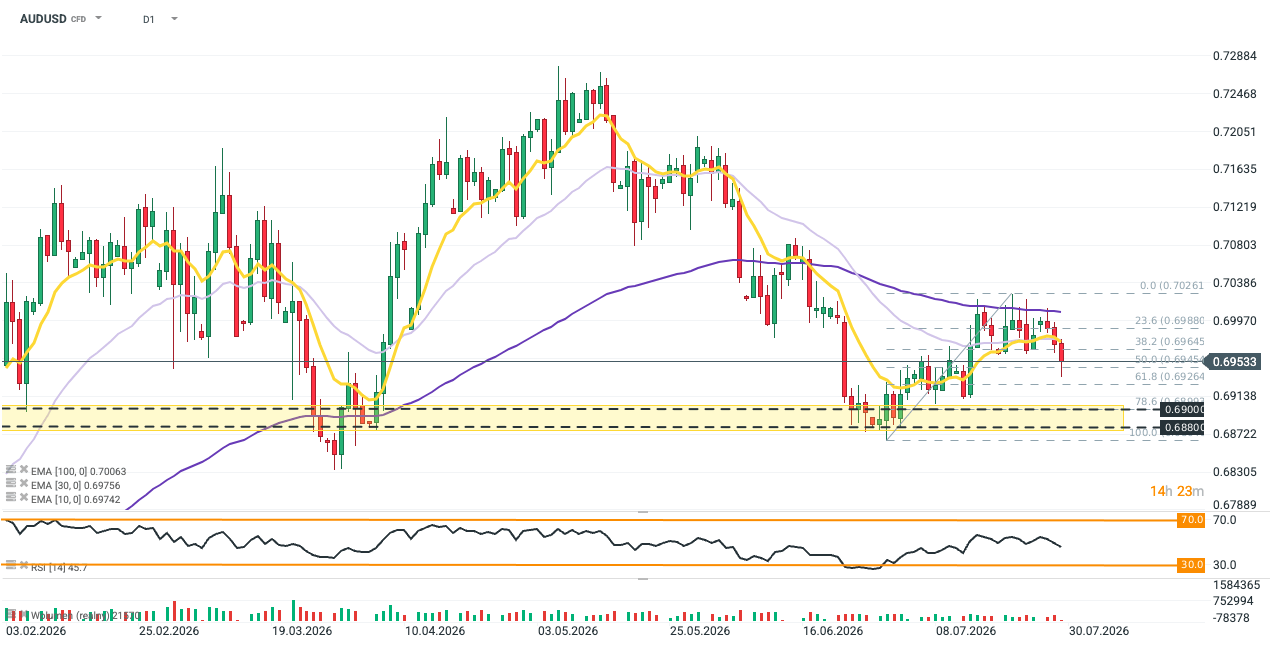
Technical Analysis: AUDUSD (D1)

AUDUSD is testing key levels amidst intensifying selling pressure. Defending the 50.0% and 61.8% Fibonacci retracements is essential to prevent a deeper decline toward the 0.6900 area. A move below the yellow buffer zone (0.68800โ€“0.69000) would signal a decisive return of the downtrend, potentially exacerbated by further disinflation in Australia. The RSI remains near the neutral 50 level, leaving room for further bearish pressure. The only hope for the bulls remains a very dovish signal from the Fed and a return above the 100-day EMA (dark purple). However, this scenario seems unlikely given the strong US labor market (stable unemployment, record-low jobless claims), rising PMI readings, and Warsh’s uncompromising stance on above-target inflation.

Source: xStation5

What is driving the AUDUSD decline today?

  • Inflation drops below 4% : Australia’s annual CPI inflation rate fell to 3.8% YoY in June from 4.0% in May, dropping 0.1% month-on-month. In the second quarter, inflation slowed to 0.6% QoQ (4.0% YoY) compared to 1.4% QoQ in Q1. Crucially for the RBA, trimmed mean inflation came in at 3.6% YoY (0.8% QoQ), falling below the central bank’s forecast (3.8%).
  • Cheaper fuel saves the reading: The main dampening factor was a nearly 11% drop in fuel prices in June, translating into disinflation in transport and goods. On the other hand, the housing sector weighed heavily (+6.8% YoY), where new home construction costs jumped 5.8% YoY due to higher material and labor costs. Furthermore, services inflation accelerated to 4.0% YoY, pointing to ongoing domestic price pressures in the economy.
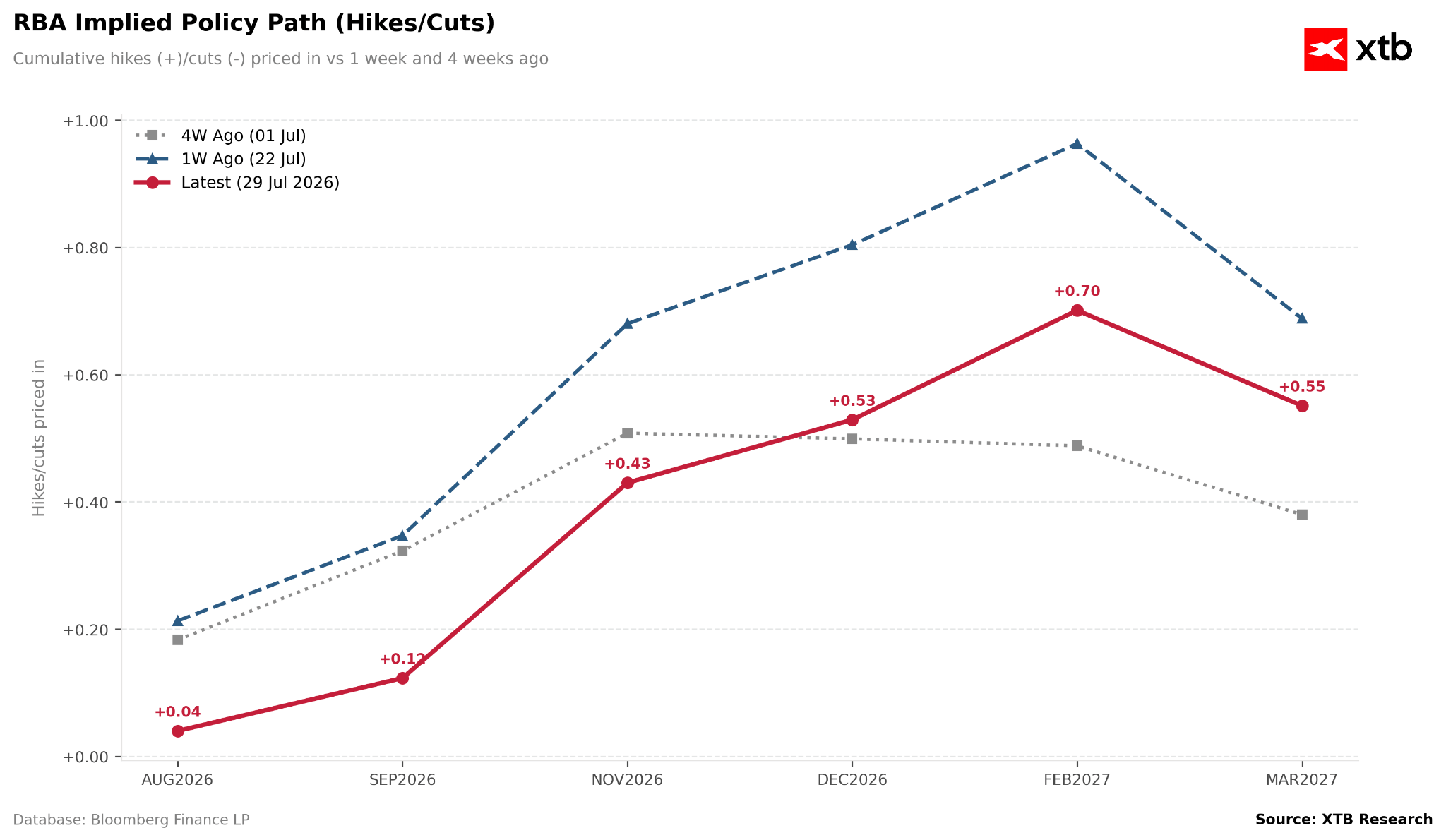
  • Market wipes out rate hike expectations: The swap-market-implied probability of an August rate hike in Australia dropped to zero. In fact, expectations fell across all time horizons. Interest rates in Australia are currently the highest among all G10 economies (4.35%). The last rate hike occurred in May, while subsequent months brought dovish signals from the RBA governor, who indicated that the current rate level is a good place to take a breather.

The market no longer pricing in a full interest rate hike in Australia until March 2027. Pricing from last week indicated a move in February with near certainty (blue line), whereas currently, we are approaching the flat curve from a month ago, which signaled a pause alongside hopes at the time for an end to the Middle East conflict. Source: XTB Research.

Currency Hedger No Comments

British Pound gains ground as US Dollar struggles ahead of Fed decision

  • GBP/USD gains as the US Dollar declines amid high uncertainty for the Fed’s upcoming rate decision.
  • Middle East geopolitical tensions and persistent US inflation risks could provide underlying support for the Greenback.
  • The Bank of England is widely expected to hold rates at 3.75% after June inflation slowed to 2.6%.

GBP/USD edges higher after remaining flat in the previous day, trading around 1.3300 during the Asian hours on Wednesday. The currency pair gains ground as the US Dollar (USD) struggles ahead of the Federal Reserveโ€™s (Fed) upcoming policy decision.

While the central bank is widely expected to leave interest rates unchanged, traders are currently pricing in an unusually high 30.5% chance of an immediate rate hike, signaling notable uncertainty ahead of the announcement. Looking further ahead, markets are factoring in a 76.6% probability of a rate increase in September, reinforcing expectations that borrowing costs will remain elevated for longer.

Despite its current weakness, the Greenback may find support from renewed hostilities in the Middle East. Re-ignited geopolitical tensions are keeping investor focus firmly on potential inflationary risks and the broader interest rate outlook in the United States.

Meanwhile, investors are also eyeing the Bank of England’s (BoE) upcoming policy decision later this week, where interest rates are widely anticipated to hold steady at 3.75%. This outlook is supported by recent inflation data showing annual consumer price growth slowed to a 15-month low of 2.6% in June, falling below the Bank of England’s previous projections.

Currency Hedger No Comments

Euro advances as US Dollar declines ahead of Fed policy decision

  • EUR/USD climbs as the US Dollar weakens ahead of the Fed’s anticipated interest rate hold.
  • Traders price in an unusually high 30.5% chance of an immediate rate hike, signaling rare policy uncertainty.
  • The ECB is expected to deliver a rate hike in September.

EUR/USD holds ground for the second successive day, trading around 1.1390 during the Asian hours on Wednesday. The US Dollar (USD) struggles against the Euro (EUR) as investors are closely monitoring the Federal Reserveโ€™s (Fed) upcoming policy decision, where the central bank is widely expected to leave interest rates unchanged.

Traders are currently pricing in a 30.5% chance of an immediate rate hike, an unusually high level of uncertainty so close to a policy announcement. Looking further ahead, markets are also factoring in a 76.6% probability of a rate increase in September, reinforcing expectations that borrowing costs could remain elevated for longer.

The US Dollar (USD) may find support amid renewed hostilities in the Middle East, which have reignited geopolitical tensions, keeping investor focus firmly on inflationary risks and the broader interest rate outlook in the United States (US).

Geopolitical risk escalated sharply after the IRGC launched a surprise ballistic missile strike targeting a US military base in Jordan at approximately 5:45 PM ET. US Central Command reported that defense systems successfully intercepted all incoming missiles, preventing casualties and structural damage. Believed to be a direct countermeasure to recent US strikes against Iranian naval assets, the incident triggered immediate retaliation; CENTCOM subsequently executed precision airstrikes in Iraq aimed at neutralizing Iran-backed groups planning operations against US forces and Saudi energy infrastructure.

The European Central Bank (ECB) unanimously kept interest rates on hold at 2.25% on July 23, but strongly signaled a September rate hike. Leadership revealed that several Governing Council members pushed for an immediate increase, warning that sustained high energy prices risk driving up broader inflation through second-round effects.