

Facts: The pair bounced off the key technical support near 1.1660 Mid-term trend remains upward Recommendation: Trade: Long position on EURUSD at market price Target: 1.1830, 1.1900 Stop: 1.1600
Opinion : EURUSD has been trading in an upward trend recently. Looking at the H4 interval, one can see that the recent downward correction reached the key support, where buyers appeared .The area 1.1660-1.1670 is marked with previous price reactions, 200-period moving average, as well as lower limit of 1:1 structure. According to the classic technical analysis and Overbalance methodology, continuation of the upward move looks to be the base case scenario. We recommend going long EURUSD at market price with two targets: 1.1830 and 1.1900. We also recommend placing a stop loss order at 1.1600. Source: xStation5
USD/CAD may fall toward the descending channel support at 1.3560.
The 14-day Relative Strength Index falls to 44, signaling strengthening bearish momentum.
The immediate barrier lies at the nine-day EMA of 1.3714.
USD/CADย continues its winning streak for the fourth successive day, trading around 1.3710 during the early European hours on Friday. However, the technical analysis of the daily chart indicates the pair is remaining within the descending channel pattern, signaling a persistent bearish bias.
The USD/CAD pair holds a modest bearish near-term bias as spot remains capped under the nine-day Exponential Moving Average (EMA) and the 50-day EMA. The pair has been fading from last monthโs highs while the 14-day Relative Strength Index (RSI) slips to 44, hinting at strengthening bearish momentum and leaving the downside vulnerable as long as price trades beneath these overlapping EMA barriers.
On the downside, the USD/CAD pair may navigate the region around the lower boundary of the descending channel around 1.3560. A sustained break below the channel would reinforce the bearish bias and put downward pressure on the pair to fall toward 1.3473, the lowest since September 2024.
The immediate barrier lies at the nine-day EMA of 1.3714, followed by the 50-day EMA at 1.3750, aligned with the upper descending channel boundary. Further advances above this confluence resistance zone would cause the emergence of the bullish bias and support the USD/CAD pair to explore the region around the four-month high of 1.3967, reached in December 2025.
USD/CAD: Daily Chart
Canadian Dollar Price Today
The table below shows the percentage change of Canadian Dollar (CAD) against listed major currencies today. Canadian Dollar was the weakest against the Japanese Yen.
USD
EUR
GBP
JPY
CAD
AUD
NZD
CHF
USD
0.06%
0.04%
-0.03%
0.08%
0.10%
0.12%
0.16%
EUR
-0.06%
-0.01%
0.00%
0.03%
0.03%
0.06%
0.10%
GBP
-0.04%
0.00%
-2.13%
0.04%
0.06%
0.09%
0.11%
JPY
0.03%
0.00%
2.13%
0.11%
0.12%
0.14%
0.17%
CAD
-0.08%
-0.03%
-0.04%
-0.11%
0.00%
0.02%
0.07%
AUD
-0.10%
-0.03%
-0.06%
-0.12%
0.00%
0.01%
0.05%
NZD
-0.12%
-0.06%
-0.09%
-0.14%
-0.02%
-0.01%
0.04%
CHF
-0.16%
-0.10%
-0.11%
-0.17%
-0.07%
-0.05%
-0.04%
The heat map shows percentage changes of major currencies against each other. The base currency is picked from the left column, while the quote currency is picked from the top row. For example, if you pick the Canadian Dollar from the left column and move along the horizontal line to the US Dollar, the percentage change displayed in the box will represent CAD (base)/USD (quote).
What is the technical outlook for AUDCAD, NZDUSD, and USDJPY?
This analysis from the Overbalance series aims to identify three financial instruments, analyzed primarily on the daily/four-hour (D1/H4) timeframe. The analysis uses only the Overbalance methodology, which helps determine where a trend may continue or where a reversal might occur. Todayโs analysis covers three instruments, evaluated solely in terms of 1:1 correction structures.
AUDCAD
Since late March, AUDCAD has been trending upward. The key level remains the support at 0.9755, which stems from the lower boundary of the local 1:1 pattern, as well as from previous local peaks. According to the Overbalance methodology, as long as the price remains above this level, the uptrend remains in effect. However, it is worth noting the lack of a clear demand reactionโfurther tests of this support level could weaken it, increasing the risk of a breakout to the downside. Therefore, the 0.9755 level is critical in the short term for the direction of the market.
AUDCAD – H4 timeframe. Source: xStation
NZDUSD
Since early April, the NZDUSD pair has been trending upward, but the market is currently testing key support at the 0.5840 level. Holding this level could trigger another upward move. Conversely, a break below this level and a return below 0.5828 could pave the way for a resumption of the downward trend. The current levels are therefore crucial for determining the short-term direction.
NZDUSD – H4 chart. Source: xStation
USDJPY
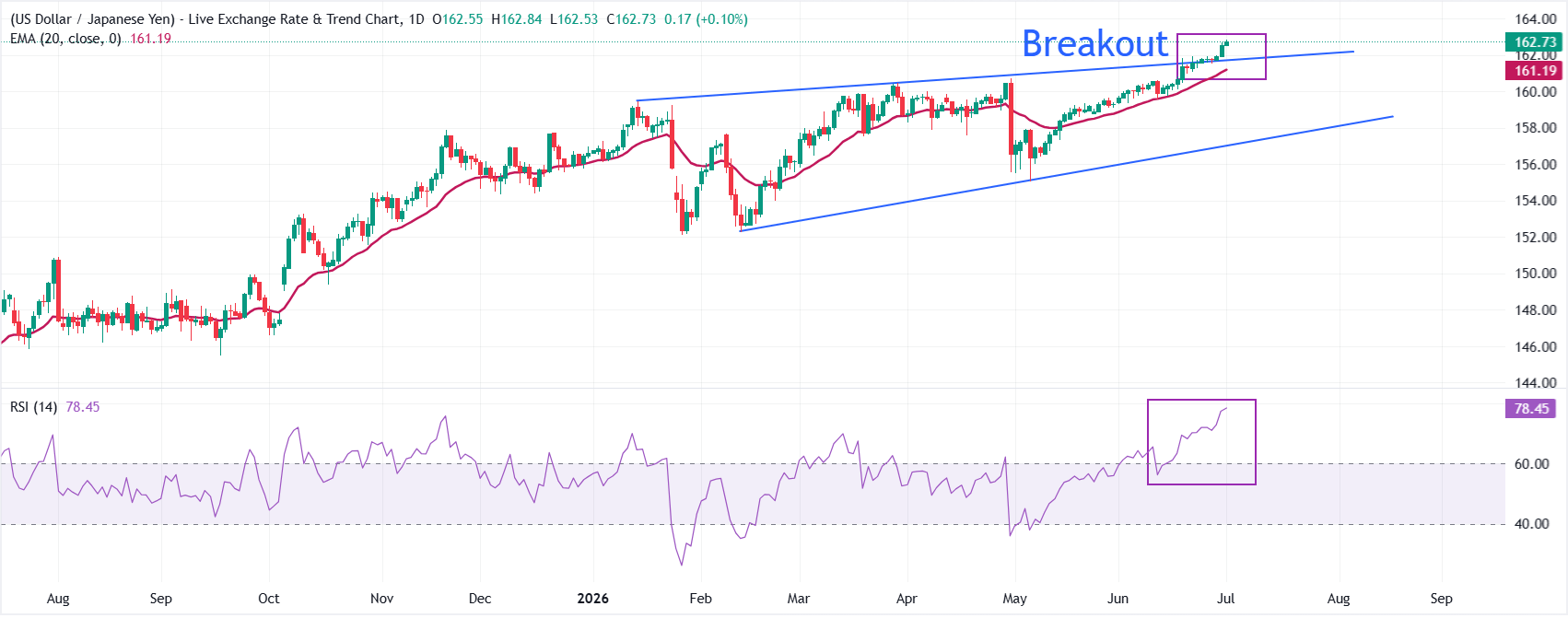
USDJPY has been trending upward for quite some time, but in April we saw a consolidation phase and two tests of support at the 158.10 level. This level was successfully defended, which supports the current uptrend. A break above the March 29 high would confirm the continuation of the uptrend. However, as long as support at 158.10 holds, the base case scenario is for further gains. A break below this level, however, could lead to a larger correction toward 155.11.
The Indian Rupee weakens further against the US Dollar amid higher oil prices.
The selling pressure from FIIs in the Indian stock market has increased.
Investors expect the Fed to hold interest rates steady next week.
The Indian Rupee (INR) opens positively against the US Dollar (USD) on Friday, extending its losing streak for the fifth trading day. The USD/INR pair trades firmly near the weekly high of 94.38 as the Indian currency continues to underperform in the wake of higher energy prices and the resumption of significant foreign selling in the Indianย stockย market.
In addition to the above-mentioned headwinds for the Indian Rupee, the upbeat US Dollar is also supporting the USD/INR pair. As of writing, the US Dollar Index (DXY), which tracks the Greenbackโs value against six major currencies, trades firmly near the 10-day high of around 99.00.
Investors fear prolonged Hormuz closure
Higher oil prices amid the suspension of oil flows through the Strait of Hormuz, a vital passage to almost 20% of global energy supply, by Iran as part of retaliation against the United States (US), have undermined the Indian Rupee.
During the press time, the WTI Oil price holds onto weekly gains at around $95.00. Currencies from economies, such as India, which rely heavily on oil imports to meet their energy needs, underperform in a high oil price environment.
Investors doubt that the Hormuz will open soon, as Iran has not yet agreed to resume peace talks with the US, blaming Washington for the continuous blockade of Iranian sea ports.
Meanwhile, a report from CNN has shown that US military officials are developing new plans to target Iranโs capabilities in the Strait of Hormuz in the event the current ceasefire with Iran fails.
FIIs remain net sellers in last four trading days
So farย this week, FIIs have remained net sellers in all four trading days and have offloaded their stake worth Rs. 8,311.99 crore. Foreign investors have resumed selling after a brief pause in the last three trading days of the previous week. Elevated oil prices have dimmed the interest of overseas investors in the Indian stock market amid concerns over India Inc.’s forward earnings and the expectations that the government would trim its capital expenditure to offset obligations towards rising energy prices.
Investors shift focus to the Fed policy
Going forward, the major trigger for global markets will be the monetary policy announcement by theย Federal Reserveย (Fed) on Wednesday. The Fed is widely anticipated to leave interest rates unchanged in the range of 3.50%-3.75% and warn of upside inflation risks in the wake of higher energy prices. Investors will pay close attention to cues regarding whether the Fed plans to hike interestย ratesย anytime this year.
Technical Analysis: USD/INR strives to revisit all-time high around 95.20
USD/INRย trades higher above 94.20 at the press time, holding a constructive bullish bias as spot remains firmly above the 20-period Exponential Moving Average (EMA) at 93.3565. The positioning over this short-term trend line suggests buyers retain control, while the Relative Strength Index (14) near 59 shows positive but not overstretched momentum, hinting that the advance could extend as long as the pair defends its underlying supports.
On the downside, initial support is seen at the 20-period EMA at 93.3565, which underpins the current structure and is likely to attract dip buyers on shallow pullbacks. A daily close below this dynamic floor would weaken the immediate bullish tone and expose deeper retracements, whereas holding above it keeps the door open for further gains toward the all-time high at around 95.20.
EUR/USD struggles to register any meaningful recovery and hangs near a two-week low.
Rising Iran tensions and reviving hawkish Fed bets underpin the USD, capping spot prices.
The technical setup seems tilted in favor of bears and backs the case for further losses.
The EUR/USD pair remains on the back foot through the Asian session on Friday and currently trades around the 1.1680-1.1675 region, just above a nearly two-week low touched the previous day.
Despite a temporary extension of the ceasefire, the lack of progress in peace talks due to the US naval blockade of Iranian ports tempers hopes for a durable de-escalation and keeps investors on edge. Furthermore, elevated Crude Oil prices revive inflationary concerns and fuel hawkish USย Federal Reserveย (Fed) expectations. This, in turn, assists the US Dollar (USD) in preserving its gains registered over the past three days and acts as a headwind for the EUR/USD pair.
From a technical perspective, spot prices currently hover around the 200-period Exponential Moving Average (EMA) on the 4-hour chart, keeping the immediate tone neutral after the recent slide from higher levels. However, Thursday’s breakdown below the 38.2%ย Fibonacciย retracement level of the recent upswing from the March swing low favors the EUR/USD bears. Moreover, the Relative Strength Index (RSI) near 32 suggests lingering downside pressure.
Meanwhile, the slightly negative Moving Average Convergence Divergence (MACD) reading reinforces a lack of clear bullish momentum despite the EMA support. In the meantime, any further weakness could find immediate support near the 50.0% Fibonacci retracement at 1.1648. A convincing break below this zone would open the way toward the deeper retracement levels at 1.1600 and 1.1532, ahead of the cycle floor at 1.1445.
On the upside, initial resistance is located at the 38.2% Fibo. retracement at 1.1696, with a break there exposing the next hurdle at the 23.6% retracement at 1.1755. Nevertheless, the broader setup suggests that the path of least resistance forย the EUR/USD pairย is to the downside, and any meaningful recovery attempt is more likely to get sold into.
(The technical analysis of this story was written with the help of an AI tool.)

EUR/USD 4-hour chart
US Dollar Price This week
The table below shows the percentage change of US Dollar (USD) against listed major currencies this week. US Dollar was the strongest against the Swiss Franc.
USD
EUR
GBP
JPY
CAD
AUD
NZD
CHF
USD
0.52%
0.18%
0.61%
0.18%
-0.01%
0.14%
0.70%
EUR
-0.52%
-0.33%
0.00%
-0.32%
-0.49%
-0.42%
0.18%
GBP
-0.18%
0.33%
2.17%
0.02%
-0.17%
-0.09%
0.52%
JPY
-0.61%
0.00%
-2.17%
-0.43%
-0.54%
-0.49%
0.11%
CAD
-0.18%
0.32%
-0.02%
0.43%
-0.08%
-0.07%
0.51%
AUD
0.01%
0.49%
0.17%
0.54%
0.08%
0.15%
0.68%
NZD
-0.14%
0.42%
0.09%
0.49%
0.07%
-0.15%
0.57%
CHF
-0.70%
-0.18%
-0.52%
-0.11%
-0.51%
-0.68%
-0.57%
The heat map shows percentage changes of major currencies against each other. The base currency is picked from the left column, while the quote currency is picked from the top row. For example, if you pick the US Dollar from the left column and move along the horizontal line to the Japanese Yen, the percentage change displayed in the box will represent USD (base)/JPY (quote).
GBP/USD steadies after three days of losses, trading around 1.3470 during the Asian hours on Friday. The pair stays calm following the release of United Kingdom (UK) Retail Sales data, which rebounded 0.7% month-over-month (MoM) in March after declining by a revised 0.6% in February. The market forecast was for a 0.1% growth in the reported month.
The annual UK Retail Sales rose 1.7% in March, slightly below the prior 1.8% (revised from 2.5%) but above expectations of 1.3%. Core Retail Sales, excluding auto fuel, increased 0.2% MoM, reversing a revised 0.6% decline (from -0.4%). On an annual basis, core Retail Sales grew 1.7% in March, down from Februaryโs 2.7% (revised from 3.4%).
The GBP/USD pairย may further depreciate as the US Dollar (USD) receives support from safe-haven demand amid persistent uncertainty surrounding the United States (US)โIran conflict. The Guardian reported on Thursday that Lebanon will push for a one-month extension of the current ceasefire with Israel during a second round of direct talks in Washington. Israelโs Ambassador to the United Nations (UN), Danny Danon, said in a CNNย Newsย interview on Friday that the Lebanon ceasefire extension is “not 100%”.
The US military intercepted two Iranian oil supertankers attempting to evade its blockade, as Washington presses ahead with efforts to curb Iranโs shipping. Meanwhile, Tehran continues to threaten vessels in the Strait of Hormuz. US military officials are also preparing contingency plans to target Iranโs capabilities in the Strait should the current ceasefire collapse.
The offshore yuan weakened past 6.83 per dollar on Friday, heading for its first weekly decline in three weeks, as the greenback continued to strengthen amid little sign of easing in Middle East tensions. President Trump ordered a โshoot and killโ against Iranian boats allegedly laying mines in the Strait of Hormuz, injecting fresh volatility into energy markets.
Surging crude costs are already feeding through supply chains, prompting some Chinese exporters to raise prices to offset higher fuel and raw material expenses. In March, several consumer goods categories recorded notable annual costs increases, reversing a prolonged period of relative price stability. Despite these headwinds, analysts remain cautiously optimistic about the yuanโs broader trajectory, noting that Chinaโs substantial domestic energy reserves, along with signs of a steady economic recovery, could help anchor the currency and limit sustained depreciation pressure.
NZD/USD attracts sellers for the second straight day as Iran tensions continue to underpin the USD.
Elevated Oil prices revive Inflation fears, tempering dovish Fed bets and further benefiting the buck.
Expectations that the RBNZ may consider tightening policy could limit losses for the NZD and the pair.
The NZD/USD pair is seen extending this week’s retracement slide from the 0.5925-0.5930 horizontal barrier and drifting lower for the second straight day on Friday. Spot prices slide back to the 0.5840 region during the Asian session and seem vulnerable near a technically significant 200-day Simple Moving Average (SMA) amid a bullish US Dollar (USD).
The USD Index (DXY), which tracks the Greenback against a basket of currencies, retains its positive bias for the fourth straight day on the back of intensifying US-Iran tensions. Moreover, the lack of progress in peace talks, due to a standoff over the Strait of Hormuz, keeps investors on edge and further benefits the USD’s safe-haven status. This, in turn, is seen as a key factor exerting some downward pressure on the NZD/USD pair.
US President Donald Trump said on Tuesday that the US Navy blockade of Iranian ports will continue, while Iran has set the complete removal of the blockade as a strict precondition for resuming negotiations. Furthermore, Trump ordered the US Navy to shoot and kill any boat laying mines in the critical shipping channel. This keeps geopolitical risks in play and dampens hopes for a durable de-escalation, underpinning the USD.
Meanwhile, continued disruptions to energy supplies remain supportive of elevated Crude Oil prices and fuel inflationary fears, tempering hopes for a dovish USย Federal Reserveย (Fed). Traders now see the possibility of only one 25-basis-point (bps) rate cut by the Fed in 2026. This backs the case for a further appreciating move for the USD and suggests that the path of least resistance for the NZD/USD pair is to the downside.
However, persistent sticky inflation has spurred bets that the Reserve Bank of New Zealand (RBNZ) may maintain a cautious policy stance or consider tightening to bring inflation back to the 2% midpoint. In fact, data earlierย this weekย showed that New Zealand’s annual inflation held at 3.1% in the March 2026 quarter, slightly above the central bank’s 1โ3% target range. This could limit losses for the New Zealand Dollar (NZD) andย the NZD/USD pair.
To provide the best experiences, we use technologies like cookies to store and/or access device information. Consenting to these technologies will allow us to process data such as browsing behavior or unique IDs on this site. Not consenting or withdrawing consent, may adversely affect certain features and functions.
Functional
Always active
The technical storage or access is strictly necessary for the legitimate purpose of enabling the use of a specific service explicitly requested by the subscriber or user, or for the sole purpose of carrying out the transmission of a communication over an electronic communications network.
Preferences
The technical storage or access is necessary for the legitimate purpose of storing preferences that are not requested by the subscriber or user.
Statistics
The technical storage or access that is used exclusively for statistical purposes.The technical storage or access that is used exclusively for anonymous statistical purposes. Without a subpoena, voluntary compliance on the part of your Internet Service Provider, or additional records from a third party, information stored or retrieved for this purpose alone cannot usually be used to identify you.
Marketing
The technical storage or access is required to create user profiles to send advertising, or to track the user on a website or across several websites for similar marketing purposes.