
The South Korean won weakened to around 1,538 per dollar, remaining under pressure as the US dollar stayed firm. Markets continued to price in the possibility of further Fed tightening, while investors awaited key US inflation data later this week for additional clues on the interest-rate path. Higher US yields continued to support dollar-denominated assets, reducing the appeal of emerging Asian currencies and contributing to broader strength in the greenback. The won also faced headwinds from renewed Middle East uncertainty, with oil prices rising amid ongoing US-Iran negotiations and concerns over potential disruptions to energy supplies through the Strait of Hormuz. Meanwhile, South Korea’s exports surged 60.4% year-on-year in the first 20 days of June, driven by robust semiconductor shipments amid strong global AI-related demand. This supported expectations of continued foreign-currency inflows from overseas sales.

Rupee Holds Firm on Softer Oil
The Indian rupee hovered near 94.3 per dollar, steadying after reaching six-week highs as easing geopolitical tensions and softer crude oil prices supported sentiment. Oil prices declined after Iranian officials reported progress in negotiations with the United States, with Brent crude for August delivery falling 1.7% to $79.24 per barrel following signs of constructive talks in Switzerland. However, uncertainty persisted after US President Donald Trump warned that military action against Iran could resume, even as Vice President JD Vance met Iranian officials under an interim peace arrangement. Tehran’s renewed closure of the Strait of Hormuz added to market caution. Gains were partly capped as the dollar index held just below 101 and the benchmark 10-year US Treasury yield edged higher, though it remained below recent peaks. Investors are now focused on upcoming US inflation and growth data for clues on the Federal Reserve’s policy outlook.
The US Dollar remembers how to rally
- DXY printed a fresh 13-month high this week after a hawkish FOMC pushed markets toward pricing a 2026 rate hike.
- The move is driven by rate differentials, not a growth scare, as the Fed out-hawks a stalling field of peers.
- Next week’s combined GDP and PCE print is the validation test for the rally.
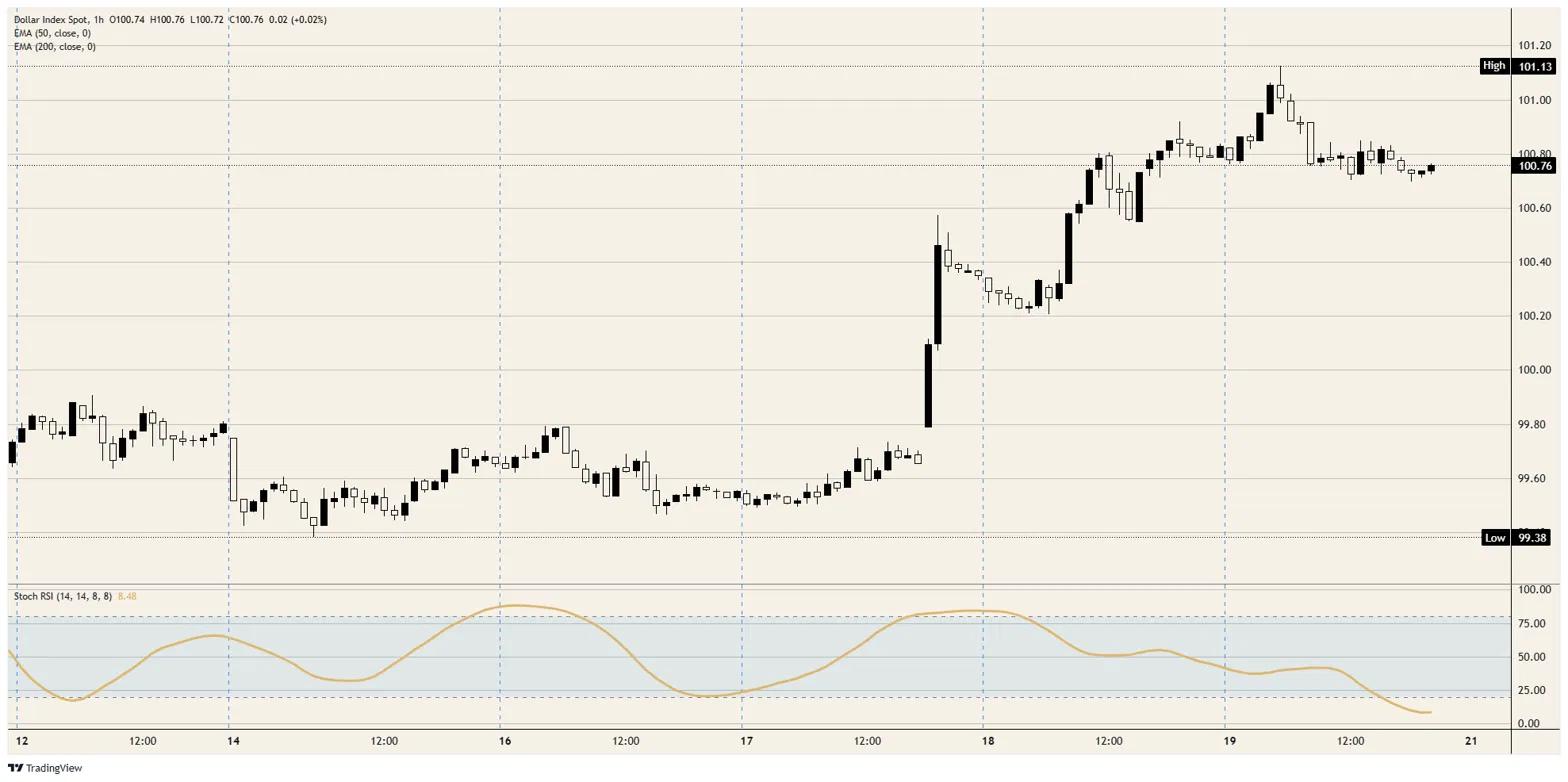
The US Dollar Index (DXY) spent the back half of this week doing something most desks had written off six months ago: rallying on the prospect of a Federal Reserve (Fed) rate hike. The index pushed to a fresh 13-month high before easing back; the move owed less to safe-haven flight than to a cold read on rate differentials. With the Federal Open Market Committee (FOMC) leaning hawkish at its June meeting, the Greenback has become the cleanest way to play the only major central bank still willing to tighten into an energy shock.
A yield gap, not a panic
Underneath the geopolitical noise, the Dollar’s bid is a yield story. The Fed has parked itself in a higher-for-longer posture while the field around it has stalled or blinked. The Bank of England (BoE) and the Swiss National Bank (SNB) both held this week, with the Greenback taking its largest gains against the Pound and the Franc. Even the European Central Bank (ECB), which delivered its first hike since 2023, is tightening defensively into a contracting economy rather than a strong one; that distinction is the entire trade.
Warsh pulls the guidance rug
New Fed Chair Kevin Warsh used his first meeting to do less, not more. The Committee held at 3.75% as expected; the updated dot plot told the real story, with the rate projections revised higher across the board and the median now embedding a hike bias for the year. Warsh himself declined to signal the next move, leaning instead on the line that inflation has sat above target for years and that restoring price stability comes first. Markets took the hint and ran: pricing on CME FedWatch now leans toward a hike by the autumn, with inflation forecasts revised higher on the back of the Middle East conflict. A central bank that refuses to promise cuts, in a world where everyone else is cornered, is a powerful tailwind for its currency.
The number that settles it
Every bar of this rally is implicitly long the hawkish-Fed thesis, which means next week hands the Dollar its first real audit. Thursday delivers a rare double-header at 12:30 GMT: the third estimate of first-quarter Gross Domestic Product (GDP) lands alongside the May Personal Consumption Expenditures Price Index (PCE), the Fed’s preferred inflation gauge. The growth print is seen confirming 1.6%, down from the initial 2.0%; the spotlight therefore falls on PCE. Core PCE is already pencilled in to accelerate to 0.3% MoM from 0.2%, which means even an in-line print stamps reacceleration onto core inflation; an upside surprise, coming after May headline Consumer Price Index (CPI) leapt above 4% YoY, would cement the hike pricing and send the index back to test its highs. A soft one would expose how much good news is already in the price.
Resistance: The 101.00 round figure caps the immediate upside, with this week’s 13-month peak just above it; a clean break opens room toward 102.00.
Support: Initial support sits near 100.50, then the psychological 100.00 handle; below that, the 50-day and 200-day Exponential Moving Average (EMA) cluster near 99.00 marks where the trend would come into question. The hourly Stochastic Relative Strength Index (Stoch RSI) is washed out near oversold, which argues the current dip is a pause rather than a turn.
Bias: Bullish while the index holds above 100.00 and the hawkish-Fed narrative survives next week’s data. A hot PCE keeps the path toward 102.00 open; a downside inflation surprise is the one catalyst that turns this stretched-but-intact rally into a deeper pullback toward 99.00.
US Dollar Index hourly chart
The Euro Falls on its own rate hike
- EUR/USD broke to a fresh multi-week low this week before steadying near a tentative floor.
- The slide came despite the ECB’s first rate hike since 2023, a move forced by the energy shock rather than by strength.
- With the eurozone economy contracting, the Euro stays chained to broad Dollar direction into next week’s US data.
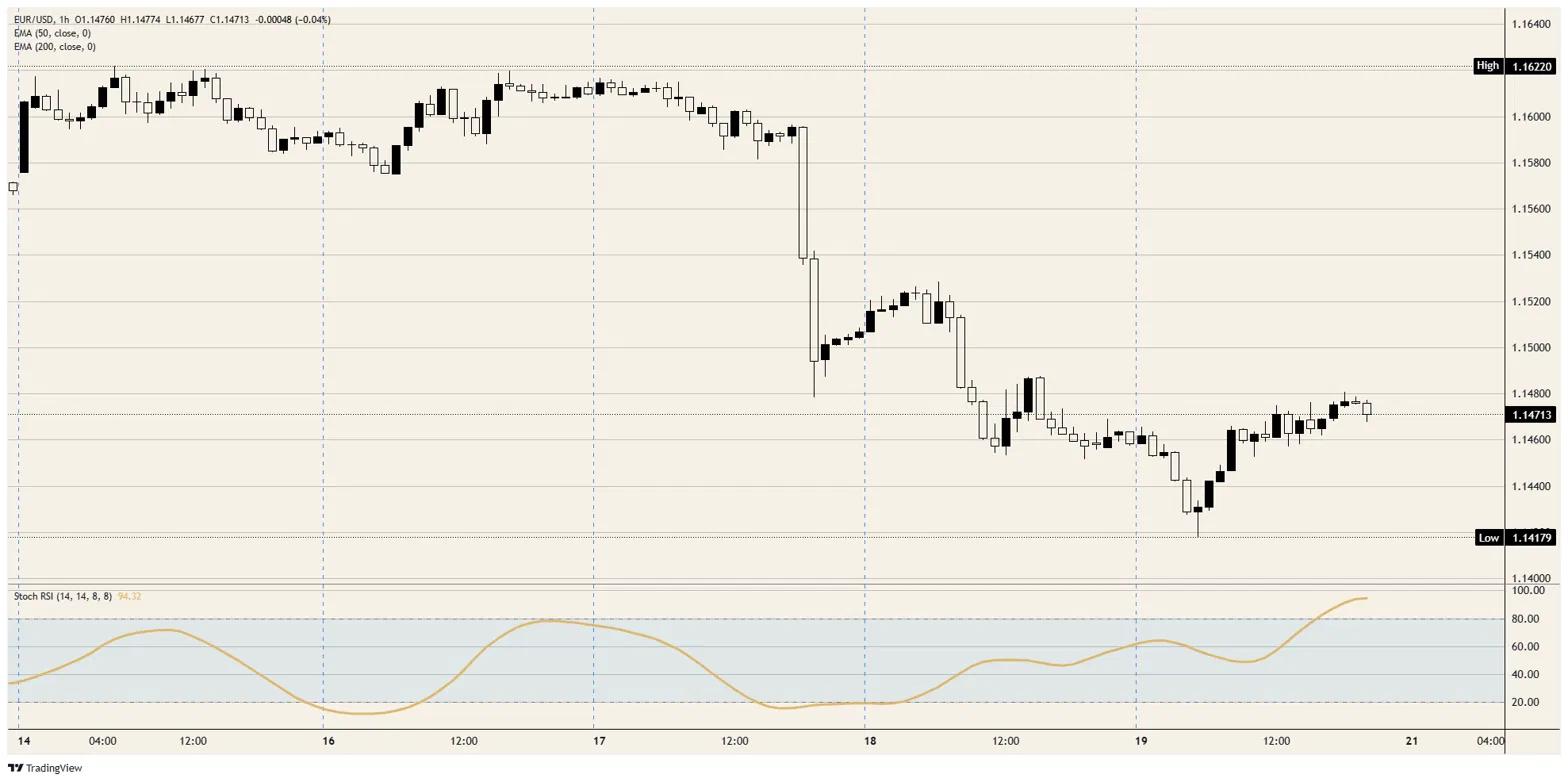
The Euro did something this week that ought to be impossible: it fell in the same fortnight the European Central Bank (ECB) delivered its first interest rate hike since 2023. EUR/USD slid to a fresh multi-week low near 1.1400 before clawing back to a tentative floor around 1.1450; the lesson is that not every rate hike is a vote of confidence. The ECB tightened because an energy shock forced its hand, not because the eurozone economy is firing. That distinction is why the single currency cannot turn a hawkish central bank into a rally.
A hike that smells like surrender
Look at what the ECB actually did and the bind becomes obvious. It raised the deposit rate for the first time in nearly three years while simultaneously cutting its growth forecasts and lifting its inflation projections, an unambiguous stagflation signal. Euro-area inflation has climbed to its highest in nearly three years on surging energy costs tied to disruptions through the Strait of Hormuz, even as the bloc’s economy contracted in the first quarter. Tightening into that mix is a defensive move; currency markets know the difference between a central bank hiking from strength and one hiking because it has no choice.
Out-hawked across the Atlantic
Even on the narrow question of rate differentials, the Euro is losing. The ECB paired its hike with no-preset-path guidance, which markets read as a one-and-watch rather than the start of a campaign; German Bund yields barely budged. The Federal Reserve (Fed), by contrast, held at 3.75% but revised its dot plot higher, pricing toward a hike of its own from a position of relative economic strength, with the US Dollar Index parked at a 13-month high. When both sides lean hawkish, the currency attached to the stronger economy and the firmer conviction wins; right now that is unambiguously the Greenback.
A bounce on a short leash
The near-term picture is the one part of the Euro story that favours the bulls, and only just. Price has carved out a tentative floor near 1.1450, with the hourly Stochastic Relative Strength Index (Stoch RSI) pushing into overbought after the bounce off the lows, a sign the immediate move is stretched. There is room for a corrective rally toward the 1.1500 area, though it stays on a short leash: the daily chart sits below both the 50-day and 200-day Exponential Moving Average (EMA), clustered near 1.1600, with the broader trend still pointing lower.
A wall of ECB speakers and Tuesday’s still-contractionary flash Purchasing Managers Index (PMI) prints will not change that calculus; whatever bounce the Euro manages is unlikely to survive a hot reading from next Thursday’s US data, when the third estimate of first-quarter Gross Domestic Product (GDP) and the May Personal Consumption Expenditures Price Index (PCE) land together at 12:30 GMT.
Resistance: The 1.1500 area is the first test, then 1.1550; the heavier barrier is the 1.1600 zone, where the 50-day and 200-day EMA converge and any recovery would have to prove itself.
Support: The tentative floor near 1.1450 is the level bulls must defend. Below it sit the 1.1400 handle and this week’s low; a clean break there reopens the downtrend.
Bias: Tactically neutral with scope for a short-term bounce toward 1.1500 while 1.1450 holds, but bearish on any longer horizon. The Euro remains a hostage to the Dollar; a hot US PCE next week is the most likely trigger to drag it back to 1.1400 and beyond. Only a soft US inflation print gives the bounce real legs.
EUR/USD hourly chart
The Canadian Dollar ditches Crude Oil for Gold
- USD/CAD pushed to a fresh 14-month high this week, dragging the Loonie to its weakest against the Greenback since early 2025.
- The slide defies firm Crude Oil prices; the Loonie’s traditional link to Crude Oil has broken down and even turned negative.
- The real drivers are a widening Canada-US rate gap and a six-week slide in Gold.
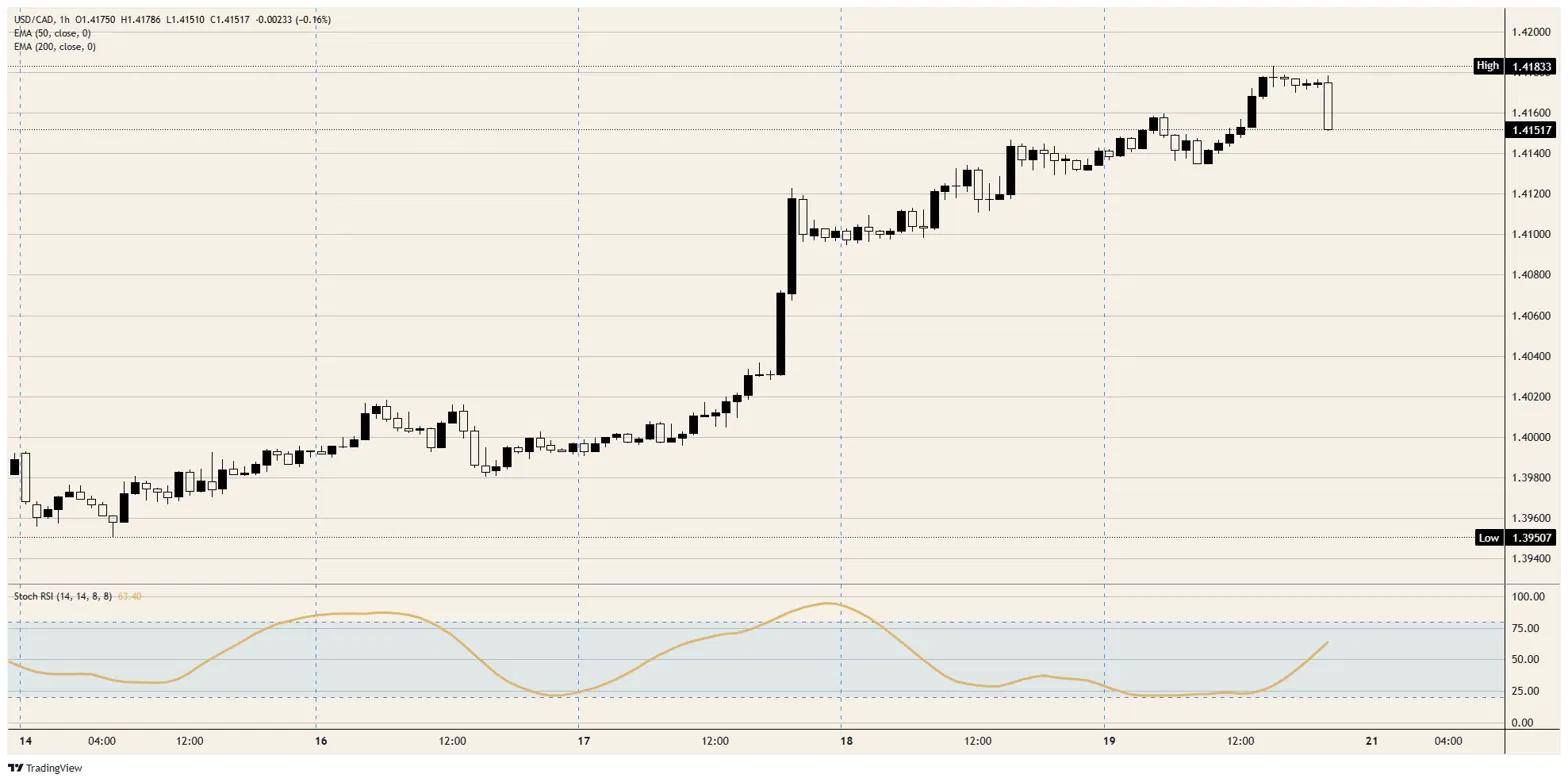
The textbook calls the Canadian Dollar a petro-currency, which means that with a Middle East war keeping Crude Oil bid, the Loonie should be holding its own. Instead it spent this week sliding to a fresh 14-month low against the Greenback, capping a run in which the US Dollar has closed higher in six of the last seven weeks. The textbook is wrong, at least for now: the Loonie has quietly stopped trading like a Crude Oil proxy, with its weakness driven by two forces that have nothing to do with the price of a barrel.
A petro-currency in name only
For years the Loonie moved with the price of a barrel; that relationship has quietly inverted. The rolling correlation between daily moves in the currency and Crude Oil has turned negative in recent months, a clean break from the historical norm. In its place, a less obvious driver has taken over: Gold. Canada is a major bullion producer; with Gold down for six straight weeks and well off its recent record, that slide has become a genuine weight on the currency. The market has swapped one commodity anchor for another; traders still watching only the barrel have missed it.
Two central banks moving apart
The second force is the one doing most of the damage: a widening gap between the Federal Reserve (Fed) and the Bank of Canada (BoC). The Fed held at 3.75% this month and revised its dot plot higher, with markets pricing a possible 2026 hike; the BoC, at 2.25%, is going nowhere. It held again this month, caught in a two-way bind between a soft domestic economy and fresh, energy-driven inflation, and has signalled no intention of moving. When one central bank is leaning toward hikes and the other is frozen, the rate spread does the talking; right now it points squarely against the Loonie. Speculative short positions on the currency have climbed to their highest in months as a result.
Outgunned, but not without a say
What makes the move striking is that this is not simply a story about Canada falling apart. The domestic picture is mixed rather than broken: a strong May jobs report sits alongside Friday’s soft retail sales; the Loonie’s slide owes more to relative positioning than to outright collapse. That also means the currency has a busier week ahead than the bears might like.
Canada’s own May Consumer Price Index (CPI) lands Monday at 12:30 GMT. With inflation already running near 3% on elevated energy costs, a hot print would feed the BoC’s inflation side and could lend the Loonie a rare bid; Governor Macklem then speaks Tuesday. The dominant event still sits south of the border: on Thursday at 12:30 GMT the US delivers its first-quarter Gross Domestic Product (GDP) third estimate alongside the May Personal Consumption Expenditures Price Index (PCE), with core PCE seen accelerating to 0.3% MoM. A hot US PCE widens the rate gap further and points USD/CAD higher still; only a genuinely hot Canadian CPI on Monday gives the Loonie much to fight back with.
Resistance: USD/CAD is pressing the 1.4200 handle after this week’s run; a clean break opens 1.4250 and then 1.4300, levels last seen well over a year ago.
Support: Initial support sits near 1.4100, then 1.4050; only a move back below 1.4000 would suggest the Loonie has found real footing.
Bias: Higher for USD/CAD while the Fed-BoC gap widens and Gold stays heavy, meaning further Loonie weakness is the base case. The one caution is positioning: the daily Stochastic Relative Strength Index (Stoch RSI) is deep in overbought after a near-vertical climb; a sharp but shallow pullback toward 1.4100 would not surprise. A hot US PCE next week is the catalyst most likely to push the pair on toward 1.4250.
USD/CAD hourly chart
EUR/USD Price Forecast: Weakens below 1.1450 amid oversold RSI momentum
- EUR/USD softens to near 1.1425 in Friday’s early European session.
- The pair keeps a bearish vibe; downside pressure persists with an oversold RSI.
- The first upside barrier emerges at 1.1450; the initial support level to watch is 1.1411.
The EUR/USD pair trades in negative territory around 1.1425 during the early European trading hours on Friday. The uncertainty surrounding the US-Iran peace deal provides some support to a safe-haven currency such as the US Dollar (USD) and acts as a headwind for the major pair.
Reuters reported on Friday that the Swiss Foreign Ministry announced that US-Iran talks at Bürgenstock will not take place as planned on Friday. US Vice President JD Vance canceled his trip to talks with Iran in Switzerland.
On Thursday, Iran’s Tasnim news agency quoted informed sources as saying that the Iranian delegation’s trip to Switzerland had not been finalized. Meanwhile, Lebanon’s Al Mayadeen TV also quoted sources as saying that, due to the ongoing Israeli attacks in southern Lebanon, the Iranian negotiation team has postponed its trip to Switzerland.
Technical Analysis:
In the daily chart, EUR/USD extends a bearish near-term bias as spot holds below the 20-day Bollinger middle band and well under the 100-day simple moving average. The pair is pressing the lower end of the Bollinger envelope, with price lodged beneath the latest lower band, while the Relative Strength Index (RSI) at 30.6 is edging into oversold territory, hinting that downside pressure persists but could be nearing exhaustion.
On the topside, initial resistance is aligned with the lower Bollinger band at 1.1450, followed by the 20-day Bollinger SMA around 1.1577, where a recovery would start to ease immediate selling pressure. Above that, the 100-day SMA at 1.1665 and the upper Bollinger band near 1.1705 form a broader supply zone that is likely to cap rebounds unless buyers can reclaim it decisively. On the downside, the first contention level is seen at the March 13 low of 1.1411. Any follow-through selling below this level could pave the way to the April 23, 2025 low of 1.1308.
Swiss Franc weakens as traders ramp up US rate hike bets, Vance canceled trip to talks with Iran
- USD/CHF extends its upside to near 0.8075 in Friday’s early European session.
- US Vice President JD Vance pulled out of a planned trip to Switzerland for talks with Iran.
- SNB left its key interest rate at 0%, with a focus on currency risks.
The USD/CHF pair advances to around 0.8075, the highest since December 10, 2025, during the early European session on Friday. The US Dollar (USD) strengthens against the Swiss Franc (CHF) as the Federal Reserve (Fed) officials left interest rates unchanged at its June policy meeting and signaled the possibility of higher rates later this year.
Hawkish signals from the Fed provide some support to the Greenback. On Wednesday, the US central bank decided to hold its benchmark interest rate steady between 3.50% and 3.75% after Kevin Warsh’s first meeting in charge of the central bank. Warsh said during the press conference that “price stability” would be the Fed’s guiding principle.
Futures traders have priced in that the Fed is likely to raise rates by 25 basis points (bps) at its September meeting, with some chance seen of a move as soon as next month’s meeting.
On the geopolitical front, US Vice President JD Vance cancelled a planned trip to meet Iranian negotiators in Switzerland to begin complex talks on implementing a 14-point agreement struck between Tehran and Washington to end their war. Traders will closely watch the US-Iran peace deal developments. Uncertainty in the Middle East could underpin the USD against the CHF in the near term.
The Swiss National Bank (SNB) left its main policy rate unchanged at 0% on Thursday, as widely expected by markets, keeping borrowing costs well below those seen in other major economies. The SNB also said that it is ready to intervene in foreign exchange markets if a rebound in demand for the safe-haven franc drives the currency higher.
Australian Dollar softens to near 0.7000 as Vice President canceled trip to talks with Iran
- AUD/USD weakens to around 0.7010 in Friday’s Asian session.
- US Vice President cancels trip to Switzerland for Iran talks.
- Fed’s hawkish hold leads to rate-hike bets, supporting the US Dollar.
The AUD/USD pair loses momentum to near 0.7010 during the Asian trading hours on Friday. The Australian Dollar (AUD) softens against the US Dollar (USD) after reports that US Vice President JD Vance canceled his trip to talks with Iran in Switzerland, raising concerns about the US-Iran peace deal.
CNN reported on Friday that the White House indicated that the first round of technical talks with Iran under the memorandum of understanding signed this week will not take place on Friday. Vance said that the meeting wasn’t yet finalized, as it’s difficult for the Iranian officials to get out of Iran. Vice President added that he thought he would travel to Switzerland at some point this weekend.
Traders will closely monitor the developments surrounding the peace agreement. A lack of progress in US-Iran or any signs of renewed tensions in the Middle East could boost a safe-haven currency such as the Greenback and act as a headwind for the major pair.
Furthermore, the hawkish stance of the US Federal Reserve (Fed) might contribute to the USD’s upside. The US central bank on Wednesday decided to hold the interest rates steady in a 3.50% to 3.75% range as Kevin Warsh began his era in charge with a sweeping policy review. Fed officials signaled the chance of higher rates as they assess the impacts of the Iran war on inflation.
“We’ve seen very spectacular data in the U.S. that’s been surprising to the upside since late April, then the Fed was as hawkish as market expectations could ever have been, so we’ve seen more dollar upside,” said Sarah Ying, head of FX strategy at CIBC Capital Markets.