What is the technical outlook for EURGBP, EURAUD, and AUDUSD?
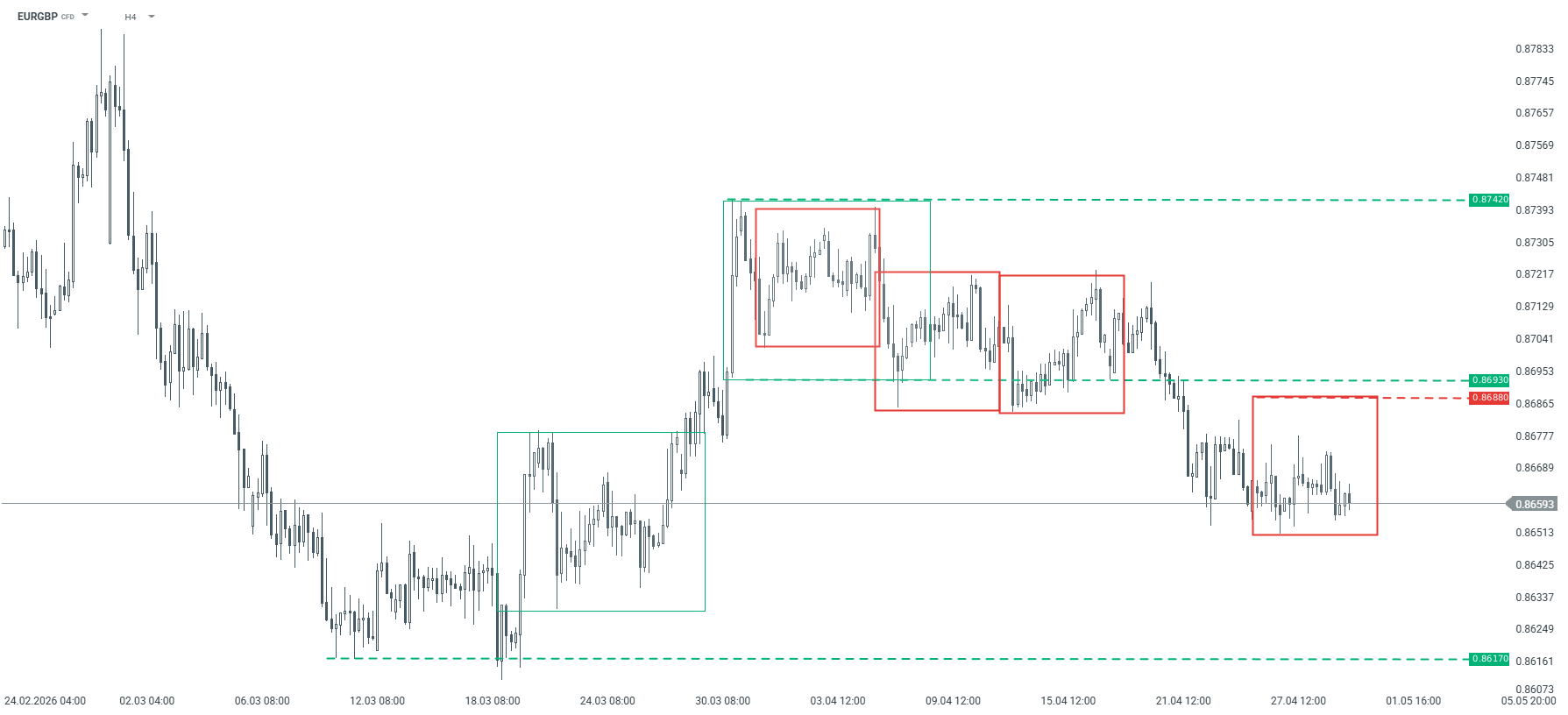
The Overbalance analysis aims to identify three financial instruments, analyzed primarily on the daily/four-hour (D1/H4) timeframe. The analysis uses only the Overbalance methodology, which helps determine where a trend may continue or where it may reverse. Today’s analysis covers three instruments, evaluated solely in terms of 1:1 correction structures. EURGBP From March 20 through the end of the month, EURGBP traded in an uptrend, but the subsequent correction turned into a stronger downtrend. After the 1:1 upward pattern was negated at the 0.8693 level, the declines accelerated. Currently, the 0.8693–0.8688 zone represents key resistance. Only a return of the price above this zone could shift the balance of power on the chart. For now, the base scenario remains a decline toward the lows at 0.8617.
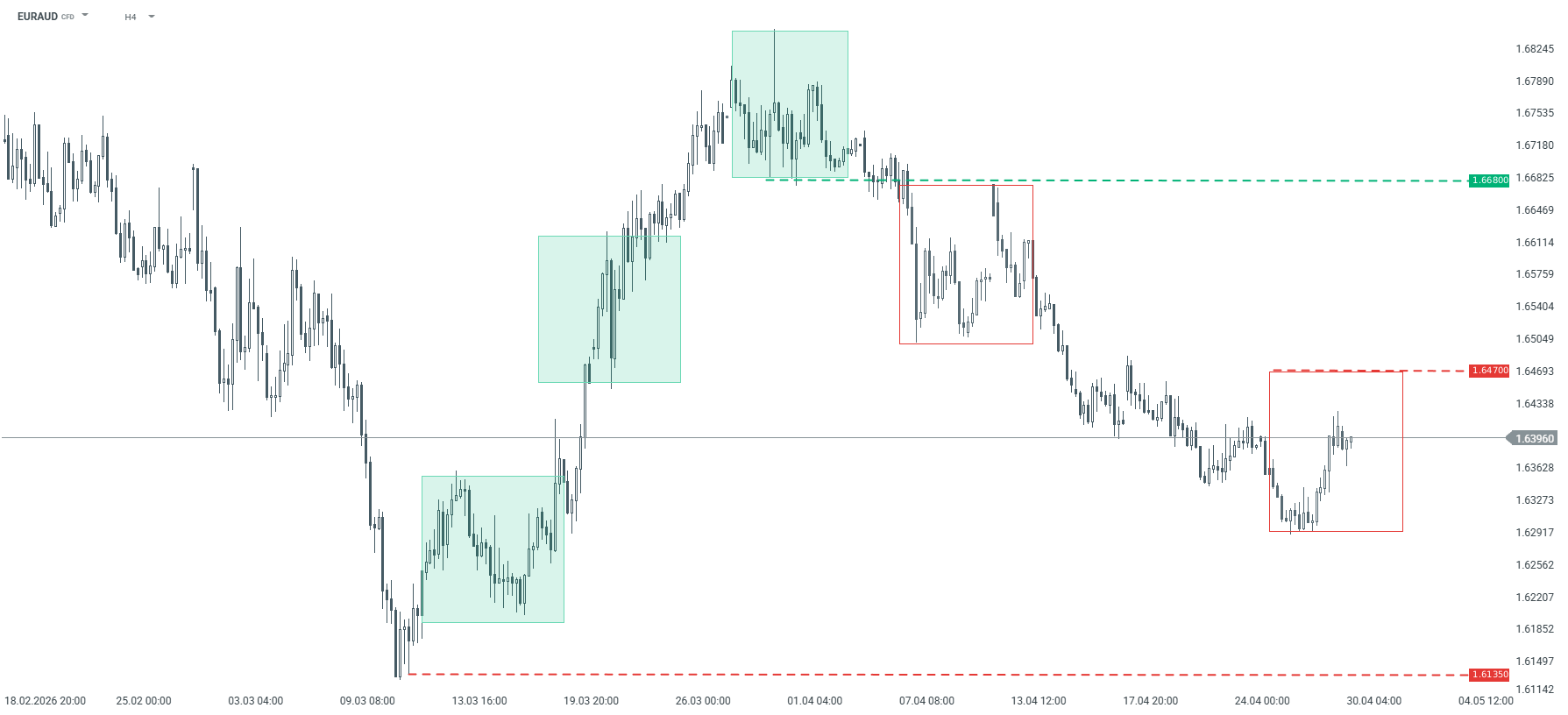
EURGBP – H4 timeframe. Source: xStation EURAUD From March 11 through the end of the month, the EURAUD pair was in an uptrend; however, the largest corrective pattern was subsequently negated at the 1.6680 level, which was then tested from the opposite side. Since then, we have observed the development of a downtrend. The largest current corrective pattern (marked in red) defines a key resistance level at 1.6470. According to the Overbalance methodology, as long as the price remains below this level, the downtrend remains in effect.
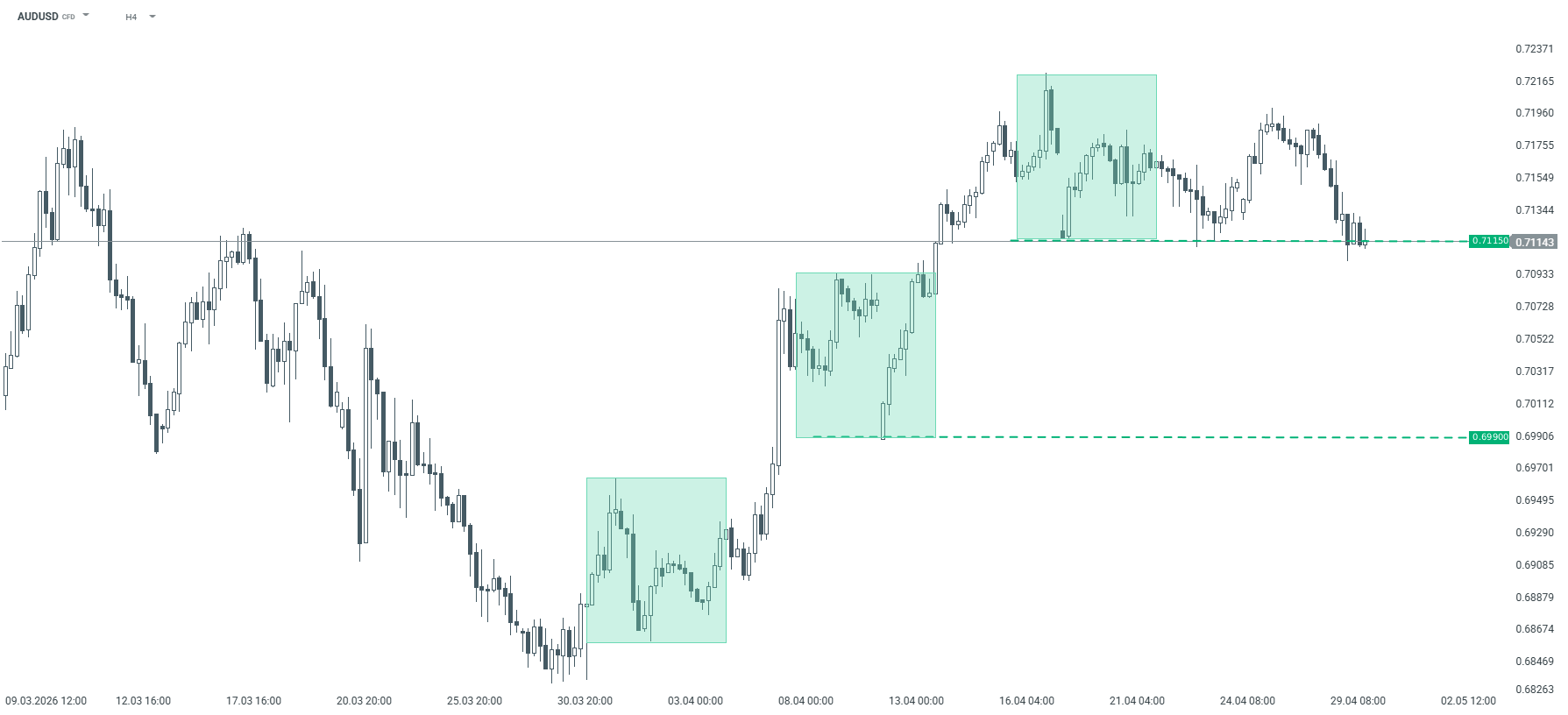
EURAUD – H4 timeframe. Source: xStation AUDUSD Since late March, the AUDUSD pair has been in an uptrend. Recently, the exchange rate has twice tested support at the 0.7015 level, which corresponds to the lower boundary of the 1:1 pattern. As long as this level holds, the uptrend remains intact. It is worth noting, however, that another test of this zone could weaken it, increasing the risk of it being broken and thus triggering a larger downward correction.
EUR/USD may hover near its eight-month low around 1.1411.
The 14-day Relative Strength Index near 48 signals weakening bullish momentum and a consolidative trend.
Immediate resistance is seen at the 50-day EMA near 1.1678.
EUR/USD extends its losses for the third successive day, trading around 1.1660 during the Asian hours on Thursday. The daily chart technical analysis indicates a potential for a bearish reversal, as the pair has slipped below the ascending channel.
The EUR/USD pair holds just under the 50-day Exponential Moving Average (EMA) and the nine-day EMA, which together suggest a capped near-term tone despite the recent recovery from lower levels.
The 14-day Relative Strength Index (RSI) around 48 hints at fading bullish momentum and a consolidative bias, reinforcing the view that upside attempts may struggle while price remains below these key dynamic barriers.
On the downside, the EUR/USD pair may navigate the region around the eight-month low of 1.1411, recorded on March 13.
The immediate resistance lies at the 50-day EMA of 1.1678, followed by the nine-day EMA at 1.1700. A return to the ascending channel would revive the bullish bias and lead the EUR/USD pair to test the two-month high of 1.1849, reached on April 17, followed by the upper boundary of the ascending channel around 1.1940. A sustained break above the channel would lead the pair to explore the region around 1.2082, the highest since June 2021, reached on January 27.
EUR/USD: Daily Chart
Euro Price Today
The table below shows the percentage change of Euro (EUR) against listed major currencies today. Euro was the weakest against the Australian Dollar.
USD
EUR
GBP
JPY
CAD
AUD
NZD
CHF
USD
0.09%
0.01%
-0.03%
-0.05%
-0.14%
-0.07%
-0.00%
EUR
-0.09%
-0.05%
-0.13%
-0.14%
-0.21%
-0.14%
-0.07%
GBP
-0.01%
0.05%
-0.04%
-0.07%
-0.15%
-0.05%
-0.02%
JPY
0.03%
0.13%
0.04%
-0.03%
-0.10%
-0.09%
-0.00%
CAD
0.05%
0.14%
0.07%
0.03%
-0.10%
-0.04%
0.05%
AUD
0.14%
0.21%
0.15%
0.10%
0.10%
0.07%
0.15%
NZD
0.07%
0.14%
0.05%
0.09%
0.04%
-0.07%
0.07%
CHF
0.00%
0.07%
0.02%
0.00%
-0.05%
-0.15%
-0.07%
The heat map shows percentage changes of major currencies against each other. The base currency is picked from the left column, while the quote currency is picked from the top row. For example, if you pick the Euro from the left column and move along the horizontal line to the US Dollar, the percentage change displayed in the box will represent EUR (base)/USD (quote).
Strong Durable Goods Orders reinforced confidence in the US economy.
Higher yields and firm oil prices supported the Greenback’s rebound.
Traders now await Fed and ECB decisions for fresh direction.
EUR/USD drops by some 0.17% during the North American session as a possible resolution of the US-Iran conflict seems far from ending, while Durable Goods Orders data in the US suggest that the economy remains solid. At the time of writing, the pair trades at 1.1684 after reaching a daily high of 1.1720.
Euro weakens as yields jump before Fed and ECB rate decisions now
High energy prices are underpinning the US Dollar, which, of late, has been correlated with WTI, posting back-to-back bullish days and rising 0.27% in the day, according to the US Dollar Index. The DXY, which measures the performance of the buck’s value against a basket of six currencies, is at 98.66.
US Treasury yields are soaring, with the 10-year Treasury note up 5 basis points to 4.398%, a sign that investors are less confident the Federal Reserve will reduce borrowing costs in the near term.
The US President Donald Trump urged Iran to sign a deal as he prepared the US Navy for an extended blockade of Iranian ports, as negotiations have stalled.
Aside from this, US Core Durable Goods Orders in March rose sharply 3.3% from February’s 1.6% print, crushing estimates for a minimal 0.6% increase, a sign that business spending is picking up, driven by companies spending on AI to improve profit margins. Headline goods orders improved from a -1.2% YoY contraction, to 0.8% exceeding forecasts of 0.5%.
Across the pond, the Harmonized Index of Consumer Prices (HICP) in Germany rose from 2.8% to 2.9% YoY, missing estimates of 3%. Monthly, the German HICP decreased form 1.2% to 0.5%, below forecasts for a 0.8% jump.
Fed and ECB meetings up next
Now, traders’ eyes would be on monetary policy meetings in both sides of the Atlantic. The Federal Reserve is projected to keep interest rates unchanged in the 3.50%-3.75% range, but the attention would be on Powell’s decision to stay at the Fed until his term as Governor ends, or whether he would leave his place open, which would increase Trump’s allies on the committee.
On Thursday, the European Central Bank is projected to keep rates unchanged, but for the rest of the year, money markets see three basis points of rate hikes towards the end of the year, as revealed by Prime Terminal’s implied forward rates curve.
Source: Prime Terminal
EUR/USD Price Forecast: Technical outlook
In the daily chart, EUR/USD trades at 1.1690, holding just above the triple simple moving average (SMA) clustered around 1.1649, which now acts as immediate support. The pair, however, remains capped by the broader trend structure, with former rising support now sitting above spot near recent highs around 1.1760 and converging with the dominant downward resistance line closer to 1.1800, suggesting rallies are still vulnerable while price trades beneath this confluence. The Relative Strength Index (RSI) at about 50.4 hovers around neutral, hinting at a loss of directional conviction after the recent recovery from mid-1.15s.
On the topside, initial resistance is seen near the former rising-support line around 1.1760, ahead of the broader downward resistance trend zone near 1.1800, where sellers are likely to re-emerge unless the pair can sustain a clear break higher. On the downside, the triple SMA support at roughly 1.1650 is the first level to watch; a daily close below this floor would expose a deeper pullback toward the mid-1.15 area, while holding above it would keep the pair in a consolidative stance within the broader corrective structure.
Euro Price This week
The table below shows the percentage change of Euro (EUR) against listed major currencies this week. Euro was the strongest against the Swiss Franc.
USD
EUR
GBP
JPY
CAD
AUD
NZD
CHF
USD
0.05%
0.16%
0.38%
0.03%
-0.08%
0.43%
0.45%
EUR
-0.05%
0.13%
0.26%
0.00%
-0.11%
0.41%
0.42%
GBP
-0.16%
-0.13%
0.17%
-0.12%
-0.24%
0.28%
0.29%
JPY
-0.38%
-0.26%
-0.17%
-0.30%
-0.44%
0.16%
0.18%
CAD
-0.03%
-0.00%
0.12%
0.30%
-0.07%
0.46%
0.42%
AUD
0.08%
0.11%
0.24%
0.44%
0.07%
0.52%
0.53%
NZD
-0.43%
-0.41%
-0.28%
-0.16%
-0.46%
-0.52%
0.02%
CHF
-0.45%
-0.42%
-0.29%
-0.18%
-0.42%
-0.53%
-0.02%
The heat map shows percentage changes of major currencies against each other. The base currency is picked from the left column, while the quote currency is picked from the top row. For example, if you pick the Euro from the left column and move along the horizontal line to the US Dollar, the percentage change displayed in the box will represent EUR (base)/USD (quote).
EUR/USD trades calmly near 1.1700 ahead of the Fed-ECB monetary policy announcement.
Both the Fed and the ECB will likely maintain the status quo.
The German HICP is estimated to have grown at a stronger pace of 3% YoY in April.
The EUR/USD pair consolidates around 1.1700, inside Tuesday’s trading range, during the Asian trading session on Wednesday. The major currency pair has remained broadly sideways, with investors awaiting monetary policy announcements by the Federal Reserve (Fed) and the European Central Bank (ECB) on Wednesday and Thursday, respectively.
Both the Fed and the ECB are expected to leave interest rates unchanged at their current levels, and warn of upside inflation risks amid elevated energy prices due to the prolonged closure of the Strait of Hormuz.
Investors will pay close attention to commentaries from Fed Chair Jerome Powell and ECB President Christine Lagarde to get cues about whether their respective central banks are discussing the need to tighten monetary conditions in the near term.
Ahead of the Fed-ECB policy announcement, investors will focus on the preliminary German Harmonized Index of Consumer Prices (HICP) data for April, which will be published at 12:00 GMT. The data is expected to show that the German inflation accelerated to 3% Year-on-Year (YoY) from 2.7% in March.
EUR/USD technical analysis
EUR/USD trades flat at around 1.1700 as of writing. The pair reflects a sideways trend as it remains sticky to the 20-day exponential moving average (EMA), which is at 1.1698, but stays above the 38.2% Fibonacci retracement at 1.1666.
The Relative Strength Index (RSI) shifts into the 40.00-60.00 zone after failing to sustain above 60.00 for longer, which indicates loss of upside momentum, but the upside bias remains intact.
On the topside, immediate resistance emerges at the 50.0% Fibonacci retracement near 1.1745, followed by the 61.8% retracement around 1.1825, with further hurdles at 1.1938 and the cycle high near 1.2082. Looking down, the 38.2% retracement at 1.1666 is the initial support; a break below that area would expose deeper supports at the 23.6% level near 1.1567 and the structural floor around 1.1408.
GBP/USD may appreciate toward the two-month high of 1.3599.
The 14-day Relative Strength Index near 56 signals positive momentum without indicating overbought conditions.
The pair is testing the lower boundary of the ascending channel around 1.3510.
GBP/USD inches higher after registering little losses in the previous day, trading around 1.3520 during the Asian hours on Wednesday. The technical analysis of the daily chart indicates a potential for a bearish reversal as the pair is hovering around the lower boundary of the ascending channel pattern.
However, the GBP/USD pair maintains a modest bullish bias as it holds above the nine-day Exponential Moving Average (EMA) and the 50-day EMA. The clustering of these averages below the spot suggests a supportive backdrop after the recent advance, while the 14-day Relative Strength Index around 56 hints at positive but not overextended momentum, leaving room for further gains while the pair remains under nearby resistance.
The GBP/USD pair may rise toward the primary barrier at the two-month high of 1.3599, recorded on April 17. Further advances would support the pair to explore the region around the upper boundary of the ascending channel near the 1.3869, the highest level since September 2021, reached on January 27.
On the downside, the GBP/USD pair is testing the lower boundary of the ascending channel around 1.3510. aligned with the nine-day EMA of 1.3509. Further support lies at the 50-day EMA at 1.3440. A successful break below this confluence support zone would expose the five-month low of 1.3159, recorded on March 31, followed by the 1.3010, the lowest since April 2025, which was recorded in November 2025.
GBP/USD: Daily Chart
Pound Sterling Price Today
The table below shows the percentage change of British Pound (GBP) against listed major currencies today. British Pound was the strongest against the New Zealand Dollar.
USD
EUR
GBP
JPY
CAD
AUD
NZD
CHF
USD
-0.02%
-0.03%
-0.02%
-0.01%
0.11%
0.14%
-0.11%
EUR
0.02%
-0.03%
0.02%
0.00%
0.11%
0.18%
-0.08%
GBP
0.03%
0.03%
0.02%
0.02%
0.13%
0.18%
-0.07%
JPY
0.02%
-0.02%
-0.02%
-0.01%
0.13%
0.18%
-0.04%
CAD
0.01%
-0.00%
-0.02%
0.01%
0.14%
0.18%
-0.07%
AUD
-0.11%
-0.11%
-0.13%
-0.13%
-0.14%
0.05%
-0.25%
NZD
-0.14%
-0.18%
-0.18%
-0.18%
-0.18%
-0.05%
-0.26%
CHF
0.11%
0.08%
0.07%
0.04%
0.07%
0.25%
0.26%
The heat map shows percentage changes of major currencies against each other. The base currency is picked from the left column, while the quote currency is picked from the top row. For example, if you pick the British Pound from the left column and move along the horizontal line to the US Dollar, the percentage change displayed in the box will represent GBP (base)/USD (quote).
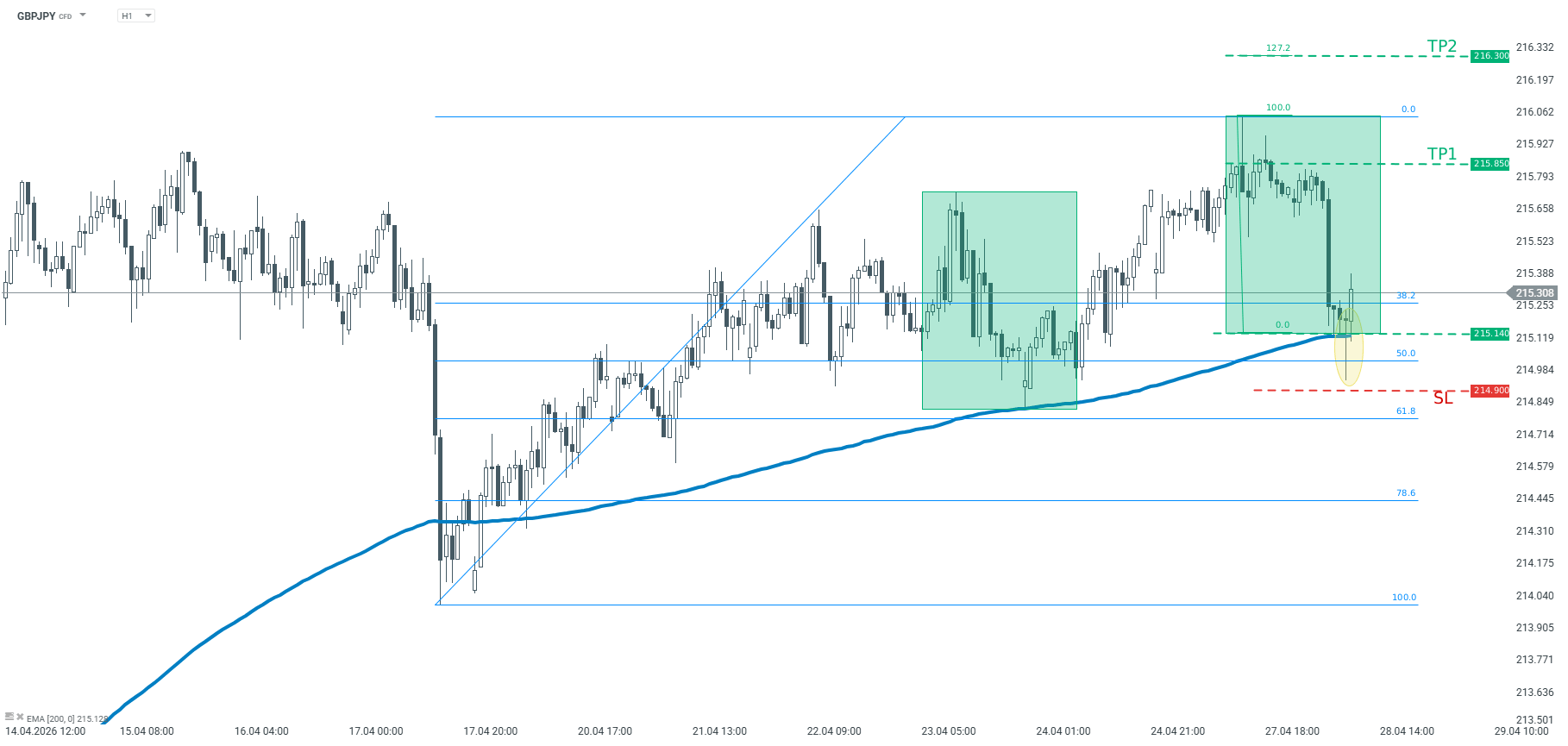
The pair reached the lower limit of 1:1 structure at 215.14 Main trend on the pair remains upward
Recommendation:
Trade: Long GBPJPY at market price Target: 215.85, 216.30 Stop: 214.90
Opinion:
Looking at GBPJPY chart, one can observe that the price reached the key technical support today. This support is marked with the lower limit of 1:1 structure (green rectangles), as well as 200-period moving average. In addition the bullish candlestick pattern – pin bar appeared on the H1 chart. Should buyers manage to hold the price above the support at 215.14, another upward impulse may be on the cards. We recommend taking a long position on GBPJPY at market price with two targets: 215.85 and 216.30 We recommend placing a stop loss order at 214.90.
The Indian Rupee falls further against the US Dollar as higher oil prices boost demand for the Greenback by Indian importers.
Fresh concerns over India Inc.’s earnings projections have dampened the FIIs interest in the Indian stock market.
This week, investors will pay close attention to the Fed’s monetary policy.
The Indian Rupee (INR) weakens further after a brief pause against the US Dollar (USD) in the opening session on Tuesday. The USD/INR pair jumps to near 94.50 as elevated oil prices continue to hurt the Indian Rupee.
As of writing, the WTI Oil price trades 0.6% higher to near $95.60 and is close to its two-week high of $97 posted on Thursday.
Currencies from economies, such as India, which rely heavily on oil imports to meet their energy needs, tend to underperform in a high oil price environment.
Oil prices have remained higher due to uncertainty over the reopening of the Strait of Hormuz, a critical passage to almost 20% of global energy supply.
According to a Reuters report, oil-linked flows and hedging-related US Dollar demand are key headwinds for the Indian Rupee
Hormuz closure keeps oil prices elevated
The uncertainty regarding the reopening of the Hormuz remains escalated, as Washington has not shown any signs of interest in proposals delivered by Iran to end the war. On late Monday, White House press secretary Karoline Leavitt stated that US President Trump discussed Iran’s proposal with the national security team, which calls for the reopening of the Strait of Hormuz and a permanent ceasefire. Leavitt didn’t reveal any information regarding the odds of whether it will be taken forward by Washington.
“I wouldn’t say they’re considering it. I would just say that there was a discussion this morning that I don’t want to get ahead of, and you’ll hear directly from the president, I’m sure, on this topic,” Leavitt said.
On Monday, US President Trump received another proposal from Iran, which he called “better” than the one, which it was expected to present in canceled peace talks in Islamabad over the weekend, but “still not good enough”.
FIIs extends selling pressure in Indian stock market
In the last six trading days, Foreign Institutional Investors (FIIs) have remained net sellers and have offloaded their stake worth Rs. 18,291.34 crore after a little buying in the April 15-17 period. FIIs appear to be dumping their stake in the Indian equity market due to elevated oil prices, which have raised concerns over India Inc.’s earnings projections.
Fed seems to maintain status quo
This week, the major trigger for the US Dollar will be the Federal Reserve’s (Fed) monetary policy announcement on Wednesday, in which it is expected to leave interest rates unchanged in the range of 3.50%-3.75% for the third time in a row. Investors will pay close attention to Fed Chair Jerome Powell’s comments regarding the monetary policy outlook in the wake of the energy price shock amid the Hormuz closure.
Technical Analysis: USD/INR approaches all-time high of 95.20
USD/INR trades higher at around 94.50, maintaining a bullish near-term bias, as it holds above the 20-day Exponential Moving Average (EMA) at 93.53. The positioning above this rising EMA suggests the broader uptrend remains intact, while the Relative Strength Index (RSI) around 61 indicates firm but not overstretched upside momentum.
On the downside, the 20-day EMA at 93.53 stands as the first layer of dynamic support, and a daily close below this level would hint at a deeper corrective phase within the broader trend. Looking up, the pair aims to revisit the all-time high around 95.20. The spot would enter uncharted territory if it manages a decisive break above 95.20.
EUR/JPY may rebound toward the nine-day EMA at 186.66 near the ascending channel’s lower boundary.
The 14-day Relative Strength Index near 53 signals positive, not overstretched momentum.
The primary support lies at the 50-day EMA at 185.00.
EUR/JPY depreciates after two days of gains, trading around 186.40 during European hours on Tuesday. The technical analysis of the daily chart indicates the currency cross slips below the ascending channel, signaling a possible bearish reversal.
However, the EUR/JPY cross holds above the 50-day Exponential Moving Average (EMA), keeping the near-term bias mildly bullish even as it consolidates just under the nine-day EMA, which acts as immediate resistance.
The 14-day Relative Strength Index (RSI) hovers near 53, suggesting positive but not overstretched momentum, and hints that dips toward the underlying averages could continue to attract buyers while the broader uptrend structure remains intact.
The rebound toward the nine-day EMA at 186.66 around the lower boundary of the ascending channel would revive the bullish bias and lead the EUR/JPY cross to test the all-time high of 187.95, which was recorded on April 17. Further advances above this level would support the currency cross to explore the region around the upper boundary of the channel, around 189.80.
On the downside, the EUR/JPY cross may fall toward initial support, which lies at the 50-day EMA at 185.00.
EUR/JPY: Daily Chart
Euro Price Today
The table below shows the percentage change of Euro (EUR) against listed major currencies today. Euro was the weakest against the Japanese Yen.
USD
EUR
GBP
JPY
CAD
AUD
NZD
CHF
USD
0.19%
0.17%
0.00%
0.05%
0.19%
0.32%
0.40%
EUR
-0.19%
-0.04%
-0.22%
-0.17%
-0.02%
0.07%
0.20%
GBP
-0.17%
0.04%
-0.17%
-0.12%
0.03%
0.13%
0.23%
JPY
0.00%
0.22%
0.17%
0.06%
0.20%
0.30%
0.40%
CAD
-0.05%
0.17%
0.12%
-0.06%
0.14%
0.24%
0.35%
AUD
-0.19%
0.02%
-0.03%
-0.20%
-0.14%
0.11%
0.24%
NZD
-0.32%
-0.07%
-0.13%
-0.30%
-0.24%
-0.11%
0.09%
CHF
-0.40%
-0.20%
-0.23%
-0.40%
-0.35%
-0.24%
-0.09%
The heat map shows percentage changes of major currencies against each other. The base currency is picked from the left column, while the quote currency is picked from the top row. For example, if you pick the Euro from the left column and move along the horizontal line to the US Dollar, the percentage change displayed in the box will represent EUR (base)/USD (quote).
To provide the best experiences, we use technologies like cookies to store and/or access device information. Consenting to these technologies will allow us to process data such as browsing behavior or unique IDs on this site. Not consenting or withdrawing consent, may adversely affect certain features and functions.
Functional
Always active
The technical storage or access is strictly necessary for the legitimate purpose of enabling the use of a specific service explicitly requested by the subscriber or user, or for the sole purpose of carrying out the transmission of a communication over an electronic communications network.
Preferences
The technical storage or access is necessary for the legitimate purpose of storing preferences that are not requested by the subscriber or user.
Statistics
The technical storage or access that is used exclusively for statistical purposes.The technical storage or access that is used exclusively for anonymous statistical purposes. Without a subpoena, voluntary compliance on the part of your Internet Service Provider, or additional records from a third party, information stored or retrieved for this purpose alone cannot usually be used to identify you.
Marketing
The technical storage or access is required to create user profiles to send advertising, or to track the user on a website or across several websites for similar marketing purposes.