

EUR/JPY softens to around 187.50 in Thursdayโs early European session.
The cross keeps the bullish vibe above the key 100-day EMA.
The first upside barrier emerges at 187.95; the initial support level is seen at 186.20.
The EUR/JPY cross trades with mild losses near 187.50 during the early European session on Thursday. The Japanese Yen (JPY) strengthens againstย the Euroย (EUR) amid intervention fears from Japanese authorities. Japanโs Finance Minister Satsuki Katayamaย said on Thursday that she told the G7 to closely watch forex moves.
The Bank of Japan (BoJ) is expected to raise its benchmark rate to 1.00% by end-June, with nearly two-thirds of economists in a Reuters poll predicting the move, and a hike in April or in June seen as equally likely amid uncertainty over the fallout from the Iran war.
Technical Analysis:
In the daily chart, EUR/JPY maintains a bullish near-term bias as price holds well above the 100-day exponential moving average (EMA). The pair is pressing the upper side of its recent volatility envelope, with the 14-day Relative Strength Index (RSI) hovering just under overbought territory around 69, which suggests strong upward momentum but also hints that upside could become stretched if gains extend without a corrective pause.
On the topside, initial resistance is seen at the upper Bollinger Band of 187.95, en route to 188.50. On the downside, any pullback would likely find first demand near the April 13 low of 186.20. The next contention level is seen at the middle Bollinger Band of 185.00, with a deeper setback exposing the rising 100-day EMA at 182.75.
USD/JPY attracts fresh sellers during the Asian session as renewed intervention fears boost the JPY.
Iran diplomacy hopes and fading hawkish Fed bets undermine the USD, further weighing on the pair.
Bears await a sustained break below the trading range support before positioning for further losses.
The USD/JPY cross attracts fresh sellers following the previous day’s modest rise and drops to over a one-week low, around the 158.25 region during the Asian session on Thursday. Spot prices, however, manage to recover a few pips in the last hour and currently trade around the 158.70 area, down over 0.15% for the day.
Comments from Japanโs Finance Minister, Satsuki Katayama, saying that she discussed with Treasury Secretary Scott Bessent on foreign exchange, revived intervention fears, and boosted the Japanese Yen (JPY). Furthermore, hopes for Iran diplomacy and fading hawkish USย Federal Reserveย (Fed) expectations drag the US Dollar (USD) to its lowest level since late February. These turned out to be key factors exerting pressure on the USD/JPY pair.
However, economic concerns stemming from the instability in the Strait of Hormuz keep a lid on any further JPY appreciation and assist the currency pair to bounce off the 200-period Exponential Moving Average (EMA) support on the 4-hour chart. The said area also represents the lower end of a short-term trading range, and a break below will be seen as a key trigger for the USD/JPY bears, which should pave the way for deeper losses.
Meanwhile, the Moving Average Convergence Divergence (MACD) indicator has slipped into negative territory and continues to edge lower. Furthermore, the Relative Strength Index (RSI) at around 41 hovers in neutral-to-bearish ground, hinting that the momentum is softening and buyers are losing some control. This further makes it prudent to wait for a decisive breakdown of structure before placing fresh bearish bets around the USD/JPY pair.
A clear break and acceptance below the 200-period EMA on the 4-hour chart, where buyers have room to defend the recent consolidation floor, would expose bigger corrective risk. However, as long as USD/JPY holds above this moving average, the underlying bias stays modestly bullish, and any recovery attempts from current levels would likely be viewed as a continuation of the prevailing uptrend rather than the start of a sustained reversal.
USD/JPY 4-hour chart
Japanese Yen Price Today
The table below shows the percentage change of Japanese Yen (JPY) against listed major currencies today. Japanese Yen was the strongest against the US Dollar.
USD
EUR
GBP
JPY
CAD
AUD
NZD
CHF
USD
-0.09%
-0.11%
-0.17%
-0.16%
-0.26%
-0.01%
-0.14%
EUR
0.09%
-0.03%
-0.07%
-0.07%
-0.17%
0.05%
-0.05%
GBP
0.11%
0.03%
-0.04%
-0.06%
-0.15%
0.08%
-0.03%
JPY
0.17%
0.07%
0.04%
-0.00%
-0.09%
0.10%
0.03%
CAD
0.16%
0.07%
0.06%
0.00%
-0.09%
0.13%
-0.00%
AUD
0.26%
0.17%
0.15%
0.09%
0.09%
0.22%
0.14%
NZD
0.00%
-0.05%
-0.08%
-0.10%
-0.13%
-0.22%
-0.10%
CHF
0.14%
0.05%
0.03%
-0.03%
0.00%
-0.14%
0.10%
The heat map shows percentage changes of major currencies against each other. The base currency is picked from the left column, while the quote currency is picked from the top row. For example, if you pick the Japanese Yen from the left column and move along the horizontal line to the US Dollar, the percentage change displayed in the box will represent JPY (base)/USD (quote).
This analysis from the Overbalance series aims to identify three financial instruments, analyzed primarily on the daily/four-hour (D1/H4) timeframe. The analysis uses only the Overbalance methodology, which helps determine where a trend may continue or where it may reverse. Todayโs analysis covers three instruments, evaluated solely in terms of 1:1 correction structures. EURAUD The EURAUD exchange rate had been in a downtrend for quite some time. However, between March and April, we observed a significant upward correction that broke through the largest corrective pattern, suggesting a potential trend reversal. Ultimately, it turned out to be merely a corrective move within the downtrend, and the price is once again attempting to resume its decline. In the short term, the local 1:1 upward pattern was negated at the 1.6680 level, which was subsequently tested from the other side. Currently, the price is attempting to fall below the 1.6545 level, where the polarity of the previously negated 1:1 downward pattern is located. If this level holds as resistance, the base case scenario will be a continuation of the decline, potentially even toward 1.6135. Conversely, a return above 1.6680 could pave the way for a shift to an uptrend.
EURAUD – H4 timeframe. Source: xStation EURGBP The EURGBP pair hit a local low around 0.8617, after which it attempted to generate a stronger upward move. Currently, however, there appears to be an issue with sustaining the rally. The price is oscillating around the key level of 0.8693, which previously acted as support. Retests of this level could result in its rejection and a return to declines. If the price remains above 0.8693, another upward impulse may be generated. Otherwise, the base scenario will be a retest of the lows around 0.8617.
EURGBP – H4 timeframe. Source: xStation AUDUSD Since late March, AUDUSD has been trading within a local uptrend. Two corrections of similar magnitudeโaround 100 pipsโare visible, confirming a market structure consistent with the Overbalance methodology. A local uptrend has been in place since the low on March 30, and as long as the geometric pattern is not negated, further gains remain the base case scenario. In the event of a correction, the key support level is 0.7043, derived from the lower boundary of the 1:1 pattern.
AUDUSD – H4 chart. Source: xStation
The material on this page does not constitute financial advice and does not take into account your level of understanding, investment objectives, financial situation or any other specific needs. All information provided, including opinions, market research, mathematical results and technical analyzes published on the Website or transmitted To you by other means, it is provided for information purposes only and should in no way be construed as an offer or solicitation for a transaction in any financial instrument, nor should the information provided be construed as advice of a legal or financial nature on which any investment decisions you make should be based exclusively To your level of understanding, investment objectives, financial situation, or other specific needs, any decision to act on the information published on the Website or sent to you by other means is entirely at your own risk if you In doubt or unsure about your understanding of a particular product, instrument, service or transaction, you should seek professional or legal advice before trading. Investing in CFDs carries a high level of risk, as they are leveraged products and have small movements Often the market can result in much larger movements in the value of your investment, and this can work against you or in your favor. Please ensure you fully understand the risks involved, taking into account investments objectives and level of experience, before trading and, if necessary, seek independent advice.

USD/JPY edges higher during the Asian session on Wednesday, though it lacks follow-through.
Hormuz risks undermine the JPY and lend support to spot prices amid a modest USD recovery.
The mixed technical setup warrants some caution before placing aggressive directional bets.
The USD/JPY pair once again shows some resilience below the 200-period Simple Moving Average (SMA) on the 4-hour chart and edges higher during the Asian session on Wednesday. Spot prices, however, lack bullish conviction and struggle to capitalize on the strength beyond the 159.00 mark.
Despite the optimism over Iran diplomacy, economic concerns stemming from the instability in the Strait of Hormuz hold back traders from placing bullish bets around the Japanese Yen (JPY). This, along with a modest US Dollar (USD) recovery from its lowest level since early March, turns out to be another factor lending some support to the USD/JPY pair. However, the optimism over continued US-Iran peace talks and diminishing odds for a rate hike by the USย Federal Reserveย (Fed) caps the upside for the currency pair.
From a technical perspective, the USD/JPY pair retains a mildly bullish near-term bias as it remains above the 158.30-158.25 horizontal support. Moreover, the Moving Average Convergence Divergence (MACD) indicator is slightly negative and flat below the zero line, suggesting waning bearish pressure rather than a strong directional impulse for now. That said, the Relative Strength Index (RSI) around 46 hints at only modest downside momentum. This, in turn, warrants caution before positioning for further gains.
Meanwhile, the 200-period SMA on the 4-hour chart near 158.76 might continue to protect the immediate downside. A sustained break would weaken the constructive tone and open the door to a deeper correction. As long as USD/JPY holds above this moving average, dips are likely to attract buyers, though the lack of bullish conviction implies that the near-term trajectory will have to be defined on the basis of forthcoming price action rather than the existing mixed technical setup.
USD/JPY 4-hour chart
Japanese Yen Price Today
The table below shows the percentage change of Japanese Yen (JPY) against listed major currencies today. Japanese Yen was the strongest against the Canadian Dollar.
USD
EUR
GBP
JPY
CAD
AUD
NZD
CHF
USD
0.07%
0.01%
0.13%
0.06%
-0.15%
0.03%
0.07%
EUR
-0.07%
-0.06%
0.07%
-0.02%
-0.15%
-0.04%
-0.00%
GBP
-0.01%
0.06%
0.11%
0.09%
-0.10%
-0.01%
0.05%
JPY
-0.13%
-0.07%
-0.11%
-0.06%
-0.21%
-0.12%
-0.07%
CAD
-0.06%
0.02%
-0.09%
0.06%
-0.13%
-0.04%
-0.01%
AUD
0.15%
0.15%
0.10%
0.21%
0.13%
0.10%
0.14%
NZD
-0.03%
0.04%
0.00%
0.12%
0.04%
-0.10%
0.04%
CHF
-0.07%
0.00%
-0.05%
0.07%
0.00%
-0.14%
-0.04%
The heat map shows percentage changes of major currencies against each other. The base currency is picked from the left column, while the quote currency is picked from the top row. For example, if you pick the Japanese Yen from the left column and move along the horizontal line to the US Dollar, the percentage change displayed in the box will represent JPY (base)/USD (quote).
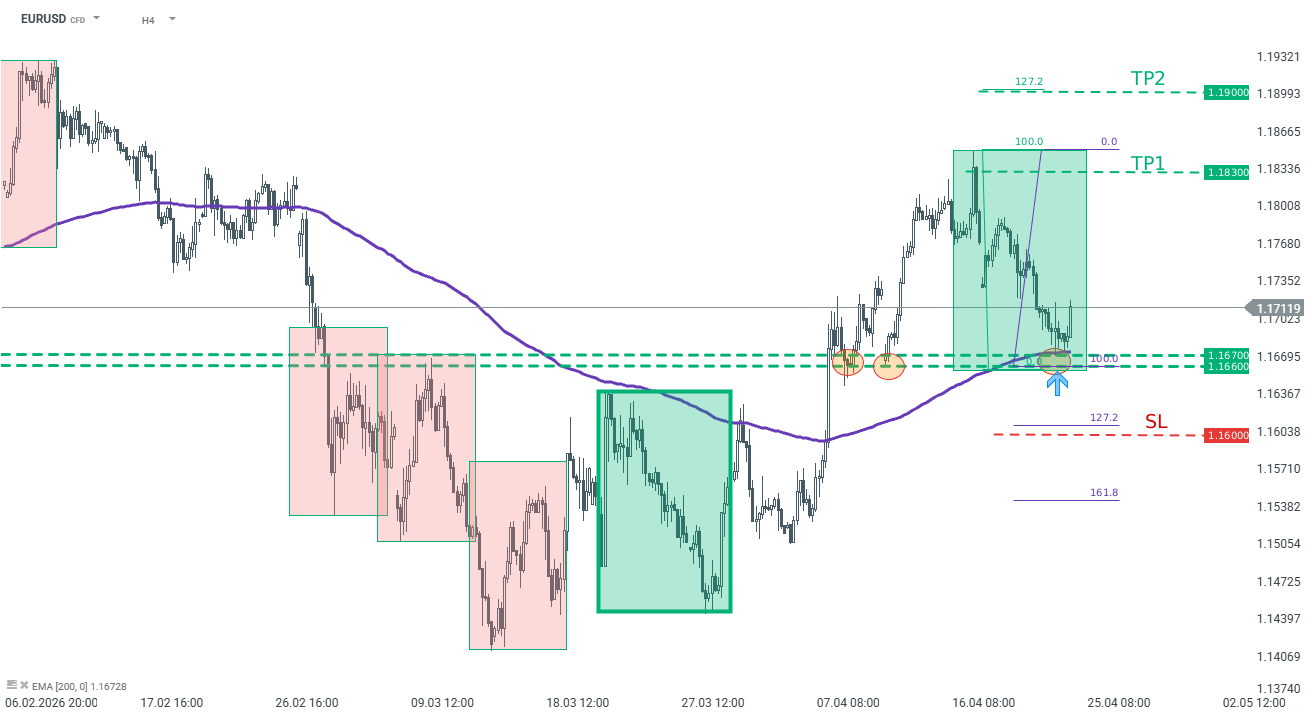
EUR/USD is trading at 1.18 12:30 PM GMT on Tuesday, April 14, one hour ahead of the U.S March PPI release
The pair has managed to break above both the 200- and 100-session exponential moving averages (EMA200 and EMA100)
The daily RSI is above 65, while MACD remains supportive, and the pair is trading near the 61.8% Fibonacci retracement of the downtrend that began on January 27
Recommendation:
Position: Short EUR/USD at market price
Take Profit: 1.16646
Stop Loss: 1.18881
View:
From a technical perspective, EUR/USD has re-entered an upward trend, but the reboundโdriven by growing optimism around a potential resolution of the U.S.โIran conflictโhas been unusually sharp. At the same time, conditions in global energy marketsโon which Europe is more dependent than the U.S remain challenging. IEA President Fatih Birol indicated that normalization of supply from the Middle East could take up to two years due to the scale of infrastructure damage. As a result, the 61.8% Fibonacci retracement of the late-January downtrend, further reinforced by prior price reactions (February consolidation), may act as a significant resistance level for EUR/USD. Uncertainty surrounding the Strait of Hormuz is likely to persist, with Iran maintaining that the U.S. will not control this key trade route. In an escalation scenario, sentiment toward EUR/USD may gradually weaken, and even if the conflict ultimately resolves favorably for Europe, the pair could experience elevated volatility along the way. Also, multiple US macro data signals that price pressure is starting to rise across the economy, which may lead to still quite ‘hawkish’ Fed stance ahead of the summer. Technically, the daily RSI has risen to 65, while the hourly RSI stands at 79.1โboth suggesting overbought conditions. Given this setup, a short position is favored, targeting 1.16646 with a protective stop at 1.18881. M
USD/JPY struggles to build on modest Asian session gains as intervention fears limit JPY losses.
The fundamental backdrop favors the USD bulls and backs the case for further gains for the pair.
The technical setup also suggests that the path of least resistance for spot prices is to the upside.
The USD/JPY pair builds on gains from the past two days and opens with a bullish gap at the start of the new week, rising to the 159.85 region during the Asian session. However, intervention fears keep a lid on any further appreciation for spot prices.
Failed US-Iran peace talks trigger a fresh wave of the global risk-aversion trade and benefit the US Dollar’s (USD) reserve currency status. Adding to this, rallying Crude Oil prices fuel inflationary fears and reaffirm hawkish USย Federal Reserveย (Fed) expectations, which further underpins the buck and offers support to the USD/JPY pair.
The Japanese Yen (JPY), on the other hand, is weighed down by economic concerns stemming from imported energy shocks due to the Middle East conflict. However, speculations that authorities would step in to stem further JPY weakness hold back bearish traders from placing aggressive bets and cap gains for the USD/JPY pair.
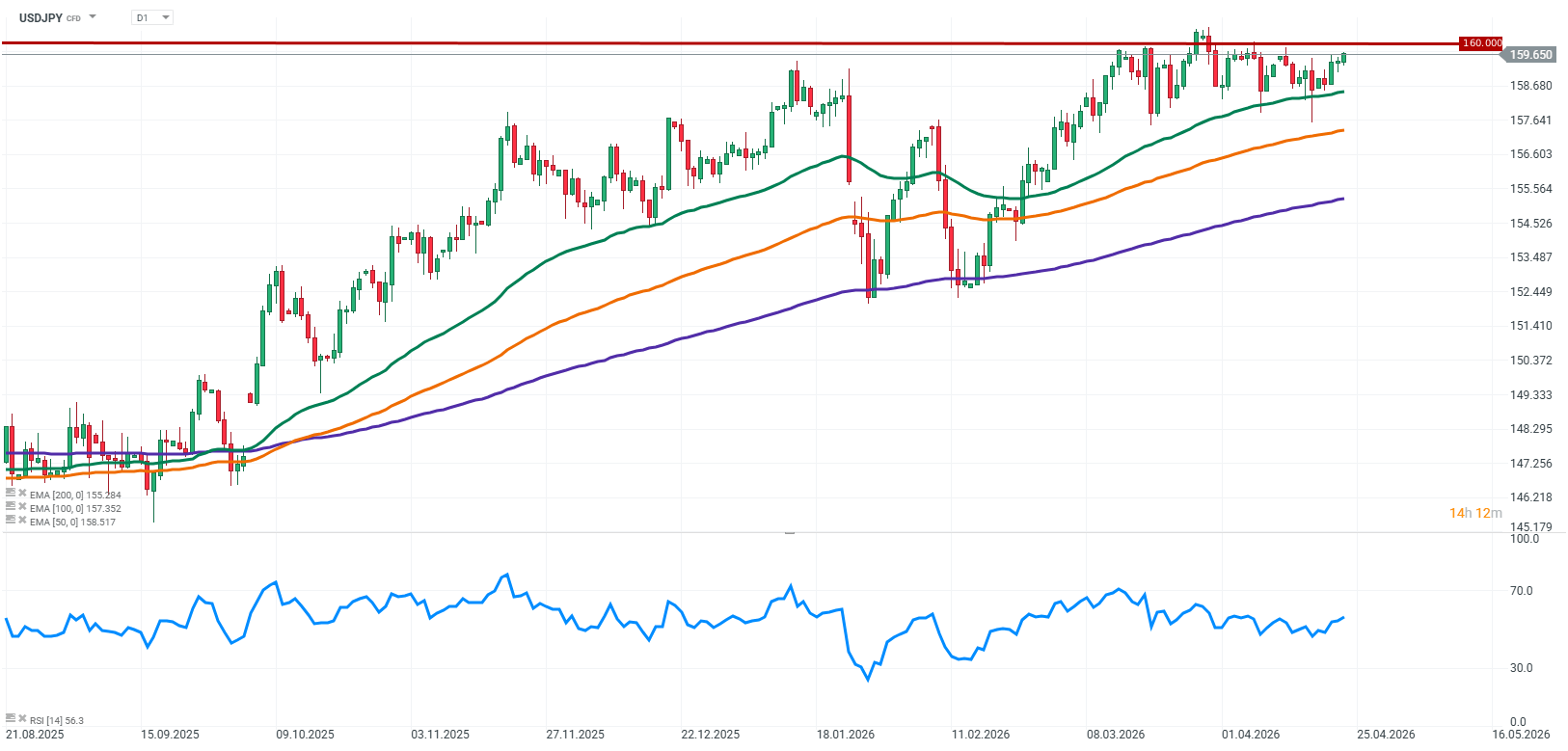
Spot prices retain a bullish bias following last week’s resilience below the 158.25-158.20 horizontal support. Furthermore, the USD/JPY pair holds comfortably above the 200-period Simple Moving Average (SMA). The Relative Strength Index (RSI) near 63 suggests firm upside momentum without yet signaling overbought conditions.
Adding to this, the Moving Average Convergence Divergence (MACD) turns increasingly positive, hinting that buyers retain control for now. The USD/JPY bulls, however, might await a sustained strength and acceptance above the 160.00 psychological mark before positioning for an extension of a three-day-old appreciating move.
On the downside, initial support is reinforced by the 200-period SMA at 158.56, which underpins the broader uptrend and would be the first level watched in the event of a corrective pullback. This is followed by the 158.25-158.20 support and the 158.00 mark, which, if broken, could turn the USD/JPY pair vulnerable.
Markets are in a jubilant mood as we lead up to the weekend. Spurred by a milder March reading of US inflation than expected, rate cut expectations are building, and stocks are rallying. Headline CPI in the US rose at a 3.4% annual rate, a hefty jump from the 2.4% rate in February, but lower than the 3.5% expected core prices rose by a 2.6% annual rate, also weaker than expected. The BLS reported that the index for energy rose by 10% in March, driven by a 21% rise in the price of gasolene.
US price growth not as bad as feared
The jump in gasolene prices accounted for three quarters of the rise in inflation last month, according to the BLS. Airline fares also rose sharply last month, but this was partly offset by a drop in medical costs and in used car prices. Todayโs data suggests two things: 1, the inflationary impact from this crisis has been huge, but it is offset by weaker inflation growth elsewhere, such as a moderate increase in shelter costs, a drop in the cost of utilities and no change in food prices last month. 2, if the Strait of Hormuz is not reopened soon, then the impact on inflation could spread to food prices and to core inflation, which typically takes longer to absorb energy price shocks.
The immediate market reaction has been relief. A higher-than-expected reading for inflation could have spooked financial markets as we lead up to the weekend. Instead, this supports current expectations of a rate cut from the Federal Reserve by year end, which is boosting the market mood.
Markets optimistic about peace talks
Some concrete economic data that quantifies the effect of the war as being less onerous than first anticipated, combined with hopes for successful peace talks is helping US stocks to extend their longest winning streak this year. Rather than selling stocks on a Friday in case of an escalation of the conflict in the Middle East over the weekend, the market is willing to โgive peace a chance.โ
Stocks have strong week, as dollar reverses course
The dollar is weaker across the board on Friday after the lower-than-expected US inflation print, which is boosting hopes of a rate cut from the Fed. However, the bond market is less enthusiastic, and bonds are selling off across Europe after Forties crude from the North Sea reached a fresh record high above $147 per barrel. Until the Strait of Hormuz is fully open and Gulf energy infrastructure is operational, the bond market is likely to trade with a more cautious tone compared to stocks.
Stocks are on course for their best weekly performance of the year so far, as you can see below, and this has been spurred by the marketโs conviction that President Trump will continue with a ceasefire and the conflict in the Middle East is now at its end stages. The Trump reversal index is now back at levels last reached before the war started. The market is pricing for a positive outcome from the negotiations between the US and Iran this weekend, below, we assess potential outcomes from this weekendโs talks and their impact on financial markets:
Peace talks, assessing the potential outcomes
1, Positive outcome: The two sides agree to reopen the Strait of Hormuz, which leads to an immediate reopening of the waterway. An even better outcome would be one without tariffs to pass through the Strait. The oil price is likely to fall back to pre-war levels for Brent, between $75 and $80 per barrel, stocks could surge and bonds will also rally, leading to another sharp decline in global bond yields. We believe there is a low probability, 30% or less, of this perfect outcome happening straight away.
2, Moderate outcome: The negotiations end without a deal, but more talks are expected. The prospect of prolonged negotiations could knock sentiment at the start of next week, but any weakness could fade if there are continued pledges to work towards a lasting peace. While stocks may extend this weekโs rally, a high oil price could stymie further gains, especially if there is no concrete plans to reopen the Strait of Hormuz. We think that this is the most likely outcome and think there is a 70-80% chance that further talks will be needed.
3, Negative outcome: The talks fail, both sides walk away and the bombing in Iran and around the Gulf resumes. This could see the oil price reach fresh highs above $120 per barrel for Brent, stocks will tank and bond yields will surge. We believe that this is also a low probability outcome, with 10-15% chance.
Overall, the outcome of negotiations are the main focus for markets as we end the week.
Chart 1: S&P 500, weekly performance chart 1 year
Source: XTB and Bloomberg
The material on this page does not constitute financial advice and does not take into account your level of understanding, investment objectives, financial situation or any other specific needs. All information provided, including opinions, market research, mathematical results and technical analyzes published on the Website or transmitted To you by other means, it is provided for information purposes only and should in no way be construed as an offer or solicitation for a transaction in any financial instrument, nor should the information provided be construed as advice of a legal or financial nature on which any investment decisions you make should be based exclusively To your level of understanding, investment objectives, financial situation, or other specific needs, any decision to act on the information published on the Website or sent to you by other means is entirely at your own risk if you In doubt or unsure about your understanding of a particular product, instrument, service or transaction, you should seek professional or legal advice before trading. Investing in CFDs carries a high level of risk, as they are leveraged products and have small movements Often the market can result in much larger movements in the value of your investment, and this can work against you or in your favor. Please ensure you fully understand the risks involved, taking into account investments objectives and level of experience, before trading and, if necessary, seek independent advice.
This analysis from the Overbalance series aims to identify three financial instruments, analyzed primarily on the daily/four-hour (D1/H4) timeframe. The analysis relies solely on the Overbalance methodology, which helps determine points where a trend may continue or where a reversal might occur. Todayโs analysis covers three instruments, evaluated solely in terms of 1:1 correction structures.
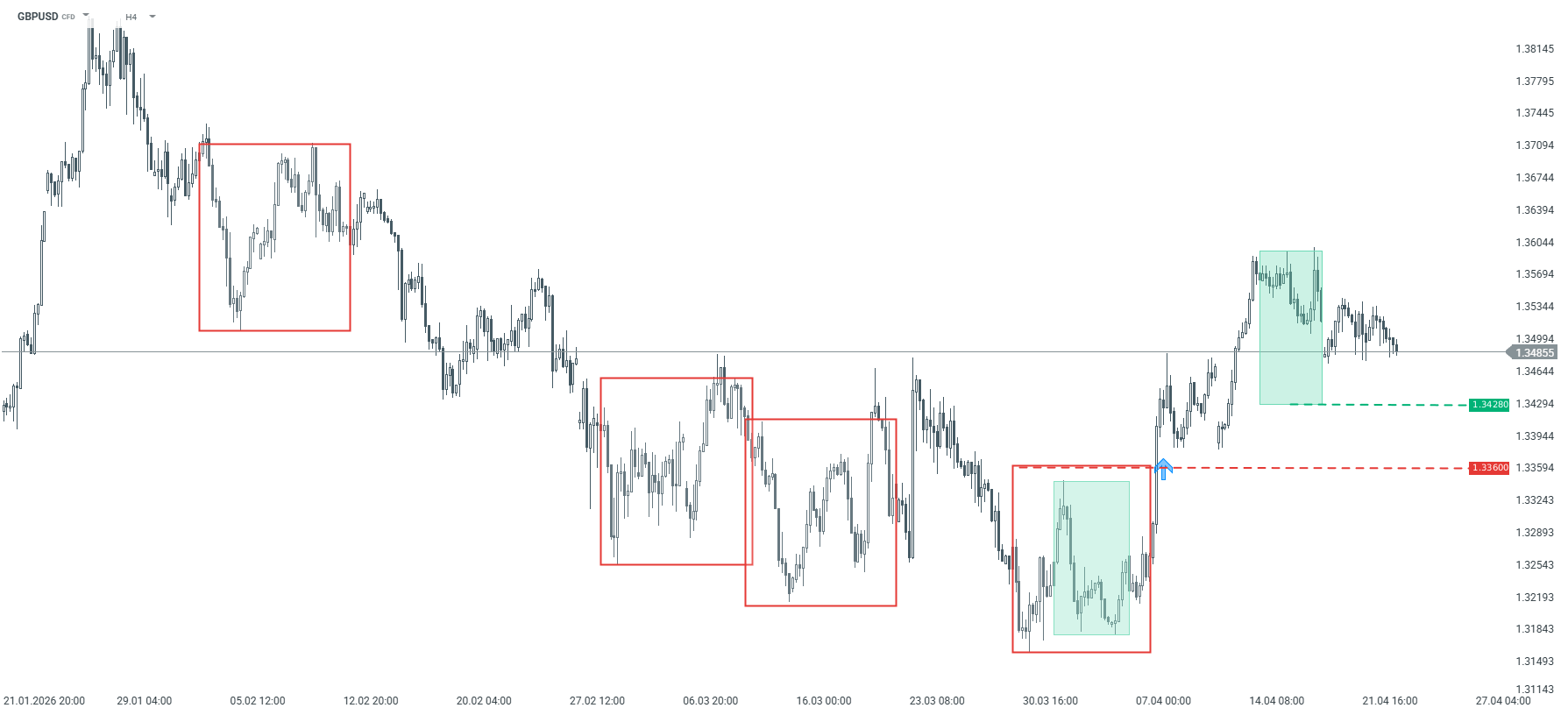
GBPUSD The GBPUSD price has broken its downward trend by rising above the 1.3360 level, which, according to the Overbalance methodology, paves the way for a larger upward correction or even a trend reversal. Currently, the 1.3360 levelโthe upper boundary of the negated 1:1 geometryโserves as key support. Conversely, for a return to the downtrend, the price would also need to fall below the 1.3315 level, where the lower boundary of the local 1:1 uptrend pattern is located.
GBPUSD – H4 chart. Source: xStation
AUDNZD The AUDNZD pair has been in an uptrend for quite some time. The latest correction was exactly the same size as the previous ones, marked by the green rectangle. We are currently observing a local corrective move. If the correction continues, key support based on the Overbalance methodology is at the 0.6992 level, where the lower boundary of the 1:1 pattern is located. As long as the price remains above this level, the uptrend remains in effect.
AUDNZD – H4 timeframe. Source: xStation
USDCHF USDCHF prices have been trending downward for quite some time, but since late January we have seen a dynamic upward correction. Currently, the price has rebounded from a key resistance level at 0.8042, where the upper boundary of the largest 1:1 pattern is located, which, according to the Overbalance methodology, may signal a return to the downtrend. For this scenario to be confirmed, the price should sustainably fall below the 0.7902 level, where the lower boundary of the smaller pattern is located. In that case, a acceleration of the decline toward recent lows would be possible. Conversely, a break above the 0.8042 level would open the way for further gains.
USDCHF – H4 timeframe. Source: xStation
The material on this page does not constitute financial advice and does not take into account your level of understanding, investment objectives, financial situation or any other specific needs. All information provided, including opinions, market research, mathematical results and technical analyzes published on the Website or transmitted To you by other means, it is provided for information purposes only and should in no way be construed as an offer or solicitation for a transaction in any financial instrument, nor should the information provided be construed as advice of a legal or financial nature on which any investment decisions you make should be based exclusively To your level of understanding, investment objectives, financial situation, or other specific needs, any decision to act on the information published on the Website or sent to you by other means is entirely at your own risk if you In doubt or unsure about your understanding of a particular product, instrument, service or transaction, you should seek professional or legal advice before trading. Investing in CFDs carries a high level of risk, as they are leveraged products and have small movements Often the market can result in much larger movements in the value of your investment, and this can work against you or in your favor. Please ensure you fully understand the risks involved, taking into account investments objectives and level of experience, before trading and, if necessary, seek independent advice.

To provide the best experiences, we use technologies like cookies to store and/or access device information. Consenting to these technologies will allow us to process data such as browsing behavior or unique IDs on this site. Not consenting or withdrawing consent, may adversely affect certain features and functions.
Functional
Always active
The technical storage or access is strictly necessary for the legitimate purpose of enabling the use of a specific service explicitly requested by the subscriber or user, or for the sole purpose of carrying out the transmission of a communication over an electronic communications network.
Preferences
The technical storage or access is necessary for the legitimate purpose of storing preferences that are not requested by the subscriber or user.
Statistics
The technical storage or access that is used exclusively for statistical purposes.The technical storage or access that is used exclusively for anonymous statistical purposes. Without a subpoena, voluntary compliance on the part of your Internet Service Provider, or additional records from a third party, information stored or retrieved for this purpose alone cannot usually be used to identify you.
Marketing
The technical storage or access is required to create user profiles to send advertising, or to track the user on a website or across several websites for similar marketing purposes.