


Negotiations between Iran, the US, and GCC states on access to the Strait of Hormuz will continue to set energy prices and interest rate outlooks for the global economy. In the meantime, updates on the AI trade, which is undergoing heightened volatility, will feature earnings from Applied Materials, Cisco, and CoreWeave. The US will publish consumer inflation data as both the FOMC and financial markets are split on the Fed’s rate decision next month. The US will also post the PPI, retail sales, and the Michigan Consumer Confidence Index. In Europe, the UK and Switzerland will post Q2 GDP figures, while the Eurozone will publish industrial production data. In Asia, Chinese monetary aggregates will be in focus, while Taiwan’s GDP will unveil concrete figures on global chip production. Also, China and India will post inflation rates. For G10 monetary policy, rate decisions are due in Australia and Norway, while the BoJ will post July’s Summary of Opinions.

USD/CAD Price: Bullish Flag pattern underway
- The USD/CAD pair ticks higher to near 1.4023 ahead of US-Canada employment data.
- The Fed is expected to hike interest rates at the September meeting.
- A bullish flag pattern is in the making, suggesting that the overall trend is still bullish.
The Canadian Dollar (CAD) trades marginally lower against the US Dollar (USD) on Friday, with the USD/CAD pair edging up to near 1.4023 in the European trading session. The Loonie pair is expected to trade sideways as investors await the labor market data for July from both the United States (US) and Canada.
Investors will pay close attention to both datasets to get fresh cues regarding the Federal Reserve (Fed) and the Bank of Canada’s (BoC) monetary policy outlook.
US jobs report in focus as Danske Bank sees solid labor backdrop
Analysts at Danske Bank highlight that “the most important data release will be the US July Jobs Report,” where they “forecast nonfarm payrolls at +70k, the unemployment rate unchanged at 4.2%, and average hourly earnings at +0.3% m/m s.a.” The bank notes that “most leading data still point towards solid labour market conditions, although weak labour supply growth also weighs on the employment growth outlook,” adding that “the unemployment rate remains the Fed’s primary focus.”
The CME FedWatch tool shows a 54.5% chance that the Fed will raise interest rates in the September policy meeting.
Meanwhile, the Canadian labor market report is expected to show that the economy created 15K fresh jobs, slightly lower than 18.2K in June. The Unemployment Rate is seen as steady at 6.5%.
USD/CAD Technical Analysis
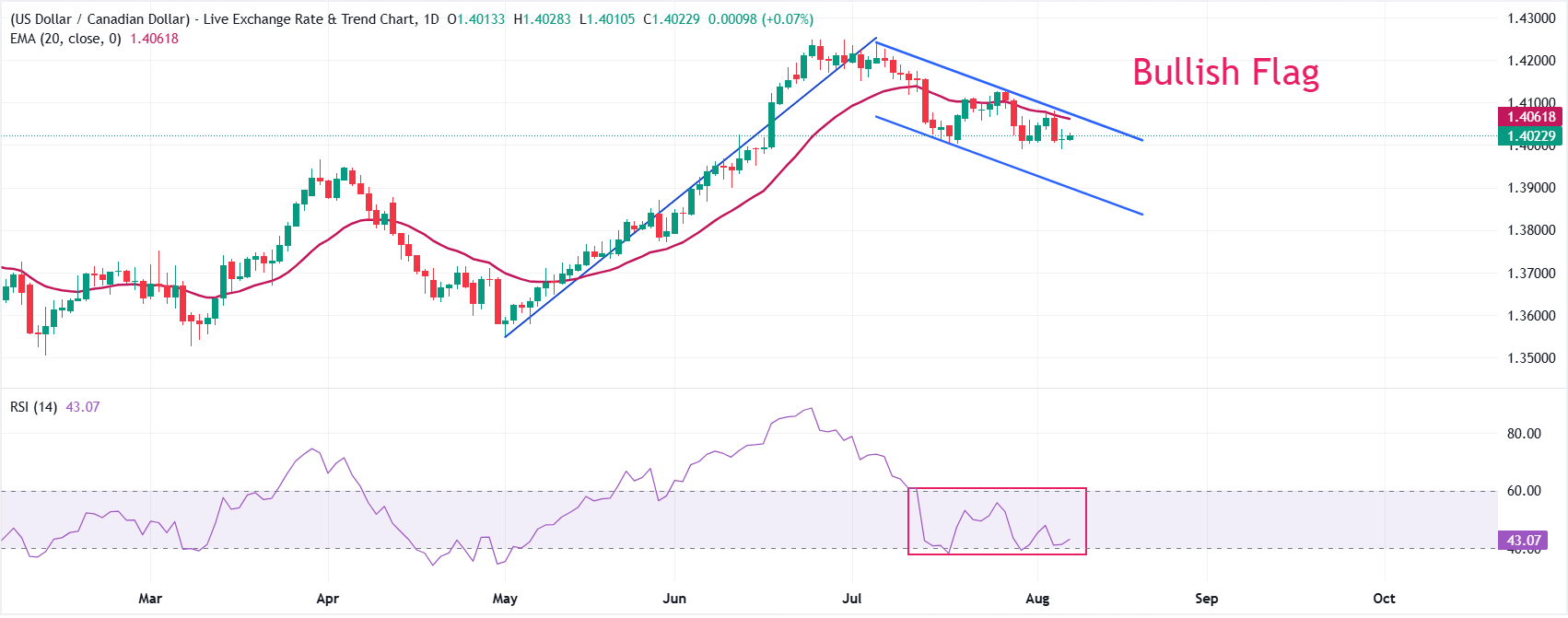
USD/CAD trades at 1.4023, retaining a bearish near-term bias as price holds below the 20-period Exponential Moving Average (EMA) at 1.4062. However, the formation of a Bullish Flag chart pattern suggests that the overall trend is still bullish.
The Relative Strength Index (RSI) at 43.1 sits just under neutral, hinting at subdued downside momentum rather than outright oversold conditions.
On the topside, immediate resistance is clustered between the 20-period EMA at 1.4062 and the channel top at 1.4076; a decisive break above that zone would open the way for an upside move towards 1.4200. On the downside, the lower boundary of the Bullish Flag channel at around 1.3902 will be the key support level.

EUR/GBP Price Forecast: Holding below 0.8580 with dips limited so far
- EUR/GBP eases to 0.8575 on Thursday after being rejected at the 0.8580 area.
- Lower oil prices and positive Eurozone data are keeping the Euro downside attempts limited.
- Failure to extend gains beyond the late-July top, at 0.8586, might give bears fresh hopes.
The Euro (EUR) nudges lower against the British Pound (GBP) on Thursday, following a three-day rally. The EUR/GBP remains capped below the late-July top of 0.8586, trading at 0.8575 at the time of writing, yet with downside attempts subdued so far.
Eurozone data was supportive on Thursday, as German Factory Orders beat expectations with a 3.1% increase in June, largely exceeding the 0.3% market forecast, and a downwardly revised 0.3% reading in May.
Regarding the Pound, FX strategists at Rabobank argue that “a re-pricing in policy expectations towards steady policy from the BoE this year combined with the prospect of nervousness ahead of the October budget suggests scope for downside pressure on the pound as the summer draws to a close.”
In this context, Rabobank continues to see value in the cross, stating that “we favour buying EUR/GBP on dips to the 0.8550 area,” and adding that “a break above the recent high in the 0.8588 region could increase upside potential.”
Technical Analysis: Failure to break 0.8586 might encourage bears
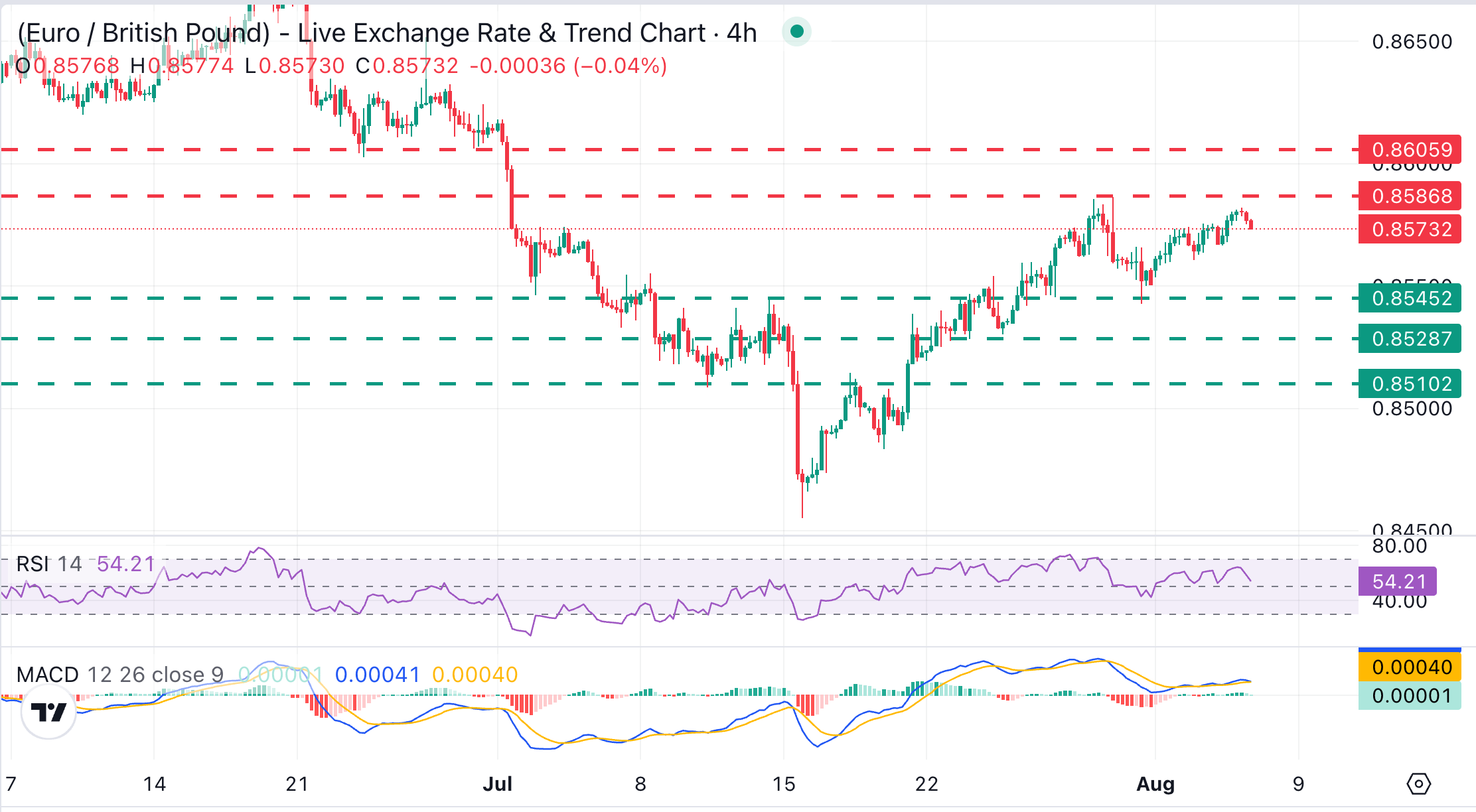
The technical picture shows the EUR/GBP pair trading at 0.8576, with momentum indicators highlighting weaker bullish traction. The Relative Strength Index (14) is trending towards the 50 midline, while the Moving Average Convergence Divergence (MACD) indicator hovers around zero, suggesting that bullish momentum is present but tentative.
Bulls need to break the mentioned 0.8586 resistance area level (July 29, 30 highs) to confirm the positive trend and target late June lows at the 0.8605 area. Failure to do so might give fresh hopes for bears to break the August 4 and 5 lows in the 0.8560-0.8565 area and aim for the July 31 low, near 0.8540, which will be the neckline of a double top pattern.
On the downside, immediate support is seen at 0.8548, followed by additional underlying demand at 0.8529 and 0.8510, with deeper structural levels resting at 0.8419 and 0.8327. On the topside, initial resistance aligns at 0.8587, ahead of 0.8606; a sustained break above these caps would open the way toward 0.8730 and 0.8741, with higher hurdles at 0.8790 and 0.8863 likely to limit any extended advance.

RBI leaves the Repo Rate unchanged at 5.25% in August, as expected
The Reserve Bank of India’s (RBI) Monetary Policy Committee (MPC) announced on Wednesday that it held the benchmark Repo Rate steady at 5.25% following the conclusion of the August monetary policy meeting.
The decision came in line with the market expectations.
Speeches from RBI Governor Sanjay Malhotra
West asia conflict continues to challenge global economy.Crude oil prices, currencies, financial markets remain volatile.
Global economic environment has become increasingly unstable.
MPC retains policy stance at ‘neutral.’
Headline inflation has edged up above target.
Higher inflation mostly on account on fuel, food with little signs of generalisation of price pressures so far.
Domestic economic activity has exhibited resilience.
There is need for greater clarity on inflation before taking policy action.
Supply side pressures from west asia conflict have eased somewhat.
Inflation not getting broad based, expected to decline after peaking in Q3FY27.
MPC underscored it will maintain close vigil, stay resolute on aligning inflation to target.
Investment activity remains steady.
Indian economy performed better than expected in Q1FY27.
Q3 FY27 CPI inflation seen at 5.9% (previously at 5.9%).
Q4 FY27 real GDP growth seen at 6.8%.
Q4 FY27 CPI inflation seen at 5.5%.
USD/INR reaction to the RBI interest rate decision
The Indian Rupee (INR) catches fresh offers and extends lower in an immediate reaction to the RBI interest rate decision. The USD/INR pair currently trades at 95.05, down 0.04% on the day.
This section below was published on August 5 at 00:30 GMT as a preview of the Reserve Bank of India (RBI) interest rate decision.
- The RBI is set to leave policy rates unchanged on Wednesday.
- The Reserve Bank of India might retain the data-dependent approach for the monetary policy outlook.
- Investors will closely track comments on FCNR deposits, inflation and the economic outlook.
The Reserve Bank of India (RBI) is set to announce its bi-monthly monetary policy decision on Wednesday at 10:00 AM IST (04:30 GMT), another meeting coming at a time when uncertainty remains high over the duration and economic fallout of the ongoing Middle East conflict.
RBI seen on hold as inflation remains within target band
Analysts at Commerzbank expect the Reserve Bank of India to maintain its current policy stance, noting that the RBI is “expected to leave the benchmark repurchase rate unchanged at 5.25% at its next meeting on 5 August.” While they acknowledge that “inflation risks remain tilted to the upside due to higher global commodity prices and a weaker monsoon season,” Commerzbank highlights that the June Consumer Price Index (CPI) print “rose 4.4% yoy, which was within RBI’s 2-6% target range,” reinforcing the case for policy continuity in the near term.
The RBI is also expected to leave the Standing Deposit Facility (SDF) and the Marginal Standing Facility (MSF) rates unchanged at 5% and 5.5%, respectively.
According to the latest Reuters poll, 68 of the 72 economists expect the RBI to leave its policy rates at their current levels.
So far this year, the RBI has maintained the status quo at all three policy meetings and has kept rates unchanged since cutting the Repo Rate by 25 basis points (bps) to 5.25% in the December 2025 meeting.
What happened in the last meeting?
In the June policy meeting, the Indian central bank raised its inflation forecast, after leaving policy rates steady, for FY26-27 to 5.1% Year-on-Year (YoY) from 4.6% projected earlier, citing that higher input prices such as base metals, plastic and rubber, and rising commercial Liquefied Petroleum Gas (LPG) prices are putting upward pressure on overall prices.
The RBI also lowered its real Gross Domestic Product (GDP) growth forecast for the current year to 6.6% from its prior expectations of 6.9%.
On the monetary policy outlook, RBI Governor Sanjay Malhotra said that it is “prudent to wait for greater clarity to emerge” and the central bank will remain “data-dependent”.
Key things to watch
Investors will pay close attention to commentary from RBI Governor Malhotra regarding inflation and the economic outlook on the back of the ongoing geopolitical crisis.
In the last meeting, RBI Governor Malhotra acknowledged heightened global uncertainty amid geopolitical risks, and said that the extended disruption in global supply chains and higher energy prices have prompted risks both to inflation and growth. However, he assured that the economy is able to “withstand these shocks with minimum pain”.
In an interview with Businessline, released last week, RBI Governor Malhotra made clear that price stability is their key priority, but policymakers don’t see any signs of price pressures entrenching. “Our primary mandate is inflation and price stability. Therefore, we will do whatever is required first, to keep price stability and then, to see to what extent we can support growth,” Malhotra said.
Investors will also focus on commentary about India’s interest rate outlook. Analysts at Axis Bank say, “The MPC is likely to shift language acknowledging risks of firmer inflation and policy action ahead, while maintaining a data-dependent approach.”
Financial markets would also be keen to know the performance of Foreign Currency Non-resident (FCNR) deposits, which were announced in the June meeting, aiming to increase the inflow of foreign funds to support forex reserves. The tool allows commercial banks to raise funds via foreign currency deposits whose full hedging cost is borne by the RBI.
India flows recover as DBS flags stronger debt, equity and FCNR(B) momentum
Analysts at DBS Group Research highlight that “the flows picture is, meanwhile, on the mend,” pointing to a “resumption in portfolio inflows into equity and debt markets as well as positive cues on the swap schemes.” They note that “July saw debt markets attract more than $2bn in inflows, bringing FYTD debt inflows to $7.7bn, while equities recorded $1.5bn worth flows following consecutive months of outflows.”
In addition, DBS cites comments from RBI Governor Malhotra, who said in an interview that “banks had mobilized a cumulative $32bn via the swap windows to-date, already surpassing the scale of inflows raised back in 2013.” Against this backdrop, DBS reiterates that “we expect the scale of the FCNR(B) deposits, in particular, to pick up in second half of the scheme’s validity period, as KYC/compliance requirements are completed,” and cautions that “at the current run-rate, our conservative estimate of $45-50bn of total inflows under the special schemes could be overshot.”
USD/INR technical outlook points to a mild bearish bias
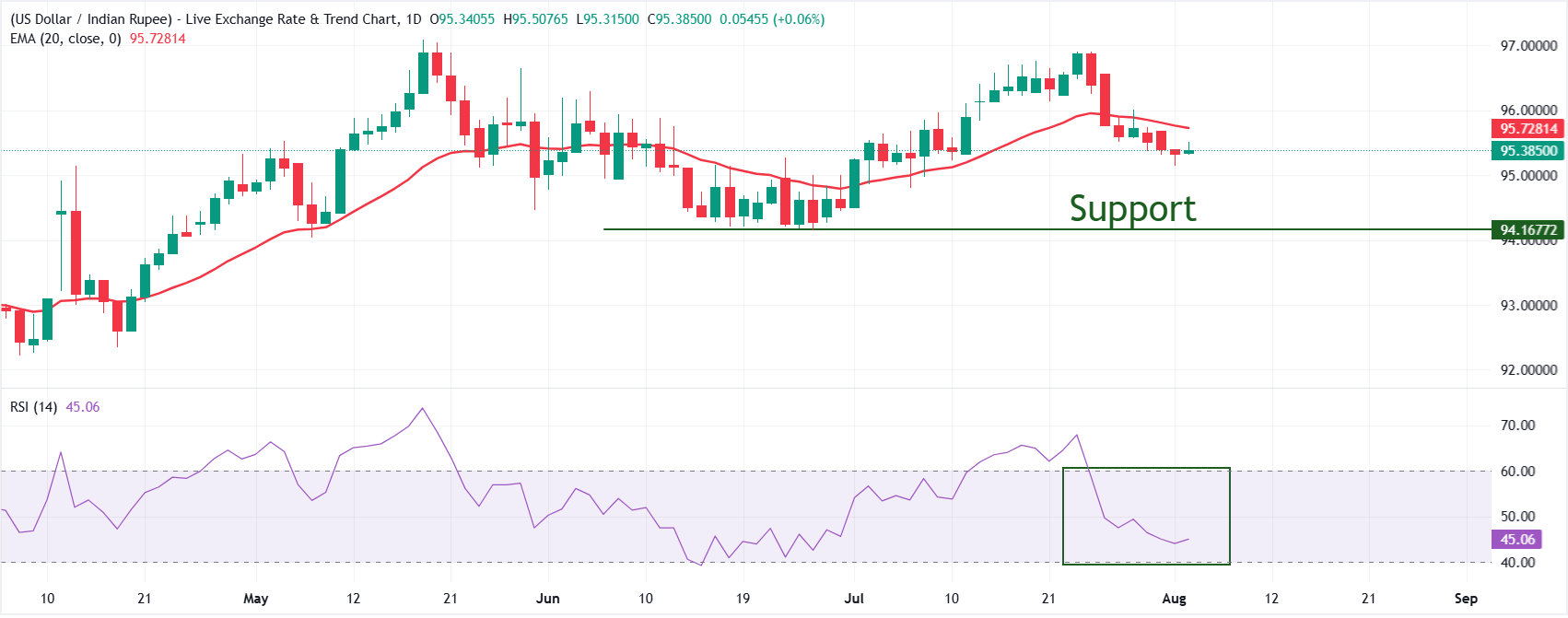
USD/INR retains a mildly bearish near-term bias as it holds below the 20-day Exponential Moving Average (EMA) at 95.72. The short-term trend structure suggests the pair is capped by this dynamic resistance, while the 14-day Relative Strength Index (RSI) at 45 keeps momentum in a neutral-to-bearish zone, hinting at a lack of strong buying conviction after the recent pullback from the 96.00 area.
On the topside, immediate resistance is defined by the 20-day EMA at 95.73, and a daily close above this barrier would be needed to extend the recovery towards 96.00. On the downside, major sup

USD/JPY Price – 200-day SMA caps rebound after intervention-led selloff
- USD/JPY edges higher as the Japanese Yen gives back part of its intervention-led gains.
- The pair has slipped below all major moving averages, turning the near-term bias bearish.
- RSI signals oversold conditions, while the 200-day SMA at 158 offers immediate resistance.
USD/JPY trades modestly higher on Tuesday despite a softer US Dollar (USD), as the impact of recent intervention fades and the Japanese Yen (JPY) comes under pressure again. At the time of writing, the pair trades around 157.60, recovering after briefly falling toward 155 on Monday, its lowest level since May 6.
Analysts at Societe Generale argue that a lasting recovery in the Yen will hinge on the domestic growth story rather than policy theatrics, maintaining that “what will trigger a durable yen rally will be a rise in consensus forecasts of Japanese growth, rather than more, bigger intervention, coordinated or otherwise.”
They add that “more, or faster BoJ rate hikes won’t solve the problem either, unless the Japanese growth outlook makes them appear realistic,” cautioning that “if Japanese growth remains weak, higher JGB yields will increasingly be unhelpful for the yen.”
In contrast, strategists at BBH focus on the near-term impact of recent official action, noting that “the coordinated US-Japan intervention – and officials’ warning that they stand ready to act again – significantly raises the cost of fighting a stronger yen and puts a much firmer ceiling on USD/JPY.”
From a technical perspective, the intervention-driven pullback in USD/JPY has weakened the near-term bullish structure, with the pair slipping below key moving averages.
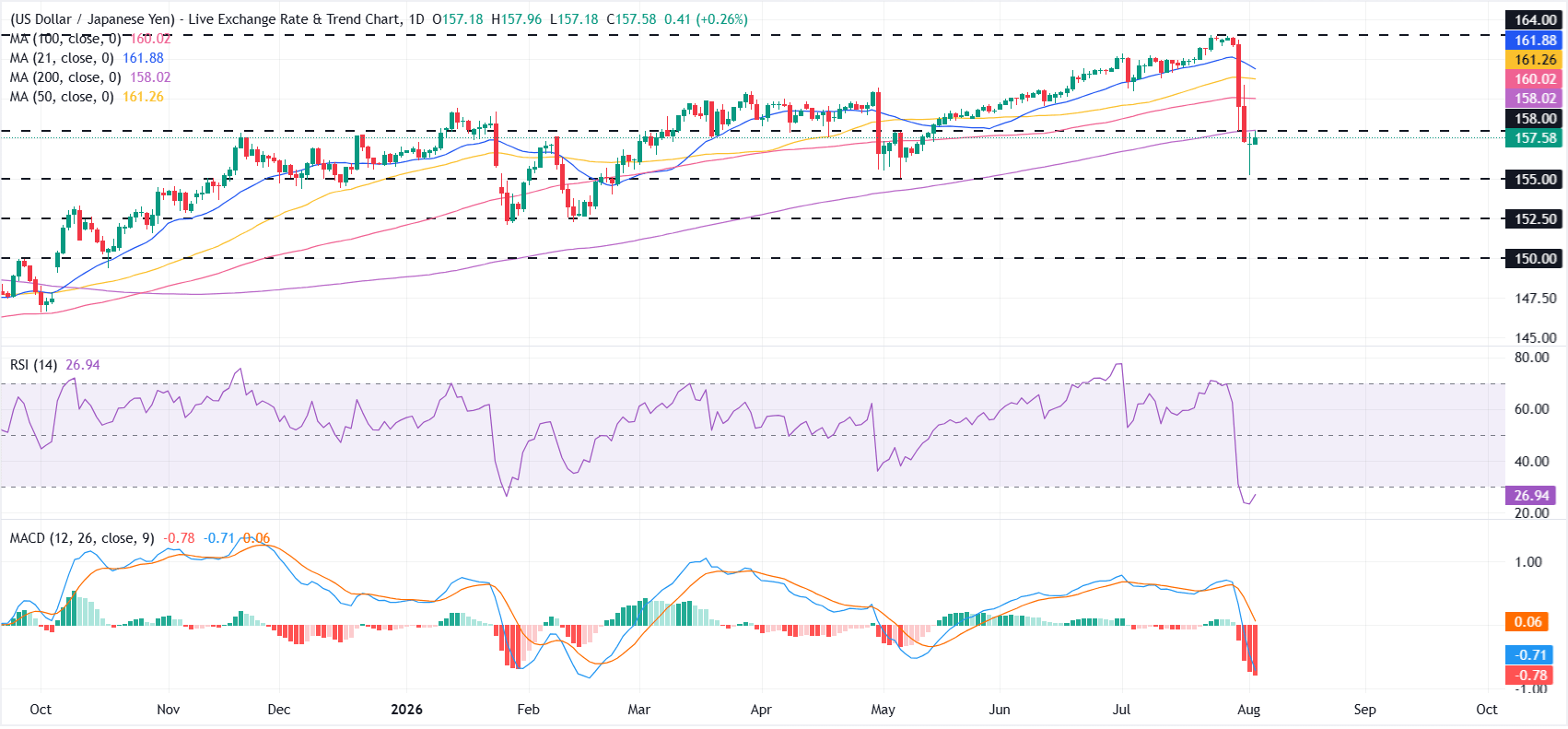
On the daily chart, the 200-day Simple Moving Average (SMA) at 158 offers immediate resistance. Further up, the 100-day SMA at 160 guards the path toward the 50-day SMA at 161.26 and the 21-day SMA at 161.89, ahead of a more distant structural hurdle at 164.
The Relative Strength Index (RSI) at 27 signals oversold conditions, while the Moving Average Convergence Divergence (MACD) remains below zero, reflecting the recent shift in momentum to the downside.
On the downside, the 155.00 psychological mark offers immediate support. A decisive break below this level could expose the 152.50 area, with the 150.00 psychological mark emerging as the next major downside target.

CHF weakens as July inflation cools to four-month lows
- Swiss CPI drops to 0.4%, signaling minimal energy cost pass-through.
- SNB Monetary policy projected to remain unchanged through the end of the year.
- Markets price in a 65% chance of a September 25-bps rate increase.
USD/CHF moves little after two days of gains, trading around 0.8100 during the Asian hours on Tuesday. The currency pair may appreciate further as the Swiss Franc (CHF) faces headwinds from easing domestic inflation.
Swiss CPI slowed to 0.4% in July, down from 0.5% in the previous month to hit its lowest level in four months. This slowdown underscores a limited pass-through from higher geopolitical energy prices, contrasting with the Swiss National Bank’s (SNB) expectations of a modest near-term inflation pickup following its decision to hold policy rates at 0%.
Franc under pressure as SNB keeps rates at zero
Strategists at Brown Brothers Harriman highlight that “Swiss July CPI stays muted,” underscoring the absence of inflationary pressure in the economy. In their view, the “bottom line” is that the SNB “has plenty of room to keep rates at 0.00% for some time, which is an ongoing drag for CHF.” They note that against this backdrop of subdued price dynamics and a firmly anchored policy rate, “CHF is the worst performing G10 currency so far this quarter.”
Looking ahead, the SNB is anticipated to keep borrowing costs unchanged through year-end; additional rate cuts remain a contingency plan rather than a base case, particularly given the absence of severe stress within the Swiss banking sector.
Meanwhile, price action in the pair remains muted as the US Dollar (USD) stabilizes amid ongoing diplomatic uncertainty. Tensions rose after US President Donald Trump characterized his offer for discussions with Iran as a “last chance,” following his decision to call off a major military strike. Iranian leadership swiftly dismissed the proposal, with General Mohsen Rezaei, an advisor to Iran’s Supreme Leader, rejecting the conditions and asserting that Iran will not permit a second corridor in the Strait of Hormuz.
Meanwhile, market participants are continuing to recalibrate their monetary policy expectations following the Fed’s decision to hold interest rates steady in July. According to the CME FedWatch tool, traders are currently pricing in roughly a 65% probability of a 25-basis-point rate hike at the Federal Reserve’s upcoming September meeting.

Euro flatlines above 1.1500 as traders turn cautious ahead of US JOLTS Job Openings data
- EUR/USD trades flat near 1.1505 in Tuesday’s early European session.
- Hot Eurozone inflation report adds to an already strong case for another ECB rate hike.
- Traders await the US JOLTS Job Openings data on Tuesday ahead of the July employment report.
The EUR/USD pair holds steady around 1.1505 during the early European trading hours on Tuesday. Markets remain cautious ahead of the US JOLTS Job Openings data, which is due on Tuesday. On Friday, the attention will shift to the crucial US July jobs report.
Eurozone inflation ticked up in July, bolstering the case for a rate hike from the European Central Bank (ECB). The headline Eurozone inflation rose to 2.9% YoY in July from 2.8% in June, in line with expectations, Eurostat data showed last week. Meanwhile, the core Eurozone inflation accelerated to 2.5% YoY in July versus 2.4% prior, above the consensus of 2.4%.
Financial markets are betting on more than two ECB rate hikes, with moves fully priced in by October and April, according to Reuters.
The US employment data will be the highlight later on Friday, which could offer some hints about the health of the labour market and US interest rate path. Economists expect Nonfarm Payrolls (NFP) to increase by 83,000 in July, while the Unemployment Rate is projected to rise to 4.3% during the same period. In case of stronger-than-expected outcomes, this could lift the Greenback in the near term.
Markets have priced in nearly a 64.7% chance of a US rate hike in September, down from about 77% before the July Fed meeting, according to the CME FedWatch tool.
Fed decision seen as key driver for EUR/USD direction into September
Strategists at ING emphasise that the path for EUR/USD in the coming weeks hinges largely on the Federal Reserve. They argue that “the bigger and more lasting driver of the EUR/USD trend will be the Fed’s September decision,” which “remains unresolved,” leaving this week’s US data as a crucial catalyst. ING notes that the incoming figures will “have a big say if we end the week pressing 1.1615/20 resistance or trading back below 1.15,” underscoring how sensitive the pair remains to shifts in Fed expectations.
Technical Analysis: EUR/USD remains capped below the key 100-day SMA
In the daily chart, EUR/USD retains a bearish near-term bias as spot remains capped beneath the 100-day Simple Moving Average (SMA). Price holds above the 20-day Bollinger SMA, but proximity to the upper Bollinger band suggests upside attempts are constrained within a tightening volatility envelope. The Relative Strength Index (14) at 58.9 stays below overbought territory, hinting at fading bullish momentum rather than a decisive trend reversal.
On the topside, immediate resistance aligns with the upper Bollinger band near 1.1535, ahead of the more significant 100-day SMA barrier at 1.1570, which continues to define the broader bearish cap on the pair. On the downside, initial support emerges at the current price pivot zone around 1.1510, followed by the mid-Bollinger baseline at 1.1435, while a deeper slide would expose the lower Bollinger band support near 1.1335.