The Indian Rupee opens flat around 95.33 against the US Dollar in the countdown to the RBI policy.
Investors expect the RBI to leave the Repo Rate unchanged.
Financial markets await the outcome of US-Iran talks.
The Indian Rupee (INR) trades flat at around 95.33 against the US Dollar (USD) in the opening session on Tuesday. The Indian currency is expected to trade sideways as investors await the Reserve Bank of India’s (RBI) monetary policy announcement on Wednesday.
RBI seen holding rates with inflation still in target band
Analysts at Commerzbank note that the Reserve Bank of India is likely to maintain its current policy stance, with the central bank “expected to leave the benchmark repurchase rate unchanged at 5.25% at its next meeting on 5 August.” They acknowledge that “inflation risks remain tilted to the upside due to higher global commodity prices and a weaker monsoon season,” but point out that the latest June CPI report “showed it rose 4.4% YoY, which was within RBI’s 2-6% target range,” reinforcing the case for policy continuity in the near term.
Oil prices rise amid US-Iran deal uncertainty
Oil prices attract bids on Tuesday as financial markets remain concerned about the outcome of talks between the United States (US) and Iran. On Monday, US President Donald Trump said that discussions with Iran are going on, but he doesn’t know why they are denying it in the media. Trump added, “This is the last chance for them to sign a good document.” He further added, “They’re going to go quickly one way or the other. It’s not very complex. We’re talking about the opening of the strait, having it open literally by tomorrow—completely open,” Reuters reported.
Over the weekend, US President Trump shelved planned attacks on Iran, stating that Tehran has agreed to reopen the Strait of Hormuz and the nuclear conditions. This led to a significant plunge in oil prices.
In the opening session, the MCX Crude Oil contract expiring on August 19 trades 1.3% higher to near Rs. 7,745.
Higher oil prices bode poorly for currencies from economies, such as India, which rely heavily on oil imports to meet their energy needs.
US JOLTS Job Openings data awaited
During the Asian session, the US Dollar clings to Monday’s recovery move, with investors awaiting the US JOLTS Job Openings data for June, which will be published at 14:00 GMT. US employers are expected to have posted 7.45 million fresh jobs, slightly lower than 7.594 million in May.
At press time, the US Dollar Index (DXY), which gauges the Greenback’s value against six major currencies, reflects strength near 100.00.
This week, the major event for the US Dollar will be the US Nonfarm Payrolls (NFP) data for July, which will be released on Friday.
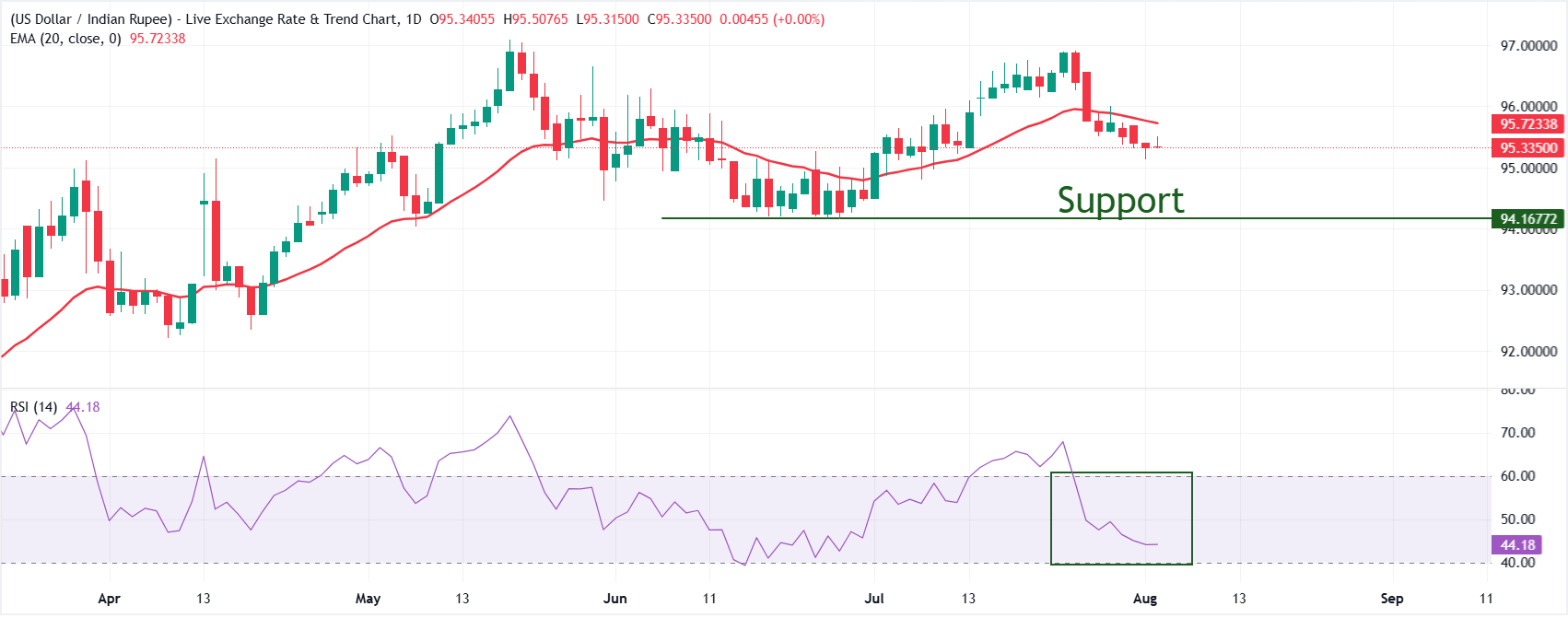
Technical Analysis: USD/INR remains under 20-day EMA
USD/INR trades at around 95.33, maintaining a bearish near-term bias as spot holds beneath the 20-day exponential moving average (EMA) at 95.7234.
The pair’s inability to reclaim this short-term EMA suggests upside remains capped, while the Relative Strength Index (14) at 44.18 leans slightly soft, hinting at waning bullish momentum rather than outright oversold conditions.
On the topside, immediate resistance is located at the 20-day EMA at 95.72, and a sustained break above this barrier would be needed for a more constructive recovery toward the July 29 high near 96.00. On the downside, major support levels are the July 7 low at 94.80 and the June low at 94.21.
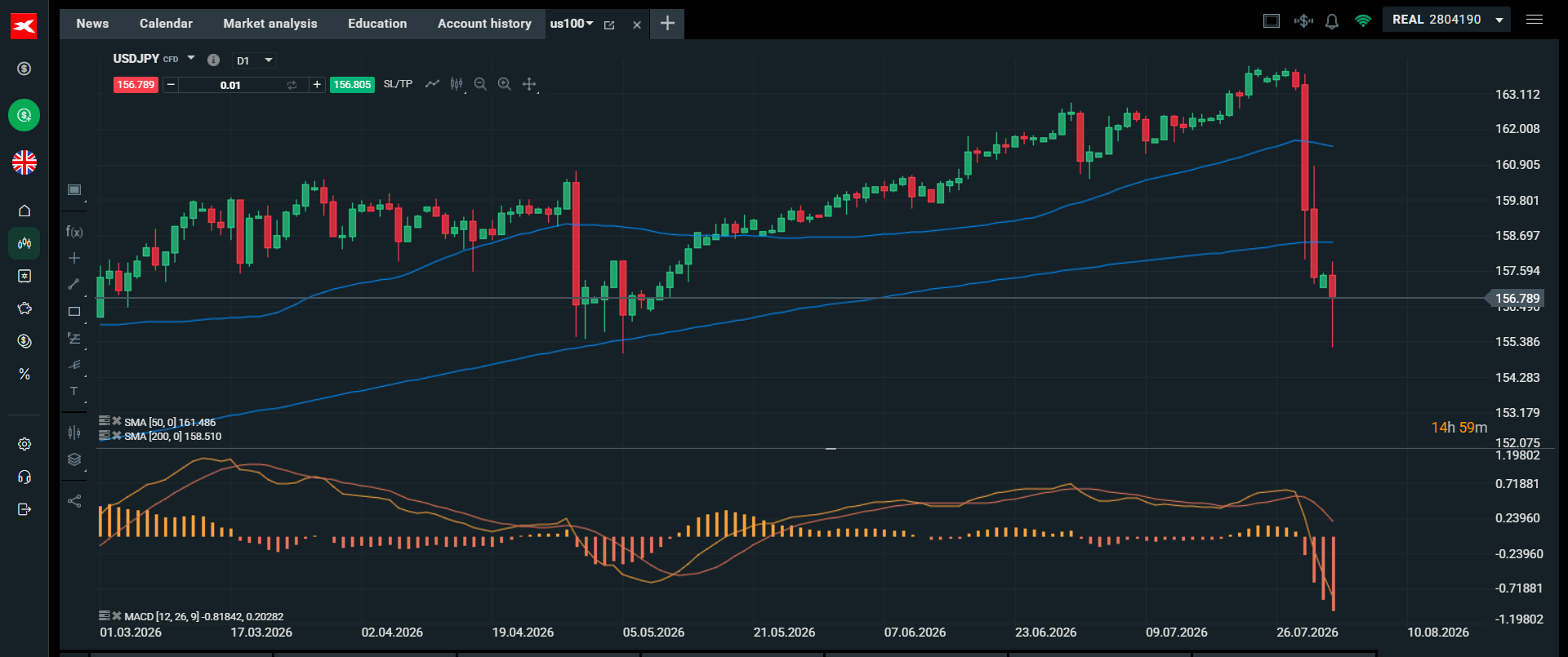
USD/JPY rises to near 157.60 as the Japanese Yen faces profit booking.
US-Japan joint intervention strengthened the Japanese Yen.
Investors await key US JOLTS Job Openings data for June.
The Japanese Yen (JPY) trades lower against its major currency peers on Tuesday after a rare juggernaut outperformance in the last few trading days. In the Asian session, the Japanese currency is down 0.25% to near 157.60 against the US Dollar (USD).
Japanese Yen Price Today
The table below shows the percentage change of Japanese Yen (JPY) against listed major currencies today. Japanese Yen was the weakest against the Australian Dollar.
USD
EUR
GBP
JPY
CAD
AUD
NZD
CHF
USD
-0.00%
0.07%
0.27%
-0.01%
-0.25%
0.12%
-0.02%
EUR
0.00%
0.06%
0.29%
-0.02%
-0.27%
0.10%
-0.01%
GBP
-0.07%
-0.06%
0.23%
-0.07%
-0.32%
0.05%
-0.07%
JPY
-0.27%
-0.29%
-0.23%
-0.29%
-0.53%
-0.19%
-0.18%
CAD
0.00%
0.02%
0.07%
0.29%
-0.24%
0.11%
0.00%
AUD
0.25%
0.27%
0.32%
0.53%
0.24%
0.36%
0.25%
NZD
-0.12%
-0.10%
-0.05%
0.19%
-0.11%
-0.36%
-0.10%
CHF
0.02%
0.00%
0.07%
0.18%
-0.00%
-0.25%
0.10%
The heat map shows percentage changes of major currencies against each other. The base currency is picked from the left column, while the quote currency is picked from the top row. For example, if you pick the Japanese Yen from the left column and move along the horizontal line to the US Dollar, the percentage change displayed in the box will represent JPY (base)/USD (quote).
The Asia-Pacific currency outperformed due to rare joint intervention by the United States (US) and Japan to support the Yen.
Japan and US step in as Yen hits weakest level since 1986
BNY notes that Japan’s finance ministry and the US Treasury have moved to shore up the Yen, jointly intervening in the foreign exchange market after the currency fell to its lowest level against the Dollar since 1986. Japanese Finance Minister Satsuki Katayama said the coordinated action was aimed at countering “excessive volatility and disorderly movements in recent months.” She underscored that Tokyo “would not hesitate to carry out further joint intervention if needed,” signaling that the authorities remain ready to defend the currency should renewed pressure emerge.
Meanwhile, the US Dollar (USD) holds onto its Monday’s recovery move, with investors awaiting key US economic data, notably the Nonfarm Payrolls (NFP), releasing this week. As of writing, the US Dollar Index (DXY), which gauges the Greenback’s value against six major currencies, trades firmly near 100.00.
In Tuesday’s session, investors will focus on the JOLTS Job Openings data for June, which will be published at 14:00 GMT. The US economy is expected to have posted 7.45 million fresh jobs, slightly lower than 7.594 million in May.
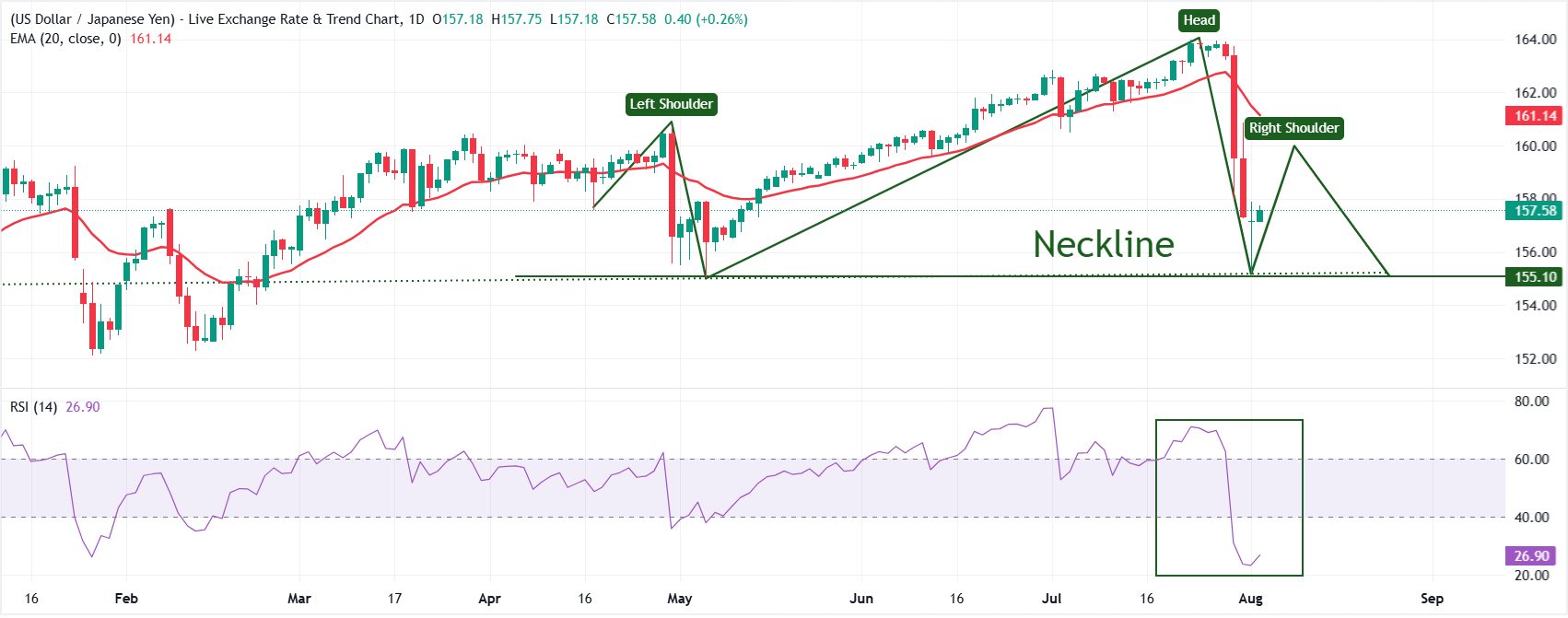
USD/JPY technical outlook
USD/JPY trades at around 157.58 at press time, retaining a bearish near-term bias as spot holds well below the 20-day exponential moving average (EMA) at 161.14. The chart structure of the pair reflects a Head and Shoulders pattern in the making, whose right shoulder is yet to be formed, likely near 160.00, suggesting a respite is highly likely after a juggernaut fall.
The pair has retreated from recent highs, and the Relative Strength Index (RSI) at 26.90 sits in oversold territory, which hints that downside momentum is stretched but does not yet show a clear reversal signal.
Going forward, a “Sell on Rise” strategy appears optimal in these conditions, and the round level of 160.00 would be a key barrier. After that, the pair might retest the neckline at around 155.10.
On the contrary, the pair would regain a bullish bias if it manages to extend the recovery above the July 16 low near 162.00. The pair would aim to revisit the multi-decade high at around 164.00 if it manages to break above 162.00.
DXY struggles to capitalize on the previous day’s solid recovery move from mid-June lows.
The US-Iran uncertainty keeps the geopolitical risk premium in play and acts as a tailwind.
Fed rate hike bets further lend support to the buck as bulls await the US NFP report on Friday.
The US Dollar Index (DXY), which tracks the Greenback against a basket of currencies, struggles to capitalize on a modest Asian session uptick and currently trades around the 100.00 psychological mark, nearly unchanged for the day. The index, for now, seems to have stalled the previous day’s solid recovery move from its lowest level since mid-June, though the fundamental backdrop warrants some caution for bearish traders.
The optimism over a potential US-Iran peace deal faded rather quickly after Iran said on Monday there were no talks underway with the US and no plans for any meetings. Meanwhile, US President Donald Trump had cited resumption of negotiations as justification for calling off attacks over the weekend. Adding to this, unconfirmed reports of drone strikes on US assets in Kuwait prompt traders to again price in the geopolitical risk premium, which, in turn, is seen offering some support to the safe-haven US Dollar (USD).
Meanwhile, Mohsen Rezaee, a senior military adviser to Iran’s Supreme Leader, said that Tehran will not permit any shipping route through the strategic waterway other than the one designated by the Islamic Republic. Rezaee further warned that US vessels and forces could face serious risk and casualties if the standoff over the strategic waterway continues. This lends some support to crude oil prices, reviving inflation fears and keeping bets for at least one rate hike by the US Federal Reserve (Fed) firmly on the table.
Adding to this, data released on Monday showed that US manufacturing sector activity increased to the highest level in more than four years in July. In fact, the US ISM Manufacturing PMI rose to 55.6 last month from 53.3 in June, surpassing consensus estimates. This reaffirms hawkish Fed expectations, validating the near-term positive outlook for the DXY. Traders, however, might refrain from placing aggressive bets and opt to wait for the release of US employment details, or the Nonfarm Payrolls (NFP) report, due on Friday.
EUR/USD trades in a narrow range as traders await clarity on US-Iran negotiations.
Strong US manufacturing data and a stabilizing US Dollar cap the Euro’s upside.
Upcoming US employment data could shape expectations for the Fed’s next policy move.
EUR/USD trades in a narrow range on Monday as traders await clarity on US-Iran negotiations, while signs of stabilization in the US Dollar following the recent intervention-led weakness cap the Euro’s upside.
At the time of writing, the pair trades around 1.1515 after reaching an intraday high of 1.1558, its highest level since June 17.
US President Donald Trump said over the weekend that he had called off a planned strike on Iran, with negotiations expected to begin on Monday. However, Iranian Foreign Ministry spokesperson Esmaeil Baghaei said Tehran is not currently holding talks with Washington. The conflicting headlines keep geopolitical uncertainty alive and leave market sentiment cautious.
Traders also assess the latest business activity data from both sides of the Atlantic. The US ISM Manufacturing Purchasing Managers’ Index (PMI) rose to 55.6 in July from 53.3 in June, beating expectations of 54.0 and marking its highest reading since May 2022. The sector expanded for a seventh consecutive month following ten months of contraction.
Meanwhile, the Eurozone Manufacturing PMI improved to a three-month high of 51.9 from 51.4 in June, although it fell short of the market forecast of 52.0. The stronger-than-expected US reading offers some support to the US Dollar.
The US Dollar Index (DXY), which tracks the Greenback’s value against a basket of six major currencies, trades around 99.84 after rebounding from an intraday low of 99.42, its weakest level since June 15.
Dollar outlook darkens as Fed caution and US-Japan action sap confidence
Economists at DBS argue that “the greenback’s trajectory looks bleak in August after stumbling badly at the end of July,” with a combination of policy and geopolitical factors leaving the Dollar exposed. They highlight “the confluence of a Fed seemingly reluctant to hike, coordinated US-Japan currency interventions, and a cooling geopolitical landscape in the Middle East” as key forces that “keep the USD vulnerable.”
DBS notes that “Fed Chairman Kevin Warsh has unsettled investors who had amassed long USD positions betting on his hawkish credentials.” Instead of signalling that rates may rise, “Warsh used the July 28-29 FOMC meeting to focus on institutional reforms, especially scaling back forward guidance.”
Attention now turns to upcoming US employment data for fresh clues on the Fed’s policy path. The JOLTS Job Openings report is due on Tuesday, followed by ADP Employment Change on Wednesday and Nonfarm Payrolls (NFP) on Friday.
The dollar has come bottom of the G10 currency rankings for the past week.
The market does not believe that Kevin Warsh, the new Fed chairman, is a hawk.
Oil prices are falling, which is also putting pressure on the US dollar.
Higher GDP growth and inflation are fuelling expectations of interest rate rises in the eurozone.
The yen is strengthening following the first coordinated intervention by the US and Japan in 15 years.
In recent months, the market has repeatedly cast doubt on Donald Trump’s promises and announcements. This phenomenon has become so widespread that it has even been given its own name (TACO, i.e. Trump Always Chickens Out). In keeping with this motto, the US President backed down from a planned attack on Iran over the weekend, which, as he himself put it, was to be “the biggest since the Second World War”.
However, what proved more significant for the currency was investors’ scepticism regarding statements made by another US official. Kevin Warsh, the new Fed chairman, continued to emphasise his uncompromising stance on inflation, seeking to convince the markets of his supposed hawkishness. Whilst this was sufficient in June, by July investors were expecting much more.
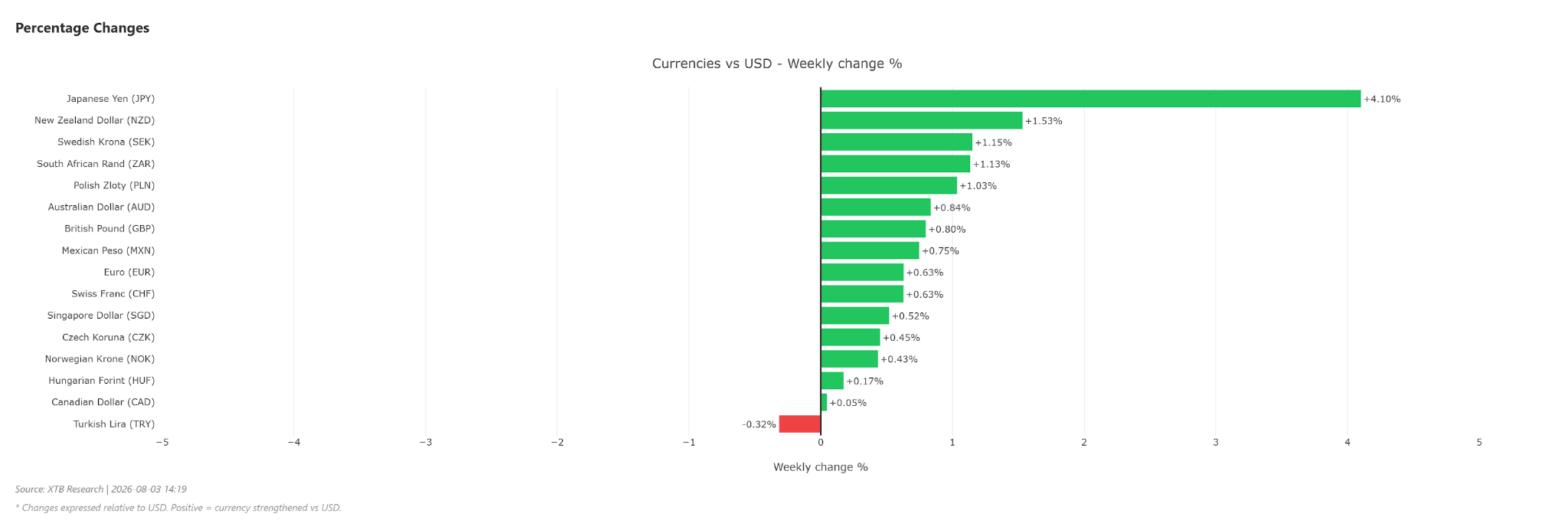
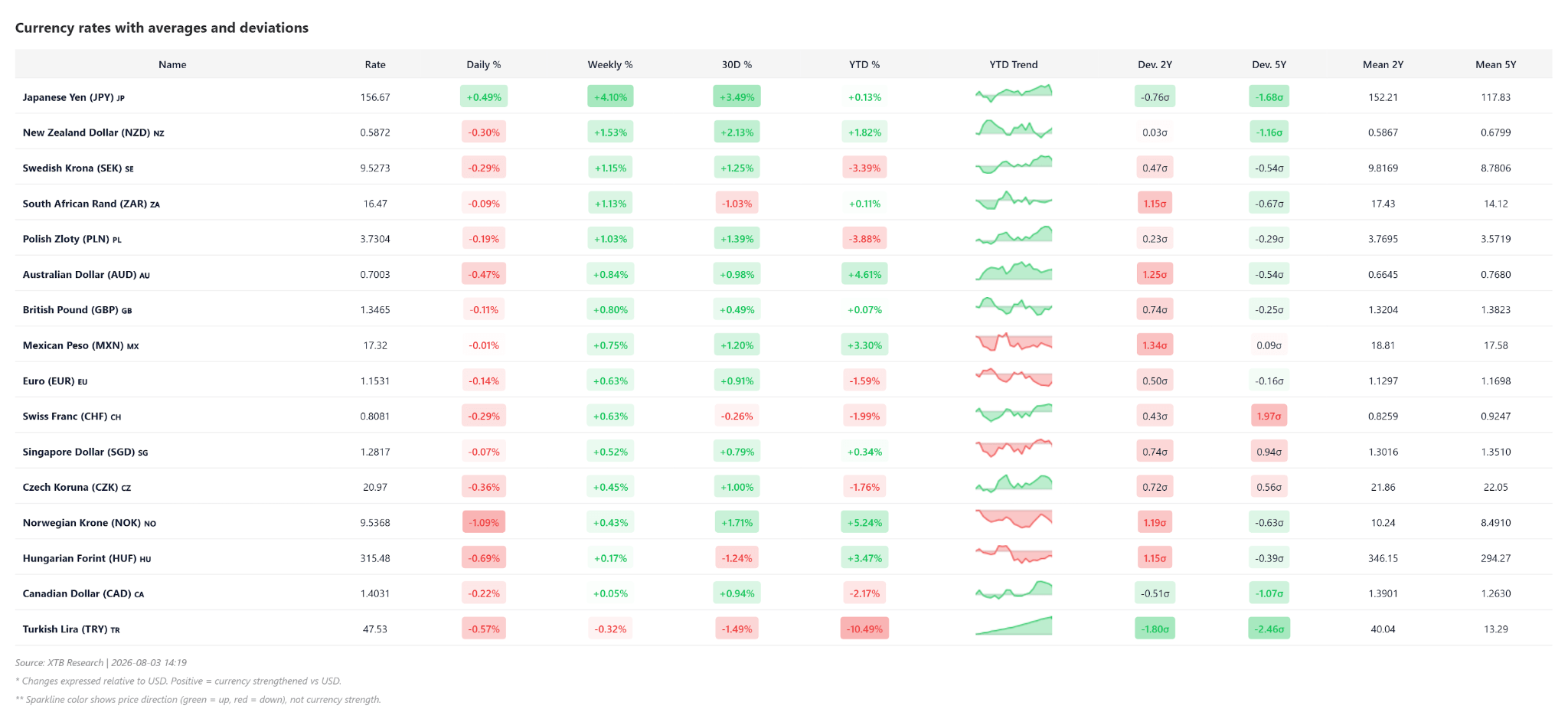
Chart 1: Exchange rates of selected currencies [vs. USD] (27 July – 3 August)
Source: Bloomberg, 3 August 2026 The US dollar has therefore come under pressure, weakening against almost every currency we analyse on a regular basis. Currencies with a higher beta (e.g. the Swedish krona or the Polish zloty) performed particularly well, as did those whose economies could suffer most from a deepening energy crisis (e.g. the South African rand or the South Korean won). At the very top of the list was, of course, the Japanese yen, which was bolstered last Thursday by the first joint currency intervention by the United States and Japan since 2011.
US dollar (USD)
The dollar is being weighed down by both the fall in energy commodity prices (of which it is a net exporter) and a dovish revision to market expectations regarding the Fed’s interest rate path. The Federal Open Market Committee (FOMC) decided last week to hold rates steady. The vote was 9 to 3. Only three policymakers voted in favour of a rate rise, and Warsh was not among them (the others were Beth Hammack, Neel Kashkari and Lorie Logan). During the conference itself, the Fed Chair stuck to his decision not to provide forward guidance. Although he spoke for nearly 45 minutes, few of the words that came out of his mouth were of any great significance from a market perspective. He avoided answering both questions regarding the justification for the pause and those concerning the current economic situation.
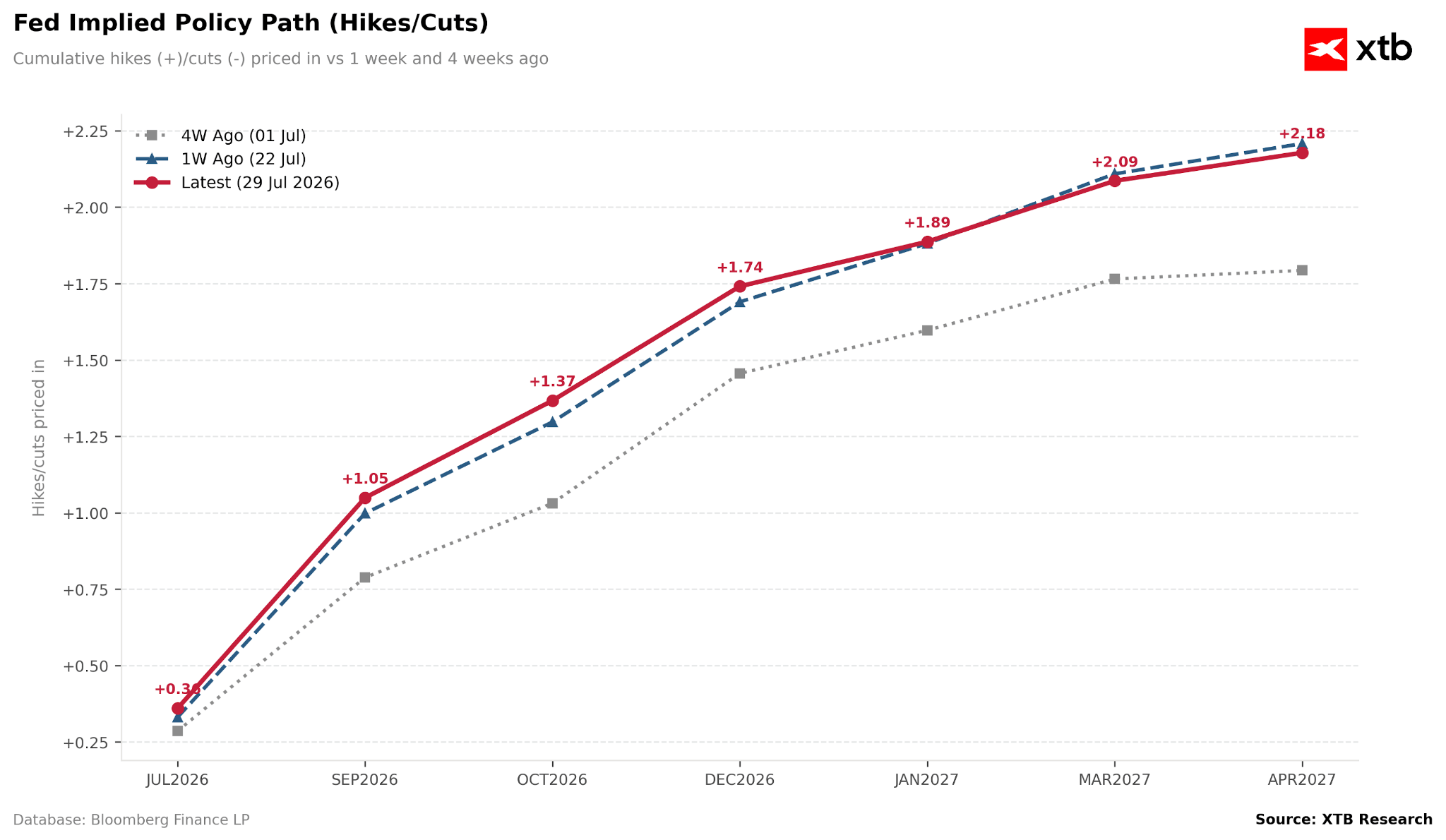
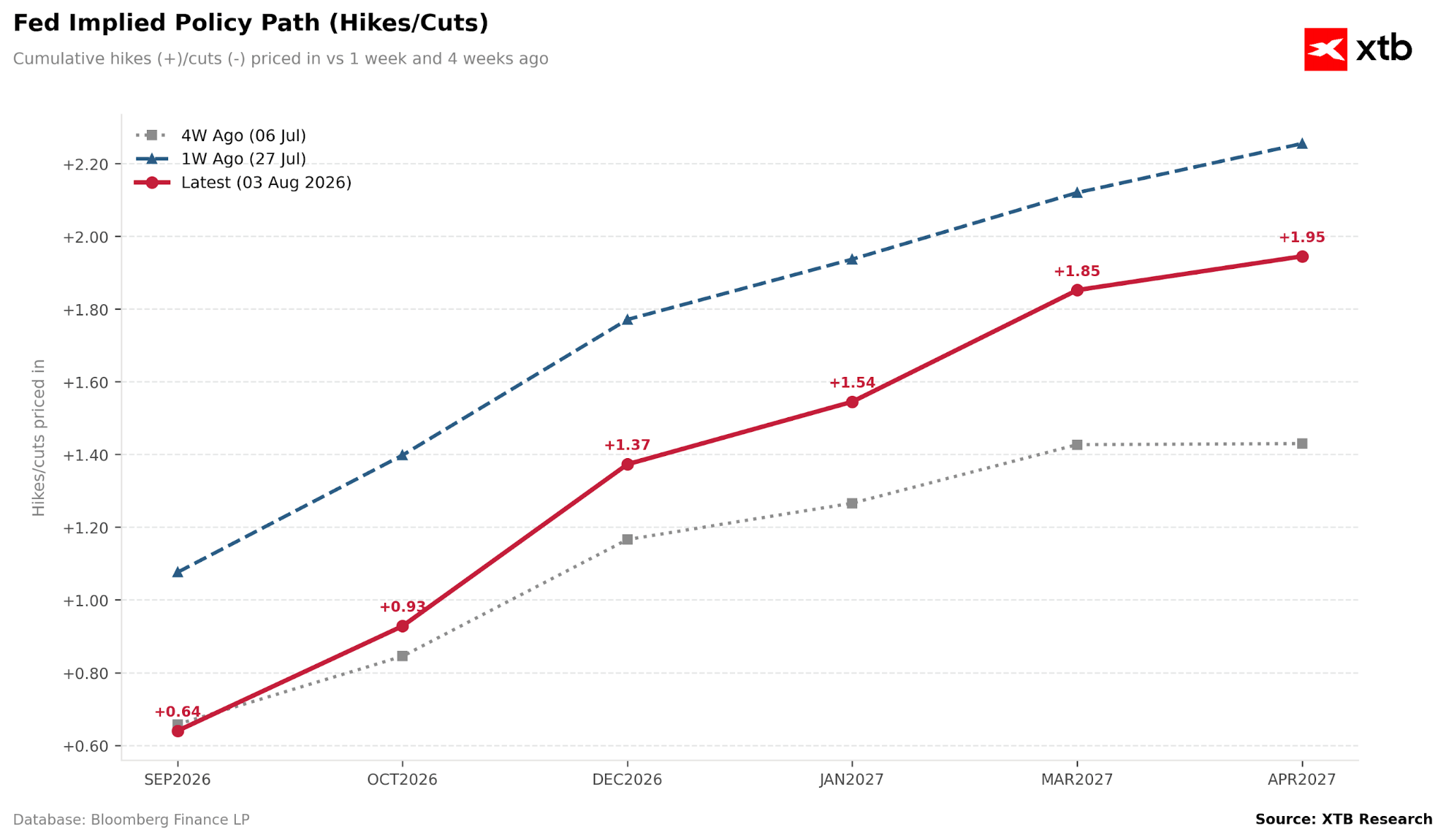
He mainly emphasised that the energy shock is hampering the committee’s work, and that the rise in CAPEX among hyperscalers should translate into future economic growth. This is largely consistent with his past comments on AI, when he argued that the productivity surge driven by artificial intelligence would, over time, have a disinflationary effect. The question is being raised once again as to whether Kevin Warsh is a dove in hawk’s clothing. The market seems increasingly sceptical that hawkish statements will be followed by concrete action, leading to a pullback in bets on interest rate rises. It currently assigns a probability of just over 60 per cent to a rate rise in September. Prior to the meeting, this was fully priced in. Chart 2: Market pricing of interest rate rises ahead of the FOMC decision (2026–2027)
Source: XTB Research, 29 July 2026 Chart 3: Market pricing of interest rate rises following the FOMC decision (2026–2027)
Source: XTB Research, 3 August 2026 It is worth recalling that almost exactly a year ago, he openly sided with the president, stating on FOX News that Donald Trump’s frustration with Powell’s conduct of monetary policy was entirely justified, and criticising the institution for being too slow to cut interest rates and for placing too much emphasis on historical economic data.
Euro (EUR)
In the eurozone, attention last week was focused not on monetary policy but on macroeconomic data. There are increasing signs that, following the pause in July, the time has come for a rate rise. The probability of a rate rise in September is estimated at almost 90 per cent. In recent days, both GDP growth (up 0.4 per cent quarter-on-quarter, compared with expectations of 0.2 per cent) and core inflation (2.5 per cent, consensus 2.4 per cent) have come in higher than expected. Both figures are consistent with further monetary tightening.
G10
Chart 4: Exchange rates of selected currencies [vs. USD]
Source: Bloomberg, 3 August 2026
Japanese yen (JPY)
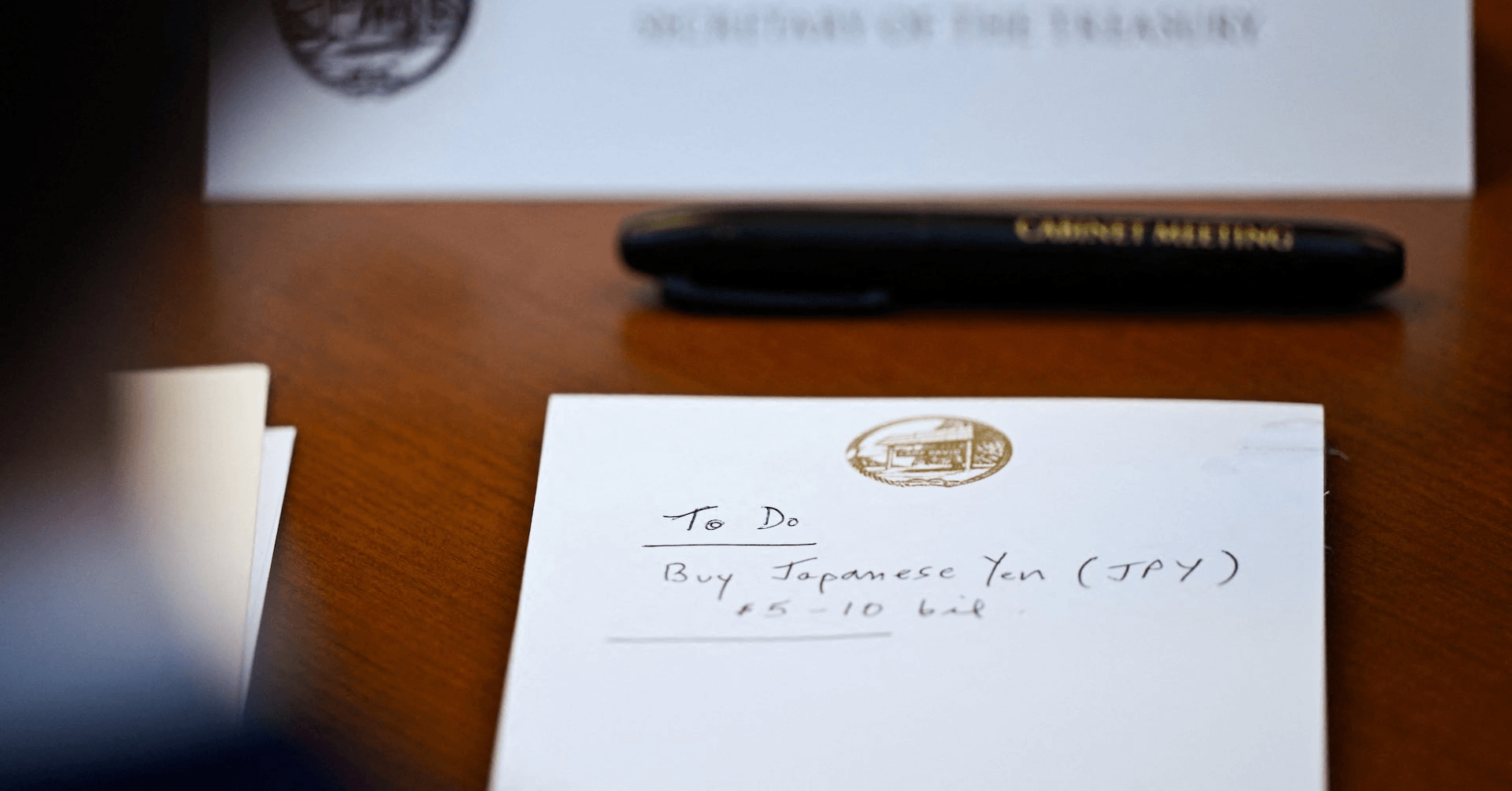
After reaching its highest level since 1986 (163.99), the USDJPY pair experienced a very sharp fall. This move was driven by the first coordinated intervention by the US and Japan since 2011. At that time, the yen had weakened following a massive earthquake. As emphasised by the US Treasury Secretary, Scott Bessent, and the Japanese Finance Minister, Satsuki Katayama, both sides remain ready to take further measures to stabilise the exchange rate. According to data provided by the Bank of Japan, the scale of the Japanese intervention may have reached as much as 59 billion dollars, which would be an unprecedented move (in terms of the scale of a single-day intervention). Although we cannot estimate the scale of US operations using official data, there are strong indications that it amounted to between 5 and 10 billion dollars. This is at least what is suggested by a note left by Scott Bessent during a meeting in Maryland.
Source: Reuters President Trump confirmed the US intervention at the weekend: “Japan has been very good to us, except, of course, for the attack on Pearl Harbour. (…) Their yen is weakening and they needed a bit of help. And we are always ready to help Japan.” Today, Minister Katayama published an official letter confirming the intervention.
After reaching its highest level since 1986 (163.99), the USDJPY pair recorded a very dynamic decline. The movement was driven by the first coordinated intervention by the US and Japan since 2011. At that time, the yen was weakened following a massive earthquake. US Treasury Secretary Scott Bessent and Japan’s Minister of Finance Satsuki Katayama emphasised that both sides are prepared to take further action to stabilise the exchange rate.
Historic intervention
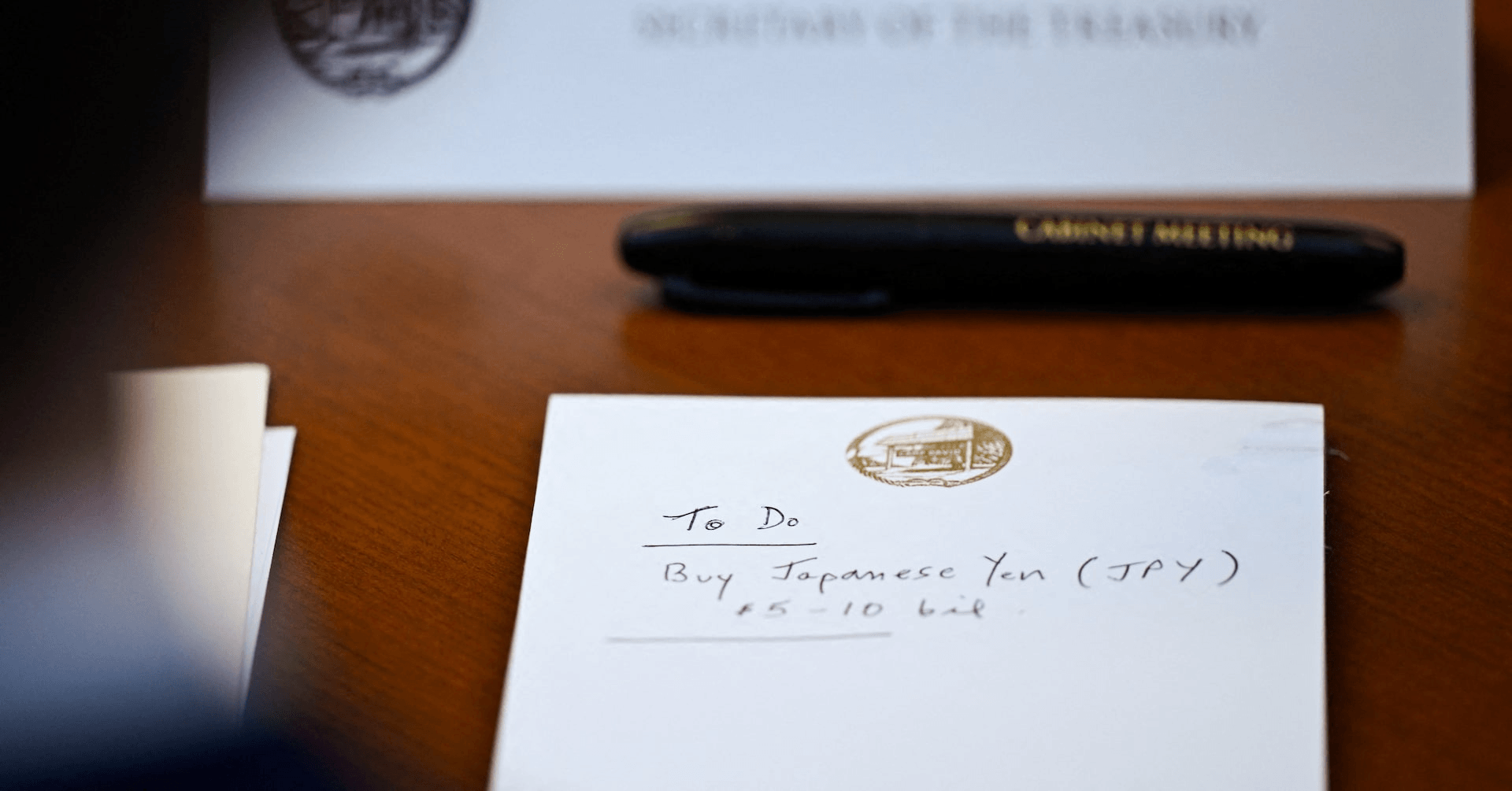
According to data provided by the Bank of Japan, the scale of the Japanese intervention may have reached as much as 59 billion dollars, which would be unprecedented given the scale of a one-day intervention. Although we cannot estimate the scale of the US action using official data, many indications suggest it reached 5-10 billion dollars. This is suggested, at least, by a note left by Scott Bessent during a meeting in Maryland.
Source: Reuters The US intervention was confirmed over the weekend by President Trump: “Japan has been very good to us, except, of course, for the attack on Pearl Harbor. (…) They have a weakening yen and they needed a little help. And we are always ready to help Japan.” Today, an official letter confirming the intervention was published by Minister Katayama.
Is the Mar-a-Lago accord returning?
Due to US cooperation in the recent intervention aimed at strengthening the yen, the issue of broader White House policy is returning to the fore. A return to actions aimed at weakening the US currency, which would support domestic exports, seems possible. At the beginning of 2025, such actions were termed the “Mar-a-Lago Accord,” a modern attempt to repeat the premises of the 1985 Plaza Accord.
What is behind the earlier weakening of the yen?
Key to this was the return of the carry trade, i.e., trading on interest rate differentials.
How does this work?
This strategy is based on borrowing a currency (in this case, the yen) at near-zero interest rates and immediately exchanging it for another (e.g., the dollar) to make investments in a market offering higher returns. Although the Bank of Japan has moved away from its ultra-loose monetary policy and implemented five interest rate hikes in recent months, bringing the reference interest rate to its highest level in over 20 years (1%), it still remains far below levels seen in the United States (3.75%) and many other developed economies, such as Australia (4.35%), Norway (4.25%), the UK (3.75%), or the eurozone (2.4% – deposit rate).
BoJ holds rates
In line with market expectations, the Bank of Japan kept interest rates unchanged overnight from Thursday to Friday. The main interest rate remains at 1%. The decision was made by a vote of 8 to 1. One of the hawks, Hajime Takata, voted in favour of a hike. Due to government initiatives aimed at supporting households regarding energy prices, the BoJ revised down its inflation forecast for the 2026 fiscal year, lowering it from 2.8% to 2.5%. At the same time, the inflation forecast for 2027 was raised from 2.3% to 2.4%. The meeting was treated as a pause to assess the impact of recent tightening. Naoki Tamura, a board member, suggested the possibility of raising rates at intervals of a few months by 25 basis points until reaching a level of approx. 2%. This is largely consistent with market valuations. The market-implied probability of a hike in September can be compared to a coin toss. An upward move before the end of the year is fully priced in. It is possible that the BoJ will raise rates twice in the mentioned period.
What is the inflation situation?
The quarterly report published in July showed that households estimate prices will grow at a rate of 10.8% over the next five years. The survey has never shown such high values (though it should be noted that it has only been conducted for 20 years). Although this figure is inflated by the survey methodology – an average is presented, which is contaminated by irrationally high expectations of part of the society – the anxiety regarding rising price pressure cannot be underestimated. The median (5%) is also growing very dynamically, which may be a more reliable indicator in this regard. Inflation grew in the last four months by 0.4%, 0.1%, 0.4%, and 0.3% respectively on a monthly basis – when annualised, this data suggests price growth in the region of 4-5%. After excluding the most volatile energy and food prices, the situation looks better, but much still points to a significant rise in the indicator from current levels (1.6%). Significant factors may include, among others, relatively dynamic wage growth (3.2% in May).
Dependence on energy imports
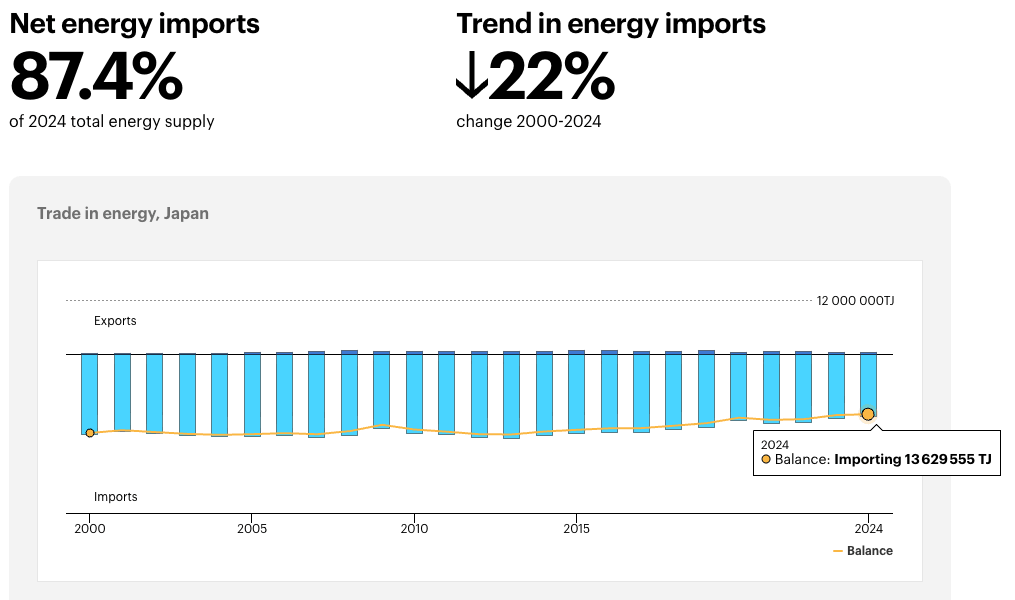
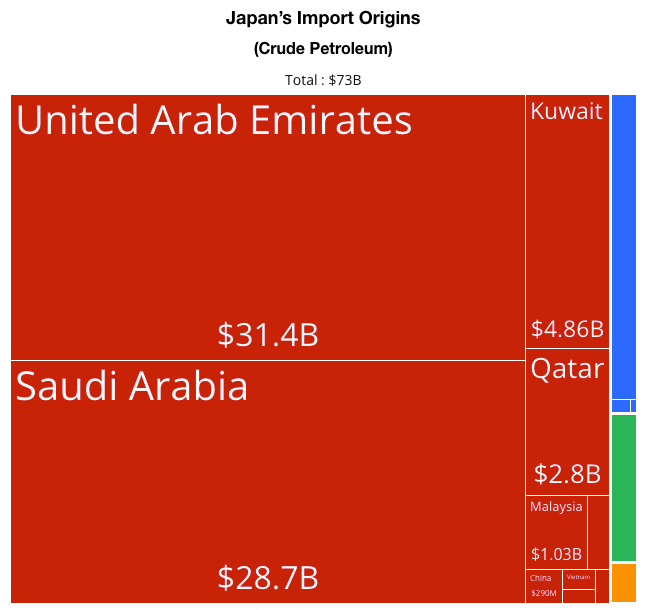
A weaker yen is not just a matter of carry trade. The outbreak of war in the Middle East plays a significantly important role, which brought oil and LNG prices to their highest levels since 2022, when Russia launched a full-scale attack on Ukraine. Nearly 90% of Japan’s energy demand comes from imports, and under normal conditions, its main suppliers are Middle Eastern countries.
Figure 1: Japan’s Energy Sector Trade Balance (1998 – 2026)
Source: IEA, 03.08.2026 The prolonged lack of de-escalation in the conflict between the United States and Iran may translate not only into a significant increase in inflationary pressure but also into problems maintaining the continuity of key energy resource supplies. Figure 2: Structure of Japan’s Crude Oil Imports (2024)
Source: OEC, 03.08.2026
Technical analysis
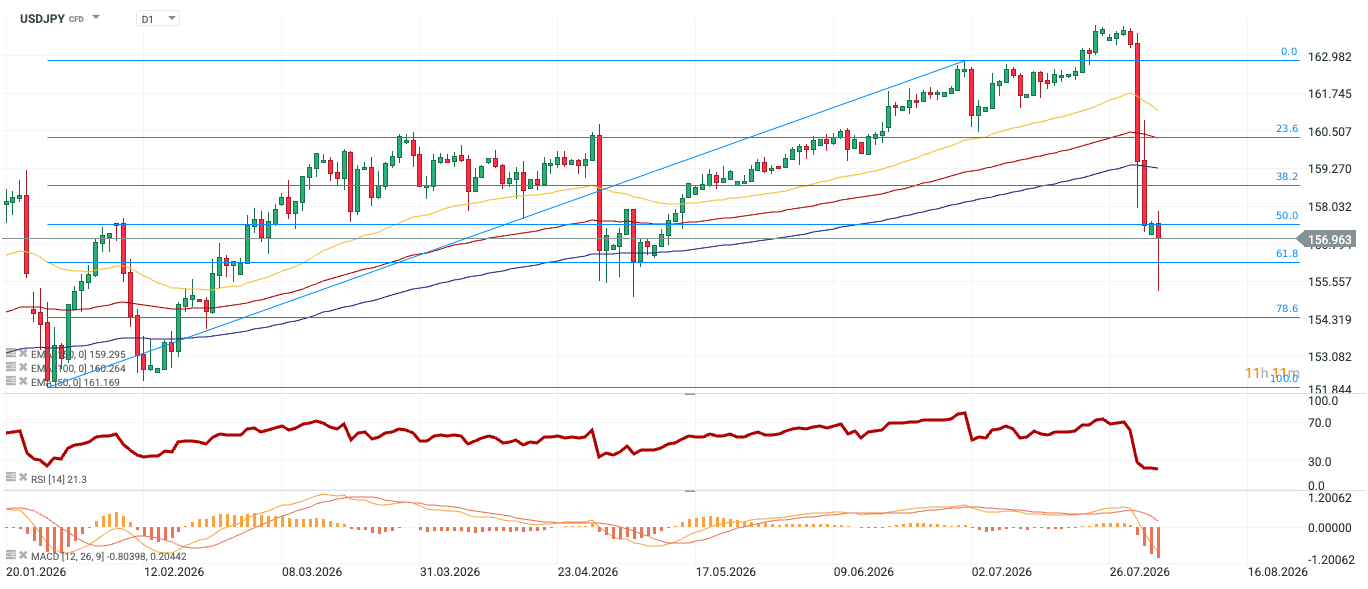
Figure 3: USDJPY [D1] (20.01.2026 – 03.08.2026)
Source: xStation, 03.08.2026 After reaching a local peak near the 164 level, the market experienced a sharp collapse. The price broke through key structural supports with momentum and is currently in the 157 region. It is worth noting, however, that a long lower wick formed on one of the recent candles – this signifies the first serious attempt at defence and a reaction from demand. The price drastically broke down through the band of moving averages (EMA 50, EMA 100, and EMA 200). For a long time, these averages (blue, red, and yellow lines) served as dynamic supports in the uptrend. Currently, this setup has been negated. The closest of them (blue, around 159.3) now constitutes the first very important dynamic resistance in the case of a possible rebound.
The long lower wick of the bearish candle tested the 78.6 Fibo retracement. Currently, the price has rebounded and is fighting to hold above the 61.8 retracement. The RSI indicator is at the 21.3 level. This is an extreme oversold zone (below 30). Although in strong downtrends, the RSI can stay in this zone for a long time, such a low value is a strong warning signal of a possible upward correction or at least a transition into consolidation to “cool down” the indicator. MACD confirms a strong downtrend. The lines have crossed downwards and are moving away from the zero level, and the histogram is growing in the negative zone. There are no divergences here at this moment.
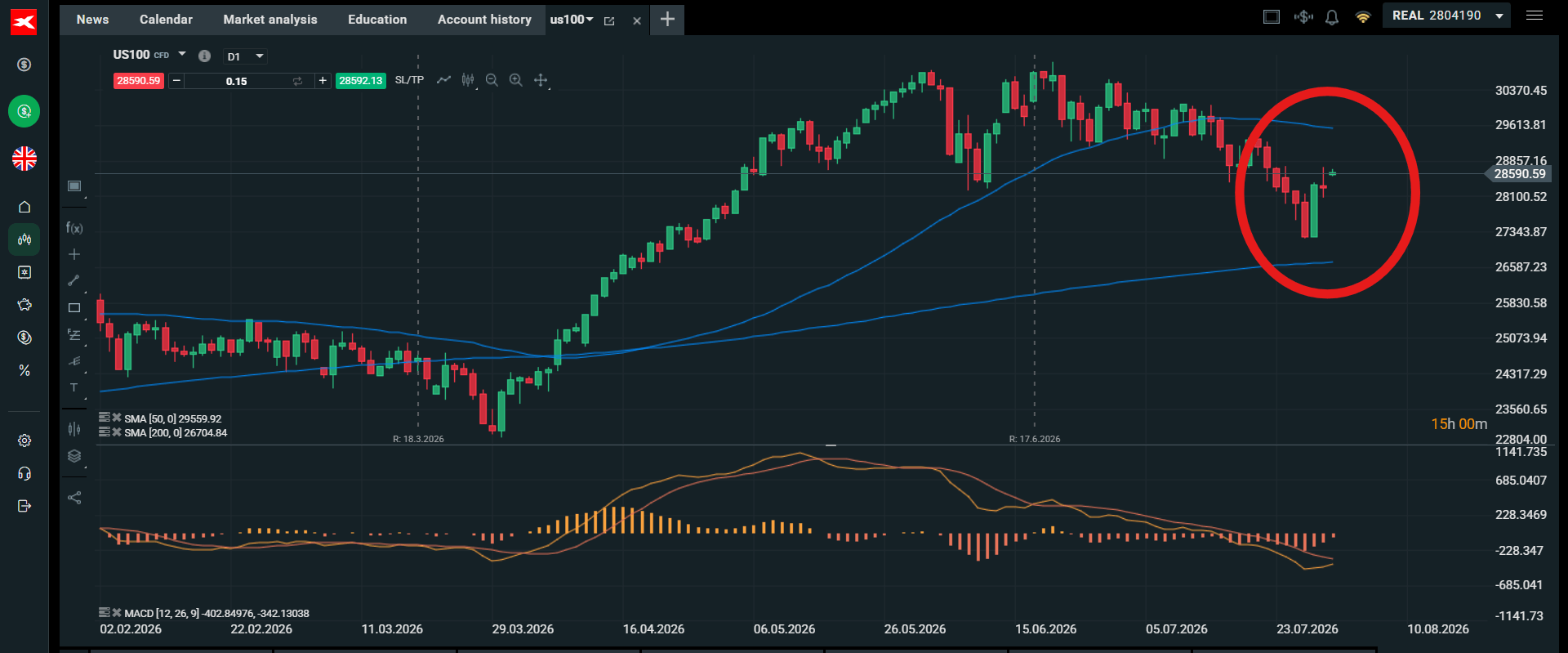
Risk is back, as we wait for payrolls Stocks are in a buoyant mood as we start August. Futures are in positive territory on Monday, with European indices expected to open higher today, and US futures expected to carry on last week’s rally. The Nasdaq is currently expected to open higher by more than 0.8%. Last week, US stocks made a stunning comeback from Thursday onwards and the gains are expected to continue this week. The question now is, can US indices outperform their European counterparts this week, after falling behind for the past month?
Oil price boost for markets
The 5% drop in the oil price is also helping to boost sentiment. Overnight, President Trump said that negotiations to find a peace deal with Iran could start today, which has led Brent crude to fall back towards $83 per barrel. This will ease inflation fears and could also act as a dampener on bond yields, which rose sharply last week, especially at the long end, where 30-year US Treasury yields jumped to their highest level for 19 years.
Economic data and earnings to spur price action
This is another huge week for financial markets. Firstly, there is a large amount of fresh economic data, including the latest labour market data from the US. 20% of the S&P 500 report earnings this week, including Palantir and SanDisk. SpaceX will also release its first earnings report on Tuesday. The market wants to know if the tech selloff is over, what the yen will do next after unprecedented multilateral intervention to prop up the currency, and US Treasury yields are also in focus. If anyone thought things would be quiet for markets this August, they are only heating up.
3 main themes dominate markets
Last week three main narratives dominated price action as we rounded off July trading. The first was a week of two halves for the tech trade. The first half of the week saw severe tech deleveraging, which included a 17% sell off for South Korea’s Kospi index. Then came tech earnings, and a powerful rally on Thursday that drove Microsoft higher by 16%, and gave hope that the severe drawdown in the AI favourites, that started on 22nd June, could be at an end.
Nasdaq 100
Source: XTB
Microsoft winning the AI race
The rally in Microsoft is symbolic for a few reasons. Last week’s Q2 results showed that Copilot could be a big winner in enterprise AI. It increased the number of subscriptions to 30mn and is part of the Microsoft 365 suite of products. Thus, it is already well integrated into products that hundreds of millions of people use every day, and the growth trajectory is huge for Microsoft, which has now proven that it can monetize its AI investments.
Can chip stocks make a comeback?
Value in the tech space is shifting to some of the big Magnificent 7 names, after a bruising start to the year. However, there could also be a recovery in the chip sector. Several of the Magnificent 7 including Alphabet, Meta, Microsoft and Amazon are all increasing their AI capex plans for this year, which should give the AI trade another late summer burst of energy.
Did the AI trade reach a bottom?
Due to both of these factors, we could have seen the short-term bottom in the tech sell off as we march further into Q3. The question now, is there a strong rally ahead of us when August and September are traditionally the worst months for stock market returns?
USD/JPY in focus
The second narrative that dominated the market last week was the intervention in the yen. USD/JPY fell more than 4% last week, At the start of the week, the yen is higher by another 0.5% vs the USD and is trading at 156.60. The intervention came after a surprise hold from the Bank of Japan sent the yen sharply lower. The confirmed intervention cost the Japanese authorities $50bn, with another $10bn of support coming from the US and potentially South Korea. This time the intervention worked, but the question is, for how long? FX intervention and manually propping up a currency does not have a strong track record of working in the long term, and this rate of FX intervention is unstainable over longer time periods. Thus, will the market test the resolve of the authorities? Although the yen is off to a strong start on Monday, if it does drop this week then it will put dramatic pressure on the Bank of Japan to raise interest rates in the coming months to try and naturally boost yen strength.
USD/JPY
Source: XTB
The fallout from the Fed
The third narrative from last week was Treasury yields. Long end yields surged, the US Treasury yield curve steepened sharply, the 2s-10s yield curve is 48bps, while the 2s-30s yield curve is at 98bps, up 18bps last week, which is a huge move in one week. The 10-year yield closed the week at 4.69%, while the 30-year yield rose to its highest level since 2007 and closed the week at 5.23%. The impact on the housing market could be severe and is worth watching in the coming months. Yields are rising in the US even though the Fed kept interest rates unchanged at last week’s meeting. When rates are on pause, it is natural for the yield curve to steepen, after all, inflation is above the target rate. However, it is the unrelenting rise in yields that could unnerve investors. Interetsingly, stress in the long end of the US yield curve did not impact the global equity market rally at the end of last week.
However, if yields do keep surging, then we could see pressure in the equity space. While the Fed’s message was blamed for causing the volatility in the US Treasury curve, we think that this is unfair. Fed chair Kevin Warsh reiterated that the Fed would return US inflation back to the target rate, and there are some who think that he is nearly as hawkish as the three dissenting members of the FOMC who voted to hike rates last week. Interetsingly, Treasury yields are rising at the same time as the Fed is shifting to a potentially hawkish stance when there are signs that inflation is moderating and the labour market is weakening. PCE inflation was weaker than expected for Q2, and the labour market was much weaker than expected in June, we need to see if the pattern reoccurs for July.
However, yields are also rising because there is huge supply of debt. It is not just governments who are funding their activities with debt, the AI infrastructure build out is also increasingly funded by debt. When supply outstrips demand, yields have to rise to attract investors. Thus, we may not see bond yields moderate any time soon. The key questions that investors are asking as we start a new week, where will the oil price go next? Have tech stocks, specifically chip stocks, bottomed out, and will a sell off in long end Treasury yields hurt equities? Below, we look at the two main events to watch in the week ahead:
1, Non Farm Payrolls
While the focus on Monday is on an improving geopolitical backdrop and a falling oil price, the focus as we move through the week will be the US Non Fram Payrolls report, which will be another test of the resilience of the US labour market. This is a pivotal release for financial markets, and there are 4 things in this report that are worth watching. These include the payrolls number, the unemployment rate, wage growth and the labour force participation rate. This data will help to define the future of Fed policy, and could be a major market-moving event, especially since the Fed is no longer offering forward guidance. The Fed is particularly worried about demand side inflation fears and a wage-price spiral, so the wage data is worth watching closely. Economists currently expect a 91k increase in payrolls and for the unemployment rate to tick up a notch to 4.3%. If we get a major surprise in the data then USD/JPY is worth watching closely to see if an upside surprise weighs on the yen .
2, Earnings
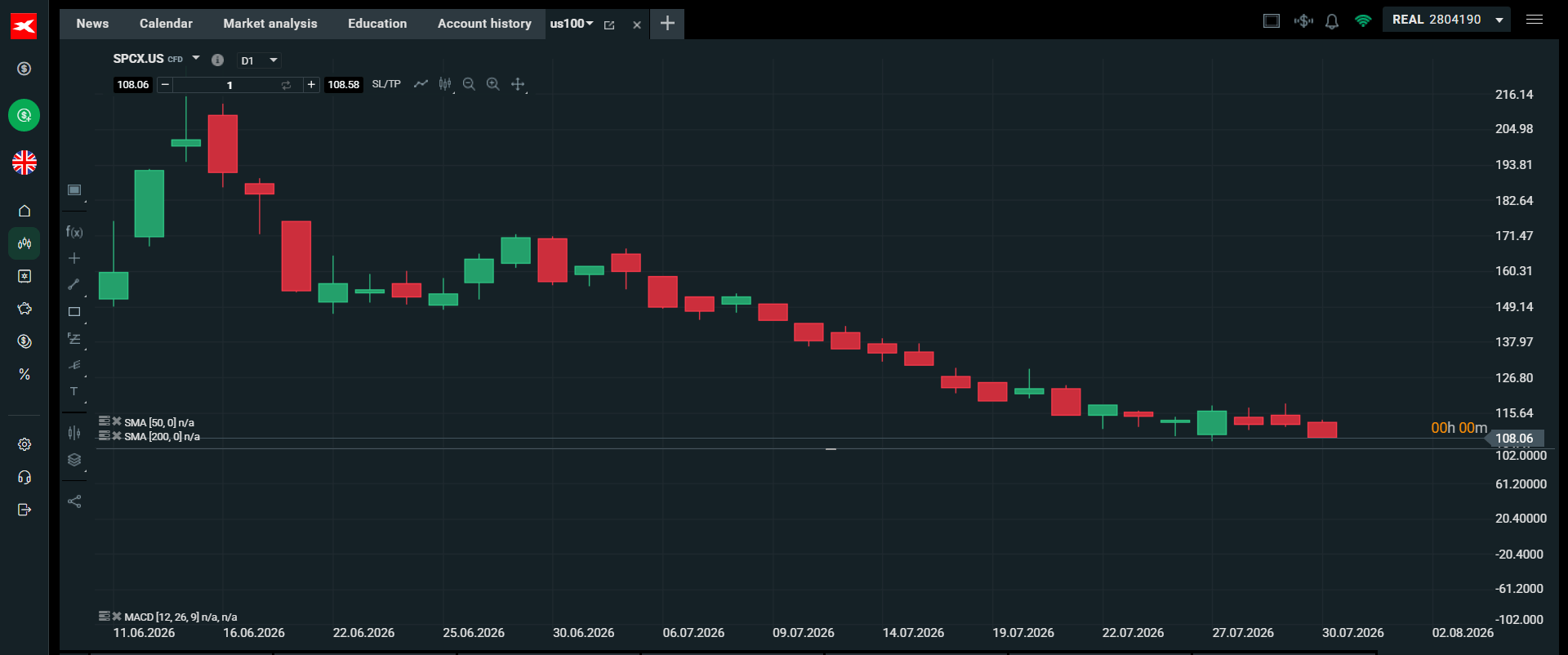
This is a massive week for earnings reports on both sides of the Atlantic. Tech earnings will be watched closely after strong reports for Microsoft and Amazon helped to spur a major rally. Apple did not impress with last week’s report, and its stock price slumped more than 7% on Friday, although it did show signs of stabilization overnight. Palantir, SpaceX and SanDisk are the highlights in the US earnings calendar for this week. SpaceX’s share price dropped sharply last week and fell 3% on Friday. It closed the week at a record low below $110. The question now is, can the earnings report, especially forecasts of future revenue, help the stock price to recover?
EUR/USD gains ground to around 1.1535 in Monday’s early Asian session.
The bearish tone of the major pair prevails under the 100-day SMA.
The initial support level is seen at 1.1530; the immediate resistance level to watch is 1.1570.
The EUR/USD pair trades in positive territory near 1.1535 during the early European trading hours on Monday, bolstered by improved risk sentiment. The Euro (EUR) edges higher against the US Dollar (USD) after reports that US President Donald Trump had called off an attack on Iran and talks between the two sides would happen on Monday. Traders will closely monitor the developments surrounding US-Iran negotiations.
Traders brace for the German Retail Sales data for June, which is due later on Monday. If the reports come in weaker than expected, this could drag the shared currency lower. On the US docket, the US ISM Manufacturing Purchasing Managers Index (PMI) data will be published.
Technical Analysis:
In the daily chart, EUR/USD trades at 1.1533. The pair remains capped in the near term as spot holds below the 100-day simple moving average (SMA) at 1.1569, keeping the broader tone heavy despite the latest bounce. The Relative Strength Index (14) at 62.5 shows firm positive momentum, but with price still under the key trend average, this strength merely hints at a corrective rebound within a broader bearish backdrop.
On the downside, immediate support is aligned with the upper Bollinger Band at 1.1529, with the 20-day SMA middle band at 1.1430 and the lower band near 1.1331 marking deeper cushions if selling resumes. On the topside, a daily close above the 100-day SMA at 1.1569 would be needed to ease bearish pressure and open the way for a more sustained recovery toward higher levels.
Euro briefly lifted by French CPI as ECB commentary stays muted
Analysts at Scotiabank note that the Euro received “a modest lift” earlier in the session after French CPI data “came in well above expectations,” but stress that the support quickly faded as “the impact was short-lived as broader themes took hold.” They add that “comments from the ECB have been limited and the speaking calendar is empty over the next week or so,” leaving the currency largely to trade on prevailing macro drivers rather than fresh policy signals.
To provide the best experiences, we use technologies like cookies to store and/or access device information. Consenting to these technologies will allow us to process data such as browsing behavior or unique IDs on this site. Not consenting or withdrawing consent, may adversely affect certain features and functions.
Functional
Always active
The technical storage or access is strictly necessary for the legitimate purpose of enabling the use of a specific service explicitly requested by the subscriber or user, or for the sole purpose of carrying out the transmission of a communication over an electronic communications network.
Preferences
The technical storage or access is necessary for the legitimate purpose of storing preferences that are not requested by the subscriber or user.
Statistics
The technical storage or access that is used exclusively for statistical purposes.The technical storage or access that is used exclusively for anonymous statistical purposes. Without a subpoena, voluntary compliance on the part of your Internet Service Provider, or additional records from a third party, information stored or retrieved for this purpose alone cannot usually be used to identify you.
Marketing
The technical storage or access is required to create user profiles to send advertising, or to track the user on a website or across several websites for similar marketing purposes.