
The offshore yuan steadied around 6.76 per dollar on Friday, hovering near its strongest level since February 2023, bolstered by reports of an extended ceasefire agreement between the US and Iran. Both sides agreed to prolong the truce for another 60 days to allow further negotiations over Tehranโs nuclear program, although US President Donald Trump has yet to formally approve the arrangement. Meanwhile, Chinaโs currency has drawn additional support from the global AI investment boom, which has fueled demand for Chinese technology exports and eased concerns in Beijing over yuan appreciation. For the month, the yuan remains on track for a second consecutive monthly gain despite continued weaker-than-expected daily midpoint fixings from the People’s Bank of China, as investors navigated rapidly shifting developments surrounding the Iran conflict while also assessing progress following the meeting between Presidents Donald Trump and Xi Jinping earlier this month.
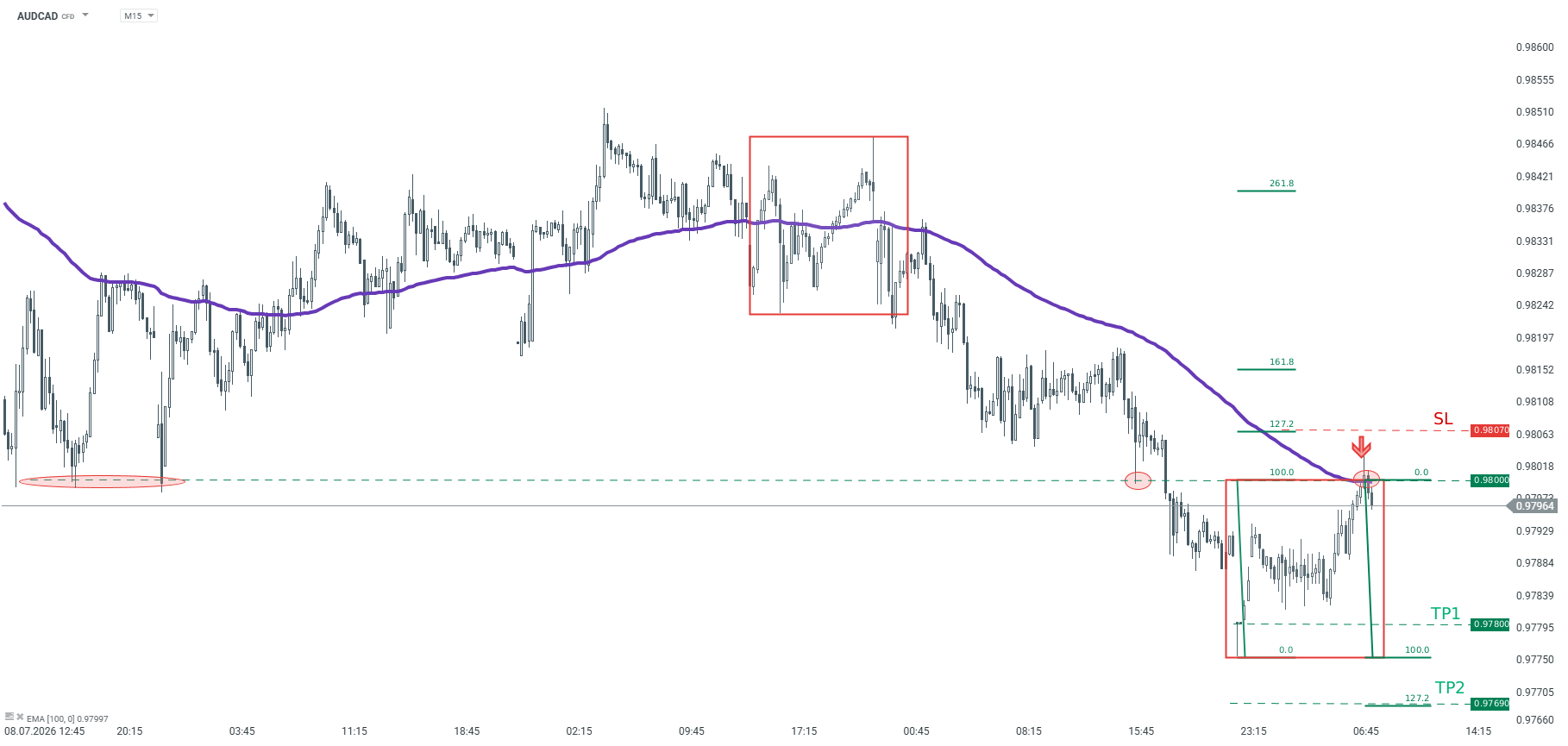
Trade of The Day: AUD/USD
- The AUDUSD exchange rate opened today below the 10- and 30-day exponential moving averages (EMA10 – yellow, EMA30 – light purple).
- Core PCE inflation in the US rose to 3.3% YoY in April (previously 3.2% YoY).
- The swap market-implied probability of a US interest rate hike in 2026 increased from 82% to 86% over the course of the week.
Recommendation:
- Position: Short (SELL) on AUDUSD at market price
- Target Price (Take Profit; TP): 0.70550 (TP1), 0.70170 (TP2)
- Stop Loss (SL): 0.72100

Source: xStation5
Opinion
The AUDUSD pair erased some of its losses from today’s session following the release of the latest US inflation data, which turned out slightly softer than expected. Core PCE increased in line with expectations to 3.3% year-on-year, while on a month-on-month basis, prices rose by 0.2% (against a 0.3% forecast). However, the lack of a negative inflation surprise is not exactly “good news” for monetary policy, especially since inflation remains in an upward trend and is proving to be stickier than assumed. The Fed’s narrative is also becoming increasingly hawkish. Recent remarks from Cook, Goolsbee, Kashkari, and Jefferson unanimously emphasize the growing and materializing upside risks to inflation, along with a clear readiness to hike interest rates should this trend continue.
Furthermore, the AUDUSD’s reaction to the optimism generated by hopes of a truce between Iran and the US last week was quite moderate, and the gains were insufficient to push the price above the 10- and 30-day exponential moving averages. Therefore, risk-sensitive currencies (including the AUD) can be expected to remain under heavy pressure until real progress is made in the Middle East, and a potential rebound in reaction to the end of the war is unlikely to trigger a rapid return to an upward trend for the pair. The options market is also pointing to further declines for AUDUSD. The 1-week and 1-month risk reversal indicators sit below zero, showing that options betting on the depreciation of the AUD dominate the market. In other words, the market is systematically hedging against further declines in AUDUSD consistently across various time horizons.
Methodology
The recommendation was prepared based on the technical analysis of the AUDUSD chart and the fundamental analysis of the discussed economies (monetary policy in Australia and the US). The direction of the recommendation was determined using moving averages and market expectations regarding central bank policies. Take Profit and Stop Loss levels were set using the Fibonacci retracement of the last upward wave and price action (TP1 at the 50.0 Fibo level, TP2 between the D1 interval EMA100 and the 61.8 Fibo level, and SL at the support from which the price rebounded before breaking the last peak).
Canadian Dollar: Rebalancing offers near-term relief โ BNY
Geoff Yu at BNY highlights that Canadian Dollar (CAD) dynamics differ from the U.S., with equity-based rebalancing pointing toward CAD support as growth and allocation trends move opposite to the US Dollar. Fixed income steepening and poor CAD performance are seen amplifying CAD buying signals, suggesting some relief for the Canadian Dollar into month-end.
Canadian Dollar supported by flows
“Mathematically, our figures suggest that the unwinding of USD/CAD hedges โ the discontinuation of forward USD selling against CAD on U.S. positions โ played a big role in the dollarโs performance and some reversion is needed.”
“The only other equity-based rebalancing signal is in the CAD, where growth and asset allocation trends are pointing in the opposite direction.”
“In contrast, CAD buying is being amplified by similar steepening in bond markets on top of poor currency performance.”
“USD and CAD have again generated the same net selling and buying signals, though the dollarโs signal is far weaker, as poor bond performance offset dollar purchases. In contrast, CAD buying is being amplified by similar steepening in bond markets on top of poor currency performance.”
GBP recovers against US Dollar; outlook remains weak due to Iran worries
- The British Pound recovers almost half of its early losses against the US Dollar.
- Middle East tensions re-escalate due to the exchange of attacks between the US and Iran.
- 10-year UK gilt yields have remained lower in the past few weeks due to easing hawkish BoE bets.
The British Pound claws back half of its early losses and rebounds to near 1.3400 against the US Dollar (USD) during the European trading session on Thursday from the intraday low of 1.3367. The recovery move in the GBP/USD pair appears to be short-lived as Middle East conflicts have re-escalated.
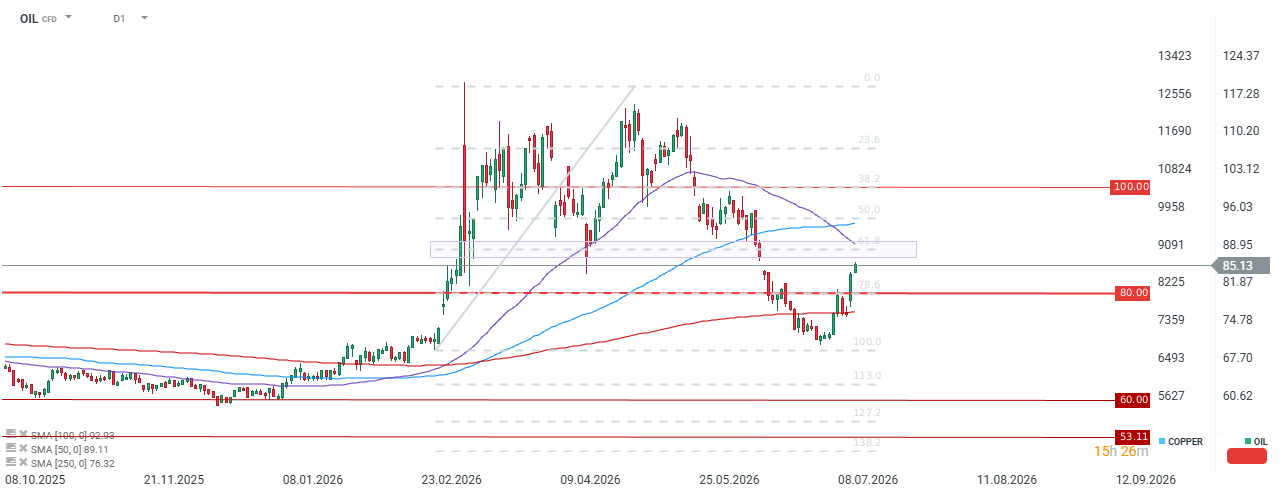
At press time, S&P 500 futures and Asian stock markets have also recovered significantly. The US Dollar Index (DXY), which tracks the Greenbackโs value against six major currencies, retreats from its intraday high of 99.54, but is still 0.18% higher to near 99.40. A slight correction in the WTI Oil price has also been observed from the dayโs high of $91.17 to near $90.14.
Geopolitical tensions in the Gulf region have been reignited due to the exchange of attacks between the United States (US) and Iran. Earlier in the day, Iranโs Islamic Revolutionary Guard Corps (IRGC) said that it attacked US military bases in retaliation against Washingtonโs strikes near Bandar Abbas airport.
This was the second attack by the US this week after the so-called โdefensive strikesโ on Iranian boats deploying mines and their missile launching sites.
Meanwhile, United Kingdom (UK) gilt yields have also recovered strongly after a weak opening due to Middle East concerns. 10-year UK gilt yields have rebounded to near 4.87% from the dayโs low of 4.81%.
UK gilt yields have been declining in the past few weeks due to easing hopes of a near-term Bank of England (BoE) interest rate hike. Traders have pared hawkish BoE bets lately due to weakening job market conditions and lower household spending.
New Zealand Dollar drops after NZ budget announcement
- The New Zealand Dollar faces selling pressure after the NZ budget 2026 announcement.
- On Wednesday, the RBNZ held its OCR steady at 2.25%, but guided a hawkish monetary policy outlook.
- Renewed concerns over the US-Iran deal have underpinned the US Dollar.
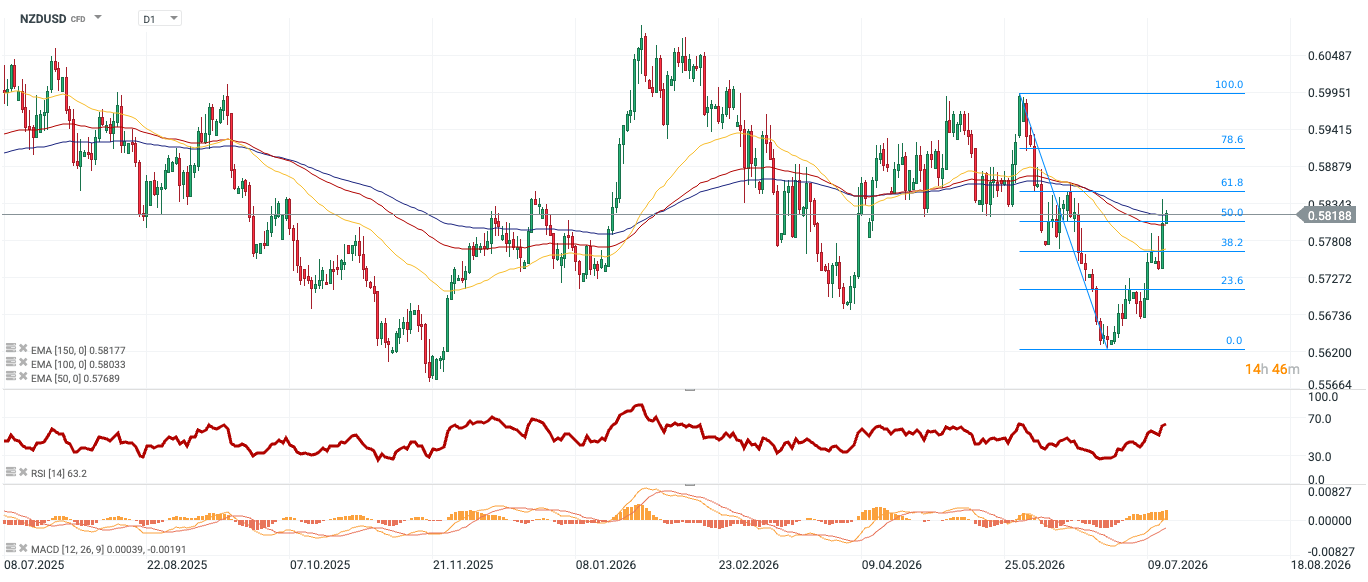
The New Zealand Dollar (NZD) drops to near 0.5883 against the US Dollar (USD) during the Asian trading session on Thursday, following the New Zealand (NZ) budget 2026 announcement. The Kiwi pair edges down even as the nationsโ Debt Management Office (DMO) has reduced its gross bond issuance plans for four years to June 30, 2030 to NZ$124 billion from NZ$130 billion forecasted in December, which diminishes fears of widening fiscal concerns.
For the current year, DMOโs plans to issue NZ$34 billion worth of bonds remain unchanged with the December forecast.
However, the broader outlook of the antipodean has improved as prospects of the Reserve Bank of New Zealand (RBNZ) raising interest rates in the July meeting have increased after a โhawkish holdโ on Wednesday.
Markets quickly nudged up the probability of a quarter-point increase in July to around 75%, and saw rates reaching 3.0% by year’s end, Reuters report.
On Wednesday, the RBNZ left its Official Cash Rate (OCR) steady at 2.25%, as expected, but expressed the need to tighten monetary conditions amid rising inflation. โCommittee sees inflationary pressures going forward, agrees cash rate needs to be higher going forward,โ RBNZ Governor Anna Breman said.
Meanwhile, the US Dollar trades sharply higher on renewed concerns regarding the dismissal of the United States (US)-Iran negotiations. As of writing, the US Dollar Index (DXY), which tracks the Greenbackโs value against six major currencies, trades 0.2% higher to near 99.40.
GBP softens to near 1.3400 as US-Iran tensions boost safe-haven US Dollar
- GBP/USD loses momentum to around 1.3400 in Thursdayโs early Asian session.
- US military carried out new strikes in Iran; Trump said he wonโt rush into a deal with Tehran.
- Traders reduce their bets on BoE rate hikes due to easing concerns about political developments and softer UK data.
The GBP/USD pair attracts some sellers near 1.3400 during the Asian trading hours on Thursday. The British Pound (GBP) weakens against the US Dollar (USD) on fresh geopolitical developments. Markets remain cautious ahead of the release of the US April Personal Consumption Expenditures (PCE) Price Index inflation report, which is due later in the day.
The US military carried out new strikes in Iran, targeting a site that posed a threat to US forces and commercial traffic, according to Reuters. The US described the actions as measured, purely defensive, and intended to maintain the ceasefire.
On Wednesday, President Donald Trump vowed to reach a favorable deal to end the war with Iran, warning that the regime’s efforts to bore him with waiting will not work because “I don’t care about the midterm elections.โ Rising tensions and signs of a prolonged conflict in the Middle East could boost a safe-haven currency such as the Greenback and create a headwind for the major pair in the near term.
Markets have scaled back expectations for a rate hike from the Bank of England (BoE) following softer inflation data, an unexpected rise in the Unemployment Rate to 5.0% for April, and easing political concerns.
โTraders now price one rate hike fewer in 2026 than at the end of the previous week, and gilt yields saw the biggest weekly drop since late-2023,โ Pantheon Macroeconomics said in a note on Tuesday. โWe estimate that lower yields were driven by lower oil prices, a fall in betting-market odds on Sir Keir Starmer being replaced, and Andy Burnham committing to maintain current fiscal rules,โ they added.
Japanese Yen hits four-week low vs firmer USD as Hormuz risks counter intervention fears
- USD/JPY attracts buyers for the third straight day, though JPY intervention fears cap gains.
- Economic concerns stemming from Hormuz risk undermine the JPY and support spot prices.
- Mideast tensions and Fed rate hike bets benefit the USD ahead of the crucial US macro data.
The USD/JPY pair trades with a positive bias for the third straight day and touches a four-week high, around the 159.60 region, during the Asian session on Thursday. The Japanese Yen (JPY) continues with its relative underperformance amid economic concerns stemming from the ongoing Middle East conflict. This, along with a broadly firmer US Dollar (USD), acts as a tailwind for spot prices, though intervention fears might cap further gains ahead of important US macro releases.
Investors remain worried that Japan’s economy will come under substantial strain due to the continued disruption to energy supplies through the Strait of Hormuz. In fact, shipping traffic through the strategic waterway has drastically reduced since the start of the Middle East conflict due to Iran’s restrictions on movements and the US naval blockade of Iranian ports. Adding to this, renewed US strikes on Iran raise the risk of a further escalation of tensions in the region, which continues to undermine the JPY and supports the USD/JPY pair.
A US official told Reuters that the US military carried out fresh strikes in Iran on Wednesday, targeting a military site that posed a threat to American forces and commercial maritime traffic in the Strait of Hormuz. The US official also said American forces intercepted and shot down multiple Iranian drones that posed a similar threat. Moreover, US President Donald Trump said that he is not satisfied with the terms negotiated with Iran and that he wonโt be rushed into a deal, dampening hopes for a diplomatic solution to end a three-month-old war.
The latest developments, in turn, underpin the Greenback’s reserve currency status amid bets that the US Federal Reserve (Fed) will hike interest rates in 2026 amid inflationary concerns and further supports the USD/JPY pair. The JPY bears, however, seem hesitant amid speculations that Japanese authorities will step in again to prop up the domestic currency. Furthermore, traders might opt to move to the sidelines ahead of the release of the US Personal Consumption Expenditures (PCE) Price Index and the Preliminary US GDP report later today.
Pound Little-Changed Amid Middle East Optimism
The pound held steady at $1.344 as investors awaited Middle East developments amid optimism over a potential US-Iran peace deal and diminishing expectations for Bank of England rate hikes. Investors remain focused on the region, heartened by the recent lack of negative signals from both sides and lingering hopes that an agreement to ease tensions and reopen the Strait of Hormuz remains possible despite recent strikes. Traders have trimmed their bets on BoE rate hikes, now expecting about 40 basis points of tightening by year-end, with a roughly 50% chance of a hike next month. Attention now turns to upcoming BoE policymaker speeches for monetary policy signals and political developments around Prime Minister Keir Starmer following Labourโs regional election setbacks.