

Currency Hedger No Comments

Chart of The Day – EUR/USD Higher, but Still a Game of Expectations, Not a Trend

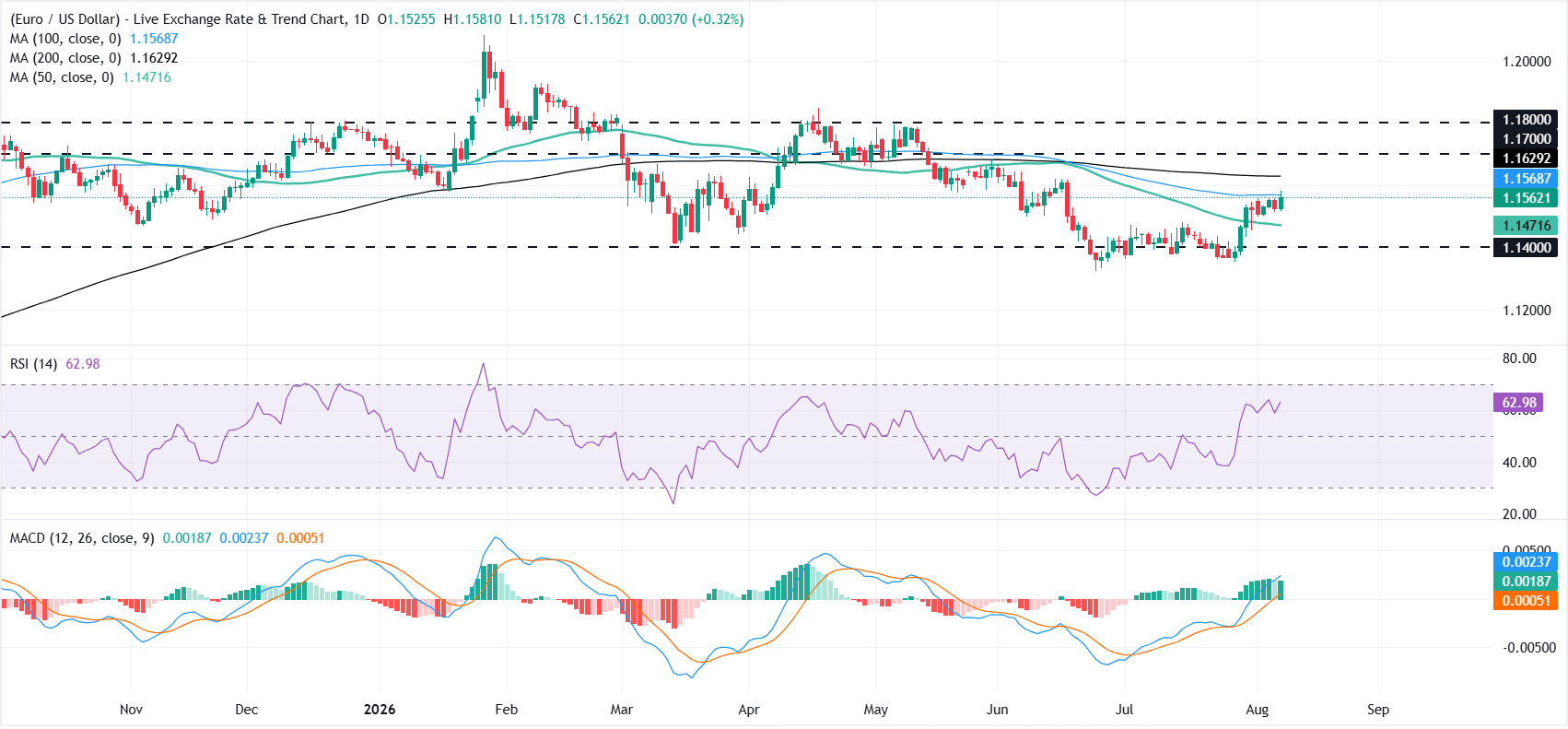
In todayโ€™s session, EUR/USD is strengthening around the 1.17 area, but the move is not driven by a single dominant factor. Instead, it reflects a combination of several parallel impulses, including unchanged policy rates from both the Fed and the ECB, improving sentiment linked to potential de-escalation of tensions around Iran, and stronger-than-expected German industrial data. It is important to stress that the current appreciation looks more like a repricing of expectations than a durable shift in underlying fundamentals.

Source: xStation5

What is shaping EUR/USD price action? Fed on hold, but the market is already pricing rate cuts

The Federal Reserve kept interest rates unchanged, while signalling a gradual slowdown in economic momentum and increasing sensitivity in the labour market. At the same time, inflation in the US is still not fully under control, particularly in services and core inflation, where price pressures remain persistent. Despite this, markets are increasingly pricing in future rate cuts, not as a response to rapidly falling inflation, but rather as a reaction to a potential weakening in economic activity. This scenario reduces the attractiveness of the US dollar and gradually supports EUR/USD through expectations of a narrowing interest rate differential.

The ECB remains cautious, with no automatic path to hikes

The European Central Bank also left rates unchanged, maintaining a cautious and data-dependent communication stance. While some forecasts still allow for further tightening, the dominant view remains one of stabilisation and inflation-driven decisions rather than an aggressive hiking cycle. At the same time, improving real economy data, especially from Germany, is limiting earlier expectations of a deeper slowdown in the euro area, supporting the single currency through the activity channel rather than monetary policy expectations alone.

Geopolitics and hopes for an Iran agreement

Reports of potential de-escalation in tensions surrounding Iran are improving global risk sentiment. A decline in the geopolitical risk premium reduces demand for the US dollar as a traditional safe-haven currency, while benefiting risk-sensitive assets such as the euro. In addition, a potential easing of tensions in the Middle East lowers pressure on energy prices, which in the medium term could reduce inflationary pressures and strengthen expectations of a more accommodative Fed stance.

Germany surprises to the upside, lifting European sentiment

Stronger-than-expected German industrial data is an important element of todayโ€™s market picture. Against the backdrop of earlier concerns about stagnation in Europe, this release is helping stabilise perceptions of the euro area. As a result, the euro is increasingly seen not only through the lens of cyclical weakness, but also as a relatively stable alternative to the US dollar, particularly in an environment of shifting monetary policy expectations.

What else is influencing the market in the background

Beyond central bank decisions and macroeconomic data, the key driver remains the pace of change in market expectations regarding future Fed and ECB policy. The market is currently in a repricing phase rather than a full economic cycle shift. This makes EUR/USD particularly sensitive to incoming data and central bank communication that could either confirm or challenge the scenario of faster US easing combined with relatively stable policy in Europe. In such an environment, even moderately positive European data can support the euro in the short term, but the sustainability of the trend will ultimately depend on whether the Fed actually moves towards more decisive monetary easing.

Currency Hedger No Comments

Trade of The Day – EUR/CHF

Facts:

  • The pair returned below the horizontal resistance area at 0.9220
  • EURCHF is trading below the 100-period exponential moving average from D1 interval

Recommendation: Trade: Short EURCHF at market price Target: 0.8995 Stop: 0.9272

Opinion:

Looking at EURCHF on the D1 interval, one can see a potential downward trend resumption. Following a break above the 1:1 geometry, the pair quickly returned below the upper limit of the aforementioned 1:1 structure. According to the Overbalance methodology, the main trend remains downward. In addition the pair sits below the 100-period moving average from the D1 interval. We recommend going short USDCAD at market price with a target of 0.8995. We also recommend placing a stop loss order at 0.9272.

Source: xStation

Currency Hedger No Comments

Currency Talk – USD/CAD, NZD/USD, EUR/NZD

Key takeaways

  • What is the technical outlook for USDCAD, NZDUSD, and EURNZD?

This analysis from the Overbalance series aims to identify three financial instruments, analysed primarily on the daily/four-hour (D1/H4) timeframe. The analysis utilises only the Overbalance methodology, which helps to identify points where a trend may continue or where a reversal may occur. Todayโ€™s analysis covers three instruments, assessed solely in terms of 1:1 correction structures.

USDCAD

USDCAD prices have been on a downward trend since the beginning of April. The chart shows a 1:1 pattern with a range of around 80 pips. Although the latest pattern has been slightly breached, the price has not exceeded the 127.2% level, which, according to the Overbalance methodology, indicates that the downward trend remains intact. The current correction has stalled around 1.3630, where the upper boundary of the 1:1 pattern is located. Until this level is broken, the scenario of further declines remains in place.

USDCAD โ€“ H4 timeframe. Source: xStation

NZDUSD

Since 6 April, NZDUSD has been trading within a local uptrend. The lower boundary of the pattern at 0.5840 has recently been tested twice. This level was only slightly breached, but the price failed to return below the polarity of the previously negated downward pattern at 0.5828, which led to the emergence of another upward impulse. According to the Overbalance methodology, the uptrend remains in place, and the key support level remains at 0.5865, derived from the lower boundary of the green 1:1 pattern. The pattern remains valid as it has only been slightly breached but not negated.

NZDUSD โ€“ H4 chart. Source: xStation

EURNZD

Since 7 April, the EURNZD has been trading in a downtrend. The price attempted to break through the support level at 1.9969 on several occasions and eventually both broke through it and negated the 1:1 upward trend, confirming the bearish scenario. In the event of a correction, the key short-term resistance remains at 1.9930. If the downward movement continues, the lows from February and March at 1.9540 remain a potential target for selling.

EURNZD โ€“ H4 chart. Source: xStation

Currency Hedger No Comments

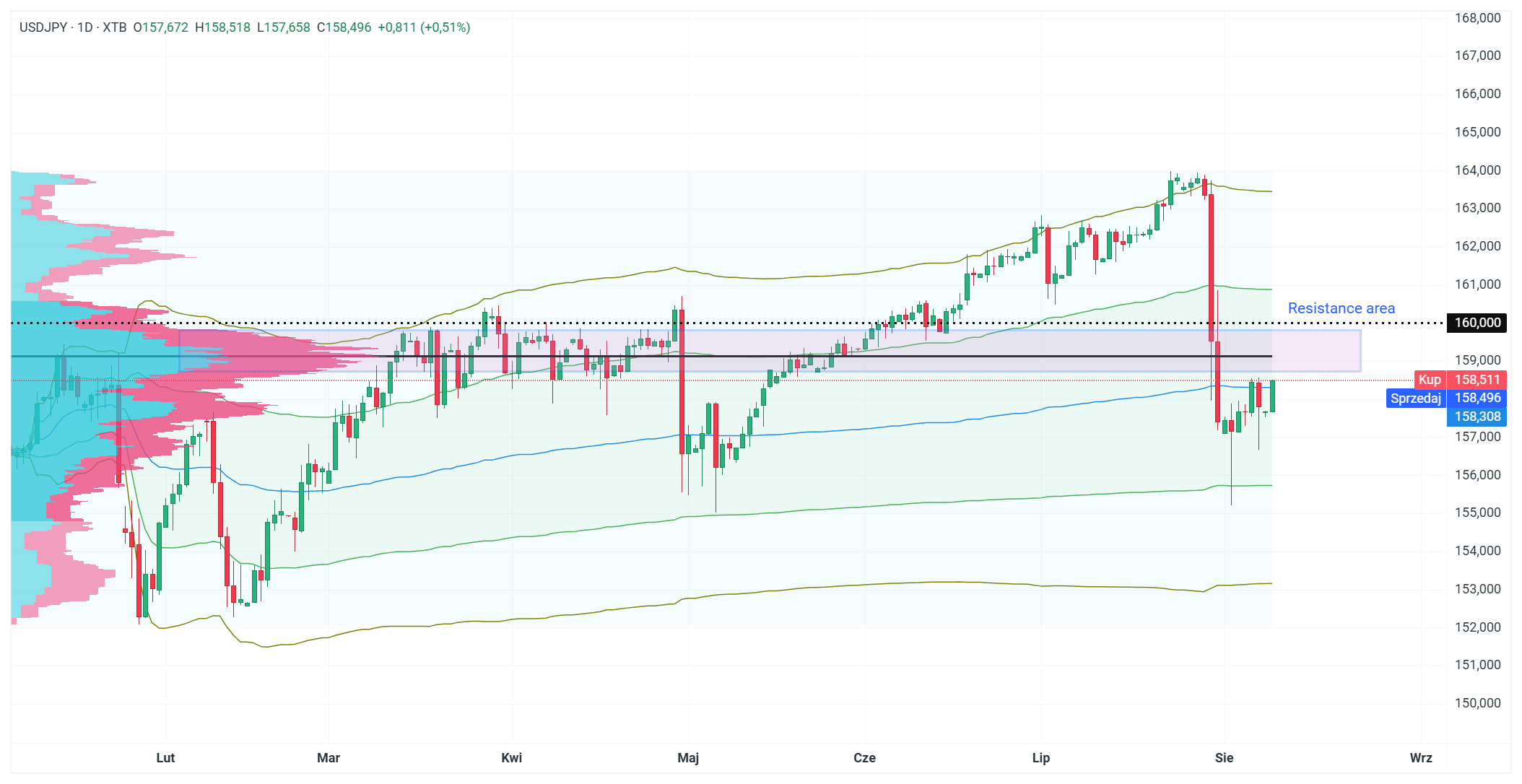
USDJPY: another intervention by Japanese authorities, yen gains 1.00%

USDJPY was hit again today by a strong wave of yen buying, with the pair falling from the upper 157.700 area to 155.030. The move is being interpreted as another intervention by Japanese authorities. The timing fits the recent pattern: low liquidity around Japanese holidays and the transition from the Asian to the European session, when official flows can have a greater market impact. At the peak of the move, the yen strengthened by nearly 2%, toward the 155 area โ€” the strongest level since February 24, 2026 โ€” after Finance Minister Satsuki Katayama warned against speculative movements in the FX market.

This is another such intervention following last weekโ€™s large-scale operation. At that time, Bank of Japan money market data suggested that Tokyo may have spent around 5.48 trillion yen, or roughly 35 billion USD, to support the yen after USDJPY broke above the 160 level. The key signal for investors is that Japanโ€™s Ministry of Finance is no longer limited to verbal warnings, but is actively attempting to cap USDJPY gains, particularly in the 158โ€“160 zone. At the same time, rapid rebounds following earlier interventions show that these actions are buying time rather than changing the broader trend itself. Levels above 160 were also a critical point during the July 2024 intervention.

The fundamental backdrop remains difficult for the yen: the wide interest rate differential between the US and Japan, Japanโ€™s dependence on energy imports, and geopolitical pressure related to the Strait of Hormuz continue to support the dollar and weaken the yen. The recent improvement in sentiment surrounding a potential USโ€“Iran agreement has helped Tokyo through lower oil prices and a weaker USD, but if this pressure does not continue to ease โ€” or if the Bank of Japan does not adopt a more hawkish stance โ€” investors may continue to support the current weakening trend in JPY.

Currency Hedger No Comments

AUD/USD Price Forecast: Rallies to June 2022 high, closer to mid-0.7200s on weaker USD

  • AUD/USD attracts strong follow-through buyers amid a combination of supporting factors.
  • US-Iran peace deal hopes and receding hawkish Fed expectations weigh heavily on the USD.
  • The RBAโ€™s hawkish outlook benefits the Aussie and contributes to the positive momentum.

Theย AUD/USDย pair is seen building on the previous day’s bounce from the 0.7135 region, or the weekly low, and gaining strong follow-through positive traction for the second straight day on Wednesday. The momentum lifts spot prices to a fresh high since June 2022, closer to mid-0.7200s, during the Asian session, and is sponsored by a broadly weaker US Dollar (USD).

The incoming headlines fuel optimism over a potential US-Iran peace deal and boost investors’ confidence, undermining the safe-haven buck and benefiting the risk-sensitive Aussie. Furthermore, sliding Crude Oil prices ease inflationary concerns and temper bets for a rate hike by the USย Federal Reserveย (Fed). This exerts additional pressure on the USD, which, along with the Reserve Bank of Australia’s (RBA) hawkishย outlook, contributes to the bid tone surrounding the AUD/USD pair.

From a technical perspective, spot prices hold a bullish near-term bias following the recent resilience below the 100-period Exponential Moving Average (EMA) on the 4-hour chart. The said support is pegged at 0.7145, which now underpins the broader upturn from recent lows. Moreover, a firm Relative Strength Index (RSI) around 65 suggests strong but maturing upside momentum, while the positive Moving Average Convergence Divergence (MACD) reading hints that buyers still retain control.

This, in turn, suggests that any corrective pullback might still be seen as a buying opportunity near the 100-period EMA on H4, at 0.7145, as the broader structure remains constructive above this zone. A sustained break beneath this moving average would weaken the current bullish tone and open the door to a deeper corrective phase on the four-hour timeframe.

(The technical analysis of this story was written with the help of an AI tool.)

AUD/USD 4-hour chart

Chart Analysis AUD/USD

US Dollar Price Today

The table below shows the percentage change of US Dollar (USD) against listed major currencies today. US Dollar was the strongest against the Japanese Yen.

USDEURGBPJPYCADAUDNZDCHF
USD-0.20%-0.18%-0.06%-0.14%-0.69%-0.75%-0.20%
EUR0.20%0.02%0.15%0.07%-0.48%-0.57%0.00%
GBP0.18%-0.02%0.13%0.06%-0.50%-0.57%0.00%
JPY0.06%-0.15%-0.13%-0.09%-0.64%-0.72%-0.12%
CAD0.14%-0.07%-0.06%0.09%-0.55%-0.62%-0.04%
AUD0.69%0.48%0.50%0.64%0.55%-0.07%0.50%
NZD0.75%0.57%0.57%0.72%0.62%0.07%0.57%
CHF0.20%-0.00%-0.00%0.12%0.04%-0.50%-0.57%

The heat map shows percentage changes of major currencies against each other. The base currency is picked from the left column, while the quote currency is picked from the top row. For example, if you pick the US Dollar from the left column and move along the horizontal line to the Japanese Yen, the percentage change displayed in the box will represent USD (base)/JPY (quote).

Currency Hedger No Comments

Trade of The Day – EUR/GBP

Facts: EURGBP bounced off the 1:1 structure at 0.8647 The pair is trading below the 100-period exponential moving average foram H1 interval Recommendation: Trade: Short position on EURGBP at market price Target: 0.8620, 0.8611 Stop Loss: 0.8655

Opinion: EURGBP has been trading in a downward trend recently. Taking a look at the H1 internal, we can see that the pair bounced off the key resistance, signaling a potential bearish trend resumption. The resistance at 0.8647 is marked with the upper limit of 1:1 structure. In addition the price sits below the 100- period moving average. According to the Overbalance strategy, as long as the price sits below the 0.8647 resistance, one should expect the price to continue to fall. Taking this into account, we recommend going short EURGBP at market price with two targets: 0.8620 and 0.8611. We also recommend placing a stop loss at 0.8655. Source: xStation5

Currency Hedger No Comments

Currency Talk – AUDCAD, GBPUSD, AUDUSD

Key takeaways

  • What is the technical outlook for AUD/CAD, GBP/USD and AUD/USD?

This analysis from the Overbalance series aims to identify three financial instruments, analysed primarily on the daily/four-hour timeframe (D1/H4). The analysis utilises only the Overbalance methodology, which helps to identify points where a trend may continue or where a reversal may occur. Todayโ€™s analysis covers three instruments, assessed solely in terms of 1:1 correction structures. AUDCAD After several tests, the AUDCAD exchange rate has broken through the key support level at 0.9755, which, according to the Overbalance methodology, paves the way for a deeper downward correction. A potential target for the downside is the 0.9610 level, where the lower boundary of the large 1:1 pattern is located. Currently, the 0.9755 level is acting as resistance, and only a sustained return of the price above this zone could restore the bullish scenario.

AUDCAD โ€“ H4 timeframe. Source: xStation GBPUSD Since the beginning of April, GBPUSD has been trading within a local uptrend, supported by the 1:1 bullish pattern highlighted in green. The key support level remains at 1.3488. A potential bounce at this point could lead to the generation of another upward impulse. Conversely, a break below this level would open the way for a decline towards 1.3360, where the polarity of the previously broken downward pattern lies.

GBPUSD โ€“ H4 chart. Source: xStation AUDUSD The AUDUSD pair remains in an uptrend. Recently, the pair reached a new local high, followed by a rapid correction. Should this correction deepen, the key support level is 0.7121, derived from the lower boundary of the 1:1 pattern. As long as this level holds, the base case scenario remains a continuation of the upward trend.

AUDUSD โ€“ H4 chart. Source: xStation

Currency Hedger No Comments

USD/INR stays near fresh record highs as risk aversion prevails

  • USD/INR appreciates as the US Dollar gains on increased risk aversion amid Middle East concerns.
  • Modiโ€™s BJP won a third term in Assam and captured opposition stronghold West Bengal in a key election.
  • Indiaโ€™s forex reserves fell from $728.5 billion, while equity outflows hit $19 billion in March and April.

USD/INR extends gains for the third successive day, trading around the fresh record high of 95.40, during the Asian hours on Tuesday. Traders will likely observe Indiaโ€™s HSBC Composite and Services Purchasing Managers’ Index (PMI) data to be released on Wednesday.

The USD/INR pair appreciates as the US Dollar (USD) strengthens on safe-haven demand following Iranโ€™s attack on the United Arab Emirates (UAE). CNBC reported Monday that the UAE was targeted by Iranian drones and missiles, while the US said it destroyed Iranian boats in the Strait of Hormuz. US President Donald Trump warned that Iran would be โ€œblown off the face of the earthโ€ if it targets US ships protecting commercial vessels passing through the Strait of Hormuz.

The Indian Rupee (INR) faced challenges as an overnight surge in crude oil prices dampened investor sentiment. Oil prices, however, have since declined as concerns over immediate supply disruptions eased, with the United States (US) Navy taking steps to reopen the crucial Strait after Iran attempted to close it. Maersk, a Danish shipping and logistics company, later confirmed that its Alliance Fairfax, a US-flagged vehicle carrier, exited the strait under US military escort.

Indian Prime Minister Narendra Modiโ€™s Bharatiya Janata Party (BJP) clinched a third straight term in Assam and captured opposition stronghold West Bengal in a key election.

On Monday, HSBC Manufacturing Purchasing Managers’ Index (PMI) in India came in at 54.7 for April, revised down from the preliminary 55.9 but higher than 53.9 in the prior month. Both output and new orders continued to expand, though growth remained subdued relative to levels seen over the past three and a half years.

Foreign institutional investors (FII) turned net buyers of Indian equities on Monday after nine consecutive days of selling, with inflows totaling 28.36 billion rupees ($298 million). Domestic institutional investors (DII) bought local shares worth 47.64 billion rupees, marking their seventh straight session of purchases, per Reuters.

Stock-specific moves linked to earnings are also expected to remain in focus. Nifty 50 constituents Larsen & Toubro, Mahindra and Mahindra, and Hero MotoCorp are scheduled to announce their quarterly results later in the day.

Indiaโ€™s foreign exchange reserves have declined from a peak of $728.5 billion, while equity outflows reached $19 billion across March and April. Nevertheless, the Reserve Bank of India (RBI) has stated that it remains comfortable with reserve levels sufficient to cover 11 months of imports, though recent policy discussions highlight renewed urgency to strengthen buffers amid ongoing capital outflows.

Technical Analysis: USD/INR nears rectangular channel top, all-time highs near 95.50

USD/INR trades around 95.40 at the time of writing on Tuesday. The technical analysis of the daily chart indicates a potential for a bullish emergence as the pair is testing the upper boundary of the rectangular channel.

However, the USD/INR pair retains a bullish near-term bias as price holds above the nine-day and 50-day Exponential Moving Averages (EMAs). The 14-day Relative Strength Index (RSI) at 66.7 points to firm positive momentum edging toward overbought territory, suggesting upside pressure persists while leaving the pair vulnerable to bouts of consolidation if buyers lose traction.

The USD/INR pair is testing the upper boundary of the rectangle, followed by the all-time high of 95.40, which was recorded on May 4. On the downside, the initial support lies at the nine-day EMA of 94.71. A break below the short-term average would lead the pair to test the 50-day EMA at 93.20, followed by the lower rectangle boundary around 92.50 and a seven-week low of 92.14.

(The story was corrected on May 5 at 6:10 GMT to say in the first paragraph to say that the HSBC PMI data will be released on Wednesday, not Tuesday.)

USD/INR: Daily Chart

US Dollar Price Today

The table below shows the percentage change of US Dollar (USD) against listed major currencies today. US Dollar was the strongest against the Australian Dollar.

USDEURGBPJPYCADAUDNZDINR
USD0.04%0.06%0.00%-0.02%0.16%0.10%0.14%
EUR-0.04%0.00%-0.02%-0.03%0.12%0.06%0.25%
GBP-0.06%-0.00%-0.04%-0.08%0.10%0.07%0.09%
JPY0.00%0.02%0.04%-0.01%0.15%0.11%0.30%
CAD0.02%0.03%0.08%0.00%0.16%0.11%0.32%
AUD-0.16%-0.12%-0.10%-0.15%-0.16%-0.04%0.15%
NZD-0.10%-0.06%-0.07%-0.11%-0.11%0.04%-0.01%
INR-0.14%-0.25%-0.09%-0.30%-0.32%-0.15%0.01%

The heat map shows percentage changes of major currencies against each other. The base currency is picked from the left column, while the quote currency is picked from the top row. For example, if you pick the US Dollar from the left column and move along the horizontal line to the Japanese Yen, the percentage change displayed in the box will represent USD (base)/JPY (quote).