

Currency Hedger No Comments

GBP slides to fresh low since April vs bullish USD amid UK political crisis

  • GBP/USD prolongs its downtrend for the third straight day amid a combination of negative factors.
  • The UK political turmoil undermines the GBP amid reduced bets for aggressive rate hikes by the BoE.
  • The Fedโ€™s hawkish tilt and the Iran uncertainty boost the USD, further exerting pressure on the pair.

The GBP/USD pair attracts some follow-through selling for the third straight day and weakens further below the 1.3200 mark, hitting a fresh low since April during the Asian session on Friday. Spot prices remain on track to register heavy weekly losses, and the fundamental backdrop suggests that the path of least resistance remains to the downside.

The British Pound (GBP) continues with its relative underperformance in the wake of lingering domestic political risks, which, along with a bullish US Dollar (USD), validates the near-term negative outlook for the GBP/USD pair. Greater Manchester Mayor Andy Burnham cleared a path to attempt to oust British Prime Minister Keir Starmer after winning a parliamentary seat in northern England on Friday. In his victory speech, Burnham said the result could be a “turning point” for British politics and told his party that this was a final chance to change direction.

Meanwhile, traders have scaled back expectations for more aggressive interest rate hikes by the Bank of England (BoE) following the release of softer inflation figures earlier this week. Furthermore, the US-Iran peace deal eased concerns about the energy shock, endorsing the view that the BoE will hold interest rates steady. This is seen as another factor undermining the GBP. The USD, on the other hand, stands firm near its highest level since late March amid the US Federal Reserve’s (Fed) more hawkish tilt, signaling the possibility of at least one rate hike by the year-end.

On the geopolitical front, US Vice President JD Vance canceled his planned trip for talks with Iran in Switzerland, saying that the meeting wasnโ€™t yet finalized. Adding to this, Israeli air strikes in Lebanon threaten to unravel the US-Iran deal. This further benefits the safe-haven USD and backs the case for an extension of the GBP/USD pair’s steep downfall from the weekly swing high, near the 1.3460 region. This, in turn, suggests that any attempted recovery could be seen as a selling opportunity as traders now look to UK monthly Retail Sales data for a fresh impetus.

Pound Sterling Price This week

The table below shows the percentage change of British Pound (GBP) against listed major currencies this week. British Pound was the strongest against the New Zealand Dollar.

USDEURGBPJPYCADAUDNZDCHF
USD1.17%1.70%0.74%1.14%0.66%1.61%1.32%
EUR-1.17%0.50%-0.42%-0.03%-0.53%0.43%0.14%
GBP-1.70%-0.50%-1.09%-0.52%-1.03%-0.07%-0.35%
JPY-0.74%0.42%1.09%0.39%-0.10%0.89%0.56%
CAD-1.14%0.03%0.52%-0.39%-0.52%0.50%0.16%
AUD-0.66%0.53%1.03%0.10%0.52%0.96%0.69%
NZD-1.61%-0.43%0.07%-0.89%-0.50%-0.96%-0.28%
CHF-1.32%-0.14%0.35%-0.56%-0.16%-0.69%0.28%

The heat map shows percentage changes of major currencies against each other. The base currency is picked from the left column, while the quote currency is picked from the top row. For example, if you pick the British Pound from the left column and move along the horizontal line to the US Dollar, the percentage change displayed in the box will represent GBP (base)/USD (quote).


Currency Hedger No Comments

Aussie Heads for Weekly Loss

The Australian dollar held below $0.705, near ten-week lows and headed for a modest weekly loss as a stronger US dollar and fading bets of additional RBA rate hikes weighed on the currency. Markets increasingly suspect the Reserve Bank of Australia has finished tightening after keeping the cash rate unchanged this week, with the odds of one more hike this year reduced to about 50%. While Governor Michele Bullock maintained that further tightening remains possible if inflation persists, markets expect it would take a sharply higher second-quarter inflation reading to trigger another move. Meanwhile, the US dollar index climbed to a one-year high after the Fed Reserve’s hawkish hold prompted traders to increase bets on further rate hikes. Nearly half of policymakers projected at least one increase this year amid growing inflation concerns. Elsewhere, a US-Iran interim deal and the resumption of energy flows through the Strait of Hormuz provided some support for the risk sensitive AUD.

Currency Hedger No Comments

Dollar Towers on Hawkish Fed Signals

The dollar index traded around 100.8 on Friday, hovering at its highest level since May 2025 as investors piled on rate hike bets this year following hawkish signals from the Federal Reserve. On Wednesday, the Fed left rates unchanged as widely expected, but roughly half of FOMC members now anticipate at least one rate increase in 2026. The central bank also raised its inflation projections to account for the economic effects of the conflict in the Middle East. Chair Kevin Warsh declined to provide guidance on the next policy move but reaffirmed the Fedโ€™s commitment to restoring price stability. Meanwhile, the US-Iran interim peace agreement took effect on Thursday, bringing an end to a prolonged conflict that triggered a historic disruption to global energy supplies. While the deal helped ease geopolitical risks and pushed oil prices lower, markets remained focused on the Fedโ€™s policy outlook and the prospect of tighter monetary conditions.

Currency Hedger No Comments

Yen Weakens Despite Verbal Interventions

The Japanese yen weakened beyond 161 per dollar on Friday, falling to its lowest level since July 2024 despite renewed verbal intervention from Japanese authorities. Chief Cabinet Secretary Minoru Kihara said on Thursday that the government remains prepared to respond to excessive currency movements whenever necessary. The yen has now erased all the gains recorded on April 30, when authorities conducted a record-sized intervention to support the currency. The latest decline came despite the Bank of Japanโ€™s gradual tightening cycle, including a 25-basis-point rate hike to 1% earlier this week aimed at addressing an energy-driven inflation shock linked to the Middle East conflict. The dollar also strengthened following the Federal Reserveโ€™s decision to leave interest rates unchanged while signaling increasing support for additional rate hikes later this year. The widening policy divergence between Japan and the US continued to weigh on the Japanese currency.

Currency Hedger No Comments

Offshore Yuan Heads for Weekly Loss

The offshore yuan weakened to around 6.78 per dollar on Friday, putting the currency on track for a weekly loss as a resilient US dollar capitalized on intensifying rate-hike bets. While the Federal Reserve recently left interest rates unchanged as widely anticipated, roughly half of the FOMC policymakers now project at least one additional rate hike by the end of 2026. On the domestic front, traders are closely watching next weekโ€™s fixing of the one- and five-year Loan Prime Rates (LPR). The upcoming policy decision carries extra weight following a string of recent data underscoring China’s uneven economic growth. Meanwhile, Hong Kong is set to debut its highly anticipated offshore yuan bond futures this August. The milestone launch represents a strategic push by Beijing to cement the cityโ€™s status as a premier global offshore yuan hub while accelerating the broader internationalization of the currency.

Currency Hedger No Comments

Rupee Rises to 6-Week High

The Indian rupee hovered around 94.2 per dollar, extending gains to a six-week high as improving capital flows lifted investor sentiment. Market participants reported an improvement in foreign-exchange flows, with increased investment into Indian bonds and a slowdown in foreign equity outflows helping strengthen demand for the local currency. This marks a shift from the one-sided dollar demand that had pressured the rupee in recent weeks. The decline in crude oil prices following easing geopolitical tensions has reduced pressure on India’s import bill. Interbank market sentiment has also improved, with traders becoming more willing to take positions on both sides of the market rather than consistently buying dollars on dips, reflecting increased confidence in the rupee. However, the rupee’s gains remain challenged by a stronger dollar, with expectations of tighter Federal Reserve policy boosting demand for the greenback amid persistent inflation concerns.

Currency Hedger No Comments

Canadian Dollar dips as Fed hawkish outlook, weaker Oil pressure CAD

  • USD/CAD rises 0.21% on Thursday and trades around 1.4130 at the time of writing.
  • The US Dollar remains supported after a hawkish Fed meeting, despite the preliminary US-Iran agreement.
  • Lower Oil prices emphasise downside pressure on the Canadian Dollar.

USD/CADย trades around 1.4130 on Thursday, up 0.21% on the day, as the US Dollar (USD) maintains a positive tone following the Federal Reserveโ€™s (Fed) monetary policy decision. The pair continues to hold above the 1.4100 level, supported by a reassessment of US interest rate expectations.

The Fed left its benchmark interest rate unchanged within the 3.5%-3.75% range, in line with market expectations. However, updated economic projections showed that roughly half of Federal Open Market Committee (FOMC) members expect at least one additional rate hike this year. During his first press conference as head of the central bank,ย Fedย Chair Kevin Warsh reaffirmed his commitment to restoring price stability, highlighting the resilience of the labor market and persistent underlying inflation pressures.

This more restrictive policy outlook continues to support the Greenback, even as safe-haven demand eases following the announcement of a preliminary memorandum of understanding between the United States (US) and Iran aimed at ending hostilities in the Middle East. According to Rabobank, improving geopolitical prospects and a potential full reopening of the Strait of Hormuz could reduce demand for safe-haven assets, but the impact of the Fedโ€™s hawkish shift is currently outweighing those factors for the US Dollar.

On the Canadian side, the Canadian Dollar (CAD) is weighed down by lower Oil prices. West Texas Intermediate (WTI) is hovering below $75 per barrel, down more than 0.90% on Thursday at the time of press. This factor is generally negative for the commodity-linked currency, given the importance of energy exports to the Canadian economy.

At the same time, investors remain focused on the global growthย outlookย and the potential consequences of higher US interestย rates. A further rise in US Treasury yields could continue to favor the US Dollar against the Canadian Dollar, even as overall market sentiment improves.

Canadian Dollar Price Today

The table below shows the percentage change of Canadian Dollar (CAD) against listed major currencies today. Canadian Dollar was the strongest against the Swiss Franc.

USDEURGBPJPYCADAUDNZDCHF
USD0.33%0.47%0.16%0.16%0.11%0.13%0.56%
EUR-0.33%0.16%-0.15%-0.17%-0.23%-0.25%0.22%
GBP-0.47%-0.16%-0.32%-0.33%-0.37%-0.39%0.05%
JPY-0.16%0.15%0.32%0.02%-0.06%-0.08%0.38%
CAD-0.16%0.17%0.33%-0.02%-0.08%-0.09%0.37%
AUD-0.11%0.23%0.37%0.06%0.08%-0.02%0.44%
NZD-0.13%0.25%0.39%0.08%0.09%0.02%0.47%
CHF-0.56%-0.22%-0.05%-0.38%-0.37%-0.44%-0.47%

The heat map shows percentage changes of major currencies against each other. The base currency is picked from the left column, while the quote currency is picked from the top row. For example, if you pick the Canadian Dollar from the left column and move along the horizontal line to the US Dollar, the percentage change displayed in the box will represent CAD (base)/USD (quote).

Currency Hedger No Comments

Swiss franc weakens after SNB keeps rates unchanged

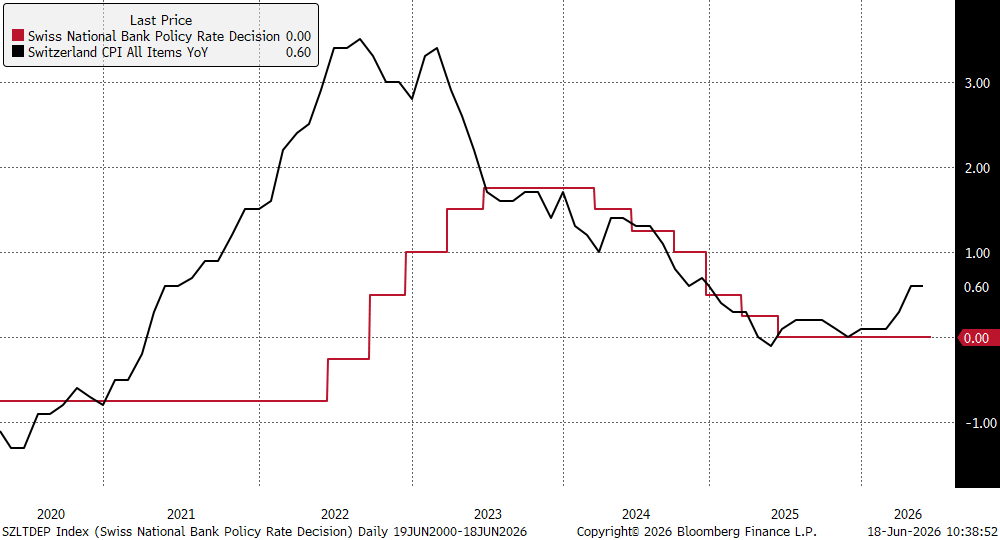
The Swiss National Bank (SNB) decided to keep its main interest rate unchanged during its June meeting. The interest rate has remained unchanged exactly since June last year. It is worth emphasizing that interest rate decisions in Switzerland are made quarterly. The interest rate remains at 0% and currently, due to slightly elevated inflation, we should not expect any pressure for cuts, but at the same time, it is still far from the upper limit of the inflation target.

Despite the fact that the war in Iran caused a temporary increase in imported energy prices and pushed the May inflation reading to 0.6%, the Swiss CPI index still sits comfortably in the lower range of the 0-2% inflation target. Switzerland shows significantly less dependence on energy commodities from the Middle East thanks to developed hydropower and nuclear energy, which protects the local economy from global price shocks more strongly than the Eurozone. The main focus for policymakers remains the exchange rate of the Swiss franc and the risk of its excessive appreciation in the face of geopolitical uncertainty.

Macroeconomic forecasts The SNB made a slight upward revision to its inflation forecasts in the short and medium term:

  • Inflation: The Bank now forecasts average inflation at 0.6% in 2026 (up from 0.5% in the March forecast) and 0.6% in 2027 (also up from 0.5%). In 2028, inflation is expected to be 0.7% (compared to 0.6% previously), and a reading of 0.8% is expected in the first quarter of 2029.
  • GDP Growth: Economic forecasts remained unchanged. The SNB expects the Swiss economy to grow by about 1.0% in 2026 and 1.5% in 2027.

Statements from bankers at the SNB conference

Key members of the SNB Governing Board sent clear signals during today’s conference:

  • Martin Schlegel (Chairman of the SNB):”If necessary, we show an increased readiness to intervene in the foreign exchange market. In this way, we counteract a rapid and excessive strengthening of the Swiss franc, which would threaten price stability in Switzerland”.”Inflation has risen in recent months as a result of higher energy prices. However, medium-term inflationary pressure is virtually unchanged compared to the last monetary policy assessment”.”Everything between 0 and 2% is fine regarding inflation” and “no preference as to where in the range inflation is located”.He also indicated that monetary conditions are weaker than in March, and the bank does not currently see second-round effects in Switzerland.
  • “If necessary, we show an increased readiness to intervene in the foreign exchange market. In this way, we counteract a rapid and excessive strengthening of the Swiss franc, which would threaten price stability in Switzerland”.
  • “Inflation has risen in recent months as a result of higher energy prices. However, medium-term inflationary pressure is virtually unchanged compared to the last monetary policy assessment”.
  • “Everything between 0 and 2% is fine regarding inflation” and “no preference as to where in the range inflation is located”.
  • He also indicated that monetary conditions are weaker than in March, and the bank does not currently see second-round effects in Switzerland.
  • Antoine Martin (Member of the SNB Governing Board):He pointed out that the situation in the Middle East remains fragile, adding that global inflation should be expected to remain at an elevated level.
  • He pointed out that the situation in the Middle East remains fragile, adding that global inflation should be expected to remain at an elevated level.
  • Attilio Tschudin (Member of the SNB Governing Board):He noted that domestic indicators show a solid economic recovery, but the main risk for Swiss prospects is the condition of the global economy.
  • He noted that domestic indicators show a solid economic recovery, but the main risk for Swiss prospects is the condition of the global economy.

What to expect for EURCHF and USDCHF? EURCHF

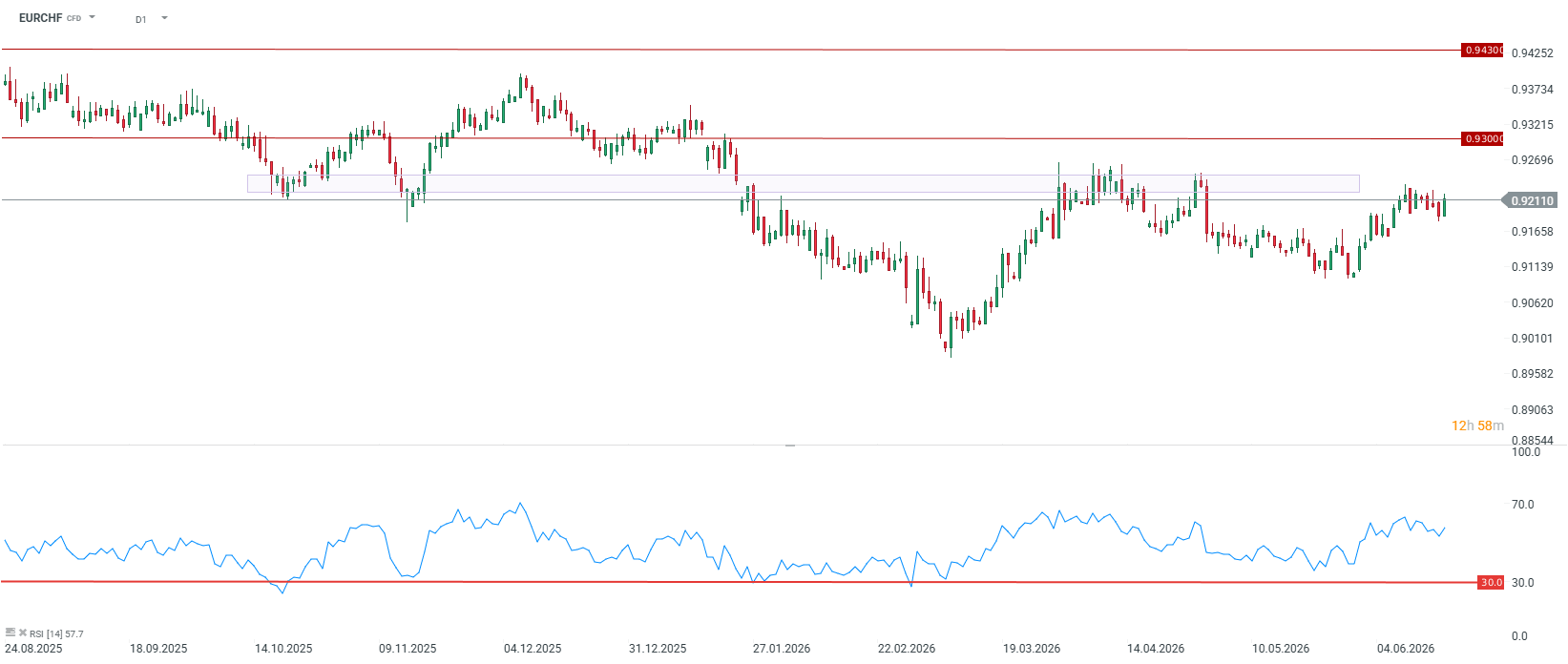
Immediately after the decision was announced, the franc weakened slightly against the euro, falling by 0.2%-0.3% to a level of around 0.9215 per euro. Since the sudden strengthening of the franc at the turn of February and March (outbreak of war in Iran), clear communication from the SNB about its readiness to intervene has systematically pushed the CHF rate down. A strong supply zone for the pair is around 0.9220 to 0.9250.

USDCHF

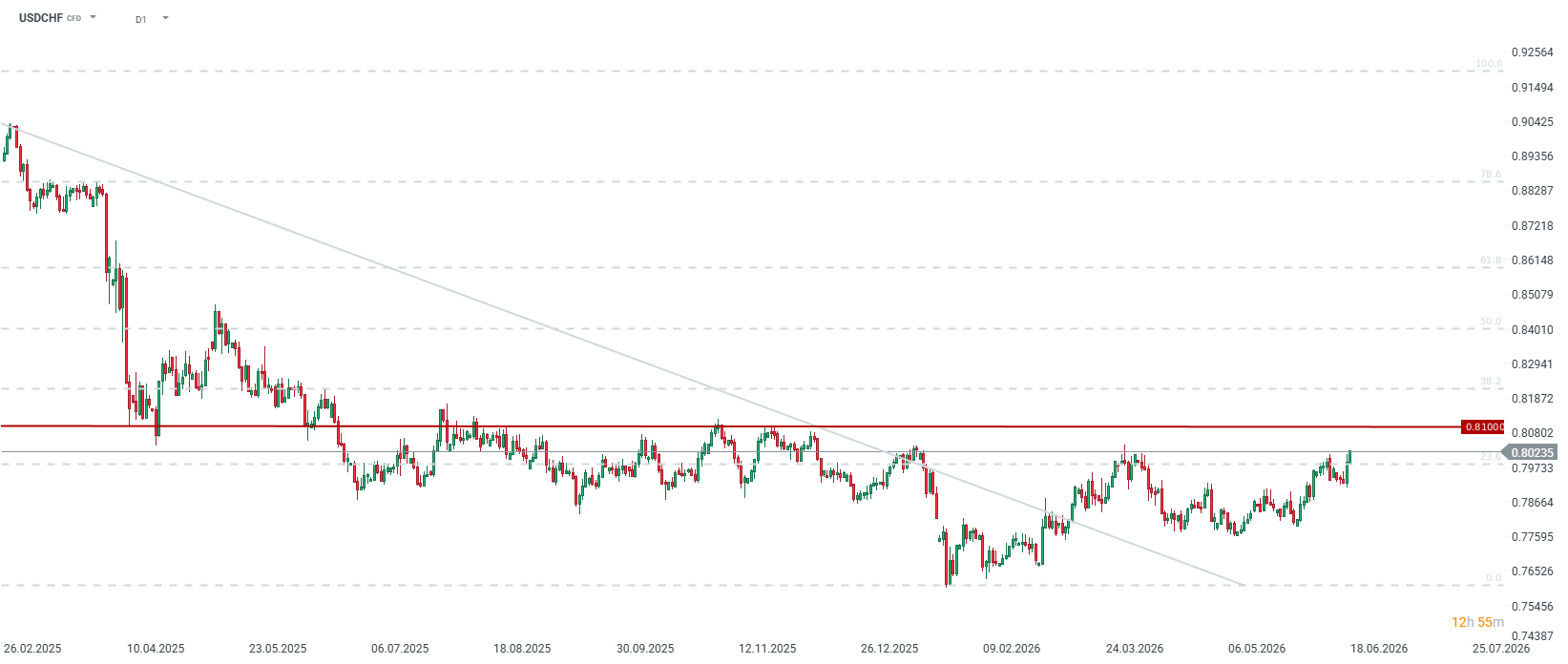
Wednesday’s signing of a peace agreement in Versailles between the US and Iran by President Trump and the Iranian President is a strong factor mitigating tensions in energy commodity markets. This means a drop in demand for the franc as a “safe haven,” which should favor a rebound and stabilization of EURCHF and USDCHF rates. Nevertheless, due to Martin Schlegel’s declared “increased readiness to intervene” in the event of any turmoil, investors must take into account that the SNB is artificially limiting the franc’s potential for further strengthening. Any sudden attempts at CHF appreciation will likely be met with a decisive sell-off of the currency by the Swiss central bank, which sets a solid long-term floor for EURCHF and USDCHF quotes.