

The offshore yuan slipped to around 6.76 per dollar on Tuesday, retreating from a more than three-year high reached in the previous session as investors weighed a mixed set of economic data from China. New home prices across 70 cities marked the 35th consecutive month of contraction and remaining at their steepest pace since May 2025, while fixed-asset investment declined more than market expectations in the JanuaryโMay period. Moreover, retail sales unexpectedly fell in May, marking the first annual decline since December 2022. Providing some support, industrial output exceeded market expectations in May, accelerating from April’s near three-year low. In addition, the surveyed urban unemployment rate eased to a five-month low in May. Adding to the currency’s pullback, Allianz Global Investors scaled back some of its bullish yuan positions and shifted to a neutral stance, locking in gains after a rally that propelled the yuan to become Asia’s best-performing major currency this year.
Trade of The Day – EUR/GBP
Facts:
- The price is near the lower boundary of a consolidation range between 0.886 and 0.861.
- Upward corrections within the consolidation are breaking to increasingly lower levels, while at the same time testing resistance around 0.863.
- The EMA100 has crossed the EMA200 from above.
Recommendation:
Short position (Sell) on EURGBP at the market price.
- Target price (Take Profit; TP): 0.8400
- Stop Loss (SL): 0.8817
EURGBP (D1)

Source: xStation5
OPINION :
The EURGBP rate is once again testing the lower boundary of the consolidation, which can also be treated as a developing 1:1 pattern, potentially ending with a downside breakout. The repeated defense of the ~0.86 level indicates the strength of this zone; however, increasingly weaker upward corrections within the consolidation reveal buyer weakness and point to the likely direction of further price movement.
Methodology and assumptions:
- The recommendation is based on technical analysis of the chart, in particular EMA moving averages and Fibonacci levels.
- The target level was determined based on Fibonacci levels.
- The protective stop-loss order was set based on a favorable risk-to-reward ratio and with reference to a Fibonacci level.
Swiss Franc edges higher on USโIran peace deal
- USD/CHF falls to around 0.7930 in Mondayโs early European session.
- US and Iran confirmed a โpeace deal’ was reached, signing in Switzerland on Friday.
- The Fed is widely anticipated to keep its interest rate steady as it remains in “wait-and-see” mode.
The USD/CHF pair slumps to near 0.7930, the lowest since June 5, during the early European trading hours on Monday. The US Dollar (USD) weakens against the Swiss Franc (CHF) after the US and Iran announced a framework deal for peace. Traders brace for the US Federal Reserve (Fed) interest rate decision later on Wednesday.
US President Donald Trump on Sunday announced a โgreat dealโ to end the war with Iran. Iranโs National Security Council stated that the US naval blockade will be lifted immediately and the war will end on all fronts, including Lebanon. Pakistanโs Prime Minister Shehbaz Sharif said that the official signing ceremony for the โpeace dealโ will take place on Friday in Switzerland. Signs of progress in the US-Iran peace agreement boost the CHF and create a headwind for the pair.
The US central bank is set to keep its benchmark interest rate unchanged at a target range of 3.50% to 3.75% at its upcoming policy meeting on Wednesday. Traders will closely monitor the press conference and take more cues about how new Fed chair Kevin Warsh will lead the US central bank into its next era. Any hawkish remarks from Fed officials could lift the Greenback and act as a headwind for the major pair.
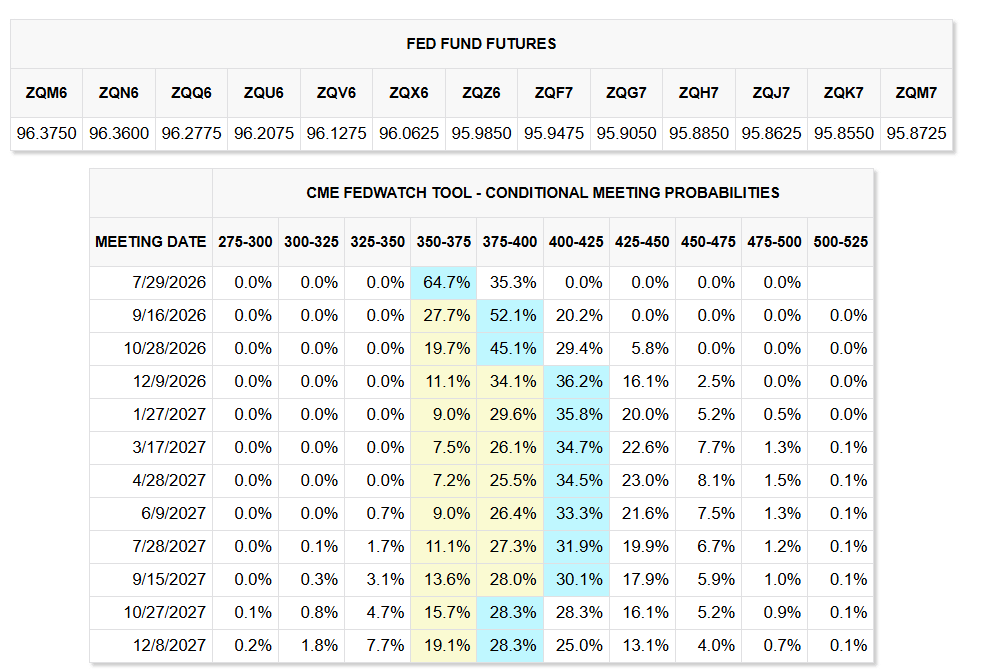
Markets have priced in nearly a 64% chance of a Fed interest rate hike in December this year after the peace deal, down from 69% last week, according to the CME FedWatch tool.
New Zealand Dollar gains on easing risk aversion
- NZD/USD holds strong despite New Zealandโs services sector contracting for a fourth straight month as May’s PSI dropped to 47.5.
- The US Dollar declines as a US-Iran peace deal eases geopolitical tensions, lowering global inflation and interest rate concerns.
- Iran stated final talks depend on US compliance, demanding an immediate and complete end to the maritime blockade.
NZD/USD gains ground after registering minor losses in the previous day, trading around 0.5850 during the Asian hours on Monday. The pair remains stronger as the New Zealand Dollar (NZD) holds ground following the release of domestic economic data.
New Zealand’s services sector continues to struggle, as the BusinessNZ Performance of Services Index (PSI) fell to 47.5 in May, down from a revised 48.7 in April. This marks the fourth consecutive month of contraction for the sector.
Concurrently, the broader economy is showing signs of a deeper slowdown. The Performance of Composite Index dropped from a revised 49.2 to 48.4, signaling its third straight month of contraction and its steepest decline since June 2025.
The NZD/USD pair appreciates as the US Dollar (USD) declines after the United States (US) and Iran had reached a deal to end their conflict, easing concerns about inflation and higher interest rates.
Washington and Tehran said on Sunday that they have reached an agreement that will take effect on Friday. US President Donald Trump stated that the US is lifting its naval blockade on Iranian ports and that the Strait of Hormuz will reopen after the agreement is signed.
The United Kingdom (UK), France, Germany โand Italy said that the countries were prepared to lift sanctions on Iran in response to steps on its nuclear program after the US and Iran reached a deal to end their war.
Iran’s National Security Council confirmed a ceasefire agreement with the US, adding that final deal talks will start after the other party fulfills commitments under the memorandum of understanding. Iranian officials said the maritime blockade against Iran should end immediately and entirely.
United States Dollar Index drops as safe-haven demand fades
- US Dollar Index declines on fading safe-haven demand as a US-Iran deal eases inflation and interest rate concerns.
- Washington and Tehran announced Sunday they have reached a peace agreement, which will officially take effect this coming Friday.
- The CME FedWatch tool shows December Fed rate hike odds falling to nearly 27% after the peace deal.
The US Dollar Index (DXY), which measures the value of the US Dollar (USD) against six major currencies, is losing ground and trading around 99.50 during the Asian hours on Monday. The Greenback declines on fading safe-haven demand following reports that the United States (US) and Iran reached a deal to end their conflict, easing concerns about inflation and higher interest rates.
Washington and Tehran said on Sunday that they have reached an agreement that will take effect on Friday. US President Donald Trump stated that the US is lifting its naval blockade on Iranian ports and that the Strait of Hormuz will reopen after the agreement is signed.
The United Kingdom (UK), France, Germany โand Italy said that the countries were prepared to lift sanctions on Iran in response to steps on its nuclear program after the US and Iran reached a deal to end their war.
Iran’s National Security Council confirmed a ceasefire agreement with the US, adding that final deal talks will start after the other party fulfills commitments under the memorandum of understanding. Iranian officials said the maritime blockade against Iran should end immediately and entirely.
The CME FedWatch tool indicates that the markets are pricing in nearly a 27% probability of a US Federal Reserve (Fed) interest rate hike in December this year after the peace deal, down from 40% a week ago.
AUD/JPY – Strengthens above 113.00, positive tone remains intact
- AUD/JPY gathers strength to near 113.35 in Mondayโs early European session.
- RBA is anticipated to leave the interest rate unchanged, while BoJ is set to raise its benchmark rate on Tuesday.
- The cross keeps the bullish vibe, but further consolidation cannot be ruled out with neutral RSI momentum.
- The first upside barrier emerges at 113.60; the initial support level to watch is 112.25.
The AUD/JPY cross trades in positive territory around 113.35 during the early European session on Monday. The reports that the United States (US) had agreed to a peace deal with Iran provide some support to the riskier assets, such as the Australian Dollar (AUD) against the Japanese Yen (JPY). All eyes will be on the Reserve Bank of Australia (RBA) and Bank of Japan (BoJ) interest rate decisions later on Tuesday.
CNN reported on Sunday that Washington and Tehran have reached an agreement that will take effect on Friday. US President Donald Trump said the US is lifting its naval blockade on Iranian ports and that the Strait of Hormuz will reopen after the agreement is signed.
On Tuesday, the RBA is expected to keep its key interest rate unchanged for the first time this year, with money markets paring bets on further tightening. Traders will take more cues from the press conference on whether RBA Governor Michele Bullock signals some comfort at the current rate or keeps the door open to further moves to counter stubborn price pressures. Fading expectations of additional interest rate hikes by the Australian central bank might cap the upside for the Aussie in the near term.
The BoJ is likely to raise its benchmark interest rate to the highest level since 1995, undeterred by the absence of its governor. A Reuters poll showed economists projecting the Japanese central bank to raise rates to 1.25% in the fourth quarter (Q4) after a hike in June to 1.0%.
Technical Analysis:
In the daily chart, AUD/JPY retains a constructive bias as it holds above the 100-day simple moving average (SMA) and the lower Bollinger Band, suggesting underlying demand on dips. Price, however, trades just under the Bollinger mid-line, while the Relative Strength Index (RSI) hovers near a neutral 50, hinting at a consolidative tone within an overall uptrend.
On the topside, initial resistance emerges at the Bollinger middle band around 113.60, with the upper Bollinger Band near 114.92 acting as the next barrier if buyers regain control. On the downside, support sits first at the lower Bollinger Band around 112.25, ahead of the 100-day SMA clustered near 111.90, where a break would weaken the current bullish structure and open the door to a deeper corrective slide.
Australian Dollar strengthens on risk-on mood
- AUD/USD advances despite the fact that markets are ruling out any interest rate action on Tuesday.
- US Dollar declines as a US-Iran peace deal faded safe-haven demand, easing fears of inflation and higher interest rates.
- The CME FedWatch tool shows December Fed rate hike odds falling to nearly 27% after the peace deal.
AUD/USD gains around 0.5% after registering minor losses in the previous day, trading around 0.7080 during the Asian hours on Monday. However, the Australian Dollar (AUD) could struggle against the US Dollar (USD) as markets are ruling out a Reserve Bank of Australia (RBA) rate move at Tuesday’s June meeting and have lowered bets for an August hike. All eyes now turn to the May CPI data on June 24, which will be critical for policymakers looking for signs of persistent inflation to justify future policy tightening.
The AUD/USD pair appreciates as the US Dollar (USD) declines on fading safe-haven demand following reports that the United States (US) and Iran reached a deal to end their conflict, easing concerns about inflation and higher interest rates.
Washington and Tehran said on Sunday that they have reached an agreement that will take effect on Friday. US President Donald Trump stated that the US is lifting its naval blockade on Iranian ports and that the Strait of Hormuz will reopen after the agreement is signed.
The United Kingdom (UK), France, Germany โand Italy said that the countries were prepared to lift sanctions on Iran in response to steps on its nuclear program after the US and Iran reached a deal to end their war.
The CME FedWatch tool indicates that the markets are pricing in nearly a 27% probability of a US Federal Reserve (Fed) interest rate hike in December this year after the peace deal, down from 40% a week ago.
Indian Rupee surges as oil prices nosedive on US-Iran MoU finalization
- The Indian Rupee soars against the US Dollar on the finalization of the US-Iran deal.
- Plunging oil prices due to the reopening of the Strait of Hormuz, as per the post from US President Trump.
- The selling pressure by overseas investors has slowed down in the last two trading days.
The Indian Rupee (INR) opens strongly against the US Dollar (USD) at the start of the week. The USD/INR pair plunges to near 94.60 as oil prices have nosedived, following the announcement that the United States (US) and Iran have reached a permanent peace deal.
In Indiaโs opening trading hours, the MCX Crude Oil contract expiring on June 18 is down 5.5% to near 7,630, the lowest level seen in almost two weeks.
The appeal of currencies from economies, such as India, which rely heavily on oil imports to meet their energy needs, improves significantly when oil prices fall like a house of cards.
US-Iran reaches peace deal
On Sunday, both the US and Iran confirmed that they have finalized a Memorandum of Understanding (MoU).
Iranโs Supreme National Security Council confirmed Sunday that Tehran had finalized an MoU, saying all military operations on all fronts, including Lebanon, would cease โimmediately and permanentlyโ, CNBC reported.
US President Donald Trump also said in a post on Truth Social, โI hereby fully authorize the toll free opening of the Strait of Hormuz, and, simultaneously herewith, authorize the immediate removal of the United States Naval blockade.โ
Meanwhile, Pakistan Prime Minister (PM) Shehbaz Sharif has stated in a post on X, formerly known as Twitter, that the finalized MoU between the US and Iran will be signed on June 19 in Switzerland.
FIIs selling pressure cool down
Although Foreign Institutional Investors (FIIs) have remained net sellers in all trading days so far in June, a slowdown in the pace of selling pressure is observed in the last two trading days. So far this month, FIIs have offloaded their stake worth Rs. 46,430.42 crore, an average selling of Rs. 4,643 crore in 10 trading days. In the last two trading days, the average selling by overseas investors was Rs. 1,534.63 crore.
Indiaโs WPI Inflation data awaited
On the domestic front, investors await Indiaโs Wholesale Price Index (WPI) Inflation data for May, which will be published at 12:00 PM IST (06:30 GMT). Inflation at the wholesale level is expected to arrive higher at 9.1% from 8.3% in April.
Theoretically, higher inflation at the factory level boosts expectations for the Reserve Bank of Indiaโs (RBI) interest rate hikes in the near-term. However, the impact is expected to be limited as oil prices have started declining, a scenario that would anchor inflation expectations.
Technical Analysis: USD/INR slides to near 94.60

USD/INR tumbles to near 94.60 in the opening trade. The near-term bias of the pair turns bearish as it extends distance with the 20-day exponential moving average (EMA), which is at 95.33, on the downside.
The pairโs slide away from that dynamic barrier keeps the short-term trend under pressure, while the Relative Strength Index (RSI) near 42 leans lower, suggesting sellers retain control despite not yet reaching oversold territory.
On the topside, initial resistance is defined by the 20-day EMA at 95.33, where a sustained break higher would be needed to ease the current downside pressure and open the way for a deeper corrective bounce towards 96.00. Looking down, the pair could slide to the May 7 low at 94.03 if it drops below the May 29 low at 94.46.