

Currency Hedger No Comments

British Pound weakens below 1.3550 on renewed US strikes on Iran

  • GBP/USD softens to around 1.3530 in Thursdayโ€™s early Asian session. 
  • The US military launched another wave of strikes against Iran. 
  • Rising tensions in the Middle East have prompted traders to increase bets on BoE rate hikes this year. 

The GBP/USD pair declines to near 1.3530 during the early Asian session on Thursday. The British Pound (GBP) weakens against the US Dollar (USD) as renewed conflict and shipping disruptions in the Strait of Hormuz have reignited energy-driven inflation risks. Traders brace for the UK monthly Gross Domestic Product (GDP) report and the US Retail Sales data, which are due later on Thursday. 

The US military said it has launched another wave of strikes against Iran in a further effort to keep the Strait of Hormuz open, per the Guardian. Explosions were reported late on Wednesday on Iranโ€™s Qeshm Island, Bandar Abbas, and locations in the Sistan-Baluchestan province.

Iranโ€™s top negotiator, Mohammad Bagher Ghalibaf, said that if Iran did not benefit from its memorandum of understanding with the United States, โ€œWe have no reason to adhere to such an understanding.โ€ Rising tensions in the Middle East could boost a safe-haven currency such as the Greenback and act as a headwind for the major pair in the near term. 

Andy Burnham is expected to be officially named UK Prime Minister on July 20, pushing the focus onto his choice of finance minister, given the nation’s shaky public finances.

Traders raise their bets on rate hikes from the Bank of England (BoE) this year, given the expected impact on inflation from higher oil prices.

Money markets are fully pricing in a hike by the November policy meeting, with a second rate hike priced in by April 2027, according to Reuters. Before the US-Iran war, traders had been expecting the BoE to lower interest rates twice this year.

Currency Hedger No Comments

Japanese Yen strengthens on intervention warning, cooling US inflation

  • USD/JPY edges lower to around 162.15 in Thursdayโ€™s Asian session. 
  • Japanโ€™s Katayama said ready to take appropriate action on currency anytime as needed. 
  • Cooling US inflation curbs Fed rate hike bets. 

The USD/JPY pair loses ground to near 162.15 during the Asian trading hours on Thursday. The Japanese Yen (JPY) strengthens against the US Dollar (USD) after verbal intervention from Japanese authorities. Traders await the release of the US June Retail Sales data later on Thursday for fresh impetus. 

Traders remain on alert for possible intervention from Japanese officials. On Thursday, Japanโ€™s Finance Minister Satsuki Katayama said that the authorities are ready to take appropriate action on currency anytime as needed. She added that the officials will track market trends and economic data to ensure fiscal sustainability. 

Softer-than-expected US inflation data reinforced bets that the US Federal Reserve (Fed) can stay โ€Œpatient on interest rate hikes, weighing on the Greenback. Data released by the US Bureau of Labor Statistics (BLS) on Wednesday showed that the US Producer Price Index (PPI) rose by 5.5% YoY in June, versus 6.0% in May (revised from 6.5%). This reading came in below the market consensus of 6.2%. 

On a monthly basis, the PPI declined by 0.3%, compared to the 0.6% increase recorded in May (revised from 1.1%) and improved compared with the estimate for no change.

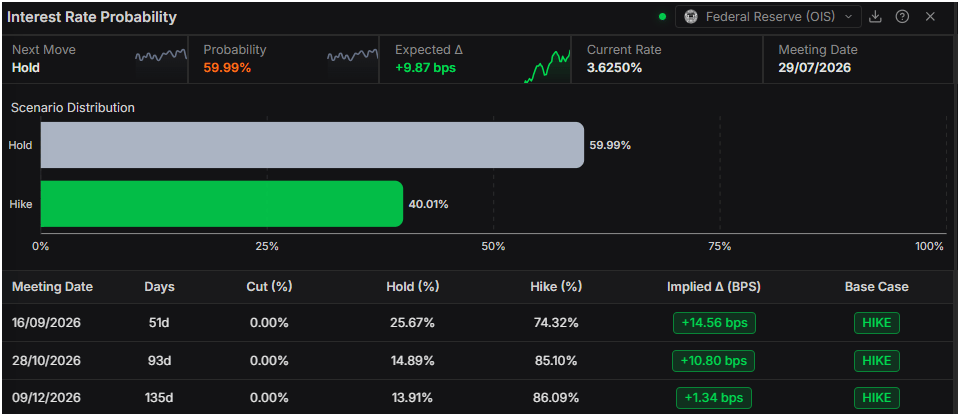
The probability for a rate hike in July was slashed to 9.6%, versus a 45% implied โ€Œprobability at the start of the week. Markets still see even odds of at least a 25 basis points (bps) increase in September, according to the CME FedWatch tool. 

Currency Hedger No Comments

EUR/JPY Price Positions near ascending triangle top around 186.00

  • EUR/JPY near the 186.10 ascending triangle ceiling suggests building bullish pressure.
  • The 14-day Relative Strength Index at 56 indicates positive, sustainable upward momentum.
  • The currency cross could find the initial support at the nine-day EMA at 185.35.

EUR/JPY depreciates after three days of gains, trading around 185.90 during the Asian hours on Thursday. The currency cross is retaining a constructive bullish bias as it holds above both the nine-period and 50-period Exponential Moving Averages (EMAs). The 14-day Relative Strength Index (RSI) around 56 suggests positive but not overextended momentum, hinting that buyers still control the near-term tone.

The daily chart technical analysis shows the EUR/JPY cross positioning near the upper boundary of an ascending triangle around 186.10, suggesting that price crowding right against that flat ceiling indicates that buyers are aggressively absorbing all selling pressure at that level. This positioning shows immense bullish pressure. Since the dips are getting shallower, staying near the top suggests a breakout above resistance is likely building up.

A decisive daily close above this upper boundary typically triggers a powerful bullish continuation, which could expose the all-time high of 187.95, which was recorded on April 17.

On the downside, primary support lies at the nine-day EMA at 185.35, followed by the 50-day EMA at 185.05. Further declines would put downward pressure on the EUR/JPY cross to test the ascending triangleโ€™s lower boundary around 184.70. A break below the triangle would expose the four-month low of 181.87, recorded on March 16, and the six-month low of 180.81.

Chart Analysis EUR/JPY
EUR/JPY: Daily Chart

Euro Price Today

The table below shows the percentage change of Euro (EUR) against listed major currencies today. Euro was the weakest against the Japanese Yen.

USDEURGBPJPYCADAUDNZDCHF
USD0.00%0.12%-0.05%0.08%0.09%0.12%0.11%
EUR-0.00%0.11%-0.04%0.08%0.19%0.13%0.10%
GBP-0.12%-0.11%-0.15%-0.02%0.06%0.02%0.00%
JPY0.05%0.04%0.15%0.09%0.20%0.16%0.15%
CAD-0.08%-0.08%0.02%-0.09%0.10%0.07%0.05%
AUD-0.09%-0.19%-0.06%-0.20%-0.10%-0.01%-0.05%
NZD-0.12%-0.13%-0.02%-0.16%-0.07%0.01%-0.03%
CHF-0.11%-0.10%-0.01%-0.15%-0.05%0.05%0.03%

The heat map shows percentage changes of major currencies against each other. The base currency is picked from the left column, while the quote currency is picked from the top row. For example, if you pick the Euro from the left column and move along the horizontal line to the US Dollar, the percentage change displayed in the box will represent EUR (base)/USD (quote).

Currency Hedger No Comments

Swiss Franc holds losses as US Dollar recovers on Middle East tensions

  • USD/CHF remains stronger as the US Dollar recovers, fueled by safe-haven buying and prolonged high Fed rates.
  • June CPI and PPI reports fell below market expectations, temporarily easing immediate fears of further rate hikes.
  • Swiss Franc safe-haven demand, fueled by oil supply disruptions and rising inflation fears, points to further downside for USD/CHF.

USD/CHF inches lower after opening at a bullish gap, remaining in positive territory and trading around 0.8060 during the Asian hours on Thursday. The pair holds ground as the US Dollar (USD) recovers its daily losses amid rising risk aversion, which could be attributed to United States (US)-Iran tensions boosting oil prices and sparking fresh inflation concerns. This geopolitical friction threatens to prolong the Federal Reserve’s (Fed) higher interest rate environment.

The Guardian reported that the US Central Command (CENTCOM) launched another wave of strikes as part of a concerted effort to keep the critical Strait of Hormuz open. In a direct escalation of hostilities, CENTCOM confirmed that US aircraft fired missiles into an oil tankerโ€™s smokestack within the strategic passage, effectively disabling the vessel and keeping global markets on edge.

Amid this escalating conflict in the Middle East, traders are closely assessing the Federal Reserve’s policy outlook in light of recently softened US inflation data. Tuesdayโ€™s US Consumer Price Index (CPI) declined to 3.5% in June from the three-year high of 4.2% set in May, coming in well below the market expectation of 3.8%. This weaker consumer inflation data initially helped reduce immediate concerns that the Fed would soon raise interest rates.

CME FedWatch Tool suggests that markets scaled back expectations for a Fed rate hike in September, with the implied probability falling to around 44% from 50% just a day earlier. However, because the interim US-Iran peace agreement reached last month has effectively unraveled, Juneโ€™s inflation data does not yet capture the economic impact of this latest military escalation between the US and Iran.

Further supporting this cooling trend, Wednesday’s data showed the US Producer Price Index (PPI) declined to 5.5% on a yearly basis in June, down from 6% in May and below the market expectation of 6.2%. On a monthly basis, the PPI dropped by 0.3%, a notable shift from the 0.6% increase recorded in May and an improvement compared to analysts’ estimates of no change.

The USD/CHF pair faces further downside as rising inflation fears, triggered by oil supply disruptions, fuel safe-haven demand for the Swiss Franc (CHF). Meanwhile, the Swiss National Bank (SNB) maintained its policy rate at 0%. The central bank reconfirmed its readiness to step into the foreign exchange markets to prevent an excessive appreciation of the franc and shield the economy from imported inflation.

Currency Hedger No Comments

Senior BoJ official: Delay in adjustment amid high inflation risk could trigger economic downturn

Senior officials from the Bank of Japan (BoJ) said on Thursday that a delay in stimulus adjustment amid high inflation risk could trigger an economic downturn. 

Key quotes

Delay in stimulus adjustment amid high inflation risk could trigger economic downturn. 

Suitable monetary policy would ensure stable inflation, place economy on sustainable growth trajectory. 

When upside inflation risk high as is the case now, delay in adjusting degree of stimulus could materialise such risk, lead to economic downturn in future.

Market reaction 

At the time of writing, USD/JPY is down 0.06% on the day at 162.09.

Currency Hedger No Comments

Rupee Remains Under Pressure

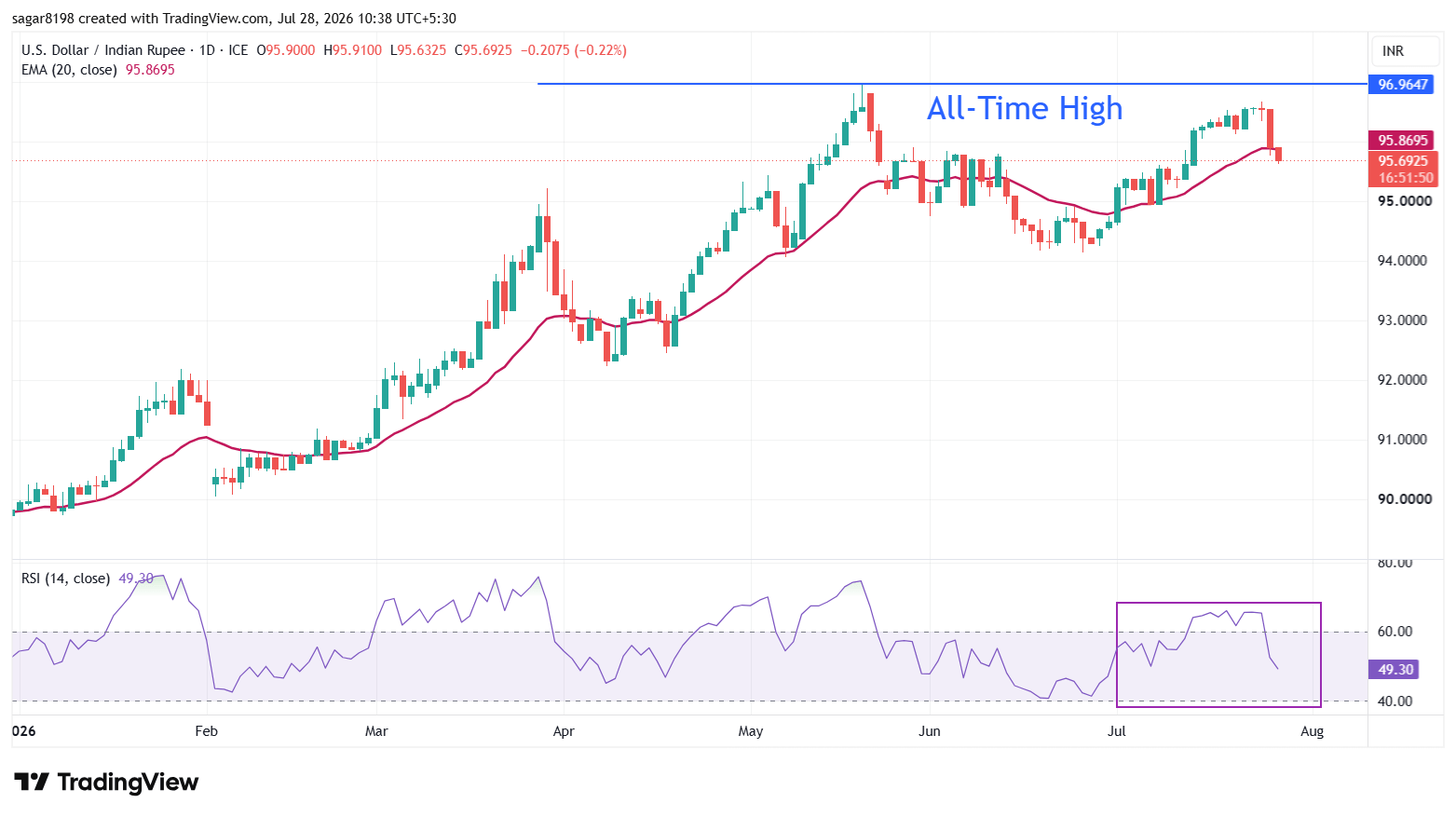
The Indian rupee hovered around 96.2 per dollar, remaining under pressure after reaching eight-week lows as sentiment weakened on rising crude oil prices. Brent crude climbed above $85 per barrel amid escalating tensions between the US and Iran, raising concerns over potential supply disruptions through the Strait of Hormuz and increasing India’s oil import bill. The rupee has fallen about 1.7% so far this month, moving closer to its record low reached in May. Meanwhile, the positive sentiment from the Reserve Bank of India’s recent measures to attract dollar inflows has largely faded, prompting traders to resume buying dollars on dips in anticipation of further rupee weakness. Additional pressure came from more than $14 billion in overseas investment announcements by Indian companies early in the fiscal year, boosting demand for foreign currency, while foreign portfolio outflows and higher oil imports continued to weigh on the rupee and India’s foreign exchange reserves.

Currency Hedger No Comments

New Zealand Dollar Trades Near 6-Week High

The New Zealand dollar hovered near a six-week high at around $0.583, supported by expectations that the Reserve Bank of New Zealand will continue tightening monetary policy, alongside broad weakness in the US dollar. Markets widely expect the RBNZ to deliver another rate hike in September, with the OCR seen reaching at least 3.0% by the end of the year. RBNZ Chief Economist Paul Conway said earlier this week that renewed conflict in the Middle East could fuel inflationary pressures, reinforcing the case for further policy tightening following last week’s first rate increase in more than three years. Meanwhile, the greenback hovered near a one-month low as investors scaled back bets on a near-term Federal Reserve rate hike after softer-than-expected inflation data. However, escalating geopolitical tensions remain a downside risk for the New Zealand dollar, as heightened uncertainty could weaken global risk appetite and weigh on risk-sensitive currencies such as the kiwi.

Currency Hedger No Comments

South Korean Won Rises to Over 2-Month High

The South Korean won strengthened to around 1,485 per dollar, advancing for a fifth straight session and reaching its highest level since mid-May, after the Bank of Korea raised interest rates. The central bank lifted its benchmark interest rate by 25 basis points to 2.75%, as widely expected, marking its first increase since early 2023 as policymakers sought to curb persistent inflation and support the currency following months of depreciation. The decision marked the start of a new tightening cycle, with investors assessing whether policymakers will deliver further rate increases if inflation remains elevated. Meanwhile, gains in the won were limited as fresh US strikes on Iran boosted demand for the safe-haven US dollar and heightened concerns over potential disruptions to global energy supplies. Broader market sentiment also remained fragile as renewed volatility in technology shares weighed on risk appetite.