


Currency Hedger No Comments

EUR/GBP Price Forecast: In a positive trend with bulls eyeing 0.8555 resistance

  • EUR/GBP dips found buyers at 0.8530, which keeps the 0.8555 high on the bulls’ focus.
  • A cease of hostilities in Iran and the decline in oil prices have given a fresh boost to the Euro.
  • The Euro is on a bullish correction after a 2.5% sell-off from June’s highs.

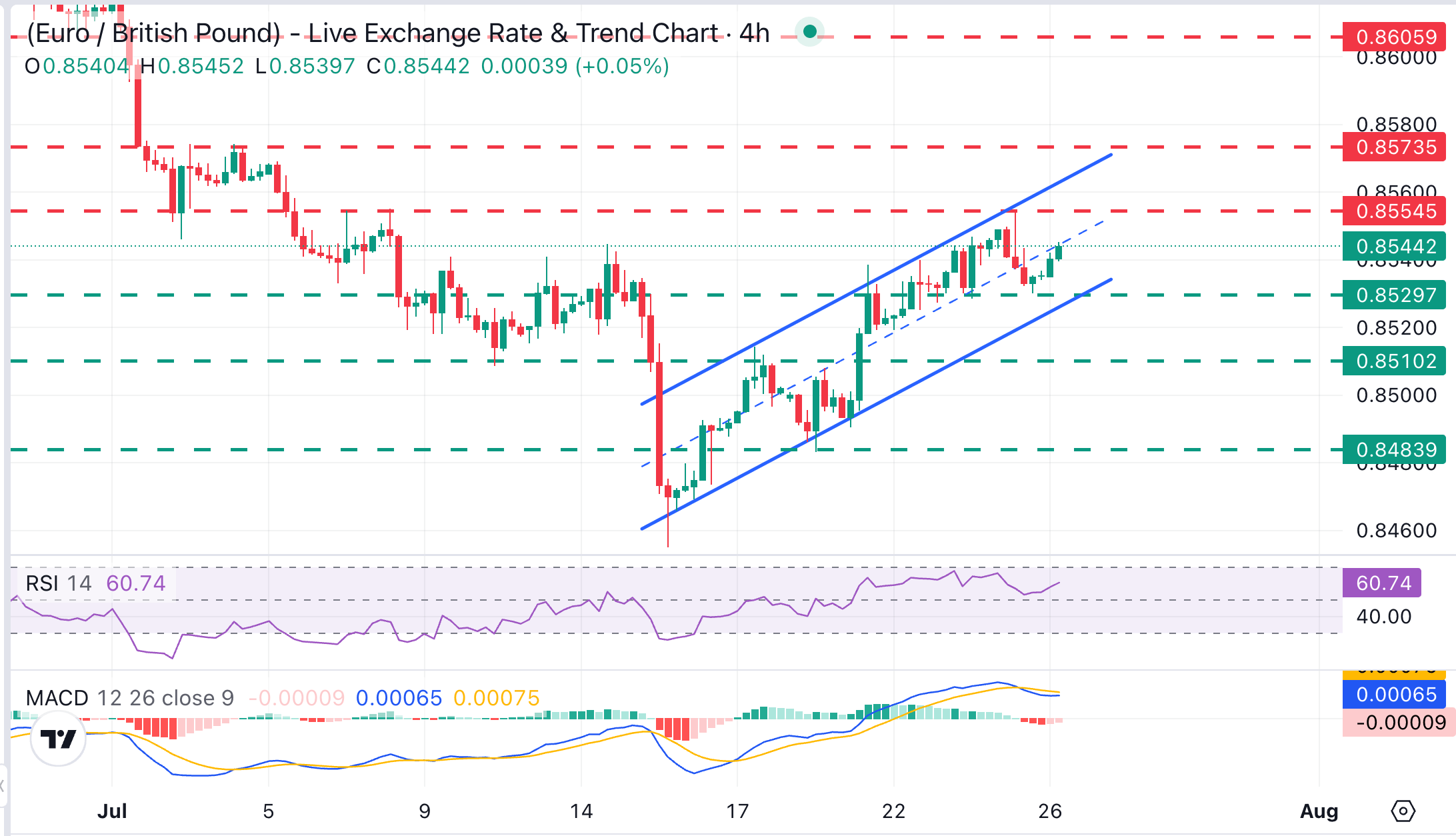
The Euro (EUR) has picked up towards the 0.8540 area against the British Pound (GBP) on Monday, after a mild pullback on Friday found support at 0.8530. The pair maintains the immediate bullish trend from mid-July lows at 0.8455, with bulls looking at three-week highs in the area of 0.8555. 

The Euro is drawing support from a moderate relief rally on Monday, as the US and Iran halted their hostilities, which allowed Oil prices to decline about 9% from last weekโ€™s highs, with the barrel of Brent Oil down to $87.40 from above $96.00 last Thursday. Eurozone countries are net Oil importers, and the Crude rally seen over the last few weeks had threatened to strangle economic activity.

In the UK, Prime Minister Andrew Burnhamโ€™s spending plans keep investors on edge while the focus this week shifts to the Bank of England (BoE) monetary policy decision. The BoE will, all but certain, leave interest rates on hold, but investors will be very attentive to the vote split and Governor Baileyโ€™s press release to assess the chances of any rate hike in the near-term.

Technical Analysis: In a bullish correction following the June-July sell-off
EUR/GBP Chart Analysis

EUR/GBP trades at 0.8543, keeping a constructive near-term tone as it holds within a bullish channel from mid-July lows. The pair is correcting higher after a 2.5% decline from June highs, with momentum indicators hinting at a mild upside bias. The Relative Strength Index (14) is around 60, hinting at positive momentum, even as the MACD (12, 26, close, 9) has slipped marginally into negative territory.

The bullish structure maintains the July 8 and 24 highs at 0.8555 in play. Above that level, the top of the channel, now around 0.8565, and July 2 and 3 highs, in the area of 0.8575, are likely to test bulls.

On the downside, immediate support emerges at the confluence of the channel floor and July 23 and 24 lows, around 0.8530. Below here, a previous resistance area, around 0.8510 (July 17, 20 highs), is likely to be targeted ahead of the July 20 low, at 0.8483.

Currency Hedger No Comments

Indian Rupee recovers further as US-Iran war pause hits oil prices

  • The Indian Rupee gains further, capitalizing on a correction in oil prices and the US Dollar.
  • US President Donald Trump pauses attacks on Iran to allow time for diplomacy.
  • Investors expect the Fed to leave interest rates unchanged on Wednesday.

The Indian Rupee (INR) extends its recovery against the US Dollar (USD) at the start of the Federal Reserveโ€™s (Fed) monetary policy week. The USD/INR pair falls further to near 96.10 as the pause in military aggression between the United States (US) and Iran has weighed heavily on oil prices and has diminished the safe-haven appeal of the US Dollar.

In the opening trade, the MCX Crude Oil contract expiring on August 19 trades 4.75% lower to near Rs. 8,200.

The appeal of currencies from economies, such as India, which rely heavily on oil imports to fulfill their energy needs, improves when oil prices fall sharply.

Meanwhile, the US Dollar Index (DXY), which gauges the Greenbackโ€™s value against six major currencies, trades 0.25% lower to near 101.25.

US holds strikes on Iran on exhaustion of target list

Two-week-long exchange of attacks between the US and Iran paused over the weekend as Washington confirmed that further military aggression would be unnecessary, confirming that the target list has been exhausted.

According to Axios, Adm Bradley Cooper, the top US military commander in the region, had told Trump the US military campaign had reached the limits of its effectiveness, The Guardian reported. Cooper added that there was little point in continuing the bombing campaign without a return to major combat operations.

In response, Iran also paused attacking US bases in its neighbouring nations, but confirmed that its position remains “attack for attack”.

Meanwhile, US ambassador to the United Nations (UN), Mike Waltz, also told Fox News on โ Sunday that President Donald Trump had decided to pause US attacks to allow more time for diplomacy, Reuters reports. This has renewed hopes for diplomatic efforts between both nations.

Investors await key Fed policy

This week, the major trigger for global markets will be the Federal Reserveโ€™s (Fed) monetary policy announcement on Wednesday, in which the central bank is expected to leave interest rates unchanged in the range of 3.50%-3.75%. So far this year, the Fed has not done any monetary policy adjustments.

Investors will pay close attention to the monetary policy statement and Fed Chair Kevin Warshโ€™s press conference to get fresh cues regarding inflation and the economic outlook. Warsh is unlikely to deliver any remarks regarding the monetary policy guidance, as he clarified in its last press conference that โ€œso-called forward guidance is not well-suited in the current policy junctureโ€.

Technical Analysis: USD/INR falls toward 20-day EMA

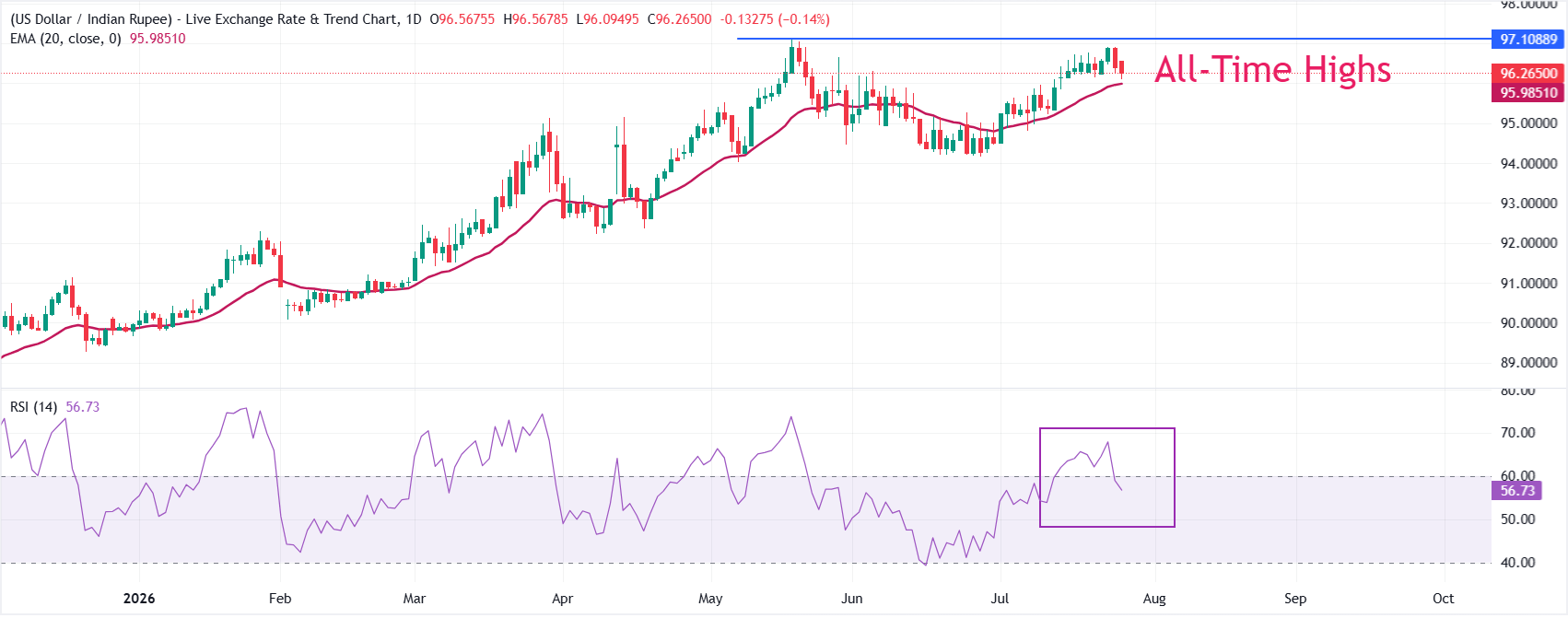
USD/INR trades lower at around 96.26 at press time. The pair remains underpinned by a constructive near-term bias, with spot holding above the 20-day Exponential Moving Average (EMA) at 95.9851.

The mildly positive 14-day Relative Strength Index around 57 suggests ongoing bullish momentum, though not yet in overbought territory, allowing room for further gains while the price action stays supported above the short-term EMA.

On the downside, immediate support is now seen at the 20-day EMA near 95.99, which protects the recent advance; a daily close below this level would hint at a deeper corrective phase toward prior price congestion. Looking up, the all-time high at around 97.10 will be the key resistance level.

Currency Hedger No Comments

EUR/JPY Price Holds gains around 186.50 within rising wedge

  • EUR/JPY could face initial resistance around the rising wedge top at 186.90.
  • The 14-day Relative Strength Index near 60 indicates firm upside momentum without entering overbought territory.
  • The primary support lies at the nine-day EMA of 186.04.

EUR/JPY gains ground after registering minor losses in the previous day, trading around 186.50 during the Asian hours on Monday. The currency cross is keeping a bullish near-term bias as it holds above both the nine-period and 50-period Exponential Moving Averages (EMAs). The configuration of the short-term EMA above the longer-term EMA suggests a constructive trend backdrop.

Meanwhile, the 14-day Relative Strength Index (RSI) near 60 points to firm but not yet overbought upside momentum, hinting that buyers still retain control unless price slips back below the nearby averages. However, the daily chart technical analysis shows that the EUR/JPY cross is rising within a rising wedge, indicating a strong bearish reversal risk.

The EUR/JPY cross could find the primary resistance at the upper boundary of the rising wedge around 186.90. Further advances could support the currency cross to explore the region around the all-time high of 187.95, which was recorded on April 17.

On the downside, the initial support lies at the nine-day EMA of 186.04, followed by the 50-day EMA at 185.31, aligned with the lower boundary of the rising wedge. A break below the wedge put downward pressure on the EUR/JPY cross to navigate the region around the five-month low of 181.87, recorded on March 16, and the seven-month low of 180.81.

Chart Analysis EUR/JPY
EUR/JPY: Daily Chart
Currency Hedger No Comments

Swiss Franc climbs as US Dollar falls on easing safe-haven demand

  • USD/CHF falls as easing US-Iran tensions weaken the US Dollar following a weekend pause in hostilities.
  • The Fed will likely hold rates steady in July before potential September hikes.
  • Falling Swiss 10-year bond yields, now near 0.46%, could weigh on the Swiss Franc.

USD/CHF depreciates after five days of losses, trading around 0.8150 during the Asian hours on Monday. The pair loses ground as the US Dollar (USD) declines on easing geopolitical tensions following a weekend pause in military hostilities between the US and Iran, offering a reprieve after 13 days of escalating conflict.

US halted strikes amid growing concerns over depleting interceptor supplies and a shrinking list of remaining targets within Iran. Additionally, General Dan Caine, Chairman of the Joint Chiefs of Staff, reportedly cautioned President Trump on Friday that continuing the military campaign would severely strain critical munitions reserves.

However, market participants remain cautious about potential supply disruptions after Iran-backed Houthis in Yemen claimed responsibility for attacks on Saudi Arabian facilities along the Red Sea.

Traders expect the Federal Reserve (Fed) to hold interest rates steady on Wednesday before resuming rate hikes in September, though a minority of market participants still anticipate a surprise move at this week’s meeting. Moving forward, investors are closely watching upcoming economic indicators, including advance Q2 GDP data, PCE inflation figures, and earnings reports from major US corporations, for further insight into the underlying strength of the economy.

The USD/CHF pair could rebound as falling Swiss government bond yields may weigh on the Swiss Franc (CHF). With the 10-year Swiss yield dropping near 0.46%, reduced returns on domestic fixed-income assets are prompting global investors to rotate capital toward higher-yielding foreign bonds.

Currency Hedger No Comments

Indonesian Rupiah weakens as Bank Indonesia Governor Perry Warjiyo resigns

  • USD/IDR rises as the Indonesian Rupiah weakens following Bank Indonesia Governor Perry Warjiyo’s surprise resignation, rattling investors.
  • The pairโ€™s upside could be restrained as the US Dollar declines, as easing US-Iran geopolitical tensions reduced safe-haven demand.
  • The Fed will likely hold rates steady Wednesday before September hikes, though some anticipate a surprise move this week.

USD/IDR has recovered its losses from the previous trading day, hovering around 18,050 during the Asian hours on Monday. The pair appreciates as the Indonesian Rupiah (IDR) faces pressure following the surprise resignation of Bankย Indonesiaย (BI) Governor Perry Warjiyo, a move expected to rattle investors and reignite concerns over central bank independence. Senior Deputy Governor Destry Damayanti has been appointed interim governor, clarifying that Warjiyo stepped down for personal reasons.

The upside of the USD/IDR pair could be limited as the US Dollar (USD) falls sharply, as geopolitical tensions eased following a weekend pause in military hostilities between the US and Iran, offering a reprieve after 13 days of escalating conflict. However, market participants remain cautious about potential supply disruptions after Iran-backed Houthis in Yemen claimed responsibility for attacks on Saudi Arabian facilities along the Red Sea.

US halted strikes amid growing concerns over depleting interceptor supplies and a shrinking list of remaining targets within Iran. Additionally, General Dan Caine, Chairman of the Joint Chiefs of Staff, reportedly cautioned President Trump on Friday that continuing the military campaign would severely strain critical munitions reserves.

Traders expect theย Federal Reserveย (Fed) to hold interestย ratesย steady on Wednesday before resuming rate hikes in September. However, a minority of market participants still anticipate a surprise move at this week’s meeting. Moving forward, investors are closely watching upcoming economic indicators, including advance Q2ย GDPย data, PCE inflation figures, and earnings reports from major US corporations, for further insight into the underlying strength of the economy.

Currency Hedger No Comments

Australian Dollar gains as Mideast tensions ease, RBA rate expectations rise

  • AUD/USD rises as falling oil prices and a pause in the Middle East conflict weigh on the US Dollar.
  • US military caution and depleted interceptor supplies help curb further escalation with Iran for now.
  • Strong Australian June employment data boosts expectations of another RBA rate hike following upcoming inflation reports.

AUD/USD extends its gains for the second consecutive trading day, hovering near 0.7000 during the Asian hours on Monday. The pair appreciates as the US Dollar (USD) declines alongside a sharp drop in oil prices. This movement followed the United States (US) decision to refrain from striking Iran over the weekend, paired with Tehran suspending its own retaliatory strikes.

The brief US-Iran pause came after 13 days of escalating conflict. However, market participants remain cautious about potential supply disruptions as Iran-backed Houthis in Yemen claimed responsibility for attacks on Saudi Arabian facilities along the Red Sea.

While the US did not officially disclose its reasons for halting the strikes, reports suggest growing concerns over depleting interceptor supplies and a shortage of remaining targets within Iran. Additionally, General Dan Caine, Chairman of the Joint Chiefs of Staff, reportedly cautioned President Trump on Friday that continuing the campaign would severely strain critical munitions reserves.

Beyond geopolitical developments, investors are bracing for the upcoming Federal Reserve (Fed) policy meeting. The Fed is widely expected to hold interest rates steady on Wednesday before resuming rate hikes in September, though a minority of market participants still anticipate a surprise move at this week’s meeting.

Meanwhile, strong June employment data out of Australia has reinforced expectations of further monetary tightening by the Reserve Bank of Australia (RBA), which has already raised rates three times this year. Investors are now closely watching the June and Q2 inflation figures due later this week, as persistent price pressures continue to dominate the local outlook.

Currency Hedger No Comments

Japanese Yen gains as oil prices fall after US-Iran strike pause

  • USD/JPY drops as lower oil prices boost the Yen after the US and Iran paused strikes.
  • Japanese PM Sanae Takaichiโ€™s approval rating fell in July to a term low, weighed down by rising living costs.
  • US military caution and depleted interceptor supplies help curb further escalation with Iran for now.

USD/JPY remains subdued for the second successive day, trading around 163.60 during the Asian hours on Monday. The pair depreciates as the Japanese Yen (JPY) receives support from lower oil prices after the United States (US) decision to refrain from striking Iran over the weekend, paired with Tehran suspending its own retaliatory strikes. Japan remains heavily dependent on Middle Eastern oil imports, making its economy particularly sensitive to supply disruptions and swings in crude prices.

Japanese Prime Minister Sanae Takaichiโ€™s approval rating fell in July to its lowest point since she took office last year, driven by rising living costs. The slump intensifies pressure on Takaichi, whose expansionary economic policies have driven up bond yields and pushed the Yen to four-decade lows, according to a Yomiuri newspaper report on Sunday.

The USD/JPY pair loses ground as the US Dollar (USD) falls as risk aversion eases on the brief US-Iran pause, which came after 13 days of escalating conflict. However, market participants remain cautious about potential supply disruptions as Iran-backed Houthis in Yemen claimed responsibility for attacks on Saudi Arabian facilities along the Red Sea.

Reports suggest that the US halted strikes amid growing concerns over depleting interceptor supplies and a shortage of remaining targets within Iran. Additionally, General Dan Caine, Chairman of the Joint Chiefs of Staff, reportedly cautioned President Trump on Friday that continuing the campaign would severely strain critical munitions reserves.

On the policy front, the Fed is widely expected to hold interest rates steady on Wednesday before resuming rate hikes in September, though a minority of market participants still anticipate a surprise move at this week’s meeting. The Bank of Japan (BoJ) is also expected to hold rates on Friday.

Currency Hedger No Comments

Euro climbs beyond 1.1400 as renewed Iran diplomacy hopes undermine safe-haven USD

  • EUR/USD kicks off the new week on a positive note as US-Iran diplomacy hopes weigh on the USD.
  • Falling oil prices ease inflation fears and temper Fed rate hike bets, further undermining the buck.
  • Traders, however, seem hesitant as the focus remains on the crucial FOMC policy meeting this week.

The EUR/USD pair builds on a modest bullish gap opening and climbs back above the 1.1400 mark during the Asian session on Monday. The intraday move up is sponsored by a broadly weaker US Dollar (USD), weighed down by renewed optimism over a diplomatic resolution to end a five-month-old US-Iran war.

The US paused its bombing campaign following 13 consecutive nights of strikes on Iranian targets late on Friday, prompting Tehran to suspend its retaliatory attacks against Washington’s allies in the Middle East. US ambassador to the United Nations (UN) Mike Waltz said that while forces remained locked and loaded, President Donald Trump wants to give negotiations a little bit of room. This, in turn, boosts investors’ sentiment and undermines the safe-haven Greenback.

Meanwhile, the easing in hostilities triggers a sharp fall in crude oil prices and eases inflationary concerns, tempering US Federal Reserve (Fed) rate hike expectations. This turns out to be another factor that drags the USD Index (DXY), which tracks the buck against a basket of currencies, away from the vicinity of the monthly high retested last week. Traders, however, might refrain from placing aggressive bets on the EUR/USD pair ahead of the key central bank event risk.

The US central bank is scheduled to announce its policy decision at the end of a two-day meeting on Wednesday. Traders will look for fresh cues about the future policy path, which will play a key role in influencing the near-term USD price dynamics. Apart from this, the focus will be on further developments surrounding the Middle East crisis, which would further drive the USD demand and produce some meaningful trading opportunities around the EUR/USD pair.

According to TD Securities, the FOMC is expected to leave policy steady, with the bank stating, โ€œWe expect the FOMC to keep rates unchanged.โ€ The team acknowledges that โ€œhigher oil prices driven by Middle East tensions have increased inflation risks and strengthened the case for a rate hike,โ€ but they argue that โ€œmore evidence is needed to win majority support.โ€ In their view, โ€œhawkish momentum is building,โ€ yet Chair Warsh is โ€œunlikely to provide guidance,โ€ and they anticipate โ€œtwo dissents from Hammack and Logan.โ€