Currency Hedger No Comments

British Pound strengthens beyond mid-1.3300s vs weak USD amid fresh Iran diplomacy hopes

  • GBP/USD attracts strong follow-through buying on Monday amid a broadly weaker USD.
  • US-Iran diplomacy hopes and receding Fed rate hike bets undermine the safe-haven buck.
  • Traders might refrain from placing aggressive bets ahead of the FOMC meeting this week.

The GBP/USD pair builds on Friday’s modest bounce from a three-week low and gains strong follow-through positive traction at the start of a new week. This marks the second straight day of a positive move and lifts spot prices above mid-1.3300s during the Asian session amid a broadly weaker US Dollar (USD).

The USD Index (DXY), which tracks the Greenback against a basket of currencies, moves away from the vicinity of the monthly high, retested last week, amid reviving hopes for a diplomatic resolution to end a five-month-old US-Iran conflict. In fact, the US paused its bombing campaign following 13 consecutive nights of strikes on Iranian targets late on Friday, prompting Tehran to suspend its retaliatory attacks against Washington’s allies in the Middle East.

US ambassador to the United Nations (UN) Mike Waltz said that while forces remained locked and loaded, President Donald Trump wants to give negotiations a little bit of room. Traders were quick to unwind some of the geopolitical risk premium, undermining the safe-haven buck. Moreover, the latest developments trigger a sharp fall in oil prices and ease inflation fears, tempering US Federal Reserve (Fed) rate hike bets and further weighing on the Greenback.

Meanwhile, restricted shipping traffic through the Strait of Hormuz and the Bab el-Mandeb Strait helps limit losses for oil prices. USD bears might also refrain from placing aggressive bets and opt to wait for the outcome of the highly-anticipated two-day FOMC meeting on Wednesday. Investors will look for more cues about the Fed’s policy path, which, along with geopolitical developments, will drive the USD and provide some meaningful impetus to the GBP/USD pair.

Currency Hedger No Comments

Canadian Dollar advances as easing risk aversion lifts US Dollar

  • USD/CAD slips as easing US-Iran geopolitical tensions reduced safe-haven demand and sparked a market risk-on rally.
  • Despite a brief US-Iran pause, markets fear supply disruptions following Houthi attacks on Saudi Red Sea facilities.
  • Falling oil prices could weigh on the commodity-linked Canadian Dollar.

USD/CAD depreciates after posting minor gains in the previous trading day, hovering around 1.4080 during the Asian hours on Monday. The pair loses ground as the US Dollar (USD) falls sharply on easing geopolitical tensions following a weekend pause in military hostilities between the US and Iran.

The brief US-Iran pause came after 13 days of escalating conflict. However, market participants remain cautious about potential supply disruptions as Iran-backed Houthis in Yemen claimed responsibility for attacks on Saudi Arabian facilities along the Red Sea.

Reports suggest that the US halted strikes amid growing concerns over depleting interceptor supplies and a shortage of remaining targets within Iran. Additionally, General Dan Caine, Chairman of the Joint Chiefs of Staff, reportedly cautioned President Trump on Friday that continuing the campaign would severely strain critical munitions reserves.

On the policy front, the Fed is widely expected to hold interest rates steady on Wednesday before resuming rate hikes in September, though a minority of market participants still anticipate a surprise move at this week’s meeting.

The downside of the USD/CAD pair is restrained as the commodity-linked Canadian Dollar (CAD) could struggle on lower oil prices. West Texas Intermediate (WTI) oil price opened at a bearish gap, down by over 5%, trading around $84.50 per barrel at the time of writing.

Currency Hedger No Comments

New Zealand Dollar bulls seem hesitant; downside seems limited amid weak USD

  • NZD/USD struggles to build on an Asian session uptick, though the downside remains cushioned.
  • Iran diplomacy hopes and receding Fed hike bets undermine the USD, lending support to the pair.
  • Hawkish RBNZ expectations also warrant caution for bears ahead of the FOMC meeting this week.

The NZD/USD pair kicks off the new week on a positive note amid a broadly weaker US Dollar (USD), though it struggles to capitalize on gains beyond the 0.5800 mark.

The US and Iran paused following 13 straight nights of strikes, reviving hopes for a diplomatic resolution to end a five-month-old US-Iran conflict. US ambassador to the United Nations (UN) Mike Waltz said that while forces remained locked and loaded, President Donald Trump wants to give negotiations a little bit of room. This prompts traders to unwind some of the geopolitical risk premium, which, in turn, undermines the safe-haven USD and lends some support to the NZD/USD pair.

Meanwhile, the latest optimism triggers a steep decline in crude oil prices, easing inflationary fears and tempering US Federal Reserve (Fed) rate-hike expectations. This is evident from a modest pullback in US Treasury bond yields, which turns out to be another factor that drags the USD away from the vicinity of the monthly high, retested last week. Traders, however, refrain from placing aggressive bearish bets on the USD and opt to wait for the outcome of a two-day FOMC policy meeting.

The US central bank is scheduled to announce its decision on Wednesday and is universally anticipated to leave interest rates unchanged. Hence, investors will look for fresh cues about the Fed’s future policy path, which will play a key role in influencing the USD price dynamics. Apart from this, developments surrounding the Middle East crisis should infuse volatility in financial markets, which should further drive the USD demand and provide some meaningful impetus to the NZD/USD pair.

In the meantime, stronger-than-expected inflation data from New Zealand reaffirmed expectations that the Reserve Bank of New Zealand (RBNZ) will deliver another rate hike at its September meeting. The hawkish outlook might continue to act as a tailwind for the New Zealand Dollar (NZD), which favors NZD/USD bulls and suggests that any corrective pullback is more likely to be bought into.

Currency Hedger No Comments

South Korean Shares Extend Losses

The benchmark KOSPI fell more than 1% to around 6,620 on Monday, extending losses from the previous session as weakness in US technology stocks continued to weigh on investor sentiment. The decline followed another selloff on Wall Street, with investors staying cautious ahead of major US technology earnings and this week’s Federal Reserve policy decision, which could offer fresh clues on AI spending and interest rates. Samsung Electronics (-0.7%), SK Hynix (-1.4%), SK Square (-4.9%), Hyundai Motor (-1.1%), and Hanwha Aerospace (-7.7%) were among the notable decliners. Meanwhile, easing geopolitical tensions after the US paused strikes on Iran over the weekend pushed oil prices sharply lower and improved global risk sentiment. Markets also found support from a series of AI cooperation agreements between South Korean firms and global technology companies, including a long-term semiconductor supply deal involving SK Group and Nvidia, as well as Nvidia’s investment in Naver.

Currency Hedger No Comments

Offshore Yuan Hits Over 1-Month High

The offshore yuan rose to around 6.76 per dollar on Monday, its strongest level since mid-June, as easing geopolitical tensions in the Middle East reduced safe-haven demand for the US dollar. US Ambassador Mike Waltz said President Trump had paused strikes on Iran for a second consecutive night to facilitate diplomatic efforts, while an Iranian military spokesperson said Tehran had suspended its retaliatory operations. The development signals a tentative easing in tensions after nearly two weeks of reciprocal attacks that had effectively undermined the June ceasefire. On the domestic front, investors are turning their attention to the upcoming Politburo meeting later this week, where President Xi Jinping and other top policymakers are expected to outline priorities for the second half of the year. Expectations for additional policy support have grown after recent economic indicators pointed to an uneven recovery, reinforcing calls for measures to bolster growth and stabilize demand.

Currency Hedger No Comments

Three markets to watch next week

The past week was marked by crude oil prices returning to triple digits on expiring September contracts and a continuation of the equity market selloff. Geopolitics once again served as the primary driver for investors, fueled not only by the situation in the Middle East but also by broad new US tariffs. Wall Street earnings season delivered solid corporate results, though these proved insufficient to lift investor sentiment. A fresh wave of reports from tech giants such as Microsoft and Apple might alter that dynamic. Furthermore, decision day arrives for two key central banks, namely the Federal Reserve and the Bank of Japan. Given this concentration of high-impact events, three markets warrant close attention in the coming days: USD/JPY , Gold and US100 .

USDJPY

The Japanese currency has struggled recently, with the past week defined by mounting inflationary pressure in Japan driven in part by higher global energy costs. This week brings a direct showdown between two major central banks. On Wednesday, the FOMC will announce its policy decision, followed by the second press conference from the new Fed Chair Kevin Warsh. On Friday, the Bank of Japan will present its stance on interest rates, preceded in the morning by the Tokyo consumer price index release. Market consensus anticipates that both the Fed and the BoJ will hold interest rates at current levels, with the BoJ policy rate currently at 1.0 percent. Investors will focus heavily on potential guidance regarding future monetary tightening, particularly given that the yen trades near 40-year lows alongside rising import costs. Historical currency interventions in Japan demonstrate that verbal pressure alone, lacking decisive BoJ action, offers only temporary relief for the yen. Moreover, sentiment conveyed by the US central bank remains the primary catalyst for USD/JPY trends. Should the Fed maintain a hawkish stance while the BoJ holds back from aggressive signals due to growth concerns, USDJPY could resume its upward trajectory toward the 165 level. Conversely, a hawkish surprise from the BoJ, supported by a hotter Tokyo CPI reading and upwardly revised inflation forecasts, could trigger a sharp rally in the yen and force a rapid unwinding of massive speculative short positions.

Gold

While last week was shaped by shifting sentiment surrounding Middle Eastern geopolitical tensions and oil prices, this week presents a direct test for the gold market from US monetary policy and incoming economic data. The principal catalyst for volatility will be Wednesday’s FOMC decision, followed on Thursday by US GDP figures and the June PCE inflation metric, which remains the Federal Reserve’s preferred inflation gauge. Gold continues to show high sensitivity to real interest rates and the trajectory of US Treasury yields. The bullion’s historic gains during periods when rate cuts are priced in clearly illustrate this relationship: as real yields decline, capital shifts smoothly into non-yielding assets. If Thursday’s PCE report points to persistent inflationary pressures and the Fed signals that rates must remain elevated for longer, gold could stay under pressure, particularly if crude oil marches back toward 100 dollars per barrel. In the alternative scenario, featuring a cooler PCE reading and waning geopolitical risk, the precious metal would gain strong momentum to break out of its recent downtrend.

US100 (Nasdaq 100 Futures)

The past week delivered another wave of selling across the global semiconductor and AI memory sectors. This week introduces the next slate of Big Tech quarterly earnings on Wall Street, coinciding directly with the Federal Reserve meeting. On Wednesday, Microsoft and Meta Platforms will report their quarterly results, followed by Apple and Amazon on Thursday. These announcements overlap with the FOMC interest rate decision on Wednesday and the US GDP and PCE releases on Thursday. Investors will scrutinize not only top-line revenue growth but primarily the return on capital expenditure dedicated to artificial intelligence infrastructure. Stretched valuations among Big Tech firms leave a remarkably narrow margin for error. Market dynamics seen during previous tech corrections demonstrate that even minor disappointment regarding forward margin outlooks can trigger index-wide selling, regardless of robust current earnings. Strong reports from market leaders coupled with measured commentary from the Fed could provide the US100 with the momentum needed to rebound from its recent pullbacks. Conversely, disappointing forward guidance paired with hawkish rhetoric from Kevin Warsh risks deepening the ongoing correction.

Currency Hedger No Comments

Oil Slides Into The Weekend!

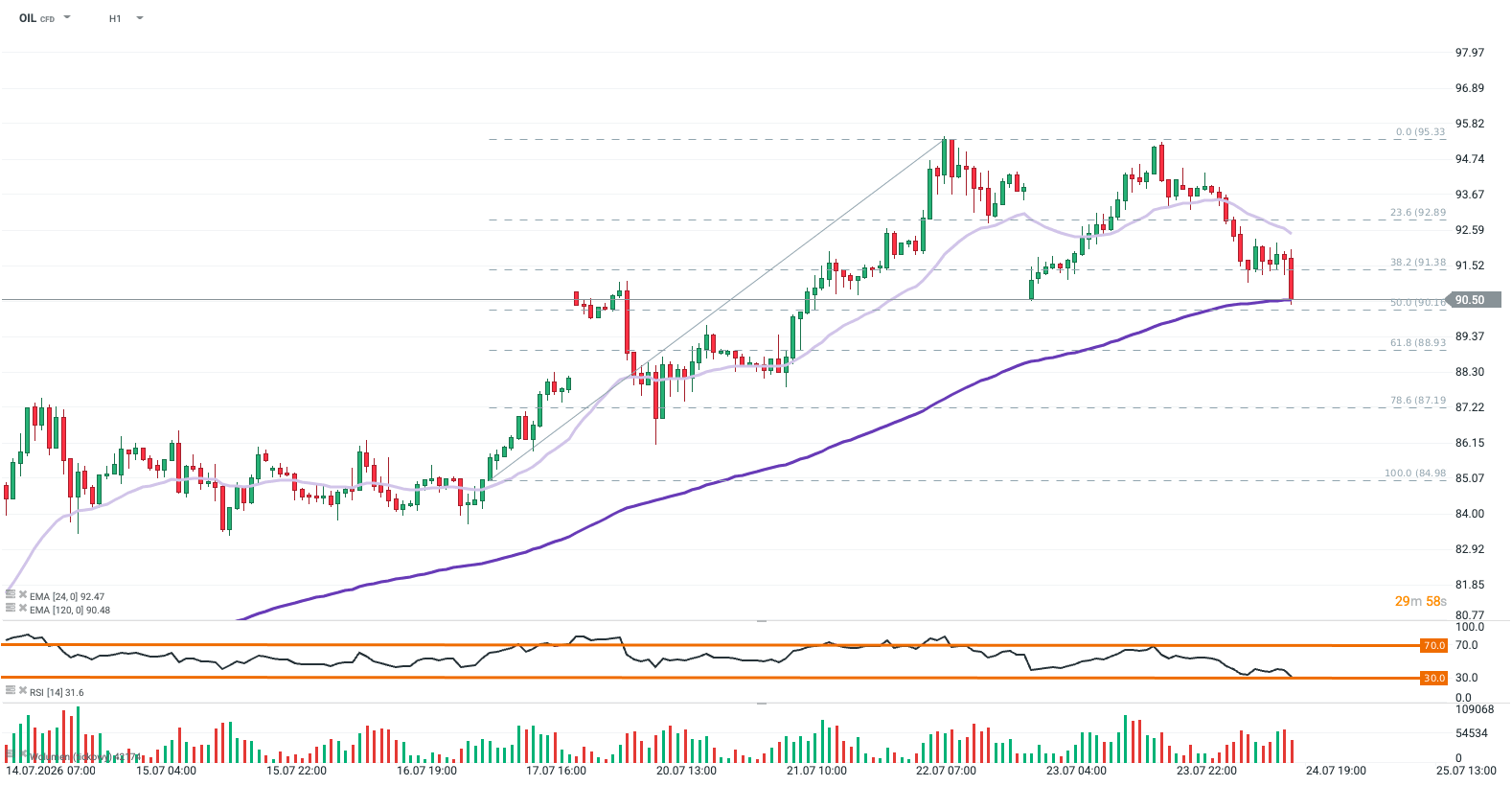
Brent futures (OIL) down 3.5%! Diplomacy is back? Oil prices sharply turned lower following reports that, under pressure from Beijing, Pakistan and Iran are considering a return to the negotiating table with the US. Brent futures (OIL) immediately pulled back by 1% to around $90.50 per barrel, deepening today’s losses and erasing nearly all of yesterday’s gains (currently: -3.5%).

Mixed Signals from the Middle East: A Potential Return of Diplomacy?

Following the recent escalation of Middle East tensions and oil prices returning to a monthly high, the market is eagerly snapping up the slightest mention of returning diplomacy, attempting to extract some end-of-week optimism. Over the longer term, Pakistan’s efforts alone will not be enough, especially since both sides of the conflict are playing solely to safeguard their own interests, and reports of resuming talks are accompanied by further warnings for US citizens in the region.

Below are the key headlines from recent hours:

  • Omani delegation in Tehran regarding the Strait of Hormuz: An Omani delegation arrived in Iran to discuss mechanisms for managing ship traffic in the Strait of Hormuz. Tehran advocates co-managing the waterway alongside Oman, but the US and Gulf states reject such a setup.
  • China and Pakistan push for a resumption of peace talks: Under pressure from China, Pakistan is considering attempting to resume stalled negotiations between the US and Iran aimed at ending the nearly five-month-old war. Exploratory discussions took place this week in Islamabad during a visit by the Iranian interior minister.
  • Tough rhetoric from Iranโ€™s foreign minister: Abbas Araghchi stated that Iran will not bow to the US nor tolerate threats, pointing to Washington’s stance as the main obstacle to peace talks. He also reported continuous consultations with Russia and China, pledging unconditional protection of Iran’s interests in the Strait of Hormuz.
  • US warning for citizens in the Middle East: The US Embassy in Jordan urged Americans to reconsider travel to the Middle East due to escalation risks and potential attacks by Iran and its allies. Warnings were issued regarding airspace closures and flight cancellations, and citizens were advised to avoid US military bases in Jordan.
  • Trump warns Iran’s allies: In his latest social media post, the US President stated that Russia or China supplying weapons to Iran “will end badly for them.” Donald Trump added, however, that Xi and Putin said they do not plan such sales.

Technical Analysis: OIL (Brent Futures)

Reports of potential de-escalation in the Middle East sparked selling pressure on Brent crude (OIL). On the H1 chart, price dynamically dropped into a key support zone defined by the 120-period EMA ($90.48) and the 50.0% Fibonacci retracement ($90.16). A breakdown below this area could open the door for further declines toward the 61.8% Fibo level ($88.93). Conversely, defending current levels could favor a corrective bounce. The immediate resistance lies at the 38.2% Fibo retracement ($91.38), followed by the 24-period EMA ($92.47). The RSI is approaching oversold territory (32.1), suggesting the possibility of a temporary easing in bearish pressure, especially if no new pro-war comments emerge from the White House.

Source: xStation5

Currency Hedger No Comments

Indonesian Rupiah: BI pause seen as hawkish hold โ€“ UOB

UOB Global Economics & Markets Research notes that Bank Indonesia kept its policy rate at 5.75%, opting to let earlier tightening filter through. Despite the pause, the team still expects three further hikes totalling 75 bps by end-2026 to stabilise the Rupiah and inflation expectations, while USD/IDR edged slightly higher after what markets perceived as a hawkish hold.

Further BI hikes expected to support Rupiah

“Bank Indonesia maintained its benchmark policy rate at 5.75% at the Jul MPC meeting, likely choosing to allow the cumulative 100 bps tightening implemented between May and June to fully transmit through the real economy.”

“Despite the policy pause, risks on rupiahโ€™s trajectory coupled with marketโ€™s divided expectation of US Fedโ€™s policy direction and upside risks to global inflation forecasts amid the rising energy prices continue to underpin our expectation of two additional 25 bps rate hikes in3Q26 and a final 25bps in the final quarter of 2026 to anchor rupiahโ€™s stability and inflation expectations.”

“This will bring the policy rate to a terminal level of6.50% by end-2026.”

“In South East Asia, USD/IDR inched higher from