

GBP advances as US-Iran ceasefire improves market sentiment

April 8, 2026
  • GBP/USD rises as the US Dollar weakens on reduced safe-haven demand after a US-Iran two-week ceasefire.
  • Trump agreed to a two-week ceasefire with Iran, conditional on reopening the Strait of Hormuz.
  • US-Iran ceasefire lowers oil prices, easing inflation pressures and giving the BoE room to resume policy easing.

GBP/USD extends its winning streak for the third consecutive day, trading around 1.3400 during the Asian hours on Wednesday. The pair appreciates as the US Dollar (USD) declines on decreased safe-haven demand after the United States (US) and Iran agreed on a two-week ceasefire.

However, the GBP/USD pair’s upside may be limited as the Pound Sterling (GBP) could struggle after the US-Iran ceasefire eased oil prices, dampening inflation pressures and giving the Bank of England (BoE) room to resume easing. Prior to the conflict, markets had priced in two to three rate cuts for 2026, expectations that were later erased by the energy-driven inflation shock.

US President Donald Trump shared in a post on Truth Social late Tuesday that he’d agreed to a two-week ceasefire with Iran on the condition that Iran agree to reopen the critical Strait of Hormuz. A White House official said that Israel has also agreed to the ceasefire.

Moreover, an Iranian official said that negotiations with the US will be held in Islamabad, Pakistan, to finalize details, aiming to confirm Iran’s battlefield achievements politically within a maximum of 15 days. Iran added that the meeting will begin on Friday and may be extended if both sides agree.

However, Iranian attacks continue in the Middle East and Israel as missile alerts keep sounding. The Israeli military said it has identified missiles launched from Iran towards Israel. The Qatar Defence Ministry also confirmed that armed forces intercepted the missile attack targeting Qatar.


Offshore Yuan Rallies to Over 3-Year High

April 8, 2026

The offshore yuan strengthened to around 6.82 per dollar on Wednesday, continuing its upward momentum for a fourth consecutive session and reaching its highest level since February 2023, primarily driven by a pressured greenback following a ceasefire announcement.

President Donald Trump revealed that the US and Iran had reached a two-week ceasefire agreement, narrowly averting what the president had previously warned could escalate into an attack with catastrophic consequences for the region. Shortly after the announcement, Iranian Foreign Minister Seyed Abbas Araghchi stated that access to the Strait of Hormuz would be possible through coordination with Iran’s Armed Forces. Domestically, investors are turning their attention to China’s upcoming inflation data, due later this week. Analysts expect a slight uptick in annual consumer prices, while producer prices are projected to see its first annual rise since September 2022.

EUR/USD – Rises above 1.1650, moving averages amid bullish reversal

April 8, 2026
  • EUR/USD may rise toward the six-week high of 1.1795.
  • The 14-day Relative Strength Index at 56 indicates positive momentum above the midline.
  • The immediate support lies at the 50-day EMA of 1.1632.

EUR/USD extends its winning streak for the third successive day, trading around 1.1670 during Asian hours on Wednesday. The daily chart technical analysis indicates a bullish reversal as the pair is rising above the descending channel pattern.

The EUR/USD pair has rebounded above the nine-day and 50-day Exponential Moving Averages (EMAs), framing a tentative bullish bias after an earlier downside phase.

The 14-day Relative Strength Index (RSI) momentum indicator at 56 shows positive momentum above the midline, backing the recovery and reducing immediate downside pressure. This configuration points to buyers regaining control as long as the EUR/USD pair holds above recent breakout levels, with scope for an extension higher if it can sustain above the shorter moving average cluster.

On the upside, the EUR/USD pair may target the six-week high of 1.1795, reached on March 2. Further advances would support the pair in exploring the region around 1.2082, the highest since June 2021, reached on January 27.

The EUR/USD pair may find the immediate support at the 50-day EMA of 1.1632, followed by the nine-day EMA of 1.1575. A return to the descending channel would put downward pressure on the pair to test the eight-month low of 1.1411, recorded on March 13. Further declines would put downward pressure on the pair to test the descending channel around 1.1220.

EUR/USD: Daily Chart

(The technical analysis of this story was written with the help of an AI tool.)

Euro Price Today

The table below shows the percentage change of Euro (EUR) against listed major currencies today. Euro was the strongest against the US Dollar.

USDEURGBPJPYCADAUDNZDCHF
USD-0.64%-0.77%-0.74%-0.32%-1.04%-1.49%-0.93%
EUR0.64%-0.14%-0.13%0.32%-0.40%-0.89%-0.30%
GBP0.77%0.14%0.00%0.46%-0.24%-0.72%-0.16%
JPY0.74%0.13%0.00%0.44%-0.26%-0.74%-0.17%
CAD0.32%-0.32%-0.46%-0.44%-0.70%-1.16%-0.61%
AUD1.04%0.40%0.24%0.26%0.70%-0.48%0.08%
NZD1.49%0.89%0.72%0.74%1.16%0.48%0.57%
CHF0.93%0.30%0.16%0.17%0.61%-0.08%-0.57%

The heat map shows percentage changes of major currencies against each other. The base currency is picked from the left column, while the quote currency is picked from the top row. For example, if you pick the Euro from the left column and move along the horizontal line to the US Dollar, the percentage change displayed in the box will represent EUR (base)/USD (quote).

NZD/USD sticks to gains near two-week top, around 0.5800 after RBNZ leaves rates unchanged

April 8, 2026
  • NZD/USD catches aggressive bids as the US-Iran ceasefire news weighs heavily on the USD.
  • The RBNZ leaves interest rates unchanged, doing little to influence the NZD or spot prices.
  • Traders now look to the RBNZ’s post-meeting press conference for short-term impetuses.

The NZD/USD pair turns positive for the third straight day following a modest Asian session dip to the 0.5700 mark and rallies to a nearly two-week top on Wednesday in reaction to the US-Iran ceasefire news. Spot prices stick to strong intraday gains above the 0.5800 mark and move little following the Reserve Bank of New Zealand (RBNZ) policy decision.

As was widely anticipated, the RBNZ decided to leave the Official Cash Rate (OCR) unadjusted at 2.25% for the second meeting in a row amid uncertainties over the economic and inflation outlook due to the Iran war. The announcement, however, does little to influence the New Zealand Dollar (NZD) or the NZD/USD pair as traders now look to RBNZ Governor Dr. Anna Breman’s comments during the post-meeting press conference for some meaningful impetus.

In the meantime, positive geopolitical developments remain supportive of the upbeat market mood, which undermines the US Dollar’s (USD) reserve currency status and acts as a tailwind for the NZD/USD pair. US President Donald Trump announced that he will suspend planned military strikes against Iran for two weeks, provided Tehran agrees to an immediate and safe opening of the Strait of Hormuz. Moreover, Iran’s Foreign Minister, Seyed Abbas Araghchi, said in a statement that Tehran will cease its defensive operations if attacks against the country are halted.

Iran’s foreign minister further added that safe passage through the key waterway will be possible for a period of two weeks, triggering a steep decline in Crude Oil prices and easing inflationary concerns. This tempers market bets for a rate hike by the US Federal Reserve (Fed), which, along with the risk-on impulse, continues to weigh on the safe-haven US Dollar (USD) and offers support to the NZD/USD pair.

AUD/JPY Gains momentum, bullish bias prevails above 100-day EMA

April 8, 2026
  • AUD/JPY strengthens to near 111.80 in Wednesday’s Asian session. 
  • The cross maintains the constructive outlook above the 100-day EMA, with bullish RSI momentum. 
  • The initial support level is located at 111.00; the first upside barrier emerges at 112.50.  

The AUD/JPY cross gathers strength to around 111.80 during the Asian trading hours on Wednesday. The Australian Dollar (AUD) edges higher against the Japanese Yen (JPY) amid improved risk sentiment. US President Donald Trump said late Tuesday that he had agreed “to suspend the bombing and attack of Iran for a period of two weeks” on the condition that Iran reopens the Strait of Hormuz.

Iranian Foreign Minister Seyed Abbas Araghchi stated that during the two weeks, safe passage through the Strait of Hormuz “will be possible via coordination with Iran’s Armed Forces and with due consideration of technical limitations.” Easing tensions in the Middle East undermines a safe-haven currency such as the JPY and acts as a tailwind for the cross in the near term. 

On the other hand, fears that Japanese authorities would step in to support the domestic currency might cap the downside for the JPY. Japan’s top currency diplomat Atsushi Mimura said last week that officials may need to take “decisive” steps if speculative moves persist in the currency market.

Chart Analysis AUD/JPY

Technical Analysis:

In the daily chart, the near-term bias of AUD/JPY is bullish as price extends its advance well above the 100-day exponential moving average around 107.50, confirming a dominant uptrend and resilient dip demand. The latest candles hold in the upper half of the Bollinger Band envelope, while the bands remain relatively wide, signalling sustained upside momentum rather than a volatility blow-off. RSI has rebounded toward the high-50s, recovering from mid-range readings and aligning with renewed buying pressure after the recent consolidation above the 111.00 handle.

Initial support emerges at 111.00, where recent lows converge with the mid-Bollinger zone, and a break below would expose deeper pullback risk toward the 110.00 area. Stronger downside protection aligns near the 109.00 region, close to the Bollinger lower band cluster and prior congestion, and a loss of this floor would weaken the broader bullish structure. On the topside, immediate resistance stands at the March 19 high of 112.61, followed by the upper boundary of the Bollinger Band of 113.15. 

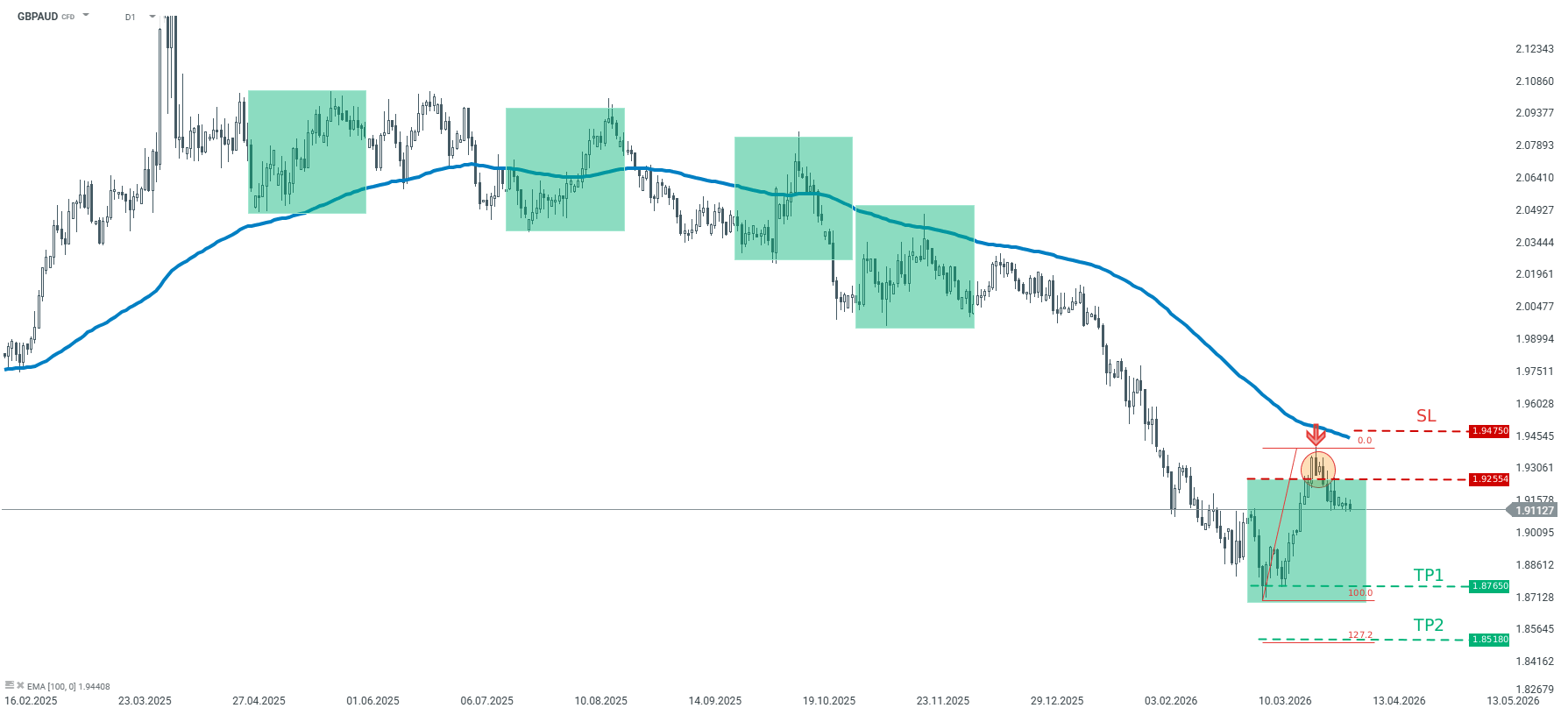
Trade of The Day – GBP/AUD

April 7, 2026

Facts:
The price bounced off the upper limit of 1:1 structure at 1.9255
GBPAUD sits below the 100-period moving average form H4 interval

Recommendation: 
Trade: Short position on GBPAUD at market price
Target: 1.8765, 1.8518
Stop: 1.9475

Opinion: Looking at the GBPAUD chart at the H4 interval, one can see that the price bounced off the key resistance today. The price bounced off the resistance marked with the upper limit of 1:1 structure at 1.9255. According to the Overbalance strategy, as long as the price sits below the aforementioned resistance, the main trend remains downward. In addition the price sits below the 100-period moving average from the H4 interval which also confirms the bearish scenario.  We recommend going short GBPAUD at market price with two targets: 1.8765 and 1.8518. We also recommend placing a stop loss order at 1.9475 Source: xStation5

EUR/USD hits one-week highs beyond 1.1570 highs as sentiment brightens

April 7, 2026
  • EUR/USD pierces the range top at 1.1570 amid a brighter market mood.
  • Eurozone Services PMI has been revised slightly higher in March.
  • Investors hold their breath ahead of Trump’s deadline for destroying Iran.

The Euro (EUR) has brushed off previous weakness to extend its recovery against the US Dollar (USD) to reach fresh weekly highs above 1.1570 on Tuesday’s European morning session. The market sentiment has improved, with European equities turning positive after a negative opening, and Eurozone services activity revised up, which has provided some support for the common currency.

Eurozone HCOB Services Purchasing Managers’ Index (PMI) has been revised to 50.2 on Tuesday from the 50.1 preliminary reading, although it remains significantly below February’s 51.9 reading. Among country members, Spain’s services activity stands out with a 53.3 reading, although France’s services contracted for the third consecutive month, and Germany’s expansion was revised down to 50.9 from preliminary estimations of 51.2.

Investors’ appetite for risk remains limited as the US deadline to Iran draws closer. US President Donald Trump reiterated his threats on Monday, warning Tehran that the US could destroy a country tonight if the Strait of Hormuz is not reopened before Tuesday, at 8 PM Easter Time (00:00 GMT on Wednesday).

Previously, the US and Iran rejected the 45-day ceasefire proposal offered by Pakistan, and Tehran came out with an alternative plan, considered “significant” by Trump but not good enough.

Before that, the European Central Bank’s (ECB) Governing Council member, Dimitar Radev, affirmed that it is still “too early” to say whether the bank will hike rates in April, as they might need some data amid the elevated level of uncertainty.

Technical Analysis: Pushing against the range top

EUR/USD Chart Analysis

The EUR/USD has turned higher, with technical indicators in the 4-hour chart suggesting an incipient bullish momentum. The Relative Strength Index (RSI) nears 60 after having remained flat around the 50 level, and the Moving Average Convergence Divergence (MACD) histogram is popping up above zero, although the MACD line remains practically flat.

A confirmation above the near-term channel’s top, at the 1.1570 area, would expose the late March and early April highs, in the area between 1.1630 and 1.1640. Further up, the March 10 high, at 1.1667, emerges as a plausible target.

Immediate support emerges at the 1.1505 area, which held bears on April 2 and 6. A confirmation below here would expose the March 30 and 31 lows near 1.1440, ahead of the multi-month lows, at 1.1411 hit in mid-March.

EUR/GBP approaches 0.8700 lows following Eurozone and UK services data

April 7, 2026
  • Euro maintains a moderate near-term bias, with bears looking at the 0.8700 area.
  • Eurozone’s services activity for March has been revised up, yet at levels well below February’s.
  • UK services sector grew at its slowest pace of the last 11 months in March.

The Euro (EUR) extends losses against the British Pound (GBP) for the second consecutive day on Tuesday, approaching the bottom of its near-term horizontal range at 0.8700, from Monday’s highs at 0.8735.

The pair has been unfazed by the moderate upward revision of the Eurozone’s HCOB Services Purchasing Managers’ Index figures, which were revised up on Tuesday.

Mixed Eurozone services data

Business activity in the countries sharing the Euro expanded at a 50.2 pace, according to final estimations, an inch higher than the 50.1 preliminary reading but well below the 51.9 reading seen in February.

Spain’s services sector has been the main driver of the revision, with business activity rising to 53.3 from Flash estimates of 51.9. The numbers for the region’s stronger economies, however, have disappointed, as France’s sector contracted for the third consecutive month and Germany’s expansion was revised down to 50.9 from 51.2 preliminary estimation and 53.5 in February.

In the UK, the S&P Global Services PMI has also been revised down to 50.5 in March, its slowest growing pace in almost a year, from flash estimations of a 51.0 reading and 53.9 in February.

These figures reflect the strong economic impact of the war in Iran on the Eurozone and UK economies, the day when US President Donald Trump’s deadline on Tehran expires. Investors are holding their breath after Trump threatened to “demolish” Iran’s bridges and energy plants, refusing claims against war crimes