

AUD/USD weakens on Middle East tensions as markets await RBA minutes

March 30, 2026
  • AUD/USD weakens as rising geopolitical tensions in the Middle East weigh on investor sentiment.
  • Threats to key Oil shipping routes and the involvement of the Houthis increase fears of a broader escalation.
  • Markets continue to assess the outlook for Australian interest rates ahead of the RBA’s minutes release.

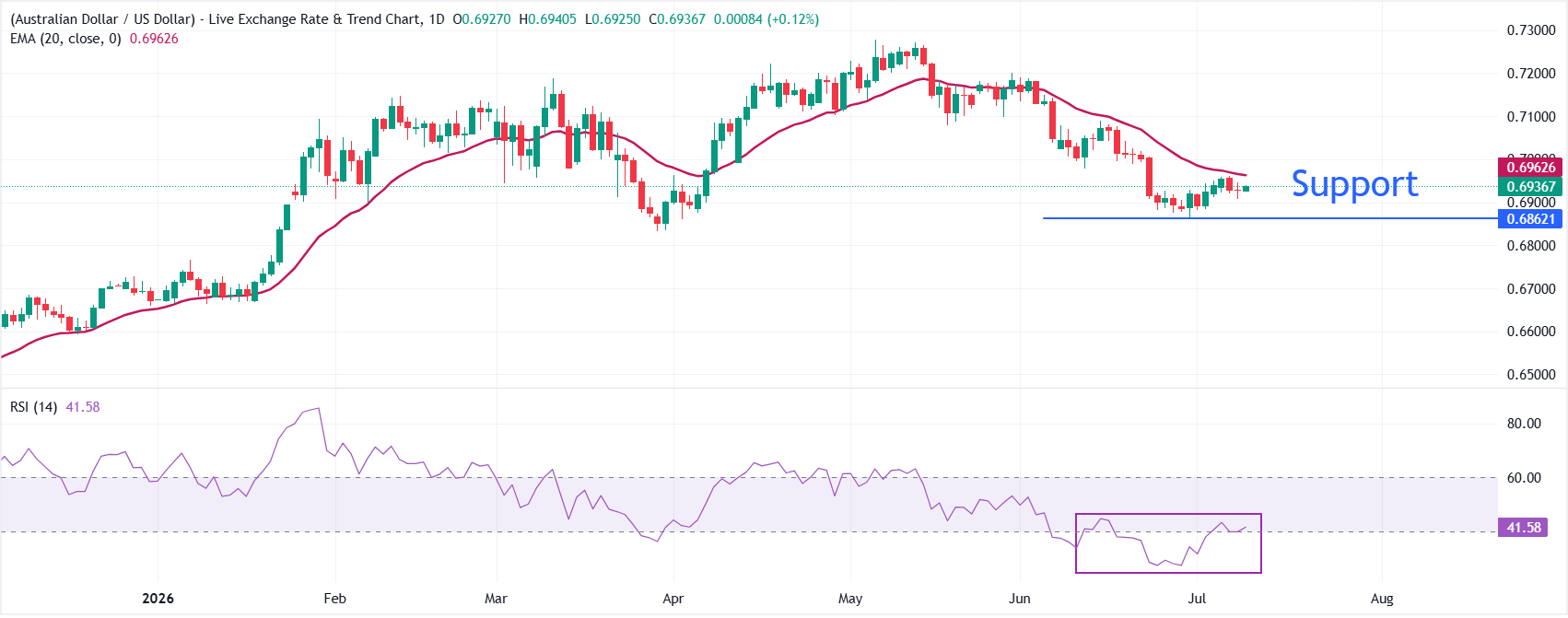
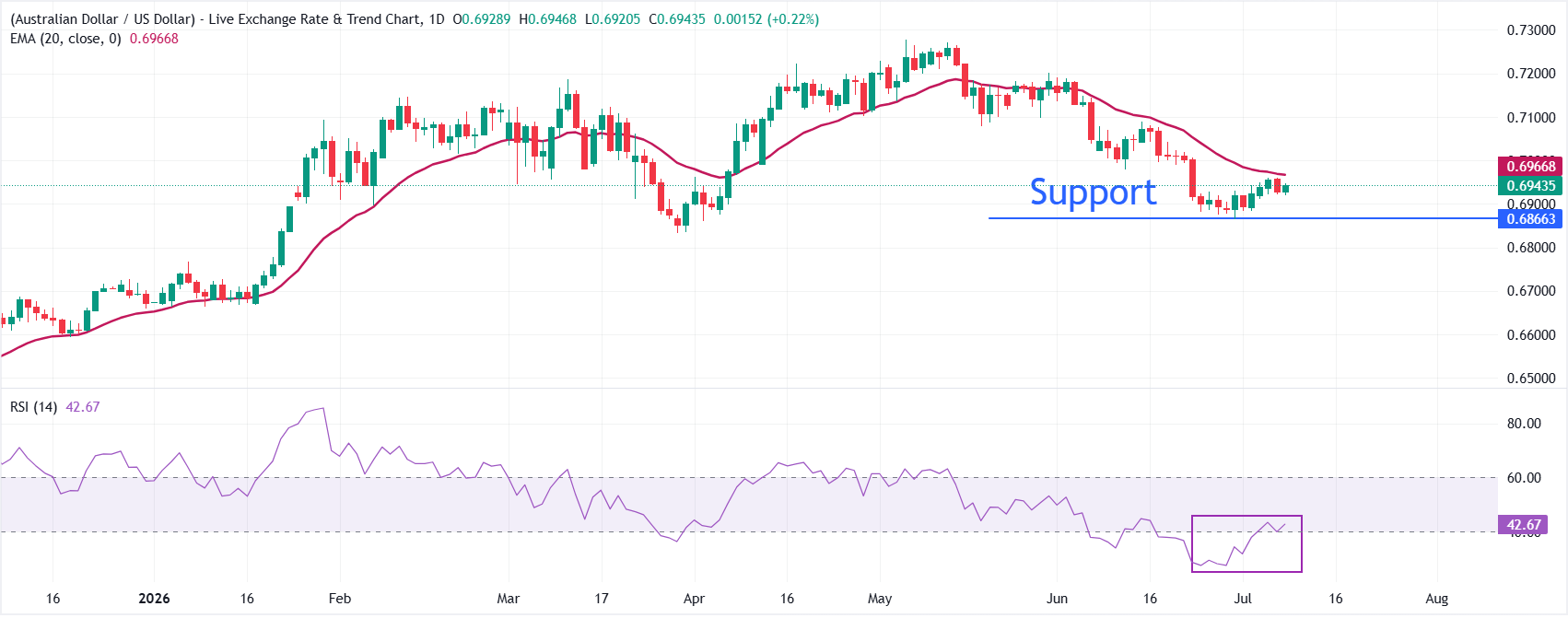
AUD/USD trades around 0.6860 on Monday at the time of writing, down 0.21% on the day, as investors adopt a cautious stance amid escalating geopolitical tensions in the Middle East.

Market sentiment remains fragile after Iran-backed Houthi forces in Yemen joined the conflict between Israel and Iran. Over the weekend, the militants launched missiles toward Israel and threatened to close the Bab el-Mandeb Strait, a strategic shipping route for Middle Eastern Oil supplies. This new source of uncertainty has increased fears of a broader regional escalation and added volatility to financial markets.

In this environment of risk aversion, growth-sensitive currencies such as the Australian Dollar (AUD) tend to come under pressure, while investors shift toward assets perceived as safer. The conflict is also complicating the outlook for energy markets, with some analysts warning that Oil prices could rise further if maritime routes are disrupted.

On the political front, US President Donald Trump said on Monday that Washington is holding “serious discussions” with what he described as a new regime in Iran in an effort to end military operations. However, he also warned that the US could launch massive strikes against Iranian energy infrastructure if a deal is not reached quickly or if the Strait of Hormuz remains closed to commercial traffic.

Markets have reacted cautiously to these remarks. Iranian officials have expressed skepticism about the negotiations, accusing Washington of speaking about diplomacy while preparing the ground for a possible military invasion.

On the Australian side, investors are focusing on the upcoming release of the minutes from the latest Reserve Bank of Australia (RBA) meeting, scheduled for Tuesday. The central bank raised its key interest rate by 25 basis points at that meeting, bringing the cash rate to 4.1%. Traders will look for clues in the minutes about the policy outlook in the coming months.

According to the ASX’s RBA Rate Tracker, markets currently price in about a 69% chance of another rate hike at the May 5 meeting. Confirmation of this outlook could provide support to the Aussie, although geopolitical risks and shifts in global risk appetite remain key drivers for AUD/USD in the near term.

Australian Dollar Price Today

The table below shows the percentage change of Australian Dollar (AUD) against listed major currencies today. Australian Dollar was the strongest against the New Zealand Dollar.

USDEURGBPJPYCADAUDNZDCHF
USD0.20%0.24%-0.59%0.20%0.19%0.46%0.09%
EUR-0.20%0.03%-0.77%0.00%0.04%0.26%-0.12%
GBP-0.24%-0.03%-0.82%-0.02%-0.01%0.23%-0.15%
JPY0.59%0.77%0.82%0.79%0.78%1.03%0.66%
CAD-0.20%-0.00%0.02%-0.79%-0.01%0.19%-0.13%
AUD-0.19%-0.04%0.01%-0.78%0.01%0.24%-0.11%
NZD-0.46%-0.26%-0.23%-1.03%-0.19%-0.24%-0.38%
CHF-0.09%0.12%0.15%-0.66%0.13%0.11%0.38%

The heat map shows percentage changes of major currencies against each other. The base currency is picked from the left column, while the quote currency is picked from the top row. For example, if you pick the Australian Dollar from the left column and move along the horizontal line to the US Dollar, the percentage change displayed in the box will represent AUD (base)/USD (quote).

Currency Talk – EUR/NZD, EUR/CAD, AUD/USD

March 30, 2026

The Overbalance analysis aims to identify three financial instruments, analyzed primarily on the daily/four-hour (D1/H4) timeframe. The analysis uses only the Overbalance methodology, which helps determine where a trend may continue or where it may reverse.
Today’s analysis covers three instruments, evaluated solely in terms of 1:1 correction structures.

EURNZD
Last week, the EURNZD broke through key resistance at 1.9855, which corresponded to the upper boundary of the 1:1 geometric pattern. According to the Overbalance methodology, this breakout suggests potential for a move toward last November’s highs, around 2.0680. An additional argument in favor of the bullish scenario is the earlier double bounce off support at 1.9540. In the event of a correction, the 1.9855 level should act as short-term support.

EURNZD – H4 timeframe. Source: xStation

EURCAD
The EURCAD pair is attempting to resume its upward trend. The price has broken above the upper boundary of the 1:1 bearish pattern at the 1.5945 level and has also broken above the polarity of the previous bullish pattern, which falls exactly at the same point. According to the Overbalance methodology, as long as the price remains above the 1.5945 level, the bullish scenario remains in effect.

EURCAD – H4 timeframe. Source: xStation

AUDUSD
The AUDUSD price has broken below the key support level at 0.6905, which corresponded to the lower boundary of a broad 1:1 pattern. A break below this level could support a scenario involving a deeper correction or even a trend reversal. Currently, the 0.6905 level acts as key resistance. To signal a return to an uptrend, the price would need to additionally break above the 0.6984 level, where the upper boundary of the local 1:1 downtrend pattern is located.

AUDUSD – H4 chart. Source: xStation

The material on this page does not constitute financial advice and does not take into account your level of understanding, investment objectives, financial situation or any other specific needs. All information provided, including opinions, market research, mathematical results and technical analyzes published on the Website or transmitted To you by other means, it is provided for information purposes only and should in no way be construed as an offer or solicitation for a transaction in any financial instrument, nor should the information provided be construed as advice of a legal or financial nature on which any investment decisions you make should be based exclusively To your level of understanding, investment objectives, financial situation, or other specific needs, any decision to act on the information published on the Website or sent to you by other means is entirely at your own risk if you In doubt or unsure about your understanding of a particular product, instrument, service or transaction, you should seek professional or legal advice before trading. Investing in CFDs carries a high level of risk, as they are leveraged products and have small movements Often the market can result in much larger movements in the value of your investment, and this can work against you or in your favor. Please ensure you fully understand the risks involved, taking into account investments objectives and level of experience, before trading and, if necessary, seek independent advice.

AUD/USD edges up from from 0.6840 low but risk aversion limits rallies

March 30, 2026
  • AUD/USD rebound from 0.6842 lows fails to find acceptance above 0.6870.
  • The risk-averse mood weighs on the Aussie as the Iran war complicates.
  • Analysts at UOB contemplate a further decline towards 0.6765.

The Aussie Dollar (AUD) is trimming losses against the US Dollar (USD) on Monday. The pair bounced from two-month lows around 0.6840 but is struggling to rise above 0.6870, as negative market sentiment keeps weighing on any significant Aussie recovery.

Investors’ mood remains sour on Monday, as the Middle East War gets messier by the day. The irruption of the Iran-backed Houthis in Yemen this weekend has added a new variable to an already complicated scenario, blurring any swift end to the conflict. The Houthis have launched missiles at Israel from Yemen, and threatened to close the Strait of Bab el Mandab, another bottleneck for Saudi Oil supply, which might trigger a further escalation in Crude prices.

Scepticism about Trump’s “negotiations”

Meanwhile, US President Donald Trump has reiterated that there are direct and indirect talks with the Iranian leaders, praising their “very reasonable” attitude, and Pakistan offered to hold talks between the US and Iran.

Investors, however, have taken these comments in stride, as Tehran remains sceptical. Iran’s Parliament Speaker, Mohammed Baqer Qalibat, accused the US of sending messages about negotiations while preparing a ground invasion, and other Iranian leaders threatened with a bloodbath if that invasion finally takes place.

Bearing this in mind, rallies in the risk-sensitive Aussie are likely to find sellers. Technical analysts at UOB see the pair in a bearish trend with 0.6765 as a potential target: “While the weekly MACD remains in positive territory, it has been heading steadily lower over the past few weeks (…) The overall technical picture suggests that AUD/USD could continue to head lower. A clear break below the 0.6850/0.6870 support zone could potentially trigger a sharp decline toward 0.6765.”

Australian Dollar falls to two-month lows on US–Iran peace uncertainty

March 27, 2026
  • AUD/USD fell to a two-month low of 0.6877 on Friday.
  • Rising oil prices weighed on sentiment amid US–Iran peace uncertainty.
  • Trump said Washington would pause attacks on Iran’s energy sector for 10 days, while Tehran denied any request.

AUD/USD extends its losing streak for the fourth consecutive day, trading around 0.6880 during the Asian hours on Friday. The pair recorded a two-month low of 0.6877, pressured by weakness in the Australian Dollar (AUD) as rising oil prices weigh on sentiment amid uncertainty surrounding United States (US)–Iran peace talks.

US President Donald Trump said earlier that Washington would pause attacks on Iran’s energy sector for 10 days, extending the previous April 6 deadline to allow room for negotiations. Trump suggested the decision followed a request from Iran. However, the Wall Street Journal reported that mediators say Iran denies making such a request, underscoring the fragility of the diplomatic process and the low likelihood of a near-term ceasefire.

Meanwhile, the Pentagon is considering plans to deploy up to 10,000 additional ground troops to the Middle East. Defence officials noted that the option is intended to enhance strategic flexibility, enabling rapid escalation if talks break down while maintaining a credible deterrent in the region.

On the monetary policy front, Reserve Bank of Australia (RBA) Assistant Governor Christopher Kent warned on Thursday that policymakers may need to act to contain inflation as energy prices rise. Kent added that the board remains focused on achieving low, stable inflation and full employment, which could push up short-run neutral rates and necessitate tighter policy.

Federal Reserve (Fed) Governor Stephen Miran said on Thursday that reducing the size of the Fed’s balance sheet would support more effective interest rate policy. Miran outlined a potential path to shrink holdings by $1 trillion to $2 trillion, noting that a smaller balance sheet would give the Fed greater flexibility in future crises, while a larger one risks distorting markets.

US data offered little fresh direction, with Initial Jobless Claims coming in exactly as expected at 210K. Attention now turns to Friday’s University of Michigan (UoM) consumer sentiment and one-year inflation expectations.

AUD/USD remains under pressure as geopolitical risks support the US Dollar

March 26, 2026
  • AUD/USD trades around 0.6920, holding near its lowest level since early February.
  • The US Dollar is supported by safe-haven demand and rising US Treasury yields.
  • Markets largely ignore the RBA’s hawkish tone, reinforcing the bearish outlook.

AUD/USD trades around 0.6920 on Thursday at the time of writing, down 0.35% on the day, and remains close to its monthly lows amid a bearish consolidation phase. The pair struggles to stage any meaningful rebound as the US Dollar (USD) continues to draw solid support.

Market sentiment remains fragile despite conciliatory remarks from US President Donald Trump, as Iran has rejected any prospect of negotiations and dismissed a ceasefire proposal. Persistent tensions in the Middle East, combined with additional US troop deployments, are fueling fears of further escalation. In this context, the US Dollar benefits from its safe-haven status, weighing on the Australian Dollar (AUD).

At the same time, the energy situation is adding to global inflationary pressures. The effective closure of the Strait of Hormuz is pushing Oil prices higher, reinforcing expectations that major central banks, including the Federal Reserve (Fed), will maintain a hawkish stance. This dynamic is driving US Treasury yields higher, further supporting the Greenback.

On the domestic front, comments from Reserve Bank of Australia (RBA) Assistant Governor Christopher Kent failed to provide support to the currency. Although he highlighted inflation risks linked to rising energy prices and stressed the need to maintain restrictive monetary conditions, the market reaction remained muted. This lack of traction reflects growing concerns about the domestic economic outlook.

According to economists at Commerzbank, Australia is facing a stagflation dilemma, with slowing growth and energy-driven inflation pressures. They note that consumer confidence has dropped sharply while Services Purchasing Managers Index (PMI) indicators have slipped into contraction territory, complicating the central bank’s policy path. Markets still price in around a 54% chance of a rate hike in May, according to the economists.

Over the longer term, Rabobank maintains a more constructive view. The bank argues that Australia’s status as a net energy exporter could support its terms of trade in the current environment, potentially allowing AUD/USD to return to the 0.71 area over a three- to six-month horizon, and to 0.72 over twelve months.

In the near term, however, the combination of a resilient US Dollar driven by safe-haven flows, elevated US yields, and a lack of supportive domestic catalysts suggests that the bearish bias for the pair is likely to persist.

Australian Dollar Price Today

The table below shows the percentage change of Australian Dollar (AUD) against listed major currencies today. Australian Dollar was the strongest against the New Zealand Dollar.

USDEURGBPJPYCADAUDNZDCHF
USD0.08%-0.03%0.05%0.12%0.31%0.27%0.13%
EUR-0.08%-0.11%-0.06%0.03%0.23%0.19%0.05%
GBP0.03%0.11%0.09%0.16%0.34%0.30%0.16%
JPY-0.05%0.06%-0.09%0.07%0.26%0.21%0.08%
CAD-0.12%-0.03%-0.16%-0.07%0.20%0.15%0.01%
AUD-0.31%-0.23%-0.34%-0.26%-0.20%-0.04%-0.15%
NZD-0.27%-0.19%-0.30%-0.21%-0.15%0.04%-0.14%
CHF-0.13%-0.05%-0.16%-0.08%-0.01%0.15%0.14%

The heat map shows percentage changes of major currencies against each other. The base currency is picked from the left column, while the quote currency is picked from the top row. For example, if you pick the Australian Dollar from the left column and move along the horizontal line to the US Dollar, the percentage change displayed in the box will represent AUD (base)/USD (quote).

AUD moves little following RBA’s Kent cautious remarks

March 26, 2026
  • AUD/USD remains silent after RBA’s Christopher Kent warned of inflation risks from rising energy prices.
  • The Australian Dollar struggled after softer domestic inflation data on Wednesday.
  • The US Dollar holds firm as markets track Middle East developments, with uncertainty over efforts to resolve the Iran conflict.

AUD/USD steadies after two days of losses, trading around 0.6950 during the Asian hours on Thursday. The pair trades flat as the Australian Dollar (AUD) stays steady. This follows Reserve Bank of Australia (RBA) Assistant Governor Christopher Kent’s warning that policymakers may need to contain inflation amid rising energy prices. Kent also noted the board will target low, stable inflation and full employment. This may lift short-run neutral rates and require tighter policy.

However, the Australian Dollar weakened after softer domestic inflation data on Wednesday. Australia’s annual CPI slowed to 3.7% in February from 3.8% in January. The trimmed mean CPI came in at 3.3%, below the 3.4% forecast and in line with January’s revised figure.

Meanwhile, the AUD/USD pair remains subdued as the US Dollar (USD) holds firm. Markets are watching Middle East developments closely, with uncertainty surrounding efforts to end the Iran conflict.

The White House said talks are ongoing, with the Trump administration reportedly sending a 15-point proposal to Iran via Pakistan. Senior Iranian officials are reviewing the proposal but show little willingness to engage with Washington. Tehran is also expected to reject a US ceasefire offer, instead proposing a five-point plan that includes sovereign control over the Strait of Hormuz.

Currency Talk – GBP/AUD AUD/NZD EUR/AUD

March 25, 2026

The Overbalance analysis aims to identify three financial instruments, analyzed primarily on the daily/four-hour (D1/H4) timeframe. The analysis uses only the Overbalance methodology, which helps determine where a trend may continue or where it may reverse.
Today’s analysis covers three instruments, evaluated solely in terms of 1:1 correction structures.

GBPAUD
Since last November, the GBPAUD currency pair has been trading in a downtrend; however, in mid-March, the upper boundary of the broad 1:1 pattern was broken at the 1.8990 level, which may indicate a shift in sentiment toward an uptrend. Currently, the 1.8975 level should be considered key short-term support, as it marks the lower boundary of the local 1:1 bullish pattern. According to the Overbalance methodology, as long as this level holds, further expansion of the upward movement is possible. Conversely, a drop back below 1.8990 could signal a resumption of the downward trend.

GBPAUD – H4 timeframe. Source: xStation

AUDNZD
The AUDNZD exchange rate has been in an uptrend since April of last year. Due to the prolonged period without a major correction, the recent downward move is similar in magnitude to previous corrections, allowing us to identify support at the 1.1730 level, where the lower boundary of the 1:1 pattern is located. According to the Overbalance methodology, as long as this level holds, the uptrend remains in effect.

AUDNZD – H4 timeframe. Source: xStation

EURAUD
Since last October, the EURAUD pair has been trading in a downtrend; however, in recent days, the 1.6545 level has been broken, which may suggest the start of an upward correction or even a trend reversal. According to the Overbalance methodology, as long as the price remains above this level, the base case scenario remains a continuation of the uptrend. Conversely, a return below 1.6545, as well as a break below the 1.6506 level—where the lower boundary of the local 1:1 uptrend pattern lies—could signal a return to the downtrend. For now, the base case remains an upward correction.

EURAUD – H4 timeframe. Source: xStation

The material on this page does not constitute financial advice and does not take into account your level of understanding, investment objectives, financial situation or any other specific needs. All information provided, including opinions, market research, mathematical results and technical analyzes published on the Website or transmitted To you by other means, it is provided for information purposes only and should in no way be construed as an offer or solicitation for a transaction in any financial instrument, nor should the information provided be construed as advice of a legal or financial nature on which any investment decisions you make should be based exclusively To your level of understanding, investment objectives, financial situation, or other specific needs, any decision to act on the information published on the Website or sent to you by other means is entirely at your own risk if you In doubt or unsure about your understanding of a particular product, instrument, service or transaction, you should seek professional or legal advice before trading. Investing in CFDs carries a high level of risk, as they are leveraged products and have small movements Often the market can result in much larger movements in the value of your investment, and this can work against you or in your favor. Please ensure you fully understand the risks involved, taking into account investments objectives and level of experience, before trading and, if necessary, seek independent advice.

Australian Dollar underperforms as Iran pushes back hopes of peace talks

March 24, 2026
  • The Australian Dollar underperforms across the board as risk-aversion revives after Iran dismisses peace talks with the US.
  • US President Trump announced on Monday that military attacks on Iran’s power plants have been postponed.
  • Weak Australian PMI data has also weighed on the Australian Dollar.

The Australian Dollar (AUD) trades lower against its major currency peers, trading 0.6% down to near 0.6760 during the Asian trading session on Tuesday. The antipodean has come under pressure as remarks from Iran that they are not involved in any peace talks with the United States (US), which were contrary to comments from President Donald Trump, have revived the risk-aversion mood.

Australian Dollar Price Today

The table below shows the percentage change of Australian Dollar (AUD) against listed major currencies today. Australian Dollar was the weakest against the US Dollar.

USDEURGBPJPYCADAUDNZDCHF
USD0.21%0.21%0.14%0.18%0.53%0.35%0.26%
EUR-0.21%-0.02%-0.07%-0.03%0.33%0.14%0.05%
GBP-0.21%0.02%-0.04%-0.02%0.34%0.16%0.07%
JPY-0.14%0.07%0.04%0.05%0.39%0.21%0.12%
CAD-0.18%0.03%0.02%-0.05%0.34%0.16%0.08%
AUD-0.53%-0.33%-0.34%-0.39%-0.34%-0.17%-0.29%
NZD-0.35%-0.14%-0.16%-0.21%-0.16%0.17%-0.09%
CHF-0.26%-0.05%-0.07%-0.12%-0.08%0.29%0.09%

The heat map shows percentage changes of major currencies against each other. The base currency is picked from the left column, while the quote currency is picked from the top row. For example, if you pick the Australian Dollar from the left column and move along the horizontal line to the US Dollar, the percentage change displayed in the box will represent AUD (base)/USD (quote).

On Monday, US President Trump announced that he has instructed the Department of War to pause military attacks on Iran’s power plants for five days, as we are having “very good and productive conversations” with Tehran regarding a complete and total resolution of our hostilities in the Middle East.

The revival of risk-off sentiment has offered support to the US Dollar, which declined significantly after US President Trump’s remarks. As of writing, the US Dollar Index (DXY), which tracks the Greenback’s value against six major currencies, trades 0.25% higher to near 99.40.

In addition to deteriorating market sentiment, weak preliminary Australian S&P Global Purchasing Managers’ Index (PMI) data for March has also weighed on the Australian Dollar. Earlier in the day, the data showed that the overall business activity swung to contraction due to a sharp decline in the services sector output.

The Composite PMI arrived at 47.0 against 52.4 in February. A figure below 50.0 is considered a contraction in the business activity.

Meanwhile, investors await the Australian Consumer Price Index (CPI) data for February, which will be released on Wednesday. However, the impact of the Feb inflation data is expected to be limited on the Reserve Bank of Australia’s (RBA) monetary policy outlook, as it would lack the impact of the recent surge in energy prices due to the Iran conflict.