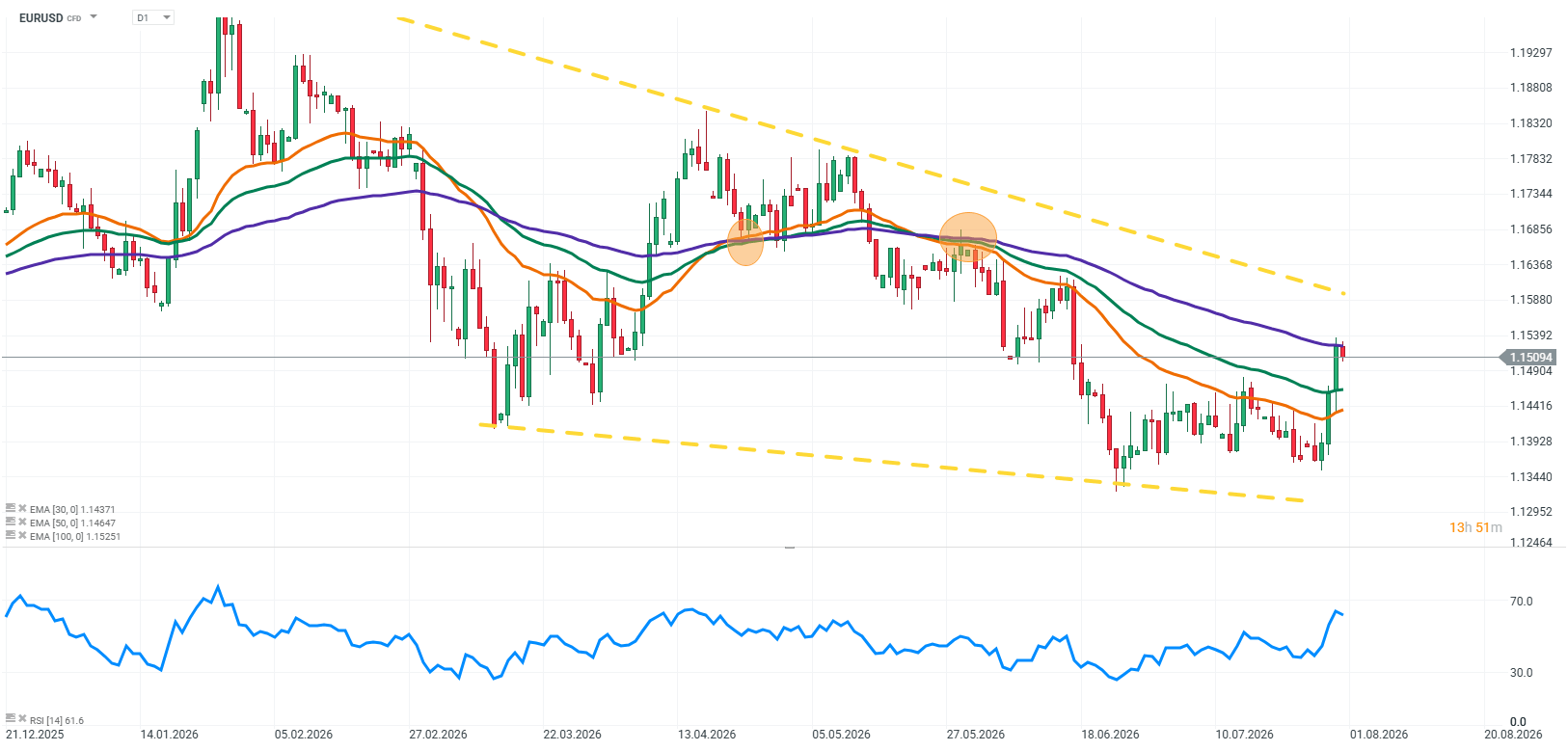
EUR/USD trades in a narrow range as traders await clarity on US-Iran negotiations.
Strong US manufacturing data and a stabilizing US Dollar cap the Euro’s upside.
Upcoming US employment data could shape expectations for the Fed’s next policy move.
EUR/USD trades in a narrow range on Monday as traders await clarity on US-Iran negotiations, while signs of stabilization in the US Dollar following the recent intervention-led weakness cap the Euro’s upside.
At the time of writing, the pair trades around 1.1515 after reaching an intraday high of 1.1558, its highest level since June 17.
US President Donald Trump said over the weekend that he had called off a planned strike on Iran, with negotiations expected to begin on Monday. However, Iranian Foreign Ministry spokesperson Esmaeil Baghaei said Tehran is not currently holding talks with Washington. The conflicting headlines keep geopolitical uncertainty alive and leave market sentiment cautious.
Traders also assess the latest business activity data from both sides of the Atlantic. The US ISM Manufacturing Purchasing Managers’ Index (PMI) rose to 55.6 in July from 53.3 in June, beating expectations of 54.0 and marking its highest reading since May 2022. The sector expanded for a seventh consecutive month following ten months of contraction.
Meanwhile, the Eurozone Manufacturing PMI improved to a three-month high of 51.9 from 51.4 in June, although it fell short of the market forecast of 52.0. The stronger-than-expected US reading offers some support to the US Dollar.
The US Dollar Index (DXY), which tracks the Greenback’s value against a basket of six major currencies, trades around 99.84 after rebounding from an intraday low of 99.42, its weakest level since June 15.
Dollar outlook darkens as Fed caution and US-Japan action sap confidence
Economists at DBS argue that “the greenback’s trajectory looks bleak in August after stumbling badly at the end of July,” with a combination of policy and geopolitical factors leaving the Dollar exposed. They highlight “the confluence of a Fed seemingly reluctant to hike, coordinated US-Japan currency interventions, and a cooling geopolitical landscape in the Middle East” as key forces that “keep the USD vulnerable.”
DBS notes that “Fed Chairman Kevin Warsh has unsettled investors who had amassed long USD positions betting on his hawkish credentials.” Instead of signalling that rates may rise, “Warsh used the July 28-29 FOMC meeting to focus on institutional reforms, especially scaling back forward guidance.”
Attention now turns to upcoming US employment data for fresh clues on the Fed’s policy path. The JOLTS Job Openings report is due on Tuesday, followed by ADP Employment Change on Wednesday and Nonfarm Payrolls (NFP) on Friday.
The dollar has come bottom of the G10 currency rankings for the past week.
The market does not believe that Kevin Warsh, the new Fed chairman, is a hawk.
Oil prices are falling, which is also putting pressure on the US dollar.
Higher GDP growth and inflation are fuelling expectations of interest rate rises in the eurozone.
The yen is strengthening following the first coordinated intervention by the US and Japan in 15 years.
In recent months, the market has repeatedly cast doubt on Donald Trump’s promises and announcements. This phenomenon has become so widespread that it has even been given its own name (TACO, i.e. Trump Always Chickens Out). In keeping with this motto, the US President backed down from a planned attack on Iran over the weekend, which, as he himself put it, was to be “the biggest since the Second World War”.
However, what proved more significant for the currency was investors’ scepticism regarding statements made by another US official. Kevin Warsh, the new Fed chairman, continued to emphasise his uncompromising stance on inflation, seeking to convince the markets of his supposed hawkishness. Whilst this was sufficient in June, by July investors were expecting much more.
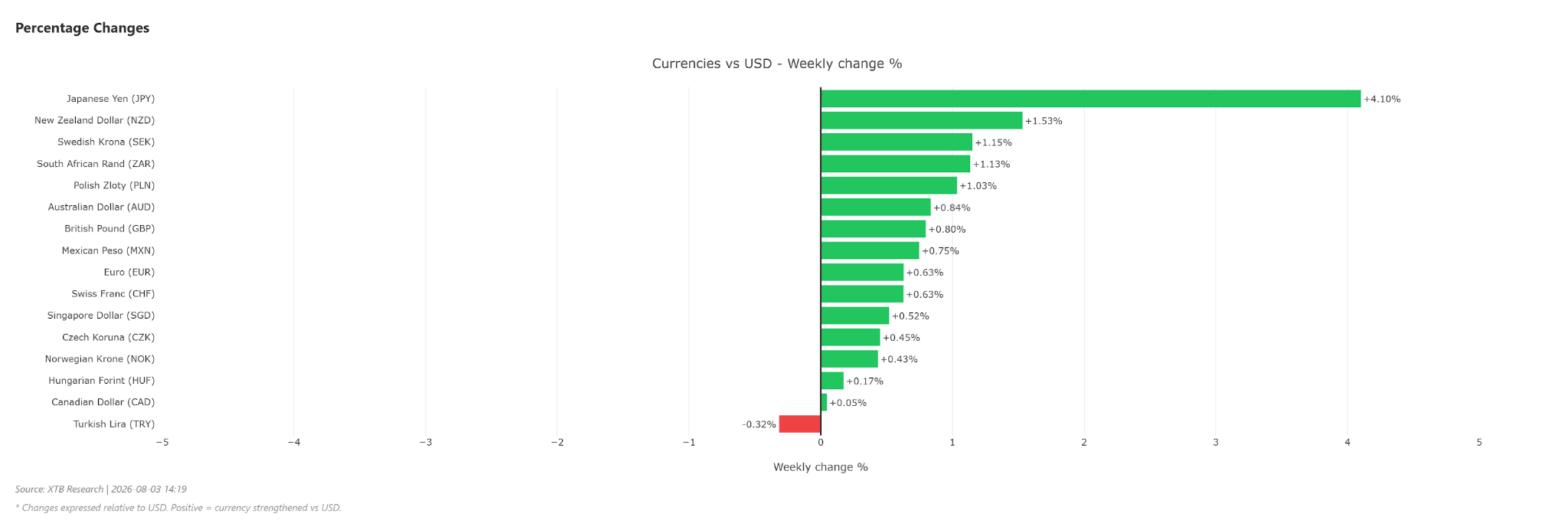
Chart 1: Exchange rates of selected currencies [vs. USD] (27 July – 3 August)
Source: Bloomberg, 3 August 2026 The US dollar has therefore come under pressure, weakening against almost every currency we analyse on a regular basis. Currencies with a higher beta (e.g. the Swedish krona or the Polish zloty) performed particularly well, as did those whose economies could suffer most from a deepening energy crisis (e.g. the South African rand or the South Korean won). At the very top of the list was, of course, the Japanese yen, which was bolstered last Thursday by the first joint currency intervention by the United States and Japan since 2011.
US dollar (USD)
The dollar is being weighed down by both the fall in energy commodity prices (of which it is a net exporter) and a dovish revision to market expectations regarding the Fed’s interest rate path. The Federal Open Market Committee (FOMC) decided last week to hold rates steady. The vote was 9 to 3. Only three policymakers voted in favour of a rate rise, and Warsh was not among them (the others were Beth Hammack, Neel Kashkari and Lorie Logan). During the conference itself, the Fed Chair stuck to his decision not to provide forward guidance. Although he spoke for nearly 45 minutes, few of the words that came out of his mouth were of any great significance from a market perspective. He avoided answering both questions regarding the justification for the pause and those concerning the current economic situation.
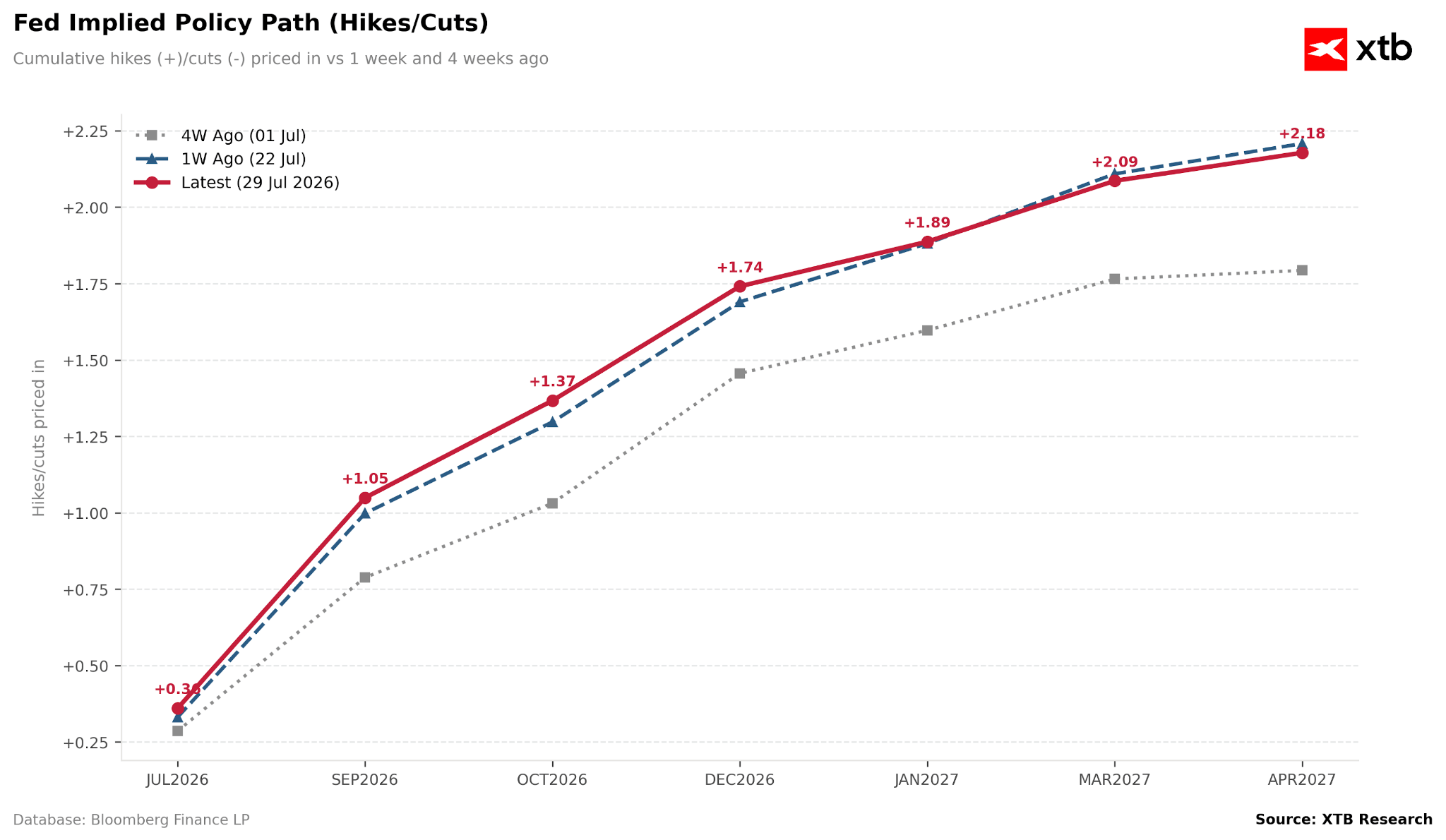
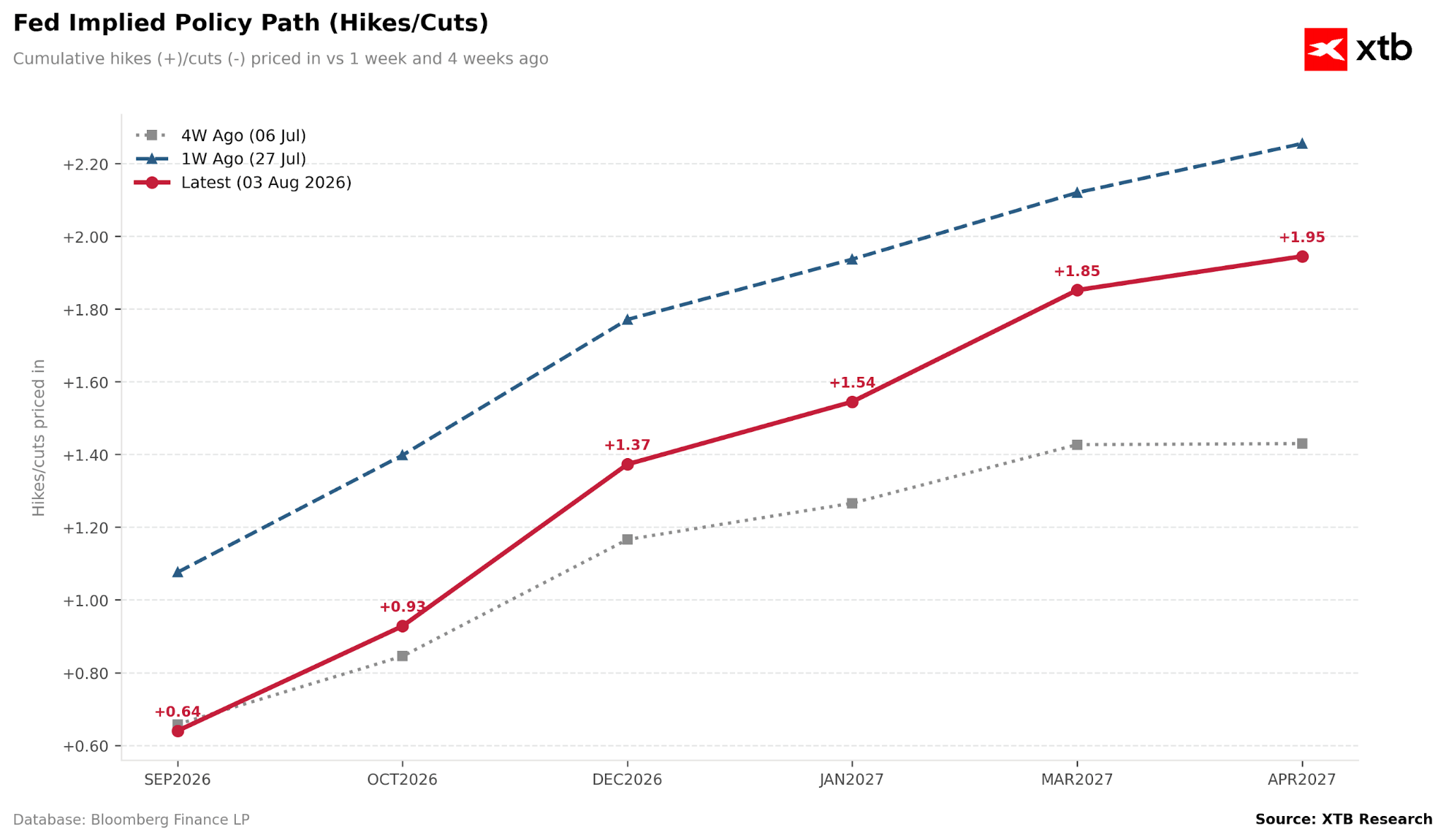
He mainly emphasised that the energy shock is hampering the committee’s work, and that the rise in CAPEX among hyperscalers should translate into future economic growth. This is largely consistent with his past comments on AI, when he argued that the productivity surge driven by artificial intelligence would, over time, have a disinflationary effect. The question is being raised once again as to whether Kevin Warsh is a dove in hawk’s clothing. The market seems increasingly sceptical that hawkish statements will be followed by concrete action, leading to a pullback in bets on interest rate rises. It currently assigns a probability of just over 60 per cent to a rate rise in September. Prior to the meeting, this was fully priced in. Chart 2: Market pricing of interest rate rises ahead of the FOMC decision (2026–2027)
Source: XTB Research, 29 July 2026 Chart 3: Market pricing of interest rate rises following the FOMC decision (2026–2027)
Source: XTB Research, 3 August 2026 It is worth recalling that almost exactly a year ago, he openly sided with the president, stating on FOX News that Donald Trump’s frustration with Powell’s conduct of monetary policy was entirely justified, and criticising the institution for being too slow to cut interest rates and for placing too much emphasis on historical economic data.
Euro (EUR)
In the eurozone, attention last week was focused not on monetary policy but on macroeconomic data. There are increasing signs that, following the pause in July, the time has come for a rate rise. The probability of a rate rise in September is estimated at almost 90 per cent. In recent days, both GDP growth (up 0.4 per cent quarter-on-quarter, compared with expectations of 0.2 per cent) and core inflation (2.5 per cent, consensus 2.4 per cent) have come in higher than expected. Both figures are consistent with further monetary tightening.
G10
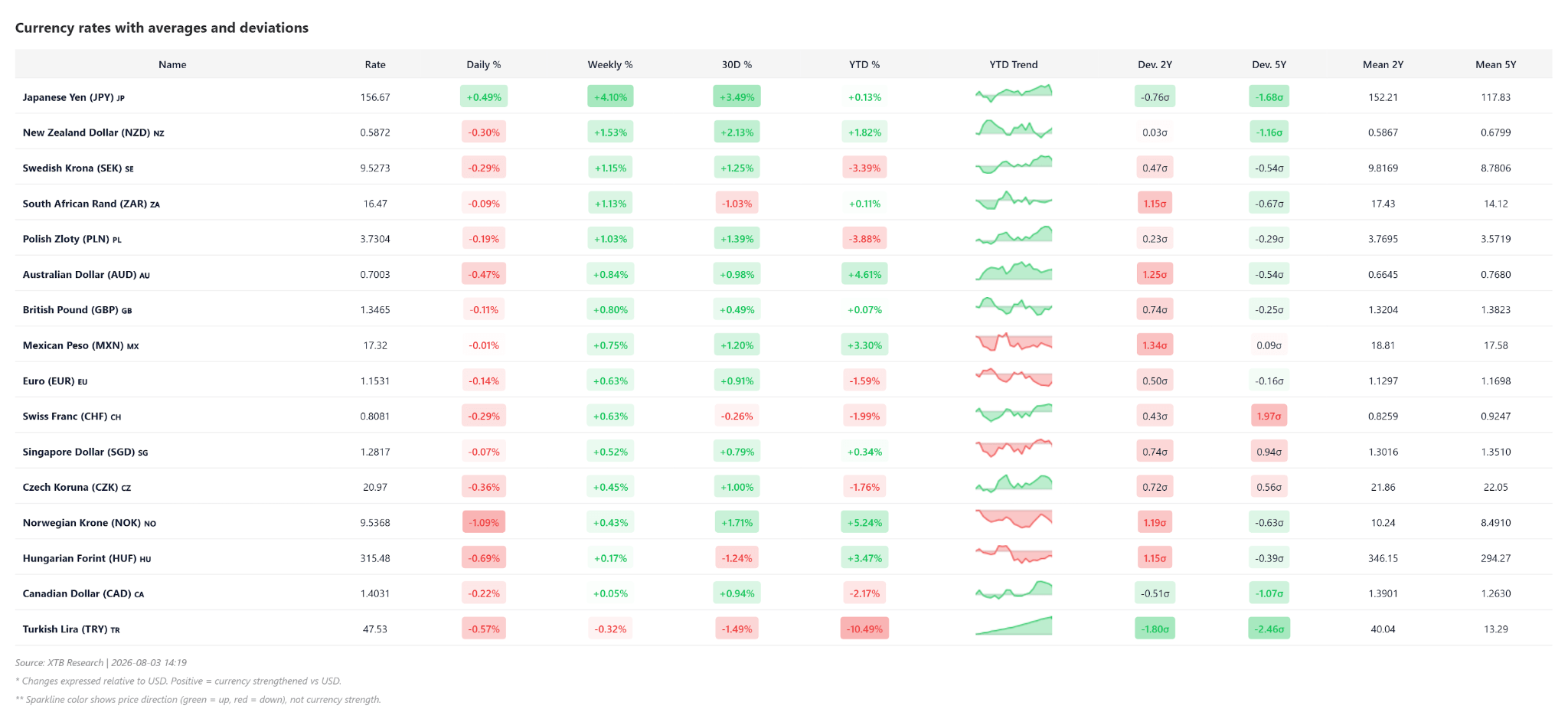
Chart 4: Exchange rates of selected currencies [vs. USD]
Source: Bloomberg, 3 August 2026
Japanese yen (JPY)
After reaching its highest level since 1986 (163.99), the USDJPY pair experienced a very sharp fall. This move was driven by the first coordinated intervention by the US and Japan since 2011. At that time, the yen had weakened following a massive earthquake. As emphasised by the US Treasury Secretary, Scott Bessent, and the Japanese Finance Minister, Satsuki Katayama, both sides remain ready to take further measures to stabilise the exchange rate. According to data provided by the Bank of Japan, the scale of the Japanese intervention may have reached as much as 59 billion dollars, which would be an unprecedented move (in terms of the scale of a single-day intervention). Although we cannot estimate the scale of US operations using official data, there are strong indications that it amounted to between 5 and 10 billion dollars. This is at least what is suggested by a note left by Scott Bessent during a meeting in Maryland.
Source: Reuters President Trump confirmed the US intervention at the weekend: “Japan has been very good to us, except, of course, for the attack on Pearl Harbour. (…) Their yen is weakening and they needed a bit of help. And we are always ready to help Japan.” Today, Minister Katayama published an official letter confirming the intervention.
EUR/USD gains ground to around 1.1535 in Monday’s early Asian session.
The bearish tone of the major pair prevails under the 100-day SMA.
The initial support level is seen at 1.1530; the immediate resistance level to watch is 1.1570.
The EUR/USD pair trades in positive territory near 1.1535 during the early European trading hours on Monday, bolstered by improved risk sentiment. The Euro (EUR) edges higher against the US Dollar (USD) after reports that US President Donald Trump had called off an attack on Iran and talks between the two sides would happen on Monday. Traders will closely monitor the developments surrounding US-Iran negotiations.
Traders brace for the German Retail Sales data for June, which is due later on Monday. If the reports come in weaker than expected, this could drag the shared currency lower. On the US docket, the US ISM Manufacturing Purchasing Managers Index (PMI) data will be published.
Technical Analysis:
In the daily chart, EUR/USD trades at 1.1533. The pair remains capped in the near term as spot holds below the 100-day simple moving average (SMA) at 1.1569, keeping the broader tone heavy despite the latest bounce. The Relative Strength Index (14) at 62.5 shows firm positive momentum, but with price still under the key trend average, this strength merely hints at a corrective rebound within a broader bearish backdrop.
On the downside, immediate support is aligned with the upper Bollinger Band at 1.1529, with the 20-day SMA middle band at 1.1430 and the lower band near 1.1331 marking deeper cushions if selling resumes. On the topside, a daily close above the 100-day SMA at 1.1569 would be needed to ease bearish pressure and open the way for a more sustained recovery toward higher levels.
Euro briefly lifted by French CPI as ECB commentary stays muted
Analysts at Scotiabank note that the Euro received “a modest lift” earlier in the session after French CPI data “came in well above expectations,” but stress that the support quickly faded as “the impact was short-lived as broader themes took hold.” They add that “comments from the ECB have been limited and the speaking calendar is empty over the next week or so,” leaving the currency largely to trade on prevailing macro drivers rather than fresh policy signals.
EUR/JPY may retest initial support at its eight-month low of 179.37.
With the 14-day Relative Strength Index at 27.71, the decline’s pace may soon moderate.
The currency cross could rise toward its nine-day EMA at 184.07.
EUR/JPY extends its gains for the third successive day, trading around 179.40 during the Asian hours on Monday. The currency cross is extending a bearish near-term tone as price holds beneath both the nine-period and 50-period Exponential Moving Averages (EMAs).
The short-term EMA remains below the longer 50-period EMA, reinforcing downside pressure, while the 14-day Relative Strength Index (RSI) indicator at 27.71 slips into oversold territory, hinting that while sellers are in control, the pace of the decline could soon moderate.
The EUR/JPY cross may retest the initial support at the eight-month low of 179.37, reached on August 3. Further support lies at the nine-month low of 175.70.
On the upside, the EUR/JPY cross rises toward the nine-day EMA at 184.07, followed by 185.02. A break above these moving averages would cause a bullish shift and support the currency cross to explore the region around the all-time high of 187.95, which was recorded on April 17.
EUR/USD gains positive traction for the fifth straight day amid sustained USD selling bias.
A slump in oil prices ease inflation fears and tempers Fed hike bets, undermining the USD.
Aggressive JPY short-covering further weighs on the buck amid hopes for a US-Iran deal.
The EUR/USD pair builds on last week’s breakout momentum above the 1.1460-1.1470 horizontal barrier and attracts buyers for the fifth straight day on Monday. Spot prices climb to a fresh high since June 17, beyond mid-1.1500s during the Asian session and seem poised to appreciate further amid a broadly weaker US Dollar (USD).
In fact, the USD Index (DXY), with tracks the Greenback against a basket of currencies, prolongs last week’s retracement slide from the vicinity of the year-to-date as a slump in crude oil prices force traders to temper bets on extreme Fed tightening. US President Donald Trump said that he will order American forces to hold off on new strikes against Iran, claiming Mideast allies have reached the parameters of a deal to end the 5-month-old war. This, along with the OPEC+ decision on Sunday to increase production in September, is seen weighing heavily on crude oil prices.
Brown Brothers Harriman’s Elias Haddad argues that the recent strength in the Dollar is losing momentum, with the bank now judging that “the USD rally from May has run its course, with DXY poised to retreat back into a 96.00-100.00 range.” BBH contends that the earlier “tailwind to USD from resilient US economic activity” is increasingly being offset by policy concerns, specifically that “Fed Chair Kevin Warsh failure to turn tough inflation rhetoric into a credible policy” is “increasing the risk the Fed falls behind the curve in containing inflation.”
Apart from this, aggressive follow-through short-covering in the Japanese Yen (JPY) turns out to be another factor undermining the USD. The Euro, on the other hand, continues to draw support from resilient Eurozone inflation data, which backs the case for the European Central Bank (ECB) to raise interest rates again in September. This, in turn, validates the near-term positive outlook for the EUR/USD pair as traders now look forward to important US macro releases scheduled at the beginning of a new month, starting with the ISM Manufacturing PMI later this Monday, for fresh impetus.
Societe Generale’s Sam Cartwright argues that the latest inflation figures, taken together with the “solid 2Q26 GDP print,” strengthen the policy case for further tightening. In his view, “today’s release should support another ECB rate hike in September,” as resilient growth and slightly firmer price pressures give the central bank room to maintain a hawkish stance.
Friday’s session on EURUSD is focused on the market’s continued assessment of Wednesday’s Federal Reserve meeting and the latest macroeconomic data from the United States. The market is increasingly assuming that the Fed will not rush into further rate hikes, although recent data still shows that the US economy remains relatively resilient. Wednesday’s Fed decision did not bring any change in interest rates, but the communication from the central bank was more important than the decision itself. Kevin Warsh stressed that the Fed needs to remain cautious and cannot declare victory over inflation too quickly. At the same time, the lack of a clear signal pointing towards the need for further policy tightening was interpreted by the market as confirmation that the current hiking cycle may be close to an end. Before the meeting, market pricing suggested the possibility of two more rate hikes this year. This scenario is now significantly less likely, which removes one of the key sources of support for the US dollar. Another factor affecting the US currency was yesterday’s macroeconomic data. US GDP growth is slowing, PCE inflation is gradually declining, although it remains elevated, while the labour market continues to show strong resilience. Today’s CPI inflation release from the euro area will be another important signal for future European Central Bank decisions. EURUSD is currently caught between two opposing narratives. On one side, reduced expectations for further Fed rate hikes are weighing on the dollar. On the other hand, the US economy continues to perform relatively well, allowing the Fed to maintain a restrictive stance. On the euro side, the market is waiting for confirmation that inflation in Europe will continue to decline and that the ECB will have room to begin easing monetary policy.
Source: xStation5
Factors currently shaping EURUSD
Fed moves closer to the end of the hiking cycle
The most important event for the currency market in recent days was the Federal Reserve meeting. The decision to leave interest rates unchanged was largely expected, which is why the main focus was placed on the central bank’s communication. Kevin Warsh did not reinforce expectations of further interest rate hikes. The Fed continues to emphasise the need for caution in its fight against inflation, but at the same time it is not signalling that additional increases in borrowing costs are currently the base-case scenario. This marks a significant shift compared with the situation before the meeting. Previously, the market was pricing in the possibility of further rate increases as inflation remained elevated and the US economy continued to show considerable resilience. Those expectations have now been clearly reduced. For the dollar, this means a loss of some support from the prospect of further interest rate increases. However, this does not automatically signal the beginning of a sustained downward trend for the US currency. The Fed will continue to react to incoming data, and persistent inflation leaves the possibility of keeping rates higher for longer.
US data points to a slowdown, but the economy remains resilient
The latest macroeconomic releases paint an increasingly complex picture of the US economy. GDP growth is gradually slowing, which reflects the impact of previous rate hikes and tighter financial conditions. Slower economic momentum reduces the scope for further monetary tightening. At the same time, PCE inflation, one of the most important indicators for the Federal Reserve, remains above levels considered consistent with the central bank’s target. However, the direction of travel is positive, as price pressures are gradually easing. The strongest argument for continued Fed caution remains the labour market. Despite high interest rates, employment conditions remain relatively strong, and consumer spending in the US continues to show resilience. For the dollar, this creates a mixed picture. Slower growth and declining inflation do not support the case for another hiking cycle, but economic resilience allows the Fed to maintain elevated interest rates for an extended period.
Eurozone inflation as an important test for the ECB
On the euro side, the key event remains today’s CPI inflation release from the euro area. The market will focus not only on the inflation level itself, but also on the pace of price moderation. For the ECB, the key question is whether inflation is declining quickly enough to allow the central bank to begin easing monetary policy in the future. If the data show that inflation remains persistent, particularly in the services sector, this could reduce expectations for rapid rate cuts in Europe. Such a scenario would provide support for the euro. On the other hand, a stronger decline in inflation would increase expectations that the ECB has greater room to lower interest rates. In that case, the advantage from the interest rate differential could shift back in favour of the dollar.
Bond yields remain crucial for the dollar
Despite the change in expectations surrounding the Fed, US bond yields remain a very important factor for the currency market. A decline in inflation alone does not necessarily mean a lasting weakening of the dollar. If the Fed keeps interest rates at elevated levels for longer, dollar-denominated assets may continue to remain attractive. For this reason, the market is currently focused not only on economic data itself, but also on how central banks respond to those developments. The key issue will be how quickly expectations for future Fed and ECB policy paths change.
EURUSD waits for the next catalyst
The current situation on EURUSD reflects a clash between two different scenarios. The Fed has signalled that the room for further rate hikes is becoming limited, which is negative for the dollar. At the same time, the US economy remains relatively resilient, and the labour market does not yet provide a strong argument for rapid rate cuts. For the euro, inflation data and future ECB decisions will remain crucial. If inflation in Europe declines more slowly than the market expects, the euro could receive support. If the disinflation process accelerates, pressure on the common currency could increase. EURUSD therefore remains primarily a reflection of differences in monetary policy expectations. For the market, the key issue is no longer only the current inflation level, but which central bank will have more room to maintain a restrictive policy stance for longer.
Key takeaways
The Fed left interest rates unchanged, and the lack of a clear signal for further tightening reduced expectations of additional rate hikes.
The market has significantly lowered the pricing of further rate increases in the US.
US data point to slower economic growth and gradually easing inflation, but the labour market remains strong.
Today’s eurozone CPI inflation data will be an important signal for future ECB decisions.
The direction of EURUSD will largely depend on whether the Fed’s stance changes faster or whether the ECB will be forced to maintain higher interest rates for longer.
EUR/GBP stalls at 0.8555 after pulling back from four-week highs at 0.8585.
A divided BoE and Governor Bailey’s comments hinting at a conditional rate hike boosted the Pound’s recovery on Thursday.
Euro bears are testing the base of the last two weeks’ ascending channel.
The Euro (EUR) is trading practically flat against the British Pound (GBP) on Friday, as bears kept testing the base of the ascending trendline from mid-July highs, around 0.8555, following Thursday’s reversal from 0.8585 highs. The Pound pared some losses on Thursday as the Bank of England (BoE) hinted at interest rate hikes if the war in Iran escalates.
The BoE left its Bank Rate on hold at 3.75%, as widely expected on Thursday, but the three hawkish dissenters within the committee and Governor Bailey’s openness to tighten monetary policy if the Middle East conflict pushes Oil prices beyond $100 provided a fresh impulse to a weakening Pound.
In Europe, data released on Thursday revealed that the German preliminary Harmonised Index of Consumer Prices (HICP) accelerated to a 2.8% year-on-year (YoY) rate from 2.4% in June. These figures followed strong preliminary Gross Domestic Product (GDP) figures in Germany and the Eurozone, which add to the case for a European Central Bank (ECB) rate hike in September and keep Euro dips limited.
Technical Analysis: Euro bulls have run out of steam
EUR/GBP trades at 0.8560 with price action contained within an upward-sloping channel, but with momentum indicators hinting at a faltering bullish traction. The 4-hour Relative Strength Index (14) hovers just above the neutral 50 line, while the Moving Average Convergence Divergence (MACD) dips further within negative levels, suggesting waning momentum although not yet a decisive trend shift.
Sellers would have to breach the mentioned channel base, at 0.8555, and Wednesday’s low at 0.8545 to confirm a bearish reversal and shift the focus to the July 23 and 25 lows around 0.8530.
On the topside, initial resistance emerges at Thursday’s high of 0.8586, ahead of the channel top, near 0.8595, and the support area of late June, between 0.8600 and 0.8605, which is likely to act as resistance now.
The Euro surges further against the Japanese Yen to near 185.20 after the BoJ leaves interest rates unchanged at 1%.
The BoJ reiterates the hawkish stance on interest rates while warning of upside inflation risks.
Investors await the Eurozone flash HICP data for July.
The Euro (EUR) extends the intraday rally to near 185.20 against the Japanese Yen (JPY) after the Bank of Japan’ (BoJ) monetary policy decision during the Asian trading session on Friday. The BoJ has kept interest rates steady at 1%, as expected, with an 8-1 majority.
BoJ member Hajime Takata dissented from the vote to hold and favored a 25 basis points (bps) interest rate hike to push rates to 1.25%.
The Japanese central bank has warned that medium-to-long-term inflation expectations are set to climb and has reiterated that the monetary policy path will remain on the upside. “Will keep raising interest rates in response to economic, price trends and financial conditions,” BoJ said.
The BoJ was already anticipated to do so as it is unlikely to deliver back-to-back rate hikes to build pressure on the economy. In the June meeting, the Japanese central bank raised borrowing rates by 25 basis points (bps) to 1%, the highest level not seen since 1995.
On the Eurozone front, investors await the preliminary Harmonized Index of Consumer Prices (HICP) data for July, which will be published at 09:00 GMT. The inflation data from Germany and Spain showed on Monday that inflationary pressures grew at a faster-than-expected pace.
According to TD Securities, Eurozone inflation is likely to firm only modestly in the latest print, with the bank expecting “euro area HICP to pick up only slightly to 2.9% y/y (mkt: 2.9%; prior: 2.8%), as the recent rebound in energy is largely offset by softer food and core goods prices.” The analysts note that “airfares may provide some upside given higher jet fuel costs and the start of the summer holiday season,” but they judge that “broader services HICP is likely to remain contained, with limited evidence so far of a wider pass-through of the energy shock.” In this context, TD Securities concludes that “we see the core inflation number remaining steady at 2.4% y/y (mkt: 2.4%, prior: 2.4%).”
Signs of acceleration in inflationary pressures in the Eurozone would prompt expectations of more interest rate hikes by the European Central Bank (ECB) in the near term.
To provide the best experiences, we use technologies like cookies to store and/or access device information. Consenting to these technologies will allow us to process data such as browsing behavior or unique IDs on this site. Not consenting or withdrawing consent, may adversely affect certain features and functions.
Functional
Always active
The technical storage or access is strictly necessary for the legitimate purpose of enabling the use of a specific service explicitly requested by the subscriber or user, or for the sole purpose of carrying out the transmission of a communication over an electronic communications network.
Preferences
The technical storage or access is necessary for the legitimate purpose of storing preferences that are not requested by the subscriber or user.
Statistics
The technical storage or access that is used exclusively for statistical purposes.The technical storage or access that is used exclusively for anonymous statistical purposes. Without a subpoena, voluntary compliance on the part of your Internet Service Provider, or additional records from a third party, information stored or retrieved for this purpose alone cannot usually be used to identify you.
Marketing
The technical storage or access is required to create user profiles to send advertising, or to track the user on a website or across several websites for similar marketing purposes.