Currency Hedger No Comments

Eur sticks to positive bias above 1.1600 as bulls await Fed rate decision

  • EUR/USD attracts some buyers for the third straight day as the US-Iran peace deal undermines the USD.
  • The ECBโ€™s hawkish outlook benefits the shared currency and further lends support to the currency pair.
  • Traders, however, seem hesitant and opt to wait for the highly anticipated FOMC interest rate decision.

The EUR/USD pair trades with a positive bias for the third straight day and holds steady above the 1.1600 mark through the Asian session on Wednesday. Bulls, however, seem hesitant and opt to wait for the outcome of a two-day FOMC policy meeting before positioning for an extension of the recent goodish recovery from the 1.1500 psychological mark, or over a two-month low, touched last week.

The latest optimism over an interim peace deal between the US and Iran keep the safe-haven US Dollar (USD) on the defensive, which, in turn, is seen as a key factor acting as a tailwind for the EUR/USD pair. The shared currency, on the other hand, draws support from the European Central Bank’s (ECB) hawkish signal following an interest rate hike for the first time in three years. In fact, the ECB raised its 2026 inflation projections to 3% amid prolonged energy shocks and broadening price pressures across the eurozone.

Furthermore, traders are still pricing in a roughly 40 basis points in additional hikes for 2026 by the ECB despite the de-escalation of tensions in the Middle East. The US and Iran agreed to a framework peace deal intended to end the war that began earlier in 2026. The initial memorandum of understanding (MOU) establishes a 60-day ceasefire, the reopening of the Strait of Hormuz, and sets the stage for technical negotiations over Iran’s nuclear program. However, other details about the agreement remain scarce.

This, along with expectations that the US Federal Reserve (Fed) might still hike interest rates by 25 bps in December, holds back the USD bears from placing aggressive bets and caps the upside for the EUR/USD pair. Hence, market focus will remain glued to the crucial Fed rate decision, the latest economic projections, and the so-called dot plot. Adding to this, the new Fed Chair, Kevin Warsh’s comments during the post-meeting presser will be scrutinized for cues about the future policy path.
Currency Hedger No Comments

EUR/JPY – Could rebound toward 186.50 as bullish bias prevails

  • EUR/JPY cross may rise toward the all-time high of 187.95.
  • The 14-day Relative Strength Index near 60 indicates solid upward momentum.
  • The primary support appears at the nine-day EMA of 185.66.

EUR/JPY depreciates after three days of gains, trading around 186.20 during the Asian hours on Wednesday. The currency cross holds a constructive bullish bias as it remains above both the nine-day and 50-day Exponential Moving Averages (EMAs). This positioning suggests the recent advance is supported by underlying demand.

The 14-day Relative Strength Index (RSI) near 60 hints at firm but not yet overextended upside momentum. Additionally, the technical analysis of the daily chart suggests the EUR/JPY cross is remaining within the ascending channel pattern, suggesting an ongoing bullish bias.

The EUR/JPY cross may explore the region around the all-time high of 187.95, recorded on April 17, followed by the upper boundary of the ascending channel around 188.30.

On the downside, the primary support lies at the nine-day EMA of 185.66, followed by the 50-day EMA of 185.18. A break below these moving averages would cause a bearish shift, exposing the lower boundary of the ascending channel near 184.70. Further declines could push the EUR/JPY cross to test its nearly four-month low of 181.87, recorded on March 16, with further declines targeting the six-month low of 180.81, reached on February 12.

Chart Analysis EUR/JPY
EUR/JPY: Daily Chart

Euro Price Today

The table below shows the percentage change of Euro (EUR) against listed major currencies today. Euro was the weakest against the Swiss Franc.

USDEURGBPJPYCADAUDNZDCHF
USD-0.03%-0.01%-0.08%0.02%0.05%0.01%-0.13%
EUR0.03%0.01%-0.06%0.03%0.08%0.08%-0.10%
GBP0.01%-0.01%-0.06%0.03%0.11%0.05%-0.08%
JPY0.08%0.06%0.06%0.08%0.12%0.05%-0.02%
CAD-0.02%-0.03%-0.03%-0.08%0.04%-0.00%-0.11%
AUD-0.05%-0.08%-0.11%-0.12%-0.04%-0.02%-0.13%
NZD-0.01%-0.08%-0.05%-0.05%0.00%0.02%-0.11%
CHF0.13%0.10%0.08%0.02%0.11%0.13%0.11%

The heat map shows percentage changes of major currencies against each other. The base currency is picked from the left column, while the quote currency is picked from the top row. For example, if you pick the Euro from the left column and move along the horizontal line to the US Dollar, the percentage change displayed in the box will represent EUR (base)/USD (quote).

Currency Hedger No Comments

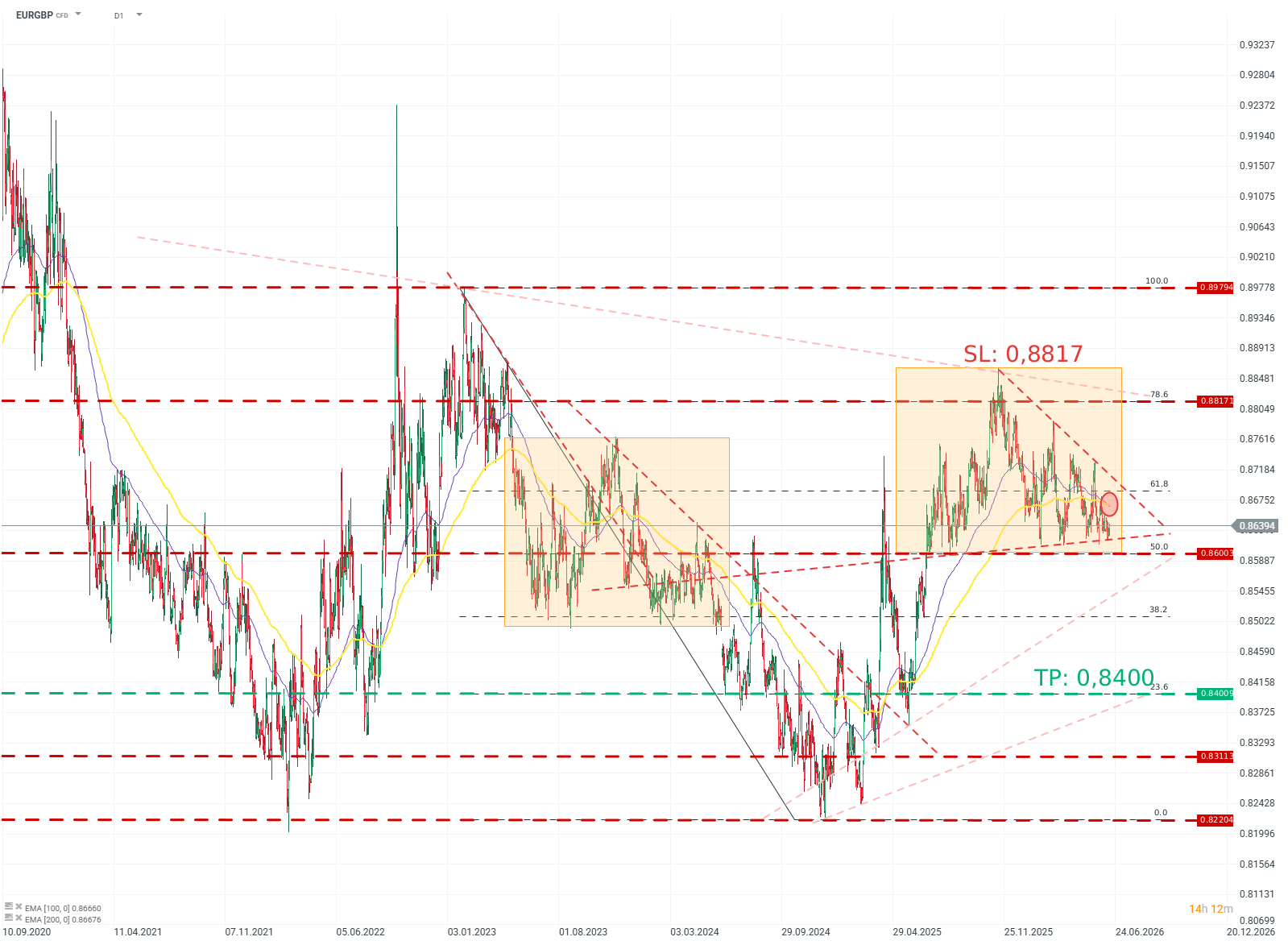
Trade of The Day – EUR/GBP

Facts:

  • The price is near the lower boundary of a consolidation range between 0.886 and 0.861.
  • Upward corrections within the consolidation are breaking to increasingly lower levels, while at the same time testing resistance around 0.863.
  • The EMA100 has crossed the EMA200 from above.

Recommendation:

Short position (Sell) on EURGBP at the market price.

  • Target price (Take Profit; TP): 0.8400
  • Stop Loss (SL): 0.8817

EURGBP (D1)

Source: xStation5

OPINION :

The EURGBP rate is once again testing the lower boundary of the consolidation, which can also be treated as a developing 1:1 pattern, potentially ending with a downside breakout. The repeated defense of the ~0.86 level indicates the strength of this zone; however, increasingly weaker upward corrections within the consolidation reveal buyer weakness and point to the likely direction of further price movement.

Methodology and assumptions:

  • The recommendation is based on technical analysis of the chart, in particular EMA moving averages and Fibonacci levels.
  • The target level was determined based on Fibonacci levels.
  • The protective stop-loss order was set based on a favorable risk-to-reward ratio and with reference to a Fibonacci level.
Currency Hedger No Comments

Euro climbs above 1.1600 on USโ€“Iran peace breakthrough

  • EUR/USD edges higher to around 1.1610 in Mondayโ€™s early European session. 
  • The US and Iran announced a framework deal for peace. 
  • ECBโ€™s Nagel said the central bank is ready to hike again in July if necessary. 

The EUR/USD pair gains traction to near 1.1610 during the early European trading hours on Monday. The reports that the US and Iran have reached a deal to reopen the Strait of Hormuz improved risk sentiment, supporting the Euro (EUR) against the US Dollar (USD). The US Federal Reserve (Fed) interest rate decision will be in the spotlight later on Wednesday. 

Washington and Tehran have announced a framework deal for peace, which will be signed in Switzerland on Friday. US President Donald Trump said the US is lifting its naval blockade on Iranian ports and that the Strait of Hormuz will reopen after the agreement is signed.

The Fed is widely expected to keep its benchmark interest rate unchanged at a target range of 3.50% to 3.75% at its upcoming policy meeting on Wednesday. Traders will closely monitor the press conference and take more cues about how new Fed chair Kevin Warsh will lead the US central bank into its next era. Any hawkish remarks from Fed officials could lift the Greenback and act as a headwind for the major pair. 

Last week, the European Central Bank (ECB) hiked its key interest rates, saying โ€œthe war in the Middle East is generating inflation pressures.โ€ This marks the first rate increase since September 2023, after seven consecutive meetings where interest rates were kept on hold.  

ECB Governing Council member Joachim Nagel said on Friday that the central bank is prepared to raise interest rates for a second straight meeting in July, if the shock from the war in the Middle East requires it. 

Currency Hedger No Comments

Euro: Seen drifting toward 1.1400 against US Dollar โ€“ BBH

Brown Brothers Harrimanโ€™s Elias Haddad reports that EUR/USD briefly dipped toward 1.1500 after the ECB decision before rebounding on the US-Iran breakthrough. Haddad expects EUR/USD to edge lower and stabilize closer to 1.1400 as US growth outperforms the Eurozone. The ECBโ€™s 25 bps hike and hawkish inflation stance are seen cushioning, but not reversing, Euro downside.

Euro pressured by weaker growth outlook

“EUR/USD dipped towards 1.1500 following yesterdayโ€™s ECB policy decision before rebounding to a high of 1.1590 driven by the positive US-Iran breakthrough. We expect EUR/USD to edge lower and stabilize closer to 1.1400, reflecting a stronger US growth outlook relative to the Eurozone. ECB rate hikes in a sluggish growth, high inflation environment, is not bullish for EUR but should help cushion the downside”

“As was widely expected, the ECB raised the policy rate 25

Currency Hedger No Comments

Euro steadies against British Pound following UK GDP, German HICP inflation data

  • EUR/GBP remains subdued following the release of data from the UK and Germany.
  • UK GDP contracted by 0.1% month-on-month in April, meeting market forecasts after a 0.3% expansion in March.
  • German May HICP inflation met forecasts, landing at 2.7% year-on-year.

EUR/GBP inches lower after two days of gains, trading around 0.8630 during the Asian hours on Friday. The currency cross remains subdued following the release of economic data from the United Kingdom (UK) and Germany.

The UK Gross Domestic Product (GDP) contracted by 0.1% MoM in April, following a 0.3% rise reported in March. The market forecast was for a 0.1% decline in the same period. Meanwhile, the Index of Services (April) rose 0.8% 3M/3M versus Marchโ€™s 0.8%. Meanwhile, monthly Industrial Production came in at 0% MoM in April, while Manufacturing Production increased by 0.4% during the same period.

Money markets are currently pricing in at least a 25-basis-point interest rate hike by the Bank of England (BoE) this coming September, with a strong probability of a second increase before the end of the year. This potential tightening comes amid broader economic challenges, as political uncertainty surrounding the leadership of the Labour Party continues to weigh on investor sentiment and compound the current downturn.

Over in the Eurozone, inflation data met forecasts as Germanyโ€™s revised Harmonized Index of Consumer Prices (HICP) for May landed at 2.7% year-on-year. On a monthly basis, HICP growth experienced a slight contraction of 0.1%.

The European Central Bank (ECB) took aggressive action on Thursday by raising interest rates for the first time in nearly three years. The central bank also signaled a prolonged hawkish stance, indicating that restrictive monetary policy will likely remain firmly in place through 2027.

Currency Hedger No Comments

Euro: Complex rate path questions for EUR โ€“ Commerzbank

Commerzbankโ€™s Thu Lan Nguyen notes the European Central Bank sounded slightly hawkish, but investors already price in two further hikes, leaving the Euro softer after President Lagarde avoided clear guidance. Nguyen argues whether hikes come in July or later still matters, as an earlier move would signal urgency, yet markets may see rapid tightening as a policy mistake and price in future cuts, limiting Euro support.

ECB timing debate clouds Euro outlook

“Basically, things turned out just as my colleague Michael had predicted in the morning: in our view the ECB sounded slightly hawkish yesterday. But that was not enough to lure investors out of hiding who are already pricing in two further rate hikes by the end of the year anyway. Accordingly, the euro ultimately edged slightly lower, as President Lagarde avoided sending a clear signal in favour of further rate hikes.”

“This was probably not the main reason for the upward move in EUR/USD over the course of yesterdayโ€™s trading โ€“ the decisive factor here was US President Trumpโ€™s statement that he had called off another military strike against Iran because a deal was virtually in the bag. However, it is likely to have contributed to positive euro sentiment. After all, the discussion shows that a rate hike in July is at least on the table.”

“One might argue: whether the next two rate hikes expected by the market take place in July and September, or in September and December, hardly makes a big difference and is therefore irrelevant for the euro. But it is not quite that simple. A second rate hike as early as July would suggest a certain urgency behind the tightening and would therefore have a somewhat hawkish flavour.”

“If the market shares this view, it is likely to price in a rapid correction in rates downwards at the long end, which would dilute โ€“ if not completely negate โ€“ the positive effect of the rate hike for the euro. So: the debate about the timing of the next rate hike is by no means irrelevant. The situation is more complex than it appears at first glance