Currency Hedger No Comments

EUR/GBP posts modest gains above 0.8650 ahead of Eurozone, UK PMI releases

  • EUR/GBP posts modest gains near 0.8675 in Thursdayโ€™s early European session.ย 
  • The UK CPI inflation climbed to 3.3%YoY in March, driven by higher fuel costs due to the Iran war.
  • ECB’s Simkus said the central bank shouldn’t raise interest rates in April.

Theย EUR/GBPย cross trades with mild gains around 0.8675 during the early European session on Thursday. However, the potential upside for the cross might be limited due to hot UK inflation data. Traders will keep an eye on the preliminary readings of the Purchasing Managers Index (PMI) from theย Eurozoneย and the United Kingdom (UK).ย 

Data released by the Office for National Statistics (ONS) on Wednesday showed that the UK headline Consumer Price Index (CPI) inflation rose to 3.3% YoY in March, compared to 3.0% in February. This increase marks the first official reflection of the US-Israel war with Iran on the UK’s cost of living. The core CPI, excluding volatile food and energy items, climbed 3.1% YoY in March, versus 3.2% prior, below the forecast of 3.2%.

The Bank of England (BoE) is expected to hold the base rate at 3.75% at its next meeting on April 30, though the jump in inflation has fueled speculation of potential future hikes or delayed cuts.

The European Central Bank (ECB) officials are leaning toward leaving interestย ratesย unchanged at the April policy meeting.ย ECBย Governing Council member Martins Kazaks said on Wednesday that the central bank has โ€˜luxuryโ€™ to wait on interest rate rises.ย 

Meanwhile, ECB policymaker Gediminas Simkus reiterated the cautious stance regarding the ECB’s monetary policy, saying that while a rate hike in April is unlikely, the door remains open for policy tightening later this year. While a hold is expected in the April policy meeting, Barclays analysts anticipate the focus to shift toward potential 25 basis point (bps) hikes in June and September to combat an energy-driven inflation surge.

Currency Hedger No Comments

When are the German/ Eurozone flash HCOB PMIs for April and how could they affect EUR/USD?

German/ Eurozone flash PMIs Overview

The preliminary German and Eurozone flash HCOB Purchasing Managersโ€™ Index (PMI) data for April is due for release today at 07:30 and 08:00 GMT, respectively.

Amongst the Euro area economies, the German and the compositeย Eurozoneย PMI reports hold more relevance, in terms of their impact on the European currency and the related markets as well.

The flash Composite PMI for Germany is expected to have expanded again, but at a moderate pace due to a slowdown in both the manufacturing and the services sectors. The Composite PMI is seen arriving lower at 51.1 from 51.9 in March.

Germanyโ€™s Manufacturing PMI is expected to have fallen to 51.3 from the previous reading of 52.2. Meanwhile, the Services PMI is estimated to have dropped to 50.3 from the prior release of 50.9.

The forecast for the Eurozone flash Composite PMI for April also shows that the overall private sector output expanded at a moderate pace. Eurozoneโ€™s manufacturing output growth slowed down, and the services sector activity contracted. A figure below the 50.0 threshold is considered a contraction in the economic activity.

According to preliminary estimates, the Eurozone Composite PMI drops to 50.2 from 50.7 in March. Theย Manufacturing PMIย is seen arriving lower at 50.8 from the prior release of 51.6. The Services PMI is expected to have contracted to 49.8 after slowing down to 50.2 in March.

How could German/ Eurozone flash PMIs affect EUR/USD?         

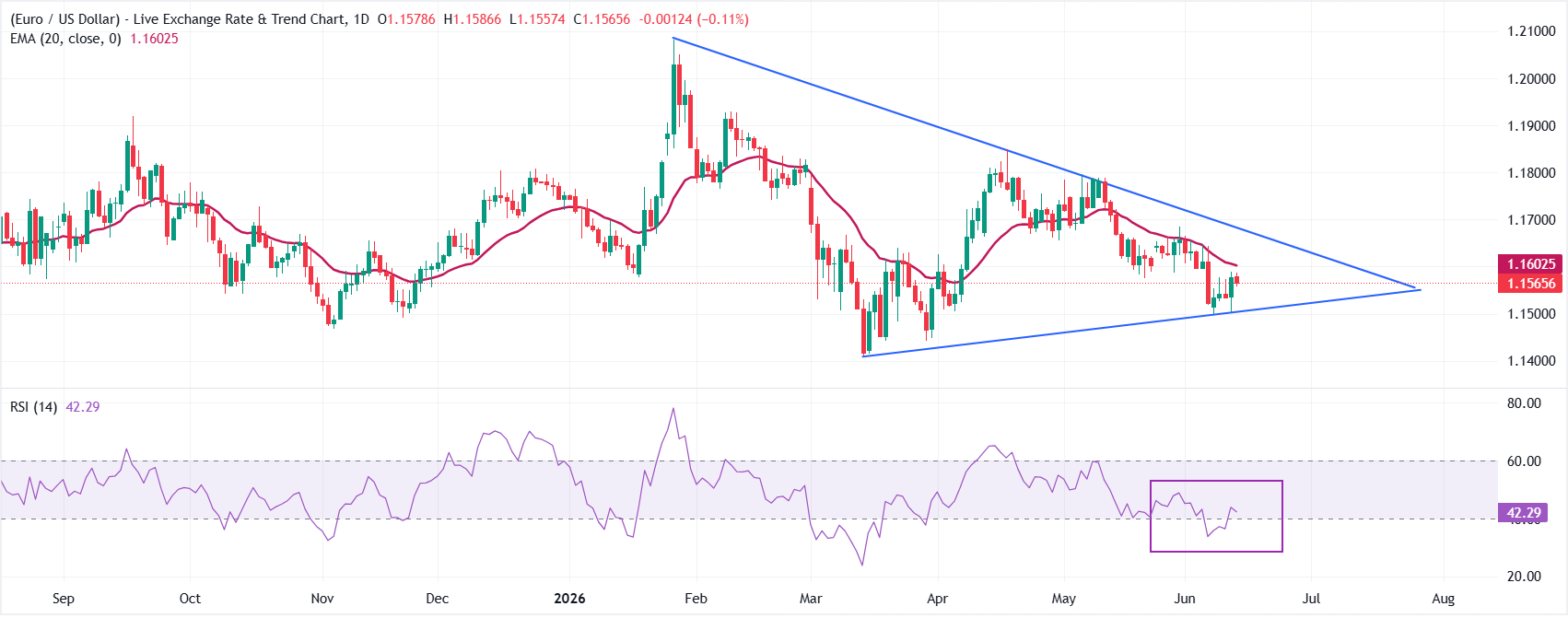
EUR/USDย is marginally down to near 1.1700 during the early European trade on Thursday. The pair has corrected to near the 20-period exponential moving average (EMA), which is at 1.1691, but sits north of the 38.2%ย Fibonacciย retracement at 1.1666 of the 1.1408โ€“1.2082 swing, suggesting underlying demand on shallow pullbacks.

The Relative Strength Index (RSI) falls into the 40.00-60.00 zone after failing to hold above the 60.00 level, indicating balanced momentum with an upside bias.

On the topside, initial resistance is located at the 50% Fibonacci retracement at 1.1745; a daily close above this barrier would expose the 61.8% retracement at 1.1825, followed by 1.1938 and the cycle high region near 1.2082. On the downside, immediate support is provided by the 20-period EMA at 1.1691, ahead of the 38.2% retracement at 1.1666; a deeper setback would bring the 23.6% level at 1.1567 into view, with more important structural support down at the 1.1408 swing low.

Currency Hedger No Comments

EUR/USD: PMI signals and softer pair โ€“ Danske Bank

Danske Research Team highlights that Euro area April flash PMIs (Purchasing Managers’ Index) are a key input ahead of the next European Central Bank (ECB) meeting, withย Manufacturing PMIย expected to drop below 50 while Services PMI holds at 50.2. The bank notes unusually high uncertainty around the indices and stresses that price components will be crucial. In markets, EUR/USD has slipped back below 1.1700.

Euro PMIs and weaker currency tone

“Inย the euroย area, the April flash PMI report is released, a key input ahead of the ECB meeting. We expect the manufacturing PMI to show a steep decline from 51.6 to 49.6, driven by higher energy prices.”

“The surprise increase in the headline index in March was largely due to longer delivery times, which pose an upward risk to the headline number again. As such, monitoring the output sub-component will be crucial.”

“The services PMI fell more than expected in March to 50.2 and we expect it to remain at same level in April, as services are less directly hit than manufacturing. However, the uncertainty of the index is unusually high, so interpretation should be more cautious than usual.”

“Markets open on a weak foot with headlines from a locked-in stand-off over the SOH [Strait of Hormuz] dominating the news. Asianย equitiesย are down while US treasuries rise a couple of basis points this morning and EUR/USD falls back below 1.1700.”

Currency Hedger No Comments

EUR/JPY falls to near 186.50 as risk aversion increases on Middle East uncertainty

  • EUR/JPY falls as the Euro weakens amid rising risk aversion from US-Iran truce uncertainty.
  • Iran fired on three ships in the Strait of Hormuz, escorting two into Iranian waters on Wednesday.
  • Traders expect BoJ to hold rates this month, but signal possible policy normalization as early as June.

EUR/JPY remains subdued for the third successive day, trading around 186.60 during the Asian hours on Thursday. The currency cross loses ground as the risk-sensitive Euro (EUR) faces challenges amid increasedย risk aversionย due to ongoing Middle East uncertainty.

The Wall Street Journal reported that Iran fired on three ships in the Strait of Hormuz and escorted two of them into Iranian waters on Wednesday. Iranian media reported that the paramilitary Revolutionary Guard was moving the vessels to Iran, marking a further escalation, although White House press secretary Karoline Leavitt said the seizures did not breach the terms of the ceasefire.

Iran continues to assert control over the Strait of Hormuz, restricting transit and targeting vessels. Iranian parliament speaker and chief negotiator Mohammad Bagher Ghalibaf stated that reopening the strait would be โ€œimpossibleโ€ while the United States (US) and Israel persist with what he described as โ€œflagrantโ€ ceasefire violations, including the US naval blockade. Meanwhile, President Donald Trump said the current truce would remain in place indefinitely as Washington awaits a renewed peace proposal from Tehran.

The downside of the EUR/JPY cross could be restrained as the Japanese Yen (JPY) loses ground amid higher oil prices, reflecting Japanโ€™s significant reliance on Middle East crude imports. West Texas Intermediate (WTI) rises for the third consecutive day, trading around $93.30 per barrel at the time of writing.

In Japan, focus has turned to next weekโ€™s Bank of Japan (BoJ) policy meeting as officials navigate uncertainty from the regional conflict. Traders expect the BoJ to leave interestย ratesย unchanged this month, though it may hint at a potential shift back toward policy normalization as early as June.

Currency Hedger No Comments

EUR/USD slips as Hormuz tensions persist despite Iran ceasefire extension

  • EUR/USD weakens as Strait of Hormuz tensions offset Iran ceasefire extension.
  • US naval blockade and stalled peace talks keep geopolitical risks elevated.
  • Elevated Oil prices and Fed outlook support the US Dollar, capping EUR/USD upside.

The Euroย (EUR) weakens against the US Dollar (USD) on Wednesday, as ongoing tensions in the Strait of Hormuz offset the impact of the US-Iran ceasefire extension, keeping the Greenback supported.

At the time of writing, EUR/USD is trading around 1.1712, extending losses for the second straight day. Meanwhile, the US Dollar Index (DXY), which tracks the Greenbackโ€™s value against a basket of six major currencies, is trading around 98.57, near a one-week high.

Iranโ€™sย Islamicย Revolutionary Guard Corps (IRGC) said it has seized two ships in the Strait of Hormuz, according to Iranian media. The development follows earlier reports of two vessels and a third ship coming under attack in the strategic waterway, according to the UK Maritime Trade Operations (UKMTO).

The escalation comes as the US naval blockade remains in place after US President Donald Trump extended the ceasefire with Iran just hours before its expiry. The move reflects Washingtonโ€™s strategy to maintain economic pressure on Tehran, while Iranian leaders have said the US must end the blockade if it wants to resume negotiations.

Trump said talks with Iran could take place as soon as Friday, according to the New York Post, while Iranโ€™s Tasnimย Newsย Agency reported that Tehran has not yet decided whether to participate.

With key differences remaining over nuclear and missile issues, markets view the ceasefire as a temporary pause in military escalation, suggesting the conflict may not end anytime soon. This is limiting downside in the US Dollar and capping EUR/USDโ€™s upside after a corrective rebound earlier this month.

Meanwhile, Oil prices remain elevated, keeping inflation risks in focus and shaping central bank expectations. Investors expect theย Federal Reserveย (Fed) to keep interestย ratesย higher for longer, while markets are pricing in the possibility of European Central Bank (ECB) rate hikes.

On the data front, theย US economic calendarย is largely empty on Wednesday, leaving markets driven by geopolitical headlines. In theย Eurozone, preliminary Consumer Confidence for April dropped to -20.6 from -16.3 previously, marking its lowest level in over three years and pointing to weakening household sentiment amid ongoing geopolitical tensions and higher energy prices.

Currency Hedger No Comments

Trade of The Day: EUR/USD

Key takeaways

  • How does the technical situation on EURUSD looks like?

Facts:

  • EURUSD is trading in an upward move from mid-March
  • The pair bounced off the horizontal support at 1.1725 USD
  • The pair is trading above the 100 – period moving average form H4 interval

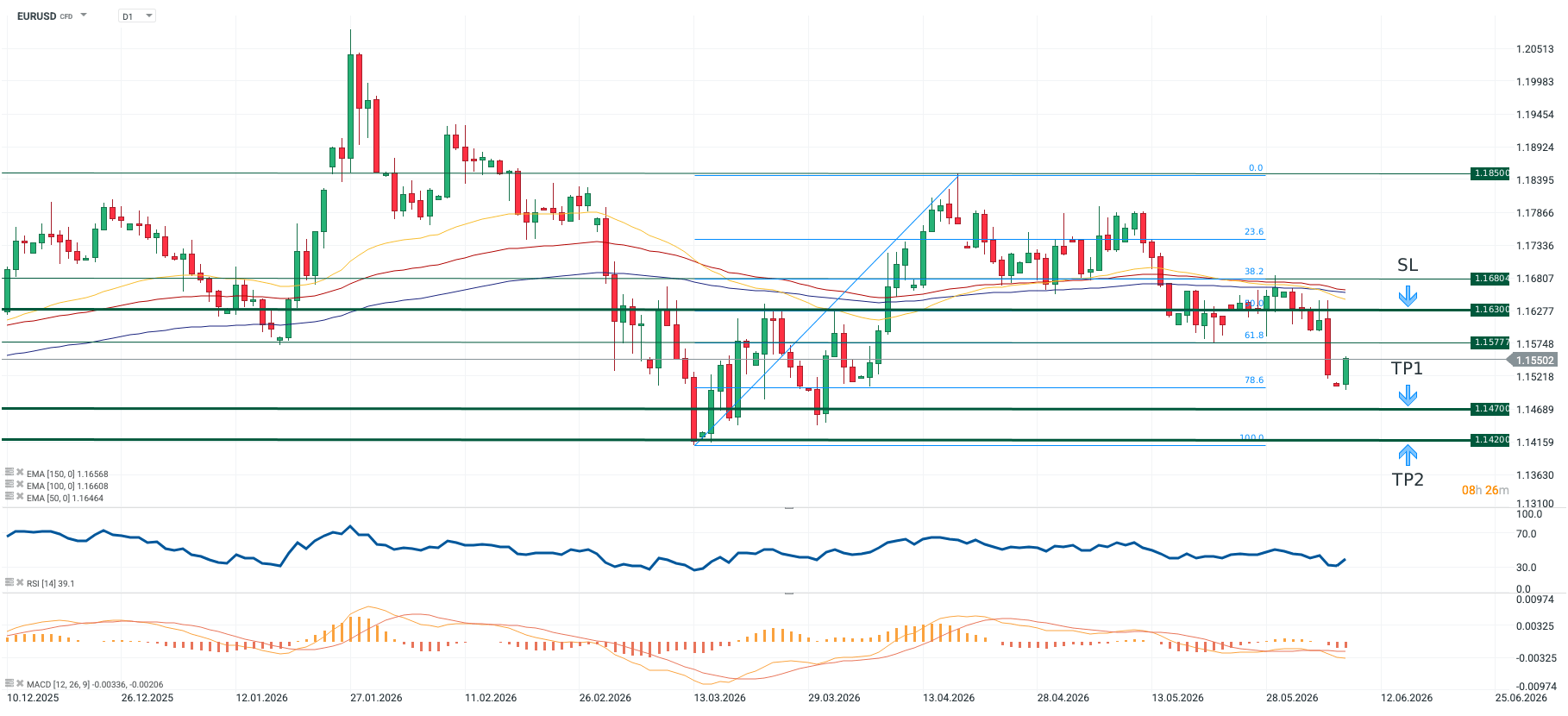
Recommendation: Trade: Long position on EURUSD at market price Target: 1.1833, 1.1884 Stop: 1.1680

Opinion: Looking at EURUSD at the H4 interval, we can see that the main sentiment on the pair is bullish. However, a downward correction has occurred recently, which has brought the pair down to the key support at 1.1725 USD. The support is a result of previous reactions as well as a lower limit of 1:1 structure. According to the Overbalance strategy, as long as the price sits above 1.1725 support, the main trend remains upward. We recommend going long EURUSD at market price with two targets: 1.1833 and 1.1884. We also recommend placing a stop loss order at 1.1680. Source: xStation5

Currency Hedger No Comments

EUR/CAD steadies below 1.6050 as improved oil prices lift Canadian Dollar

  • EUR/CAD holds losses as the Canadian Dollar gains on improved oil prices.
  • Maritime authorities said an IRGC-linked gunboat fired on a Liberia-flagged vessel and two other cargo ships.
  • ECBโ€™s Lagarde warns Eurozone outlook is highly uncertain due to a significant energy supply shock.

EUR/CAD extends its losing streak for the sixth consecutive day, trading around 1.6040 during the European hours on Wednesday. The currency cross stays subdued as the Canadian Dollar (CAD) draws support from a stronger risk-on mood after US President Donald Trump extended the ceasefire despite the collapse of second-round USโ€“Iran talks.

Moreover, the commodity-linked CAD is further supported by firmer oil prices amid renewed attacks on shipping near Iran. Maritime authorities reported that a Liberia-flagged container vessel was fired upon by a gunboat linked to Iranโ€™sย Islamicย Revolutionary Guard Corps, while two additional outbound cargo ships were also targeted.

However, a Bloomberg headline, citing Tasnimย Newsย Agency affiliated with the IRGC, noted that Iran has received โ€œsome signโ€ the United States (US) may be willing to ease its naval blockade.

The Canadian Dollar may continue to gain as rising energy prices could boost foreign exchange inflows into Canadaโ€™s financial system, reflecting the countryโ€™s status as the largest crude exporter to the United States. Higher energy costs could also lift inflation, potentially prompting the Bank of Canada (BoC) to signal a firm stance against persistent price pressures, further underpinning the currency.

European Central Bank (ECB) Presidentย Christine Lagardeย warned that theย Eurozoneย outlookย remains highly uncertain due to a significant energy supply shock tied to Middle East tensions and the Strait of Hormuz blockade. While energy prices have yet to reach worst-case levels, she stressed that the outlook remains fragile.

Currency Hedger No Comments

EUR/GBP remains depressed below 0.8700 after hot UK CPI figures

  • EUR/GBP extends losses for the second consecutive day and trades below 0.8700.
  • UK consumer price figures confirm the inflationary impact of the US-Iran war.
  • In the Eurozone, ECB speakers, including President Lagarde, will grab some attention later in the day.

The Euroย (EUR) is heading south for the second consecutive day against theย British Poundย (GBP) on Wednesday, trading near session lows below 0.8700, as UK inflation figures put pressure on the Bank of England to bring the possibility of an interest rate hike back to the table.

Data released by the Office for National Statistics earlier on Wednesday showed that the UK Consumer Prices Index (CPI) accelerated to a 3.3% year-on-year (YoY) rate in March. These figures follow two consecutive months of prices growing steadily by 3% YoY, and highlight the inflationary impact of the Middle East war.

The monthly CPI accelerated by 0.7%, its highest level in almost one year, beating expectations of a 0.6% increase, and following a 0.4% gain in February.

Likewise, producer and retail prices have increased beyond forecasts. The Input Producer Prices Index (PPI) surged 4.4% in March and 5.4% year on year. Retail prices rose 0.8% from February and 4.1% over the last 12 months, both above market expectations of 0.7% and 3.9%, respectively.

The Bank of England (BoE) meets on April 30 and is widely expected to keep interestย ratesย unchanged. The upside risks to inflation, however, are likely to give hawkish committee members grounds to call for some monetary tightening down the road.

In theย Eurozone, the focus on Wednesday will be on a slew of European Central Bank (ECB) speakers, including Presidentย Christine Lagarde, later in the day. The ECB is also expected to keep its monetary policy on hold at its April meeting, and therefore, they are likely to stick to the mantra of waiting for further economic data.