
The pound fell back below $1.34, retreating from three-week highs, as investors reacted to rising Middle East tensions. Oil prices surged following another wave of US strikes on Iran, with both sides clashing over the status of the Strait of Hormuz. The US Central Command confirmed strikes on dozens of targets to curb Iran’s ability to threaten shipping in the region, while Iran declared the strait would remain closed “until further notice.” The resulting uncertainty amplified inflation concerns, prompting investors to increase bets on further Bank of England interest rate hikes. Markets now anticipate at least one rate increase later this year, with a possibility of a second. Politically, Andy Burnham is set to become the new Labour party leader when the leadership contest ends on Friday and is expected to be officially appointed as prime minister next Monday. Sterling’s resilience amid recent political turmoil suggests much of the negative news has already been factored in.
British Pound gains traction above 1.3400 as markets bet on BoE rate hikes
- GBP/USD gains ground to near 1.3430 in Friday’s Asian session.
- Andy Burnham is set to become the next UK Prime Minister on July 20.
- Iranian officials have reported multiple explosions in the country’s south, including near the Bushehr nuclear facility.
The GBP/USD pair gathers strength to around 1.3430 during the Asian trading hours on Friday. The British Pound (GBP) edges higher against the US Dollar (USD) on the UK government leadership transition and growing expectations of further Bank of England (BoE) interest rate hikes.
Andy Burnham’s path to becoming the next UK prime minister looks certain after a vast majority of Labour MPs formally nominated him to be the next party leader. Bloomberg reported on Thursday that 322 of 403 Labour members of Parliament voted for Burnham at the end of the first day of the party’s leadership contest to replace Keir Starmer. Burnham is expected to formally become Prime Minister on July 20.
Traders increased bets on BoE interest rate hikes amid escalating tensions between the US and Iran. Markets are now fully pricing in a 25 basis points (bps) BoE rate hike by year-end, most likely in December, according to Reuters.
Renewed tensions in the Middle East could boost a safe-haven currency such as the Greenback and cap the upside for the major pair. US forces struck several more locations in coastal Iran on Thursday, according to Iranian state media, though the US did not confirm carrying out the attacks. Iranian officials and state media have reported multiple explosions in the country’s south, including near the Bushehr nuclear facility.
EUR/GBP Price Languishes below 0.8550 with bullish attempts subdued
- EUR/GBP treads water around 0.8530, a few pips above one-year lows, at 0.8519.
- German Trade Balance surplus beat expectations in May, yet with no impact on the Euro.
- Rising geopolitical tensions and higher Oil prices are keeping Euro bulls subdued.
The Euro (EUR) keeps treading water right above one-year lows against the British Pound (GBP) on Thursday. The EUR/GBP is trading flat in the area of 0.8530 at the time of writing, weighed by rising tensions between the US and Iran and the rebound in oil prices.
In the Eurozone, German Trade Balance data beat expectations with a EUR 19.1 billion surplus in May, from the 14.5 billion surplus seen in April, as exports grew against expectations. The data, however, has failed to provide any significant support to the Euro.
Meanwhile, the US has launched a new round of attacks in Iran, which targeted US bases in Gulf countries in retaliation. US President Donald Trump said on Wednesday that the ceasefire was over, and Crude prices have bounced up nearly10% with Brent Oil hitting the $80 level on Wednesday, after bottoming near $70.00 last week.
Technical Analysis: EUR/GBP bears have lost momentum
EUR/GBP shows a bearish near-term tone, although sellers seem to have lost momentum. The Relative Strength Index (14), now near 28, highlights a bullish divergence, while the Moving Average Convergence Divergence (MACD) indicator stabilizes around the zero line, hinting at consolidation rather than a decisive bullish reversal.
Bulls, however, must break above the previous yearly low, at 0.8533 (Jul 7 low), and the top of the descending wedge pattern from mid-June highs, now around 0.8555, to confirm a bullish correction.
On the downside, below the mentioned Wednesday’s low at 0.8519, the confluence of the wedge bottom and late June 2025 lows, just above 0.8500, is likely to test bulls. Further down, there is no clear support until the early June 2025 lows, in the area of 0.84100.8863.
Euro Price This week
The table below shows the percentage change of Euro (EUR) against listed major currencies this week. Euro was the strongest against the Japanese Yen.
| USD | EUR | GBP | JPY | CAD | AUD | NZD | CHF | |
|---|---|---|---|---|---|---|---|---|
| USD | 0.03% | -0.46% | 0.65% | -0.20% | -0.03% | -0.32% | 0.38% | |
| EUR | -0.03% | -0.51% | 0.61% | -0.26% | -0.03% | -0.39% | 0.30% | |
| GBP | 0.46% | 0.51% | 1.00% | 0.26% | 0.47% | 0.13% | 0.82% | |
| JPY | -0.65% | -0.61% | -1.00% | -0.87% | -0.55% | -0.93% | -0.28% | |
| CAD | 0.20% | 0.26% | -0.26% | 0.87% | 0.30% | -0.07% | 0.56% | |
| AUD | 0.03% | 0.03% | -0.47% | 0.55% | -0.30% | -0.36% | 0.33% | |
| NZD | 0.32% | 0.39% | -0.13% | 0.93% | 0.07% | 0.36% | 0.69% | |
| CHF | -0.38% | -0.30% | -0.82% | 0.28% | -0.56% | -0.33% | -0.69% |
The heat map shows percentage changes of major currencies against each other. The base currency is picked from the left column, while the quote currency is picked from the top row. For example, if you pick the Euro from the left column and move along the horizontal line to the US Dollar, the percentage change displayed in the box will represent EUR (base)/USD (quote).
GBP/USD Price – Holds a constructive bullish tone above 1.3400 as UK political risk eases
- GBP/USD gathers strength to near 1.3405 in Thursday’s early European session.
- The pair maintains constructive bias, with a mildly bullish RSI momentum.
- The first upside barrier emerges at 1.3470; the initial support level to watch is 1.3300.
The GBP/USD pair trades in positive territory around 1.3405 during the early European trading hours on Thursday. Fading political uncertainty in the United Kingdom (UK) provides some support to the British Pound (GBP) against the US Dollar (USD).
Following the resignation of Keir Starmer in late June, UK political risk has eased significantly. The formal race to replace outgoing Prime Minister Keir Starmer begins on July 9. Frontrunner Andy Burnham is widely expected to become Prime Minister by July 20.
Technical Analysis:
In the daily chart, GBP/USD holds a mildly bullish near-term bias as price sits above the Bollinger middle band and the 100-day simple moving average (SMA). The pair is pressing the upper half of the recent range, with the Bollinger Bands (20, 2) still widening modestly, while the Relative Strength Index (14) at 57.6 suggests constructive but not overextended upside momentum.
On the topside, initial resistance is aligned with the Bollinger upper band at 1.3470, where buyers could hesitate. On the downside, immediate support is provided by the Bollinger middle band near 1.3300, while a deeper pullback would likely be contained by the Bollinger lower band around 1.3130.
Dolar snaps back – the return of Middle East hostilities drains currency markets
ge market has turned defensive following a sudden escalation in the conflict between Iran and the United States. Iran’s attack on commercial vessels in the Strait of Hormuz brought an end to the month-long ceasefire that had been in place. As a result, the geopolitical risk premium has returned to the FX market, draining capital from most currencies and redirecting it toward the U.S. dollar. Timeline of the escalation: How did the memorandum collapse?
The renewed escalation followed the sequence of events below:
- Signing of the memorandum: Last month, the United States and Iran reached a temporary 60-day agreement. The deal guaranteed safe, toll-free passage for ships through the Strait of Hormuz in exchange for the temporary suspension of U.S. sanctions on Iranian oil exports and the launch of negotiations over Tehran’s nuclear program.
- Iran attacks commercial vessels (beginning of the escalation): Iran violated the agreement by targeting three commercial ships transiting the Strait of Hormuz, including an LNG tanker carrying liquefied natural gas.
- U.S. retaliation: In response to the attacks on commercial shipping, U.S. forces launched a large-scale retaliatory strike against more than 80 targets across Iran. Washington also immediately reinstated sanctions on Iranian oil trade.
- Iranian counterattack: Tehran responded with another wave of strikes, this time targeting sites in Bahrain and Kuwait.
- Official end of the ceasefire: Speaking to reporters during the NATO summit in Ankara, Donald Trump ended any speculation by declaring that the ceasefire was over (“as far as I’m concerned, it’s over”). The President sharply criticized the Iranian leadership, calling them “scum” and “liars,” effectively ruling out any near-term return to diplomacy.
FX market reversal: Risk aversion weighs on emerging-market currencies
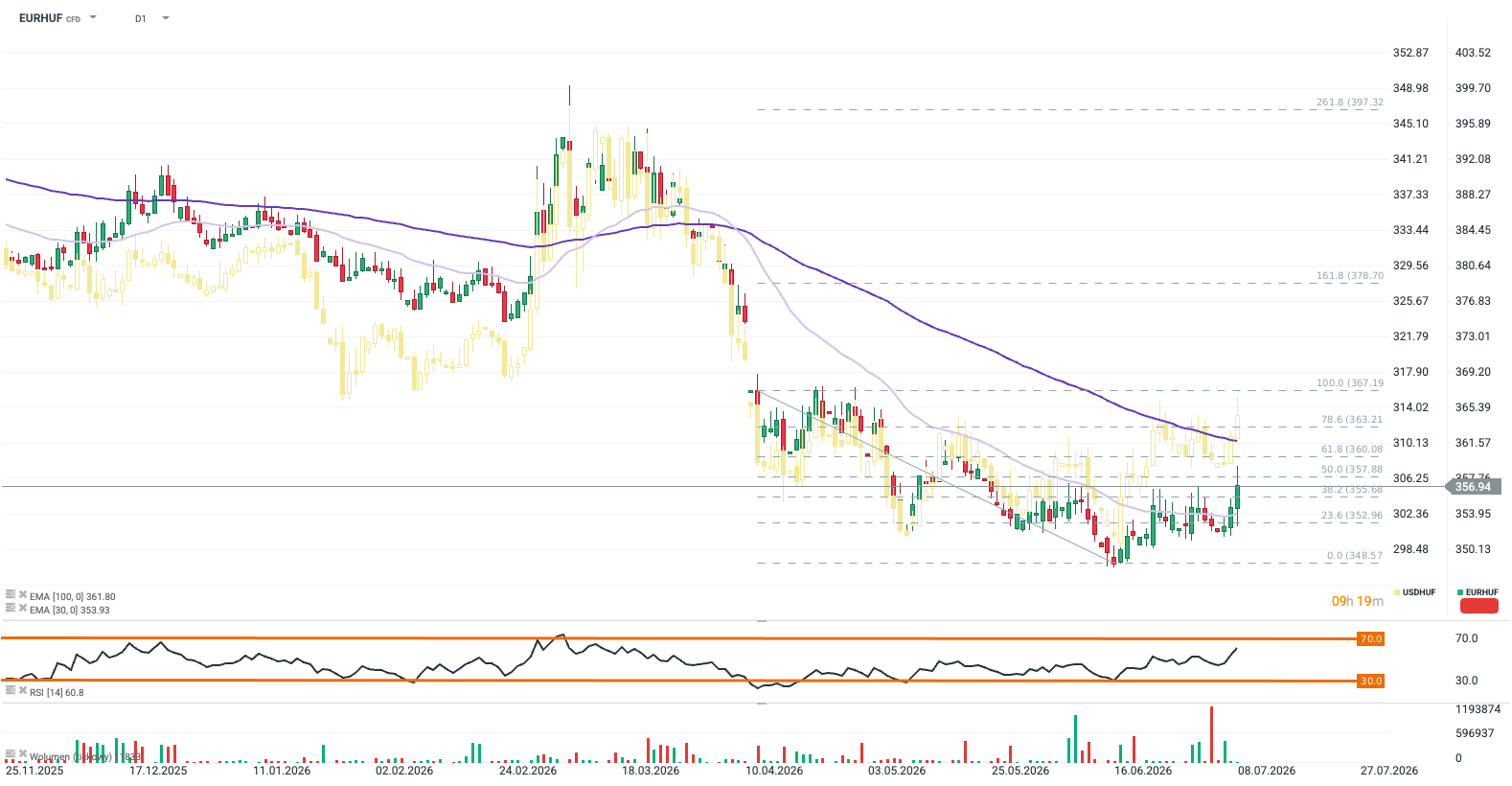
Smaller emerging-market currencies are the biggest losers of today’s session, rapidly surrendering the gains accumulated during the past several weeks of relative geopolitical calm. The Hungarian forint is the weakest performer today ( EUR/HUF: +0.85%, USD/HUF: +1.0% ), falling to a two-month low against the euro and a three-month low against the U.S. dollar. However, the forint entered this new phase of the Middle East conflict from a position of considerable strength, retreating from multi-year highs reached on the back of investor optimism following Peter Magyar’s party’s victory in the parliamentary elections. For the HUF, the current move may represent a justified correction after most positive developments had already been priced in. Any further appreciation will likely depend on more structural improvements in the Hungarian economy, particularly stronger foreign direct investment. Alongside the forint, the South African rand (USD/ZAR: +0.6%, EUR/ZAR: +0.4%) and the Indian rupee (USD/INR: +0.5%) are also posting broad losses. India remains directly dependent on crude oil shipments passing through the Strait of Hormuz, while South Africa relies heavily on refined petroleum products. Meanwhile, the Polish zloty is down around 0.3% against both the euro and the U.S. dollar.
Chart 1: EUR/HUF and USD/HUF exchange rates (yellow)
Source: xStation5
EUR/USD: Bears regain the upper hand
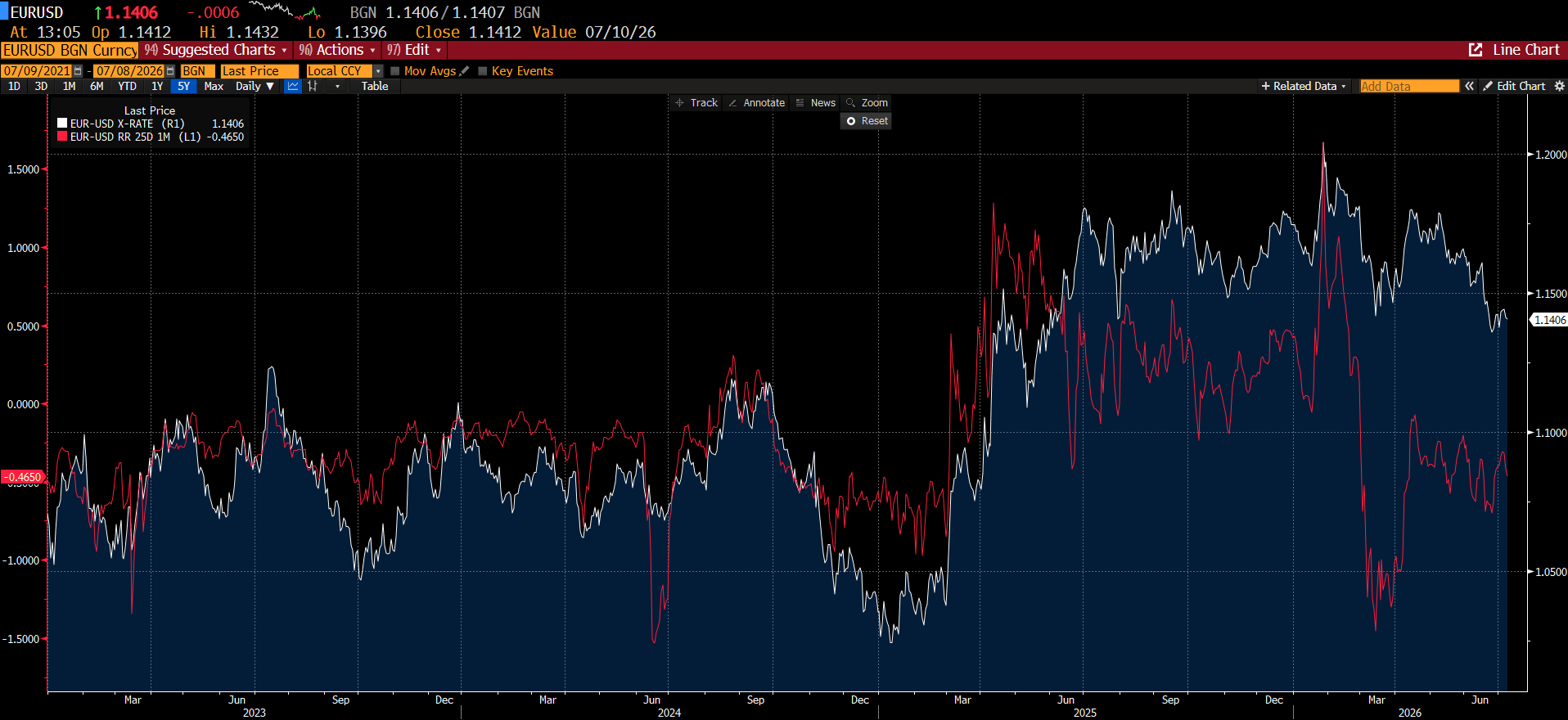
The increase in risk aversion is also weighing on the broader G10 currency complex. The only notable exceptions are the New Zealand dollar , supported by the Reserve Bank of New Zealand’s recent rate hike to 2.50% and hawkish remarks from the RBNZ Governor, and the Norwegian krone , which continues to benefit from renewed upward pressure on oil prices. The resumption of hostilities in the Middle East has effectively erased a week’s worth of gains on EUR/USD. The world’s most traded currency pair has declined by roughly 0.4% since yesterday and, despite relatively flat trading today, remains vulnerable to further downside. This is especially true given that the European Central Bank is unlikely to respond with the kind of reactive hawkish rhetoric that would provide meaningful support for the euro. Options market participants are also increasingly hedging against further EUR/USD declines. The one-month Risk Reversal indicator has remained below zero almost continuously since March 2026, indicating that demand for EUR/USD put options exceeds demand for call options. In other words, investors are showing a greater preference for contracts that protect against further euro weakness.
Chart 2: One-month EUR/USD Risk Reversal and EUR/USD spot
Source: Bloomberg Finance LP
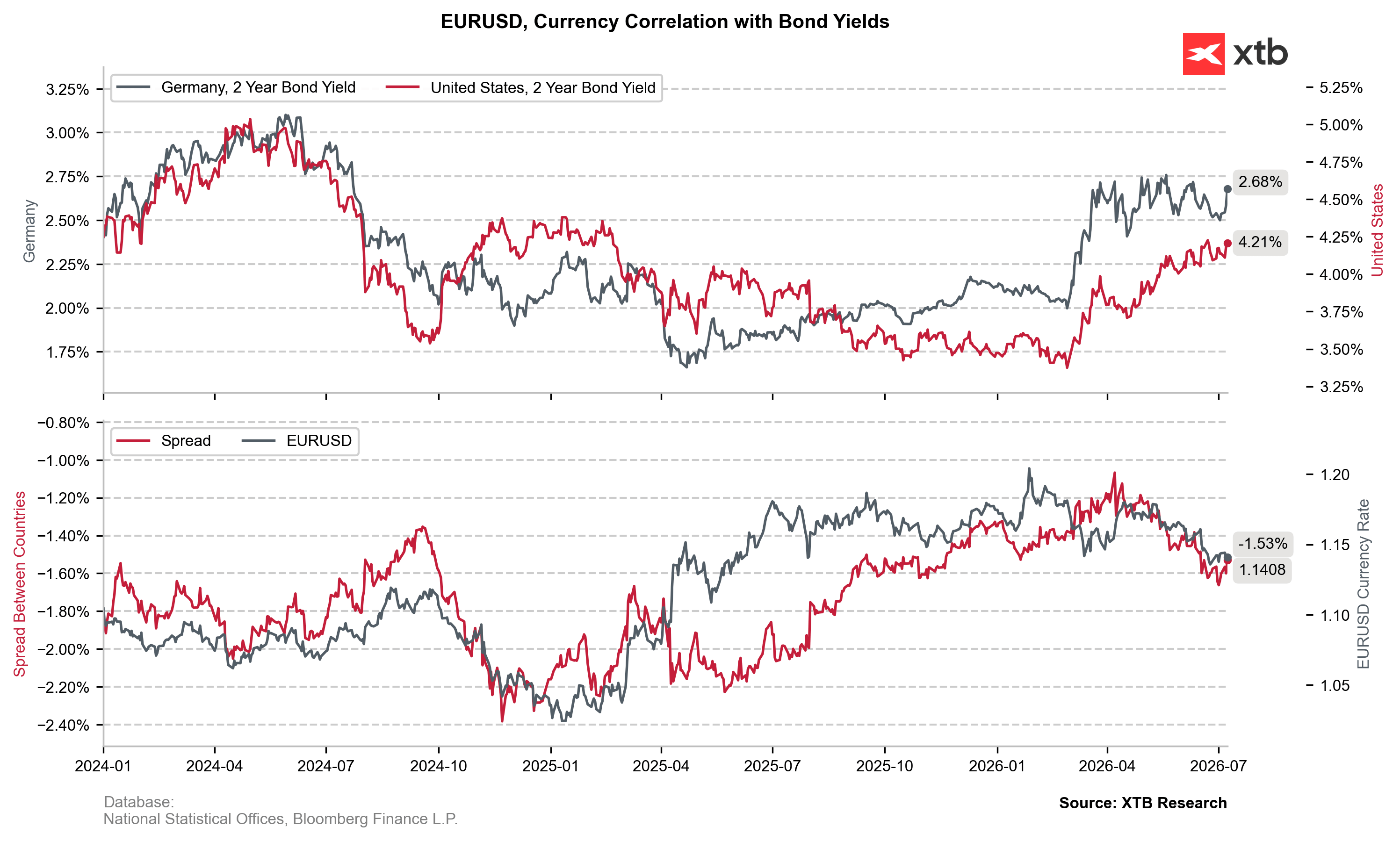
On the other hand, developments in the bond market may provide fundamental support for EUR/USD. Yields on two-year German government bonds have rebounded much more sharply (around +10 bps) than their U.S. counterparts, reflecting the euro area’s significantly greater sensitivity to a prolonged energy shock. If military tensions persist over the longer term, the ECB may be forced to adopt a more hawkish, inflation-focused stance. Even without additional rate hikes, such a shift in communication could help EUR/USD defend support around 1.1400. Chart 3: EUR/USD and the yield spread between two-year German and U.S. government bonds
Source: Bloomberg Finance LP
British Pound declines to near 1.3350 as US launches strikes on Iran
- GBP/USD softens to around 1.3355 in Wednesday’s Asian session.
- US launched strikes on Iran after tankers hit in Strait of Hormuz.
- Burnham is widely expected to become Prime Minister by July 20.
The GBP/USD pair loses traction to near 1.3355 during the Asian trading hours on Wednesday. The US Dollar (USD) edges higher against the British Pound (GBP) amid renewed geopolitical tensions after the US renewed strikes on Iran. The Federal Reserve’s (Fed) June meeting minutes will be published later on Wednesday.
Washington unleashed a new wave of strikes against Tehran on Tuesday and revoked a license allowing the country to sell oil after three tankers were attacked in the Strait of Hormuz, per Reuters. Geopolitical fears surge following this headline, supporting the Greenback as a safe-haven asset.
Westpac analysts said that concerns for the stability of the peace deal reemerged after Iran attacked ships crossing the Strait of Hormuz. “Concerns over the inflation outlook were in focus, seeing yields jump higher across the globe,” they wrote.
The formal race to replace outgoing Prime Minister Keir Starmer begins on July 9. Frontrunner Andy Burnham is widely expected to become Prime Minister by July 20. The Cable might receive some support as the UK political landscape stabilizes. Investors are pricing out the domestic risk premium as Burnham anchors his position as the leader-in-waiting to succeed Keir Starmer.
Euro languishes at one-year lows against the British Pound despite positive German data
- EUR/GBP holds losses around 0.8540, despite a sharp increase in German Industrial Production.
- Factory output rose 0.9% in Germany in May, beyond the 0.2% expected by the market.
- The Euro has dropped more than 1% in about a week, as markets pare back ECB tightening hopes.
The Euro (EUR) has failed to draw support from the upbeat German industrial figures released earlier on Tuesday and consolidates losses at one-year lows against the British Pound (GBP). The EUR/GBP pair trades at 0.8540, its lowest price since July last year, after falling from levels above 0.8600 last week.
Data released by the German statistics office on Tuesday showed that Industrial Production increased 0.9% in May, more than twice April’s 0.4% rise, and well above the 0.2% increase forecasted by the market analysts.
In the UK, the Lloyds House Price Index, released at the same time, has shown a 0.2% increase in June, following a 0.1% contraction in May, also beating expectations of a 0.1% rise. Year-over-year, housing prices accelerated to a 0.6% growth, from the 0.5% seen in May, according to the Lloyds report.
The Euro loses support from ECB’s monetary policy
The pair has depreciated more than 1% since last week, as soft German consumer price data suggested that inflationary pressures from the Middle East war might have already peaked, easing pressure on the European Central Bank (ECB) to hike interest rates in the near term.
ECB President Christine Lagarde refused to commit to any particular rate path at a central bankers’ summit in Sintra last week. Her comments pointing to levelled risks for growth and inflation and denying second-round effects on inflation, however, suggest that the bank is likely to stand pat in July after June’s rate hike.
This has deprived the Euro of the favourable monetary policy divergence between the ECB and the Bank of England (BoE), which is not expected to change its monetary policy in the coming months.