

GBP moves little as uncertainty prevails over US-Iran peace talks

March 26, 2026
  • GBP/USD steadies as the US Dollar holds firm amid ongoing uncertainty over efforts to end the Iran war.
  • Iranian officials are reviewing the US proposal but signaled no willingness to engage in talks with Washington.
  • UOB economist highlighted a hawkish BoE shift, holding the Bank Rate at 3.75% after a 9–0 vote.

GBP/USD remains flat after two days of losses, hovering around 1.3360 during the Asian trading hours on Thursday. The pair remains steady as the US Dollar (USD) holds firm, with traders closely tracking developments in the Middle East amid persistent uncertainty over efforts to end the Iran war.

The White House stated that talks are ongoing, with the Trump administration reportedly sending a 15-point proposal to Iran via Pakistan to resolve the conflict. Senior Iranian officials are reviewing the US proposal but have signaled no willingness to engage in talks with Washington. However, Tehran indicated it would reject a US ceasefire offer, instead putting forward a five-point plan that includes sovereign control over the Strait of Hormuz.

The Pound Sterling (GBP) may find support from easing oil prices amid hopes of de-escalating Middle East tensions. UK inflation data for February showed headline CPI steady at 3%, in line with expectations, while core CPI edged higher to 3.2%, surpassing the 3.1% forecast. However, these pre-conflict figures had a limited impact on market sentiment.

UOB economist Lee Sue Ann pointed to a hawkish shift by the Bank of England (BoE), with the Bank Rate held at 3.75% following a unanimous 9–0 vote. The report removes earlier expectations for three rate cuts in 2026, now projecting the GBP Repo Rate to remain at 3.75% through the fourth quarter of 2026 as inflation risks persist.

GBP/JPY holds above 213.00, eyes monthly high amid bearish JPY sentiment

March 26, 2026
  • GBP/JPY bulls move to the sidelines as intervention fears offer some support to the JPY.
  • Economic concerns stemming from the Iran war might cap any meaningful JPY move up.
  • The BoE’s hawkish outlook underpins the GBP and backs the case for some upside for the pair.

The GBP/JPY cross holds steady above the 213.00 mark during the Asian session on Thursday and remains close to a one-month peak, retested earlier this week. Moreover, the fundamental backdrop seems tilted in favor of bullish traders and suggests that the path of least resistance for spot prices is to the upside.

Investors remain worried that the war-driven surge in energy prices would weigh on Japan’s economic outlook and drive up inflationary pressures. This increases the risk of a “stagflationary” environment and might complicate the Bank of Japan’s (BoJ) normalization efforts. The outlook, in turn, has been a key factor behind the Japanese Yen’s (JPY) recent underperformance and continues to act as a tailwind for the GBP/JPY cross.

Meanwhile, BoJ Governor Kazuo Ueda said on Tuesday that he expects underlying inflation to accelerate moderately and added that he will guide monetary policy appropriately to stably achieve the inflation target, accompanied by wage gains. The JPY fails to gain any respite from Ueda’s hawkish comments amid economic concerns stemming from the Middle East conflict, though bears seem hesitant on the back of rising intervention fears.

In fact, Japan’s Vice Finance Minister for International Affairs and top foreign exchange official, Atsushi Mimura, said earlier this week that the government might consider taking measures on all fronts in foreign exchange (FX) volatility. Apart from this, the lack of any meaningful buying interest around the British Pound (GBP), amid a bullish US Dollar (USD), contributes to keeping a lid on any meaningful upside for the GBP/JPY cross.

That said, the UK Consumer Price Index (CPI) released on Wednesday reaffirmed the Bank of England’s (BoE) hawkish tilt and could act as a tailwind for the GBP. In fact, the BoE signaled last week a potential interest rate hike as early as April amid inflation fears. This, along with the underlying bearish sentiment surrounding the JPY, validates the near-term positive outlook and backs the case for an extension of over a one-month-old uptrend.

Japanese Yen Price This Month

The table below shows the percentage change of Japanese Yen (JPY) against listed major currencies this month. Japanese Yen was the strongest against the New Zealand Dollar.

USDEURGBPJPYCADAUDNZDCHF
USD2.00%0.94%2.09%1.02%2.29%3.09%2.29%
EUR-2.00%-1.04%0.07%-0.94%0.28%1.05%0.29%
GBP-0.94%1.04%1.15%0.09%1.34%2.12%1.33%
JPY-2.09%-0.07%-1.15%-1.05%0.19%0.97%0.19%
CAD-1.02%0.94%-0.09%1.05%1.25%2.04%1.25%
AUD-2.29%-0.28%-1.34%-0.19%-1.25%0.79%0.00%
NZD-3.09%-1.05%-2.12%-0.97%-2.04%-0.79%-0.78%
CHF-2.29%-0.29%-1.33%-0.19%-1.25%-0.01%0.78%

The heat map shows percentage changes of major currencies against each other. The base currency is picked from the left column, while the quote currency is picked from the top row. For example, if you pick the Japanese Yen from the left column and move along the horizontal line to the US Dollar, the percentage change displayed in the box will represent JPY (base)/USD (quote).

Currency Talk – GBP/AUD AUD/NZD EUR/AUD

March 25, 2026

The Overbalance analysis aims to identify three financial instruments, analyzed primarily on the daily/four-hour (D1/H4) timeframe. The analysis uses only the Overbalance methodology, which helps determine where a trend may continue or where it may reverse.
Today’s analysis covers three instruments, evaluated solely in terms of 1:1 correction structures.

GBPAUD
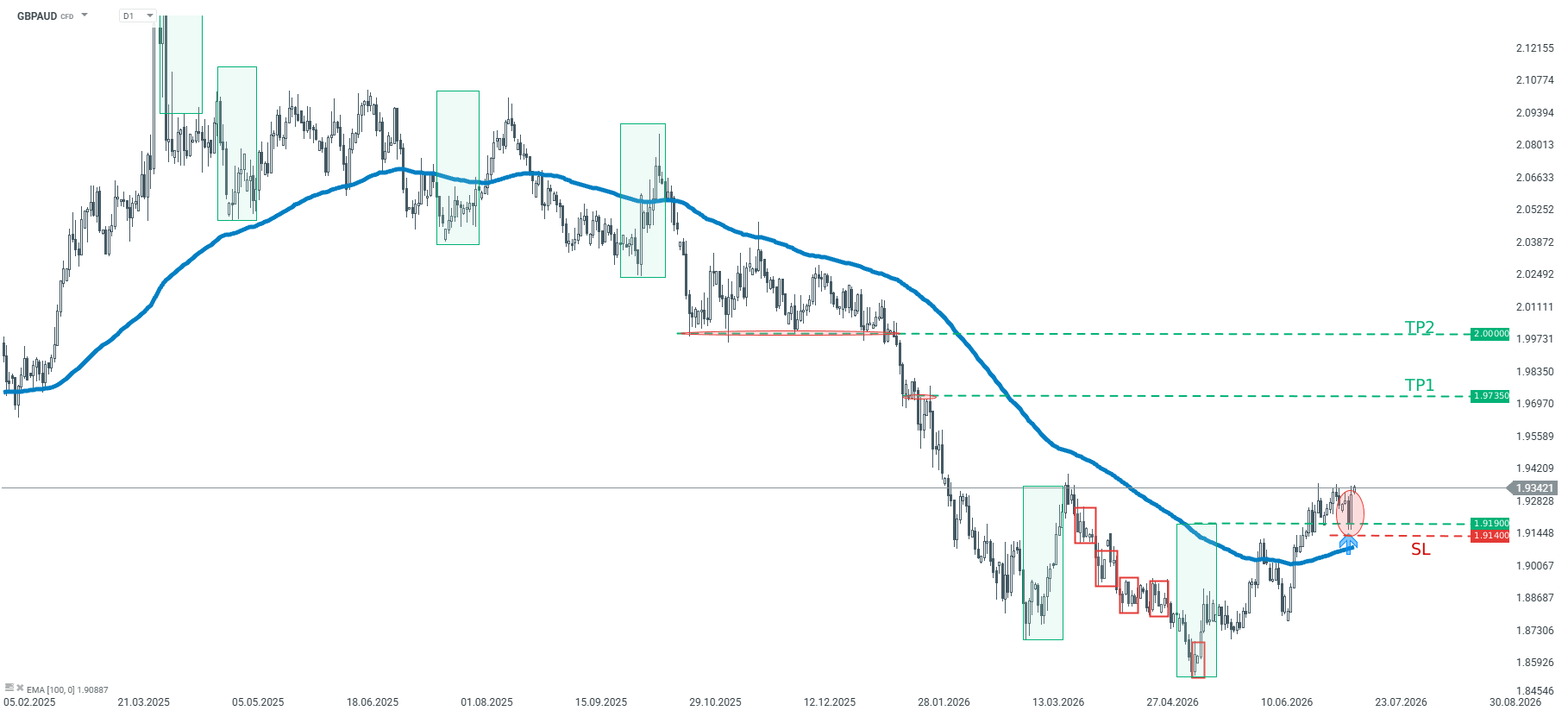
Since last November, the GBPAUD currency pair has been trading in a downtrend; however, in mid-March, the upper boundary of the broad 1:1 pattern was broken at the 1.8990 level, which may indicate a shift in sentiment toward an uptrend. Currently, the 1.8975 level should be considered key short-term support, as it marks the lower boundary of the local 1:1 bullish pattern. According to the Overbalance methodology, as long as this level holds, further expansion of the upward movement is possible. Conversely, a drop back below 1.8990 could signal a resumption of the downward trend.

GBPAUD – H4 timeframe. Source: xStation

AUDNZD
The AUDNZD exchange rate has been in an uptrend since April of last year. Due to the prolonged period without a major correction, the recent downward move is similar in magnitude to previous corrections, allowing us to identify support at the 1.1730 level, where the lower boundary of the 1:1 pattern is located. According to the Overbalance methodology, as long as this level holds, the uptrend remains in effect.

AUDNZD – H4 timeframe. Source: xStation

EURAUD
Since last October, the EURAUD pair has been trading in a downtrend; however, in recent days, the 1.6545 level has been broken, which may suggest the start of an upward correction or even a trend reversal. According to the Overbalance methodology, as long as the price remains above this level, the base case scenario remains a continuation of the uptrend. Conversely, a return below 1.6545, as well as a break below the 1.6506 level—where the lower boundary of the local 1:1 uptrend pattern lies—could signal a return to the downtrend. For now, the base case remains an upward correction.

EURAUD – H4 timeframe. Source: xStation

The material on this page does not constitute financial advice and does not take into account your level of understanding, investment objectives, financial situation or any other specific needs. All information provided, including opinions, market research, mathematical results and technical analyzes published on the Website or transmitted To you by other means, it is provided for information purposes only and should in no way be construed as an offer or solicitation for a transaction in any financial instrument, nor should the information provided be construed as advice of a legal or financial nature on which any investment decisions you make should be based exclusively To your level of understanding, investment objectives, financial situation, or other specific needs, any decision to act on the information published on the Website or sent to you by other means is entirely at your own risk if you In doubt or unsure about your understanding of a particular product, instrument, service or transaction, you should seek professional or legal advice before trading. Investing in CFDs carries a high level of risk, as they are leveraged products and have small movements Often the market can result in much larger movements in the value of your investment, and this can work against you or in your favor. Please ensure you fully understand the risks involved, taking into account investments objectives and level of experience, before trading and, if necessary, seek independent advice.

Pound Sterling weakens as Middle East tensions escalate

March 24, 2026
  • GBP/USD depreciates amid rising Middle East conflict. 
  • Gulf states are near direct involvement in the Iran conflict, with Saudi Arabia signaling a potential military shift. 
  • Traders await Tuesday’s flash S&P Global PMI data for March from both economies.

The GBP/USD pair faces selling pressure after registering modest gains in the previous day, trading near 1.3400 during the Asian session on Tuesday. The risk-sensitive pair weakens amid rising risk aversion as US-aligned Gulf states move closer to direct involvement in the Iran conflict, with Saudi Arabia signaling a potential military shift, according to a Wall Street Journal report.

Israel launched its latest attack on Iran despite US President Donald Trump signaling a pause in strikes on energy infrastructure after what he described as productive talks with Tehran. However, Iran’s Foreign Minister Abbas Araghchi denied any engagement with Washington. Iranian Parliament Speaker Mohammad Bagher Ghalibaf also said on Monday that no negotiations had taken place with the US. Meanwhile, senior military adviser Mohsen Rezaei stated that the conflict would persist until Iran receives full compensation for the damage incurred.

Traders await Tuesday’s flash S&P Global Purchasing Managers’ Index (PMI) data for March headlines the calendar on both sides of the pair. UK manufacturing PMI is expected at 51.1, down from 51.7, with services forecast at 53.0 versus 53.9 previously; any further softening would test the hawkish BoE repricing.

The Bank of England (BoE) kept interest rates steady at 3.75% at its March meeting on Thursday, as widely expected. BoE Governor Andrew Bailey said the Middle East conflict will cause a “shock to the economy” and push up inflation in the near term, adding that restoring safe shipping through the Strait of Hormuz is key to addressing rising energy prices.

Pound Sterling Price Today

The table below shows the percentage change of British Pound (GBP) against listed major currencies today. British Pound was the weakest against the US Dollar.

USDEURGBPJPYCADAUDNZDCHF
USD0.21%0.24%0.14%0.18%0.55%0.36%0.20%
EUR-0.21%0.00%-0.07%-0.03%0.34%0.14%-0.01%
GBP-0.24%-0.00%-0.06%-0.04%0.34%0.14%-0.01%
JPY-0.14%0.07%0.06%0.05%0.42%0.22%0.07%
CAD-0.18%0.03%0.04%-0.05%0.37%0.17%0.03%
AUD-0.55%-0.34%-0.34%-0.42%-0.37%-0.19%-0.37%
NZD-0.36%-0.14%-0.14%-0.22%-0.17%0.19%-0.15%
CHF-0.20%0.00%0.01%-0.07%-0.03%0.37%0.15%

The heat map shows percentage changes of major currencies against each other. The base currency is picked from the left column, while the quote currency is picked from the top row. For example, if you pick the British Pound from the left column and move along the horizontal line to the US Dollar, the percentage change displayed in the box will represent GBP (base)/USD (quote).