

The Indian rupee hovered around 94.6 per dollar, retreating from recent gains as the US dollar strengthened after the Federal Reserve concluded its latest policy meeting. Investors reassessed the interest-rate outlook after the Fed unanimously left its benchmark rate unchanged at 3.5%–3.75%, while updated projections signaled a notable shift in policymakers’ expectations. Further pressure on the rupee came as US Treasury yields climbed, with the two-year yield rising 12 basis points, supported by a series of resilient economic indicators that reinforced the case for higher-for-longer interest rates. Meanwhile, crude oil prices continued to move lower after the United States and Iran reached an interim agreement to halt the conflict and restore traffic through the Strait of Hormuz, easing concerns over energy supply disruptions.

Indian Rupee remains flat as risk-on mood weighs on US Dollar
- The Indian Rupee holds ground as oil prices continue to ease.
- Indian shares opened higher but edged lower as caution grew ahead of the US Fed policy decision.
- Traders expect a hawkish tone from Fed Chair Kevin Warsh during his first policy meeting on Wednesday.
The Indian Rupee (INR) holds ground after two days of gains against the US Dollar (USD) on Wednesday. However, the upside potential for the USD/INR pair could be capped in the near term as downward pressure on the Indian Rupee eases, supported by declining global oil prices.
Following recent policy interventions by the Reserve Bank of India (RBI), economists have notably upgraded their forecasts for the nation’s balance of payments. Most analysts now anticipate a small surplus, marking a sharp reversal from previous projections of a substantial deficit.
However, the true extent of any Rupee rally will ultimately hinge on the central bank’s comfort level. Experts suggest the RBI may strategically leverage the currency’s strength to pare down its massive foreign exchange forward book, which saw short-dollar positions balloon to a record $104 billion in March during efforts to defend the INR.
Indian equity indexes hold gains on Wednesday despite the prevailing market caution ahead of the US Federal Reserve’s (Fed) upcoming policy decision. The US central bank is widely expected to maintain its cautious “wait-and-see” stance, keeping benchmark interest rates steady within the 3.50% to 3.75% range.
Nevertheless, market participants remain highly attentive, as traders expect Fed Chair Kevin Warsh to adopt a more hawkish tone during his first policy meeting later in the day. This cautious domestic sentiment follows a mixed session on Tuesday, where institutional data from the NSE revealed that foreign institutional investors sold shares worth INR 749.18 crore, while domestic institutional investors made modest purchases worth INR 6 lakhs.
Broader market sentiment also faces headwinds from lingering global uncertainties and geopolitical frictions. Industry experts express widespread skepticism regarding a swift economic rebound, warning that shipping and energy exports could take several weeks to fully recover from recent disruptions. Complicating the global outlook further, the Iran-backed group Hezbollah stated in Lebanon that Iran would likely refuse a final nuclear agreement unless Israel withdraws from Lebanese territory, adding a layer of geopolitical risk that continues to keep investors on edge.
West Texas Intermediate (WTI) oil price extends losses for the fifth successive day, trading around $75.20 per barrel at the time of writing. Crude oil prices declined as anticipation grew over a looming United States (US)-Iran peace deal that could significantly boost global supply.
The US and Iran are scheduled to sign an interim agreement in Switzerland this Friday, which would grant Tehran broad economic incentives and allow the immediate resumption of Iranian oil exports. Furthermore, international tankers are expected to resume safe transit through the strategic Strait of Hormuz once the pact officially takes effect.
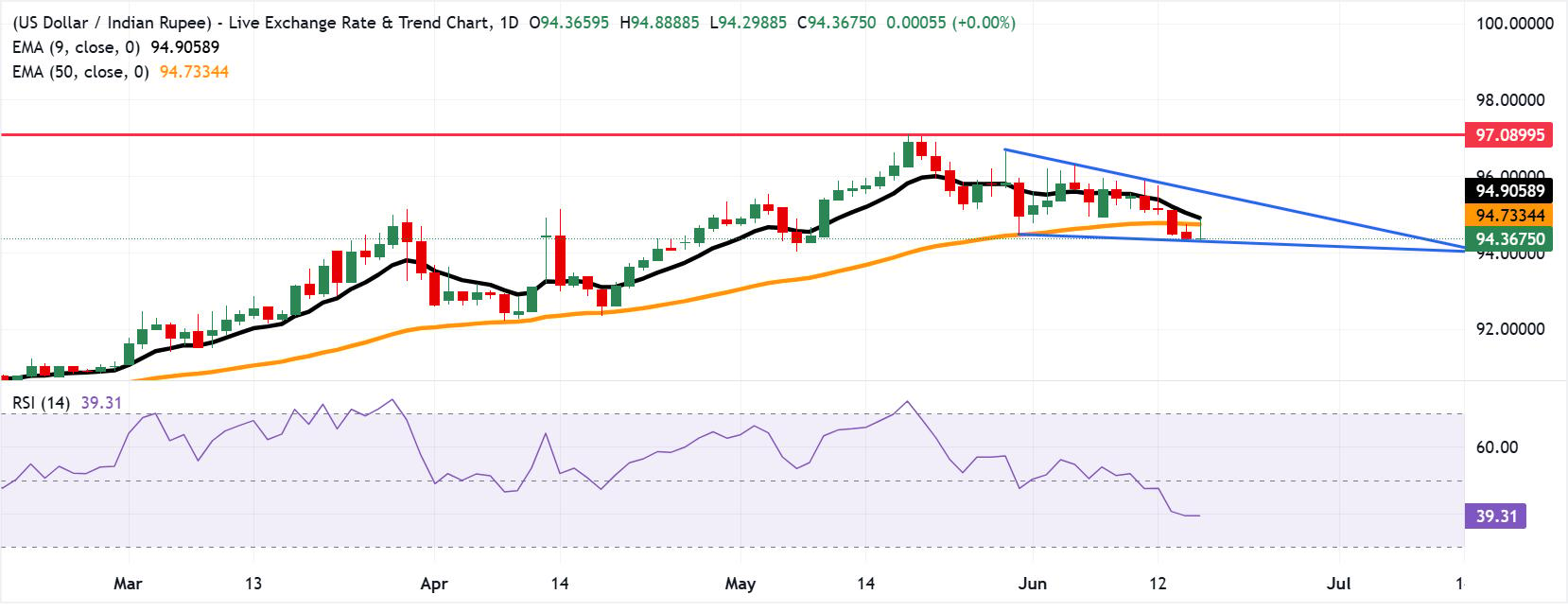
Technical Analysis: USD/INR trades near 94.50 above descending triangle bottom
USD/INR flattens after two days of losses, trading around 94.40 at the time of writing. The technical analysis of the daily chart suggests that spot price sits just slightly above the lower boundary of the descending triangle, indicating the “drumroll” moment of the pattern.
The flat lower boundary represents a major demand zone where buyers have historically stepped in to stop the bleeding. When the spot price hovers just above it, the market is testing whether those buyers still have the cash and the will to defend that floor.
The USD/INR pair maintains a bearish near-term tone as it holds below both the nine-day and 50-day Exponential moving averages (EMAs). The clustering of these EMAs above the spot hints at a capped market, while the 14-day Relative Strength Index (RSI) around 40 suggests weak momentum, reinforcing the risk of further downside as long as price remains suppressed beneath these moving averages.
The immediate support lies at the lower boundary of the descending triangle around 94.30, while the initial resistance lies at the 50-day EMA of 94.73, followed by the nine-day EMA at 94.90.
Indian Rupee trades firmly amid signs of renewed FIIs’ interest towards Indian stock market
- The Indian Rupee trades firmly against the US Dollar due to multiple tailwinds.
- Lower oil prices and signs of improvement in FIIs sentiment towards the Indian stock market have strengthened the Indian Rupee.
- The Fed is expected to leave interest rates steady on Wednesday.
The Indian Rupee (INR) opens firmly against the US Dollar (USD) on Tuesday. The USD/INR pair trades lower around 94.58 as lower oil prices due to the successive reopening of the Strait of Hormuz, following the signing of a peace deal between the United States (US) and Iran, and signs of improvement in sentiment of overseas investors towards the Indian stock market have strengthened the Indian Rupee.
In the opening session, the MCX Crude Oil contract expiring on June 18 rises slightly to near 7,640, but is close to its over eight-week low of 7,550 posted on Monday.
Currencies from economies, such as India, which rely heavily on oil imports to meet their energy needs, tend to outperform when oil prices remain lower.
US-Iran signs peace deal
On Monday, US President Donald Trump announced that a peace deal with Iran had signed and the Strait of Hormuz had fully reopened. Trump added that details of the deal will be released shortly, but confirmed that Tehran won’t have nuclear weapons.
Investors await details of the deal to get clarification regarding whether Hormuz remains toll-free or not. The resumption of normal traffic will keep oil prices lower, a scenario that will be favorable for the Indian currency.
FIIs turns of net buyers for first time in June
On Monday, Foreign Institutional Investors (FIIs) emerged as net buyers in the Indian stock market for the first time in June after diluting their stake worth Rs. 46,430.42 crore in the first two weeks. The sentiment of foreign investors towards the Indian equity market appears to have improved due to the US-Iran peace deal signing, which has eased the global risk-off impulse. In Monday’s session, FIIs bought shares worth Rs. 200.05 crore.
Investors await two-day Fed policy meeting
This week, the major trigger for the US Dollar will be the Federal Reserve’s (Fed) monetary policy announcement on Wednesday. According to the CME FedWatch tool, the Fed is certain to leave interest rates unchanged in the 3.50%-3.75%.
Investors will pay close attention to the Fed’s monetary policy guidance under the new Chairman Kevin Warsh, and interest and economic projections in the near-to-longer term.
US President Trump has provided significant breathing room to Chairman Warsh by giving him a free hand on decision-making, stating in recent days that he wants him to “do whatever he wants” and “be totally independent”, CNBC reported. While Trump was seen criticizing former Chairman Jerome Powell numerous times for not reducing interest rates quickly, despite inflationary pressures remaining higher.
Technical Analysis: USD/INR stays below 20-day EMA
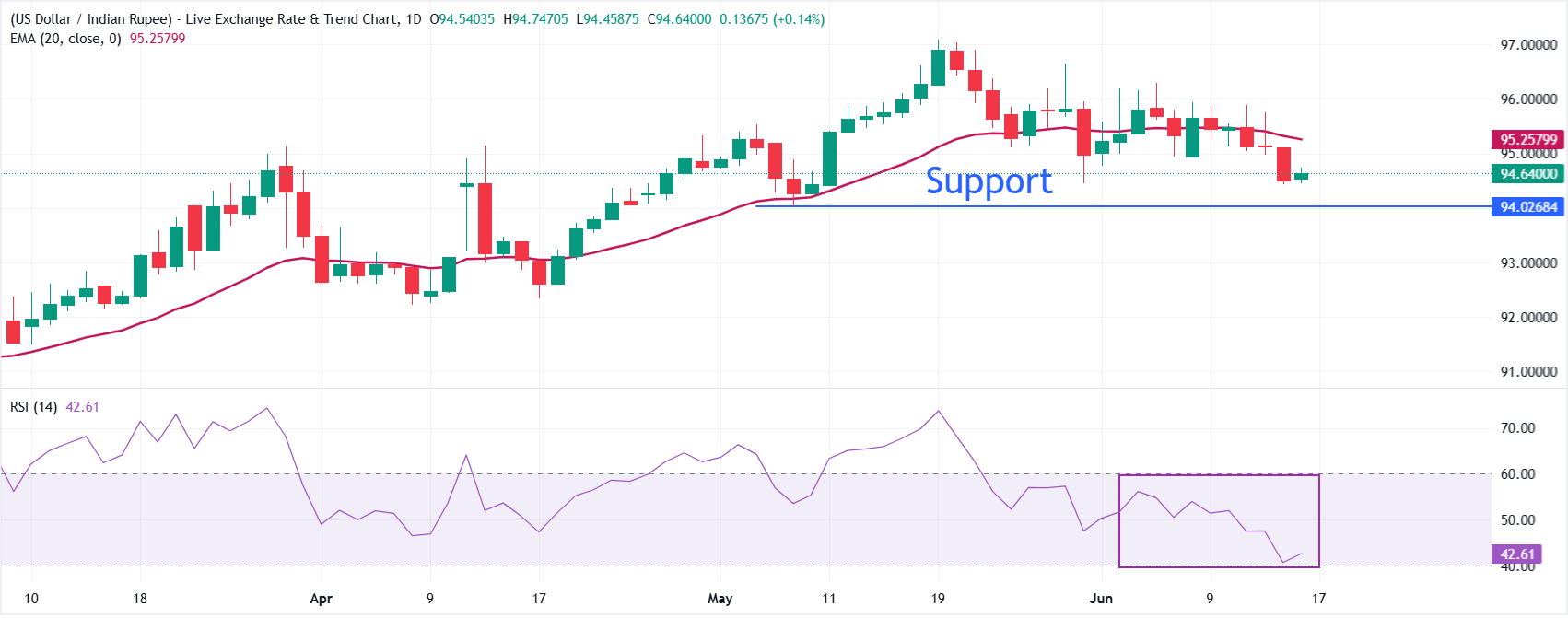
USD/INR trades weakly at around 94.58, extending a corrective phase below its 20-day exponential moving average (EMA) at 95.2580, which now acts as the first topside barrier and keeps the near-term bias tilted lower.
The Relative Strength Index (RSI) at 42.6 remains below the midline, suggesting waning bullish momentum and leaving the pair vulnerable while it holds under the short-term EMA cap.
On the topside, a daily close above the 20-day EMA around 95.26 would be needed to ease immediate downside pressure and open the way for a more sustained rebound towards 96.00. Looking down, the pair could extend the decline to the May 7 low at 94.03 if it fails to hold the June 15 low at 94.43.
Indian Rupee surges as oil prices nosedive on US-Iran MoU finalization
- The Indian Rupee soars against the US Dollar on the finalization of the US-Iran deal.
- Plunging oil prices due to the reopening of the Strait of Hormuz, as per the post from US President Trump.
- The selling pressure by overseas investors has slowed down in the last two trading days.
The Indian Rupee (INR) opens strongly against the US Dollar (USD) at the start of the week. The USD/INR pair plunges to near 94.60 as oil prices have nosedived, following the announcement that the United States (US) and Iran have reached a permanent peace deal.
In India’s opening trading hours, the MCX Crude Oil contract expiring on June 18 is down 5.5% to near 7,630, the lowest level seen in almost two weeks.
The appeal of currencies from economies, such as India, which rely heavily on oil imports to meet their energy needs, improves significantly when oil prices fall like a house of cards.
US-Iran reaches peace deal
On Sunday, both the US and Iran confirmed that they have finalized a Memorandum of Understanding (MoU).
Iran’s Supreme National Security Council confirmed Sunday that Tehran had finalized an MoU, saying all military operations on all fronts, including Lebanon, would cease “immediately and permanently”, CNBC reported.
US President Donald Trump also said in a post on Truth Social, “I hereby fully authorize the toll free opening of the Strait of Hormuz, and, simultaneously herewith, authorize the immediate removal of the United States Naval blockade.”
Meanwhile, Pakistan Prime Minister (PM) Shehbaz Sharif has stated in a post on X, formerly known as Twitter, that the finalized MoU between the US and Iran will be signed on June 19 in Switzerland.
FIIs selling pressure cool down
Although Foreign Institutional Investors (FIIs) have remained net sellers in all trading days so far in June, a slowdown in the pace of selling pressure is observed in the last two trading days. So far this month, FIIs have offloaded their stake worth Rs. 46,430.42 crore, an average selling of Rs. 4,643 crore in 10 trading days. In the last two trading days, the average selling by overseas investors was Rs. 1,534.63 crore.
India’s WPI Inflation data awaited
On the domestic front, investors await India’s Wholesale Price Index (WPI) Inflation data for May, which will be published at 12:00 PM IST (06:30 GMT). Inflation at the wholesale level is expected to arrive higher at 9.1% from 8.3% in April.
Theoretically, higher inflation at the factory level boosts expectations for the Reserve Bank of India’s (RBI) interest rate hikes in the near-term. However, the impact is expected to be limited as oil prices have started declining, a scenario that would anchor inflation expectations.
Technical Analysis: USD/INR slides to near 94.60
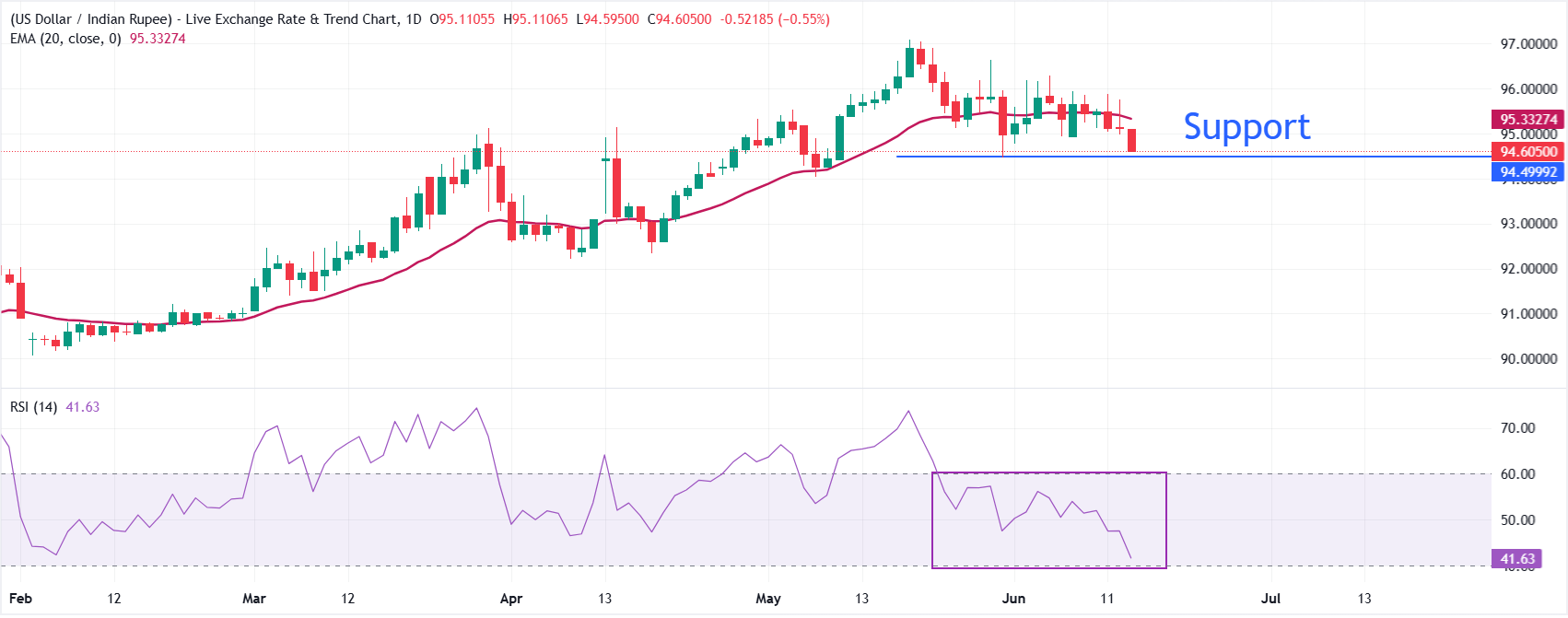
USD/INR tumbles to near 94.60 in the opening trade. The near-term bias of the pair turns bearish as it extends distance with the 20-day exponential moving average (EMA), which is at 95.33, on the downside.
The pair’s slide away from that dynamic barrier keeps the short-term trend under pressure, while the Relative Strength Index (RSI) near 42 leans lower, suggesting sellers retain control despite not yet reaching oversold territory.
On the topside, initial resistance is defined by the 20-day EMA at 95.33, where a sustained break higher would be needed to ease the current downside pressure and open the way for a deeper corrective bounce towards 96.00. Looking down, the pair could slide to the May 7 low at 94.03 if it drops below the May 29 low at 94.46.
Indian Rupee slumps as oil price surges amid fears of US-Iran ceasefire collapse
- The Indian Rupee faces intense selling pressure against the US Dollar due to a strong recovery in oil prices.
- FIIs continue to squeeze their stake in the Indian stock market.
- India’s CPI in May is seen higher at 4% YoY from 3.48% in April.
The Indian Rupee (INR) tumbles at open against the US Dollar (USD) on Thursday, with the USD/INR pair rising to near 95.65. The pair gains as a sharp recovery in oil prices due to fears surrounding the collapse of the ceasefire between the United States (US) and Iran has weakened the Indian Rupee.
In India’s morning session, the MCX Crude Oil contract expiring on June 18 is up 0.7% to near 8,787. The contract surged 3.6% on Wednesday even after recovering significant losses.
The appeal of currencies from economies, such as India, which rely heavily on oil imports to meet their energy needs, diminishes in a high oil price environment.
US launches strikes against Iran’s unwarranted aggression
On late Wednesday, the US Central Command (CENTCOM) confirmed that it launched additional “self-defense strikes” on multiple targets in Iran as retaliation against Tehran’s “unwarranted and continued aggression”. This came after the US CENTCOM launched a series of attacks on Iran’s air defense, ground control stations, and surveillance radar sites near the Strait of Hormuz on Tuesday in response to Iran shooting down the US Apache helicopter.
Additional military operations from Washington were already anticipated as US President Donald Trump said in an interview with Fox News that he is close to ordering new strikes against Iran for taking too long in finalizing a deal.
Before remarks pointing to ordering fresh strikes against Iran, US President Trump also said in a post on Truth Social that Iran has to pay the price for taking too much time in reaching a deal.
However, the ceasefire between the US and Iran announced in April appears not to have collapsed yet as US President Trump has told aides to deliver a message to Iran via Qatar that the attacks did not mean a “restart of all-out war,” and were only in response to the helicopter downing, The Wall Street Journal (WSJ) reported.
FIIs keep squeezing stake in Indian stock market
Overseas investors continue to pare their stake in the Indian stock market as higher oil prices keep weighing on India Inc.’s earnings projections. So far in June, Foreign Institutional Investors (FIIs) have remained net sellers on all trading days and have offloaded their stake worth Rs. 62,654.34 crore.
India’s CPI data awaited
On the domestic front, the major trigger for the Indian Rupee will be the Consumer Price Index (CPI) data for May, which will be published on Friday. Investors will closely monitor the data to get fresh cues regarding the Reserve Bank of India’s (RBI) monetary policy outlook.
In the policy meeting last week, the RBI kept the Repo Rate unchanged at 5.25%, as expected, and warned that the central bank would need to act “if inflation gets generalized”.
India’s CPI data is expected to arrive higher at 4% Year-on-Year from 3.48% in April.
Technical Analysis: USD/INR stays in Symmetrical Triangle formation
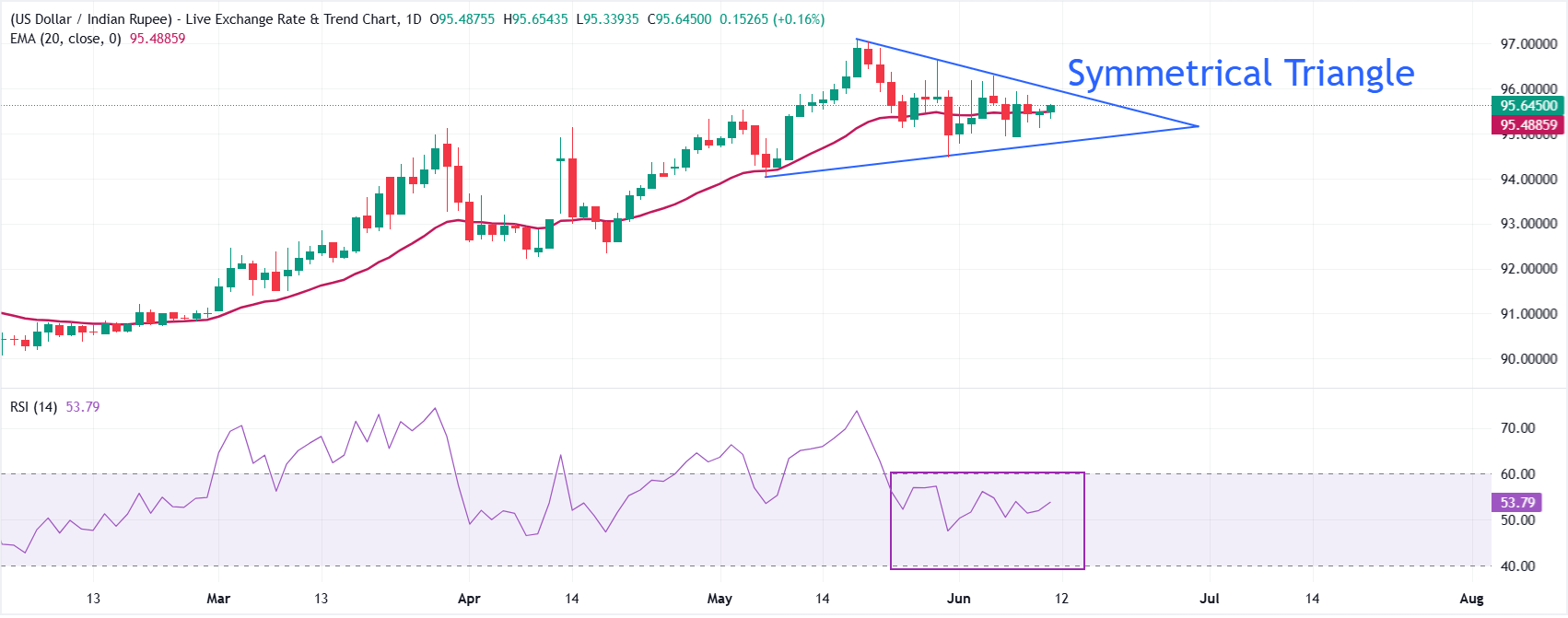
USD/INR trades higher at around 95.65 at press time. The near-term trend of the pair appears to be sideways in an overall bullish structure amid the Symmetrical Triangle formation. The pair remains close to the 20-day exponential moving average (EMA), which is at 95.4886, indicating a sideways trend.
The Relative Strength Index (RSI) at 53.79 is near neutral but slightly positive, hinting that upside pressure persists, even as the pair consolidates beneath the descending resistance trend structure derived from prior highs.
On the topside, initial resistance is seen at the bearish trend-line break area near 96.03, where a clear daily close above would open the way for a more sustained recovery towards the all-time high at 97.08. On the downside, immediate support sits at the 20-day EMA at 95.49, with the next, more structural, floor at the rising trend-line region around 94.77; a break below this latter level would weaken the current constructive tone and expose deeper retracements.
Indian Rupee flattens while flaring US-Iran tensions dampen outlook
- The Indian Rupee trades calmly at open against the US Dollar; however, the outlook has become uncertain.
- The exchange of attacks between the US and Iran has renewed Middle East tensions.
- Investors await the US-India CPI data for May.
The Indian Rupee (INR) opens almost flat against the US Dollar (USD) on Wednesday. The USD/INR pair consolidates around 95.42; however, the outlook of the pair has turned bullish as Middle East tensions have flared up again, following the United States (US) retaliation against Iran over the shooting down of an American helicopter.
Renewed US-Iran tensions have offered support to oil prices. As of writing, the MCX Crude Oil contract expiring on June 18 is up 0.8% to near 8,490. Oil prices also clawed back half of their early losses on Tuesday after sliding to 8,212.
Currencies from economies, such as India, which rely heavily on oil imports to meet their energy needs, tend to underperform in a high oil price environment.
US strikes after Trump vows retaliation over the shooting down of an Apache helicopter over Hormuz
On late Tuesday, the US Central Command (CENTCOM) announced that it launched a series of attacks on Iran’s air defense, ground control stations, and surveillance radar sites near the Strait of Hormuz, a vital passage to almost 20% of global energy supply. The US was expected to conduct military operations against Iran as President Donald Trump vowed retaliation for shooting down a US Apache helicopter over Hormuz.
In response, Iran has launched missiles on various US airbases in Jordan, Kuwait, and Bahrain, and has warned Washington to leave the Gulf region for their own safety.
“Powerful armed forces will not ignore any attack or threat,” Iran’s Foreign Minister Abbas Araghchi said, adding, “Get out of our region if you want to be safe.”
FIIs remain net sellers on all trading days so far in June
Overseas investors continue to dump their stake in the Indian stock market, as Middle East tensions continue to hurt their sentiment towards risky assets. So far in June, Foreign Institutional Investors (FIIs) have remained net sellers in all trading days of June and have offloaded their stake worth Rs. 60,529.36 crore.
US-India CPI data under spotlight
Later in the day, investors will pay close attention to the US Consumer Price Index (CPI) data for May, which will be published at 12:30 GMT. The US Bureau of Labor Statistics (BLS) is expected to show that the headline CPI grew at an annualized pace of 4.2%, faster than 3.8% in April. In the same period, the core CPI – which excludes volatile food and energy items – is expected to have risen at a faster pace of 2.9% against the previous reading of 2.8%.
Signs of price pressures accelerating further would prompt expectations of the Federal Reserve’s (Fed) interest rate hikes for the year. As of now, the CME FedWatch tool shows that the odds of the Fed delivering at least one interest rate hike this year are almost 72%.
Meanwhile, India’s CPI data on Friday is expected to arrive higher at 4% YoY from 3.48% in April.
Technical Analysis: USD/INR trades in a Symmetrical Triangle formation
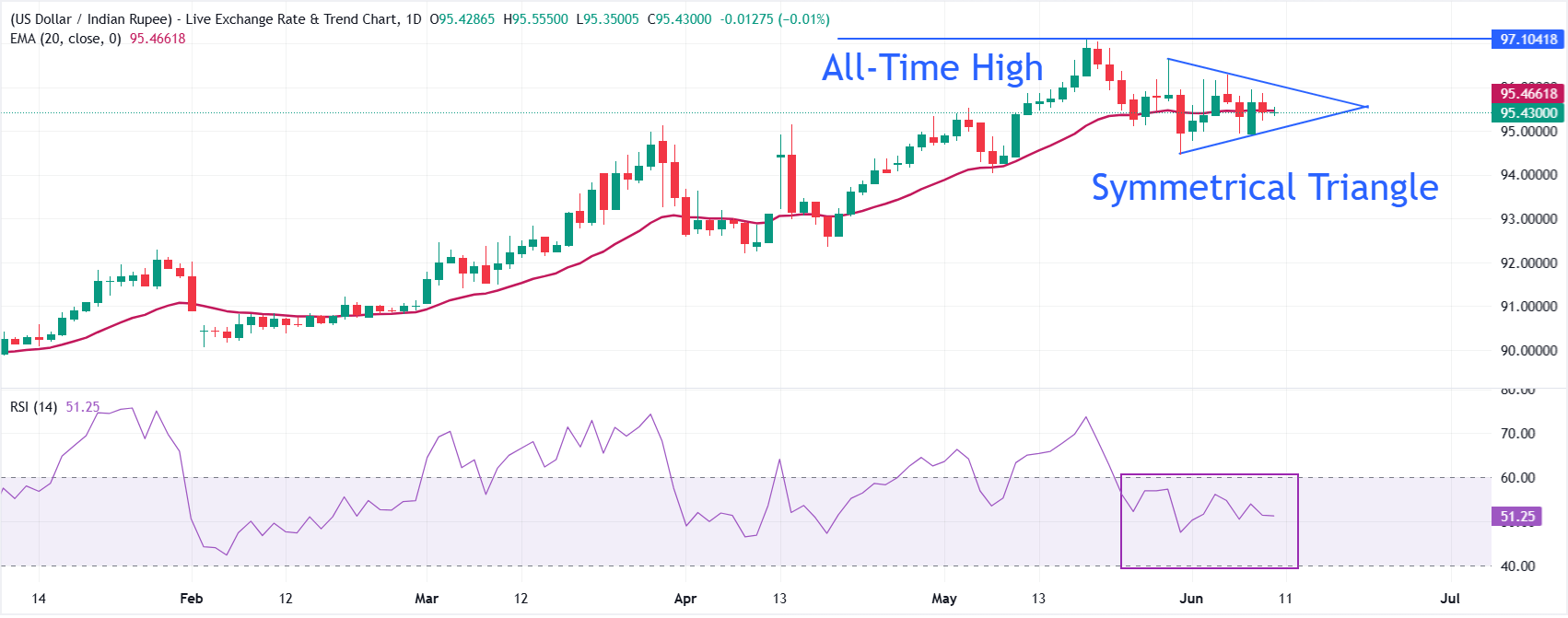
USD/INR trades almost flat at around 95.43 at press time. The Symmetrical Triangle formation and pair’s stickiness to the 20-period Exponential Moving Average (EMA) at 95.46, reflects that the immediate trend has turned sideways.
The Relative Strength Index (RSI) wobbles inside the 40.00-60.00 zone, suggesting indecisiveness among investors.
On the topside, immediate resistance is located near the downward-sloping border of the above-mentioned chart pattern at around 96.00. A decisive break above 96.00 would open the door for further upside towards the all-time high at 97.10. On the downside, initial support is seen at the upward support trend-line break level near 95.04, ahead of the structural trend-line origin around 94.49; a sustained drop below these marks would open the way for a deeper corrective phase, while holding above them would keep the broader constructive pattern intact.
Indian Rupee rebounds as oil prices slump on Iran-Israel truce
- The Indian Rupee bounces back against the US Dollar as Israel-Iran ceasefire pushes oil prices lower.
- US President Trump expresses confidence that a total victory over Iran could be announced in two weeks.
- Investors shift focus to the US-India CPI data for May.
The Indian Rupee (INR) rebounds against the US Dollar (USD) at open on Tuesday after a sharp decline the previous day. The USD/INR pair drops to near 95.50 as oil prices tumble, following reports of a ceasefire between Israel and Iran after the exchange of attacks over the weekend.
As of writing, the MCX Crude Oil contract expiring on June 18 is down 1% to near 8,600. Currencies from economies, such as India, which rely heavily on oil imports to meet their energy needs, tend to underperform in a high oil price environment.
Iran-Israel ceasefire drags oil prices
Oil prices started retreating after a strong start on Monday, following confirmation from Iran that it will stop attacking on Israeli territory. However, Iran’s armed forces warned of harsher attacks if Israel resumes attacks on Lebanon.
Iran agreed to a truce with Israel after United States (US) President Donald Trump urged both to stop attacking each other immediately.
On late Monday, US President Trump expressed confidence that Washington can announce a total victory over Iran in the next two weeks and “oil prices will come tumbling down”.
FIIs keep paring stake in Indian stock market
Overseas investors continue to lighten their stakes in the Indian stock market amid growing concerns over India Inc.’ earnings projections in the wake of higher energy prices. So far in June, Foreign Institutional Investors (FIIs) have remained net sellers on all trading days, and have offloaded their stake worth Rs. 36,370.14 crore. In May, FIIs also remained net sellers and sold their investments worth Rs. 55,963.33 crore.
Investors await US-India CPI data
This week, major triggers for USD/INR will be the Consumer Price Index (CPI) data for May from both the US and India, which will be released on Wednesday and Friday, respectively. The US headline CPI is expected to arrive higher at 4.2% Year-on-Year (YoY) from 3.8% in April. In the same period, the US core CPI – which excludes volatile food and energy items – is seen higher at 2.9% from the previous reading of 2.8%.
Signs of US inflationary pressures accelerating further would prompt expectations of interest rate hikes by the Federal Reserve (Fed) this year.
Meanwhile, India’s CPI data for May is also expected to come in higher at 4% YoY from 3.48% in April.
Last week, the Reserve Bank of India (RBI) warned of upside inflation risks in the monetary policy announcement and stated that it would act if it becomes more persistent. “If inflation becomes generalized, persistent and starts influencing inflation expectations, policy action may become necessary,” the RBI Governor Sanjay Malhotra said.
Technical Analysis: USD/INR sees downside below 95.00
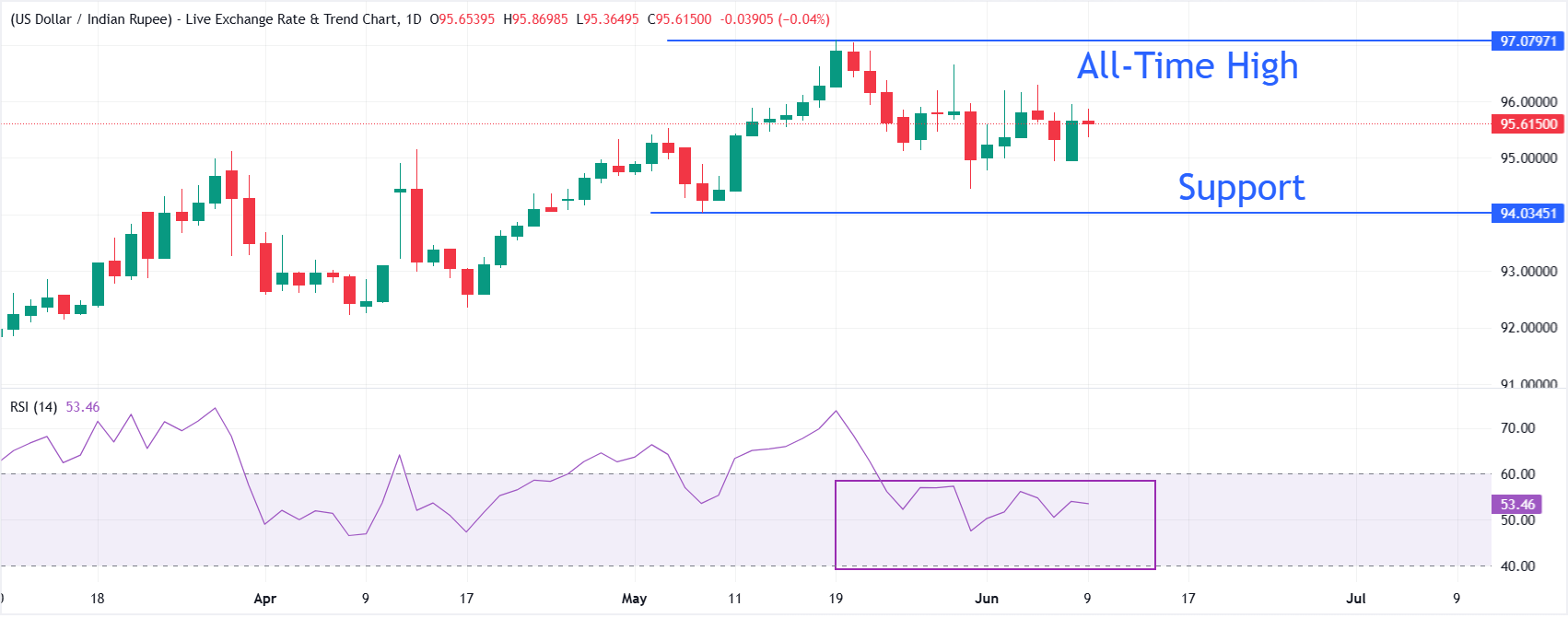
USD/INR trades slightly lower at around 95.50. The pair is essentially flat, trading sideways for almost two weeks. The Relative Strength Index (RSI) at 53.46 hovers just above the midline, hinting at balanced momentum with only a slight bullish tilt but no clear directional conviction.
On the downside, the pair could slide towards the May 07 low at 94.03 if it fails to hold the key support level of 95.00. Looking up, the pair could aim to revisit the all-time high above 97.00 if it manages to recover above the June 4 high at 96.30.
Indian Rupee declines due to rising hawkish Fed bets, renewed Middle East war
- The Indian Rupee opens on a negative note against the US Dollar.
- The US Dollar gains as surprisingly strong US NFP numbers boost hawkish Fed bets.
- Renewed Israel-Iran war has prompted oil prices.
The Indian Rupee (INR) starts the week on a negative note against the US Dollar (USD), with the USD/INR pair rising to near 95.30. The pair gains at open as surprisingly upbeat United States (US) Nonfarm Payrolls (NFP) data for May has strengthened the US Dollar, and rising oil prices due to re-escalating conflicts between Iran and Israel have weakened the Indian Rupee.
During the press time, the US Dollar Index (DXY), which tracks the Greenback’s value against six major currencies, holds onto Friday’s gains around 100.00, the highest zone seen in two months.
Upbeat US NFP data prompts hawkish Fed bets
On Friday, the US Bureau of Labor Statistics (BLS) reported surprisingly upbeat official employment data for May. The US NFP arrived significantly higher at 172K against 85K estimates. Meanwhile, the April reading was also revised higher to 179K from 115K. The Unemployment Rate remained steady at 4.3%, as expected. Strong job growth data, compounded with already high inflationary pressures, have resulted in a significant increase in hawkish Federal Reserve (Fed) bets.
The CME FedWatch tool shows that the possibility of the Fed delivering at least one interest rate hike this year has increased to 73.8% from 45.2% seen a week ago.
Oil prices jump on renewed Middle East conflicts
The attacks from Israeli Defense Forces (IDF) in western and central Iran over the weekend, despite US President Donald Trump urging Israeli Prime Minister Benjamin Netanyahu not to retaliate against Iran’s attacks, have renewed fears of an all-out war in the Middle East.
Iran fired ballistic missiles at Israeli military targets over the weekend in retaliation for Israeli aggression in Lebanon.
Rising hostilities in the Middle East have raised concerns over the US-Iran peace deal, prompting fears of a prolonged closure of the Strait of Hormuz, which has resulted in a sharp increase in oil prices. As of writing, the MCX Crude Oil contract expiring on June 18 is up 4.6% to near 9,020.
Currencies from economies, such as India, which rely heavily on oil imports to meet their energy needs, tend to underperform in a high oil price environment.
FIIs continue to remain net sellers in Indian stock market
So far in June, Foreign Institutional Investors (FIIs) have remained net sellers on all trading days, and offloaded their stake worth Rs. 30,814.47 crore. Overseas investors also remained net sellers in May and pared their stake worth Rs. 55,963.33 crore. Foreign investors are dumping their investments in the Indian stock market due to growing concerns over India Inc.’s earnings projections amid higher oil prices.
Technical Analysis: USD/INR attarct bids near 95.00
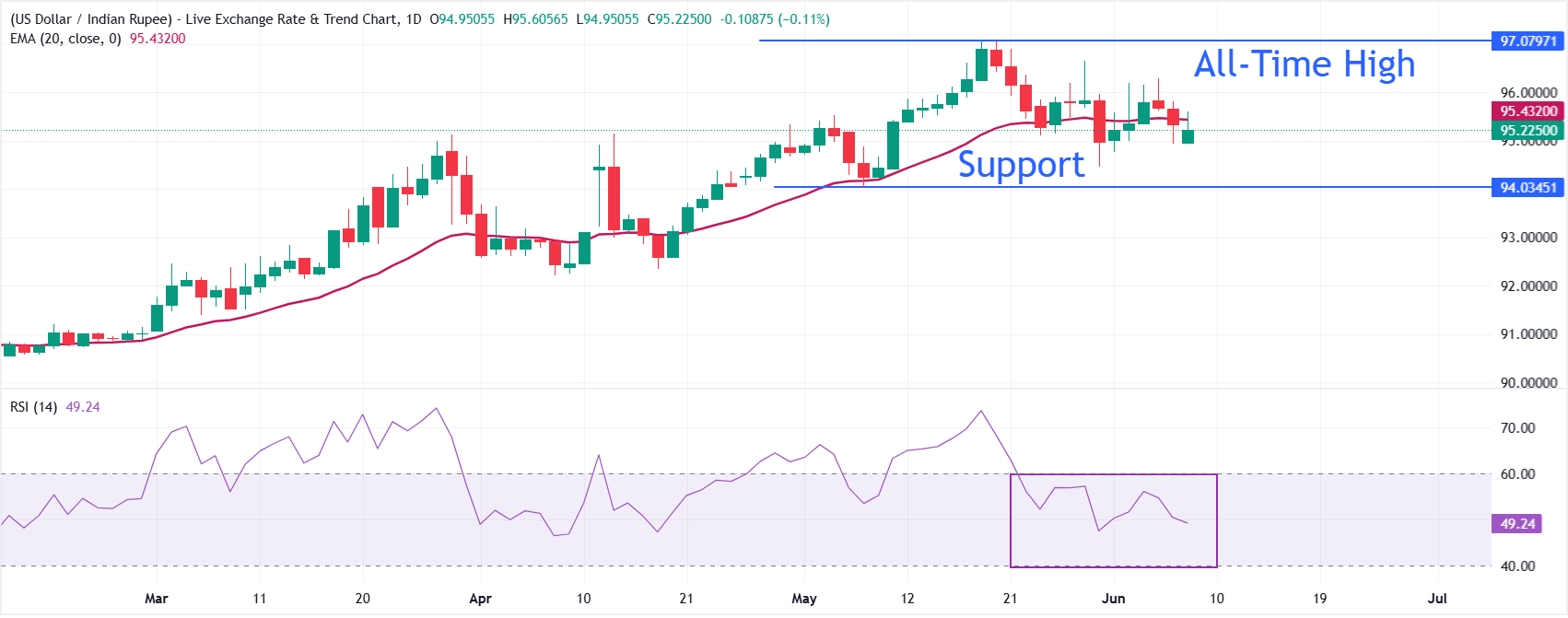
USD/INR trades higher at around 95.30 with a mildly bearish near-term bias, holding just under its 20-day exponential moving average (EMA) at 95.4320. The pair has retreated from recent highs and the loss of traction against this short-term EMA hints that upside momentum is fading, while the Relative Strength Index (RSI) around 49 suggests neutral momentum rather than a clear directional push.
On the downside, immediate focus is on whether sellers can keep the pair capped beneath the 20-day EMA at 95.4320, which now acts as the first area of supply limiting rebounds. A sustained daily close back above this moving average would ease the current pressure and open the door to a further slippage towards the May 7 low around 94.00. Looking up, the pair needs to return above the 20-day EMA to ease downside pressure, and a further rally above the June 4 high at 96.30 would allow it to reclaim the all-time high around 97.10.