

The Indian rupee hovered around 95.2 per dollar, pausing recent losses after multi-week lows as investors assessed persistent dollar demand, Reserve Bank of India intervention, and broader weakness in Asian currencies. The local currency’s outlook weakened after it fell nearly 1% last week, pressured by arbitrage-related outflows, routine importer demand for US dollars, and a stronger greenback amid expectations that the Federal Reserve could keep interest rates higher for an extended period. Although the dollar eased following a softer-than-expected June employment report, traders expect only limited relief for the rupee. While lower crude oil prices offered support, persistent dollar demand has limited the rupee’s recovery, even as the central bank continues to smooth volatility through dollar sales. Globally, attention is on the Fed’s latest meeting minutes and the upcoming US inflation report, both of which could shape interest rate expectations and the dollar’s direction.

Rupee Pauses Losses on Softer Dollar
The Indian rupee hovered around 95.2 per dollar, pausing recent losses as the greenback softened on softer-than-expected labor data. June payroll growth slowed sharply while gains for the previous two months were revised lower, prompting traders to reduce the probability of a September Federal Reserve rate hike to around 53%, down from 75% before the report. The weaker dollar lifted most Asian currencies, providing support for the rupee. Despite the improved sentiment, investors continue to monitor merchant and portfolio flows after the rupee fell to a three-week low in the previous session, pressured by arbitrage-related demand and importer dollar purchases. Earlier this week, the currency was supported by interventions from the RBI in both the onshore spot and offshore non-deliverable forwards markets. However, those efforts were largely offset by persistent dollar demand from foreign banks and oil companies, as well as continued foreign investor outflows from Indian equities.
Indian Rupee Extends Losses
The Indian rupee hovered around 94.7 per dollar, extending its recent losses as rising US Treasury yields strengthened the greenback and weighed on Asian currencies. Higher bond yields dampened demand for emerging-market assets, while renewed dollar buying and weaker regional currencies kept pressure on the rupee. Market sentiment remained cautious after stronger-than-expected US labor market data reinforced expectations that the Federal Reserve could keep interest rates higher for longer. Investors are now awaiting additional US employment data for further clues on the Fed’s policy outlook. Meanwhile, higher oil prices added another headwind for the currency, as firmer crude prices typically increase India’s import bill and demand for dollars. Oil gained support after a Qatari official said US envoys in Doha would not hold high-level talks with Iran, casting doubt on near-term diplomatic progress and reducing expectations of a potential increase in Iranian oil supplies.
Indian Rupee ticks down against US Dollar, US data in focus
- The Indian Rupee edges down against the US Dollar as investors shift focus to an array of US data.
- Lower oil prices continue to limit the downside in the Indian Rupee.
- FIIs turned out to be net sellers on Monday.
The Indian Rupee (INR) opens slightly lower against the US Dollar (USD) on Tuesday. The USD/INR pair edges up to near 94.65 as the US Dollar trades firmly amid caution surrounding the United States (US) Nonfarm Payrolls (NFP) data for June, which will be released on Thursday.
At press time, the US Dollar Index (DXY), which gauges the Greenback’s value against six major currencies, trades 0.2% higher to near 101.32.
US NFP to be key trigger for global markets
The US NFP data always holds significant importance for the Federal Reserve’s (Fed) interest rate expectations. However, this time, its impact is expected to be higher as remarks from new Fed Chairman Kevin Warsh in his monetary policy conference this week showed that he would refrain from delivering forward-looking statements.
“Absent, also, is so-called forward guidance—which we agreed was not well suited to the current policy conjuncture,” according to the transcript of Fed Chairman Warsh’s Press Conference.
According to estimates, the US economy created 110K fresh jobs, lower than 172K in May. The Unemployment Rate remains steady at 4.3%.
In Tuesday’s session, investors will focus on the US JOLTS Job Openings data for May, which will be published at 14:00 GMT. The data is expected to show that employers posted 7.3 million fresh jobs, lower than 7.618 million in April.
This week, investors will also focus on the US ADP Employment Change and the ISM Manufacturing PMI data for June, which will be released on Wednesday.
Lower oil prices continue to offer support to Indian Rupee
Oil prices remaining lower due to the maintenance of a ceasefire between the US and Iran continue to support the Indian Rupee.
Currencies from economies, such as India, which rely heavily on oil imports to meet their energy needs, tend to outperform when oil prices remain lower.
Meanwhile, Iran continues to demand recognition of its authority near the Strait of Hormuz, a critical chokepoint to almost 20% of global energy supply, for which it is in talks with Oman.
On Monday, Iranian Deputy Foreign Minister Kazem Gharibabadi stated in a post on X, formerly known as Twitter, that Tehran has concluded a meeting with Oman in which it reviewed current issues related to the Hormuz, and also exchanged views on the future management of the waterway.
FIIs remain net sellers in Indian stock market on Monday
Foreign Institutional Investors (FIIs) continue to pare their stake in the Indian stock market even as lower oil prices have improved India Inc.’s earnings projections. On Monday, FIIs remained net sellers, offloading their stake worth Rs. 1,350.10 crore.
Technical Analysis: USD/INR trades in tight range inside Descending Triangle
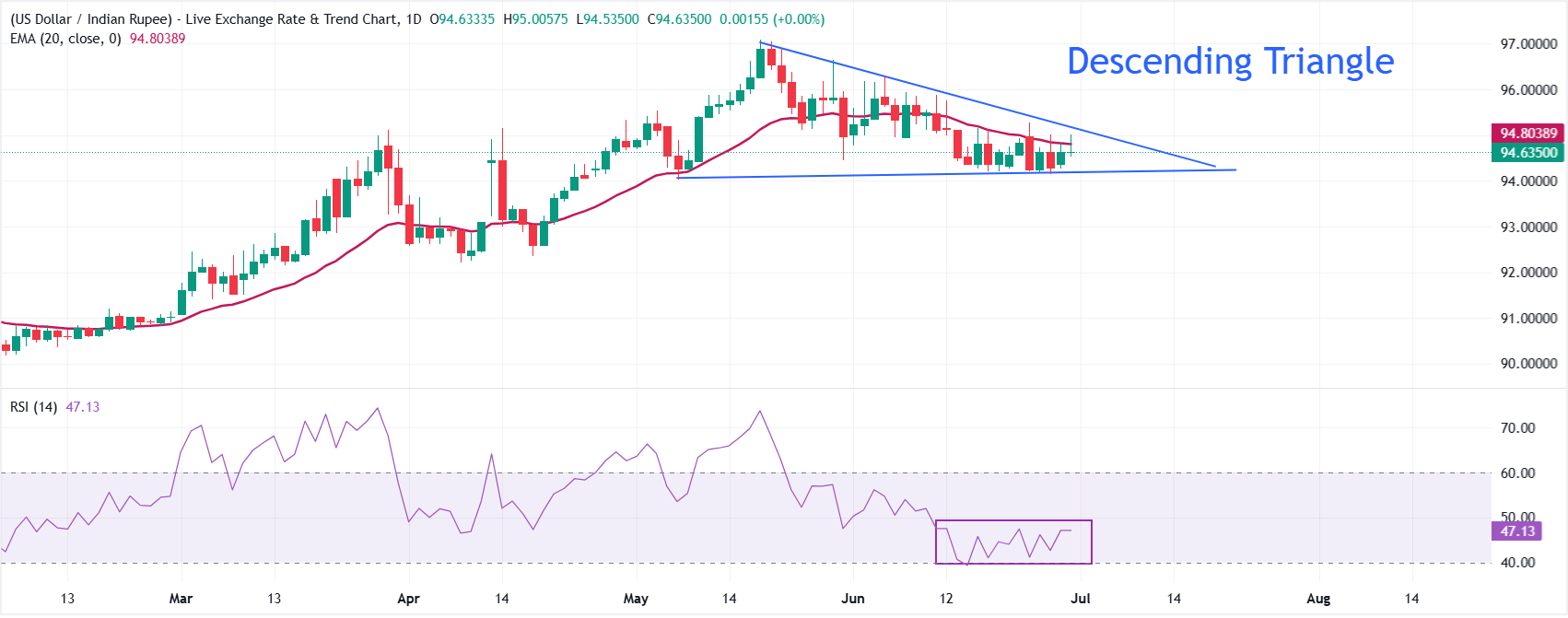
USD/INR trades at around 94.65, keeping a bearish near-term tone as it holds beneath the 20-period Exponential Moving Average (EMA) at 94.80 and the downward-sloping border of the Descending Triangle formation, whose break level sits at 95.18.
The exchange rate has slipped back into the lower half of the recent range, while the Relative Strength Index (RSI) at 47 suggests neutral-to-soft momentum rather than outright oversold conditions, hinting that downside pressure persists but without capitulation.
On the topside, immediate resistance is seen at the 20-period EMA at 94.80, followed by the downtrend-line break level at 95.1822, with the origin of that bearish line near 97.0285 acting as a more distant cap. On the downside, the horizontal border of the above-mentioned chart pattern at around 94.00 is the key support zone; a break below that would expose the pair to the April 15 high at 93.47.
Indian Rupee flattens while focus shifts to US-Iran talks in Oman
- The Indian Rupee trades calmly near 94.35 against the US Dollar ahead of US-Iran talks and NFP data.
- Iran stresses the recognition of its authority near the Strait of Hormuz.
- The Fed is expected to deliver at least one interest rate hike this year.
The Indian Rupee (INR) trades flat against the US Dollar (USD) after a long weekend on Monday. The USD/INR pair wobbles around 94.35 as investors await the outcome of talks between the United States (US) and Iran, scheduled on Tuesday in Oman, regarding peace near the Strait of Hormuz, a critical chokepoint to almost one-fifth of global energy supply.
US-Iran agree on a ceasefire after trading attacks over weekend
The exchange of attacks between the US and Iran near the Strait of Hormuz over the weekend renewed fears of a global energy supply disruption again. Comments from Iran’s Foreign Minister Abbas Araghchi signaled that Tehran’s attacks were meant to demonstrate its intentions to have authority over the Hormuz.
Iran’s Foreign Minister Araghchi said that responsibility for the Strait of Hormuz lies solely with Tehran and warned that any attempt to bypass its preferred route in the waterway will cause “tension and escalation”. However, both nations later agreed on a ceasefire and scheduled talks regarding the same in Oman for Tuesday.
Market participants worry that signs of renewed conflicts between the two nations could lift oil prices again, which have returned close to their pre-war levels, a scenario that diminishes the appeal of currencies from economies, such as India, which rely heavily on oil imports to meet their energy needs.
US Dollar consolidates at start of US NFP week
The US Dollar Index, which gauges the Greenback’s value against six major currencies, trades calmly near 101.30. Investors seem to have sidelined, awaiting a slew of US data, especially the Nonfarm Payrolls (NFP) data for June, which will be released on Thursday.
Investors will pay close attention to the US NFP data for fresh cues regarding the Federal Reserve’s (Fed) monetary policy outlook. The impact of the official employment data will be significant as comments from new Fed Chairman Kevin Warsh in his monetary policy conference this month signaled that forward-looking statements from the central bank would be restricted in the current policy conjuncture.
According to the CME FedWatch tool, the odds of the Fed delivering at least one interest rate hike this year are almost 90%.
This week, investors will also focus on the US ISM Manufacturing PMI and the ADP Employment Change data for June, and the JOLTS Job Openings data for May.
Technical Analysis: USD/INR remains lower below 20-day EMA
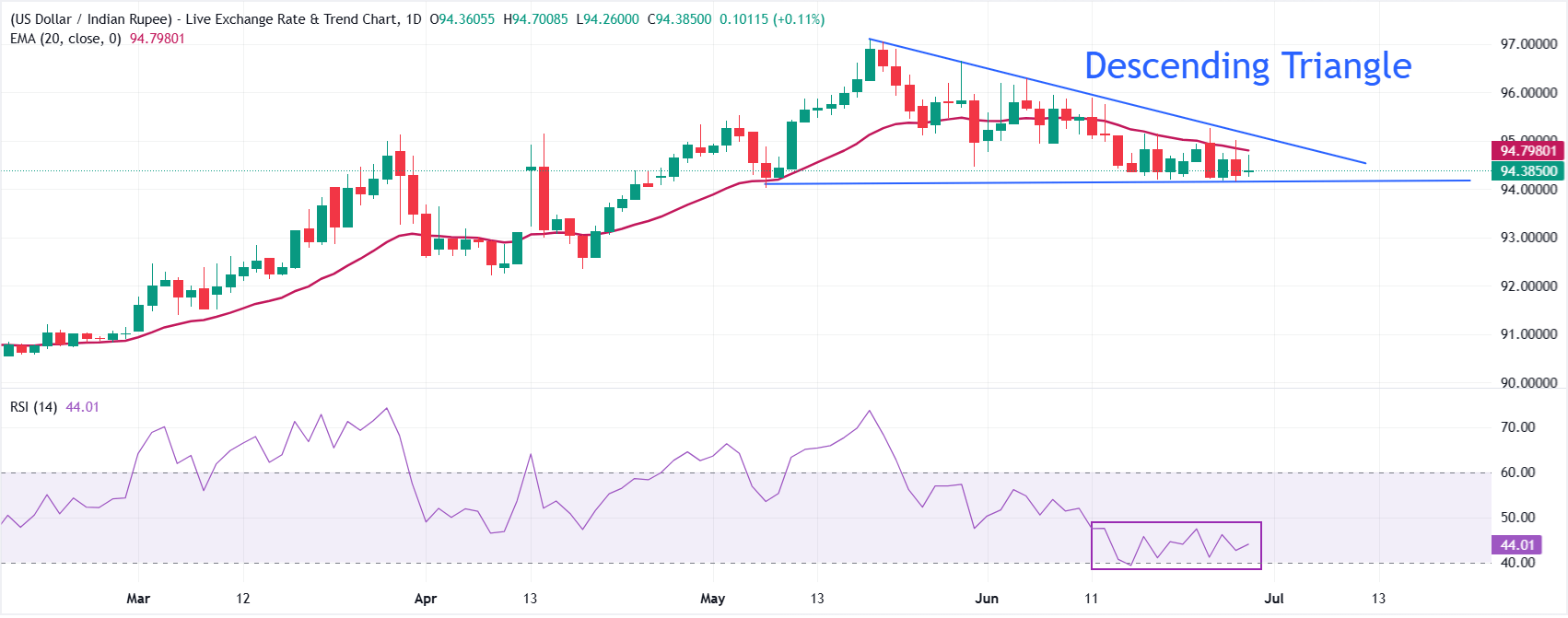
USD/INR trades flat at around 94.38, keeping a bearish near-term tone as spot holds below the 20-period exponential moving average (EMA) at 94.7980 and under the broader downward resistance trend line of the Descending Triangle formation starting near 97.1042.
The pair has been sliding off recent highs and now trades closer to its rising support line from 94.1051, while the Relative Strength Index (14) around 44 suggests waning bullish momentum and leaves the door open for further downside pressure.
On the topside, initial resistance is defined by the 20-period EMA at 94.7980, with a subsequent barrier coming from the longer-term descending trend line near 97.1042. On the downside, the immediate focus is on the horizontal support line drawn from 94.1051, with the current price area around 94.3850 acting as a pivotal zone where a sustained break lower would reinforce the bearish bias and expose deeper losses in the coming sessions.
Indian Rupee Slides to One-Week Low
The Indian rupee fell to around 94.8 per dollar, retreating after a brief stabilization as renewed strength in the greenback and shifting expectations for US monetary policy overshadowed lower crude oil prices. The currency came under renewed pressure after the dollar index climbed to its highest level in more than a year, driven by growing market expectations that the Federal Reserve could implement one or two additional interest-rate hikes before the end of the year. The rupee’s decline was partly cushioned by a sharp drop in oil prices, with Brent crude falling below $77 per barrel and posting losses of roughly 16.5% for the month. The decline in energy prices has been supported by signs that tanker movements through the Strait of Hormuz are gradually returning to normal. Additional support came from improving capital-flow dynamics. Foreign investment into Indian debt markets has strengthened, while equity-market outflows have moderated compared with earlier months.
Rupee Holds Firm on Softer Oil
The Indian rupee hovered near 94.3 per dollar, steadying after reaching six-week highs as easing geopolitical tensions and softer crude oil prices supported sentiment. Oil prices declined after Iranian officials reported progress in negotiations with the United States, with Brent crude for August delivery falling 1.7% to $79.24 per barrel following signs of constructive talks in Switzerland. However, uncertainty persisted after US President Donald Trump warned that military action against Iran could resume, even as Vice President JD Vance met Iranian officials under an interim peace arrangement. Tehran’s renewed closure of the Strait of Hormuz added to market caution. Gains were partly capped as the dollar index held just below 101 and the benchmark 10-year US Treasury yield edged higher, though it remained below recent peaks. Investors are now focused on upcoming US inflation and growth data for clues on the Federal Reserve’s policy outlook.
Rupee Rises to 6-Week High
The Indian rupee hovered around 94.2 per dollar, extending gains to a six-week high as improving capital flows lifted investor sentiment. Market participants reported an improvement in foreign-exchange flows, with increased investment into Indian bonds and a slowdown in foreign equity outflows helping strengthen demand for the local currency. This marks a shift from the one-sided dollar demand that had pressured the rupee in recent weeks. The decline in crude oil prices following easing geopolitical tensions has reduced pressure on India’s import bill. Interbank market sentiment has also improved, with traders becoming more willing to take positions on both sides of the market rather than consistently buying dollars on dips, reflecting increased confidence in the rupee. However, the rupee’s gains remain challenged by a stronger dollar, with expectations of tighter Federal Reserve policy boosting demand for the greenback amid persistent inflation concerns.