


Technical Analysis – EUR/USD
Since mid-April, the EUR/USD pair has been trending downward. Recently, new lows were set and the March lows were broken, confirming the dominance of the supply side. We are currently observing a local upward correction. The price is approaching a key short-term resistance level at 1.1430, where, among other things, the lows from mid-March of this year are located.
This is the first zone where increased selling activity may emerge. If the 1.1430 level were to be broken through on a sustained basis, the next significant resistance level would be around 1.1466, where the upper boundary of the 1:1 geometry and the 100-period moving average—marked in blue on the chart—are located. A bounce off both the 1.1430 and 1.1466 levels could trigger another downward wave.
Only a sustained break above the 1.1466 zone could invalidate the current setup and increase the chances of a larger upward correction. For now, however, the base case scenario remains a continuation of the downtrend.
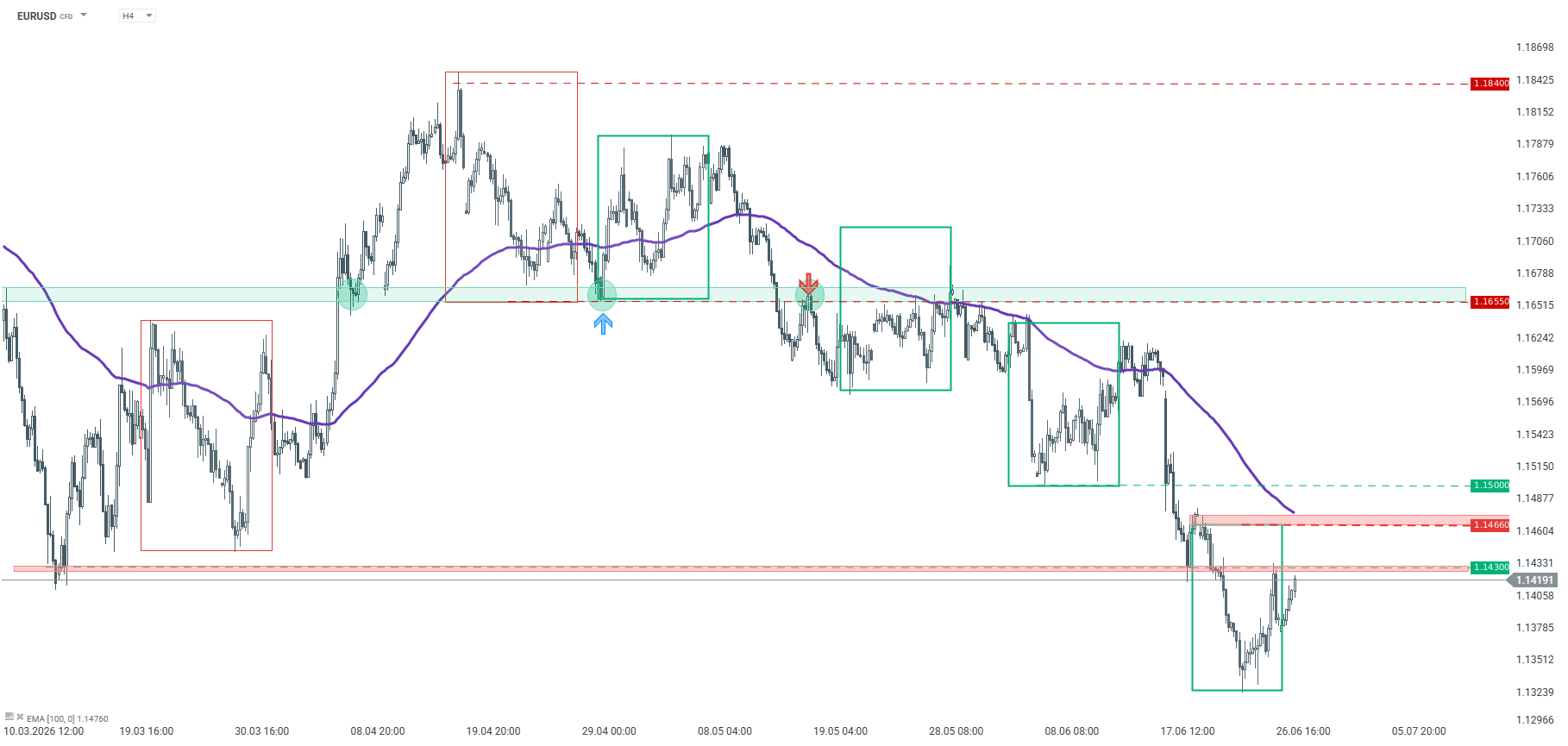
EURUSD – H4 timeframe. Source: xStation5

Indian Rupee ticks down against US Dollar, US data in focus
- The Indian Rupee edges down against the US Dollar as investors shift focus to an array of US data.
- Lower oil prices continue to limit the downside in the Indian Rupee.
- FIIs turned out to be net sellers on Monday.
The Indian Rupee (INR) opens slightly lower against the US Dollar (USD) on Tuesday. The USD/INR pair edges up to near 94.65 as the US Dollar trades firmly amid caution surrounding the United States (US) Nonfarm Payrolls (NFP) data for June, which will be released on Thursday.
At press time, the US Dollar Index (DXY), which gauges the Greenback’s value against six major currencies, trades 0.2% higher to near 101.32.
US NFP to be key trigger for global markets
The US NFP data always holds significant importance for the Federal Reserve’s (Fed) interest rate expectations. However, this time, its impact is expected to be higher as remarks from new Fed Chairman Kevin Warsh in his monetary policy conference this week showed that he would refrain from delivering forward-looking statements.
“Absent, also, is so-called forward guidance—which we agreed was not well suited to the current policy conjuncture,” according to the transcript of Fed Chairman Warsh’s Press Conference.
According to estimates, the US economy created 110K fresh jobs, lower than 172K in May. The Unemployment Rate remains steady at 4.3%.
In Tuesday’s session, investors will focus on the US JOLTS Job Openings data for May, which will be published at 14:00 GMT. The data is expected to show that employers posted 7.3 million fresh jobs, lower than 7.618 million in April.
This week, investors will also focus on the US ADP Employment Change and the ISM Manufacturing PMI data for June, which will be released on Wednesday.
Lower oil prices continue to offer support to Indian Rupee
Oil prices remaining lower due to the maintenance of a ceasefire between the US and Iran continue to support the Indian Rupee.
Currencies from economies, such as India, which rely heavily on oil imports to meet their energy needs, tend to outperform when oil prices remain lower.
Meanwhile, Iran continues to demand recognition of its authority near the Strait of Hormuz, a critical chokepoint to almost 20% of global energy supply, for which it is in talks with Oman.
On Monday, Iranian Deputy Foreign Minister Kazem Gharibabadi stated in a post on X, formerly known as Twitter, that Tehran has concluded a meeting with Oman in which it reviewed current issues related to the Hormuz, and also exchanged views on the future management of the waterway.
FIIs remain net sellers in Indian stock market on Monday
Foreign Institutional Investors (FIIs) continue to pare their stake in the Indian stock market even as lower oil prices have improved India Inc.’s earnings projections. On Monday, FIIs remained net sellers, offloading their stake worth Rs. 1,350.10 crore.
Technical Analysis: USD/INR trades in tight range inside Descending Triangle
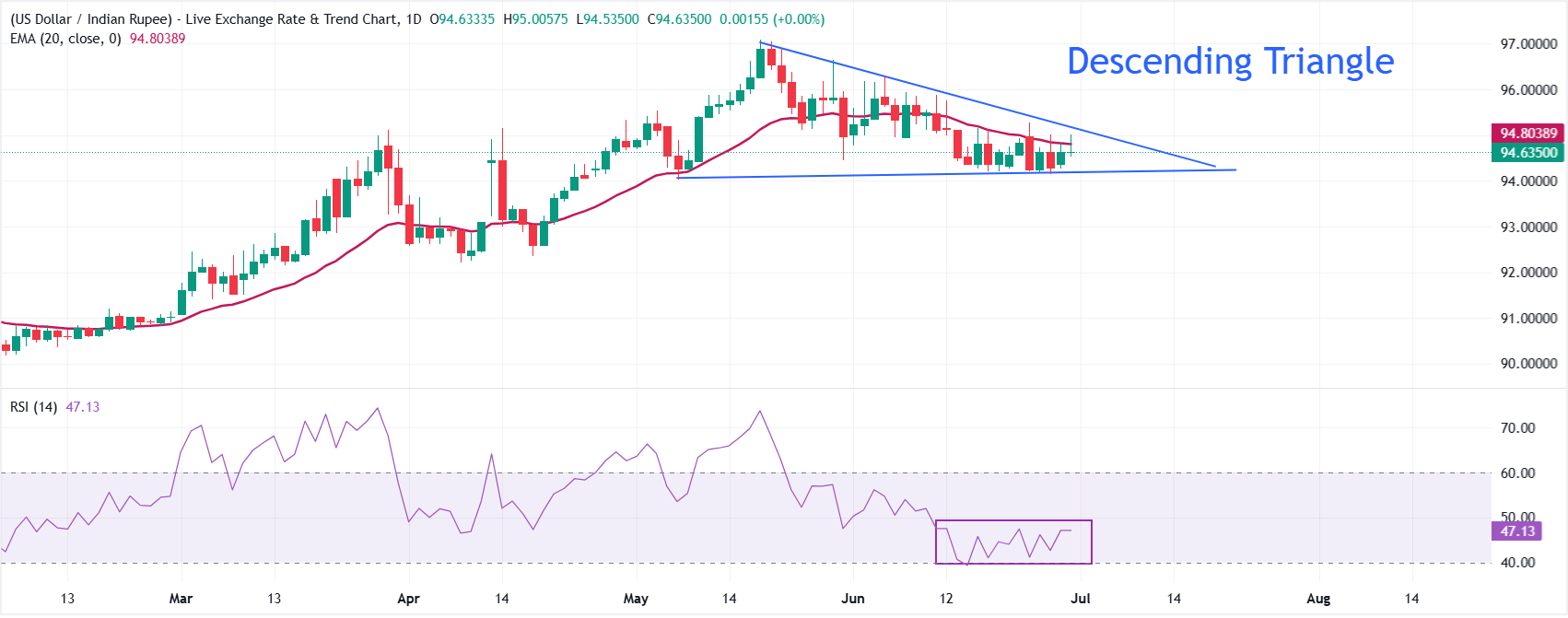
USD/INR trades at around 94.65, keeping a bearish near-term tone as it holds beneath the 20-period Exponential Moving Average (EMA) at 94.80 and the downward-sloping border of the Descending Triangle formation, whose break level sits at 95.18.
The exchange rate has slipped back into the lower half of the recent range, while the Relative Strength Index (RSI) at 47 suggests neutral-to-soft momentum rather than outright oversold conditions, hinting that downside pressure persists but without capitulation.
On the topside, immediate resistance is seen at the 20-period EMA at 94.80, followed by the downtrend-line break level at 95.1822, with the origin of that bearish line near 97.0285 acting as a more distant cap. On the downside, the horizontal border of the above-mentioned chart pattern at around 94.00 is the key support zone; a break below that would expose the pair to the April 15 high at 93.47.

GBP/USD Price – Retreats from one-week top as USD firms; 1.3300 holds the key
- GBP/USD meets with a fresh supply and snaps a three-day winning streak to a one-week high.
- The US-Iran uncertainty and elevated Fed rate hike expectations help revive the USD demand.
- The mixed technical setup warrants some caution before placing aggressive directional bets.
The GBP/USD pair attracts some sellers during the Asians session on Tuesday and reverses a part of the previous day’s strong move up to a one-week top. Spot prices, for now, seem to have snapped a three-day winning streak and currently trade around the 1.3235-1.3230 region, down nearly 0.20% for the day.
The US Dollar (USD) regains some positive traction amid mixed signals on US-Iran talks and firming expectations that the US Federal Reserve (Fed) will hike interest rates in 2026. Furthermore, the UK political uncertainty ahead of a leadership contest is seen as undermining the British Pound (GBP) and exerting some downward pressure on the GBP/USD pair.
From a technical perspective, the recent repeated failures near the 200-period Simple Moving Average (SMA) on the 4-hour chart favor bearish traders. Moreover, spot prices retain a negative bias below the 1.3300 mark, though momentum indicators suggest that upside attempts could persist while the broader structure is still constrained by the overhead supply zone.
In fact, the Relative Strength Index (RSI) hovers near 54 while the Moving Average Convergence Divergence (MACD) histogram remains modestly positive. Hence, any further decline is more likely to find a decent support near the 1.3200 mark, below which the GBP/USD pair could aim to retest the year-to-date low, around the 1.3140 region, and decline further.
On the topside, initial resistance is located near the 1.3300 round figure, which is followed by the 200-period SMA at 1.3366. A sustained strength above this barrier would start to ease the broader bearish bias and open the way for a more convincing recovery phase, though a failure would leave the GBP/USD pair vulnerable to resume its downtrend.
(The technical analysis of this story was written with the help of an AI tool.)
GBP/USD 4-hour chart
US Dollar Price Today
The table below shows the percentage change of US Dollar (USD) against listed major currencies today. US Dollar was the strongest against the Euro.
| USD | EUR | GBP | JPY | CAD | AUD | NZD | CHF | |
|---|---|---|---|---|---|---|---|---|
| USD | 0.28% | 0.19% | 0.16% | 0.16% | 0.21% | -0.02% | 0.24% | |
| EUR | -0.28% | -0.09% | -0.15% | -0.16% | -0.08% | -0.31% | -0.05% | |
| GBP | -0.19% | 0.09% | -0.04% | -0.08% | 0.02% | -0.21% | 0.03% | |
| JPY | -0.16% | 0.15% | 0.04% | 0.00% | 0.05% | -0.16% | 0.07% | |
| CAD | -0.16% | 0.16% | 0.08% | -0.00% | 0.03% | -0.17% | 0.08% | |
| AUD | -0.21% | 0.08% | -0.02% | -0.05% | -0.03% | -0.20% | 0.07% | |
| NZD | 0.02% | 0.31% | 0.21% | 0.16% | 0.17% | 0.20% | 0.23% | |
| CHF | -0.24% | 0.05% | -0.03% | -0.07% | -0.08% | -0.07% | -0.23% |
The heat map shows percentage changes of major currencies against each other. The base currency is picked from the left column, while the quote currency is picked from the top row. For example, if you pick the US Dollar from the left column and move along the horizontal line to the Japanese Yen, the percentage change displayed in the box will represent USD (base)/JPY (quote).

USD/CAD Price – Holds gains above 1.4200, bullish trend intact despite overbought signals
- USD/CAD gains momentum to near 1.4235 in Tuesday’s early European session.
- The pair keep the bullish vibe, but further consolidation cannot be ruled out with the overbought RSI.
- The first upside barrier emerges at 1.4310; the initial support level to watch is 1.4169.
The USD/CAD pair trades in positive territory around 1.4235 during the early European trading hours on Tuesday. The growing chances of Federal Reserve (Fed) interest rate hikes and optimism about the US economy provide some support to the US Dollar (USD) against the Canadian Dollar (CAD).
The key US jobs data for June will be in the spotlight later on Thursday. This report could give traders a greater sense of how accurately markets are pricing the chances of Fed rate hikes this year. Money markets showed traders fully expect one rate hike this year, with a roughly 50% chance of a second, according to LSEG data.
Crude oil prices have edged lower following a 60-day interim ceasefire agreement between the US and Iran. Traders will closely monitor the US-Iran peace talks in Doha, Qatar, later in the day. Positive developments surrounding the ceasefire deal could drag the crude oil prices lower. It is worth noting that Canada is a major oil-exporting country, and lower crude oil prices generally have a negative impact on the Canadian Dollar (CAD).
Technical Analysis:
In the daily chart, USD/CAD remains in a bullish near-term bias as spot holds above the 100-day Simple Moving Average (SMA) and the Bollinger middle band, reinforcing an underlying uptrend. The Relative Strength Index (14) stands at 82.4 sits in overbought territory, hinting that the latest advance could be stretched.
On the topside, immediate resistance is located at the Bollinger upper band at 1.4310, where buyers may hesitate to extend gains. On the downside, initial support is seen at the June 26 low of 1.4169, followed by the Bollinger middle band around 1.4068, before deeper demand emerges at the lower band near 1.3825 and the 100-day SMA at 1.3793, which together mark a more substantial structural floor.

Australian Dollar struggles against Japanese Yen despite hawkish RBA Minutes
- AUD/JPY falls despite hawkish RBA Minutes showing readiness to raise rates further if financial conditions require it.
- China’s manufacturing and non-manufacturing PMIs both rose, beating market expectations to signal steady economic expansion.
- Japan’s Finance Minister Katayama warned Tuesday that the government will intervene appropriately to address volatile currency moves as needed.
AUD/JPY loses ground after remaining flat in the previous day, trading around 111.40 during the Asian hours on Tuesday. The currency cross remains subdued as the Australian Dollar (AUD) holds losses following the release of the Reserve Bank of Australia’s (RBA) Meeting Minutes and key Purchasing Managers’ Index (PMI) data from China.
The RBA June monetary policy Meeting Minutes revealed that while the board views current financial conditions as somewhat tight, it remains prepared to implement further rate hikes if necessary to ensure price stability. The central bank highlighted that the ongoing conflict in the Middle East poses a dual threat to the economic outlook, presenting significant upside risks to inflation alongside downside risks to overall growth.
China, Australia’s close trading partner, showed stronger-than-expected resilience in June. The official Manufacturing PMI edged up to 50.3 from the previous 50.0, beating market expectations of 50.1. Simultaneously, the NBS Non-Manufacturing PMI improved to 50.2 from May’s 50.1, comfortably defying the consensus forecast of a contractionary 49.9 print and signaling expansion across both sectors.
The downside of the AUD/JPY cross is limited by persistent weakness in the Japanese Yen (JPY), which remains under pressure due to the wide interest rate gap between Japan and other major economies. This ongoing depreciation has kept policymakers concerned and investors on high alert for potential currency intervention by Tokyo. Highlighting this stance, Japan’s Finance Minister Satsuki Katayama stated on Tuesday that the government “will respond appropriately to currency moves at any time as needed.”

New Zealand Dollar remains depressed as USD benefits from Iran risks and hawkish Fed
- NZD/USD edges lower as geopolitical risks and hawkish Fed bets help revive the USD demand.
- The better-than-expected official PMIs from China fail to provide any impetus to antipodeans.
- The lack of follow-through selling warrants caution before placing fresh bearish bets on the pair.
The NZD/USD pair attracts some sellers during the Asian session on Tuesday, though it lacks bearish conviction and remains confined in a familiar range held over the past week or so. Spot prices move little following the release of China’s official PMIs and currently trade just below mid-0.5600s, down 0.05% for the day.
An official survey published by the National Bureau of Statistics (NBS) showed that business activity in China’s manufacturing sector grew slightly above expectations in June. In fact, the official Manufacturing PMI rose from the 50.0 seen in May to 50.3, slightly above expectations of 50.1. Adding to this, the gauge for the non-manufacturing sector improved to 50.2 in June vs 50.1 in the previous month and forecast for a 49.9 print. The data, however, indicated that business activity barely remained in expansion territory on the back of sluggish domestic demand and weak consumer spending. This, in turn, fails to provide any impetus to antipodean currencies, including the New Zealand Dollar (NZD) and the NZD/USD pair.
The US Dollar (USD), on the other hand, draws some support from persistent geopolitical uncertainties and mixed signals on US-Iran talks. US President Donald Trump wrote on Truth Social that Iran had requested a meeting, and it will take place in Qatar’s capital, Doha, on Tuesday. However, Deputy Iranian Foreign Minister Kazem Gharibabadi denied that there were plans for technical talks this week. Furthermore, fresh Israeli strikes on Lebanon keep geopolitical risk premiums in play, which, along with hawkish US Federal Reserve (Fed) bets, underpins the safe-haven USD and weighs on the NZD/USD pair.
According to the CME Group’s FedWatch Tool, traders are still pricing in around 63% chance that the US central bank will raise borrowing costs in September and assigning over an 80% probability of a move by the end of this year. Adding to this, renewed US-Iran hostilities sparked inflationary fears, which, in turn, favor the USD bulls. However, the NZD/USD pair, so far, has held above its lowest level since November 2025, touched last week, warranting some caution before positioning for any further depreciating move.

United States Dollar Index strengthens above 101.00 on Fed rate hike bets
- US Dollar Index gains momentum to around 101.30 in Tuesday’s early European session.
- Growing chances of US rate rises and optimism about the American economy support the DXY.
- Traders brace for the upcoming US June jobs report, which is due on Thursday.
The US Dollar Index (DXY), an index of the value of the US Dollar (USD) measured against a basket of six world currencies, currently trades near 101.30 during the early European trading hours on Tuesday. The DXY gathers strength and is heading for its biggest monthly gain in nearly a year on optimism over US economic growth and the prospect of Federal Reserve (Fed) interest rate hikes.
The Fed held its benchmark interest rate steady in a target range of 3.50% to 3.75% at its June policy meeting. The central bank’s update also removed a statement hinting that it was leaning towards lowering interest rates in the future.
A more hawkish turn at the Fed’s June meeting under new Fed Chair Kevin Warsh has led traders to increase bets on rate hikes this year, boosting the US Dollar across the board. Fed funds futures have priced in nearly a 63% chance of a rate hike by September, according to the CME FedWatch tool.
The US jobs report for June will take center stage later on Thursday. Three consecutive months of stronger-than-expected Nonfarm Payrolls (NFP) gains have supported the Fed’s hawkish shift.
Markets expect an increase of 110,000 jobs in June, and the Unemployment Rate is projected to hold steady at 4.3% during the same period. A turn in the labor market, however, could prompt a more dovish rethink of the monetary path, which would drag the DXY lower.
“The labor market appears to have accelerated,” said Marc Chandler, chief market strategist at Bannockburn Global Forex. “The concerns that the doves had pointed to about labor markets slowing down seem to have passed.”