EUR/JPY may test immediate support at its nine-day EMA of 183.59.
The 14-day Relative Strength Index at 48.21, signaling market consolidation.
The initial resistance lies at its 50-day EMA near 184.49.
EUR/JPY remains flat after registering minor gains in the previous day, trading around 183.90 during the Asian hours on Friday. The currency cross is holding above the short-term nine-period Exponential Moving Average (EMA) but remaining capped by the medium-term 50-period EMA.
The moving averages configuration, together with a near-neutral 14-day Relative Strength Index (RSI) at 48.21, suggests a consolidative tone with a slight bearish bias as the pair struggles to reclaim its 50-period EMA while still respecting nearby dynamic support.
The EUR/JPY cross may test the immediate support at its nine-day Exponential Moving Average of 183.59. A decisive break below this short-term indicator would strengthen the prevailing bearish bias, potentially pressing the currency cross down toward its eight-month low of 179.37, recorded on August 3. If downward momentum continues, the next key technical target lies at the nine-month low of 175.70.
On the upside, the primary resistance lies at its 50-day EMA near 184.49. A sustained break above the medium-term price average could signal a broader bullish resurgence, opening the path for the pair to retest the area surrounding its all-time peak of 187.95 set on April 17.
USD/JPY retreats slightly from a two-week high as receding Fed hike bets undermine the USD.
Expectations of further BoJ tightening support the JPY and contribute to capping spot prices.
The technical setup warrants caution for bulls, though the US-Japan rate gap offers support.
The USD/JPY pair trades with a mild negative bias below mid-159.00s during the Asian session on Friday, though it remains close to a nearly two-week high touched the previous day.
Signs of cooling US inflation temper expectations for an immediate rate hike by the Federal Reserve (Fed), which keeps the US Dollar (USD) depressed. The Japanese Yen (JPY), on the other hand, draws some support from bets for further policy tightening by the Bank of Japan (BoJ), which contributes to capping the upside for the USD/JPY pair.
That said, borrowing costs in Japan remain significantly lower compared to other major economies, including the USD, which keeps the so-called JPY carry trade active. Furthermore, persistent geopolitical uncertainties should help limit deeper losses for the safe-haven Greenback and support the USD/JPY pair, warranting caution for bears.
From a technical perspective, the recent strong recovery from the 155.25-155.20 area, or the lowest since early May, stalls near the 50% Fibonacci retracement level of the intervention-led slump from a four-decade peak. Meanwhile, momentum indicators hint at waning upside momentum as the USD/JPY pair consolidates under dense resistance.
The Relative Strength Index (RSI) around 56 is mildly positive, while the Moving Average Convergence Divergence (MACD) has slipped slightly below zero with a soft negative histogram. Hence, any subsequent move beyond the 50% retracement level at 159.61 might confront a hurdle near the 100-period Exponential Moving Average (EMA) at 159.85.
A move beyond these levels should pave the way for further gains to the 61.8% retracement at 160.65 and the higher Fibonacci resistances at 162.12 and 164.00. On the downside, initial support is seen at the 38.2% retracement at 158.58, ahead of the 23.6% retracement near 157.30, while a deeper slide would expose the structural floor around 155.23.
GBP/USD gains traction to around 1.3495 in Friday’s early European session.
US PPI inflation was flat in July, below expectations.
BoE’s Pill said UK growth supports case for higher interest rates.
The GBP/USD pair gathers strength to near 1.3495 during the early European trading hours on Friday. The British Pound (GBP) edges higher against the US Dollar (USD) as cooler-than-expected US consumer and producer price data have limited the Federal Reserve’s (Fed) room for further interest rate hikes. Traders will keep an eye on the US July Retail Sales report later on Friday.
Wholesale costs for goods and services in the United States (US) were flat in July, below the market consensus of 0.2% and after falling 0.1% in June, the Bureau of Labor Statistics reported on Thursday.
Additionally, the core Producer Price Index (PPI), which excludes food and energy, increased 0.2% MoM in July, compared to a rise of 0.4% in June, softer than the forecast for a 0.3% gain. On an annual basis, the headline PPI climbed 4.7% YoY in July, while the core PPI rose 4.2% YoY during the same period.
Traders further reduced the odds of a September rate hike from the Fed following signs of softening US inflation pressures. Markets are now pricing a 34.8% probability of a US rate hike at the September meeting, down from 40% immediately after the PPI data, according to the CME FedWatch Tool.
However, geopolitical tensions in the Middle East could boost a safe-haven currency such as the Greenback and act as a headwind for the major pair. A senior Islamic Revolutionary Guards Corps (IRGC) official, Hossein Taeb, said on Thursday that the Strait of Hormuz is “under Iran’s control and management” after US President Trump said Washington has “total control” over the waterway, per Fox News.
The UK economy grew by 0.4% QoQ in the second quarter (Q2) of 2026, versus a 0.6% growth in Q1, the Office for National Statistics reported on Thursday. This figure came in line with market expectations. Bank of England (BoE) Chief Economist Huw Pill stated that stronger-than-expected UK economic growth readings reinforced the case for higher borrowing costs to bring inflation back to target.
UK growth outlook clouded by geopolitical risks but activity remains resilient
Societe Generale cautions that “the key risk remains the trajectory of the US-Iran conflict,” highlighting the potential for geopolitical tensions to weigh on the UK outlook. Even so, the bank notes that “so far, UK activity data has proved resilient to the crisis,” with recent indicators suggesting that domestic momentum has, for now, withstood the external shock.
Technical Analysis: GBP/USD maintains a constructive outlook in the near term
In the daily chart, GBP/USD holds above the Bollinger Bands simple moving average (SMA) middle line and the 100-day moving average, which together reinforce a constructive, near-term bullish bias while price approaches the upper Bollinger band resistance. The Relative Strength Index (14) around 59 leans toward positive momentum without yet signaling overbought conditions, suggesting dips may attract buyers while the broader uptrend remains in place.
On the downside, immediate support is seen near the 1.3425 Bollinger SMA middle band, followed by the 100-day moving average at 1.3415, with the lower Bollinger band down at 1.3280 acting as a deeper structural floor if correction extends. On the topside, the upper Bollinger band at 1.3570 is the next notable resistance, where a sustained break would open the door to further gains, while failure to clear this barrier would likely keep GBP/USD consolidating above the current cluster of moving-average support.
The South Korean won rose to around 1,413 per dollar, approaching a more than ten-month high, as soft US inflation data eased expectations for further Federal Reserve tightening and boosted risk appetite. US producer prices were unchanged month-on-month in July, easing concerns over renewed inflation pressures. Markets now price in around a 35% chance of a rate hike in September, down from 55% a week earlier, limiting upward pressure on the dollar. Additionally, persistent dollar-selling flows and renewed foreign demand for Korean assets helped lift the won. The conversion of SK hynix’s ADR proceeds into won remained one of the key factors behind its sharp appreciation in recent weeks. Foreign investors’ return to Korean equities has also increased demand for the local currency, while Korea’s strengthening economic recovery, underpinned by strong exports and improving consumption, provides an additional positive backdrop for the won.
USD/CHF attracts buyers for the fourth straight day on Thursday amid a broadly firmer USD.
Inflation risks amid volatile oil prices keep Fed hike bets on the table and underpin the buck.
Traders now look to the US PPI and Weekly Jobless Claims data for short-term opportunities.
The USD/CHF pair prolongs the weekly uptrend for the fourth consecutive day and climbs to a two-week high, around 0.8045, during the Asian session on Thursday amid a firmer US Dollar (USD). Moreover, the fundamental backdrop favors bulls and backs the case for further appreciation for spot prices.
The initial market reaction to the in-line US Consumer Price Index (CPI) report, released on Wednesday, fades rather quickly amid concerns about inflation risks stemming from volatile oil prices and the US-Iran standoff. President Donald Trump again claimed that the US has total control over the Strait of Hormuz, while Iran has pledged to keep the vital waterway closed until all its demands are met. Moreover, Iran-backed Houthis in Yemen escalated attacks on vessels in the Red Sea and Bab el-Mandeb Strait, increasing war-risk premiums, which continue to support crude oil prices.
Analysts at HSBC highlight that “uncertainties over the path to a resolution of the Middle East conflict have caused the oil price to move in a volatile manner in recent weeks – firstly back up to USD100/b, then back below USD80/b – the difference having quite a sizeable impact on the global economic outlook.” Against this backdrop, the bank cautions that “headline inflation risks, therefore, remain acute: beyond oil and gas, other commodity prices remain elevated,” underscoring the persistence of price pressures even as energy markets swing sharply.
Investors seem convinced that higher energy prices will rekindle inflationary pressures and force the US Federal Reserve (Fed) to stick to its hawkish stance. According to the CME Group’s FedWatch Tool, traders are currently pricing in a nearly 80% chance that the US central bank will raise borrowing costs at least once by the end of this year. This, along with persistent geopolitical uncertainties, helps the safe-haven USD build on the previous day’s goodish rebound from the post-CPI swing low and climb to a one-week high, which, in turn, is seen as acting as a tailwind for the USD/CHF pair.
Market participants now look to the US economic docket, featuring the release of the Producer Price Index (PPI) and the usual Weekly Initial Jobless Claims data. This, along with speeches from influential FOMC members, would drive USD demand and provide some impetus later during the North American session. Apart from this, the incoming geopolitical headlines should produce short-term trading opportunities around the USD/CHF pair. Nevertheless, the aforementioned supporting factors suggest that the path of least resistance for spot prices remains to the upside.
EUR/JPY finds immediate support at its nine-day EMA of 183.49.
The 14-day Relative Strength Index at 47.11 signals neutral-to-soft momentum.
The Primary resistance sits at the 50-day EMA at 184.51.
EUR/JPY extends its losses for the third successive day, trading around 183.60 during the Asian hours on Thursday. The 14-day Relative Strength Index (RSI) at 47.11 reinforces a neutral-to-soft momentum backdrop rather than a decisive directional push.
The EUR/JPY cross is retaining a mildly bearish near-term bias as it holds below the 50-day Exponential Moving Average (EMA) while trading just above the nine-day EMA. This split in moving averages suggests the currency cross is capped by medium-term trend resistance despite nearby short-term support.
The EUR/JPY cross faces immediate support at its nine-day Exponential Moving Average of 183.49. A decisive break below this short-term indicator would strengthen the prevailing bearish bias, potentially pressing the currency cross down toward its eight-month low of 179.37, recorded on August 3. If downward momentum continues, the next key technical target lies at the nine-month low of 175.70.
A turn to the upside would see EUR/JPY cross head toward primary resistance at its 50-day EMA near 184.51. Clearing this medium-term hurdle could signal a broader bullish resurgence, opening the path for the pair to retest the area surrounding its all-time peak of 187.95 set on April 17.
Analysts at Scotiabank note that, while “there have been no comments from FinMin Katayama or ViceMin Mimuri,” local media coverage is increasingly “highlighting the potential for tension between US officials and Japan’s government as the US pushes for BoJ tightening.”
The Indian Rupee (INR) opens on a cautious note against the US Dollar (USD) on Thursday due to overnight gains in the latter. The USD/INR pair edges up to near 95.35 after a corrective move the previous day, as fears of a prolonged global energy supply disruption have strengthened the US Dollar.
As of writing, the US Dollar Index (DXY), which gauges the Greenback’s value against six major currencies, trades firmly near Wednesday’s high at 100.00.
Investors doubt sustainability of US Dollar’s recovery
Though the US Dollar is outperforming its peers as continued Middle East tensions have increased its safe-haven demand, easing fears of a near-term Federal Reserve (Fed) interest rate hike due to an expected slowdown in the United States (US) Consumer Price Index (CPI) growth in July have raised concerns over its strength.
According to TD Securities, the July US CPI report “should continue to bring relief to the Fed regarding the need for tighter policy, at least in the near horizon.” The bank points to “signs of normalization in services prices along with tariff pass-through that remains under control” as factors that “bode well for concerns around sticky core inflation.” On that basis, TD Securities reiterates that “we remain of the view that the Fed will keep its policy stance unchanged this year.”
In terms of market reaction, TD Securities notes that “markets remain relatively unchanged in the wake of the July report, with the pricing for a hike in the September meeting still sitting just under 50%.
Oil prices bounce back
The absence of progress in US-Iran negotiations on the reopening of the Strait of Hormuz, a critical chokepoint for almost 20% of global energy supply, has staged a strong recovery in oil prices.
In the opening trade, the MCX Crude Oil contract expiring on August 19 trades almost flat at around Rs. 7,920 after a weak opening, tracking losses in global oil prices.
Currencies from economies, such as India, which rely heavily on oil imports to meet their energy needs, tend to underperform in a high-oil-price environment.
On Wednesday, oil prices faced sharp selling pressure as OPEC revised its global oil demand growth forecast for the current year to 580,000 barrels per day (bpd) from the previous forecast of 780,000 bpd.
India’s retail CPI accelerates in July
Inflation in India at the retail level accelerated to 4.45% Year-on-Year (YoY) in July from 4.38% in June, almost in line with estimates of 4.50%. The retail CPI remains within the Reserve Bank of India’s (RBI) tolerance band of 2%-6%.
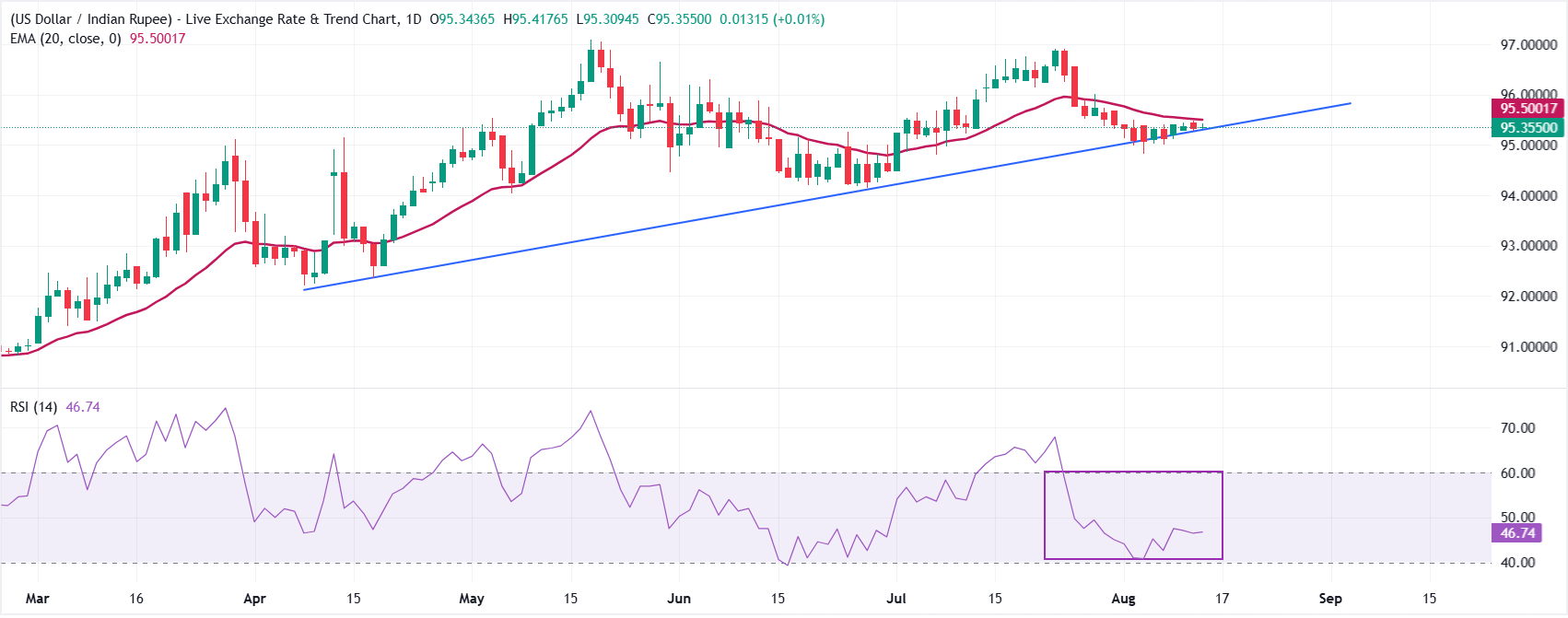
USD/INR trades at around 95.35, keeping a mild bearish near-term bias as it holds below the 20-period Exponential Moving Average (EMA) at 95.50. Price action remains under this short-term trend proxy, suggesting rallies are capped for now, while the Relative Strength Index (14) at 46.74 stays in neutral-to-soft territory, hinting at lacklustre bullish momentum rather than a decisive selloff.
On the downside, initial support is aligned with the former break point of the rising trend line at 95.30, which now acts as an underlying floor for the pair; below that, the August 5 low at 94.83 is the critical support level. On the topside, a recovery would first need to clear the 20-period EMA at 95.50 to ease bearish pressure, with a sustained move above this level required to shift the bias towards a more constructive stance. Looking up, the 96.00 level would be the next hurdle for the pair.
EUR/USD steadies around 1.1520 in Thursday’s early European session.
The major pair maintains a bearish tone, with the price holding below the 100-day SMA.
The immediate resistance level is seen at 1.1565; the first downside target to watch is 1.1500.
The EUR/USD pair holds steady near 1.1520 during the early European trading hours on Thursday. US inflation cooled on a year-over-year basis for a second straight month, easing pressure on the US Federal Reserve (Fed) to raise interest rates as soon as next month. The US Producer Price Index (PPI) report for July is due later on Thursday.
Data released by the Bureau of Labor Statistics on Wednesday revealed that the US Consumer Price Index (CPI) rose 3.4% YoY in July, compared to 3.5% in the previous reading. Additionally, the core CPI, excluding food and energy, increased 2.5% YoY in July, versus 2.6% prior. Both readings came in line with expectations.
Traders further cut the chance for a September Fed rate hike, lowering the odds to 40%, according to the CME FedWatch tool. Fed officials will get August CPI and jobs reports before their September meeting.
Nonetheless, escalating geopolitical tensions in the Middle East could boost a safe-haven currency such as the US Dollar (USD) and create a headwind for the major pair. Reuters reported that the US and Iran remain at loggerheads over efforts to agree a permanent end to the war in the Gulf. A senior Iranian official said that there had been no progress in talks to revive the interim deal agreed in June and define a time frame to implement it.
Euro holds steady as post-FOMC consolidation persists
Analysts at Scotiabank observe that the Euro is “entering Wednesday’s NA session flat vs. the USD while showing a mixed performance against the G10 currencies overall.” They note that the single currency “has spent much of August consolidating within a tight, flat range, lacking a catalyst in the period following the FOMC meeting in late July,” underscoring the absence of a clear directional driver in recent trading.
Technical Analysis: EUR/USD keeps a bearish vibe under the 100-day SMA
In the daily chart, EUR/USD holds below the 100-day simple moving average (SMA), keeping the near-term bias bearish despite a modestly constructive tone in momentum, with the Relative Strength Index (14) hovering around 56. Price remains above the 20-day Bollinger middle band SMA, suggesting downside is cushioned for now, while the upper Bollinger band near marks a broader cap on recovery attempts.
On the topside, immediate resistance aligns at the 100-day SMA at 1.1565, ahead of the upper Bollinger band around 1.1612, where selling interest could strengthen if tested. On the downside, initial support is located at the 1.1500 psychological level, followed by the 20-day Bollinger middle band at 1.1475. A deeper bearish extension is likely to target the lower Bollinger band near 1.13375 if the current floor gives way.
To provide the best experiences, we use technologies like cookies to store and/or access device information. Consenting to these technologies will allow us to process data such as browsing behavior or unique IDs on this site. Not consenting or withdrawing consent, may adversely affect certain features and functions.
Functional
Always active
The technical storage or access is strictly necessary for the legitimate purpose of enabling the use of a specific service explicitly requested by the subscriber or user, or for the sole purpose of carrying out the transmission of a communication over an electronic communications network.
Preferences
The technical storage or access is necessary for the legitimate purpose of storing preferences that are not requested by the subscriber or user.
Statistics
The technical storage or access that is used exclusively for statistical purposes.The technical storage or access that is used exclusively for anonymous statistical purposes. Without a subpoena, voluntary compliance on the part of your Internet Service Provider, or additional records from a third party, information stored or retrieved for this purpose alone cannot usually be used to identify you.
Marketing
The technical storage or access is required to create user profiles to send advertising, or to track the user on a website or across several websites for similar marketing purposes.