

The Indian rupee edged down to around 95.3 per dollar, retreating from last week’s four-week highs as a broad selloff in Asian equities and a spike in global crude prices halted its upward momentum. Broader Asian currencies similarly weakened as optimism faded surrounding a potential US-Iran peace deal. This pullback followed a Friday rally driven by aggressive Reserve Bank of India interventions to boost dollar inflows. While economists project these measures will attract $30–$50 billion by March 2027 and limit immediate downside risks, external pressures have quickly overshadowed these gains. Sentiment was further strained by rising US Treasury yields, as stronger-than-expected May jobs data fueled expectations of a Federal Reserve interest rate hike later this year. Meanwhile, investors digested data showing India’s real GDP grew 7.8% year-on-year in the March quarter of 2026. While down slightly from the revised 8% prior, the performance comfortably beat market forecasts of 7.2%.

Indian Rupee starts flat, higher oil prices keep outlook uncertain
- The Indian Rupee opens flat at around 95.72 against the US Dollar with investors await the RBI’s monetary policy.
- US President Trump said that Iran has agreed to give up its nuclear ambitions.
- Indian government approves scrapping capital gains tax on foreign investment in government bonds.
The Indian Rupee (INR) opens flat against the US Dollar (USD) on Thursday after a strong Wednesday. The USD/INR pair holds onto previous day’s gains around 95.72 as oil prices remain higher, with United States (US)-Iran negotiations remaining in deadlock.
In the opening trade, MCX Crude Oil price opens 1.2% lower to near 9,120, but is close to its 10-day high of 9,290 posted on Wednesday.
Currencies from economies, such as India, which rely heavily on oil imports to meet their energy needs, tend to underperform in a high oil price environment.
US President Trump remains confident of early deal with Iran
US President Donald Trump said in The New York Post’s “Pod Force One” program on Wednesday that Iran has agreed over not having nuclear weapons, adding, “Iran’s Ayatollah [referring Supreme Leader Mojtaba Khamenei] is involved in negotiations with Washington” and he will meet him at some time. However, Trump warned that Iran could change its mind and can pursue its nuclear ambitions.
When asked about the timeframe in which the US and Iran could reach a deal, Trump said a memorandum of understanding (MoU) between the nations could reopen the Strait of Hormuz as early as this week; however, there is a possibility that the US blockade on Iranian sea ports could last till Labor Day, September 7.
India approves scrapping capital gains tax on foreign investment in government bonds
Earlier in the day, the Cabinet meeting has approved the scrapping of capital gains tax on foreign portfolio investment in government bonds, aiming to improve the condition of foreign flows in the Indian economy.
The move was highly anticipated by the Indian government as significant Foreign Institutional Investors (FIIs) selling in the Indian stock market has been one of key reasons behind Indian Rupee’s sharp depreciation.
On Monday, FIIs also remained net sellers in the Indian equity markets, offloading their stake worth Rs. 5,616.56 crore. So far in June, overseas investors have remains net sellers in all three trading days.
RBI’s policy comes into limelight
Going forward, the major trigger for the Indian Rupee will be the Reserve Bank of India’s (RBI) monetary policy, which will be announced on Friday. The RBI is expected to hold the Repo Rate steady at 5.25% and guide a hawkish monetary policy outlook, as higher energy prices have de-anchored inflation expectations.
In the US, investors will pay close attention to the Nonfarm Payrolls (NFP) data for May, which will be released on Friday. The impact of the US NFP data will be significant on the Federal Reserve’s (Fed) monetary policy outlook.
Technical Analysis: USD/INR holds above 20-day EMA
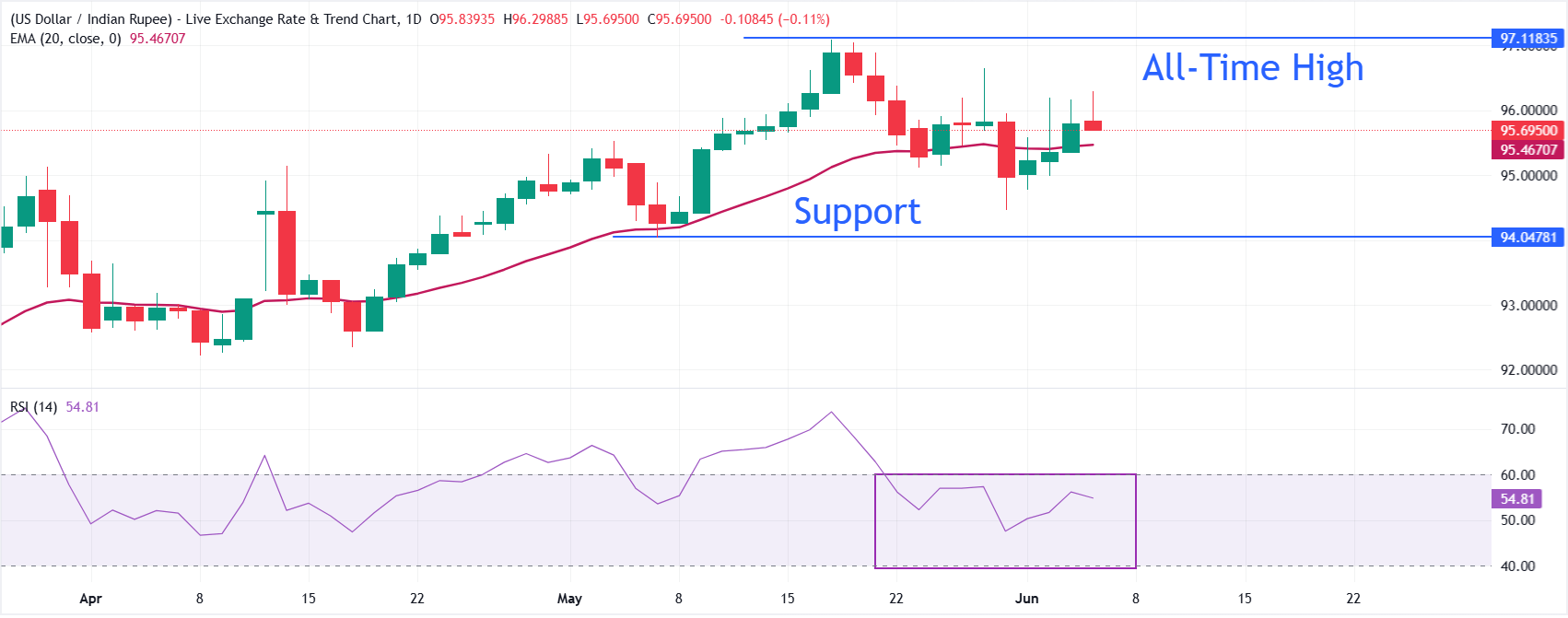
USD/INR trades aLmost flat at around 95.72 in the opening trade. The pair maintain a modest bullish bias as it stays above the 20-day Exponential Moving Average (EMA) at 95.47. The price action consolidates near recent highs while the Relative Strength Index (RSI) at about 54.8 sits slightly above the neutral territory, suggesting steady but not overextended upward momentum.
On the downside, immediate support is aligned with the 20-day EMA around 95.47, which reinforces the underlying demand zone and would need to give way to signal a deeper corrective phase towards the June 2 low at 95.00, followed by the May 7 low at around 94.00. Looking up, the pair could reclaim the all-time high of 97.09 if it manages to rise above the May 28 high at 96.65.

USD/JPY Price Trades below 160.00 intervention threshold; bullish bias intact
- USD/JPY retreats from over a one-month high set on Thursday, though it lacks follow-through.
- The Israel-Lebanon ceasefire weighs on the USD and the currency pair amid intervention fears.
- The bullish technical setup warrants some caution before positioning for any corrective decline.
The USD/JPY pair attracts some sellers during the Asian session on Thursday amid fears that authorities will step in again to prop up the Japanese Yen (JPY). Furthermore, the Israel-Lebanon truce prompts some profit-taking around the US Dollar (USD) and exerts downward pressure on the currency pair.
Spot prices, however, lack follow-through and remain close to the 160.00 psychological mark or over a one-month high set earlier today. Economic concerns stemming from the Middle East conflict hold back the JPY bulls from placing aggressive bets. Adding to this, the uncertainty over US-Iran peace talks, along with hawkish US Federal Reserve (Fed) expectations, acts as a tailwind for the USD and contributes to limiting the downside for the USD/JPY pair.
Spot prices retain a constructive near-term tone within an upward-sloping channel. The lower boundary of the said channel coincides with the 200-period simple moving average (SMA), which acted as a tailwind for the USD/JPY pair on Wednesday. Meanwhile, the Relative Strength Index (RSI) hovers above the midline, suggesting modest bullish momentum even as the Moving Average Convergence Divergence (MACD) flattens slightly below zero.
Momentum indicators hint at a slower advance rather than a sharp reversal. Hence, any corrective pullback might continue to attract fresh buyers near the 159.45 confluence support. A convincing break, however, might prompt some technical selling and pave the way for deeper losses. As long as buyers defend this support band above 159.44, the broader bias stays tilted higher, and a renewed push toward the channel top at 160.14 remains the primary topside scenario.
(The technical analysis of this story was written with the help of an AI tool.)
USD/JPY 4-hour chart
Japanese Yen Price Last 30 days
The table below shows the percentage change of Japanese Yen (JPY) against listed major currencies last 30 days. Japanese Yen was the strongest against the Canadian Dollar.
| USD | EUR | GBP | JPY | CAD | AUD | NZD | CHF | |
|---|---|---|---|---|---|---|---|---|
| USD | 0.71% | 0.76% | 1.66% | 2.05% | 0.54% | -0.02% | 0.83% | |
| EUR | -0.71% | 0.06% | 0.97% | 1.36% | -0.20% | -0.70% | 0.17% | |
| GBP | -0.76% | -0.06% | 0.92% | 1.29% | -0.23% | -0.76% | 0.12% | |
| JPY | -1.66% | -0.97% | -0.92% | 0.35% | -1.16% | -1.66% | -0.82% | |
| CAD | -2.05% | -1.36% | -1.29% | -0.35% | -1.50% | -2.00% | -1.16% | |
| AUD | -0.54% | 0.20% | 0.23% | 1.16% | 1.50% | -0.54% | 0.39% | |
| NZD | 0.02% | 0.70% | 0.76% | 1.66% | 2.00% | 0.54% | 0.89% | |
| CHF | -0.83% | -0.17% | -0.12% | 0.82% | 1.16% | -0.39% | -0.89% |
The heat map shows percentage changes of major currencies against each other. The base currency is picked from the left column, while the quote currency is picked from the top row. For example, if you pick the Japanese Yen from the left column and move along the horizontal line to the US Dollar, the percentage change displayed in the box will represent JPY (base)/USD (quote).

EUR/JPY Price Holds modest gains above 185.50, bullish bias remains intact
- EUR/JPY trades with mild gains near 185.65 in Thursday’s early European session.
- The cross keep a modest bullish bias above the key 100-day SMA.
- The first upside barrier emerges at 186.00; the initial support level is seen at 185.15.
The EUR/JPY cross posts modest gains around 185.65 during the early European session on Thursday. The potential upside might be limited for the cross amid fears of foreign exchange intervention from Japanese authorities.
Japan’s Finance Minister Satsuki Katayama said on Wednesday that officials are standing ready to respond appropriately on foreign exchange if required. Katayama added that she aligns with the Bank of Japan (BoJ) governor on several matters.
On the other hand, the hawkish stance of the European Central Bank might help limit the EUR’s losses. The ECB is likely to raise its deposit rate to 2.25% at its upcoming June policy meeting, with another increase likely in September, a Reuters poll of economists showed.
Technical Analysis:
In the daily chart, EUR/JPY trades at 185.64, holding a modest bullish bias as it consolidates above the Bollinger middle band around 185.15 and the 100-day simple moving average (SMA) near 184.48. The pair is trading closer to the upper half of its recent Bollinger envelope, with the upper band near 186.02 acting as immediate overhead resistance, while the Relative Strength Index (14) around 55 suggests steady but not overstretched upside momentum.
On the topside, a daily close above the Bollinger upper band at 186.02 would open the way for a continuation of the advance toward higher highs in the coming sessions. On the downside, initial support is seen at the Bollinger middle band near 185.15, followed by the 100-day SMA at 184.48 and the lower Bollinger band around 184.28, where buyers would be expected to re-emerge if the current pullback deepens.

CHF rises as USD slips on Israel-Lebanon ceasefire news
- USD/CHF falls as the US Dollar struggles on easing risk aversion after Israel and Lebanon renewed their ceasefire on Wednesday.
- The Greenback may regain its ground as strong May jobs data fuels expectations that the Fed will raise interest rates.
- Schlegel said recently that the SNB is ready to intervene against Middle East-driven Swiss Franc overvaluation pressures.
USD/CHF halts its three-day winning streak, trading around 0.7910 during the Asian hours on Thursday. The pair depreciates as the US Dollar (USD) loses ground on easing risk aversion following the news that Israel and Lebanon on Wednesday agreed to renew a ceasefire. However, it would require a “complete cessation” of fire by Iran-backed Hezbollah. The agreement was announced in a joint statement after US-led talks in Washington.
The Israel and Lebanon do not have formal diplomatic relations, though also agreed to establish several “pilot security zones” in which the Lebanese armed forces “will take exclusive control of the territory to the exclusion of all non-state actors.”
The downside of the USD/CHF pair could be restrained as the Greenback may regain its ground amid rising expectations that the US Federal Reserve (Fed) will raise interest rates this year. Stronger-than-expected US jobs data, including the May ADP private payrolls and JOLTS job openings, suggested a resilient US labor market. These reports might prompt traders to raise their bets that the Fed will keep interest rates higher for longer.
Market expectations have shifted dramatically as the war in Iran continues to disrupt energy markets, driving up oil prices and fueling inflation. Consequently, traders are adjusting to a more hawkish outlook, with the CME FedWatch Tool now pricing in a nearly 42% probability of a Federal Reserve interest-rate hike in December.
Swiss National Bank (SNB) Chairman Martin Schlegel noted that the Swiss Franc’s real overvaluation is notably lower than its nominal overvaluation. Schlegel added that the central bank has increased its readiness to intervene in the foreign exchange market to counter safe-haven appreciation pressures driven by escalating tensions in the Middle East.

Canadian Dollar drops to two-month low vs USD as Fed-BoC gap counter higher Oil prices
- USD/CAD retains a bullish bias and continues to draw support from a combination of factors.
- Domestic growth concerns and the divergent BoC-Fed expectations undermine the Loonie.
- Geopolitical risks benefit the safe-haven USD and further offer some support to spot prices.
The USD/CAD pair climbs to a nearly two-week high during the Asian session on Thursday, with bulls now looking to build on the positive momentum further beyond the 1.3900 mark.
The Canadian Dollar (CAD) continues with its relative underperformance against the US Dollar amid slowing domestic growth, a softening labor market, and interest rate divergence between the Bank of Canada (BoC) and the US Federal Reserve (Fed). In fact, Canada faced consecutive quarters of economic contraction during the January-March 2026 period, confirming a technical recession. Adding to this, rising unemployment and weakening consumer demand could force the BoC to adopt a more dovish stance.
In contrast, traders are currently assigning over a 50% chance that the Fed will raise interest rates in 2026 amid sticky inflation. This, along with persistent geopolitical uncertainties, acts as a tailwind for the safe-haven USD and continues to offer some support to the USD/CAD pair. In the latest development surrounding the Middle East conflict, the US military said on Tuesday that it had intercepted and defeated a series of Iranian missile and drone attacks targeting regional neighbors – Kuwait and Bahrain.
Furthermore, the lack of a breakthrough in US-Iran diplomatic negotiations, amid a standoff over Tehran’s nuclear program and the Strait of Hormuz, keeps geopolitical risks in play. This, in turn, assists Crude Oil prices in preserving weekly gains registered over the past three days, which helps limit further losses for the commodity-linked Loonie. Adding to this, the Israel-Lebanon agreement on the implementation of a ceasefire keeps a lid on the safe-haven USD and contributes to capping the upside for the USD/CAD pair.
Investors also seem hesitant and opt to wait for the release of monthly employment details from the US and Canada on Friday. The crucial US Nonfarm Payrolls (NFP) report will be looked for more cues about the Fed’s policy path, which, along with the incoming geopolitical headlines, will drive the USD demand. Moreover, Crude Oil price dynamics should provide a fresh impetus to the USD/CAD pair. Nevertheless, the fundamental backdrop suggests that the path of least resistance for spot prices is to the upside.
USD/JPY Price Forecast: Bulls turn cautious near 160.00 amid rising intervention risk
- USD/JPY pauses for a breather as a fresh intervention warning helps limit JPY losses
- Economic risks stemming from the Middle East conflict cap the JPY and support the pair.
- The bullish USD sentiment backs the case for further gains amid a constructive setup.
The USD/JPY pair enters a bullish consolidation phase on Wednesday, oscillating in a narrow range just below the 160.00 psychological mark, or a one-month high touched during the Asian session. Verbal intervention by Japan’s Finance Minister Satsuki Katayama offers some support to the Japanese Yen (JPY), which, along with a subdued US Dollar (USD) price action, caps spot prices.
However, economic concerns stemming from the conflict in the Middle East and the effective closure of the Strait of Hormuz hold back the JPY bulls from placing aggressive bets. In contrast, the lack of breakthrough in US-Iran peace negotiations, along with hawkish US Federal Reserve (Fed), acts as a tailwind for the safe-haven US Dollar (USD) and helps limit downside for the USD/JPY pair.
From a technical perspective, this week’s move beyond the 78.6% Fibonacci retracement level of the late April-early May downswing comes on top of the recent solid bounce from the 200-day Exponential Moving Average (EMA) and favors bulls. Adding to this, the Relative Strength Index (RSI) around 61 suggests firm but not overextended upside momentum. Moreover, the Moving Average Convergence Divergence (MACD) remains in positive territory, hinting that buyers still retain control despite the proximity of recent cycle highs.
On the topside, immediate resistance is aligned with the late April swing high near 160.78, where a clear break would reopen the path toward fresh highs. On the downside, initial support is seen at the 78.6% retracement at 159.55, followed by the 61.8% level at 158.58 and the 50% retracement at 157.90. Deeper pullbacks would look to the 38.2% level at 157.22 and the 23.6% retracement at 156.38, ahead of a stronger demand area created by the 200-day EMA at 155.77 and the structural floor near 155.03.
(The technical analysis of this story was written with the help of an AI tool.)
USD/JPY daily chart

EUR/USD declines as traders adopt caution on risk-off mood
- EUR/USD depreciates as Middle East tensions drive safe-haven demand for the firm US Dollar.
- CENTCOM announced it successfully intercepted multiple Iranian missile and drone strikes targeting Kuwait and Bahrain.
- US Dollar remains firm as the Strait of Hormuz closure raises energy prices and inflation, keeping Fed rates higher for longer.
EUR/USD inches lower after moving little in the previous day, trading around 1.1630 during the Asian hours on Wednesday. The pair depreciates as the US Dollar (USD) remains firm, driven by stalled US-Iran peace negotiations and renewed tensions in the Middle East continued to underpin safe-haven demand.
US Central Command (CENTCOM) announced Tuesday that it successfully defeated a series of Iranian missile and drone strikes targeting Kuwait and Bahrain. In response to the regional aggression, US forces also executed self-defense strikes against military targets on Iran’s Qeshm Island, per ABC News.
The Strait of Hormuz closure threatens to drive energy prices higher and intensify global inflationary pressures, reinforcing expectations that the Federal Reserve (Fed) will maintain elevated interest rates for an extended period.
US ISM Manufacturing PMI climbed to 54 in May 2026, up from 52.7 in the prior two months and beating forecasts to mark the strongest factory expansion since May 2022. April JOLTS data showed Job Openings surging to a nearly two-year high of 7.6118 million alongside declining layoffs. With robust manufacturing and employment data complicating the inflation outlook, investors are now anxiously awaiting Friday’s Nonfarm Payrolls report for definitive clues on the future trajectory of monetary policy.
The Eurozone Harmonized Index of Consumer Prices (HICP) rose 3.2% year-on-year in May, ticking up from the previous 3% and matching market forecasts. This steady inflationary pressure keeps the spotlight firmly on the European Central Bank’s upcoming monetary policy decisions.
The Euro (EUR) could gain ground amid recent hawkish comments from the European Central Bank (ECB) members. ECB policymaker Olli Rehn noted that while long-term inflation expectations remain anchored, a rate move in June should be viewed as a precautionary “insurance hike.” Moreover, fellow ECB member Gediminas Simkus pointed out that inflation expectations currently mirror levels seen four years ago. He strongly emphasized the critical need for the central bank to react in a timely manner to prevent further price pressures from cementing.