

The Bank of Canada maintained its policy interest rate at 2.25%, a level held since October. The Governing Council decided to “look through” the immediate inflationary impact of the Middle East war. However, policy remains “nimble,” with potential for rate hikes if energy price shocks lead to persistent, generalized inflation. Economic projections:
Inflation Outlook : March CPI inflation rose to 2.4% from 1.8% in February, driven by surging gasoline prices. Inflation is forecast to peak at 3% in April before returning to the 2% target in early 2027.
Economic Growth Projections : GDP growth is projected at 1.2% in 2026, rising to 1.7% by 2028 as trade and investment gradually recover. While consumption and government spending support the economy, US tariffs and trade uncertaintyโspecifically the CUSMA reviewโweigh on exports. Canadaโs net oil exporter status provides some relative resilience.
Labor Market and Risks : The labor market is soft, with unemployment between 6.5% and 7%. Key risks include new US trade restrictions, which could trigger rate cuts, or persistent energy price pressures that might necessitate consecutive rate increases. Productivity is seeing an early boost from businesses adopting artificial intelligence technologies.
USD/JPY nudges higher on Wednesday and reaches the 159.75 area.
The US Dollar remains buoyant on cautious markets ahead of the Fed’s interest rate decision.
Japanese Finance Minister Katayama threatened “decisive action” against speculative market moves.
The US Dollar (USD) nudges higher for the second consecutive day against the Japanese Yen (JPY) on Wednesday, trading at 159.75 at the time of writing, with the key 160.00 level, considered a line in the sand for Tokyo intervention, coming closer.
The US Dollar keeps a moderate bullish trend against its main peers as investors brace for the outcome of the US Federal Reserveโs two-day monetary policy meeting, due later today. The bank will, all but certainly, leave its benchmark interestย ratesย unchanged in the 3.50%-3.75% range, with no monetary policy changes foreseen by the market until well into 2027.
Wednesday’s is highly likely to be the latest meeting with Jerome Powell as chairman, as his term ends on May 15, and former Governor Kevin Warsh has been nominated as his replacement. It is still to be seen, however, whether Powell remains on the Board of Governors or, as US President Donald Trump demanded, leaves the central bank.
In Japan, the Bank of Japan (BoJ) stood pat on rates, as expected, on Tuesday, but Governor Kazuoย Uedaย reaffirmed their commitment to gradual monetary tightening. The positive impact on the Yen, however, was muted, as the comparatively low BoJ interest rates leave the Yen as the currency of choice for carry trade, consisting of borrowing low-yielding Yen to purchase higher-yielding currencies.
Japanese Finance Minister Satsuki Katayama warned Yen sellers before the BoJ decision on Tuesday, flagging a coordinated intervention with the US. Katayama said that Crude Oil volatility is spilling over the FX markets and affecting the broader economy, and assured that Japanese Authorities are ready to take decisive action against speculative activity.
GBP/USD wobbles around 1.3500 as the US Dollar consolidates in the countdown to Fed-BoE policy announcements.
The Fed is expected to warn of upside inflation risks after leaving interest rates unchanged.
Investors expect the BoE to hold interest rates steady at 3.75%.
The GBP/USD pairย is broadly sideways around 1.3500 during the European trading session on Wednesday. The Cable consolidates as investors await monetary policy announcements by theย Federal Reserveย (Fed) and the Bank of England (BoE).
Theย Fedย is anticipated to leave interest rates unchanged in the range of 3.50%-3.75% in its monetary policy announcement at 18:00 GMT, according to the CME FedWatch tool. In the monetary policy statement, the Fed is expected to warn about de-anchored inflation projections and growing economic risks amid higher oil prices due to prolonged Strait of Hormuz closure.
Ahead of the Fedโs policy meeting, the US Dollar Index (DXY), which tracks the Greenbackโs value against six major currencies, trades 0.1% higher to near 98.70.
On Thursday, theย BoEย is expected to hold interestย ratesย steady at 3.75%, with an 8-1 majority. In an event at the International Monetary Fund (IMF) this month, BoE Governor Andrew Bailey said the war has resulted in a โbig negative shockโ to the economy; however, there is no rush for any monetary policy adjustment.
GBP/USD technical analysis
GBP/USD trades flat at around 1.3500, holding a modest bullish bias as it sits above the 20-day Exponential Moving Average (EMA) at 1.3470 and the 38.2% Fibonacci retracement at 1.3432.
The Relative Strength Index (RSI) at 55.4 leans slightly positive, suggesting buyers retain the upper hand while upside traction remains gradual.
On the topside, immediate resistance is aligned at the 50.0%ย Fibonacciย retracement at 1.3515, with further barriers at the 61.8% level at 1.3599, followed by 1.3718 and 1.3870. On the downside, initial support is seen at the 20-day EMA at 1.3470, ahead of the 38.2% retracement at 1.3432; a deeper pullback would expose the 23.6% level at 1.3328 and the structural floor near 1.3161.
USD/CAD trades firmly near 1.3700 as the US Dollar gains ahead of the Fedโs monetary policy.
The Fed and the BoC are expected to hold interest rates steady.
Investors await fresh cues on the US inflation and the interest rate outlook.
The USD/CAD pair clings to Tuesdayโs gains around 1.3690 during the European trading session on Wednesday. The Loonie pair reflects strength as the US Dollar (USD) trades higher ahead of the Federal Reserveโs (Fed) monetary policy announcement at 18:00 GMT.
At the press time, the US Dollar Index (DXY), which tracks the Greenbackโs value against six major currencies, trades 0.15% higher to near 98.75.
Investors expect theย Fedย to leave interest rates unchanged in the range of 3.50%-3.75%, as elevated energy prices have de-anchored inflation projections globally. Market participants will pay close attention to the monetary policy statement and Fed Chair Jerome Powellโs speech to get fresh cues on inflation and the United States (US) interest rateย outlook.
Ahead of the Fedโs policy, the Bank of Canada (BoC) will announce its monetary policy at 13:45 GMT, in which it is also expected to hold interestย ratesย steady. Market participants will closely monitor remarks regarding the Canadian labor market outlook, with the Unemployment Rate remaining higher at 6.7%.
USD/CAD technical analysis
USD/CADย reflects strength at around 1.3690 as of writing. However, the price keeps a mildly bearish near-term tone as it remains below the 20-period Exponential Moving Average (EMA) at 1.3724.
The Relative Strength Index (RSI) near 44 suggests fading bullish momentum and hints that sellers are gaining incremental control while price remains capped by the overhead EMA.
On the topside, immediate resistance aligns with the 20-period EMA at 1.3724, and a daily close above this barrier would be needed to ease the current downside bias and reopen a push toward 1.3800. Looking down, initial support is seen at the former trend-line-based floor near 1.3593; a sustained break below that area would reinforce the developing bearish phase.
The Indian Rupee continues to underperform against the US Dollar amid rising oil prices.
US President Trump warns of extending the blockade on Iranian sea ports.
The Fed is expected to leave interest rates unchanged.
The Indian Rupee (INR) extends its decline against the US Dollar (USD) on Wednesday. Theย USD/INRย pair rallies further to near 94.75, as oil prices have extended their advance, following comments from United States (US) officials on late Tuesday that President Donald Trump has instructed aides to prepare for an extended blockade of Iran, The Wall Street Journal (WSJ) reported.
At the press time, the WTI Oil price trades flat around $97.00 but gained sharply in the late Tuesdayโs session to near $99.50, the highest level seen in almost three weeks.
Currencies from economies, such as India, which rely heavily on oil imports to meet their energy needs, tend to underperform in a high oil price environment.
Trump prefers squeezing oil flows from Iran than bombing its territory again
The WSJ report showed the US President Trump has stated that the continuation of the blockade of Iranian sea ports is a preferred measure to push Tehran on the back foot in negotiating terms for a permanent ceasefire than bombing Iranian territory again.
The continuous US blockade on Iran means the prolonged closure of the Strait of Hormuz, a vital passage for almost 20% of global energy supply.
FIIs keep offloading their stake in Indian stock market
Overseas investors have emerged as net sellers for the seventh straight trading day on Tuesday, and have offloaded their stake worth Rs. 20,395.08 crore. Foreign Institutional Investors (FIIs) worry that โhigher-for-longerโ oil prices would be a major drag on India Inc.โs earnings projections by hitting their margins and will also diminish householdsโ spending power.
Investors shift focus to the Fed policy
On Wednesday, the major trigger for global markets will be the Federal Reserveโs (Fed) monetary policy announcement at 18:00 GMT, in which the central bank is expected to leave interestย ratesย unchanged in the range of 3.50%-3.75%.
The Fed is expected to warn of upside inflation and downside economic risks amid escalated energy prices. This will be the last Fed policy meeting by Jerome Powell as Chairman. Investors will pay close attention toย Fedย Chair Powellโs speech to get fresh cues on the US interest rateย outlook.
Technical Analysis: USD/INR approaches all-time high above 95.00
USD/INR trades higher at around 94.75 in the opening session on Wednesday. The pair holds a bullish near-term bias as spot remains above the 20-day exponential moving average (EMA) at roughly 93.66, keeping the recent advance supported.
The Relative Strength Index (RSI) around 63 suggests firm but not yet overbought upside momentum, reinforcing the constructive tone while leaving room for additional gains.
On the downside, immediate support is seen at the 20-day EMA near 93.66. As long as USD/INR defends this moving average, dips are likely to attract buying interest, and the broader uptrend is expected to stay intact. Looking up, the spot is expected to revisit the all-time high slightly above 95.00.
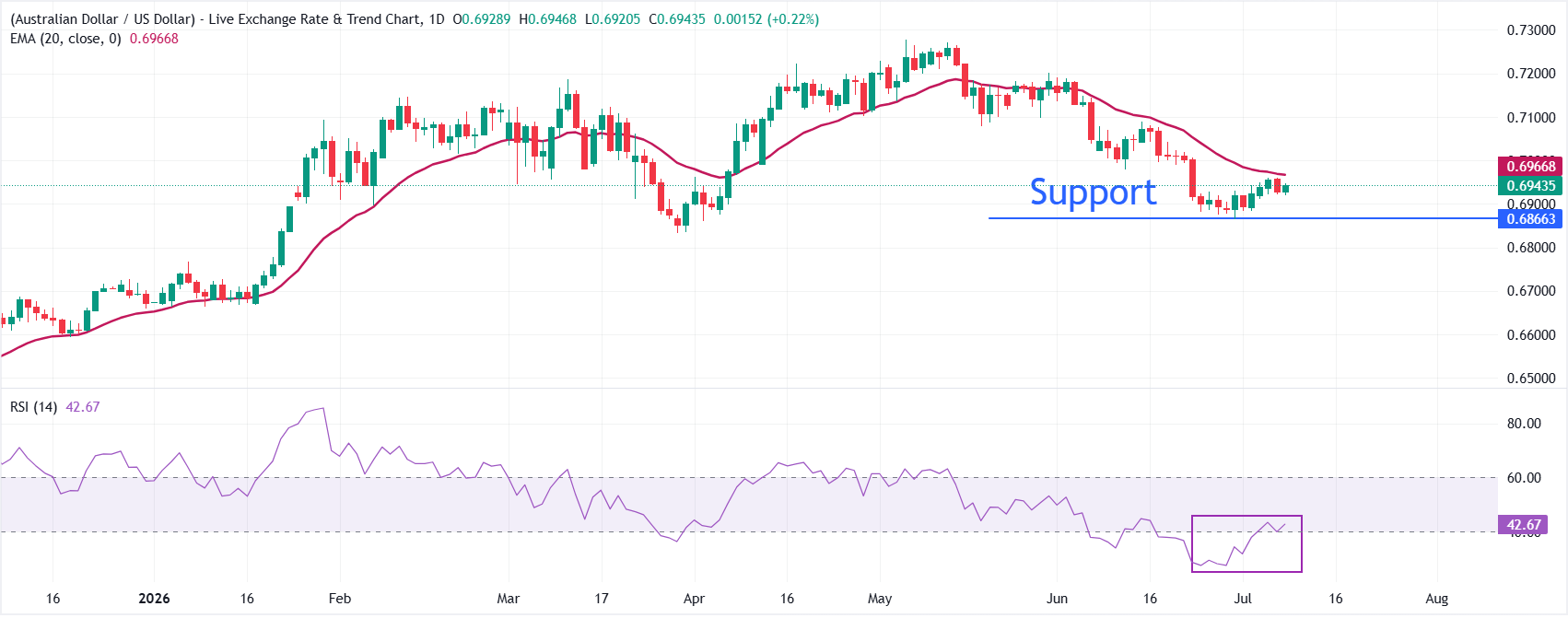
The Australian dollar edged down to below $0.72, but stayed near four-year highs as a sharp rise in inflation kept expectations of a rate hike next week. Headline inflation jumped to 4.6% annually in March, slightly below forecasts of 4.7%, but stayed above the Reserve Bankโs 2โ3% target and marked the highest since monthly CPI data began in 2025.
The annual trimmed-mean measure held at 3.3%, in line with expectations as higher fuel costs stemming from Middle East supply disruptions added to already elevated price pressures. In the absence of a major upside inflation surprise, the Aussie attracted some sellers amid cautious risk sentiment due to persistent geopolitical uncertainties. Still, markets priced in increased odds of a 25 bp rate hike next week. In the US and other G-7 economies, policymakers are likely to hold rates steady this week while monitoring the risk of rising energy costs fueling inflation, as the Strait of Hormuz remained effectively closed amid US-Iran tensions.
The Japanese yen hovered around 159.6 per dollar in holiday trading on Wednesday, lingering near the critical 160 threshold even after the Bank of Japan delivered a hawkish hold this week. On Tuesday, the BOJ kept its policy rate unchanged at 0.75% as expected, while raising its inflation outlook and lowering its growth forecast for FY2026 to reflect the economic impact of the Middle East conflict. Notably, three of the nine policy board members supported a rate hike, underscoring growing concern over inflationary pressures tied to the Iran war. BOJ Governor Kazuo Ueda also reaffirmed the central bankโs commitment to a gradual tightening trajectory, signaling that interest rates could continue to rise as economic, price, and financial conditions evolve. Meanwhile, Finance Minister Satsuki Katayama reiterated that authorities stand ready to intervene in currency markets at any time to support the yen.
The New Zealand dollar fell for a second straight session on Wednesday to $0.585, as investors digested comments from Reserve Bank of New Zealand Governor Anna Breman. Breman said first-quarter measures of core inflation remained stable within the central bankโs 1-3% target range, while emphasizing that policymakers remain focused on balancing inflation control ?while supporting an economic recovery. She also stressed that the RBNZ is prepared to act decisively and in a timely manner should short-term price pressures begin to feed into more persistent inflation. Markets are currently pricing in a rate hike as early as May. However, some caution remains, as the Middle East conflict threatens to derail the countryโs fragile economic recovery. Externally, attention is fixed on the Federal Reserveโs policy outcome due later today, with the bank widely expected to stand pat. Meanwhile, traders are awaiting President Trumpโs response to Iranโs new proposal to reopen the Strait of Hormuz.
To provide the best experiences, we use technologies like cookies to store and/or access device information. Consenting to these technologies will allow us to process data such as browsing behavior or unique IDs on this site. Not consenting or withdrawing consent, may adversely affect certain features and functions.
Functional
Always active
The technical storage or access is strictly necessary for the legitimate purpose of enabling the use of a specific service explicitly requested by the subscriber or user, or for the sole purpose of carrying out the transmission of a communication over an electronic communications network.
Preferences
The technical storage or access is necessary for the legitimate purpose of storing preferences that are not requested by the subscriber or user.
Statistics
The technical storage or access that is used exclusively for statistical purposes.The technical storage or access that is used exclusively for anonymous statistical purposes. Without a subpoena, voluntary compliance on the part of your Internet Service Provider, or additional records from a third party, information stored or retrieved for this purpose alone cannot usually be used to identify you.
Marketing
The technical storage or access is required to create user profiles to send advertising, or to track the user on a website or across several websites for similar marketing purposes.