Currency Hedger No Comments

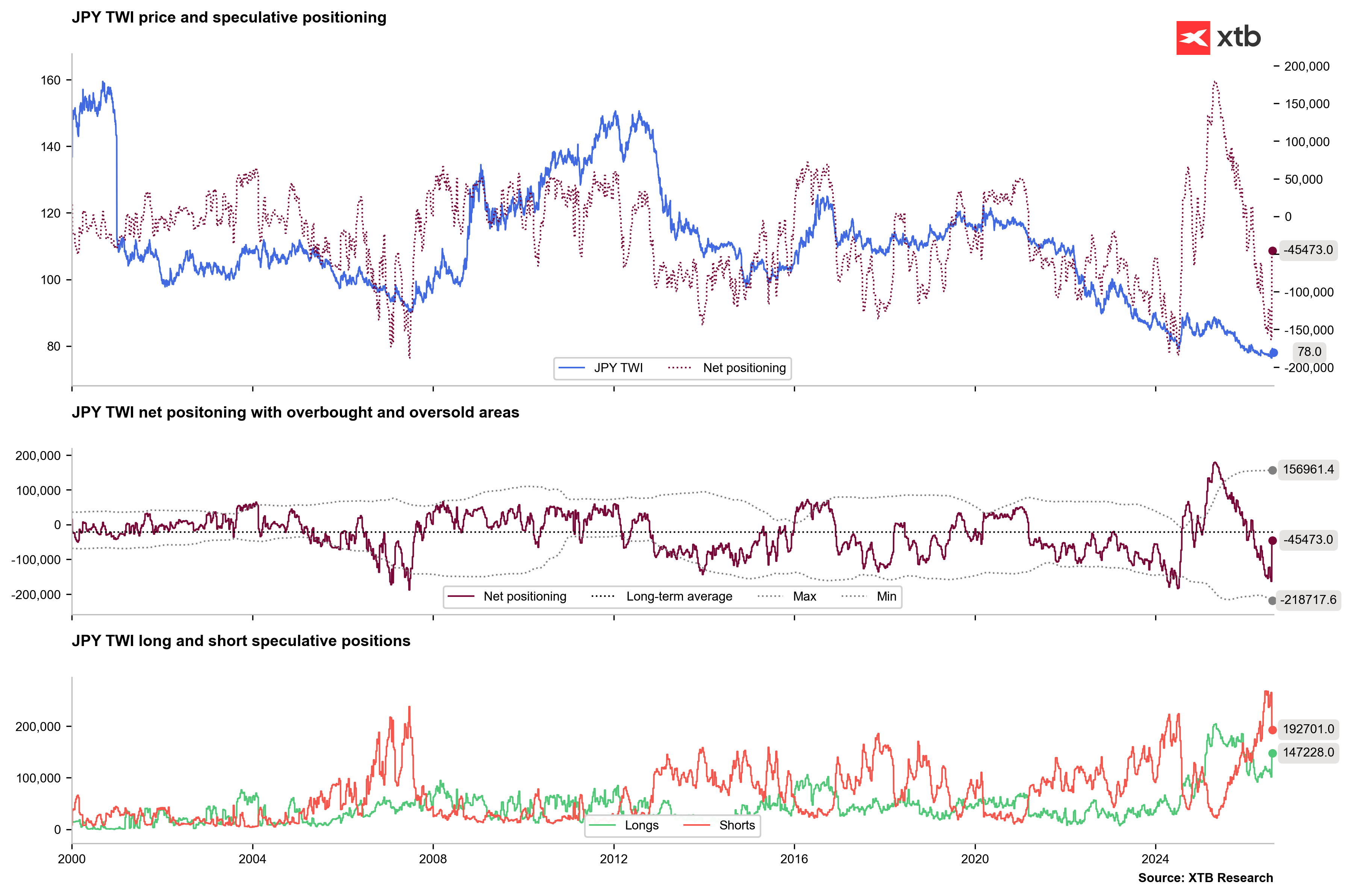
Chart of The Day – Is The USD/JPY in a stable trend or at a turning point?

USDJPY is trading slightly lower this morning at 162.70 (-0.15%) after hitting new multi-year highs around 163, as the market awaits the key U.S. payrolls report.

Context of Today’s NFP Data

Todayโ€™s June payrolls report is the main catalyst of the dayโ€”the consensus expects a marked slowdown to about 110,000 jobs following a surprisingly strong May reading of 172,000, with the unemployment rate holding steady at 4.3% and wage growth accelerating to 3.5% y/y. The market is trying to assess whether Mayโ€™s surge represented a genuine labor market recovery or merely a one-off effect (including the World Cup in the U.S.). Employment growth this year has averaged above 80,000, which supports the scenario of a resilient labor market. CBA warns that another positive surprise could push USD/JPY toward 165 and test the Japanese authoritiesโ€™ determination to defend the yen, while a weak reading (below 70,000โ€“90,000) would ease pressure on the Fed to remain hawkish and could trigger a downward correction in the pair.

Technical Analysis

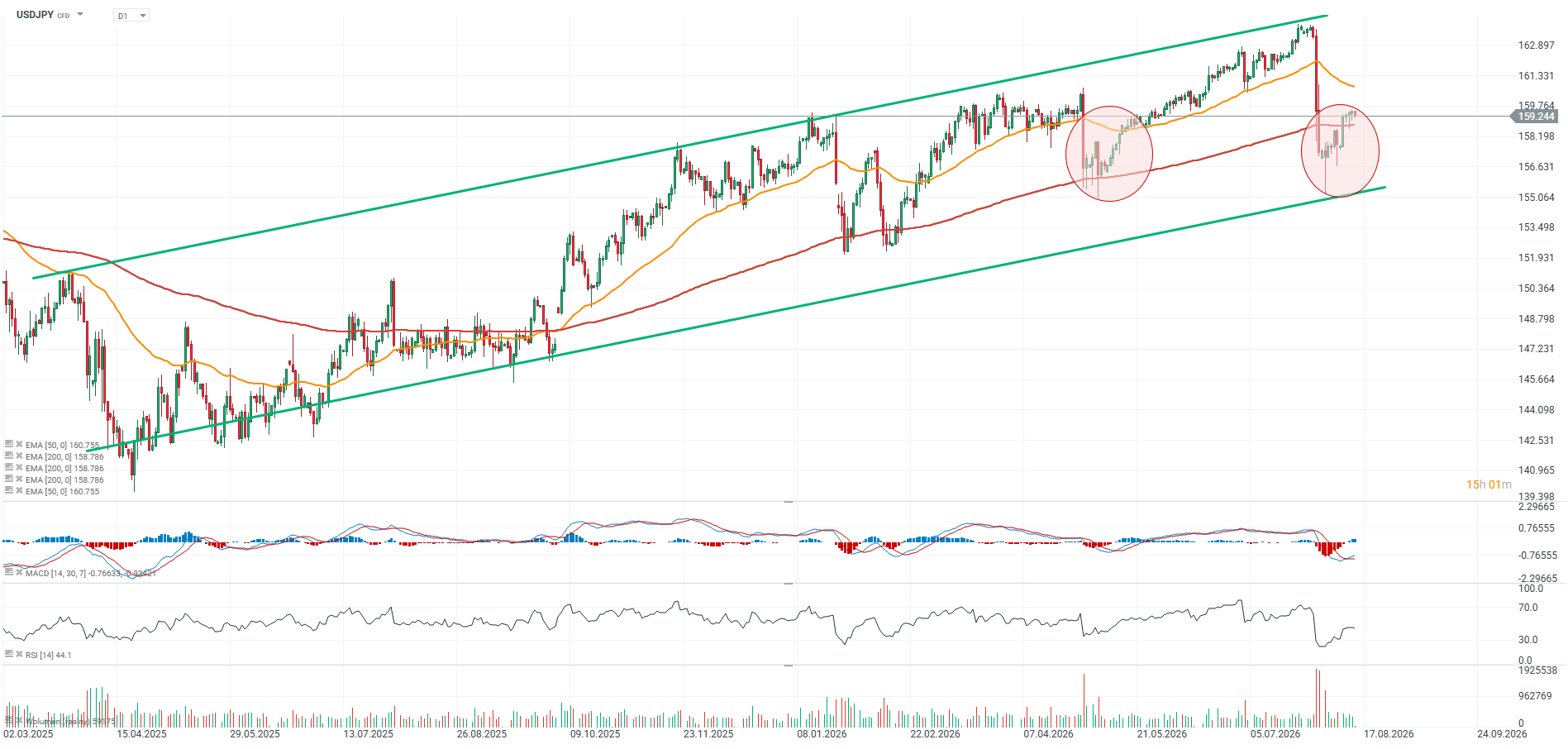
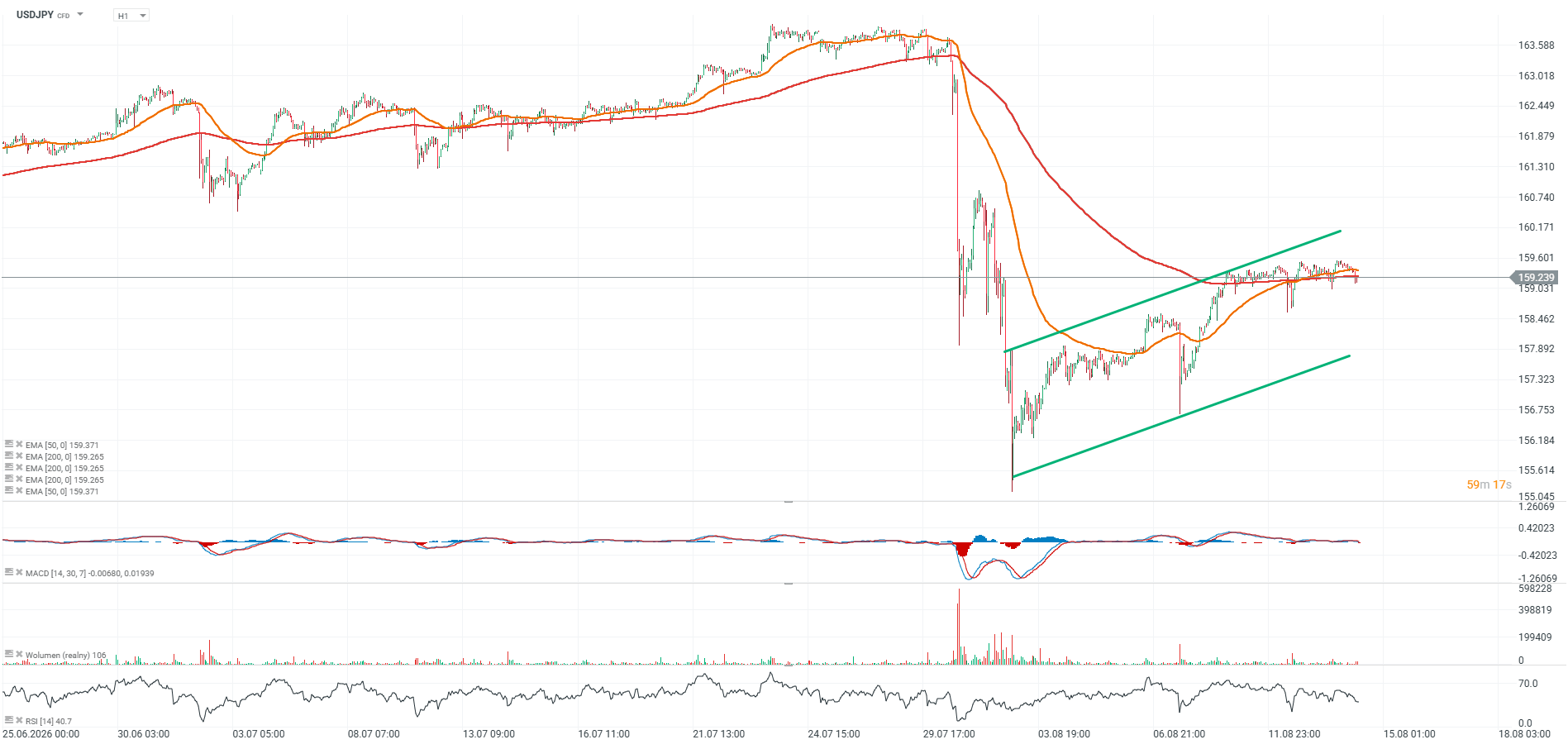
The price broke through key resistance levels at 159.52 and 160.52 JPY with momentum, moving clearly above the 50-day EMA (160.29), the 100-day EMA (159.21), and the 200-day EMA (157.31), confirming a strong uptrend. However, the RSI at 71.8โ€“76.2 signals overbought conditions on the daily chart, which historically has preceded short-term consolidations or corrections, especially near multi-year highs. The trend remains clearly bullish for the dollar (bearish for the yen), and the 162โ€“163 range also represents an area of heightened risk of currency intervention by Japanese authorities. Source: xStation

A Brief Look at Data from Japan

The Bank of Japan raised its policy rate to 1.0% in Juneโ€”the highest level in 31 yearsโ€”but the market does not expect another hike until the Octoberโ€“December 2026 window, even though about 90% of economists anticipate one more hike by December. This slow pace of policy normalization by the BoJ, coupled with the hawkish stance of the Fed, is the main structural reason why the interest rate differential between the U.S. and Japan remains wide and is sustaining the yenโ€™s long-term downward trendโ€”verbal interventions by Japanese officials have so far failed to permanently reverse this trend.

Currency Hedger No Comments

EUR/USD Price Forecast: Approaches 1.1400 as bearish flag remains in play

  • EUR/USD attracts some buyers and moves away from the weekly low.
  • The upside seems limited as traders keenly await the US NFP report.
  • The bearish setup backs the case for the emergence of fresh sellers.

The EUR/USD pair ticks higher during the Asian session on Thursday, though it lacks bullish conviction as traders keenly await the release of the crucial US Nonfarm Payrolls (NFP) report. Spot prices currently trade around the 1.1385 area and remain close to the weekly low, touched on Wednesday.

From a technical perspective, the EUR/USD pair retains a negative near-term bias beneath the 200-period Exponential Moving Average (EMA) on the 4-hour chart. Adding to this, the recent recovery from the lowest level since May 2025 has been along an upward-sloping channel, which constitutes the formation of a bearish flag pattern.

Moreover, the Relative Strength Index (14) near 42.5 and a slightly negative Moving Average Convergence Divergence (MACD) reading hint at fading bullish momentum. Momentum indicators together reinforce the near-term bearish outlook and suggest that the path of least resistance for the EUR/USD pair remains to the downside.

The EUR/USD pair holds just above the lower boundary of the rising parallel channel at 1.1366. This, however, points to only a tentative structural support, and a convincing break below would open the way for a slide. Spot prices might then aim towards retesting the year-to-date trough, around the 1.1335-1.1330 region, touched in June.

On the topside, initial resistance aligns with the upper edge of the upward parallel channel at 1.1451, ahead of stronger supply at the 200-period EMA clustered around 1.1522. The EUR/USD pair would need to reclaim the said barriers to ease the broader bearish tone and shift the technical picture toward a more constructive outlook.

(The technical analysis of this story was written with the help of an AI tool.)

EUR/USD 4-hour chart

Chart Analysis EUR/USD
Currency Hedger No Comments

AUD steadies following Trade Balance data

  • AUD/USD holds steady as a stronger Australian Dollar was supported by positive domestic Trade Balance data.
  • Australia’s Trade Balance shifted to a A$3,018M deficit in May, reversing April’s surplus.
  • The US Dollar remains calm after Fed Chair Kevin Warsh struck a relatively subdued tone at Wednesday’s ECB Forum.

AUD/USD inches higher after registering modest losses in the previous day, trading around 0.6900 during the Asian hours on Thursday. The pair holds ground as the Australian Dollar (AUD) remains stronger following the release of domestic Trade Balance data. Traders will closely monitor the US Nonfarm Payrolls figures for June later on Thursday.

Australian Bureau of Statistics (ABS) released on Thursday that the Trade Balance shifted to a deficit of A$3,018M MoM in May, following a surplus of A$1,383M in the previous reading (revised from A$1,791M). The market consensus was for a surplus of A$2,200M. Exports fell by 6.9% MoM in May from a rise of 7.2% seen a month earlier. Meanwhile, Imports rose by 2.6% MoM in May, compared to an increase of 0.2% seen in April (revised from 0.8%).

The AUD/USD pair trades within a tight range as the US Dollar (USD) stabilizes following a relatively subdued appearance by Federal Reserve (Fed) Chair Kevin Warsh at the ECB Forum on Central Banking on Wednesday. Warsh opted not to provide explicit guidance regarding the central bank’s upcoming July policy decision. While he acknowledged that inflation remains too elevated and reiterated a firm commitment to the Fed’s 2% target and institutional independence, his overall tone was perceived as less hawkish than anticipated. Additionally, Warsh noted a personal preference for winding down the central bank’s bond portfolio but emphasized that any adjustments to the balance sheet would only occur after extensive public preparation.

The Greenback could face further headwinds on easing risk aversion amid a wave of optimistic geopolitical developments out of the Middle East. Qatari officials reported “positive progress” in the ongoing negotiations between US and Iranian diplomats regarding a memorandum of understanding, noting that both sides have agreed to continue their dialogue. Reinforcing this positive sentiment, US Vice President JD Vance stated that the discussions in Doha are going well and indicated that formal talks regarding the nuclear issue are expected to commence in the near future.

Currency Hedger No Comments

CAD languishes near YTD low as USD bulls keenly await US NFP report

  • USD/CAD remains close to a 14-month high amid a combination of supporting factors.
  • Oil prices hit a four-month low amid easing supply concerns, undermining the Loonie.
  • The BoC-Fed policy divergence favors bulls amid a firmer USD and ahead of the US NFP.

The USD/CAD pair consolidates above the 1.4200 mark during the Asian session on Thursday as traders opt to wait for the release of the crucial US monthly employment details before positioning for any further gains. Spot prices, however, remain close to the highest level since April 2025 amid a combination of supporting factors.

Crude Oil prices have dropped to a fresh low since late February as the resumption of shipping traffic through the Strait of Hormuz eased fears of a prolonged supply shock. Adding to this, the Bank of Canada (BoC) maintained a dovish stance as policymakers are prioritizing a sluggish economy over inflation threats. This, in turn, continues to undermine the commodity-linked Canadian Dollar (CAD), which, along with a bullish US Dollar (USD), continues to act as a tailwind for the USD/CAD pair.

The US ADP report showed on Wednesday that private-sector employment increased by 98K in June, down from the previous month’s unrevised 122K and missing estimates for a reading of 113K. Adding to this, the ISM Manufacturing PMI eased to 53.3 in June from 54 in the previous month. The data, however, does little to temper Federal Reserve (Fed) rate-hike bets. Moreover, lingering geopolitical risks continue to act as a tailwind for the USD, which, in turn, supports the USD/CAD pair.

In fact, Iran and the US concluded โ€‹a round of indirect talks in Qatar with no sign that they have made headway toward a lasting peace agreement amid tensions over the critical Strait of Hormuz. Separately, Russia launched a barrage of missiles and drones on Ukraineโ€™s capital, Kyiv, early this Thursday. This keeps geopolitical risks in play and favors the USD bulls. Apart from this, the divergent BoC-Fed policy expectations suggest that the path of least resistance for the USD/CAD pair is to the upside.

Traders, however, seem hesitant ahead of the US Nonfarm Payrolls (NFP) report, due later during the North American session. The closely-watched data will play a key role in influencing market expectations about the Fed’s policy path and drive the USD demand. Furthermore, Oil price dynamics might continue to produce some short-term trading opportunities around the USD/CAD pair.

Currency Hedger No Comments

NZD remains close to one-week top vs USD; looks to US NFP for fresh impetus

  • NZD/USD attracts some dip-buyers and remains close to a one-week top, set on Tuesday.
  • Fed rate hike bets, along with geopolitical risks, should support the USD and cap the pair.
  • Traders might also refrain from placing aggressive directional bets ahead of the US NFP.

The NZD/USD pair edges higher following the previous day’s two-way price moves and trades around the 0.5685 region during the Asian session on Friday. Spot prices, however, remain below a one-week high, touched on Tuesday, as traders keenly await the US monthly employment details for a fresh impetus.

The popularly known US Nonfarm Payrolls (NFP) report is a crucial driver of the Federal Reserve’s (Fed) monetary policy and play a key role in influencing the US Dollar (USD) demand. Stronger data will reaffirm a resilient US labor market and bolster rate hike bets, while a dismal print would temper expectations for a more hawkish Fed. Nevertheless, the crucial report should help investors to evaluate the timing and likelihood of future interest rate changes, which, in turn, will determine the near-term trajectory for the buck and the NZD/USD pair.

Heading into the key data risk, traders have been pricing in around a 64% chance that the US central bank will raise borrowing costs in September and assigning a nearly 85% probability of a move by the end of this year amid sticky inflation. The bets were lifted by data, showing that consumer inflation accelerated to a three-year high in May. Moreover, several Fed officials also indicated that higher interest rates may be necessary to bring inflation back to the central bank’s 2% target. This, to a larger extent, offsets Wednesday’s unimpressive US data.

The US ADP report revealed that private-sector employment increased by 98K in June, down from the previous month’s unrevised 122K and missing consensus estimates for a reading of 113K. Adding to this, the ISM Manufacturing PMI eased to 53.3 in June from 54 in the previous month. The data, however, does little to dent the underlying USD bullish sentiment amid hawkish Fed expectations. Apart from this, geopolitical risks support the safe-haven USD and warrants caution before positioning for a further appreciating move for the NZD/USD pair.

Iran and the US concluded a round of indirect talks in Qatar with no sign that they had made headway toward lasting peace amid tensions over the critical Strait of Hormuz. Separately, Russia launched a barrage of missiles and drones on Ukraineโ€™s capital, Kyiv, early Thursday. This keeps geopolitical risks in play, which favors the USD bulls and should cap the NZD/USD pair. However, the Reserve Bank of New Zealand’s (RBNZ) hawkish shift might hold back traders from placing aggressive bearish bets around the New Zealand Dollar (NZD).

Currency Hedger No Comments

GBP gathers strength to near 1.3300 on Burnhamโ€™s commitment to fiscal rules, NFP data loom

  • GBP/USD attracts some buyers to around 1.3290 in Thursdayโ€™s Asian session.
  • Burnhamโ€™s commitment to fiscal rules calms traders’ nerves, supporting the British Pound.
  • The US jobs data for June will be in the spotlight later on Thursday.

The GBP/USD pair gains traction to near 1.3290 during the Asian trading hours on Thursday. The British Pound (GBP) strengthens against the US Dollar (USD) as the UK’s likely next Prime Minister, Andy Burnham, has eased market concerns by pledging strict fiscal discipline. The US Nonfarm Payrolls (NFP) data for June will take center stage later on Thursday.

Burnham vowed on Monday to deliver radical change to the nation’s politics by handing more power to its regions and by encouraging collaboration over argument in a 10-year mission to spur “good” growth. Traders continue to assess the political transition in the UK following Burnham’s emergence as the next leader.

Natixis analysts believe that maintaining investor confidence in the UK’s public finances will be critical. While Burnham’s commitment to fiscal discipline offers near-term support, markets will closely monitor future budgets for any signs that fiscal rules are being relaxed to finance higher public spending.

All eyes will be on the US jobs data later in the day as it could offer some hints about the US interest rate path. The US Nonfarm Payrolls (NFP) is expected to show 110,000 job additions in June, while the Unemployment Rate is projected to hold steady at 4.3% during the same period. Any signs of a resilient US labor market could lift the Greenback and act as a headwind for the major pair.

Currency Hedger No Comments

United States Dollar Index trades subduedly around 101.35 ahead of US NFP data

  • The US Dollar Index edges down to near 101.35 ahead of the US NFP data for June.
  • Investors will closely track the US Average Hourly Earnings data to get fresh cues regarding the inflation outlook.
  • The Fed is almost certain to deliver at least one interest rate hike this year.

The US Dollar (USD) reflects a subdued performance in the countdown to the United States (US) Nonfarm Payrolls (NFP) data for June, which will be published at 12:30 GMT.

At press time, the US Dollar Index (DXY), which tracks the Greenbackโ€™s value against six major currencies, edges lower to near 101.35.

Investors will pay close attention to theย US NFP dataย to get fresh cues regarding the Federal Reserveโ€™s (Fed) monetary policyย outlook. The US NFP report is expected to show that the economy created 110K fresh jobs, lower than 172K in May. The Unemployment Rate is seen remaining steady at 4.3%.

Average Hourly Earnings, a key measure of wage growth, is estimated to arrive higher at 3.5% Year-on-Year (YoY) from 3.4% in May, with monthly figures rising steadily by 0.3%.

The impact of the US NFP report, especially the Average Hourly Earnings data, will be significant on the Fedโ€™s interest rate expectations, as Chair Kevin Warsh warned at the European Central Bank (ECB) Forum in Sintra on Wednesday that inflation remains โ€œtoo highโ€, while stressing the need to bring price stability. As expected, Warsh didnโ€™t offer any cues regarding the Fed’s future decisions on interest rates.

Meanwhile, the CME FedWatch tool shows an almost 85% chance that the Fed will deliver at least one interest rate hike.

On Wednesday, both the US ADP Employment Change and theย ISMย Manufacturing PMI data for June missed estimates. The ADP report showed that the private sector created 98K fresh jobs, lower than the estimates of 113K. Theย Manufacturing PMIย arrived lower at 53.3, while it was expected to remain steady at 54.0.

Warsh rejects forward guidance but doubles down on 2% inflation goal

Fed Chair Warsh delivers a moderately hawkish message, with a FXS Speechtracker score of 5.6/10 that cannot be benchmarked relative to the historical average but still signals a clear focus on price stability. The refusal to provide forward guidance, coupled with the assertion that the Central Bank must judge whether the AI boom is inflationary and the insistence that anyone expecting comfort with inflation above 2% will be disappointed, underscores a data-dependent, independence-focused stance that keeps the Dollar supported while acknowledging AI as a potential macro game-changer. Warshโ€™s characterization of steady labor markets, a solid supply side, and declining inflation expectations and risks frames the current environment as one where the Fed can โ€œchart a new courseโ€ without relaxing the 2% target.

The FXS Fed Sentiment Index was unchanged, moving 0.00 points to a still-hawkish level of 123.64, confirming that the speech did not materially shift the broader policy tone captured by the FXS Speechtracker. With the index firmly above 100, the Fed remains in hawkish territory, and the lack of movement suggests markets largely anticipated Warshโ€™s emphasis on independence, price stability, and cautious engagement with the AI-driven economic backdrop.

Currency Hedger No Comments

Swiss Franc declines ahead of Swiss Real Retail Sales, SVME PMI data

  • USD/CHF holds gains as the US Dollar remains stronger amid escalating geopolitical friction.
  • The CME FedWatch tool shows fed funds futures are pricing in a nearly 63% chance of a September rate hike.
  • Switzerlandโ€™s June KOF Economic Barometer beat expectations, climbing to a four-month high of 101.2 from Mayโ€™s revised 98.6.

USD/CHF gains ground for the second consecutive day, trading around 0.8090 during the Asian hours on Wednesday. Traders will likely observe the upcoming Swiss Real Retail Sales and SVME Purchasing Managers’ Index (PMI) data due later in the day.

The USD/CHF pair appreciates as the US Dollar (USD) gains ground on safe-haven demand tied to escalating geopolitical friction. Uncertainty is clouding the US-Iran Doha peace talks after US negotiators Jared Kushner and Steve Witkoff arrived in Qatar to meet with mediators. Tehranโ€™s subsequent announcement that it will not meet directly with the US envoys has dimmed prospects for a swift or lasting resolution, keeping geopolitical risk premiums alive and well in the market.

Simultaneously, the Greenback is drawing immense strength from rising hawkish sentiment surrounding the Federal Reserve’s policy outlook. At its June meeting, the Fed held its benchmark interest rate steady at a target range of 3.50% to 3.75% while notably removing previous language that hinted at future rate cuts. Reflecting this hawkish shift, the CME FedWatch tool shows that fed funds futures are now pricing in a nearly 63% chance of an interest rate hike by September.

Looking ahead, market momentum is expected to accelerate during the US session as traders digest major upcoming catalysts. Immediate focus is on Federal Reserve Chairman Kevin Warsh’s appearance at the ECB Forum in Sintra, alongside Wednesday’s releases of the ADP private employment report and the ISM Manufacturing PMI. Following these events, market attention will shift entirely to Thursday’s crucial Nonfarm Payrolls (NFP) monthly jobs report, which will likely dictate the next major leg for the Dollar.

On Tuesday, Switzerlandโ€™s KOF Economic Barometer climbed to 101.2 in June from an upwardly revised 98.6 in May, hitting a four-month high and easily beating the market consensus of 98.2. This robust reading signals a stronger domestic economy, reducing the pressure on the Swiss National Bank (SNB) to cut interest rates to stimulate growth. Because steady or higher interest rates attract global investors looking for yield, demand for the Swiss Franc (CHF) may emerge.