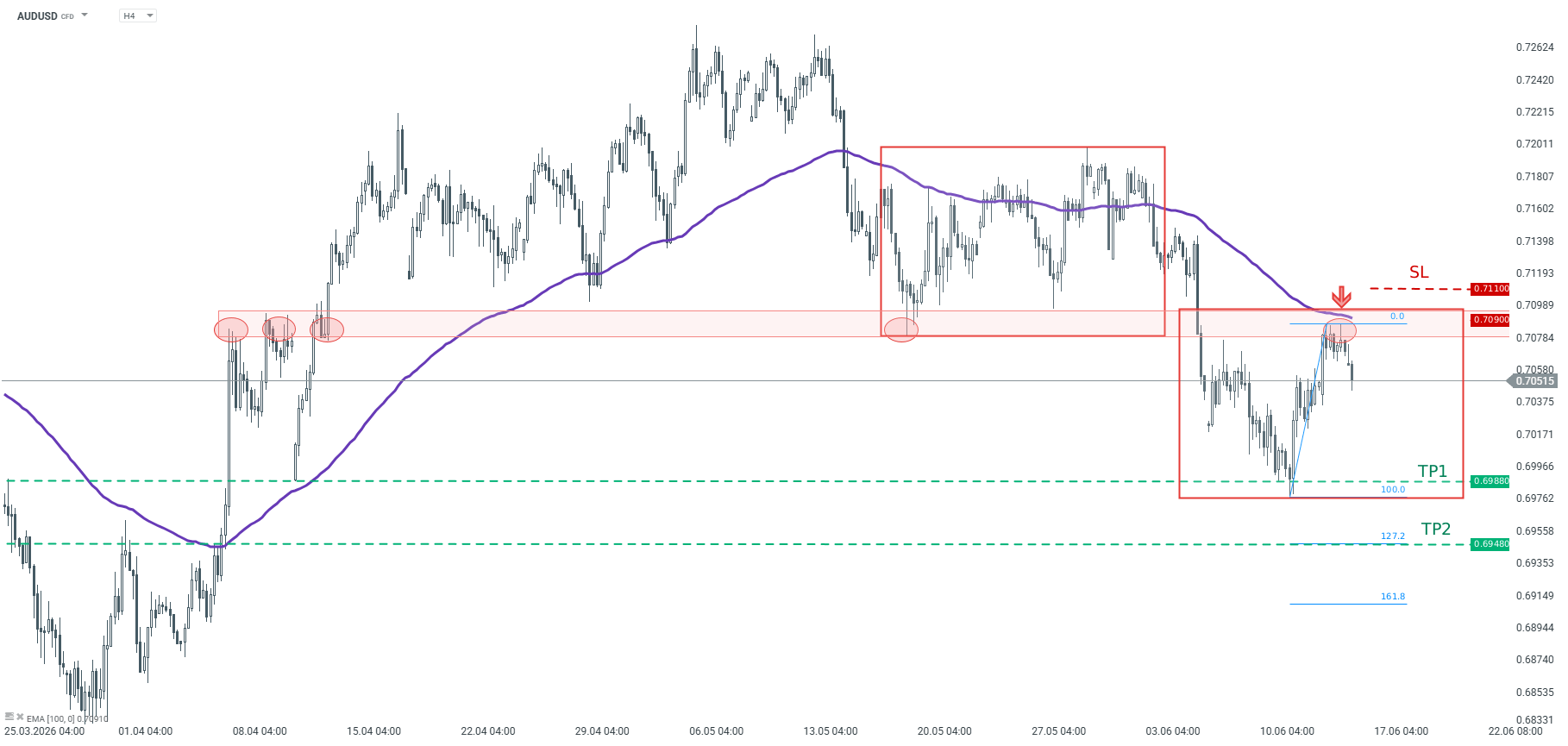
The pair bounced off the key resistance area near 0.7090 Short – term trend remains downward from the mid-May
Recommendation:
Trade: Short position on AUDUSD at market price Target: 0.6988, 0.6948 Stop: 0.7110
Opinion:
AUDUSD has been trading in a downward move recently. Looking at the H4 interval, one can see that the price bounced off the key 0.7090 resistance area. Red area near 0.7090 handle on the chart below is marked with previous price reactions, 100-period moving average from H1 interval, as well as upper limit of 1:1 structure. Taking this into account, continuation of the downward move looks to be the base case scenario for now. We recommend going short AUDUSD at market price with two targets: 0.6988 and 0.6948. We also recommend placing a stop loss order at 0.7110.
The Indian Rupee trades firmly against the US Dollar due to multiple tailwinds.
Lower oil prices and signs of improvement in FIIs sentiment towards the Indian stock market have strengthened the Indian Rupee.
The Fed is expected to leave interest rates steady on Wednesday.
The Indian Rupee (INR) opens firmly against the US Dollar (USD) on Tuesday. The USD/INR pair trades lower around 94.58 as lower oil prices due to the successive reopening of the Strait of Hormuz, following the signing of a peace deal between the United States (US) and Iran, and signs of improvement in sentiment of overseas investors towards the Indian stock market have strengthened the Indian Rupee.
In the opening session, the MCX Crude Oil contract expiring on June 18 rises slightly to near 7,640, but is close to its over eight-week low of 7,550 posted on Monday.
Currencies from economies, such as India, which rely heavily on oil imports to meet their energy needs, tend to outperform when oil prices remain lower.
US-Iran signs peace deal
On Monday, US President Donald Trump announced that a peace deal with Iran had signed and the Strait of Hormuz had fully reopened. Trump added that details of the deal will be released shortly, but confirmed that Tehran won’t have nuclear weapons.
Investors await details of the deal to get clarification regarding whether Hormuz remains toll-free or not. The resumption of normal traffic will keep oil prices lower, a scenario that will be favorable for the Indian currency.
FIIs turns of net buyers for first time in June
On Monday, Foreign Institutional Investors (FIIs) emerged as net buyers in the Indian stock market for the first time in June after diluting their stake worth Rs. 46,430.42 crore in the first two weeks. The sentiment of foreign investors towards the Indian equity market appears to have improved due to the US-Iran peace deal signing, which has eased the global risk-off impulse. In Monday’s session, FIIs bought shares worth Rs. 200.05 crore.
Investors await two-day Fed policy meeting
This week, the major trigger for the US Dollar will be the Federal Reserve’s (Fed) monetary policy announcement on Wednesday. According to the CME FedWatch tool, the Fed is certain to leave interest rates unchanged in the 3.50%-3.75%.
Investors will pay close attention to the Fed’s monetary policy guidance under the new Chairman Kevin Warsh, and interest and economic projections in the near-to-longer term.
US President Trump has provided significant breathing room to Chairman Warsh by giving him a free hand on decision-making, stating in recent days that he wants him to “do whatever he wants” and “be totally independent”, CNBC reported. While Trump was seen criticizing former Chairman Jerome Powell numerous times for not reducing interest rates quickly, despite inflationary pressures remaining higher.
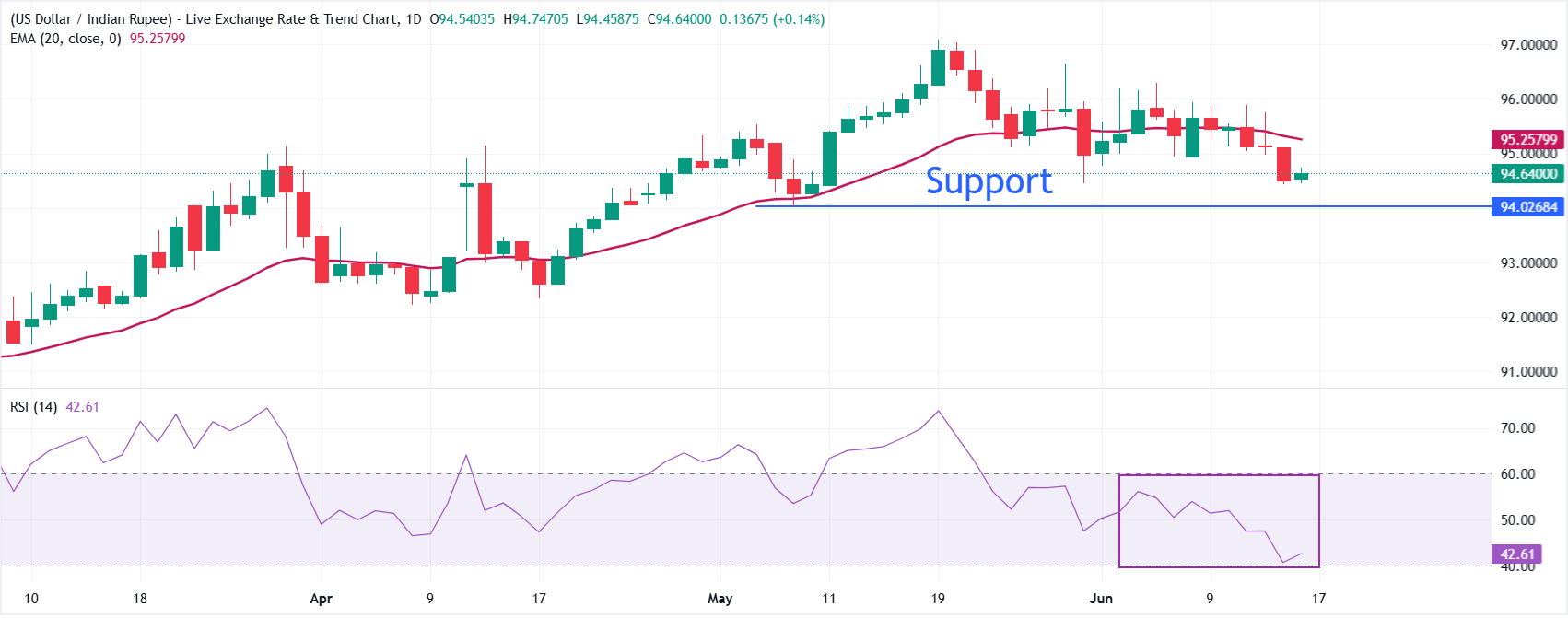
Technical Analysis: USD/INR stays below 20-day EMA
USD/INR trades weakly at around 94.58, extending a corrective phase below its 20-day exponential moving average (EMA) at 95.2580, which now acts as the first topside barrier and keeps the near-term bias tilted lower.
The Relative Strength Index (RSI) at 42.6 remains below the midline, suggesting waning bullish momentum and leaving the pair vulnerable while it holds under the short-term EMA cap.
On the topside, a daily close above the 20-day EMA around 95.26 would be needed to ease immediate downside pressure and open the way for a more sustained rebound towards 96.00. Looking down, the pair could extend the decline to the May 7 low at 94.03 if it fails to hold the June 15 low at 94.43.
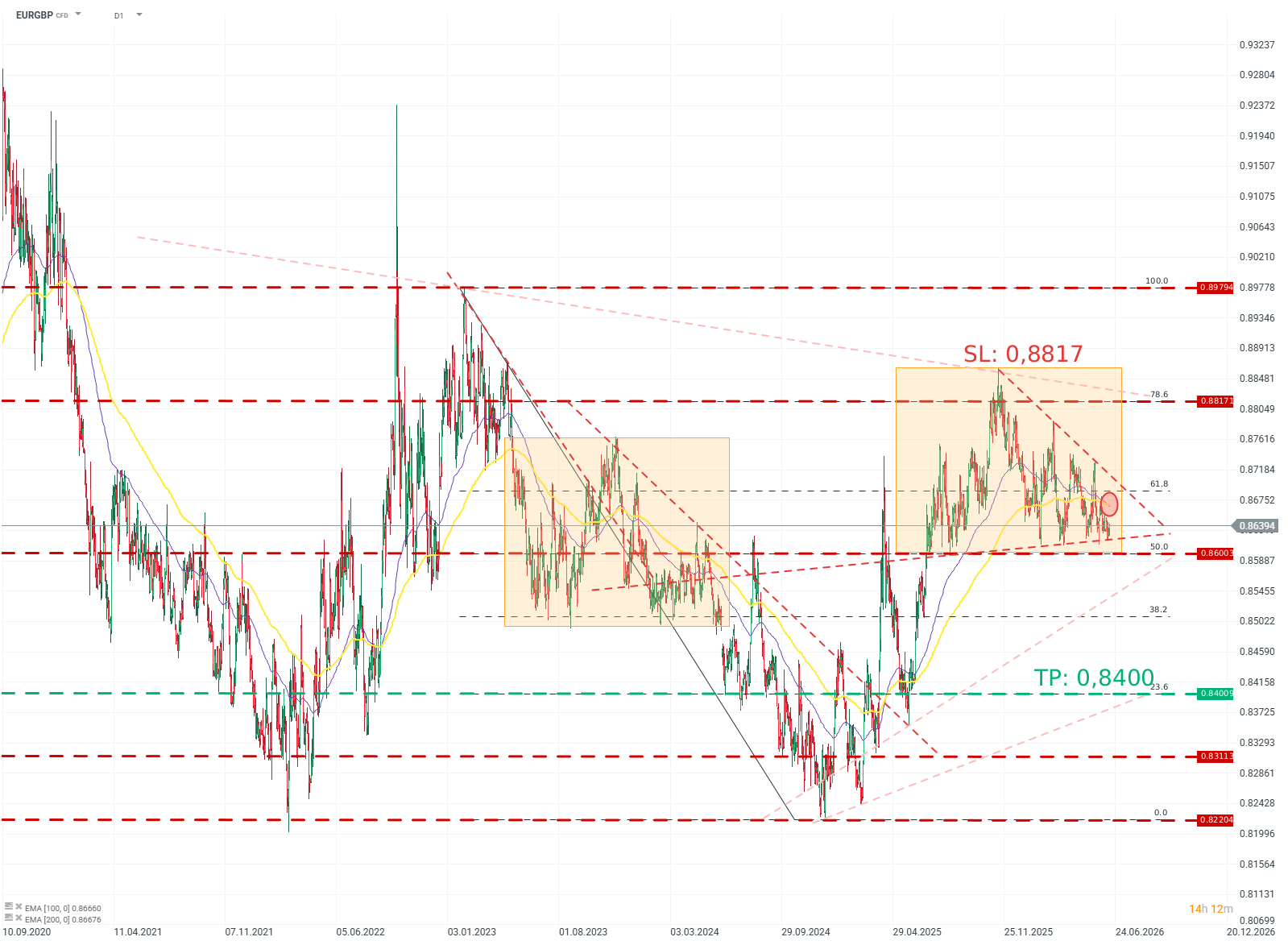
The price is near the lower boundary of a consolidation range between 0.886 and 0.861.
Upward corrections within the consolidation are breaking to increasingly lower levels, while at the same time testing resistance around 0.863.
The EMA100 has crossed the EMA200 from above.
Recommendation:
Short position (Sell) on EURGBP at the market price.
Target price (Take Profit; TP): 0.8400
Stop Loss (SL): 0.8817
EURGBP (D1)
Source: xStation5
OPINION :
The EURGBP rate is once again testing the lower boundary of the consolidation, which can also be treated as a developing 1:1 pattern, potentially ending with a downside breakout. The repeated defense of the ~0.86 level indicates the strength of this zone; however, increasingly weaker upward corrections within the consolidation reveal buyer weakness and point to the likely direction of further price movement.
Methodology and assumptions:
The recommendation is based on technical analysis of the chart, in particular EMA moving averages and Fibonacci levels.
The target level was determined based on Fibonacci levels.
The protective stop-loss order was set based on a favorable risk-to-reward ratio and with reference to a Fibonacci level.
US Dollar Index declines on fading safe-haven demand as a US-Iran deal eases inflation and interest rate concerns.
Washington and Tehran announced Sunday they have reached a peace agreement, which will officially take effect this coming Friday.
The CME FedWatch tool shows December Fed rate hike odds falling to nearly 27% after the peace deal.
The US Dollar Index (DXY), which measures the value of the US Dollar (USD) against six major currencies, is losing ground and trading around 99.50 during the Asian hours on Monday. The Greenback declines on fading safe-haven demand following reports that the United States (US) and Iran reached a deal to end their conflict, easing concerns about inflation and higher interest rates.
Washington and Tehran said on Sunday that they have reached an agreement that will take effect on Friday. US President Donald Trump stated that the US is lifting its naval blockade on Iranian ports and that the Strait of Hormuz will reopen after the agreement is signed.
The United Kingdom (UK), France, Germany and Italy said that the countries were prepared to lift sanctions on Iran in response to steps on its nuclear program after the US and Iran reached a deal to end their war.
Iran’s National Security Council confirmed a ceasefire agreement with the US, adding that final deal talks will start after the other party fulfills commitments under the memorandum of understanding. Iranian officials said the maritime blockade against Iran should end immediately and entirely.
The CME FedWatch tool indicates that the markets are pricing in nearly a 27% probability of a US Federal Reserve (Fed) interest rate hike in December this year after the peace deal, down from 40% a week ago.
EUR/USD edges higher to around 1.1610 in Monday’s early European session.
The US and Iran announced a framework deal for peace.
ECB’s Nagel said the central bank is ready to hike again in July if necessary.
The EUR/USD pair gains traction to near 1.1610 during the early European trading hours on Monday. The reports that the US and Iran have reached a deal to reopen the Strait of Hormuz improved risk sentiment, supporting the Euro (EUR) against the US Dollar (USD). The US Federal Reserve (Fed) interest rate decision will be in the spotlight later on Wednesday.
Washington and Tehran have announced a framework deal for peace, which will be signed in Switzerland on Friday. US President Donald Trump said the US is lifting its naval blockade on Iranian ports and that the Strait of Hormuz will reopen after the agreement is signed.
The Fed is widely expected to keep its benchmark interest rate unchanged at a target range of 3.50% to 3.75% at its upcoming policy meeting on Wednesday. Traders will closely monitor the press conference and take more cues about how new Fed chair Kevin Warsh will lead the US central bank into its next era. Any hawkish remarks from Fed officials could lift the Greenback and act as a headwind for the major pair.
Last week, the European Central Bank (ECB) hiked its key interest rates, saying “the war in the Middle East is generating inflation pressures.” This marks the first rate increase since September 2023, after seven consecutive meetings where interest rates were kept on hold.
ECB Governing Council member Joachim Nagel said on Friday that the central bank is prepared to raise interest rates for a second straight meeting in July, if the shock from the war in the Middle East requires it.
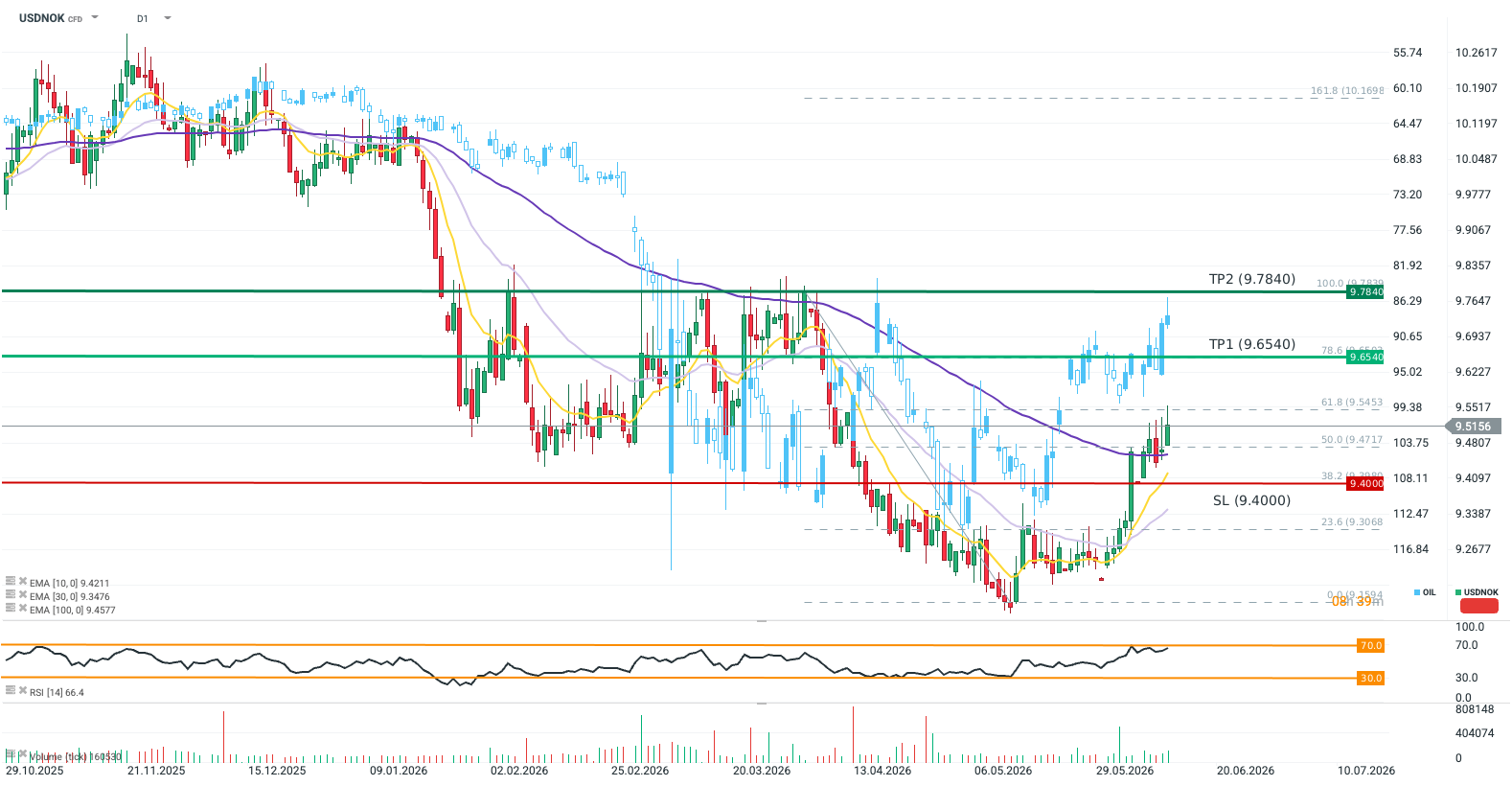
The USDNOK exchange rate ended yesterday’s session above the 100-day exponential moving average (EMA100; purple).
Brent crude oil futures (OIL) are losing ground for the second consecutive session, slipping below 90 USD per barrel—their lowest level since April 20, 2026.
CPI inflation in Norway fell to 3.1% in May from 3.4% in April.
USDNOK is gaining momentum, increasingly solidifying a trend reversal on a pair whose volatility in recent months was primarily shaped by upward pressure on oil prices. Over the past two weeks, the price crossed three exponential moving averages (the 10-, 30-, and 100-day EMA; yellow, light purple, and dark purple, respectively) and successfully defended support where the EMA100 overlaps with the 50.0 Fibonacci retracement level of the latest downward wave. This technical bullish momentum is also well-supported by geopolitical and macroeconomic realities. Fluctuations in the Trump administration’s stance toward Iran did not trigger significant volatility (by recent months’ standards) in oil contracts, and the cancellation of an attack planned for yesterday contributed to a sharp drop in commodity prices.
This suggests that, for the market, the worst regarding the Strait of Hormuz is already behind us, thereby causing the risk premium for oil-producing countries’ currencies to fade out. Alongside the correlation between the Norwegian krone and oil, the latest inflation reading from Norway indicated a second consecutive drop in CPI, with economists forecasting a further decline in price pressure—particularly in the food sector, which is vital for households and their expectations. Meanwhile, in the US, hawkish expectations are mounting for the Fed (OIS curve imlies 73% chance for a hike bedore the end of 2026), benefiting the greenback. Therefore, the monetary policy trajectories of both economies consistently support a continuation of the upward move in USDNOK. A short-term risk remains the near-overbought condition of the pair. The RSI sits right below the 70-point threshold (currently at 66.4), which may discourage investors from pushing the exchange rate higher without a minor technical correction.
Methodology
The recommendation was prepared based on a technical analysis of the USDNOK chart and a fundamental analysis of the discussed economies (monetary policy in Norway and the US), as well as the exchange rate’s correlation with crude oil prices. The direction of the recommendation was determined using moving averages and market expectations regarding Fed policy. The Take Profit and Stop Loss levels were set using Fibonacci retracements and price action (TP1 and TP2 at the 78.6 and 100 Fibo levels of the last downward wave; SL at the 38.2 Fibo level).
pril 2026 as a result of the escalating conflict in the Middle East. According to the latest data from the Office for National Statistics (ONS), this marks the first monthly GDP decline since August 2025. Although this contraction aligns with forecasts from economists polled by Reuters, it represents a sharp trend reversal from March, which recorded a 0.3% growth. However, looking at the less volatile three-month perspective, real GDP grew by 0.7% in the period to April 2026, demonstrating that the British economy entered the current crisis on relatively stable foundations.
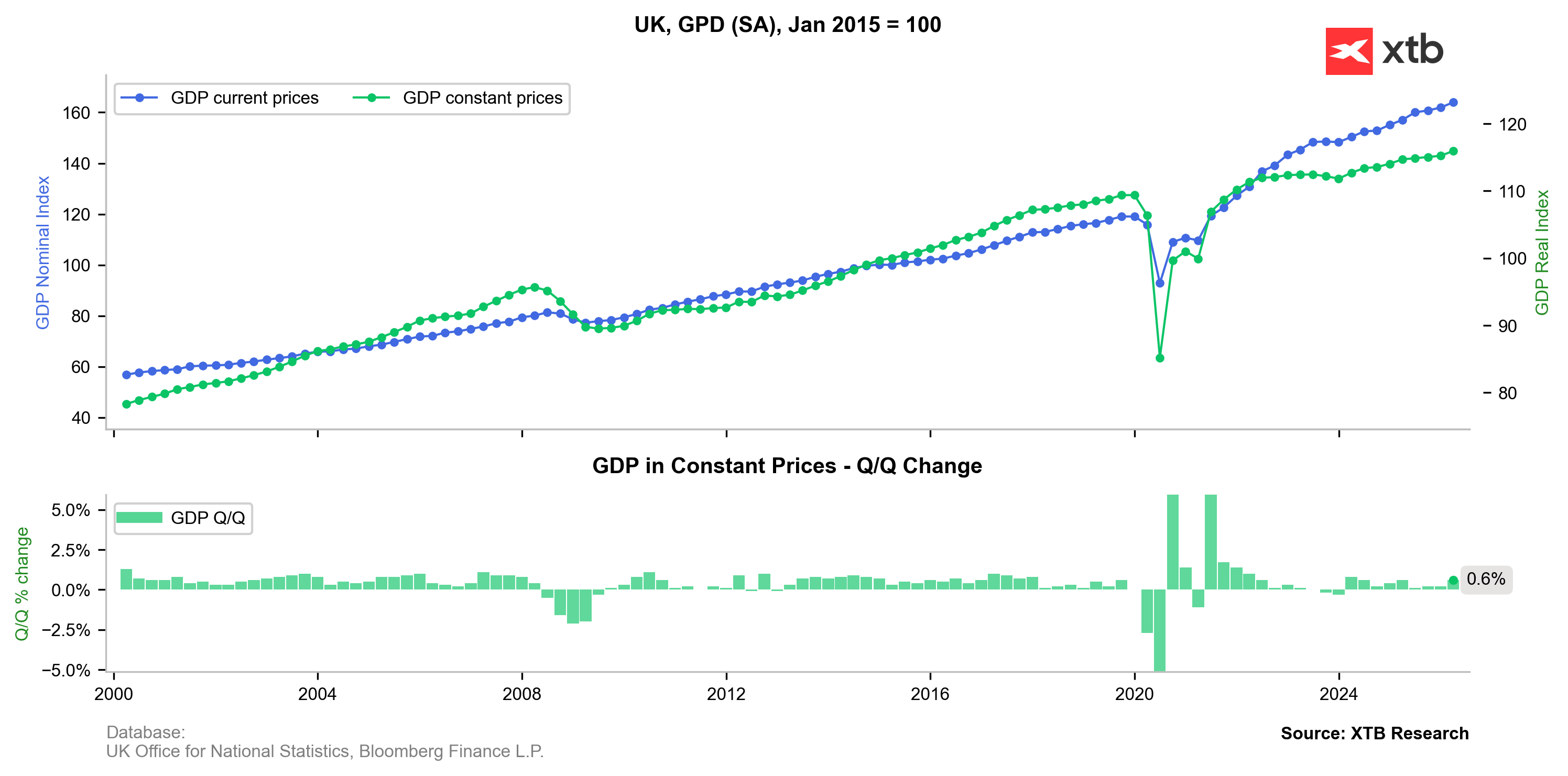
Chart 1: Real and nominal GDP in the United Kingdom (upper panel) and quarter-on-quarter change (lower panel). In Q1 2026 (January–March), the UK economy grew by 0.6%, offering a solid base by British standards before the effects of the Middle East war materialized. Source: XTB Research based on ONS/Bloomberg data.
How the Iran Conflict Stalled Growth in the United Kingdom
The main catalyst for April’s slowdown is the war between Iran and the US, which recently passed the 100-day mark. The effective blocking of the Strait of Hormuz—a crucial shipping route for oil and many other commodities—paralyzed global supply chains and triggered a sharp surge in energy and fuel prices. As a net energy importer, the UK is exceptionally vulnerable to international energy shocks. A sudden surge in prices at petrol stations forced motorists to drastically cut consumption in April, reversing the positive growth impulses seen at the beginning of the year. Furthermore, ONS surveys revealed widespread complaints from businesses regarding falling turnovers and rising production costs across the wholesale, manufacturing, and transport sectors.
Sector Breakdown: Slump in Services, Stagnation in New Construction
April’s economic slowdown was characterized by uneven performances across core industrial sectors:
Services Sector: Recorded a 0.2% decline, becoming the primary driver of the monthly GDP drop. The arts, entertainment, and recreation sector suffered the most, posting a drastic 9.1% fall. This was mainly due to the cancellation of multiple sporting events in the Middle East, which directly hit UK-based companies.
Construction: Ticked up marginally by 0.1%. However, this growth came solely from a 0.6% recovery in repair and maintenance. New construction projects fell by 0.3%, complicating the government’s political promises to accelerate housebuilding in the UK.
Industrial Production: Showed zero growth (0.0%). Although manufacturing grew by 0.4% (driven by a 4.2% surge in pharmaceutical production), these gains were completely offset by shrinking outputs in the utility sector.
Stagflation Risks and the Bank of England’s Dilemma
The sudden dip in GDP momentum has raised serious concerns about a dangerous descent towards stagflation—a situation where economic stagnation couples with stubborn inflation. The International Monetary Fund (IMF) has already downgraded its 2026 UK economic growth forecast from 1.3% to just 0.8%, warning that Britain could feel the impact of the war most acutely among major economies. Economic conditions could deteriorate further in the third quarter, when the domestic energy price cap is set to rise by 13%, allowing suppliers to pass higher oil and gas costs onto consumers. This leaves the Bank of England in a precarious position ahead of its upcoming interest rate decision. Policymakers must now balance combating war-driven inflation against the risk of triggering a deeper recession.
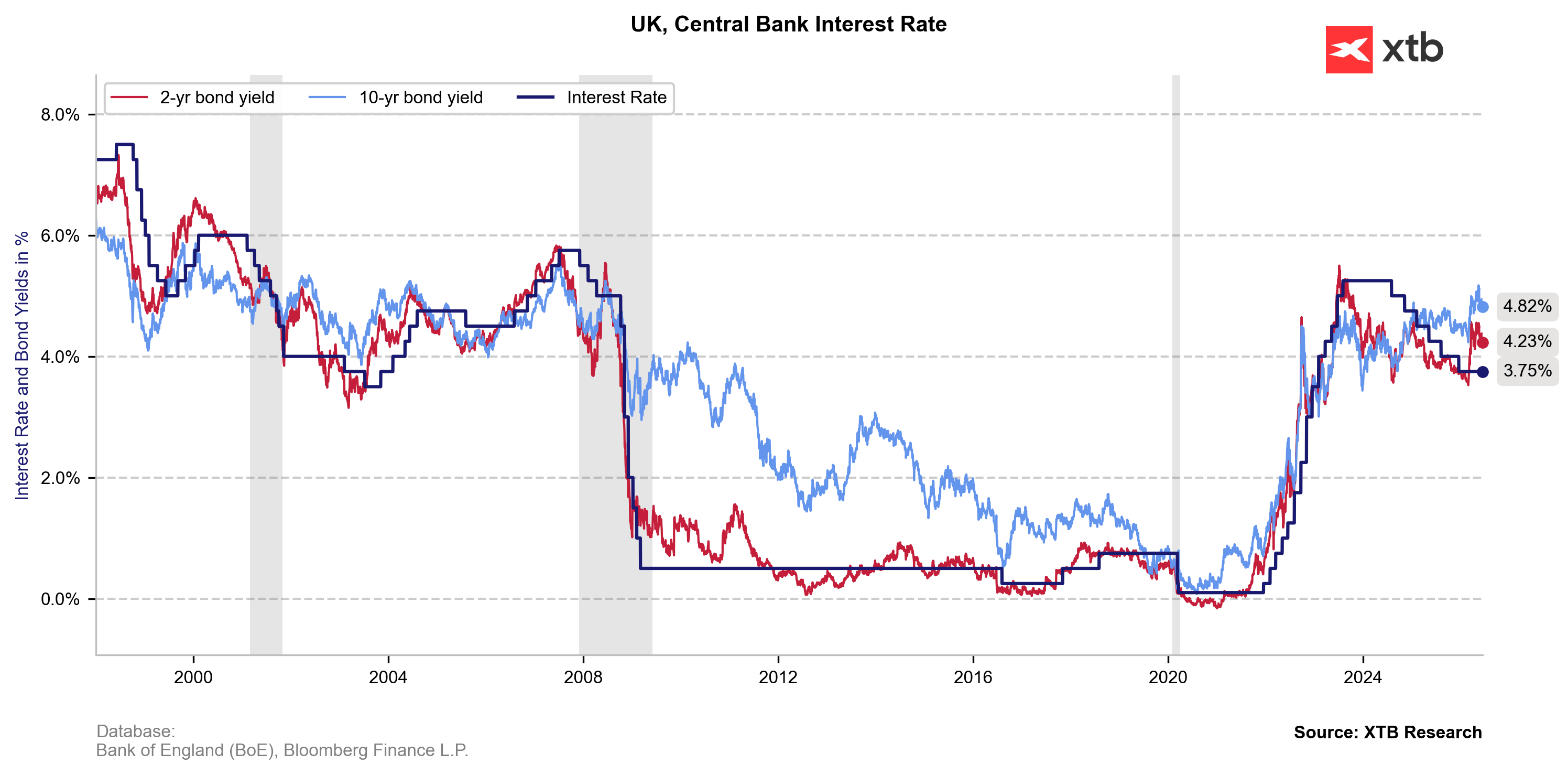
Following the ONS release, sterling initially lost 0.2% against the dollar as markets scaled back expectations for subsequent rate hikes. Over time, however, a global increase in risk appetite took over in response to easing tensions between the US and Iran, resulting in a weaker dollar. Moreover, the softer GDP does not eliminate the hawkish pressure on the Bank of England, which is widely expected to hold interest rates at 3.75%. Some members of the Monetary Policy Committee may vote for a hike, signaling the central bank’s readiness to combat the prolonged energy shock.
Chart 2: The Bank of England’s main interest rate and UK 2- and 10-year bond yields. Yields are already clearly above the 3.75% rate, signaling hawkish expectations from the debt market, which is organically tightening financial conditions. Source: XTB Research based on Bloomberg data.
Technical Analysis: GBPUSD (D1)
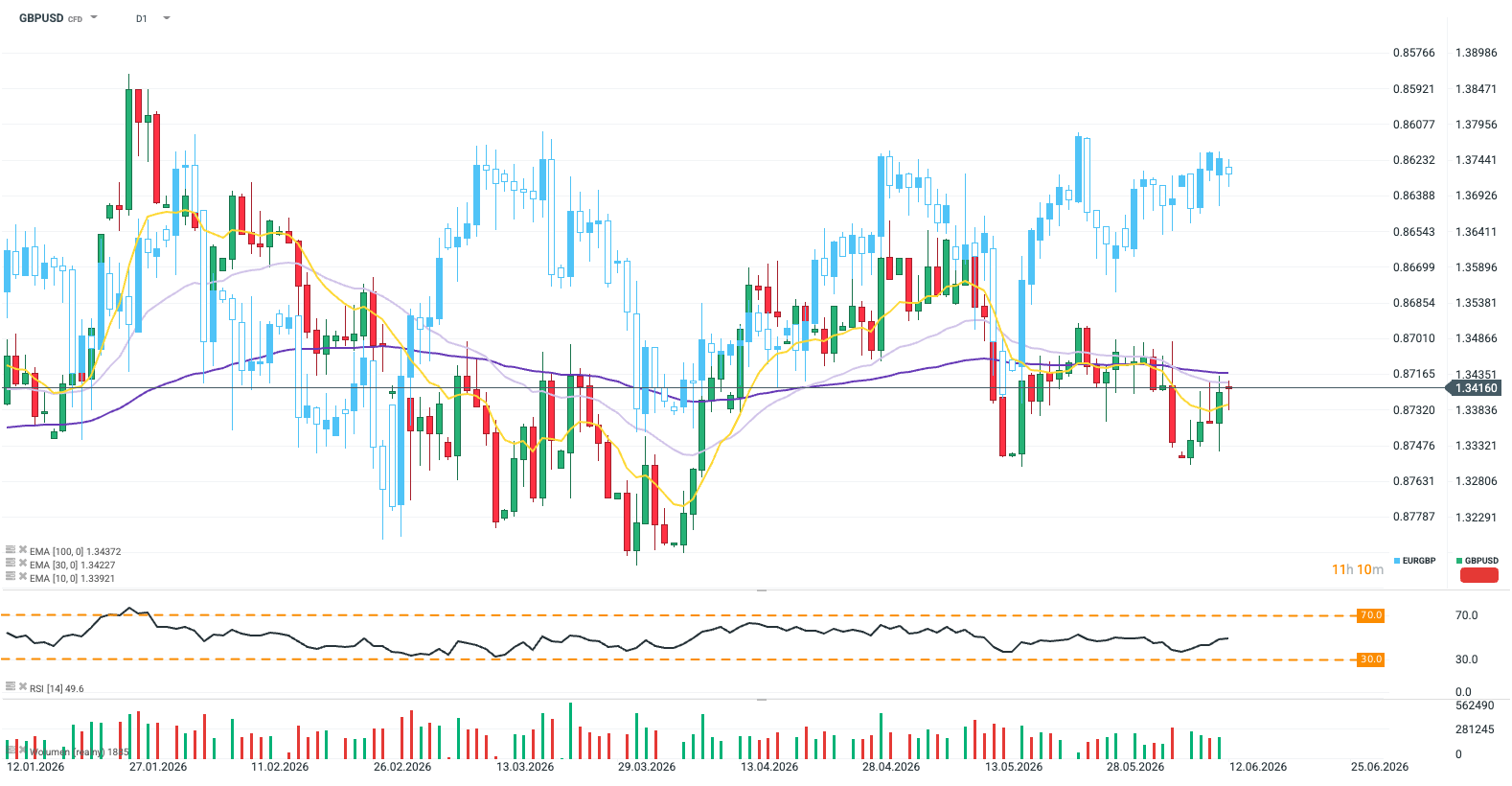
GBPUSD is currently trading slightly up (+0.05%), although the pair on the D1 interval remains in a local downtrend, consolidating around the 1.34158 level. The price is currently moving below key exponential moving averages: EMA 30 (1.34226) and EMA 100 (1.34372), which act as crucial resistance for any building momentum. Following a rebound from recent support near 1.3330, selling pressure has slowed down. The RSI (14) indicator at 49.5 signals complete market neutrality. The next direction depends on a sustained breakout above the moving averages or a return to test the recent lows.
EUR/GBP remains subdued following the release of data from the UK and Germany.
UK GDP contracted by 0.1% month-on-month in April, meeting market forecasts after a 0.3% expansion in March.
German May HICP inflation met forecasts, landing at 2.7% year-on-year.
EUR/GBP inches lower after two days of gains, trading around 0.8630 during the Asian hours on Friday. The currency cross remains subdued following the release of economic data from the United Kingdom (UK) and Germany.
The UK Gross Domestic Product (GDP) contracted by 0.1% MoM in April, following a 0.3% rise reported in March. The market forecast was for a 0.1% decline in the same period. Meanwhile, the Index of Services (April) rose 0.8% 3M/3M versus March’s 0.8%. Meanwhile, monthly Industrial Production came in at 0% MoM in April, while Manufacturing Production increased by 0.4% during the same period.
Money markets are currently pricing in at least a 25-basis-point interest rate hike by the Bank of England (BoE) this coming September, with a strong probability of a second increase before the end of the year. This potential tightening comes amid broader economic challenges, as political uncertainty surrounding the leadership of the Labour Party continues to weigh on investor sentiment and compound the current downturn.
Over in the Eurozone, inflation data met forecasts as Germany’s revised Harmonized Index of Consumer Prices (HICP) for May landed at 2.7% year-on-year. On a monthly basis, HICP growth experienced a slight contraction of 0.1%.
The European Central Bank (ECB) took aggressive action on Thursday by raising interest rates for the first time in nearly three years. The central bank also signaled a prolonged hawkish stance, indicating that restrictive monetary policy will likely remain firmly in place through 2027.
To provide the best experiences, we use technologies like cookies to store and/or access device information. Consenting to these technologies will allow us to process data such as browsing behavior or unique IDs on this site. Not consenting or withdrawing consent, may adversely affect certain features and functions.
Functional
Always active
The technical storage or access is strictly necessary for the legitimate purpose of enabling the use of a specific service explicitly requested by the subscriber or user, or for the sole purpose of carrying out the transmission of a communication over an electronic communications network.
Preferences
The technical storage or access is necessary for the legitimate purpose of storing preferences that are not requested by the subscriber or user.
Statistics
The technical storage or access that is used exclusively for statistical purposes.The technical storage or access that is used exclusively for anonymous statistical purposes. Without a subpoena, voluntary compliance on the part of your Internet Service Provider, or additional records from a third party, information stored or retrieved for this purpose alone cannot usually be used to identify you.
Marketing
The technical storage or access is required to create user profiles to send advertising, or to track the user on a website or across several websites for similar marketing purposes.