United Overseas Bank’s (UOB) Quek Ser Leang and Lee Sue Ann observe that GBP/USD’s surge to 1.3434 has stretched short-term conditions, but further gains toward a retest of 1.3435 remain possible, with 1.3465 unlikely to break. Over 1–3 weeks, they expect range trading in a higher 1.3340–1.3465 band after shifting from a negative to neutral stance, with momentum not yet strong enough for a sustained advance.
Pound holds firm but capped near resistance
“24-HOUR VIEW: While we expected GBP to “edge lower” yesterday, we indicated that “any decline is likely part of a lower range of 1.3330/1.3395.” We added that GBP “is unlikely to break clearly below 1.3330.” GBP subsequently broke below 1.3330 (low of 1.3325), but it then lifted off and surged to a high of 1.3434. While the rapid rise has room to extend, overbought conditions suggest that any advance is likely limited to a retest of 1.3435. The next resistance at 1.3465 is unlikely to come under threat. Support is at 1.3385; a breach of 1.3365 would indicate that GBP is more likely to range-trade rather than retesting 1.3435.”
“1-3 WEEKS VIEW: We revised our view from negative to neutral yesterday (11 Jun, spot at 1.3365). We indicated that the earlier “downward momentum has faded, and for the time being, GBP is likely to trade in a range between 1.3300 and 1.3435.” GBP then dipped to 1.3325 and then soared, testing the upper boundary of our range with a high of 1.3434. Upward momentum has increased, but not sufficiently to indicate a sustained advance. For the time being, we continue to expect range-trading, though the range has shifted higher to 1.3340/1.3465.”
Monday’s rise in energy commodity prices proved short-lived, weighing further on the Norwegian currency. The USDNOK pair is approaching the 9.50 level, which was last seen two months ago. Aside from headlines coming out of the Middle East, tomorrow’s scheduled releases of May inflation data from both Norway and the US should take center stage for the pair.
Geopolitics
The weekend exchange of fire between Israel and Iran has cast doubt on the fragile ceasefire currently in place across the region. Under pressure from Washington, both sides halted further strikes. However, the situation remains highly uncertain, which could sustain high volatility in the prices of key energy commodities.
Macroeconomic Data
Tomorrow’s readings are expected to show core inflation remaining unchanged at 3.2%, alongside a slight decline in the headline figure to 3.1% in Norway. An upside surprise could raise expectations for further monetary policy tightening by Norges Bank. As a reminder, the central bank delivered its first interest rate hike since 2023 back in May, reacting to rapidly rising inflation expectations, persistently elevated wage growth, and the concerning stickiness of core inflation. Meanwhile, the headline CPI figure in the United States is expected to edge upward to 4.2%. The consensus also forecasts a modest increase in the core metric to 2.9%. Investors have already fully priced in a Fed rate hike for 2026. A further build-up of price pressures could increase the likelihood of this hike occurring as early as this autumn.
Technical Analysis
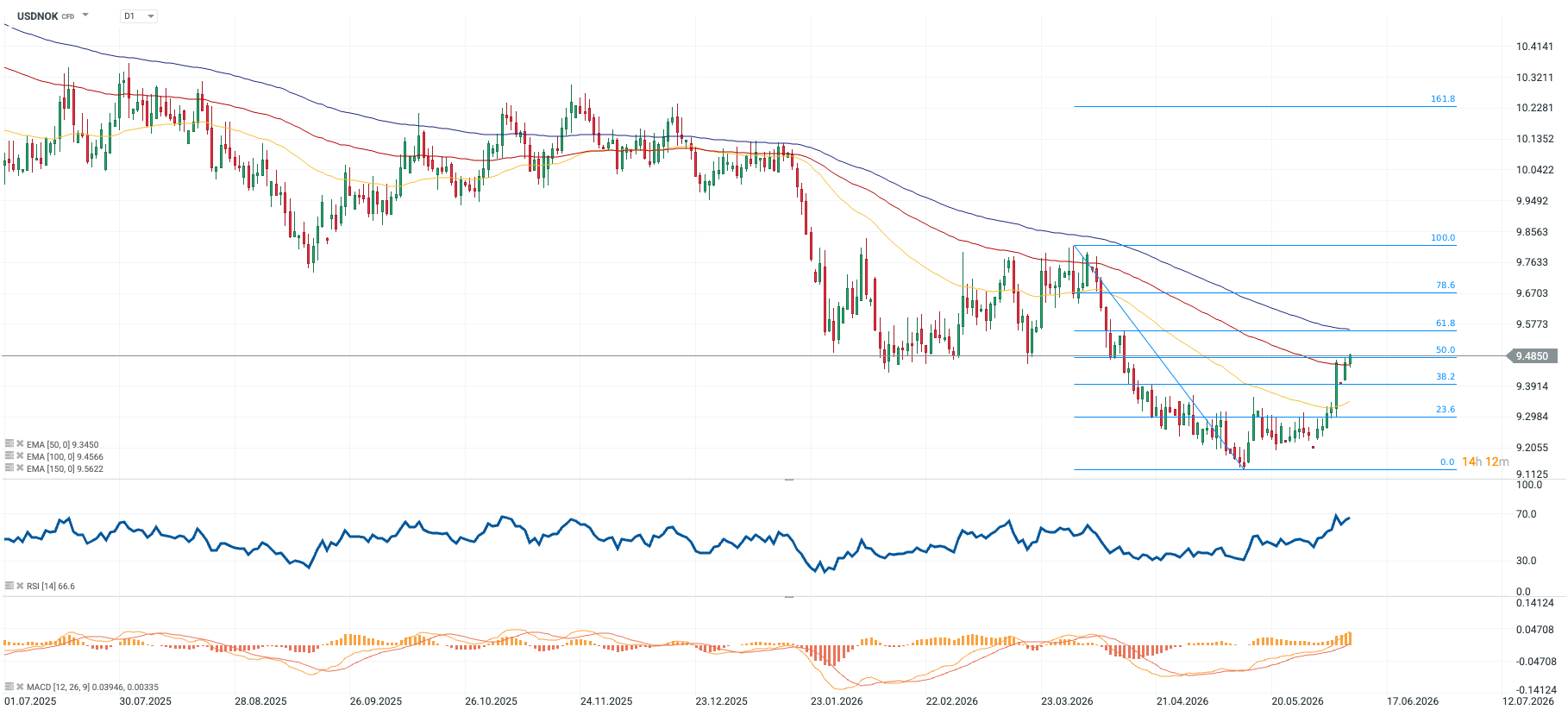
Chart 1: USDNOK (01.07.2025 – 09.06.2026)
Source: xStation, 09.06.2026
After establishing a new local low at the 9.13 level, a strong and aggressive demand-driven rebound ensued. The first two key technical resistance levels have been broken. The price has approached the 50% Fibonacci retracement level, which could serve as a crucial test for the ongoing upward trend. The strong momentum of the move is reflected in technical indicators. The RSI is currently hovering around 67 points, signaling that the market is gradually entering overbought territory, which could trigger a temporary pause in momentum.
Key Levels to Watch:
To the Upside: If buyers manage to sustain the price above the tested 50% Fibo level, the next natural target for the market could be the 9.56 level, where both the 61.8% Fibonacci retracement and the 100 EMA coincide.
To the Downside: Conversely, a sustained rejection of the current resistance level would mean anticipating a return to the primary trend and a retest of lower support levels.
GBP/USD rises to near 1.3375 as the US Dollar corrects sharply.
US President Trump sees a total victory over Iran in the next two weeks.
Investors await the US CPI data for May and the UK GDP data for April.
The GBP/USD pair trades 0.26% higher at around 1.3375 during the European trading session on Tuesday. The Cable gains as the US Dollar (USD) declines amid expectations that the United States (US) could reach a deal with Iran soon.
US Dollar Price Today
The table below shows the percentage change of US Dollar (USD) against listed major currencies today. US Dollar was the weakest against the New Zealand Dollar.
USD
EUR
GBP
JPY
CAD
AUD
NZD
CHF
USD
-0.12%
-0.20%
-0.03%
-0.14%
-0.26%
-0.54%
-0.20%
EUR
0.12%
-0.06%
0.09%
-0.02%
-0.11%
-0.40%
-0.06%
GBP
0.20%
0.06%
0.17%
0.06%
-0.07%
-0.32%
0.00%
JPY
0.03%
-0.09%
-0.17%
-0.11%
-0.22%
-0.50%
-0.16%
CAD
0.14%
0.02%
-0.06%
0.11%
-0.11%
-0.37%
-0.05%
AUD
0.26%
0.11%
0.07%
0.22%
0.11%
-0.26%
0.06%
NZD
0.54%
0.40%
0.32%
0.50%
0.37%
0.26%
0.32%
CHF
0.20%
0.06%
-0.01%
0.16%
0.05%
-0.06%
-0.32%
The heat map shows percentage changes of major currencies against each other. The base currency is picked from the left column, while the quote currency is picked from the top row. For example, if you pick the US Dollar from the left column and move along the horizontal line to the Japanese Yen, the percentage change displayed in the box will represent USD (base)/JPY (quote).
As of writing, the US Dollar Index (DXY), which tracks the Greenback’s value against six major currencies, trades 0.17% lower to near 99.83.
On late Monday, US President Donald Trump expressed confidence that a “total victory” on Iran can be announced in two weeks, adding it would lead to a sharp decline in oil prices. The statement from Trump came after Iran agreed to halt attacking the Israeli territory, which led to a sharp decline in oil prices.
The US Dollar has outperformed in the past few months as elevated oil prices due to the energy supply crisis prompted the US inflation and hawkish Federal Reserve (Fed) bets.
The appeal of currencies from economies, such as the United Kingdom (UK), which rely heavily on oil imports to meet their energy needs, improves when oil prices start falling.
Going forward, investors will focus on the US Consumer Price Index (CPI) data for May and the UK Gross Domestic Product (GDP) data for April, which will be released on Wednesday and Friday, respectively.
GBP/USD technical analysis
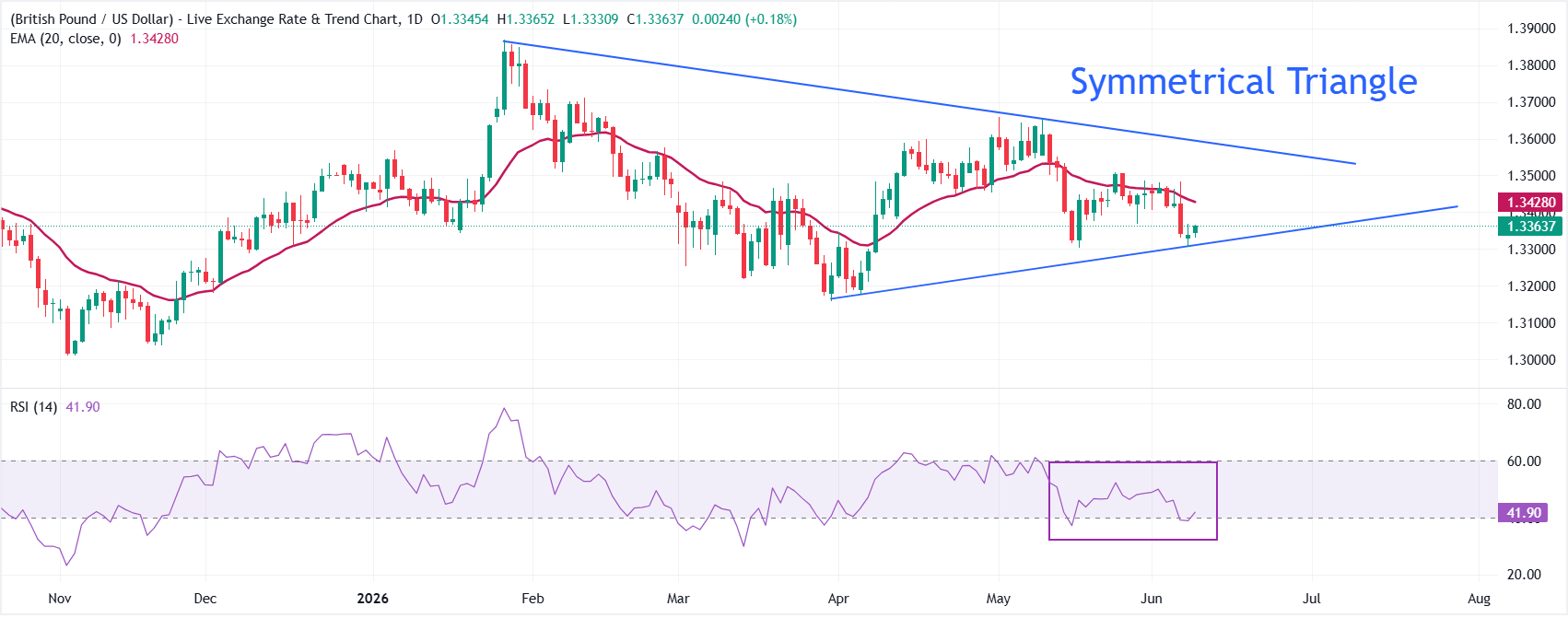
GBP/USD trades higher at around 1.3375 at the press time. However, the near-term tone remains bearish as it holds below the 20-period Exponential Moving Average (EMA), which is at 1.3428. The pair sits between an upward support trend line break around 1.3312 and the reclaimed downward resistance trend line reference at 1.3593, exhibiting a broader sideways trend. The Relative Strength Index (RSI) near 42 leans soft, hinting that downside pressure persists even if not yet overstretched.
On the topside, initial resistance is located at the 20-EMA around 1.3430, and a sustained break above this barrier would open the way toward the former downtrend resistance line reference near 1.3590. On the downside, immediate support emerges at the prior uptrend support break zone around 1.3301, and a drop below there would expose lower levels. The major support area would be the April 7 low at 1.3217, followed by the March 31 low at 1.3159.
AUD/USD hits session highs at 0.7070, although it remains near eight-week lows.
Bright Trade Balance data from China has provided a moderate impulse to the Aussie.
Markets show some relief as hostilities in the Middle East stop.
The Australian Dollar (AUD) posts moderate gains against the US Dollar (USD) on Tuesday, regaining some of the ground lost last week, although it remains at its lowest level in nearly two months. News that Israel and Iran halted hostilities has triggered a mild relief rally. At the same time, upbeat Chinese trade data has provided additional support for the Aussie, as China is Australia’s major trading partner.
Data released by the Chinese Government earlier on Tuesday showed that the Asian giant’s trade surplus rose to USD 105.43 billion in May, its highest level since January and well beyond market expectations of USD 92.1 billion. In April, China’s trade surplus amounted to USD 84.82 billion.
China’s exports bloom with the AI rush
In May, exports showed a 19.4% year-over-year (y-o-y) growth, following a 14.1% increase in April, also beating expectations of a 15% increment. Strong demand for chips, amid the sharp increase in AI investment, has been the main driver for May’s surplus, offsetting the negative impact of the energy shock on global demand.
Imports also accelerated, with a 27.4% year-on-year increase in May after 25.3% year-on-year growth in April, suggesting that domestic demand is picking up pace after months of sluggish consumer spending.
Meanwhile, news reporting a pause in the hostilities between Israel and Iran has triggered a moderate pullback in Oil prices, providing a mild risk-appetite. US President Donald Trump affirmed earlier on Tuesday that he might have a proposal for a peace agreement with Iran and showed optimism about an upcoming deal.
In the US, the strong macroeconomic figures released last week, namely Friday’s Nonfarm Payrolls report, have boosted expectations that the Fed will be able to hike interest rates in the second half of the year, if inflationary pressures remain high. In that sense, the US Consumer Price Index (CPI) release, due on Wednesday, will be key to confirm the market’s expectations and is likely to set the US Dollar’s near-term direction.
EUR/JPY holds gains as a stronger Euro is supported by robust Germany’s Industrial Production.
Germany’s seasonally adjusted industrial output rebounded by 0.4% in April, meeting market expectations and recovering from March’s 0.1% decline.
The Japanese Yen steadies as lower oil prices temper energy inflation fears, easing market pressure for aggressive rate hikes.
EUR/JPY extends its gains for the second successive day, trading around 184.90 during the Asian hours on Tuesday. The currency cross holds gains as the Euro (EUR) remains stronger following the release of Industrial Production and Trade Balance data.
Industrial Output, in the Eurozone’s economic powerhouse Germany, rose by 0.4% over the month in April, the federal statistics authority Destatis said in figures adjusted for seasonal and calendar effects, compared with the expected 0.4% rise and a decline of 0.1% recorded in March (revised from -0.7%). Annually, the German Industrial Production came in at -0.5% in the same period, following March’s revised 3.4% fall.
Germany’s trade surplus narrowed to €14.5 billion in April 2026 from an upwardly revised €14.7 billion in March, falling short of market expectations of €15.0 billion. It was the smallest trade surplus since November, as imports grew faster than exports. Exports unexpectedly increased by 0.9% month-on-month to a near 3½-year high of €136.6 billion, accelerating from a downwardly revised 0.3% gain in March and easily beating expectations of a 0.3% decline. Meanwhile, imports climbed 1.2% month-on-month to €122.1 billion, the highest level since November 2022, though easing from a downwardly revised 4.5% increase in March.
The upside for the EUR/JPY cross remains limited as a stabilizing Japanese Yen (JPY) acts as a structural headwind. Recent pullbacks in global oil prices have helped temper fears of a severe energy-driven inflation spike, consequently easing immediate market pressure for hyper-aggressive rate hikes.
However, the Bank of Japan (BoJ) is still widely anticipated to tighten monetary policy later this month. Policymakers continue to grapple with underlying inflationary pressures stemming from historically elevated energy costs. In tandem with potential rate hikes, reports indicate that the BoJ will review its bond-tapering framework, with a high likelihood of scaling back its monthly asset purchases. Market participants are now turning their focus to Wednesday’s 30-year Japanese Government Bond (JGB) auction, which will serve as a key barometer to gauge investor demand within this shifting, higher-yield environment.
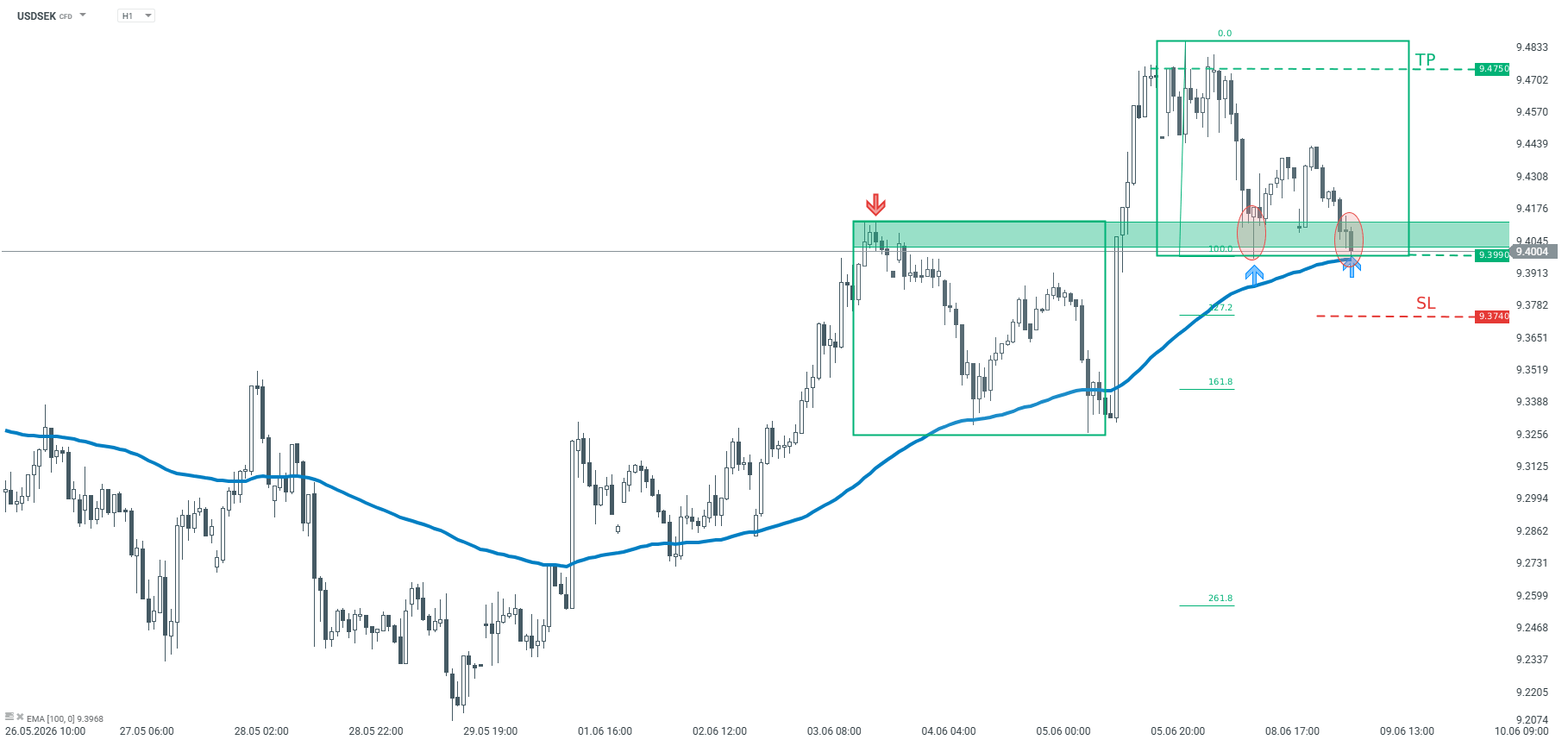
The pair is trading above the 100-period moving average from H1 interval
Recommendation: Trade: Long position on USDSEK market price Target: 9.4750 Stop: 9.3740
Opinion:
USDSEK reached a key technical support yesterday which is marked with a lower limit of 1:1 structure. The level is being tested again today and should buyers manage to hold the price above, the main sentiment remains bullish. The support at 9.3990 is also marked by the 100-period exponential moving average from H interval. According to the Overbalance methodology, as long as the price sits above the 9.3990, one should expect price to continue the upward move. We recommend going long USDSEK at market price with a target of 9.4750. We also recommend placing a stop loss order at 9.3740.
NZD/USD may find initial support at the rectangle’s lower boundary near 0.5790.
The 14-day Relative Strength Index around 43 suggests waning upside momentum rather than outright oversold conditions.
The initial barrier lies at the nine-day EMA of 0.5853.
NZD/USD gains ground for the second successive day, trading around 0.5810 during the Asian hours on Tuesday. Technical analysis of the daily chart suggests the spot price is moving sideways within a rectangle pattern, reflecting a period of market consolidation and indecision.
The NZD/USD pair is maintaining a bearish near-term bias as spot holds beneath both the nine-day and 50-day Exponential Moving Averages (EMAs). The alignment of price below these short- and medium-term EMAs suggests rallies are likely to be sold, while a soft 14-day Relative Strength Index (RSI) reading around 43 hints at waning upside momentum rather than outright oversold conditions.
The NZD/USD pair may find initial support at the lower boundary of the rectangle around 0.5790, followed by the two-week low of 0.5782, recorded on June 8. A break below this confluence support zone would put downward pressure on the pair to navigate the region around a six-month low of 0.5681, which was recorded on April 6.
On the upside, the NZD/USD pair may rise toward the primary barrier at the nine-day EMA of 0.5853, followed by the 50-day EMA at 0.5875. A successful break above these moving averages could support the pair to approach the upper boundary of the rectangle around 0.5990, followed by the three-month high of 0.5995, which was reached on February 29.
(The technical analysis of this story was written with the help of an AI tool.)
New Zealand Dollar Price Today
The table below shows the percentage change of New Zealand Dollar (NZD) against listed major currencies today. New Zealand Dollar was the strongest against the Japanese Yen.
USD
EUR
GBP
JPY
CAD
AUD
NZD
CHF
USD
-0.02%
-0.07%
0.05%
-0.04%
0.00%
-0.18%
-0.04%
EUR
0.02%
-0.02%
0.09%
-0.01%
0.07%
-0.12%
0.01%
GBP
0.07%
0.02%
0.13%
0.06%
0.06%
-0.11%
0.04%
JPY
-0.05%
-0.09%
-0.13%
-0.08%
-0.03%
-0.21%
-0.08%
CAD
0.04%
0.01%
-0.06%
0.08%
0.04%
-0.12%
0.00%
AUD
-0.00%
-0.07%
-0.06%
0.03%
-0.04%
-0.16%
-0.04%
NZD
0.18%
0.12%
0.11%
0.21%
0.12%
0.16%
0.12%
CHF
0.04%
-0.01%
-0.04%
0.08%
-0.00%
0.04%
-0.12%
The heat map shows percentage changes of major currencies against each other. The base currency is picked from the left column, while the quote currency is picked from the top row. For example, if you pick the New Zealand Dollar from the left column and move along the horizontal line to the US Dollar, the percentage change displayed in the box will represent NZD (base)/USD (quote).
EUR/JPY gathers strength near 184.85 in Tuesday’s early European session.
The cross keeps the bullish vibe, but further consolidation cannot be ruled out in near term with neutral RSI momentum.
The initial support level is seen at 184.50; the immediate resistance level to watch is 185.12.
The EUR/JPY cross holds positive ground around 184.85 during the early European session on Tuesday. A hawkish stance from the European Central Bank (ECB) underpins the Euro (EUR) against the Japanese Yen (JPY). The ECB will hold its June monetary policy meeting on Thursday. Markets have fully priced in a 25-basis-point (bps) rate hike after Eurozone inflation surged to 3.2%.
Markets are on high alert for foreign exchange intervention from Japanese authorities. This, in turn, might support the JPY and act as a headwind for the cross. Japanese authorities have issued strong verbal warnings, stating that the government is fully prepared to take decisive and appropriate action to protect the domestic currency.
Technical Analysis:
In the daily chart, EUR/JPY holds a constructive bullish bias as spot remains above the 100-day simple moving average (SMA) and the Bollinger band midline. Price also sits comfortably above the lower Bollinger band, suggesting the broader uptrend structure is still intact, while the Relative Strength Index (RSI) at 45.9 leans slightly soft but remains in neutral territory, hinting at consolidative rather than impulsive downside momentum.
On the downside, the initial support zone is formed by the 100-day SMA at 184.50, followed by the lower Bollinger band near 184.20, which should limit deeper pullbacks if the bullish structure is to persist. The first upside barrier emerges at the the Bollinger band midline at 185.12, en route to the upper boundary of the Bollinger Band at 185.12. Any follow-through buying above this level could pave the way to the 186.00 psychological level.
To provide the best experiences, we use technologies like cookies to store and/or access device information. Consenting to these technologies will allow us to process data such as browsing behavior or unique IDs on this site. Not consenting or withdrawing consent, may adversely affect certain features and functions.
Functional
Always active
The technical storage or access is strictly necessary for the legitimate purpose of enabling the use of a specific service explicitly requested by the subscriber or user, or for the sole purpose of carrying out the transmission of a communication over an electronic communications network.
Preferences
The technical storage or access is necessary for the legitimate purpose of storing preferences that are not requested by the subscriber or user.
Statistics
The technical storage or access that is used exclusively for statistical purposes.The technical storage or access that is used exclusively for anonymous statistical purposes. Without a subpoena, voluntary compliance on the part of your Internet Service Provider, or additional records from a third party, information stored or retrieved for this purpose alone cannot usually be used to identify you.
Marketing
The technical storage or access is required to create user profiles to send advertising, or to track the user on a website or across several websites for similar marketing purposes.