

Currency Hedger No Comments

Trade of The Day: AUD/USD

  • The AUDUSD exchange rate opened today below the 10- and 30-day exponential moving averages (EMA10 – yellow, EMA30 – light purple).
  • Core PCE inflation in the US rose to 3.3% YoY in April (previously 3.2% YoY).
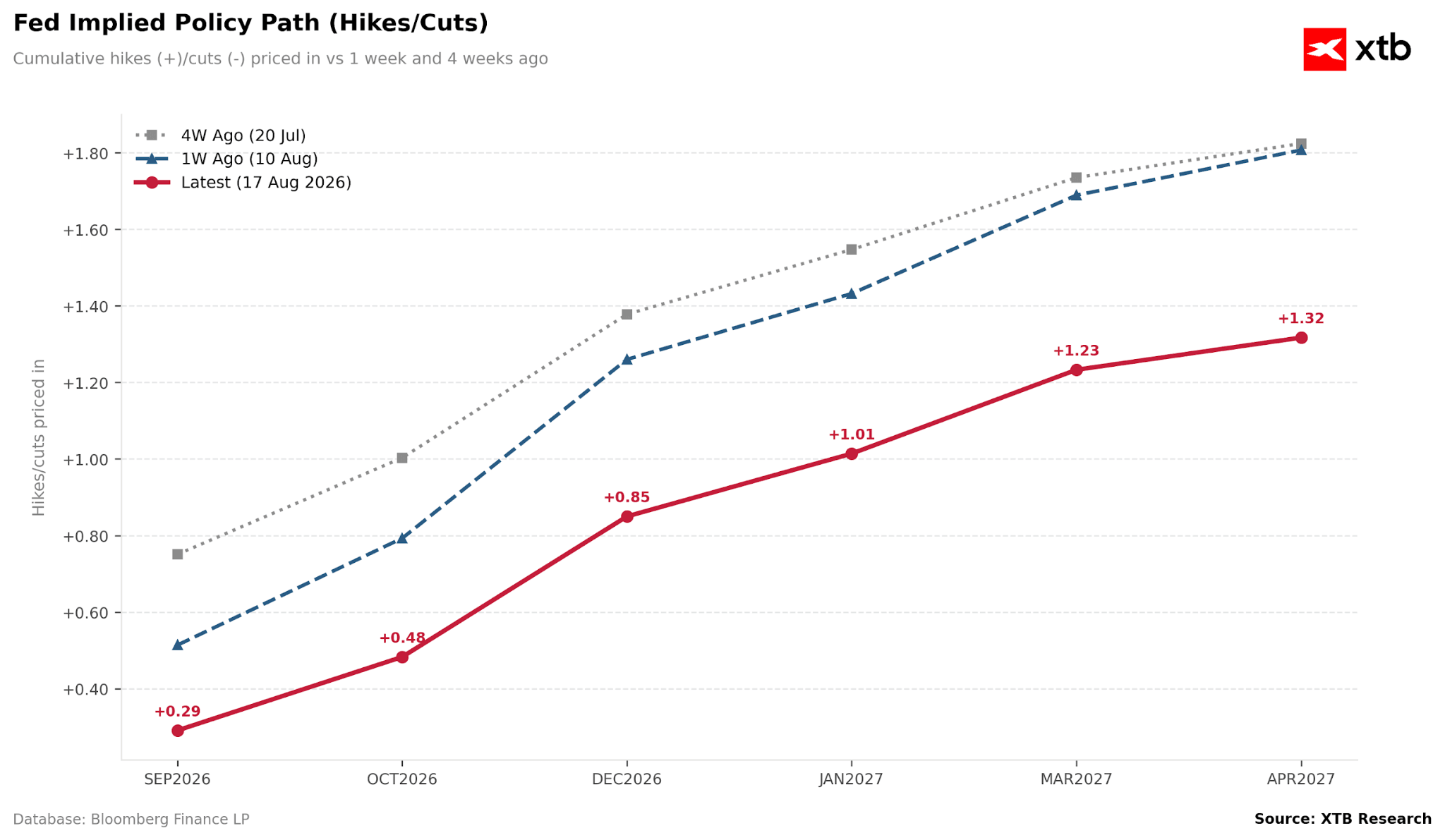
  • The swap market-implied probability of a US interest rate hike in 2026 increased from 82% to 86% over the course of the week.

Recommendation:

  • Position: Short (SELL) on AUDUSD at market price
  • Target Price (Take Profit; TP): 0.70550 (TP1), 0.70170 (TP2)
  • Stop Loss (SL): 0.72100

Source: xStation5

Opinion

The AUDUSD pair erased some of its losses from today’s session following the release of the latest US inflation data, which turned out slightly softer than expected. Core PCE increased in line with expectations to 3.3% year-on-year, while on a month-on-month basis, prices rose by 0.2% (against a 0.3% forecast). However, the lack of a negative inflation surprise is not exactly “good news” for monetary policy, especially since inflation remains in an upward trend and is proving to be stickier than assumed. The Fed’s narrative is also becoming increasingly hawkish. Recent remarks from Cook, Goolsbee, Kashkari, and Jefferson unanimously emphasize the growing and materializing upside risks to inflation, along with a clear readiness to hike interest rates should this trend continue.

Furthermore, the AUDUSD’s reaction to the optimism generated by hopes of a truce between Iran and the US last week was quite moderate, and the gains were insufficient to push the price above the 10- and 30-day exponential moving averages. Therefore, risk-sensitive currencies (including the AUD) can be expected to remain under heavy pressure until real progress is made in the Middle East, and a potential rebound in reaction to the end of the war is unlikely to trigger a rapid return to an upward trend for the pair. The options market is also pointing to further declines for AUDUSD. The 1-week and 1-month risk reversal indicators sit below zero, showing that options betting on the depreciation of the AUD dominate the market. In other words, the market is systematically hedging against further declines in AUDUSD consistently across various time horizons.

Methodology

The recommendation was prepared based on the technical analysis of the AUDUSD chart and the fundamental analysis of the discussed economies (monetary policy in Australia and the US). The direction of the recommendation was determined using moving averages and market expectations regarding central bank policies. Take Profit and Stop Loss levels were set using the Fibonacci retracement of the last upward wave and price action (TP1 at the 50.0 Fibo level, TP2 between the D1 interval EMA100 and the 61.8 Fibo level, and SL at the support from which the price rebounded before breaking the last peak).

Currency Hedger No Comments

EURUSD Rebounds Following Weak US Data

Weaker US data, in-line inflation, hawkish ECB minutes, and increased Iranian compliance trigger a sharp rebound in the EURUSD pair. A noticeable shift has taken place in the financial markets over the last few hours. The exchange rate of the major currency pair, EURUSD , recorded a sharp rebound after earlier, steeper declines briefly pushed it below the 1.16 level. The euro is currently gaining around 0.1% against the US dollar, trading around the 1.1630 mark. This move stems from a combination of disappointing macroeconomic data from the US, hawkish signals from the European Central Bank, and new developments on the geopolitical front.

Weaker US Macro Data and Inflation Relief

The main catalyst for the weakening of the greenback came from the latest macroeconomic releases from across the Atlantic, which cooled investors’ hawkish fears:

  • Disappointing GDP Growth: The US Bureau of Economic Analysis published its second revision of Q1 GDP, lowering the economic growth estimate to 1.6% from the previous 2.0%. The market widely expected the figure to hold steady at 2.0%.
  • PCE Inflation In-Line with Expectations: The headline Personal Consumption Expenditures (PCE) price index, the Fed’s preferred inflation gauge, rose to 3.8% year-over-year in April (up from 3.5% in March), which was fully in line with market consensus.
  • Core PCE Stabilization: The Core PCE index (excluding food and energy prices) came in at 3.3% annually, also matching expectations. Furthermore, on a monthly basis, core inflation increased by 0.2%, coming in slightly below forecasts of 0.3%.

The Q1 GDP revision shows lower economic growth. The fact that the conflict with Iran was already underway in March may suggest that Q2 data will also face a substantial negative impact from this front. Source: Bloomberg Finance LP, XTB

PCE inflation rebounds in line with expectations. This stands in stark contrast to the CPI inflation release, which surprised investors with noticeably higher readings. Source: Bloomberg Finance LP The fact that inflation did not surprise to the upside, despite a massive surge in commodity prices, brought relief to investors. Combined with the clear slowdown in GDP momentum, this translated into a decline in the dollar index. In-line inflation and weaker growth could damp market expectations regarding swift rate hikes from the Fed.

Hawkish ECB and Pressure on the Eurozone

While the US economy sends signs of cooling, information supporting the common currency is flowing in from Europe. The published account of the European Central Bank’s April meeting (the so-called minutes) clearly indicates that pro-inflationary risk factors in the Eurozone have significantly intensified. ECB officials highlighted mounting price pressures, suggesting that the European regulator may be forced to keep interest rates at restrictive levels for a longer period. The divergence in monetary policy outlooks between a potentially softer Fed and an inflation-wary ECB provided a strong impetus for the strengthening of the EURUSD.

The market is currently pricing in a staggering 93% probability of an ECB hike in June . Geopolitics: Sanctions and a Potential Nuclear Breakthrough Concurrently, market attention remains focused on the Middle East. Energy commodity prices rose amid renewed clashes between US and Iranian forces in the Persian Gulf region. WTI crude oil surged by over 3% during the morning European session. The situation was further exacerbated by the decision of US Treasury Secretary Scott Bessent, who announced sanctions against a new Iranian institution that had unilaterally declared control over the Strait of Hormuz. However, market sentiment improved following reports from Saudi Arabiaโ€™s Al Hadath news channel. According to these reports, Islamabad is set to propose a compromise to Washington under which Iranian uranium would be transferred to Beijing under strict international supervision. Such a diplomatic move could significantly de-escalate the regional conflict, shaving some risk premium off the markets and dampening the safe-haven demand for assets like the dollar. On the other hand, Trump recently stated that he does not want to agree to Iranian uranium ending up in either Russia or China.

Technical Outlook on EURUSD

The combination of lower-than-expected US economic growth data, a hawkish tone from the ECB, and a potential diplomatic breakthrough regarding the Iranian nuclear program provided solid ground for a sharp EURUSD rebound. Investors gained arguments suggesting that the US central bank will not be forced into immediate policy tightening. The EURUSD closing with such a pronounced candlestick shadow could suggest that key support at the 1.16 level is holding, creating the potential to test resistance at the 50.0% retracement level .

Currency Hedger No Comments

EUR/JPY Price Forecast: Loses momentum to near 185.00, but bias stays bullish

  • EUR/JPY weakens to around 185.10 in Thursdayโ€™s early European session. 
  • The cross keeps the bullish vibe, but further consolidation cannot be ruled out in near term with neutral RSI momentum. 
  • The immediate resistance to watch is 185.65; the initial support level is seen at 184.70. 

The EUR/JPY cross loses momentum to near 185.10 during the early European session on Thursday. Escalations in the US-Iran conflict boost the safe-haven currency, such as the Japanese Yen (JPY) and act as a headwind for the cross. 

CNN reported on Thursday that Iranโ€™s Islamic Revolutionary Guard Corps (IRGC) launched an attack targeting an American air base, which they said was the source of US strikes on Iranian targets hours before. The US strikes targeted Iranian drones and a launch site near the Strait of Hormuz. 

Traders will keep an eye on the Tokyo May Consumer Price Index (CPI) inflation report, which is due later on Friday. In case of a softer-than-expected Tokyo CPI print, this could drag the Japanese Yen lower against the Euro (EUR) in the near term. 

Chart Analysis EUR/JPY

Technical Analysis:

In the daily chart, EUR/JPY holds a mild bullish bias as it trades above the 100-day simple moving average and the Bollinger Bands middle line near 184.71, keeping the broader uptrend underpinned. The Relative Strength Index (RSI) hovers around 50, suggesting consolidative but still slightly constructive momentum while price drifts toward the upper Bollinger band.

On the topside, the immediate resistance is the Bollinger upper band around 185.65, and a clear break above this ceiling would open the way for a renewed extension of the advance. On the downside, initial support is seen at the Bollinger middle band near 184.70 and the 100-day SMA at 184.40, with the lower Bollinger band near 183.78 acting as a deeper cushion if a corrective pullback develops.

Currency Hedger No Comments

AUD/USD Price Forecast: On verge of Head and Shoulder breakdown

  • AUD/USD tumbles to near 0.7100 as the Australian Dollar underperforms due to multiple headwinds.
  • The exchange of attacks between the US and Iran has dented optimism towards a peace deal.
  • Slower-than-projected Australian CPI growth in April has forced traders to pare hawkish RBA bets.

The Australian Dollar (AUD) slumps over 0.5% to near 0.7100 during the Asian trading session on Thursday. The Aussie par slumps as the antipodean underperforms its peers due to risk-off market sentiment and diminished hawkish Reserve Bank of Australia (RBA) bets.

Australian Dollar Price Today

The table below shows the percentage change of Australian Dollar (AUD) against listed major currencies today. Australian Dollar was the weakest against the US Dollar.

USDEURGBPJPYCADAUDNZDCHF
USD0.30%0.38%0.05%0.16%0.55%0.51%0.32%
EUR-0.30%0.08%-0.28%-0.15%0.25%0.22%0.02%
GBP-0.38%-0.08%-0.34%-0.23%0.17%0.15%-0.07%
JPY-0.05%0.28%0.34%0.11%0.51%0.46%0.28%
CAD-0.16%0.15%0.23%-0.11%0.41%0.36%0.16%
AUD-0.55%-0.25%-0.17%-0.51%-0.41%-0.02%-0.24%
NZD-0.51%-0.22%-0.15%-0.46%-0.36%0.02%-0.21%
CHF-0.32%-0.02%0.07%-0.28%-0.16%0.24%0.21%

The heat map shows percentage changes of major currencies against each other. The base currency is picked from the left column, while the quote currency is picked from the top row. For example, if you pick the Australian Dollar from the left column and move along the horizontal line to the US Dollar, the percentage change displayed in the box will represent AUD (base)/USD (quote).

Market sentiment turns favorable for safe-haven assets as Iran has retaliated against the United States (US) attacks near Bandar Abbas airport by striking its military bases in the Gulf region. At press time, the US Dollar Index (DXY), which tracks the Greenbackโ€™s value against six major currencies, trades 0.3% higher, slightly above 99.50. S&P 500 futures and all major Asian stock markets are bleeding, as of writing, indicating a significant dent in investorsโ€™ risk appetite.

Hawkish RBA prospects have squeezed as the Australian Consumer Price Index (CPI) data for April showed that inflationary pressures cooled down at a faster-than-expected pace. Month-on-month CPI arrived at 0.4%, lower than 0.6% estimates and the previous reading of 1.1%. On an annualized basis, the Australian CPI grew at a moderate pace of 4.2% against expectations of 4.4% and the March reading of 4.6%.

Following the Australian CPI data, markets now imply almost no chance of a June move, while the probability of an August hike has more than halved to 40%, Reuters reports.

AUD/USD technical analysis

AUD/USD trades significantly lower at around 0.7100 as of writing. The near-term tone of the pair is bearish as it holds below the 20-period exponential moving average (EMA), which is at 0.7158. Also, the Head and Shoulder (H&S) formation backs a bearish bias.

The Relative Strength Index (RSI) is near 43, indicating subdued momentum rather than oversold conditions, hinting that sellers still retain the upper hand.

Looking down, the pair could enter a fresh leg of decline if it breaks below the neckline of the H&S formation at around 0.7070. Major support zones will be 0.7050 and the April 13 low around 0.6990. On the topside, the 20-day EMA at 0.7158 is the first resistance to beat for the bulls to ease immediate downside pressure and open the way for a more sustained recovery towards 0.7200.

Currency Hedger No Comments

NZD the strongest currency after a hawkish surprise from the RBNZ

RBNZ: hawkish hold The RBNZ delivered a decision that the market interpreted as a classic โ€œhawkish hold.โ€ The Official Cash Rate (OCR) was kept unchanged at 2.25% , but only after a rare 3โ€“3 split within the Monetary Policy Committee. Governor Anna Breman, Karen Silk, and Paul Conway voted to keep rates unchanged, while Carl Hansen, Hayley Gourley, and Prasanna Gai supported an immediate 25 bp hike to 2.50% . Bremanโ€™s deciding vote left policy unchanged, but the broader message was clear: the easing phase is over, and the next move will be upward. The RBNZ explicitly stated that the OCR will need to rise sooner and by more than the bank expected as recently as February. A more challenging macroeconomic environment The macroeconomic backdrop has become significantly more complicated. The central bank is now dealing with a negative supply shock stemming from the Middle East conflict โ€” primarily through higher oil, gas, and petrochemical prices โ€” while domestic demand is already beginning to weaken. Inflation is now expected to peak at 4.3% in Q3 2026 , with a return to the 2% inflation target not expected until mid- 2027 . At the same time, business and consumer sentiment indicators, housing market activity, and corporate hiring plans have all deteriorated. In practice, this means that the RBNZ is facing a difficult combination of factors:

  • inflation risks are clearly higher, especially if firms and workers begin treating the energy shock as permanent;
  • growth risks are clearly lower, as higher fuel costs reduce real incomes, margins, and consumption;
  • spare capacity and elevated unemployment should partially limit second-round effects, but not enough for the bank to ignore the risk of inflation becoming entrenched.

Implications for investors The key takeaway for investors is that the decision was not dovish despite rates being left unchanged. All six MPC members agreed that rate hikes at upcoming meetings will likely be necessary to prevent short-term inflation from feeding into medium-term inflation expectations. The updated rate path points to a significantly more restrictive stance in the future, and market commentary suggests a high probability of hikes at the July, September, and October meetings. New Zealand dollar reaction The New Zealand dollar reacted with gains. The market focused more on the hawkish forward guidance than on the hold itself. NZDUSD rose 0.70% toward the 0.5870 area following the decision release. Such a reaction is logical: the split vote, higher OCR path, and clear suggestion that hikes are likely later this year support the currency through expectations of wider interest rate differentials. At the same time, the upside potential may not be one-directional. The same statement also emphasized weaker domestic growth, fragile economic sentiment, and risks to activity, while the RBNZ itself pointed to high volatility in the trade-weighted NZD exchange rate.

Currency Hedger No Comments

Indian Rupee ticks higher as oil prices decline while Iran uncertainty persists

  • The Indian Rupee ticks higher against the US Dollar as oil prices decline.
  • Iran alleges that the US is violating the ceasefire.
  • FIIs turned out to be net sellers on Tuesday, offloading the stake worth Rs. 2,407.87 crore.

The Indian Rupee (INR) trades marginally higher against the US Dollar (USD) in the opening session on Wednesday. The USD/INR pair ticks lower to near 95.70 as oil prices fail to hold their Tuesdayโ€™s recovery move, with market participants remaining confident that the United States (US) and Iran are close to reaching a deal.

At press time, the WTI Oil price trades 1.8% lower to near $90.80. Currencies from economies, such as India, which rely heavily on oil imports to meet their energy needs, attract bids following a sharp correction in oil prices.

US-Iran negotiations continue despite US defensive attacks on Iran

On Tuesday, Iranโ€™s Islamic Revolutionary Guard Corps (IRGC) threatened retaliation after the US carried out strikes on southern Iran, which were described as โ€œself-defenseโ€ by the US Central Command. The Iranian Foreign Ministry condemned the US attacks, calling them a โ€œgross violationโ€ of the ceasefire.

However, negotiations between the US and Iran regarding an end to the Middle East war and the reopening of the Strait of Hormuz, a vital passage to almost 20% of global energy supply, continue through mediators.

An Iranian official said on Tuesday that the unfreezing of Iran’s funds is the last serious sticking point with the United States (US) being resolved through Qatar mediation, Fars agency reported. However, there had been no official confirmation.

Earlier this week, US Secretary of State Marco Rubio said that the Strait of Hormuz has to be open โ€œone way or the other,” and finalizing the deal with Iran may take a few days.

FIIs remained net sellers on Tuesday

There seems to be a mixed sentiment of Foreign Institutional Investors (FIIs) toward the Indian stock market the entire month. Overseas investors have been seen turning out net sellers on alternative days, with no clear pattern. On Tuesday, FIIs offloaded their stake worth Rs. 2,407.87 crore after increasing by Rs. 821.75 crore on Monday.

US Dollar wobbles ahead of US PCE Inflation data

The US Dollar trades in a tight range around 99.00 as investors await clear signals from the US and Iran regarding the progress in negotiations toward a permanent deal.

On the domestic front, investors await the US Personal Consumption Expenditure Price Index (PCE) data for April, which will be released on Thursday. Investors will pay close attention to the US PCE inflation data to get fresh cues on the Federal Reserveโ€™s (Fed) monetary policy outlook.

The US core PCE inflation โ€“ which is the Fedโ€™s preferred inflation gauge โ€“ is estimated to have grown at an annualized pace of 3.3%, faster than 3.2% in March, with monthly figures growing steadily by 0.3%.

Technical Analysis: USD/INR attracts bids near 20-day EMA

USD/INR trades slightly lower at around 95.70 as of writing. The pair holds a constructive bullish bias as spot remains above the 20-period Exponential Moving Average (EMA) at 95.4387.

The EMAโ€™s upward slope hints that the recent advance is still supported, while the Relative Strength Index (RSI) near 56 suggests positive but not overbought momentum, allowing room for further gains if buyers stay in control.

On the downside, initial support is located at the 20-day EMA around 95.44, where a break would signal fading short-term momentum and expose a deeper corrective move towards 95.00. Looking up, the pair would attempt to return to the all-time high around 97.00 if it manages to recover above the May 22 high at 96.37.

Currency Hedger No Comments

British Pound remains close to monthly peak vs Japanese Yen amid Mideast tensions

  • GBP/JPY regains positive traction on Wednesday and draws support from a combination of factors.
  • A modest USD downtick benefits the GBP, while economic concerns due to Iran risks weigh on the JPY.
  • Bulls seem rather unaffected by divergent BoJ-BoE expectations and JPY intervention speculations.

The GBP/JPY cross attracts some dip-buyers following the previous day’s modest pullback from the 214.65-214.70 region, or a fresh monthly peak, and sticks to its modest intraday gains through the early European session on Wednesday. Spot prices currently trade around the 214.35-214.40 area, up 0.10% for the day, and seem poised to appreciate further amid a supportive fundamental backdrop.

The British Pound (GBP) benefits from a modest US Dollar (USD) downtick, which, along with the underlying bearish sentiment surrounding the Japanese Yen (JPY), validates the near-term positive outlook for the GBP/JPY cross. In fact, the JPY has been underperforming against major global currencies amid economic concerns stemming from the ongoing Middle East conflict and the continued disruptions to energy supplies.

In fact, shipping traffic through the critical Strait of Hormuz remains drastically reduced due to Iran’s restrictions and the US naval blockade of Iranian ports. Furthermore, the US and Iran remain at odds over key issues, including Tehran’s nuclear program and the strategic waterway. This keeps geopolitical risk premium in play and continues to undermine the JPY, despite hawkish Bank of Japan (BoJ) expectations.

BoJ Deputy Governor Himino Ryozo said on Tuesday that the central bank will continue to raise the policy rate based on economic activity, prices, and financial conditions. Even speculations that Japanese authorities will step in again to prop up the domestic currency do little to impress the JPY bulls, suggesting that the path of least resistance for the GBP/JPY cross is to the upside and backing the case for further gains.

Meanwhile, traders pushed back expectations for the likely timing of the next interest rate hike by the Bank of England (BoE) to December after the UK Consumer Price Inflation (CPI) unexpectedly slowed to the 2.8% YoY rate in April. Adding to this, the UK political chaos and growing calls for Prime Minister Keir Starmer to step down might hold back the GBP bulls from placing aggressive bets and cap the GBP/JPY cross.

Japanese Yen Price This Month

The table below shows the percentage change of Japanese Yen (JPY) against listed major currencies this month. Japanese Yen was the strongest against the Canadian Dollar.

USDEURGBPJPYCADAUDNZDCHF
USD0.75%1.15%1.77%1.78%0.73%0.60%0.48%
EUR-0.75%0.38%0.96%0.98%0.00%-0.12%-0.30%
GBP-1.15%-0.38%0.58%0.64%-0.40%-0.52%-0.69%
JPY-1.77%-0.96%-0.58%0.00%-1.03%-1.26%-1.33%
CAD-1.78%-0.98%-0.64%-0.00%-1.04%-1.27%-1.30%
AUD-0.73%0.00%0.40%1.03%1.04%-0.13%-0.30%
NZD-0.60%0.12%0.52%1.26%1.27%0.13%-0.17%
CHF-0.48%0.30%0.69%1.33%1.30%0.30%0.17%

The heat map shows percentage changes of major currencies against each other. The base currency is picked from the left column, while the quote currency is picked from the top row. For example, if you pick the Japanese Yen from the left column and move along the horizontal line to the US Dollar, the percentage change displayed in the box will represent JPY (base)/USD (quote).

Currency Hedger No Comments

AUD/NZD Price Forecast: Retreats below 1.2200 on hawkish RBNZ, weak Australian data

  • AUD/NZD retreats from 1.2286 highs to levels below 1.2200.
  • A hawkish RBNZ and soft Australian CPI figures are hammering the Aussie.
  • The pair approaches the neckline of a Double Top pattern.


The Aussie Dollar (AUD) is dropping sharply against the New Zealand Dollar (NZD) on Wednesday. The pair has lost more than 0.8% so far today, hitting session lows at 1.2173, hammered by a combination of a hawkish hold by the Reserve Bank of New Zealand (RBNZ) and softer-than-expected Australian inflation figures.

The RBNZ left interest rates on hold, as widely expected earlier on Wednesday, but a split monetary policy committee hints at upcoming rate hikes. RBNZ Governor, Anna Breman, who used her casting vote to hold on Wednesday, affirmed that policymakers are concerned about second-round effects on inflation, and that further โ€œOCR increases are likely at coming meetings.โ€

In Australia, Aprilโ€™s Consumer Prices Index (CPI) showed softer-than-expected inflationary pressures. These figures provide some leeway for the Reserve Bank of Australia (RBA) to wait and see for a clearer assessment of the consequences of the war in Iran, and have prompted investors to pare back hopes of an August rate hike.

Technical Indicator: A potential double top warns of a trend shift

Chart Analysis AUD/NZD


AUD/NZD has lost more than 120 pips on Wednesday and is showing signs consistent with a trend shift. A bearish engulfing candle on the daily chart, and a potential double top at the 1.2285 area are clear indicators that bulls are giving up.

The 4-hour Relative Strength Index (RSI) has slipped to the mid-30s, hinting at persistent downside pressure. At the same time, the Moving Average Convergence Divergence (MACD) indicator has turned slightly negative, reinforcing the notion that sellers are taking control.

Immediate support is located at the 1.2125-1.2135 area, where May 7, 12, and 21 lows meet the neckline of the mentioned double top pattern. Further down, the April 9 and 14 lows, around 1.2045, would come into focus. The double top’s measured target is right below the 1.2000 psychological level. On the upside, in the unlikely case of a break above 1.2285, the 127.2% Fibonacci extension of the April-May rally lies at the 1.2380 area.

(The technical analysis of this story was written with the help of an AI tool.)

Australian Dollar Price Today

The table below shows the percentage change of Australian Dollar (AUD) against listed major currencies today. Australian Dollar was the strongest against the Canadian Dollar.

USDEURGBPJPYCADAUDNZDCHF
USD-0.13%-0.04%0.03%0.05%0.30%-0.65%-0.11%
EUR0.13%0.09%0.15%0.17%0.39%-0.52%0.01%
GBP0.04%-0.09%0.04%0.08%0.32%-0.60%-0.06%
JPY-0.03%-0.15%-0.04%0.02%0.25%-0.67%-0.12%
CAD-0.05%-0.17%-0.08%-0.02%0.23%-0.67%-0.14%
AUD-0.30%-0.39%-0.32%-0.25%-0.23%-0.90%-0.35%
NZD0.65%0.52%0.60%0.67%0.67%0.90%0.53%
CHF0.11%-0.01%0.06%0.12%0.14%0.35%-0.53%

The heat map shows percentage changes of major currencies against each other. The base currency is picked from the left column, while the quote currency is picked from the top row. For example, if you pick the Australian Dollar from the left column and move along the horizontal line to the US Dollar, the percentage change displayed in the box will represent AUD (base)/USD (quote).