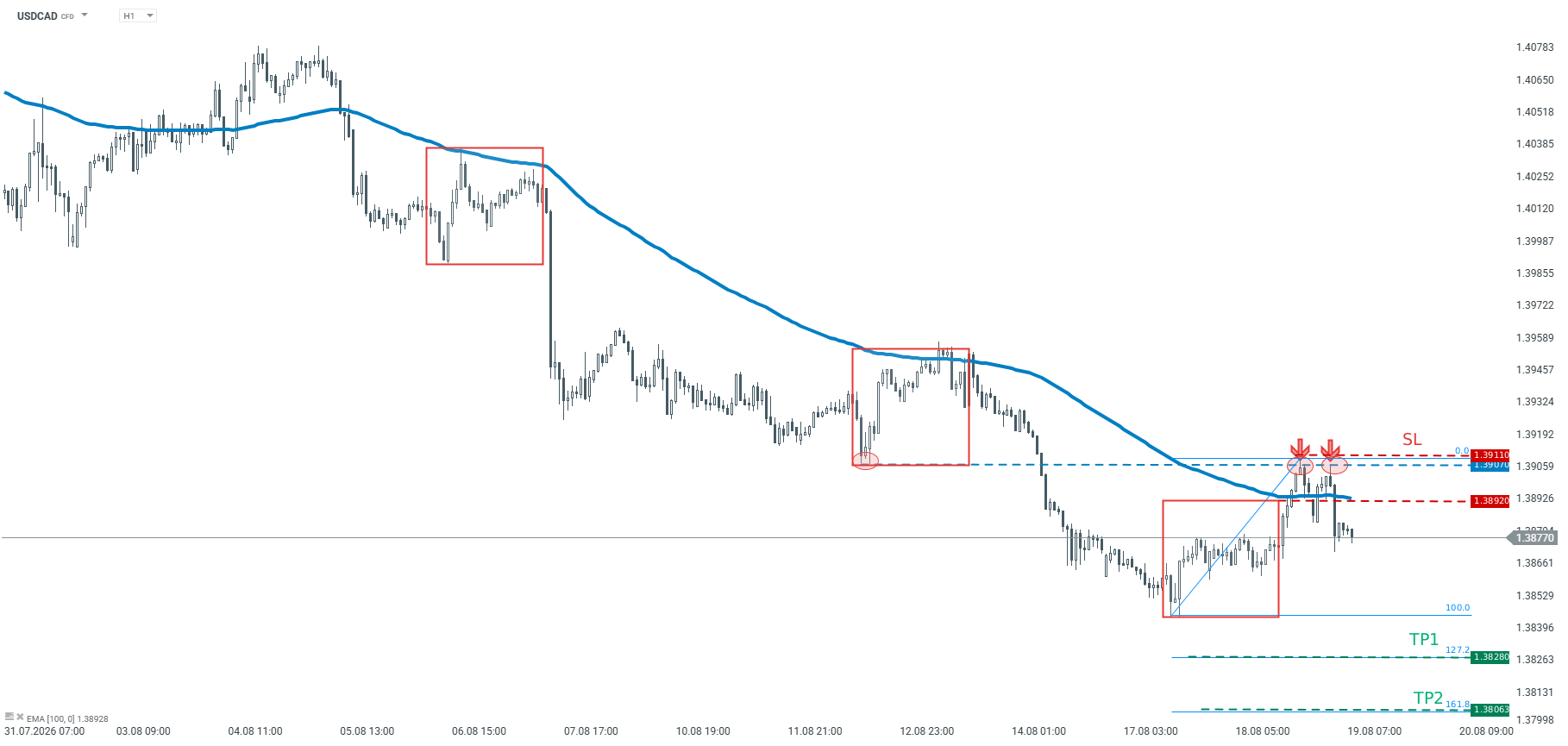
Facts: USDCAD is trading in a downward trend since the beginning of July The pair reacted to the key resistance at 1.3907
Recommendation: Trade: Short USDCAD at market price Target: 1.3828, 1.3806 Stop: 1.3911
Opinion: USDCAD has been trading in a local downward move since the beginning of July. Looking at the pair at the H1 interval, one can see that the price reacted to the key resistance at 1.3907, following a local upward correction. The resistance is a result of the previous low from August 12. In addition the price returned below the upper limit of 1:1 structure, which according to the Overbalance methodology supports a downward scenario. The pair also sits below the 100-period moving average from the H1 interval. We recommend going short USDCAD at market price with two targets: 1.3828 and 1.3806 . We also recommend placing a stop loss order at 1.3911. Source: xStation
EUR/GBP trims gains near 0.8555 in Wednesday’s early European session.
UK CPI inflation jumped to 2.9% YoY in July, the highest rate for four months.
ECB’s Lane said 3% Eurozone inflation remains too high.
The EUR/GBP cross pares gains around 0.8555 during the early European trading hours on Wednesday. The British Pound (GBP) attracts some buyers against the Euro (EUR) following the UK inflation data. The European Central Bank (ECB) President Christine Lagarde’s is scheduled to speak later on Wednesday.
Data released by the Office for National Statistics (ONS) on Wednesday showed that the UK headline Consumer Price Index (CPI) inflation climbed to 2.9% YoY in July from 2.6% in June. This figure came in line with the market expectations of 2.9%. The ONS said that it was driven by a “sharp increase” in gas prices following a rise in the household energy price cap.
Meanwhile, the core CPI, which excludes volatile food and energy items, rose 2.6% YoY in July, versus 2.6% prior, hotter than the forecast of 2.5%. On a monthly basis, the headline CPI rose 0.3% in July, compared to an increase of 0.1% in June, in line with the market consensus of 0.3%.
Money market pricing shows City economists project one Bank of England (BoE) rate hike by the end of the year, which would lift the Bank rate from 3.75% to 4.0%.
On the Eurozone front, ECB chief economist Philip Lane said Tuesday that Eurozone inflation at 3% remains too high despite appearing modest compared to previous levels. Markets are now pricing in a continuation of the ECB hiking cycle. The ECB Watch Tool indicates a 90% to 94% odds of a 25 basis points (bps) hike to 2.50% at the September policy meeting.
BoE expectations hold firm despite softer UK labour signals
Strategists at Scotiabank note that the weaker UK labour figures have done little to shift the policy outlook, with the “soft data [having] little impact on near-term BoE pricing (just 5bps of tightening risk reflected in Sep swaps)” and instead reinforcing the view that “market pricing for one more hike before year-end remains stretch.”
Technical Analysis: EUR/GBP
In the daily chart, EUR/GBP keeps a mildly bearish bias as spot holds beneath the 20-day simple moving average of the Bollinger Bands and well below the 100-day simple moving average. Price is situated between the lower and middle Bollinger bands, suggesting a capped recovery tone, while the 14-day Relative Strength Index around 50 signals neutral momentum that neither challenges nor offsets the prevailing downside structural pressure.
On the topside, initial resistance emerges at the Bollinger middle band near 0.8555, followed by the upper Bollinger band around 0.8580, ahead of the more meaningful barrier at the 100-day SMA clustered near 0.8620. On the downside, the lower Bollinger band at 0.8532 forms immediate support, and a clear break beneath this floor would likely open the way to a deeper retreat in the cross.
EUR/JPY declines to near 184.60 in Wednesday’s early Asian session.
The cross maintains a mildly bearish tone; further consolidation cannot be ruled out with neutral RSI momentum.
The first upside target to watch is 185.10; the initial support level is located at 184.10.
The EUR/JPY cross trades in negative territory around 184.60 during the early European trading hours on Wednesday. The Japanese Yen (JPY) edges higher against the Euro (EUR) amid hawkish signals from the Bank of Japan (BoJ). Japan’s National Consumer Price Index (CPI) inflation report will be the highlight later on Friday.
Growing speculation that the Bank of Japan may raise interest rates in the coming months provides some support to the JPY. Reuters in a report Friday said the Japanese central bank is considering a rate hike as soon as September. Overnight index swaps are pricing in about an 80% odds of a move by that month.
On the other hand, mounting fiscal worries in Japan could exert some selling pressure on the JPY. Prime Minister Sanae Takaichi’s proposal to cut the consumption tax on food to 1% for two years has raised market concerns, as the government has yet to identify an alternative revenue source and the measure is viewed as an ineffective way to fight inflation.
Japan political pressures bolster support for higher rates to steady the Yen
Strategists at DBS highlight a notable shift in Japan’s policy backdrop, observing that Prime Minister Sanae Takaichi has become “more supportive of raising interest rates to stabilize the JPY amid lower approval ratings and rising cost-of-living pressures.” They argue that this evolving political stance is adding to the case for a less accommodative policy mix, as authorities increasingly frame higher rates as a tool to shore up the Yen and address mounting domestic concerns.
Technical Analysis: EUR/JPY keeps a mildly bearish vibe in the near term
In the daily chart, EUR/JPY maintains a mildly bearish near-term bias as it holds below the 100-day simple moving average (SMA). Price remains confined within the Bollinger Bands, sitting above the middle band support but well under the upper band resistance, which hints at capped upside while the Relative Strength Index (14) at 52.71 stays in neutral territory.
On the topside, initial resistance appears at the 100-day SMA near 185.10. The next upside barrier is located at the June 17 high of 186.32, en route to the upper Bollinger Band around 187.65.
On the downside, immediate support is seen at the Bollinger middle band at 184.10, ahead of a deeper cushion near the August 10 low of 182.70. The next contention level is seen at the lower band around 180.50, where a more pronounced corrective phase could find demand.
Australia’s Wage Price Index grew 3.2% year-on-year in Q2 2026, matching expectations despite hitting a multi-quarter low.
RBA Deputy Governor Andrew Hauser warned inflation remains too high, requiring tighter monetary policy to cool economic demand.
Weak US Retail Sales and cooling inflation reduce September rate hike probabilities to 35%.
AUD/USD extends its losses for the second successive day, trading around 0.7080 during the Asian hours on Wednesday. Addressing the broader economic backdrop, Reserve Bank of Australia (RBA) Deputy Governor Andrew Hauser emphasized on Wednesday that inflation remains unacceptably high. Hauser stated that monetary policy must work to reduce demand in the economy and bring price pressures down. While the central bank is not anticipating a recession, it is seeing a general slowdown and remains deeply concerned about upside risks to inflation. Hauser warned that if inflation fails to cool, the RBA will have no choice but to raise interest rates again.
Australia’s seasonally adjusted Wage Price Index increased 3.2% year-on-year in Q2 2026, holding steady from the revised figure in Q1 and matching market expectations. While quarterly wages grew by 0.8%, maintaining the same pace seen over the previous four quarters, the annual figure represents the weakest wage growth since Q4 2024.
Aussie upside risk persists as UOB lifts near-term focus to 0.7150
Analysts at UOB Group maintain that “the risk for AUD is on the upside,” a view they have held since early August and reiterated on 17 August when spot was trading around 0.7080. At that point, they cautioned that “the risk for AUD remains on the upside but note that AUD must surpass 0.7100 before a move to 0.7120 can be expected.” The currency has since “quickly broken above both 0.7100 and 0.7120,” briefly reaching “a high of 0.7129 before retreating,” and UOB now flags “0.7150” as “the next level to monitor.” The bank adds that “only a breach of 0.7070” – with the prior “strong support” noted at 0.7050 – “would mean that the upside risk has faded.”
However, the downside of the AUD/USD pair could be restrained as the US Dollar (USD) weakens amid easing expectations of a US interest rate hike next month. Recent economic data showed that US Retail Sales dropped in July for the first time in nine months, compounding concerns after unexpected job losses last month and tame CPI inflation figures.
While the Fed left interest rates unchanged at its last meeting, three officials dissented in favor of a rate hike, leaving traders looking to the upcoming minutes for deeper insight into the division within the central bank. According to the CME FedWatch tool, traders now price in just a 35% chance of a rate hike at the Fed’s September meeting, down significantly from 47% a month earlier.
AUD/USD: Daily Chart
Technical Analysis:
In the daily chart, AUD/USD trades at 0.7080, retaining a bullish near-term bias as spot holds above both the nine-period and 50-period Exponential Moving Averages (EMAs). The short-term EMA clustering just beneath price suggests a constructive underlying bid, while the 14-day Relative Strength Index (RSI) at 58.4 stays in positive territory without yet reaching overbought conditions, hinting that bulls still have room to extend the advance. The technical analysis of the daily chart suggests that the pair is remaining within the ascending channel, indicating an ongoing bullish bias.
On the downside, initial support is seen around the nine-period EMA at 0.7071, followed by the 50-period EMA at 0.7029, where a deeper pullback would test the integrity of the current uptrend; below there, horizontal levels at 0.6833 and 0.6400 form a more distant structural floor. On the topside, the next significant hurdle emerges at the horizontal resistance at 0.7278, and a sustained break above this barrier would open the way for a continuation of the broader recovery phase in the pair.
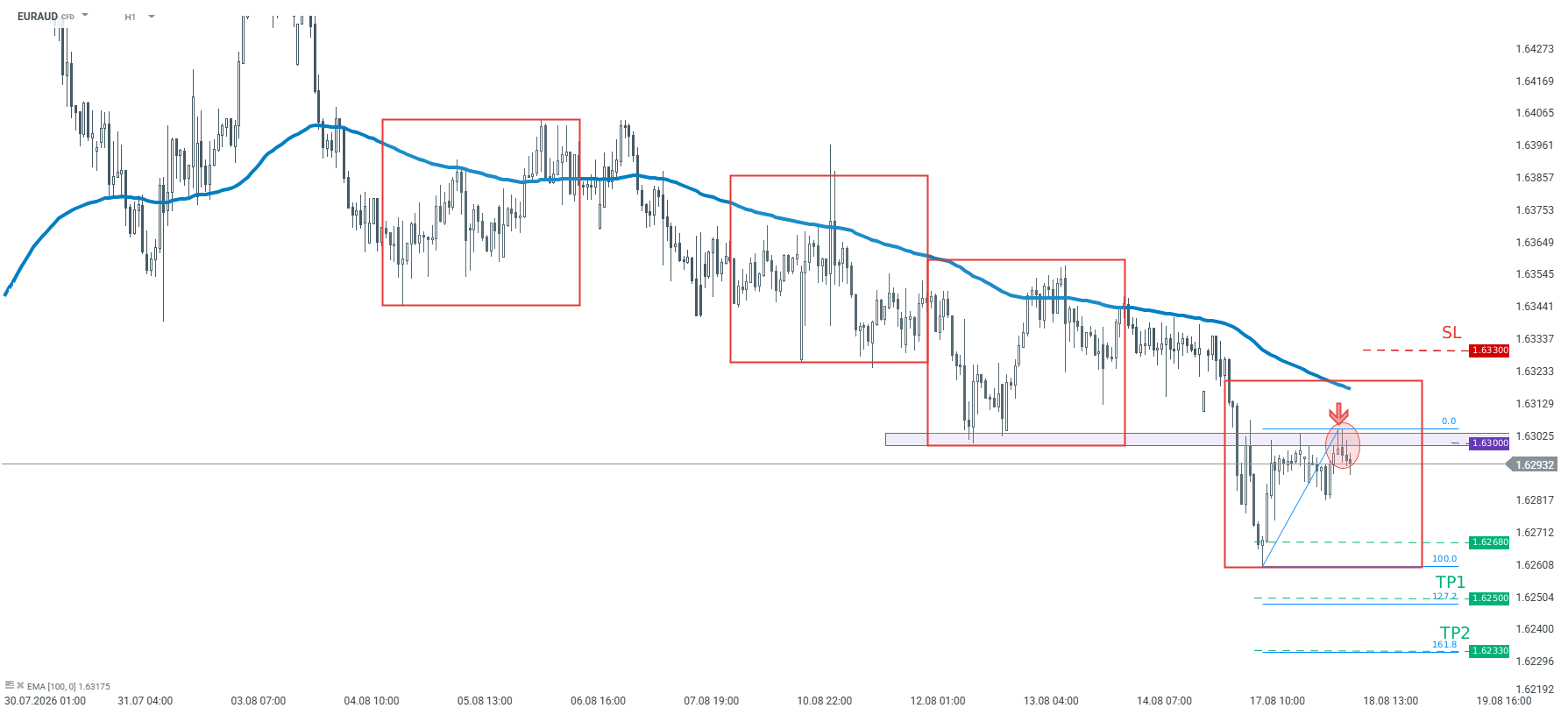
Short term sentiment remains downward The price reacted to the horizontal resistance area at 1.6300
Recommendation: Trade: Short EURAUD at market price Target: 1.6250, 1.6233 Stop: 1.6330
Opinion: Looking at the EURAUD chart from a short-term perspective, we can see that the price bounced off the key resistance today. The area at 1.6300 is marked with previous price reactions. According to the classic technical analysis, the further downward move looks to be the base case scenario. In addition the price sits below the 100-period moving average from the H1 interval. We recommend going short EURAUD at market price with two targets: 1.6250 and 1.6233. We also recommend placing stop loss at 1.6330. Source: xStation5
USD/CAD lacks a firm intraday directional bias on Tuesday amid a combination of diverging forces.
Rising oil prices underpin the Loonie, while hawkish Fed bets provide a goodish lift to the USD.
The technical setup favors bearish traders and backs the case for a further near-term depreciation.
The USD/CAD pair struggles to capitalize on the overnight bounce from its lowest level since June 3, around the 1.3845 zone, also representing the 200-day Simple Moving Average (SMA) support, and oscillates in a narrow band on Tuesday. Spot prices extend the range-bound price action through the early European session and currently trade around the 1.3870-1.3875 region, unchanged for the day amid mixed cues.
Crude oil prices climb to an over two-week high amid the US-Iran standoff over the Strait of Hormuz. This, along with Monday’s hot Canadian consumer inflation figures, continues to underpin the commodity-linked Loonie and acts as a tailwind for the USD/CAD pair. The downside, however, remains cushioned amid a strong follow-through US Dollar (USD) recovery from a two-month low, bolstered by bets for at least one rate hike by the US Federal Reserve (Fed) on the back of oil-driven inflation risks.
Meanwhile, momentum indicators suggest that bearish sentiment dominates even as spot prices stabilize above the longer-term trend support. In fact, the Relative Strength Index (14) sits in oversold territory near 29, hinting at stretched downside conditions, while the Moving Average Convergence Divergence (MACD) indicator remains below zero with negative readings. Moreover, the USD/CAD pair has found acceptance below the 50% Fibonacci retracement level of the April-June rally, validating the negative outlook.
However, a convincing break below the 200-day SMA at 1.3848 is needed to back the case for deeper losses to the 61.8% Fibo. level at 1.3822. Some follow-through selling would expose the 78.6% level at 1.3708, before the USD/CAD pair extends the fall toward the structural floor near 1.3562.
On the topside, initial resistance is located at the 50.0% retracement at 1.3902, followed by the 38.2% level at 1.3982 and then the 23.6% retracement at 1.4081, with the cycle high anchor around 1.4242 acting as a more distant barrier.
Swiss Franc ticks lower against the US Dollar as the latter rebounds.
Higher oil prices could force traders to raise hawkish Fed bets again.
Investors await FOMC Minutes of the July policy meeting.
The Swiss Franc (CHF) trades marginally lower against the US Dollar (USD) in the early European trading session on Tuesday, with the USD/CHF pair edging up to near 0.8116. The Swiss Franc pair rises as the US Dollar bounces back amid fears that surging oil prices could re-ignite hawkish Federal Reserve (Fed) interest rate expectations.
At press time, the US Dollar Index (DXY), which gauges the Greenback’s value against six major currencies, trades slightly higher to near 99.65. The USD Index recovered on Monday after posting a fresh two-month low at 99.29.
The WTI Oil price has hit a fresh two-week high near $84.50 as United States (US) President Donald Trump confirmed no renewal of the US-Iran ceasefire.
In the last few weeks, traders have pared Fed interest rate hike expectations due to soft US economic data for July.
Fed hike bets fade as HSBC sees September hold risk rising
Analysts at HSBC Asset Management highlight that “market pricing for a September Federal Reserve rate hike has fallen to its lowest level since mid-June,” as investors reassess the policy outlook. They note that expectations have been squeezed lower, “wedged between Warsh’s comments and the benign CPI print,” while “a softer labour report has also weighed on rate expectations.” HSBC adds that “if August inflation and employment data show more of the same, the Fed is likely to stay on hold in September,” underscoring the importance of upcoming US data in shaping the near-term rate path.
Going forward, investors will focus on the US Federal Open Market Committee (FOMC) minutes of the July policy meeting, which will be released on Wednesday.
Meanwhile, the price action in the Swiss Franc is expected to be driven by geopolitical headlines, as the Switzerland economic calendar has nothing much to offer this week.
Technical Analysis
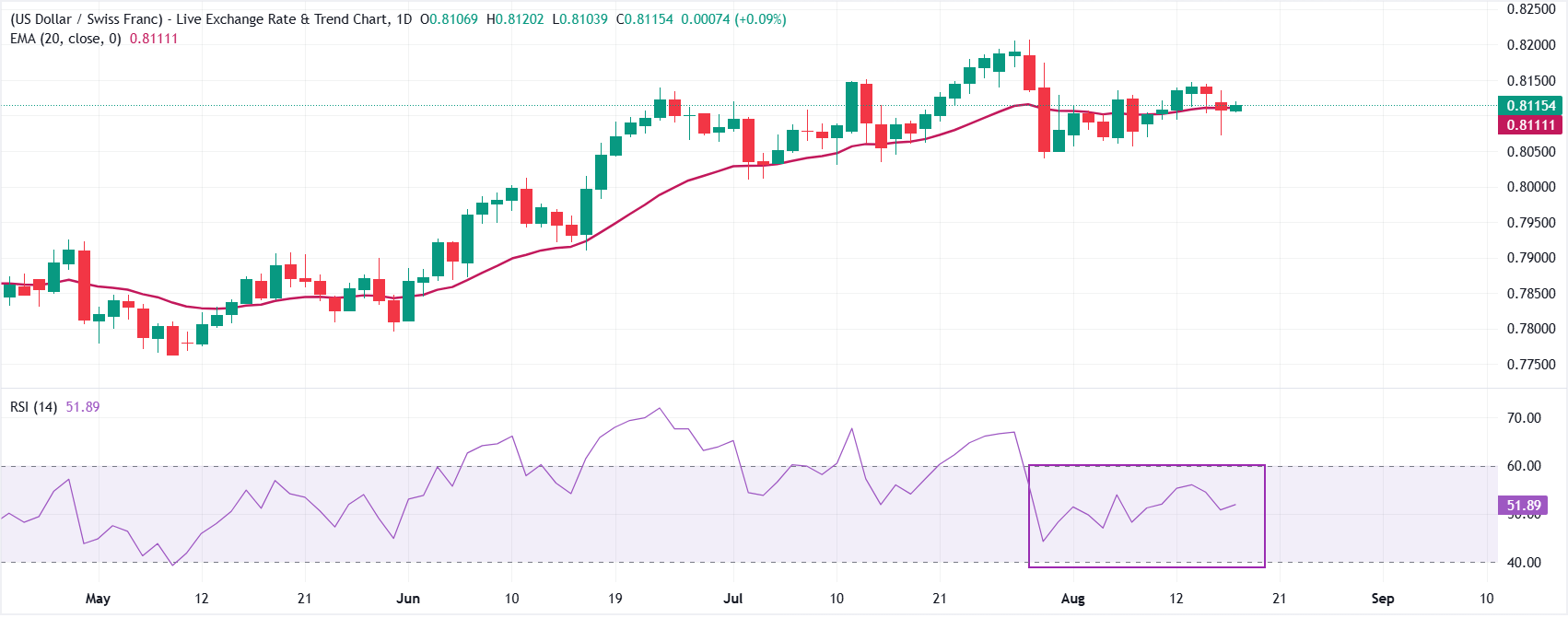
In the daily chart, USD/CHF trades at 0.8115, holding marginally above the 20-day exponential moving average (EMA) at 0.8111, which lends a mild bullish bias in the near term. The Relative Strength Index (RSI) at 51.89 sits just above the neutral 50 line, suggesting steady but unspectacular upside momentum as the pair consolidates after its recent recovery from the 0.8050 area.
On the downside, immediate support is located at the 20-day EMA at 0.8111, and a close below this level would hint at fading bullish pressure and a deeper pullback toward recent lows. As long as the pair holds above this moving average, dip-buying interest is likely to persist, keeping the short-term structure constructive while traders watch for a stronger momentum pickup to extend gains.
EUR/USD softens to near 1.1575 in Tuesday’s early Asian session.
Trump said he’s not looking to extend the ceasefire deal with Iran.
Traders walked back expectations of near-term Fed monetary tightening.
The EUR/USD pair loses traction to around 1.1575, snapping the three-day winning streak during the early European session on Tuesday. The Euro (EUR) edges lower against the US Dollar (USD) as traders remain cautious about the US-Iran conflict and the closure of the Strait of Hormuz.
Reuters reported on Tuesday that the UK Maritime Trade Operations (UKMTO) said that it has received a report of an incident in the critical waterway. UKMTO said that a company security officer has reported that the vessel was struck by an unknown projectile while conducting an outbound transit of the strait.
On Monday, US President Donald Trump said that he is not interested in renewing the expiring agreement with Iran. Meanwhile, Iran’s Foreign Ministry spokesman Esmail Baghaei stated that a deal has been elusive due to security complexities and the “obstructionist behavior of destructive elements,” adding that the US must remove its blockade.
Ongoing tensions in the Middle East could boost a safe-haven currency such as the Greenback and act as a headwind for EUR/USD in the near term. However, lower bets for a September Federal Reserve (Fed) rate hike following soft US economic data might weigh on the USD.
Data showed last week that US Retail Sales dropped in July for the first time in nine months, following unexpected job losses last month and tame inflation figures. Traders expect a 35% odds of a rate hike at the Fed’s September meeting, compared to 47% a month earlier, according to the CME FedWatch tool.
Euro support underpinned by Eurozone resilience and narrowing US yield gap
Strategists at Scotiabank highlight that the recent “firming trend in the EUR reflects economic resilience in the Eurozone despite headwinds from energy and drought conditions as well as the narrowing yield spreads between the Eurozone and the US.” They note that this combination of solid underlying activity and a reduced rate disadvantage versus the US is helping to sustain demand for the single currency.
Technical Analysis: EUR/USD keeps a bullish vibe above the key SMA
In the daily chart, EUR/USD holds a modest bullish near-term bias as spot consolidates around the daily opening pivot at 1.1573 while remaining supported by the 100-day simple moving average (SMA) just below. Price also stands above the 20-day Bollinger middle band near 1.1498, reinforcing a constructive tone, while the Relative Strength Index (14) at 62 suggests firm but not extreme upside momentum.
On the topside, initial resistance is located at the 20-day Bollinger upper band around 1.1642, where buying pressure could start to fade. On the downside, immediate support is seen at the 100-day SMA at 1.1570, followed by the Bollinger middle band near 1.1500 and the lower band around 1.1355, which together define a broader demand zone if a deeper pullback unfolds.
To provide the best experiences, we use technologies like cookies to store and/or access device information. Consenting to these technologies will allow us to process data such as browsing behavior or unique IDs on this site. Not consenting or withdrawing consent, may adversely affect certain features and functions.
Functional
Always active
The technical storage or access is strictly necessary for the legitimate purpose of enabling the use of a specific service explicitly requested by the subscriber or user, or for the sole purpose of carrying out the transmission of a communication over an electronic communications network.
Preferences
The technical storage or access is necessary for the legitimate purpose of storing preferences that are not requested by the subscriber or user.
Statistics
The technical storage or access that is used exclusively for statistical purposes.The technical storage or access that is used exclusively for anonymous statistical purposes. Without a subpoena, voluntary compliance on the part of your Internet Service Provider, or additional records from a third party, information stored or retrieved for this purpose alone cannot usually be used to identify you.
Marketing
The technical storage or access is required to create user profiles to send advertising, or to track the user on a website or across several websites for similar marketing purposes.