USD/CHF rises as the Swiss Franc weakens ahead of KOF data, despite forecasts predicting an increase to 98.2.
The US Dollar gains amid expectations of sustained higher interest rates.
Persistent Middle East friction drives safe-haven demand for the Greenback.
USD/CHF recovers its recent losses from the previous day, trading around 0.8090 during the Asian hours on Tuesday. Traders await the KOF Swiss Leading Indicator due later in the day, which is expected to inch up to 98.2 in May, from 98.0 prior.
The USD/CHF pair gains ground as the US Dollar advances amid rising hawkish sentiment surrounding the Federal Reserve’s (Fed) policy trajectory. According to the CME FedWatch tool, traders are now pricing in a nearly 60% probability of a Fed interest rate hike by September.
Traders are awaiting this week’s key US labor market reports, particularly Thursday’s Nonfarm Payrolls (NFP) data, for definitive clues on the central bank’s next moves. Forecasters currently expect June job growth to land at 114,000, with the Unemployment Rate holding flat at 4.3%.
The Greenback gains safe-haven support from persistent geopolitical friction in the Middle East, though diplomatic signals remain highly conflicted. US President Donald Trump announced that the two nations were set to hold fresh peace talks on Tuesday in Doha, Qatar, following a weekend of regional hostilities. However, Tehran sharply contradicted this claim, stating that no negotiation meetings are scheduled with Washington at any level and emphasizing that Iran remains focused on implementing its existing memorandum of understanding rather than entering final agreement talks.
Currency Hedger No Comments
EUR/JPY weakens to near 184.85 in Tuesday’s early European session.
Japan’s Katayama said the government was ready to take appropriate action against excessive currency moves.
Traders reduce their bets on the ECB rate hikes this year.
The EUR/JPY cross loses ground to around 184.85 during the early European trading hours on Tuesday. The Japanese Yen (JPY) rebounds against the Euro (EUR) as traders on alert for possible intervention from Japanese authorities. Germany’s Retail Sales and inflation data will be published later in the day.
Japanese Finance Minister Satsuki Katayama on Tuesday reiterated the authorities stood ready to respond appropriately at any time. Meanwhile, Chief Cabinet Secretary Minoru Kihara said that the Japanese government will work to build an economy less vulnerable to foreign-exchange volatility while remaining prepared to intervene in currency markets if necessary. Kihara also declined to comment on the Japanese Yen’s current level.
“It’s a question of when, not if, the Ministry of Finance (MOF) intervenes again to support the yen,” said Carol Kong, currency strategist at Commonwealth Bank of Australia.
ECB President Christine Lagarde said in a speech opening her institution’s annual retreat on Monday that Europe is becoming less vulnerable to outside shocks thanks to a better financial framework and progress on the green transition. Lagarde emphasized that tensions subside amid a peace deal, which is “far from assured.” Policymakers must decide whether further monetary tightening is needed.
Markets have pared expectations for future ECB rate increases as energy prices retreat. Oxford Economics and Capital Economics expect the ECB won’t raise the interest rates further, though investors are still pricing one more quarter-point move, which would bring the deposit rate to 2.50%.
EUR/JPY weakens to near 184.85 in Tuesday’s early European session.
Japan’s Katayama said the government was ready to take appropriate action against excessive currency moves.
Traders reduce their bets on the ECB rate hikes this year.
The EUR/JPY cross loses ground to around 184.85 during the early European trading hours on Tuesday. The Japanese Yen (JPY) rebounds against the Euro (EUR) as traders on alert for possible intervention from Japanese authorities. Germany’s Retail Sales and inflation data will be published later in the day.
Japanese Finance Minister Satsuki Katayama on Tuesday reiterated the authorities stood ready to respond appropriately at any time. Meanwhile, Chief Cabinet Secretary Minoru Kihara said that the Japanese government will work to build an economy less vulnerable to foreign-exchange volatility while remaining prepared to intervene in currency markets if necessary. Kihara also declined to comment on the Japanese Yen’s current level.
“It’s a question of when, not if, the Ministry of Finance (MOF) intervenes again to support the yen,” said Carol Kong, currency strategist at Commonwealth Bank of Australia.
ECB President Christine Lagarde said in a speech opening her institution’s annual retreat on Monday that Europe is becoming less vulnerable to outside shocks thanks to a better financial framework and progress on the green transition. Lagarde emphasized that tensions subside amid a peace deal, which is “far from assured.” Policymakers must decide whether further monetary tightening is needed.
Markets have pared expectations for future ECB rate increases as energy prices retreat. Oxford Economics and Capital Economics expect the ECB won’t raise the interest rates further, though investors are still pricing one more quarter-point move, which would bring the deposit rate to 2.50%.
The offshore yuan weakened to around 6.79 per dollar in June, reversing two consecutive months of gains as a stronger US dollar and a series of softer-than-expected daily fixings from the People’s Bank of China weighed on the currency. The dollar strengthened as investors priced in higher-for-longer US interest rates, while ongoing uncertainty in the Middle East boosted demand for the currency’s safe-haven appeal. Additional pressure came from the PBoC’s persistent setting of weaker-than-anticipated reference rates, reinforcing expectations that authorities are comfortable with a gradual depreciation of the yuan. On the economic front, manufacturing PMI edged up to 50.3 from 50.0, exceeding market expectations of 50.1, supported by resilient demand for high-tech exports that helped offset trade disruptions linked to tensions in the Middle East. Meanwhile, the non-manufacturing PMI edged up to 50.2 from 50.1, beating forecasts of 49.9 and signaling continued stabilization in the sector.
The South Korean won traded near 1,545 per dollar, remaining close to its weakest level in over three weeks as persistent foreign equity outflows continued to weigh on the currency. Overseas investors sold a record KRW 7.7 trillion worth of KOSPI shares in the previous session, extending their net selling streak to seven consecutive trading days. At the same time, South Korea’s industrial production fell 0.3% in May, with semiconductor output declining 10% due to shipment adjustments and base effects. Meanwhile, renewed diplomatic talks between the United States and Iran eased concerns over potential disruptions to oil supplies through the Strait of Hormuz, improving broader market sentiment and helping limit additional pressure on the won. For June, the KRW weakened by more than 2% against the US dollar.
GBP/USD remains flat at 1.3200, halfway through the last two weeks’ trading range.
Investors’ appetite for risk remains subdued amid a fresh escalation of the US-Iran hostilities this weekend.
Technical indicators are showing initial signs of bottoming at the 1.3050 area.
The British Pound (GBP) is practically flat against the US Dollar (USD) on Monday, with Pound bulls subdued amid rising geopolitical tensions and the UK’s political impasse, while the safe-haven USD treads water, awaiting an array of US employment indicators. The GBP/USD pair remains steady at 1.3200 halfway through the last two weeks’ trading range.
Investors are wary of risk at the week’s opening, despite the latest agreement to end a series of attacks in the Strait of Hormuz this weekend, which had shaken a precarious ceasefire. US and Iranian negotiators have also agreed to restart peace talks this week, in the latest attempt to end a four-month-long conflict that threatened to collapse the global economy.
In the UK, political uncertainty is likely to keep the Pound’s upside attempts limited until the next Prime Minister starts to define his political agenda. In the US, on the other hand, a string of employment indicators, including Thursday’s key Nonfarm Payrolls report, are expected to shed further light on the Federal Reserve’s monetary policy path.
Technical Indicator: Pound shows initial signs of bottoming
GBP/USD trades at 1.3210, with the bearish bias still in place after a nearly 3% decline in the last two months. Recent price action, however, shows signs of a potential bottoming in the mid-range of the 1.3100s, with momentum indicators in 4-hour charts turning bullish.
The 4-hour Relative Strength Index (14) around 50.7 hints at neutral momentum, and the Moving Average Convergence Divergence (MACD), hovering slightly above zero with a modestly positive line, shows an incipient upside pressure ahead of key resistance levels.
Bulls are likely to be tested at the top of the last two weeks’ horizontal channel, near 1.3270 (June 22 high). Further up the 1.3320 area (June 8, 11 lows, and June 18 high) is likely to pose some resistance ahead of the mid-June highs at the 1.3440-1.3450 area.
On the downside, session lows at 1.3195 are holding bears on Monday, ahead of last week’s horizontal floor at 1.3140, which guards the path toward the November 2025 lows near the 1.3000 psychological level.
Pound Sterling Price Today
The table below shows the percentage change of British Pound (GBP) against listed major currencies today. British Pound was the strongest against the Japanese Yen.
USD
EUR
GBP
JPY
CAD
AUD
NZD
CHF
USD
-0.15%
-0.15%
0.05%
-0.09%
-0.09%
-0.25%
-0.11%
EUR
0.15%
-0.01%
0.20%
0.05%
0.09%
-0.09%
0.04%
GBP
0.15%
0.01%
0.21%
0.07%
0.08%
-0.11%
0.05%
JPY
-0.05%
-0.20%
-0.21%
-0.13%
-0.14%
-0.32%
-0.16%
CAD
0.09%
-0.05%
-0.07%
0.13%
-0.00%
-0.18%
-0.05%
AUD
0.09%
-0.09%
-0.08%
0.14%
0.00%
-0.17%
-0.02%
NZD
0.25%
0.09%
0.11%
0.32%
0.18%
0.17%
0.16%
CHF
0.11%
-0.04%
-0.05%
0.16%
0.05%
0.02%
-0.16%
The heat map shows percentage changes of major currencies against each other. The base currency is picked from the left column, while the quote currency is picked from the top row. For example, if you pick the British Pound from the left column and move along the horizontal line to the US Dollar, the percentage change displayed in the box will represent GBP (base)/USD (quote).
USD/CAD may rebound toward the initial barrier at the 14-month high of 1.4248.
The 14-day Relative Strength Index of 75.3 signals overbought conditions, hinting that the recent advance is vulnerable to a near-term corrective pullback.
The pair may find primary support at the nine-day EMA of 1.4155.
USD/CAD loses ground for the third successive day, trading around 1.4180 during the early European hours on Monday. The pair continues its losing streak after pulling back from 14-month highs. The technical analysis of the daily chart indicates the pair is remaining within the ascending channel pattern, signaling an ongoing bullish bias.
The USD/CAD pair is retaining a bullish near-term bias as it holds above both the nine-day and 50-day Exponential Moving Averages (EMAs). The alignment of price above these short- and medium-term EMAs suggests ongoing upside pressure, although the 14-day Relative Strength Index (RSI) at 75.3 signals overbought conditions, hinting that the latest advance could be vulnerable to consolidation or a corrective pullback.
The USD/CAD pair may rebound toward the 14-month high of 1.4248, reached on June 24, aligned with the upper boundary of the ascending channel. A sustained break above this confluence resistance zone would open the door for further gains toward 1.4400.
The primary support lies at the nine-day EMA of 1.4155. A break below the short-term price average would weaken the price momentum and put downward pressure on the pair to test the lower boundary of the ascending channel around 1.4020. Further declines would explore the region around the 50-day EMA at 1.3924.
USD/CAD: Daily Chart
(The technical analysis of this story was written with the help of an AI tool.)
Canadian Dollar Price Today
The table below shows the percentage change of Canadian Dollar (CAD) against listed major currencies today. Canadian Dollar was the strongest against the Japanese Yen.
USD
EUR
GBP
JPY
CAD
AUD
NZD
CHF
USD
-0.21%
-0.17%
0.03%
-0.09%
-0.09%
-0.27%
-0.13%
EUR
0.21%
0.04%
0.26%
0.11%
0.14%
-0.06%
0.08%
GBP
0.17%
-0.04%
0.21%
0.08%
0.08%
-0.12%
0.04%
JPY
-0.03%
-0.26%
-0.21%
-0.12%
-0.14%
-0.34%
-0.17%
CAD
0.09%
-0.11%
-0.08%
0.12%
-0.01%
-0.21%
-0.07%
AUD
0.09%
-0.14%
-0.08%
0.14%
0.00%
-0.19%
-0.04%
NZD
0.27%
0.06%
0.12%
0.34%
0.21%
0.19%
0.16%
CHF
0.13%
-0.08%
-0.04%
0.17%
0.07%
0.04%
-0.16%
The heat map shows percentage changes of major currencies against each other. The base currency is picked from the left column, while the quote currency is picked from the top row. For example, if you pick the Canadian Dollar from the left column and move along the horizontal line to the US Dollar, the percentage change displayed in the box will represent CAD (base)/USD (quote).
The Indian Rupee trades calmly near 94.35 against the US Dollar ahead of US-Iran talks and NFP data.
Iran stresses the recognition of its authority near the Strait of Hormuz.
The Fed is expected to deliver at least one interest rate hike this year.
The Indian Rupee (INR) trades flat against the US Dollar (USD) after a long weekend on Monday. The USD/INR pair wobbles around 94.35 as investors await the outcome of talks between the United States (US) and Iran, scheduled on Tuesday in Oman, regarding peace near the Strait of Hormuz, a critical chokepoint to almost one-fifth of global energy supply.
US-Iran agree on a ceasefire after trading attacks over weekend
The exchange of attacks between the US and Iran near the Strait of Hormuz over the weekend renewed fears of a global energy supply disruption again. Comments from Iran’s Foreign Minister Abbas Araghchi signaled that Tehran’s attacks were meant to demonstrate its intentions to have authority over the Hormuz.
Iran’s Foreign Minister Araghchi said that responsibility for the Strait of Hormuz lies solely with Tehran and warned that any attempt to bypass its preferred route in the waterway will cause “tension and escalation”. However, both nations later agreed on a ceasefire and scheduled talks regarding the same in Oman for Tuesday.
Market participants worry that signs of renewed conflicts between the two nations could lift oil prices again, which have returned close to their pre-war levels, a scenario that diminishes the appeal of currencies from economies, such as India, which rely heavily on oil imports to meet their energy needs.
US Dollar consolidates at start of US NFP week
The US Dollar Index, which gauges the Greenback’s value against six major currencies, trades calmly near 101.30. Investors seem to have sidelined, awaiting a slew of US data, especially the Nonfarm Payrolls (NFP) data for June, which will be released on Thursday.
Investors will pay close attention to the US NFP data for fresh cues regarding the Federal Reserve’s (Fed) monetary policy outlook. The impact of the official employment data will be significant as comments from new Fed Chairman Kevin Warsh in his monetary policy conference this month signaled that forward-looking statements from the central bank would be restricted in the current policy conjuncture.
According to the CME FedWatch tool, the odds of the Fed delivering at least one interest rate hike this year are almost 90%.
This week, investors will also focus on the US ISM Manufacturing PMI and the ADP Employment Change data for June, and the JOLTS Job Openings data for May.
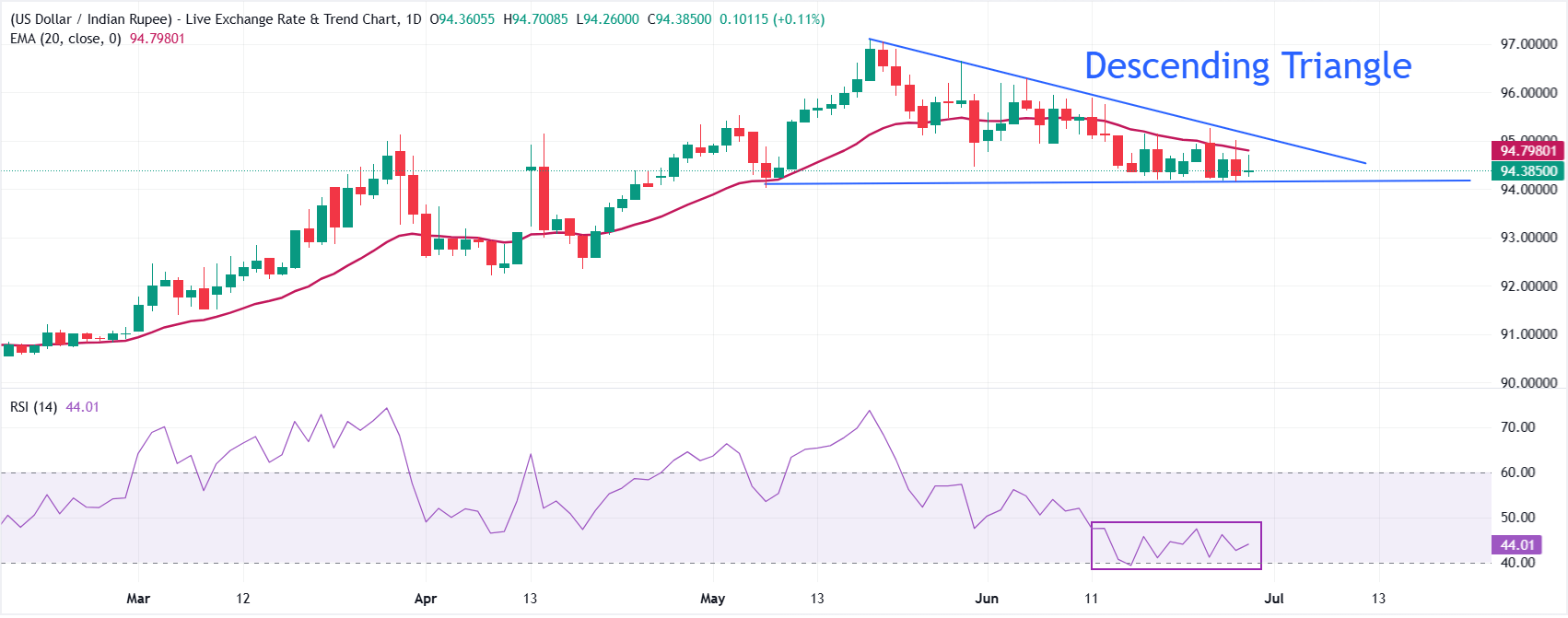
Technical Analysis: USD/INR remains lower below 20-day EMA
USD/INR trades flat at around 94.38, keeping a bearish near-term tone as spot holds below the 20-period exponential moving average (EMA) at 94.7980 and under the broader downward resistance trend line of the Descending Triangle formation starting near 97.1042.
The pair has been sliding off recent highs and now trades closer to its rising support line from 94.1051, while the Relative Strength Index (14) around 44 suggests waning bullish momentum and leaves the door open for further downside pressure.
On the topside, initial resistance is defined by the 20-period EMA at 94.7980, with a subsequent barrier coming from the longer-term descending trend line near 97.1042. On the downside, the immediate focus is on the horizontal support line drawn from 94.1051, with the current price area around 94.3850 acting as a pivotal zone where a sustained break lower would reinforce the bearish bias and expose deeper losses in the coming sessions.
To provide the best experiences, we use technologies like cookies to store and/or access device information. Consenting to these technologies will allow us to process data such as browsing behavior or unique IDs on this site. Not consenting or withdrawing consent, may adversely affect certain features and functions.
Functional
Always active
The technical storage or access is strictly necessary for the legitimate purpose of enabling the use of a specific service explicitly requested by the subscriber or user, or for the sole purpose of carrying out the transmission of a communication over an electronic communications network.
Preferences
The technical storage or access is necessary for the legitimate purpose of storing preferences that are not requested by the subscriber or user.
Statistics
The technical storage or access that is used exclusively for statistical purposes.The technical storage or access that is used exclusively for anonymous statistical purposes. Without a subpoena, voluntary compliance on the part of your Internet Service Provider, or additional records from a third party, information stored or retrieved for this purpose alone cannot usually be used to identify you.
Marketing
The technical storage or access is required to create user profiles to send advertising, or to track the user on a website or across several websites for similar marketing purposes.