

Chart of The Day – USD/JPY

March 27, 2026

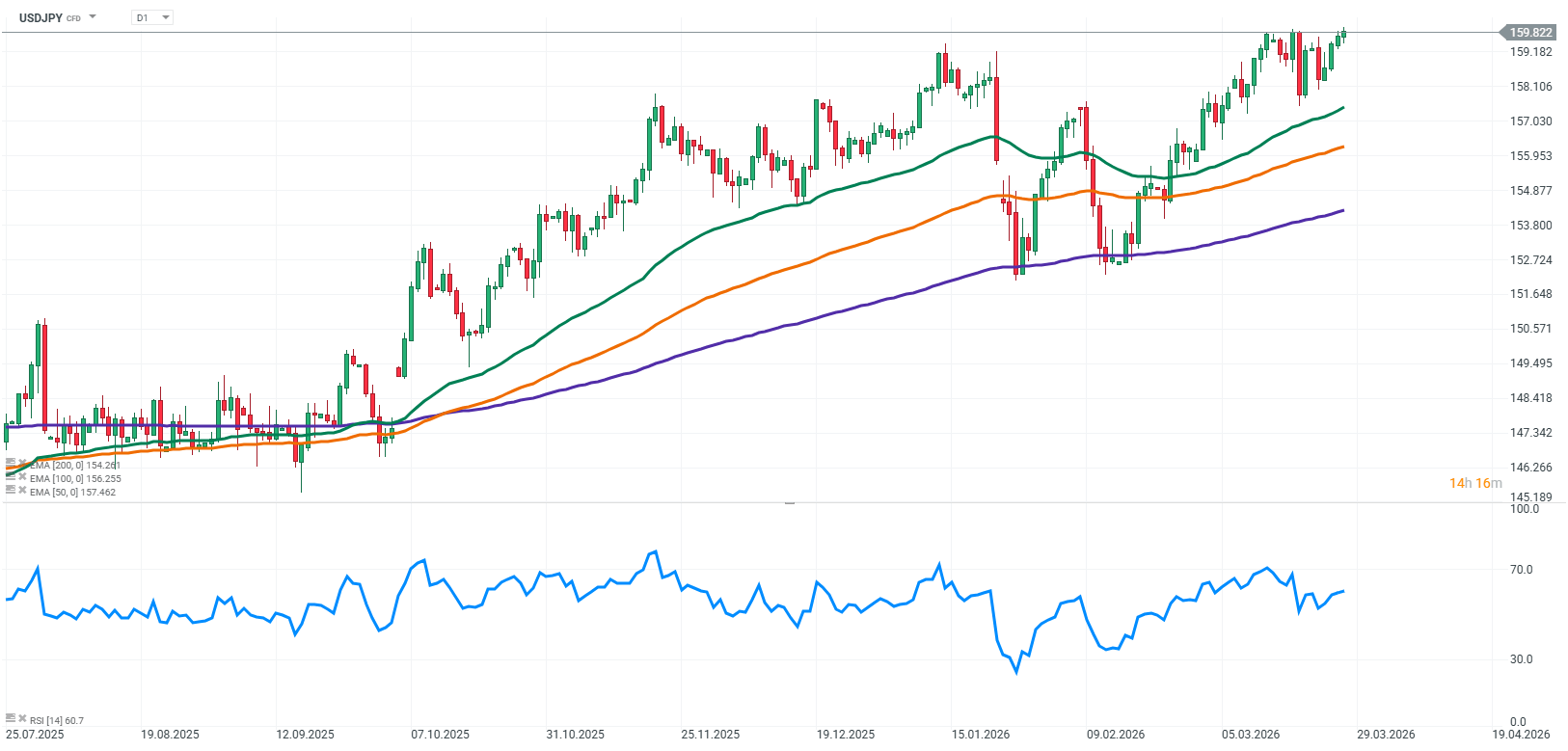
USDJPY remains under strong pressure, trading in the 159.50–159.80 range, close to the psychological barrier of 160.00. Current price movements are driven by a combination of dollar strength, concerns over potential Japanese government intervention, and macroeconomic and geopolitical factors.
Source: xStation5

What shapes USDJPY movements?

Dollar strength and global tensions
USDJPY is supported by the overall strength of the US dollar. Investors view the dollar as a safe-haven amid rising geopolitical tensions in the Middle East and uncertainty in commodity markets. Strong demand for the USD limits the potential for yen appreciation, especially in an environment of global unrest and increased risk aversion.

Risk of intervention by Japanese authorities
Japanese authorities have increasingly signaled their readiness to intervene if USDJPY exceeds the 160.00 level. The purpose of potential intervention is to protect Japanese exports and stabilize the economy. A strong dollar raises import costs and may increase inflationary pressure in Japan. Interventions serve as a tool for authorities to manage excessive currency fluctuations that could negatively impact the trade balance and financial market stability.

Monetary policy
The Bank of Japan continues its ultra-loose policy, maintaining low interest rates over the long term. At the same time, US rates remain elevated, widening the yield differential between the USD and JPY and supporting further dollar strength against the yen. This divergence in monetary policy makes the dollar more attractive to investors in the short and medium term, maintaining upward pressure on USDJPY.

Energy prices and Japan’s trade balance
Japan is heavily reliant on imported oil and gas. Rising energy prices increase import costs, weaken the trade balance, and limit growth potential. Higher commodity prices also add to inflationary pressure, increasing the risk of currency instability. In this context, a strong dollar combined with high commodity prices can further weaken the yen, keeping USD/JPY near record levels.

Conclusion

USDJPY remains sensitive to a combination of dollar strength, intervention signals from Japanese authorities, and external factors such as energy prices and geopolitical tensions. Strong dollar momentum and potential actions by the Japanese government limit the scope for stable gains above 160.00.

The material on this page does not constitute financial advice and does not take into account your level of understanding, investment objectives, financial situation or any other specific needs. All information provided, including opinions, market research, mathematical results and technical analyzes published on the Website or transmitted To you by other means, it is provided for information purposes only and should in no way be construed as an offer or solicitation for a transaction in any financial instrument, nor should the information provided be construed as advice of a legal or financial nature on which any investment decisions you make should be based exclusively To your level of understanding, investment objectives, financial situation, or other specific needs, any decision to act on the information published on the Website or sent to you by other means is entirely at your own risk if you In doubt or unsure about your understanding of a particular product, instrument, service or transaction, you should seek professional or legal advice before trading. Investing in CFDs carries a high level of risk, as they are leveraged products and have small movements Often the market can result in much larger movements in the value of your investment, and this can work against you or in your favor. Please ensure you fully understand the risks involved, taking into account investments objectives and level of experience, before trading and, if necessary, seek independent advice.


Australian Dollar falls to two-month lows on US–Iran peace uncertainty

March 27, 2026
  • AUD/USD fell to a two-month low of 0.6877 on Friday.
  • Rising oil prices weighed on sentiment amid US–Iran peace uncertainty.
  • Trump said Washington would pause attacks on Iran’s energy sector for 10 days, while Tehran denied any request.

AUD/USD extends its losing streak for the fourth consecutive day, trading around 0.6880 during the Asian hours on Friday. The pair recorded a two-month low of 0.6877, pressured by weakness in the Australian Dollar (AUD) as rising oil prices weigh on sentiment amid uncertainty surrounding United States (US)–Iran peace talks.

US President Donald Trump said earlier that Washington would pause attacks on Iran’s energy sector for 10 days, extending the previous April 6 deadline to allow room for negotiations. Trump suggested the decision followed a request from Iran. However, the Wall Street Journal reported that mediators say Iran denies making such a request, underscoring the fragility of the diplomatic process and the low likelihood of a near-term ceasefire.

Meanwhile, the Pentagon is considering plans to deploy up to 10,000 additional ground troops to the Middle East. Defence officials noted that the option is intended to enhance strategic flexibility, enabling rapid escalation if talks break down while maintaining a credible deterrent in the region.

On the monetary policy front, Reserve Bank of Australia (RBA) Assistant Governor Christopher Kent warned on Thursday that policymakers may need to act to contain inflation as energy prices rise. Kent added that the board remains focused on achieving low, stable inflation and full employment, which could push up short-run neutral rates and necessitate tighter policy.

Federal Reserve (Fed) Governor Stephen Miran said on Thursday that reducing the size of the Fed’s balance sheet would support more effective interest rate policy. Miran outlined a potential path to shrink holdings by $1 trillion to $2 trillion, noting that a smaller balance sheet would give the Fed greater flexibility in future crises, while a larger one risks distorting markets.

US data offered little fresh direction, with Initial Jobless Claims coming in exactly as expected at 210K. Attention now turns to Friday’s University of Michigan (UoM) consumer sentiment and one-year inflation expectations.

EUR/USD inches up after Trump’s Hormuz deadline extension; remains below mid-1.1500s

March 27, 2026
  • EUR/USD attracts some buyers during the Asian session amid a modest USD downtick.
  • Trump extends the deadline to reopen the Strait of Hormuz, undermining the buck.
  • Persistent geopolitical uncertainty and hawkish Fed bets could limit the USD downside.

The EUR/USD pair edges higher during the Asian session on Friday, though it lacks bullish conviction and risks attracting fresh sellers amid a bullish US Dollar (USD). Nevertheless, spot prices, for now, seem to have snapped a three-day losing streak and currently trade around the 1.1535-1.1540 area, up nearly 0.10% for the day.

US President Donald Trump delayed a threatened strike on Iran’s energy infrastructure and extended his deadline for Tehran to reopen the Strait of Hormuz until April 6. This helps ease concerns about a further escalation of tensions in the Middle East and dents the USD’s safe-haven demand, which turns out to be a key factor offering some support to the EUR/USD pair.

Meanwhile, Iran has threatened to retaliate against regional infrastructure, including desalination facilities, if Trump follows through with his threat. Moreover, the deployment of additional US troops has been fueling speculation of a potential ground operation. This keeps geopolitical risks in play and should underpin the USD’s status as the global reserve currency.

Apart from this, hawkish US Federal Reserve (Fed) expectations might continue to act as a tailwind for the buck and cap the upside for the EUR/USD pair. Investors remain worried that the war-driven surge in energy prices would revive inflationary pressures and now seem to have fully priced out the possibility of any further interest rate cuts by the Fed this year.

Moreover, traders are rapidly increasing bets for a hike by the end of this year. The outlook remains supportive of elevated US Treasury bond yields and validates the USD bullish bias. This, in turn, warrants some caution for the EUR/USD bulls and makes it prudent to wait for some follow-through buying before positioning for any further intraday appreciating move.

US Dollar Price Today

The table below shows the percentage change of US Dollar (USD) against listed major currencies today. US Dollar was the strongest against the Swiss Franc.

USDEURGBPJPYCADAUDNZDCHF
USD-0.10%-0.08%-0.14%-0.09%-0.07%-0.10%-0.04%
EUR0.10%0.02%-0.06%0.00%0.02%-0.00%0.06%
GBP0.08%-0.02%-0.09%-0.02%0.01%-0.03%0.04%
JPY0.14%0.06%0.09%0.07%0.06%0.04%0.12%
CAD0.09%-0.01%0.02%-0.07%0.00%-0.00%0.05%
AUD0.07%-0.02%-0.01%-0.06%-0.00%-0.02%0.04%
NZD0.10%0.00%0.03%-0.04%0.00%0.02%0.06%
CHF0.04%-0.06%-0.04%-0.12%-0.05%-0.04%-0.06%

The heat map shows percentage changes of major currencies against each other. The base currency is picked from the left column, while the quote currency is picked from the top row. For example, if you pick the US Dollar from the left column and move along the horizontal line to the Japanese Yen, the percentage change displayed in the box will represent USD (base)/JPY (quote).

Canadian Dollar gains as US Dollar weakens on easing risk aversion

March 27, 2026
  • USD/CAD depreciates as market sentiment improves on the US pausing attacks on Iran’s energy sector.
  • The US Dollar may rebound as inflation fears curb Fed cut bets, boosting hike expectations.
  • The commodity-linked CAD may face challenges amid softer oil prices.

USD/CAD halts its four-day winning streak, trading around 1.3850 during the Asian hours on Friday. The pair weakens as the US Dollar (USD) softens on decreasing risk aversion after recent remarks from US President Donald Trump.

Trump said Washington would pause attacks on Iran’s energy sector for 10 days at Tehran’s request, extending the April 6 deadline to allow more time for negotiations. However, the Wall Street Journal reported that mediators said Iran denied making such a request, underscoring fragile diplomacy and low odds of a near-term ceasefire.

The Greenback may regain its ground on rising inflation concerns, prompting traders to scale back expectations of further Federal Reserve (Fed) rate cuts and increase bets on a potential hike by year-end.

Federal Reserve (Fed) Vice Chair of Supervision Philip Jefferson said higher energy prices should have a modest impact on inflation, though a sustained shock could be more significant. Meanwhile, Fed Governor Michael Barr warned that another price shock could lift inflation expectations, reinforcing the case for the Fed to assess economic conditions before adjusting policy.

The downside in USD/CAD may be limited as the commodity-linked Canadian Dollar (CAD) could struggle amid softer oil prices. Traders remain cautious as the Pentagon considers deploying up to 10,000 additional ground troops to the Middle East to maintain strategic flexibility and deterrence if talks fail.

GBP/USD Price Forecast: Snaps three-day losing streak as market sentiment improves

March 27, 2026
  • GBP/USD rises to near 1.3345 as market sentiment turns favorable for riskier assets.
  • US President Trump extended the postponement of scheduled military action on Iran’s power plants.
  • Investors await UK Retail Sales data for February.

The GBP/USD pair snaps its three-day losing streak on Friday, trading 0.1% higher to near 1.3345 during the Asian trading session. The Cable rises as the market sentiment turns favorable for riskier assets, following United States (US) President Donald Trump’s extended pause on scheduled attacks on Iranian power plants until April 6, which boosts hopes of de-escalation in conflicts in the Middle East.

As of writing, S&P 500 futures trade 0.3% higher to near 6,500, indicating an improvement in investors’ risk appetite. Meanwhile, the US Dollar Index (DXY), which tracks the Greenback’s value against six major currencies, trades flat near a three-day high of around 100.00.

Late Thursday, US President Trump said through a post on Truth.Social, “I am pausing the period of Energy Plant destruction by 10 Days to Monday, April 6, 2026, at 8 P.M., Eastern Time,” and expressed confidence that talks with Iran regarding an end to the Middle East war are going well.

In Friday’s session, investors will focus on the United Kingdom (UK) Retail Sales data for February, which will be published at 07:00 GMT. Month-on-month Retail Sales, a key measure of consumer spending, is estimated to have declined 0.8% after a 1.8% growth seen in January. On an annualized basis, the consumer spending measure is expected to have risen at a moderate pace of 2.1% against the previous reading of 4.5%.

GBP/USD technical analysis

GBP/USD trades higher at around1.3345 as of writing. The near-term bias is bearish as recent lower highs reinforce the downside tone. The spot trades close to the 20-day Exponential Moving Average (EMA), which has flattened after a prior decline and now caps the upside around 1.34.

The 14-day Relative Strength Index (RSI) oscillates in the 40.00-60.00 zone, signaling a pause in the bearish momentum, while the bearish bias remains intact.

Initial resistance emerges at the 20-day EMA near 1.3400, followed by the March 23 high around 1.3480, where recent supply halted rebounds. A daily close above that level would ease the bearish pressure and open the way toward the mid-1.35 region. On the downside, immediate support aligns with Monday’s low at 1.3257, with a break exposing the next bearish target at 1.3220. A drop through 1.3220 would confirm a stronger downward extension toward the 1.31 area.

AUD/USD remains under pressure as geopolitical risks support the US Dollar

March 26, 2026
  • AUD/USD trades around 0.6920, holding near its lowest level since early February.
  • The US Dollar is supported by safe-haven demand and rising US Treasury yields.
  • Markets largely ignore the RBA’s hawkish tone, reinforcing the bearish outlook.

AUD/USD trades around 0.6920 on Thursday at the time of writing, down 0.35% on the day, and remains close to its monthly lows amid a bearish consolidation phase. The pair struggles to stage any meaningful rebound as the US Dollar (USD) continues to draw solid support.

Market sentiment remains fragile despite conciliatory remarks from US President Donald Trump, as Iran has rejected any prospect of negotiations and dismissed a ceasefire proposal. Persistent tensions in the Middle East, combined with additional US troop deployments, are fueling fears of further escalation. In this context, the US Dollar benefits from its safe-haven status, weighing on the Australian Dollar (AUD).

At the same time, the energy situation is adding to global inflationary pressures. The effective closure of the Strait of Hormuz is pushing Oil prices higher, reinforcing expectations that major central banks, including the Federal Reserve (Fed), will maintain a hawkish stance. This dynamic is driving US Treasury yields higher, further supporting the Greenback.

On the domestic front, comments from Reserve Bank of Australia (RBA) Assistant Governor Christopher Kent failed to provide support to the currency. Although he highlighted inflation risks linked to rising energy prices and stressed the need to maintain restrictive monetary conditions, the market reaction remained muted. This lack of traction reflects growing concerns about the domestic economic outlook.

According to economists at Commerzbank, Australia is facing a stagflation dilemma, with slowing growth and energy-driven inflation pressures. They note that consumer confidence has dropped sharply while Services Purchasing Managers Index (PMI) indicators have slipped into contraction territory, complicating the central bank’s policy path. Markets still price in around a 54% chance of a rate hike in May, according to the economists.

Over the longer term, Rabobank maintains a more constructive view. The bank argues that Australia’s status as a net energy exporter could support its terms of trade in the current environment, potentially allowing AUD/USD to return to the 0.71 area over a three- to six-month horizon, and to 0.72 over twelve months.

In the near term, however, the combination of a resilient US Dollar driven by safe-haven flows, elevated US yields, and a lack of supportive domestic catalysts suggests that the bearish bias for the pair is likely to persist.

Australian Dollar Price Today

The table below shows the percentage change of Australian Dollar (AUD) against listed major currencies today. Australian Dollar was the strongest against the New Zealand Dollar.

USDEURGBPJPYCADAUDNZDCHF
USD0.08%-0.03%0.05%0.12%0.31%0.27%0.13%
EUR-0.08%-0.11%-0.06%0.03%0.23%0.19%0.05%
GBP0.03%0.11%0.09%0.16%0.34%0.30%0.16%
JPY-0.05%0.06%-0.09%0.07%0.26%0.21%0.08%
CAD-0.12%-0.03%-0.16%-0.07%0.20%0.15%0.01%
AUD-0.31%-0.23%-0.34%-0.26%-0.20%-0.04%-0.15%
NZD-0.27%-0.19%-0.30%-0.21%-0.15%0.04%-0.14%
CHF-0.13%-0.05%-0.16%-0.08%-0.01%0.15%0.14%

The heat map shows percentage changes of major currencies against each other. The base currency is picked from the left column, while the quote currency is picked from the top row. For example, if you pick the Australian Dollar from the left column and move along the horizontal line to the US Dollar, the percentage change displayed in the box will represent AUD (base)/USD (quote).

Trade of The Day – EUR/USD

March 26, 2026

Facts:

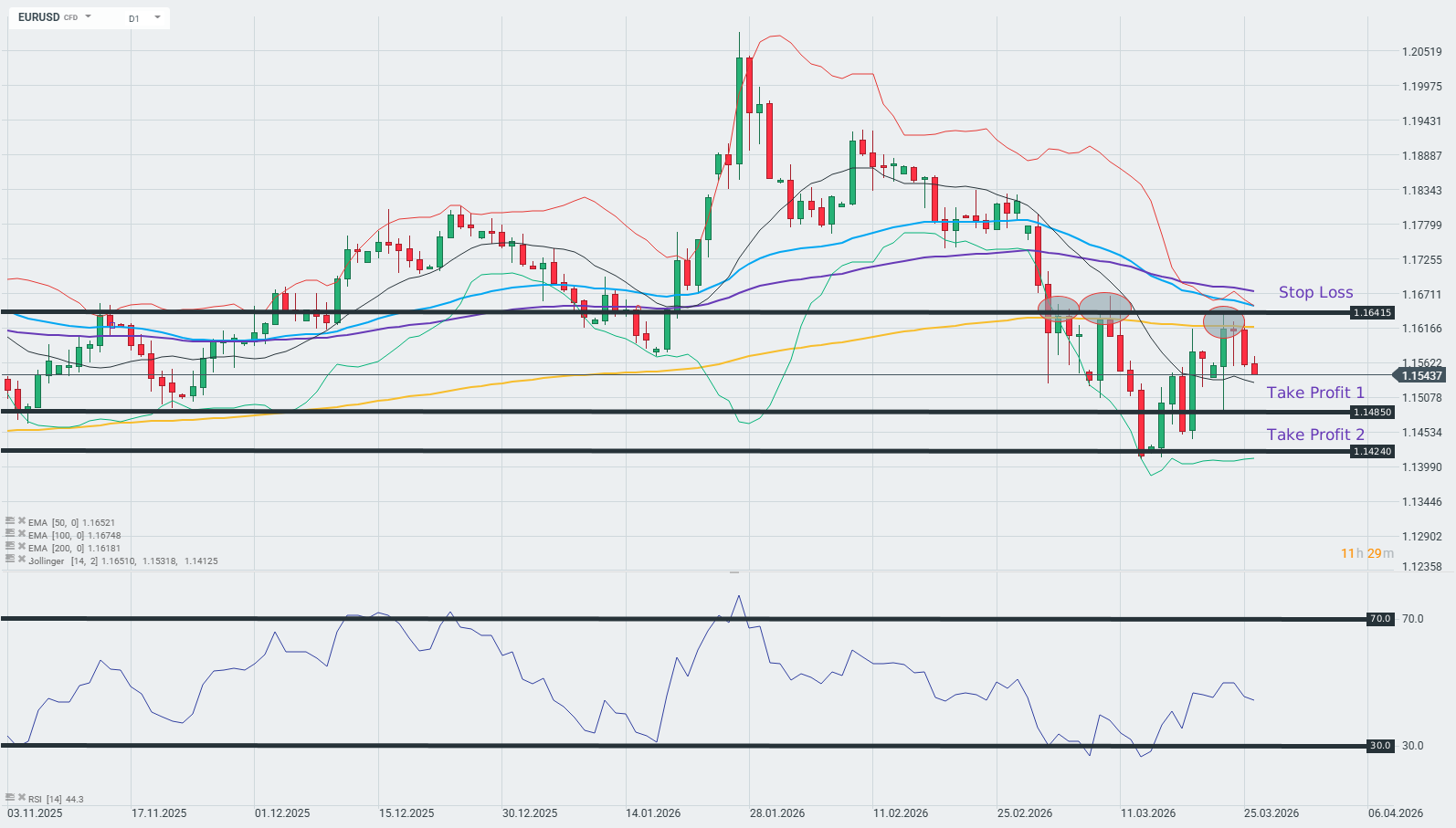
  • The EUR/USD exchange rate failed to break above the 200-day EMA
  • The price remains below the 50-, 100-, and 200-day exponential moving averages (EMA)

Recommendation: 

Trade: Short position on the EUR/USD pair at market price

Take Profit 1: 1,14850

Take Profit 2: 1,14240

Stop: 1.16415
 

Opinion:

The EUR/USD pair failed to break above the 200-day exponential moving average (EMA), which is a key technical signal confirming the euro’s continued weakness against the dollar. The price remains below the 50-, 100-, and 200-day EMAs, creating a classic bearish pattern—each of these moving averages currently acts as dynamic resistance, pushing the price back down on subsequent attempts to rebound. A stop-loss set at 1.16415 marks the zone where this pattern would be negated and would force a revision of the scenario.

Fundamental and geopolitical context

Iran’s rejection of the U.S. peace plan signals that tensions in the Middle East may persist for much longer than the market had originally anticipated. Such a scenario favors a steady inflow of capital into the dollar, a traditional safe-haven currency, and growing geopolitical uncertainty, combined with expectations of a return of inflationary pressure, creates solid foundations for a medium-term appreciation of the USD. Although the scale of the recent USD strengthening remains relatively moderate, historical analogies suggest that in similar, multi-vector crises, the dollar has tended to strengthen further.

Methodology and assumptions:


This recommendation is based on a technical analysis of the EURUSD chart. Classical technical analysis was used to assess the situation and analyze the trend. The target level—take profit 1—was set at the level of previous price reactions, using price action methodology. Take profit 2, on the other hand, is based on the location of this month’s local low. The protective stop-loss order was set above the most recent local high using price action methodology.

USD/CHF edges up to near 0.7925 as US Dollar remains firm amid Middle East uncertainty

March 26, 2026
  • USD/CHF ticks higher to near 0.7925 as the US Dollar continues to trade firmly.
  • Iran called Trump’s 15-point plan “extremely maximalist and unreasonable”.
  • The SNB could intervene against excessive appreciation in the Swiss Franc.

The USD/CHF pair ticks higher to near 0.7925 during the European trading session on Thursday. The Swiss Franc pair gains as the US Dollar (USD) holds onto gains amid growing doubts over an early ceasefire between the United States (US) and Iran, following the release of Tehran’s conditions.

During the press time, the US Dollar Index (DXY), which tracks the Greenback’s value against six major currencies, trades firmly near Wednesday’s high around 99.70.

According to a report from the Wall Street Journal (WSJ), Tehran has also called for a new order in the Strait of Hormuz that would allow it to collect transit fees, as well as guarantees that the war would not restart, an end to Israeli strikes on Hezbollah, and no interference in Tehran pursuing missile program. In response, a US official has described the demands as “ridiculous and unrealistic”.

Before Tehran’s conditions, US President Donald Trump proposes a month-long ceasefire and a 15-point settlement plan delivered through Pakistan to Iran, which was rejected by Tehran, calling it “extremely maximalist and unreasonable”, by a senior Iranian official while speaking with Al Jazeera.

The uncertainty over the outlook of the Middle East war is expected to keep underpinning the demand for safe-haven assets, such as the US Dollar.

Meanwhile, the Swiss Franc (CHF) trades almost flat against its major currency peers, while the Swiss National Bank (SNB) has expressed readiness to intervene in foreign markets against excessive appreciation in the domestic currency.

SNB Chairman Martin Schlegel said in his press conference post the monetary policy announcement, “We have increased our readiness to intervene in forex markets to dampen rapid Swiss Franc appreciation.”