AUD/JPY drifts higher to around 112.40 in Thursday’s early European session.
Broader positive outlook prevails above the 100-day SMA, but temporary sell-off cannot be ruled out with bearish RSI momentum.
The first upside barrier emerges at 113.62; the initial support level is located at 112.25.
The AUD/JPY cross gains ground near 112.40 during the early European session on Thursday, bolstered by the hawkish stance of the Reserve Bank of Australia (RBA). Macquarie analysts said the Australian central bank is likely to keep the Official Cash Rate (OCR) unchanged next week while delivering a hawkish message that reinforces market expectations for an interest-rate increase in August.
Nonetheless, the potential upside for the cross might be limited amid intervention fears from Japanese authorities. Finance Minister Satsuki Katayama issued a verbal warning, saying that the government is monitoring speculative moves and remains prepared to take decisive measures to prevent the domestic currency weakness.
Technical Analysis:
In the daily chart, AUD/JPY holds above the 100-day Simple Moving Average (SMA), keeping the broader uptrend technically supported despite the latest pullback toward the lower Bollinger Band at 112.26. However, the Relative Strength Index (14) around 39 leans toward bearish momentum, suggesting recent downside pressure is not yet fully spent even as price clings to its underlying trend support.
On the topside, initial resistance is located at the Bollinger middle band near 113.62, with the upper band up at 115.00 acting as the next hurdle if buyers regain control. On the downside, immediate support is reinforced by the lower Bollinger Band at 112.25, ahead of the more strategic 100-day SMA at 111.75, where a sustained break would hint at a deeper corrective phase within the broader bullish structure.
USD/JPY flatlines near a six-week high of 160.56 following suspected foreign-exchange intervention by Japanese authorities.
Finance Minister Satsuki Katayama stated the government is closely monitoring currency market movements to ensure economic stability.
The US Dollar may regain ground as escalating Middle East conflicts drive increased global demand for safe-haven assets.
USD/JPY remains flat after two days of gains, trading around 160.50 during the Asian hours. The pair moves little after reaching a six-week high of 160.56 during earlier hours on Thursday, which could be attributed to possible foreign-exchange intervention by Japanese authorities.
Finance Minister Satsuki Katayama stated earlier this week that the government is keeping a close watch on currency market movements. She emphasized that Japan’s stance remains unchanged regarding its preparedness to implement decisive steps when needed to ensure market stability.
The Bank of Japan (BoJ) is widely anticipated to hike interest rates next week as policymakers battle soaring energy costs driven by the Middle East conflict. Tensions escalated sharply after Iran’s Islamic Revolutionary Guard Corps (IRGC) announced an immediate, total closure of the Strait of Hormuz, warning that any commercial or oil vessels attempting to transit the strait would be targeted.
The USD/JPY pair may further appreciate as the US Dollar (USD) may regain its ground amid rising safe-haven demand due to the ongoing Middle East conflict. Israeli military says that the Home Front Command, the branch of the Israel Defense Forces (IDF) responsible for civil defense, issues an early warning after launches from Lebanon toward northern Israel.
US Central Command (CENTCOM) confirmed that the US began airstrikes in Iran on Wednesday. Furthermore, President Donald Trump warned of severe military action if an interim peace deal is not finalized, accusing Tehran of stalling. Iranian officials, however, maintain they will not back down.
USD/CHF may rebound as the US Dollar may regain ground on safe-haven demand from ongoing Middle East conflicts. Israel’s Home Front Command issued an early warning following rocket launches from Lebanon targeting northern Israel. Softer UBS capital rules being considered by Swiss lawmakers could shave off billions in regulatory burdens, potentially weakening the CHF. Swiss Franc strengthens as US Dollar struggles despite increased risk aversion
USD/CHF depreciates after four days of gains, trading around 0.7990 during the Asian hours on Thursday. However, the downside of the pair could be restrained as the US Dollar (USD) may regain its ground amid rising safe-haven demand due to ongoing Middle East conflict.
Israeli military says that the Home Front Command, the branch of the Israel Defense Forces (IDF) responsible for civil defense, issues an early warning after launches from Lebanon toward northern Israel.
Earlier, US Central Command (CENTCOM) confirmed that the US began airstrikes in Iran on Wednesday. Furthermore, President Donald Trump warned of severe military action if an interim peace deal is not finalized, accusing Tehran of stalling. Iranian officials, however, maintain they will not back down.
Following an incident where an American helicopter was shot down, the US launched “self-defense” strikes, triggering Iranian retaliatory attacks on US military facilities in Bahrain, Jordan, and Kuwait.
Adding to the crisis, the Islamic Revolutionary Guard Corps (IRGC) announced an immediate, total closure of the Strait of Hormuz to all commercial and oil vessels, warning that any transit attempts would be targeted.
May’s US CPI matched forecasts, rising to 4.2% YoY (up from 3.8% in April), while Core CPI ticked up to 2.9% YoY from 2.8%. Market attention now shifts to the upcoming release of the May Producer Price Index (PPI) and Initial Jobless Claims later today.
Swiss lawmakers are considering a new pitch to soften capital requirements on UBS, if implemented, could shave billions of dollars off the burden the bank is facing under a draft law submitted by the government, sources told Reuters.
If implemented, the move would likely have a short-to-medium-term weakening effect on the Swiss Franc (CHF). While it sounds like a paradox, helping Switzerland’s biggest bank making the currency drop, it boils down to central bank mechanics, market capital flows, and safe-haven dynamics.
Under the government’s original draft law, UBS would have been forced to fully back its foreign subsidiaries
The Indian Rupee trades calmly at open against the US Dollar; however, the outlook has become uncertain.
The exchange of attacks between the US and Iran has renewed Middle East tensions.
Investors await the US-India CPI data for May.
The Indian Rupee (INR) opens almost flat against the US Dollar (USD) on Wednesday. The USD/INR pair consolidates around 95.42; however, the outlook of the pair has turned bullish as Middle East tensions have flared up again, following the United States (US) retaliation against Iran over the shooting down of an American helicopter.
Renewed US-Iran tensions have offered support to oil prices. As of writing, the MCX Crude Oil contract expiring on June 18 is up 0.8% to near 8,490. Oil prices also clawed back half of their early losses on Tuesday after sliding to 8,212.
Currencies from economies, such as India, which rely heavily on oil imports to meet their energy needs, tend to underperform in a high oil price environment.
US strikes after Trump vows retaliation over the shooting down of an Apache helicopter over Hormuz
On late Tuesday, the US Central Command (CENTCOM) announced that it launched a series of attacks on Iran’s air defense, ground control stations, and surveillance radar sites near the Strait of Hormuz, a vital passage to almost 20% of global energy supply. The US was expected to conduct military operations against Iran as President Donald Trump vowed retaliation for shooting down a US Apache helicopter over Hormuz.
In response, Iran has launched missiles on various US airbases in Jordan, Kuwait, and Bahrain, and has warned Washington to leave the Gulf region for their own safety.
“Powerful armed forces will not ignore any attack or threat,” Iran’s Foreign Minister Abbas Araghchi said, adding, “Get out of our region if you want to be safe.”
FIIs remain net sellers on all trading days so far in June
Overseas investors continue to dump their stake in the Indian stock market, as Middle East tensions continue to hurt their sentiment towards risky assets. So far in June, Foreign Institutional Investors (FIIs) have remained net sellers in all trading days of June and have offloaded their stake worth Rs. 60,529.36 crore.
US-India CPI data under spotlight
Later in the day, investors will pay close attention to the US Consumer Price Index (CPI) data for May, which will be published at 12:30 GMT. The US Bureau of Labor Statistics (BLS) is expected to show that the headline CPI grew at an annualized pace of 4.2%, faster than 3.8% in April. In the same period, the core CPI – which excludes volatile food and energy items – is expected to have risen at a faster pace of 2.9% against the previous reading of 2.8%.
Signs of price pressures accelerating further would prompt expectations of the Federal Reserve’s (Fed) interest rate hikes for the year. As of now, the CME FedWatch tool shows that the odds of the Fed delivering at least one interest rate hike this year are almost 72%.
Meanwhile, India’s CPI data on Friday is expected to arrive higher at 4% YoY from 3.48% in April.
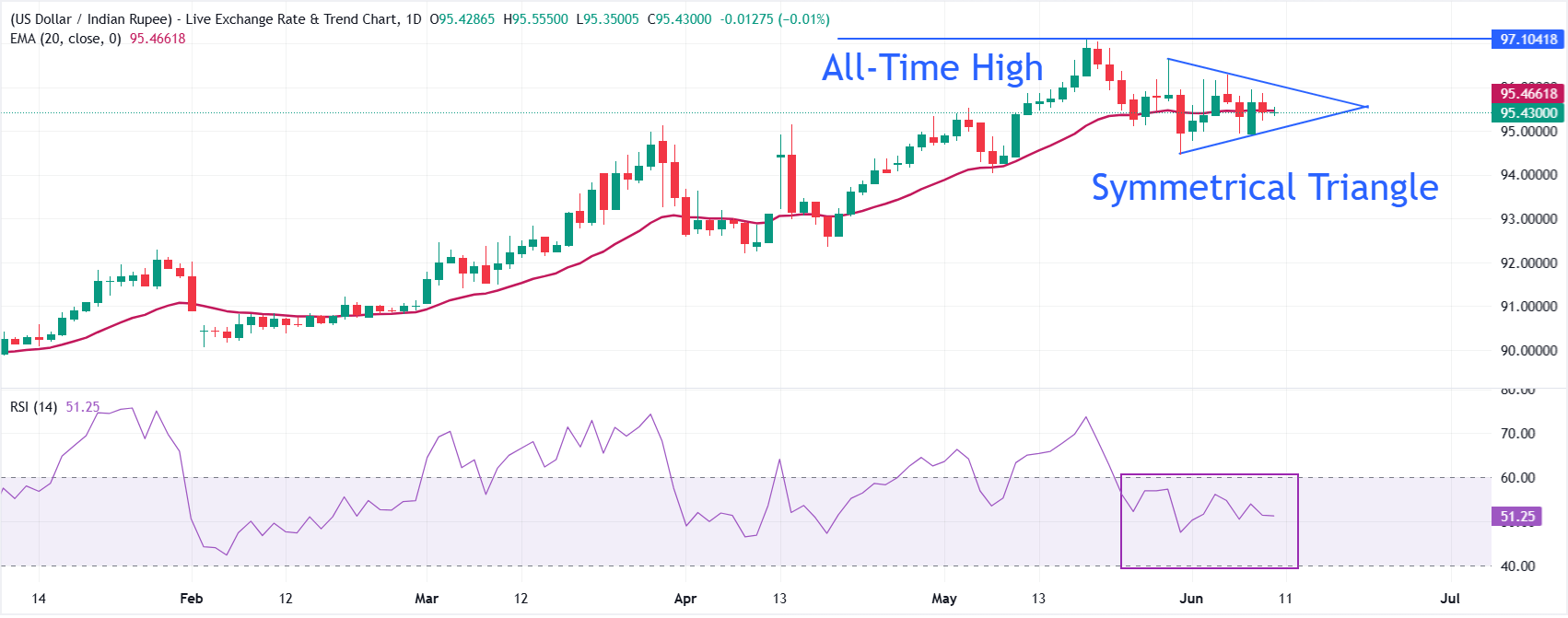
Technical Analysis: USD/INR trades in a Symmetrical Triangle formation
USD/INR trades almost flat at around 95.43 at press time. The Symmetrical Triangle formation and pair’s stickiness to the 20-period Exponential Moving Average (EMA) at 95.46, reflects that the immediate trend has turned sideways.
The Relative Strength Index (RSI) wobbles inside the 40.00-60.00 zone, suggesting indecisiveness among investors.
On the topside, immediate resistance is located near the downward-sloping border of the above-mentioned chart pattern at around 96.00. A decisive break above 96.00 would open the door for further upside towards the all-time high at 97.10. On the downside, initial support is seen at the upward support trend-line break level near 95.04, ahead of the structural trend-line origin around 94.49; a sustained drop below these marks would open the way for a deeper corrective phase, while holding above them would keep the broader constructive pattern intact.
EUR/JPY gains ground to around 185.20 in Wednesday’s early European session.
Likelihood of hawkish stance hikes from the ECB supports the Euro.
The cross keeps the bullish vibe, but consolidation cannot be ruled out in near term with neutral RSI momentum.
The first upside barrier emerges at 186.05; the initial support level is located at 185.15.
The EUR/JPY cross gathers strength to near 185.20 during the early European session on Wednesday. The Euro (EUR) edges higher against the Japanese Yen (JPY) amid expectations that the European Central Bank (ECB) would raise rates at its June policy meeting on Thursday.
The ECB is set to raise its key interest rate for the first time in almost three years on Thursday, becoming the first of its peers to tighten policy in response to a jump in energy prices caused by the conflict in the Middle East. While money markets are already pricing in a second 25 basis points (bps) hike for September, economists expect the ECB to maintain a “gently hawkish” but highly data-dependent tone without pre-committing to a fixed path.
“Lagarde may provide some indication of the ECB’s next move after she muddled communication on the rate outlook in March. We expect her to be clearer than in the past that a second hike may be in the pipeline,” said Simona Delle Chiaie, chief euro-area economist at Bloomberg. Any hawkish comments from ECB policymakers could lift the EUR against the JPY in the near term.
Technical Analysis:
In the daily chart, EUR/JPY holds a constructive near-term bias as it consolidates just above the Bollinger middle band and remains comfortably over the 100-day simple moving average, suggesting underlying demand on dips. The Relative Strength Index (14) at 49.99 is effectively neutral, hinting at a pause rather than exhaustion after the recent grind higher.
On the topside, the immediate hurdle is the Bollinger upper band near 186.05, where fresh selling interest could emerge. The next hurdle is seen at the February 9 high of 186.24, en route to the January 23 high of 186.88. On the downside, initial support is seen at the Bollinger middle band around 185.15, ahead of the 100-day SMA at 184.50, while a deeper pullback towards the lower Bollinger band near 184.25 would be expected to attract buyers as long as the broader bullish structure is preserved.
USD/JPY steadies as the Japanese Yen receives no support after May wholesale inflation rose to a three-year high of 6.3%.
Surging factory-gate inflation solidifies market expectations for an imminent hawkish interest rate pivot by the Bank of Japan.
The US Dollar may regain ground on safe-haven demand after Iran’s IRGC claimed drone attacks on the US Fifth Fleet.
USD/JPY flatlines after experiencing volatility, trading around 160.40 during the Asian hours on Wednesday. The pair continues to hold its ground, reflecting a struggling Japanese Yen (JPY) that has failed to find support despite a massive acceleration in wholesale inflation. Driven by surging energy costs linked to the ongoing Middle East conflict, Japan’s Producer Price Index (PPI) jumped 6.3% year-over-year in May. This hot printing comfortably outpaced April’s upwardly revised 5.3% figure and surpassed market consensus of 5.5%, marking the fastest pace of wholesale price growth in three years.
This dramatic uptick in Japan’s factory-gate inflation has solidified market expectations for a hawkish pivot from the Bank of Japan (BoJ). With policymakers highly sensitive to the double-whammy of a sharply depreciating JPY and rising import costs, the central bank is widely expected to lift interest rates at its policy meeting next week. Traders are now closely parsing every signal from BoJ Governor Kazuo Ueda, as aggressive market speculation builds for consecutive rate hikes in September and December to rein in stubborn price pressures.
The USD/JPY pair may further appreciate as the safe-haven demand could support the US Dollar (USD), which could be attributed to the renewed Middle East tensions. Iran’s Islamic Revolutionary Guard Corps (IRGC) said it attacked the US Fifth Fleet in Bahrain with drones in response to US strikes on areas in southern Iran. The IRGC warned of “a more severe response” if what it describes as US “aggression” continues.
Earlier, the US launched a third wave of retaliatory strikes on Iranian coastal targets on Wednesday after Iran fired at least three ballistic missiles from Isfahan. This followed an initial round of US strikes on Tuesday, which Washington called a proportional response to Iran downing a US helicopter gunship near the critical Strait of Hormuz.
Stronger-than-expected US May jobs data have boosted expectations of a Federal Reserve (Fed) rate hike this year. Traders will take more cues from the US CPI report later in the day. The headline US CPI is expected to show a rise of 4.2% YoY in May, compared to 3.8% in April. The core CPI is projected to show an increase of 2.9% YoY during the same period, versus 2.8% prior.
USD/CNH trades marginally lower to near 6.7750 as the US Dollar edges down.
China’s CPI remains steady at 1.2% YoY in May, misses 1.3% estimates.
Investors await the US inflation data for May.
The USD/CNH pair trades slightly lower to near 6.7750 during the early European trading session on Wednesday. The pair faces selling pressure due to continued outperformance by the Chinese Yuan (CNY), being a trade surplus economy.
On Tuesday, China’s Trade Balance data for May also came in stronger than projected. Trade Balance arrived at $105.43 Billion, higher than the $92.1 Billion estimate and the previous reading of $84.82 Billion. Imports grew strongly by 27.4%, while they were anticipated to rise moderately by 25% vs. the prior release of 25.3%. While Exports rose 19.4% against expectations of 15% and the previous release of 14.1%.
Meanwhile, China’s Consumer Price Index (CPI) data for May has remained steady at an annualized pace of 1.2%, while it was expected to grow at a faster pace of 1.3%.
At press time, the US Dollar Index (DXY), which gauges the Greenback’s value against six major currencies, trades 0.12% lower to near 99.87 ahead of the United States (US) CPI data for May, which will be published at 12:30 GMT. The US headline inflation is expected to come in higher at 4.2% Year-on-Year (YoY) from 3.8% in April.
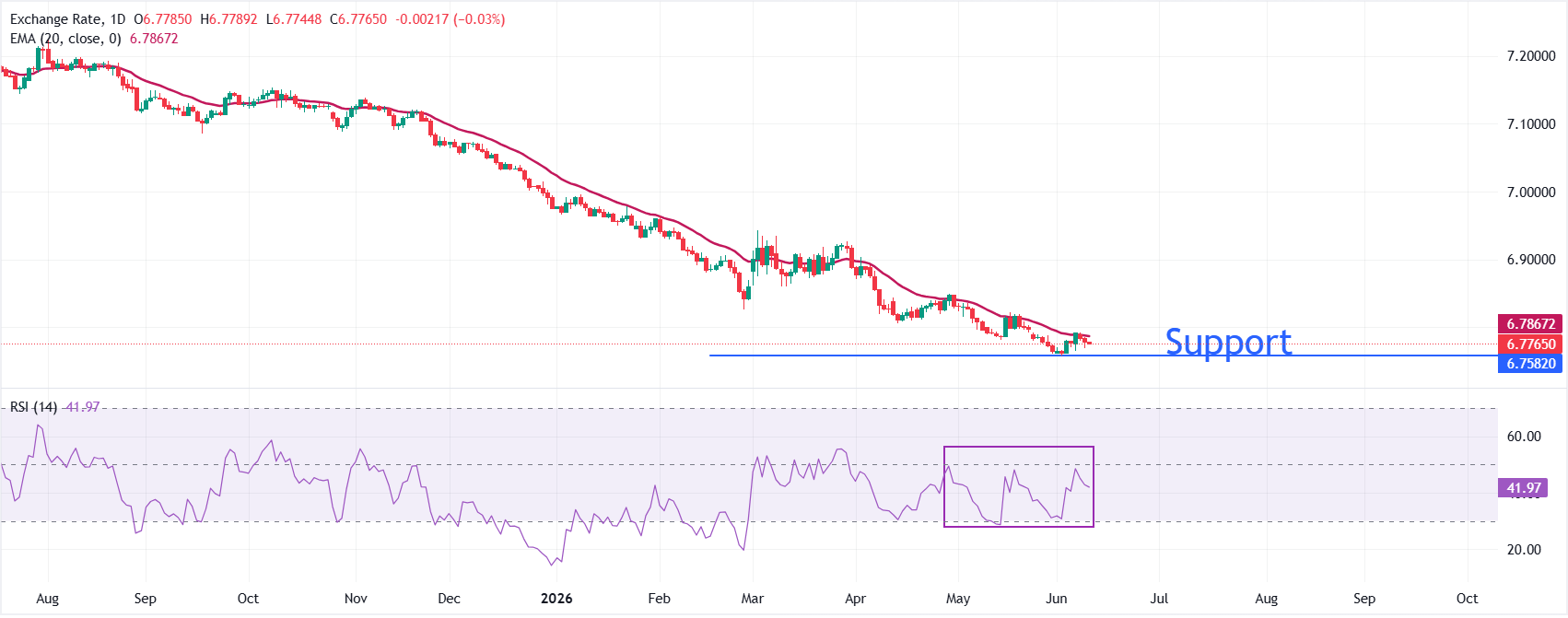
USD/CNH technical analysis
USD/CNH trades lower at around 6.7763, extending the downside bias as spot holds below the 20-day Exponential Moving Average (EMA) at 6.7867. The pair trading below this short-term average suggests sellers retain control, while the 14-day Relative Strength Index (RSI) around 42 stays below the neutral 50 line, hinting at lingering bearish momentum rather than an oversold condition.
On the topside, immediate resistance is now aligned with the 20-day EMA at 6.7867, and a daily close above this barrier would be needed to ease current downside pressure and open the way for a more sustained recovery. On the downside, the pair could slide further towards 6.7500 if it falls below the June 2 low at 6.7580.
GBP/USD gains traction to near 1.3390 in Wednesday’s early European session.
Iranian officials warned Gulf states have a “legal and moral responsibility” to prevent US and Israeli strikes.
The US May CPI inflation report will take center stage on Wednesday.
The GBP/USD pair trades in positive territory around 1.3390 during the early European trading hours on Wednesday. Markets might turn cautious later in the day ahead of the US May Consumer Price Index (CPI) inflation report. On Friday, the monthly UK Gross Domestic Product data will be in the spotlight.
Financial markets had expected the Bank of England (BoE) to cut interest rates twice this year to 3.25%. Since the US-Iran war began, the situation has reversed, and now a rise of 25 basis points (bpd) before December is projected, according to CNBC.
Nonetheless, the potential upside for the British Pound (GBP) might be limited as renewed tensions in the Middle East weigh on the riskier assets. Iran’s Foreign Minister Abbas Araghchi on Wednesday warned that its neighbors in the Gulf have a “legal and moral responsibility” to prevent American and Israeli strikes.
This statement came as the US launched retaliatory strikes against Iran on Tuesday in what it called a proportional response to the shooting down of a US helicopter gunship near the Strait of Hormuz a day earlier.
The US CPI inflation report will be closely watched as it could give some hints about the US interest rate path. If the reports show hotter-than-expected outcomes, this could lead traders to price in a higher probability of the Federal Reserve (Fed) raising interest rates, which would provide some support to the USD against the GBP.
To provide the best experiences, we use technologies like cookies to store and/or access device information. Consenting to these technologies will allow us to process data such as browsing behavior or unique IDs on this site. Not consenting or withdrawing consent, may adversely affect certain features and functions.
Functional
Always active
The technical storage or access is strictly necessary for the legitimate purpose of enabling the use of a specific service explicitly requested by the subscriber or user, or for the sole purpose of carrying out the transmission of a communication over an electronic communications network.
Preferences
The technical storage or access is necessary for the legitimate purpose of storing preferences that are not requested by the subscriber or user.
Statistics
The technical storage or access that is used exclusively for statistical purposes.The technical storage or access that is used exclusively for anonymous statistical purposes. Without a subpoena, voluntary compliance on the part of your Internet Service Provider, or additional records from a third party, information stored or retrieved for this purpose alone cannot usually be used to identify you.
Marketing
The technical storage or access is required to create user profiles to send advertising, or to track the user on a website or across several websites for similar marketing purposes.